mechanoreceptors, atrophy or muscle weakness, and knee joint degeneration2).
The PCL has been known to have remarkable healing prop- erties unlike the anterior cruciate ligament (ACL) because of the surrounding thick synovial sheath and its proximity to the branches of the middle genicular artery4,5). Accordingly, an iso- lated PCL injury was thought to heal satisfactorily with conserva- tive treatment alone in the past6-9). However, long-term follow-up studies have demonstrated that persisting instability results in the development of patellofemoral or tibiofemoral arthritis and pain recurs due to untreated meniscal tears10-12). In addition, there has been much improvement in surgical techniques, and thus the in- terest in the surgical reconstruction of the PCL has been growing recently. The success rate of anterolateral single-bundle PCL re- construction using various surgical techniques ranges from 41%
to 72%13-15). In particular, remnant-preserving ligament recon- struction has gained considerable attention due to the advantages of graft revascularization and proprioception preservation, and excellent clinical results have been reported by many authors16-19).
Proprioception and Clinical Results of Anterolateral Single-Bundle Posterior Cruciate Ligament
Reconstruction with Remnant Preservation
Dung Chul Lee, MD, Oog Jin Shon, MD, Byung Hoon Kwack, MD, and Sung Jun Lee, MD
Department of Orthopedic Surgery, Yeungnam University Medical Center, Daegu, Korea pISSN 2234-0726 · eISSN 2234-2451
Knee Surgery & Related Research
Purpose: To evaluate the clinical and radiological results and proprioception following anterolateral single-bundle posterior cruciate ligament (PCL) reconstruction with remnant preservation for PCL injury.
Materials and Methods: Twenty patients with an isolated PCL injury (16 males and 4 females) were included in this study. The mean follow-up period was 61 months (≥24 months) and the mean age of the patients was 36 years. Knee joint instability was evaluated using posterior drawer stress radiography. Knee function, level of activities, and individual satisfaction were assessed using the Lysholm knee score, Tegner activity score, and 2000 International Knee Documentation Committee (IKDC) score. Knee proprioception was assessed using an isokinetic machine.
Results: The mean ligament laxity assessed using the posterior drawer stress radiography was improved from 10.8−3.2 mm. The mean Lysholm knee score was improved from 70.0−88.9 points, and the mean Tegner activity score was improved from 2.7−6.2 points. Individual satisfaction assessed using the IKDC score was improved from 62.7−85.4 points (p<0.05). Knee proprioception was not significantly different between the treated and the uninjured knees.
Conclusions: Single-bundle PCL reconstruction with remnant preservation for PCL injury exhibited satisfactory outcomes regarding functional outcome, joint stability, and proprioception.
Keywords: Knee, Posterior cruciate ligament, Reconstruction, Remnant preservation, Proprioception
Received February 22, 2013; Revised June 9, 2013;
Accepted June 27, 2013
Correspondence to: Oog Jin Shon, MD
Department of Orthopedic Surgery, Yeungnam University Medical Center, 170 Hyeonchung-ro, Nam-gu, Daegu 705-717, Korea Tel: +82-53-620-3640, Fax: +82-53-628-4020
E-mail: [email protected]
Introduction
The posterior cruciate ligament (PCL) consists of anterolateral and posteromedial bundles that contribute to the structural sta- bility of the knee by alternately becoming taut/loose during flex- ion/extension and play a major role in proprioception1-3). Thus, an injury to the PCL results in constant posterior instability of the knee, proprioception deficits due to the lack of information from
126
This is an Open Access article distributed under the terms of the Creative Commons Attribution Non-Commercial License (http://creativecommons.org/licenses/by-nc/3.0/) which permits unrestricted non-commercial use, distribution, and reproduction in any medium, provided the original work is properly cited.
Copyright © 2013 KOREAN KNEE SOCIETY www.jksrr.org
These satisfying results can be attributed to the preservation of proprioception in the remnant ligament fibers according to stud- ies on ACL reconstruction and total knee arthroplasty. In con- trast, proprioception in PCL injured knees has been addressed in only a few studies and there is a paucity in the literature on the proprioceptive performance after PCL reconstruction1,20). In this study, we analyzed postoperative proprioception and clinical results of remnant-preserving reconstruction in PCL-deficient knees under the hypothesis that here would be no difference in the proprioceptive performance between the affected and unaf- fected knees.
Materials and Methods
1. Study Population
A total of 102 patients underwent PCL reconstruction between October 2004 and October 2009 at our institution. Of these, 58 patients were excluded due to the presence of combined injuries:
an ACL tear in 19 patients, a medial collateral injury in 13 pa- tients, a posterolateral collateral ligament tear in 14 patients, and a femoral or tibial fracture in 12 patients. Of the remaining 44 patients who had undergone remnant-preserving anterolateral single-bundle PCL reconstruction with the trans-tibial tunnel technique, 20 patients who were available for ≥2 years of follow- up and clinical and functional assessments were included in this study. Although meniscus tears were observed in 3 patients (a medial meniscus tear in 2 and a lateral meniscus tear in 1), no ad- ditional treatment was necessary due to the minor nature of the injury. The mean follow-up period was 61.3 months (range, 31 to 92 months). There were 16 males and 4 females with a mean age of 36 years (range, 17 to 60 years). The preoperative posterior drawer test demonstrated grade II ligament laxity in 12 patients (60%) and grade III laxity in 8 patients (40%). The mechanism of injury was a car accident in 6 patients, a motorcycle accident in 6 patients, a sports injury in 4 patients, and a direct injury in 4 patients. An Achilles tendon allograft was used to reconstruct the PCL in all patients.
2. Surgical Technique
The indications for surgery were ≥grade II severe ligament lax- ity in the posterior drawer test following ≥6 months of conserva- tive treatment and a PCL injury with severe pain that restricts normal daily activities13). The patient was placed in the supine position and a tourniquet was applied. The uninjured limb was kept in the lithotomy position to allow for the placement of an image intensifier. An arthroscopic examination was performed to
identify the extent of PCL injury and knee joint damage. The an- terolateral bundle was reconstructed using a single-bundle tech- nique, taking care to preserve the remnant of the torn ligament as much as possible. With guide pins inserted into the surrounding tissue, the periosteum at the femoral tunnel site was stripped off as much as possible with a narrow osteotome to prevent damage from a reamer during tunneling. A tibial tunnel was created with a 0.5 mm increment from 6mm using a drill guide and a reamer that was rotated counterclockwise under the guidance of an im- age intensifier to protect the nerves and vessels in the posterior tibia.
The femoral tunnel was drilled inside-out at a site 5−6 mm proximal to the articular cartilage at a 1 o’clock angle for the right knee and an 11 o’clock angle for the left knee, taking care to mini- mize the risk of impingement. The entry of the tibial tunnel was placed 10−15 mm below the articular surface and a guide pin was inserted from a site immediately lateral to the tibial attachment of the PCL. An Achilles tendon allograft with a thickness of 10 mm was attached to a wire loop, inserted through the anterolateral portal of the femoral tunnel above the remaining tissue. With the graft fixated to the femur using absorbable interference screws, flexion/extension exercises were performed for 15 times. With the knee in 90o flexion, the graft in the tibial tunnel was fixated using a bioabsorbable screw and a cancellous screw and s washer.
Postoperatively, long leg cast immobilization was applied with the knee in extension for 3−4 weeks. At 4−6 weeks postoperative, passive flexion exercises and weight-bearing with crutches were initiated. Flexion with the aid of a device was gradually increased to 90o−100o by 6−8 weeks postoperatively. Running was gradu- ally allowed from 8−10 weeks postoperative and return to sports activities was permitted 12 months postoperatively.
3. Clinical and Radiological Assessments
The clinical assessment was performed using the Lysholm knee score, Tegner activity score21), and 2000 International Knee Documentation Committee (IKDC) subjective knee score preop- eratively and at the last follow-up. The radiological outcome was assessed using posterior drawer stress radiography. The radio- graphs were taken with the knee in 90o flexion while posteriorly directed force was applied by the Telos Stress Device (METAX, Hungen, Germany). The radiographs of the injured and unin- jured limbs obtained preoperatively and at the last follow-up were compared.
4. Proprioceptive Evaluation
Proprioceptive evaluation was based on the kinesthesia and
joint position sense at the last follow-up. Kinesthesia was as- sessed by measuring the threshold to detect passive movement (TTDPM) and the joint position sense was assessed by reproduc- tion of passive positioning (RPP).
For the proprioceptive evaluation of the knee, TTDPM and RPP were assessed using the Biodex System 4 (Biodex Medical Systems, Shirley, NY, USA). The patient was seated in a chair with the trunk, thigh, and ankle strapped with belts to the chair. To re- duce cutaneous input, the patient was wearing a pneumatic com- pression boot and shorts during the examination. To eliminate visual and auditory cues, the patient was wearing a blindfold and a headset playing white noise (Fig. 1). The tests were performed by moving the knee into flexion and extension from two starting positions, 45o and 110o. This was because the lowest propriocep- tion was considered to be measured in 45o of flexion where the capsule, ACL, and PCL are relatively relaxed, whereas PCL was thought to start to play a role in proprioception when the knee is in 110o flexion due to tension on the ligament20). The knee was flexed/extended at a velocity of 1o/s at the starting positions.
1) Threshold to Detect Passive Movement
TTDPM was assessed by asking the patient to press a switch upon perception of sensation of movement of the knee during passive flexion/extension from the two starting positions, 45o and 110o. The tests were performed three times each for the injured and uninjured knees. The mean values of the angular differences from the starting positions were recorded.
2) Reproduction of Passive Positioning
The knee was flexed/extended passively from 45o and 110o and held for 10 seconds at a targeted angle by the tester for the patient to remember the positions. Then, the knee was returned to the starting positions. While the tester was extending/flexing the patient’s knee, the patient was asked to press a switch when he or she felt the knee was moved to the targeted angle. The targeted angle was 35o of extension and 55o of flexion from the starting point of 45o, whereas 100o of extension and 120o of flexion from the starting point of 110o. The test was performed three times each for the injured and uninjured knees. The mean values of the differences between the targeted angles and the angles reposi- tioned by the patient were recorded.
The values from the injured and uninjured knees in both groups were analyzed using the SPSS ver. 18.0 (SPSS Inc., Chica- go, IL, USA). The Mann-Whitney test was used for non-normal distribution data and the t-test was used for normal distribution data. A paired t-test was used for the comparison of the pre-and postoperative values and the proprioception was compared using an independent t-test. A p-value of <0.05 was considered statisti- cally significant.
Results
The mean Lysholm score was significantly improved from 70.00±6.89 (range, 53 to 81) preoperatively to 88.90±4.36 (range, 85 to 95) at the last follow-up (p=0.00) (Table 1).
A remarkable increase was noted in the mean Tegner activity score from 2.70±0.92 (range, 1 to 4) preoperatively to 6.20±1.32 (range, 4 to 8) at the last follow-up (p=0.00).
The mean 2000 IKDC subjective knee score was significantly improved from 62.72±10.53 (range, 29.9 to 73.5) preoperatively to 85.41±7.97 (range, 65.5 to 95.4) at the last follow-up (p=0.00).
The preoperative IKDC score was abnormal in 12 patients (60%) and severely abnormal in 8 patients (40%) and the score at the last follow-up was normal 8 (40%) patients and nearly normal in 12 patients (60%) (Table 2).
The mean side-to-side difference on the posterior drawer stress
Fig. 1. The evaluation of proprioception. The patient is sitting wearing a pneumatic compression boot, a blindfold to eliminate visual cue, and a headset to eliminate auditory cues.
Table 1. Change of Lysholm Knee Score
Preoperative Last follow-up
Excellent (100−95) 0 6
Good (94−84) 0 14
Fair (83−65) 16 0
Poor (64−0) 4 0
Mean Lysholm score 70.0 88.9
radiographs was decreased from 10.80±1.50 mm (range, 9 to 13 mm) preoperatively to 3.20±1.36 mm (range, 1 to 5 mm) at the last follow-up, indicating statistically significant improvement (p=0.00). The ligament laxity was grade II in 12 patients (60%) and grade III in 8 patients (40%) preoperatively, whereas grade I in all patients at the last follow-up (Table 3).
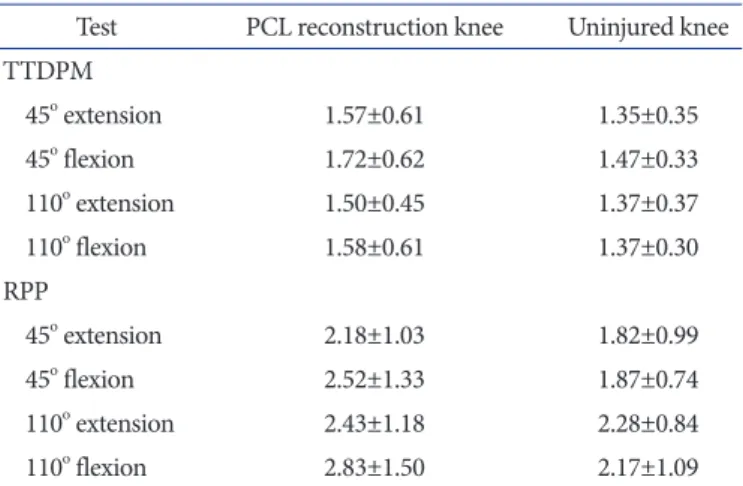
The mean TTDPM from 45o toward extension was 1.57±0.61 for the injured side and 1.35±0.35 for the uninjured side, and the value toward flexion was 1.72±0.62 for the injured side and 1.47±0.33 for the uninjured side. The mean TTDPM from 110o toward extension was 1.50±0.45 for the injured side and 1.37±0.37 for the uninjured side, and the value from 110o toward flexion was 1.58±0.61 for the injured side and 1.37±0.30 for the unin- jured side. Although the TTDPM was more improved in the injured than the uninjured side, no significant side-to-side differ- ence was observed (Table 4).
The mean RPP for extension from 45o was 2.18±1.03 for the in- jured side and 1.82±0.99 for the uninjured side, and the value for flexion from 45o was 2.52±1.33 for the injured side and 1.87±0.74 for the uninjured side. The mean RPP for extension from 110o was 2.43±1.18 for the injured side and 2.28±0.84 for the unin- jured side, and the value for flexion from 110o was 2.83±1.50 for the injured side and 2.17±1.09 for the uninjured side. Although the RPP was more improved in the injured than the uninjured side, no significant side-to-side difference was observed (Table 4).
Discussion
The hypothesis of our study was that remnant-preserving PCL reconstruction would be effective in restoring knee function and
proprioception to the level of the intact knee. The study results showed that the knee function was improved postoperatively and the postoperative proprioception was similar to that of the unin- jured knee.
Various authors have introduced remnant-preserving PCL re- construction techniques that provide satisfying clinical results.
Jung et al.22) performed tensioning of the remnant PCL and reconstruction of the anterolateral bundle of the PCL using a modified inlay technique, and reported that the IKDC score at the last follow-up was nearly normal in 87.7% and posterior tibial translation on posterior stress radiographs was ≤5 mm in all cases. In a study by Zhao et al.23) sandwich-style double-bundle PCL reconstruction yielded higher than nearly normal IKDC score and ≤5 mm posterior tibial translation in all cases at the last follow-up. According to Ahn et al.16) trans-tibial PCL reconstruc- tion with preservation of the remnant PCL fibers resulted in suc- cessful clinical outcomes. In the study, the mean Lysholm score was improved from 65.8 preoperatively to 92.9 at the last follow- up, the IKDC subjective evaluation score was higher than nearly normal in all cases at the last follow-up, the objective evaluation score was higher than nearly normal in 97% of the cases, and posterior tibial translation was ≤5 mm in 97% of the cases at the last follow-up. In addition, preservation of the original PCL fibers was effective in reducing the killer turn effect. In our study, the clinical outcomes of trans-tibial remnant preserving PCL recon- struction were satisfying: the Lysholm score was similar to those in previous studies, the IKDC score was improved, and posterior tibial translation was ≤5 mm in all knees.
The PCL contains mechanoreceptors, such as Pacinian cor- puscles, Ruffini’s corpuscles, Golgi organs, and free nerve end- ings24,25). Pacinian corpuscles are the largest receptors that rapidly Table 2. Change of 2000 International Knee Documentation Committee
Knee Evaluation
Preoperative Last follow-up
A (normal) 0 8
B (nearly normal) 0 12
C (abnormal) 12 0
D (severely abnormal) 8 0
Table 3. Change of Ligament Laxity
Preoperative Last follow-up
Grade 1 0 20
Grade 2 12 0
Grade 3 8 0
Mean ligament laxity (mm) 10.8 3.2
Table 4. Proprioception Evaluation
Test PCL reconstruction knee Uninjured knee TTDPM
45o extension 1.57±0.61 1.35±0.35
45o flexion 1.72±0.62 1.47±0.33
110o extension 1.50±0.45 1.37±0.37
110o flexion 1.58±0.61 1.37±0.30
RPP
45o extension 2.18±1.03 1.82±0.99
45o flexion 2.52±1.33 1.87±0.74
110o extension 2.43±1.18 2.28±0.84
110o flexion 2.83±1.50 2.17±1.09
PCL: posterior cruciate ligament, TTDPM: threshold to detect passive movement, RPP: reproduction of passive positioning.
detect joint movements and have a low threshold for activation.
Ruffini’s corpuscles slowly respond to changes in ligament ten- sion and are responsible for pressure reception. Free nerve end- ings act as pain sensors2,26). Mechanoreceptors that detect knee joint positions and changes in muscle tension and velocity send afferent messages to the central nervous system and receive effer- ent messages for joint movement, contributing to joint stability and injury prevention2,27). These mechanoreceptors can be evalu- ated using the passive motion threshold test and the passive joint position sense test. In a study by Clark et al.1) the passive motion threshold test with 37o set as a starting position demonstrated that PCL-deficient knees had reduced proprioception compared to the intact knees. Safran et al.20) tested the threshold to detect passive motion and the ability to reproduce passive joint position from 2 starting positions, 45o and 110o, in chronic PCL-deficient knees. In the study, the threshold to detect passive motion was reduced at 45o in the PCL-deficient knees. On the other hand, the ability to reproduce passive joint position was significantly better in the PCL-deficient knees, which can be attributed to the influ- ence of the ACL on proprioception, improved sensation after physical therapy, or the different mechanisms of the joint motion sense and the joint position sense20). In our study, the TTDPM and RPP that were evaluated from two starting positions, 45o and 110o, after remnant-preserving PCL reconstruction were reduced in the PCL-deficient knees, but the side-to-side differences were statistically insignificant. In a study by Adachi et al.28) on the joint position sense after PCL reconstruction, the authors reported that the joint position sense that had worsened immediately after reconstruction was gradually recovered from 18 months postop- eratively to the preoperative level at 24 months postoperative. In our study, the proprioception of the injured knees became similar to that of the uninjured knees at the last follow-up, although the changes during the follow-up period were not assessed.
Solomonow and Krogsgaard29) reported that mechanoreceptors are mostly present at the ligament insertion points that are firm and safe from constant changes. According to Lopes et al.30) the mean distance from the margin of the femoral plane to the cen- ter of the anterolateral insertion is 7 mm and to the center of the posteromedial insertion is 8 mm. Tajima et al.31) reported that the mean distance from the margin of the tibial plane to the center of the anterolateral insertion is 1.5 mm and to the center of the posteromedial insertion is 6 mm and the mean distance from the medial margin of the tibia to the center of the anterolateral insertion is 47% and to the center of the posteromedial insertion is 43.8%. In our study, the remnant PCL fibers were peeled off as much as possible to preserve proprioception and tunneling was
started 5−6 mm below the femoral articular surface and 10−15 mm below the tibial articular surface that is immediately lateral to the tibial attachment of the PCL during PCL reconstruction.
The limitations of this study include that the small number of study population may have caused statistical errors and the influ- ence of combined meniscal or cartilage damage was not reflected in the study results. There were no comparisons on propriocep- tion between the injured knees and the intact knees and between the preoperative and postoperative conditions. The results of PCL reconstruction for chronic PCL injury were not compared with those of conservative treatment. As the study population con- sisted of those who underwent remnant-preserving PCL recon- struction, there was no comparison with the patients in whom the remnant fibers were removed during surgery. Lastly, the influence of the difference in the amount of the remnant fibers on the treatment results was not addressed due to the difficulty of quantification.
Remnant-preserving PCL reconstruction resulted in satisfy- ing clinical and radiological outcomes. The postoperative pro- prioception was reduced in the treated knees compared to the intact knees, but the difference was not statistically significant.
Considering that the proprioception of the reconstructed knees was similar to that of the intact knees, remnant-preserving PCL reconstruction could be advantageous for preservation and resto- ration of proprioception. However, we believe that these findings should be confirmed in further studies involving larger study populations and more systematic analyses.
Conclusions
We believe that remnant-preserving anterolateral single-bundle PCL reconstruction could be a promising method for the treat- ment of isolated PCL injury based on our findings that the post- operative knee joint function and radiological results were satis- factory and the postoperative proprioception of the treated knees was similar to that of the intact knees.
Conflict of Interest
No potential conflict of interest relevant to this article was re- ported.
References
1. Clark P, MacDonald PB, Sutherland K. Analysis of proprio- ception in the posterior cruciate ligament-deficient knee.
Knee Surg Sports Traumatol Arthrosc. 1996;4:225-7.
2. Katonis P, Papoutsidakis A, Aligizakis A, Tzanakakis G, Kontakis GM, Papagelopoulos PJ. Mechanoreceptors of the posterior cruciate ligament. J Int Med Res. 2008;36:387-93.
3. Van Dommelen BA, Fowler PJ. Anatomy of the posterior cruciate ligament: a review. Am J Sports Med. 1989;17:24-9.
4. Bray RC, Leonard CA, Salo PT. Vascular physiology and long-term healing of partial ligament tears. J Orthop Res.
2002;20:984-9.
5. Scapinelli R. Comment on W. Petersen and B. Tillmann,
“Blood and lymph supply of the posterior cruciate ligament”.
Knee Surg Sports Traumatol Arthrosc. 1999;7:337.
6. Fowler PJ, Messieh SS. Isolated posterior cruciate ligament injuries in athletes. Am J Sports Med. 1987;15:553-7.
7. Janousek AT, Jones DG, Clatworthy M, Higgins LD, Fu FH.
Posterior cruciate ligament injuries of the knee joint. Sports Med. 1999;28:429-41.
8. Parolie JM, Bergfeld JA. Long-term results of nonoperative treatment of isolated posterior cruciate ligament injuries in the athlete. Am J Sports Med. 1986;14:35-8.
9. Torg JS, Barton TM, Pavlov H, Stine R. Natural history of the posterior cruciate ligament-deficient knee. Clin Orthop Relat Res. 1989;(246):208-16.
10. Boynton MD, Tietjens BR. Long-term followup of the un- treated isolated posterior cruciate ligament-deficient knee.
Am J Sports Med. 1996;24:306-10.
11. Grassmayr MJ, Parker DA, Coolican MR, Vanwanseele B.
Posterior cruciate ligament deficiency: biomechanical and biological consequences and the outcomes of conservative treatment: a systematic review. J Sci Med Sport. 2008;11:433- 43.
12. Jung YB, Tae SK, Lee YS, Jung HJ, Nam CH, Park SJ. Active non-operative treatment of acute isolated posterior cruci- ate ligament injury with cylinder cast immobilization. Knee Surg Sports Traumatol Arthrosc. 2008;16:729-33.
13. Hermans S, Corten K, Bellemans J. Long-term results of isolated anterolateral bundle reconstructions of the poste- rior cruciate ligament: a 6- to 12-year follow-up study. Am J Sports Med. 2009;37:1499-507.
14. Jenner JM, van der Hart CP, Willems WJ. Mid-term results of arthroscopic reconstruction in chronic posterior cruciate ligament instability. Knee Surg Sports Traumatol Arthrosc.
2006;14:848-53.
15. Sekiya JK, West RV, Ong BC, Irrgang JJ, Fu FH, Harner CD.
Clinical outcomes after isolated arthroscopic single-bundle posterior cruciate ligament reconstruction. Arthroscopy.
2005;21:1042-50.
16. Ahn JH, Yang HS, Jeong WK, Koh KH. Arthroscopic trans- tibial posterior cruciate ligament reconstruction with preser- vation of posterior cruciate ligament fibers: clinical results of minimum 2-year follow-up. Am J Sports Med. 2006;34:194- 204.
17. Jung HJ, Kim JH, Lee HJ, Koo S, Chang SH, Jung YB, Lee SH. The isometry of two different paths for remnant- preserving posterior cruciate ligament reconstruction. Knee Surg Sports Traumatol Arthrosc. 2013;21:1029-35.
18. Jung YB, Jung HJ, Song KS, Kim JY, Lee HJ, Lee JS. Remnant posterior cruciate ligament-augmenting stent procedure for injuries in the acute or subacute stage. Arthroscopy.
2010;26:223-9.
19. Wang CJ, Chan YS, Weng LH. Posterior cruciate ligament reconstruction using hamstring tendon graft with remnant augmentation. Arthroscopy. 2005;21:1401.
20. Safran MR, Allen AA, Lephart SM, Borsa PA, Fu FH, Harner CD. Proprioception in the posterior cruciate liga- ment deficient knee. Knee Surg Sports Traumatol Arthrosc.
1999;7:310-7.
21. Tegner Y, Lysholm J. Rating systems in the evaluation of knee ligament injuries. Clin Orthop Relat Res. 1985;(198):43-9.
22. Jung YB, Jung HJ, Tae SK, Lee YS, Yang DL. Tensioning of remnant posterior cruciate ligament and reconstruction of anterolateral bundle in chronic posterior cruciate ligament injury. Arthroscopy. 2006;22:329-38.
23. Zhao J, Xiaoqiao H, He Y, Yang X, Liu C, Lu Z. Sandwich- style posterior cruciate ligament reconstruction. Arthros- copy. 2008;24:650-9.
24. Franchi A, Zaccherotti G, Aglietti P. Neural system of the human posterior cruciate ligament in osteoarthritis. J Ar- throplasty. 1995;10:679-82.
25. Gillquist J. Knee ligaments and proprioception. Acta Orthop Scand. 1996;67:533-5.
26. Raunest J, Sager M, Bürgener E. Proprioception of the cruci- ate ligaments: receptor mapping in an animal model. Arch Orthop Trauma Surg. 1998;118:159-63.
27. Zhang K, Mihalko WM. Posterior cruciate mechanorecep- tors in osteoarthritic and cruciate-retaining TKA retrievals:
a pilot study. Clin Orthop Relat Res. 2012;470:1855-9.
28. Adachi N, Ochi M, Uchio Y, Iwasa J, Ishikawa M, Shinomiya R. Temporal change of joint position sense after posterior cruciate ligament reconstruction using multi-stranded hamstring tendons. Knee Surg Sports Traumatol Arthrosc.
2007;15:2-8.
29. Solomonow M, Krogsgaard M. Sensorimotor control of knee stability: a review. Scand J Med Sci Sports. 2001;11:64- 80.
30. Lopes OV Jr, Ferretti M, Shen W, Ekdahl M, Smolinski P, Fu FH. Topography of the femoral attachment of the posterior
cruciate ligament. J Bone Joint Surg Am. 2008;90:249-55.
31. Tajima G, Nozaki M, Iriuchishima T, Ingham SJ, Shen W, Smolinski P, Fu FH. Morphology of the tibial insertion of the posterior cruciate ligament. J Bone Joint Surg Am.
2009;91:859-66.