INTRODUCTION
As secondhand smoke has been found to be a health risk to non-smokers, household smoking bans as well workplace smoking bans have become common in the United States.
The prevalence of household smoking bans has increased from 43% in 1993 to 61% in 1999 (1). Concerning house- hold smoking bans, a variety of topics such as secondhand smoke, childhood asthma, health status, and tobacco use be- havior have been examined (2-6). Further, several studies have reported the relationship between household smoking bans and intention to quit smoking or actual smoking ces- sation. A prospective study found that a complete household ban at baseline was associated with twice the odds of a sub- sequent quit attempt (7). An international panel survey also reported that intention to quit at baseline was associated with implementing household bans between baseline and follow-
up, an average of seven months later (8).
According to the 2005 California Health Interview Survey (CHIS), 31% of Korean American (KA) men were current smokers (9). This rate is higher than current smoking among other Asian American men (18%) or the average of all men in California (19%) (9).
Given this higher smoking rate among KA men, house- hold smoking restrictions could be of particular relevance to this community. The aim of this study was to estimate the prevalence of household smoking restrictions and to exam- ine the relationship between them and the intention to quit smoking among KA male smokers in California, using data from the California Korean American Tobacco Use Survey (CKATUS), which was conducted to identify tobacco use behavior among adults of Korean descent residing in Cali- fornia (Korean Californians) (10).
245
Seung-Kwon Myung1,2, Diana D. McDonnell2, Gene Kazinets2, Hong Gwan Seo1, and Joel M. Moskowitz2
Smoking Cessation Clinic1, Center for Cancer Prevention and Detection, National Cancer Center &
Division of Cancer Prevention, National Cancer Control Research Institute, National Cancer Center, Goyang, Korea; Center for Family and Community Health2, School of Public Health, University of California, Berkeley, Berkeley, USA
Address for Correspondence Joel M. Moskowitz, Ph.D.
Center for Family and Community Health, School of Public Health, University of California at Berkeley, 50 University Hall, Berkeley, California 94720-7360, USA Tel : +1.510-643-7314, Fax : +1.510-643-7316 E-mail : [email protected]
This project was funded by the Centers for Disease Control and Prevention through Cooperative Agreement
#U48/DP000033. Its contents are solely the responsibility of the authors and do not necessarily represent the official views of the Centers for Disease Control and Prevention.
Relationships between Household Smoking Restrictions and Intention to Quit Smoking among Korean American Male Smokers in California
This cross-sectional study examined the relationships between household smok- ing restrictions and intentions to quit smoking among Korean American male smok- ers in California. We used data from the California Korean American Tobacco Use Survey (CKATUS), which was conducted in 2004 using computer-assisted tele- phone interviewing. Among the 2,545 respondents who participated in the CKA- TUS, the 387 male smokers who answered a question assessing their intention to quit smoking were included in the final analyses. In univariable analyses, smokers who reported having household smoking restrictions were more likely to intend to quit smoking as compared with those who did not (P<0.01). Other independent cor- relates of having an intention to quit smoking were being less than 50 yr of age, hav- ing spent more than 50% of one’s life in the US, being assimilated, and having other smokers in the household. In a multiple logistic regression analysis, the significant correlates of having an intention to quit smoking were household smoking restric- tions (complete or partial restriction vs. no restriction on smoking; odds ratio, 2.54;
95% confidence interval, 1.22-5.28) and absence of other smokers in the household.
In conclusion, smoking restrictions in the household are associated with an inten- tion to quit smoking among Korean American male smokers in California.
Key Words : Smoking; Family Characteristics; Intention; Korean Americans
Received : 13 February 2009 Accepted : 30 April 2009
ⓒ 2010 The Korean Academy of Medical Sciences.
This is an Open Access article distributed under the terms of the Creative Commons Attribution Non-Commercial License (http://creativecommons.org/licenses/by-nc/3.0) which permits unrestricted non-commercial use, distribution, and reproduction in any medium, provided the original work is properly cited.
MATERIALS AND METHODS
The CKATUS was conducted between 2003 and 2004 to assess tobacco knowledge, attitudes, and behavior among 2,545 adults of Korean descent residing in California, using computer-assisted telephone interviewing (CATI) (10). The survey was sponsored by the Tobacco Control Section, Cali- fornia Department of Health Services, USA.
Methodology of the CKATUS
The methodology for this survey has been presented else- where (9). The sample was obtained from a list of telephone numbers registered to individuals with Korean surnames re- siding in California. To ensure a representative sample, the original sample was stratified based on generation, region, and gender.
The sample was modified to reflect gender proportions by region only, because the number of second generation Kore- ans residing in California was too small to locate enough in- dividuals to achieve the original sampling design. To com- pensate for selection bias (which is the unequal probability of one person being selected into the sample over another person), and provide representative population estimates, we used a weighting technique. Data were weighted by num- ber of adults per household, number of residential telephone lines, and region to represent the population characteristics of KAs in California.
The survey included questions from the California Tobac- co Survey (CTS) (10), as well as additional items specific to this population, including a measure of acculturation. The CTS assesses cigarette smoking behavior and other tobacco use, attitudes toward smoking, and media exposure to smok- ing and health-related information. Interviews were conduct- ed in English and Korean by Strategic Research Group (SRG, Columbus, OH, USA). The overall response rate for the sur- vey was 48%.
Methodology of this study
We used the CKATUS data for the current study and re- ceived an exemption from the Institutional Review Board at the University of California, Berkeley because these data are publicly available and individual data are not identifiable.
Samples
Among the 2,545 total respondents (i.e., men and women) who participated in the CKATUS, 15.3% were current smok- ers. Of the current smokers, 387 adult men were included in the final analysis based on smoking at least 100 cigarettes in their lifetime, smoking everyday or some days at the time of the interview, and having responded to a question about their quitting intentions.
Measures
We evaluated participants’ intention to quit smoking with the question, “What best describes your intentions regard- ing quitting? Would you say you...,” “Are planning to quit in the next 30 days,” “Contemplating quitting in the next 6 months,” “May quit in the future, but not in the next 6 months,” or “Never expect to quit.” For the analysis, this was coded as a binary variable: any of the first three response categories was defined as having an “intention to quit,” and the last response category was defined as “not having an in- tention to quit.”
Household smoking restrictions were evaluated with the question, “What are the smoking rules or restrictions in your household, if any?” The four possible responses were, “Smok- ing is completely prohibited,” “Smoking is generally banned for everyone with few exceptions,” “Smoking is allowed in some rooms only,” or “There is no restriction on smoking.”
This was coded as a binary variable: the first three response categories were defined as having “complete or partial ban on smoking,” and the last response category was defined as
“no restrictions on smoking.”
Acculturation can be broadly defined as the cultural mo- dification of an individual, group, or people by adapting to, or borrowing, traits from another culture (11). In the CKA- TUS it was defined as the process by which a subculture is absorbed into the dominant culture. Based on this operatio- nalization, language proficiency is likely to be an appropri- ate indicator. Therefore, in the CKATUS, acculturation was defined using questions about language proficiency. Categor- ies included traditional (not acculturated), bilingual (some- what acculturated), or assimilated (acculturated). Respon- dents who spoke both English and Korean at least “pretty well” were categorized as bilingual and, therefore, somewhat acculturated. Those who only spoke Korean were categorized as traditional or not acculturated, and those who spoke only English were categorized as assimilated or acculturated.
Statistical analyses
We used weighted data to compensate for non-response bias and to provide representative population estimates. A Pearson chi-square test for categorical variables and a two- sample t-test for continuous variables were used in the uni- variable analyses to evaluate the association between smok- ing restrictions (complete or partial restriction vs. no restric- tion on smoking) or sociodemographic variables and inten- tion to quit. We also conducted a multiple logistic regression to adjust for potential confounding including age (>45 yr vs. 18-44 yr), annual household income (>US$ 50,000 vs.
≤US$ 50,000), education (≥college graduate vs. <college graduate), proportion of life spent in the US (>50% vs. ≤ 50%), and number of smokers in the household (1 vs. 0, 2 or more vs. 0). Considering the multicollinearity among pro- portion of life spent in the US, generation, and accultura- tion, only the variable of proportion of life spent in the US,
which was considered to be more objective and significant, were included in the final model. Odds ratios (OR) and 95%
confidence intervals (CIs) were calculated using Stata SE 10.0 svy commands to adjust standard errors for the complex sur- vey sample design (StataCorp, College Station, TX, USA).
All statistical tests were two-sided, and we considered P<0.05 to be statistically significant.
RESULTS Sample characteristics
Table 1 summarizes the characteristics of the adult male smokers included in the final analyses. About 60% had at least a college education. Most were first generation KAs (89.7%), and about 10% were assimilated. Almost 25% had spent more than half of their lives in the US.
*Participants were adult men current smokers among the 2,545 respondents in the California Korean American Tobacco Use Survey; �The relationship between this variable and ‘intention to quit’ variable was evaluated for only 298 subjects due to missing data.
Percentages (%) and P values were calculated from analyses of complex survey design.
Characteristics
Participants without intention to quit
(n=64); row %
Participants with intention to quit (n=323); row %
Frequencies (Unweighted)
% (Weighted) P
Age (yr) 0.02
18-29 21.6 78.4 102 25.8
30-39 11.1 88.9 95 22.8
40-49 15.0 85.0 97 25.0
≥50 30.9 69.1 86 26.3
Marital status 0.61
Married or unmarried couple 20.8 79.2 234 64.9
Not married 18.1 81.9 151 35.1
Annual household income (US$) 0.05
≤US$ 50,000 25.1 74.9 168 44.8
>US$ 50,000 15.2 84.8 172 43.8
Education level 0.06
<College graduate 25.8 74.2 148 40
≥College graduate 16.2 83.8 232 60
Generation 0.06
First generation 21.1 78.9 319 89.7
Second generation 7.9 92.1 68 10.3
Proportion of life spent in the US (%) 0.03
≤50% 23.0 77.0 255 75.1
>50% 11.7 88.3 122 24.9
Acculturation 0.01
Assimilated 6.6 93.4 62 10.1
Bilingual or traditional 21.2 78.8 325 89.9
Number of cigarettes smoked per day� 0.42
1-10 20.5 79.5 150 50.8
11-20 18.4 81.6 133 43.6
>20 34.6 65.4 15 5.6
Smoking ban in the household <0.01
No restriction on smoking 33.5 66.5 73 17.4
Restriction (complete or partial) on smoking 17.6 82.4 294 82.6
Number of other household members who are smokers <0.01
0 15.0 85.1 220 52.0
1 18.6 81.4 127 34.4
2 or more 40.8 59.2 40 13.6
Intention to quit smoking
Plan to quit in the next 30 days NA NA 71 16.7
Contemplate quitting in the next 6 months NA NA 91 22.5
May quit in the future, but not in the next 6 months NA NA 161 41.0
Never expect to quit NA NA 64 19.8
Table 1. Sample characteristics and comparison by intention to quit*(n=387)
Forty-one percent reported that they might quit smoking in the future, but not in the next 6 months, while 19.8% ne- ver expected to quit. Regarding smoking restrictions, 17.4%
had households with no restriction on smoking, while 82.6%
lived in households where smoking was completely or par- tially prohibited (40.2% and 42.4%, respectively; data not shown in Table 1). Almost half (48%) lived with other smok- ers.
Comparison of characteristics by intention to quit
Table 1 compares characteristics of respondents who had no intention to quit smoking with those who did. Compared with those who had no intention to quit, those who intend- ed to quit smoking were significantly more likely to be youn- ger than 50 yr (P=0.02), have spent more than 50% of their lives in the US (P=0.03), be assimilated (P=0.01), have restrictions on smoking in their household (P<0.01), and have other household members who smoked (P<0.01). High- er annual household income (P=0.05), higher education level (P=0.06), and second generation (P=0.06) had marginally significant associations with intentions to quit smoking.
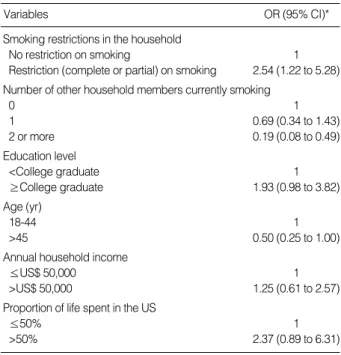
Independent correlates of having an intention to quit smoking As shown in Table 2, the significant independent corre-
lates of having an intention to quit smoking in the multiple logistic regression analysis were household smoking restric- tions (complete or partial restriction vs. no restriction on smo- king; OR, 2.54; 95% CI, 1.22-5.28) and absence of other smokers in the household (2 or more vs. no other smokers in the household; OR, 0.19; 95% CI, 0.08-0.49). Higher education (≥college graduate vs. <college graduate; OR, 1.93; 95% CI, 0.98-3.82) and younger age (>45 yr vs. 18- 44 yr; OR, 0.50; 95% CI, 0.25-1.00) had marginally sig- nificant associations with intention to quit smoking.
DISCUSSION
In this cross-sectional survey of KA adult male smokers in California, we found that household smoking restrictions were associated with having an intention to quit smoking.
This finding is similar to those of previous studies (7, 8, 12).
A prospective study reported that a complete ban at baseline, compared with no ban or a partial ban, was significantly asso- ciated with an increase in subsequent quit attempts (OR, 2.0) (7). The International Tobacco Control (ITC) Four Country Survey-a cohort study conducted in 2002 with an average of seven months follow-up-reported that intentions to quit at baseline were associated with implementing bans between baseline and follow-up (8). Bans at baseline were also associ- ated with more quit attempts and success at follow-up (8).
Another longitudinal study showed that smokers in the prepa- ration stage (i.e., planning to quit seriously within the next 30 days and having made at least one-day quit attempt in the past year) were more likely to adopt a full ban than those either in precontemplation (having no intention to quit with- in the next 6 month) or contemplation (considering quitting seriously within the next 6 months) stages (12).
We also found that those who lived with 2 or more other smokers were less likely to intend to quit smoking, and those who were more educated were more likely to intend to quit smoking. Other significant factors associated with an inten- tion to quit from univariable analyses included age and pro- portion of life spent in the US. Also, higher education and younger age had marginally significant associations with in- tentions to quit smoking. Several previous studies have report- ed that the intention to quit smoking was more prevalent among those who were younger, had higher income, and smo- ked fewer cigarettes per day (13-15). Our findings were con- sistent with earlier studies except for daily cigarette consum- ption, which may be due to missing data on this variable in the CKATUS.
Smokers who were linguistically assimilated and spent more than half of their life in the US were more likely to have an intention to quit smoking. These findings may be due to different social norms about smoking in the US and their country of origin (in this case, Korea). According to the Organisation for Economic Cooperation and Development
*OR and 95%CI were calculated from analyses of complex survey de- sign and were adjusted for age, annual income, education, proportion of life spent in the US, smoking restrictions in the household, and num- ber of smokers in the household, using weighted data.
OR, odds ratio; CI, confidence interval.
Variables OR (95% CI)*
Smoking restrictions in the household
No restriction on smoking 1
Restriction (complete or partial) on smoking 2.54 (1.22 to 5.28) Number of other household members currently smoking
0 1
1 0.69 (0.34 to 1.43)
2 or more 0.19 (0.08 to 0.49)
Education level
<College graduate 1
≥College graduate 1.93 (0.98 to 3.82)
Age (yr)
18-44 1
>45 0.50 (0.25 to 1.00)
Annual household income
≤US$ 50,000 1
>US$ 50,000 1.25 (0.61 to 2.57)
Proportion of life spent in the US
≤50% 1
>50% 2.37 (0.89 to 6.31)
Table 2. Independent correlates of having an intention to quit smoking from the multiple logistic regression analysis (n=387)*
(OECD) 2001 Health Data, current smoking prevalence of adult men in Korea (52.9%) was much higher than in the US (20.3%) (16). The low smoking prevalence in the US may, therefore, facilitate intentions to quit smoking, especially among more assimilated men.
Also, we performed univariable analyses and a multiple logistic regression analysis based on a different operational- ization for the outcome variable (i.e., intention to quit in the next 6 months-stages of contemplation and preparation vs.
no intention to quit in the next 6 months-stage of precon- templation). However, there was no significant association between household smoking restrictions and having an inten- tion to quit smoking (P=0.40). Therefore, in the current stu- dy, we could conclude that those who had household smok- ing restrictions were significantly more likely to have an in- tention to quit smoking (vs. never expect to quit smoking), even though they were not likely to contemplate quitting in the near future (i.e., in the next 6 months).
Our study had several limitations. First, due to the cross- sectional nature of the survey, we are unable to assess whether the smoking restrictions in the household led to having an intention to quit smoking or vice versa. We were neither able to evaluate the causal direction between household smoking restrictions and intention to quit smoking, nor test the rela- tionship between household smoking restrictions and suc- cessful smoking cessation. Although two longitudinal stud- ies (13, 17) mentioned above indicated that stages of change at baseline predicted the adoption of smoking restrictions in the household, the direction in our study is unclear. Further large cohort studies are needed to confirm the directional rel- ationship between these factors. Second, we were unable to evaluate these relationships in women because of the small number of women smokers in the CKATUS data. Larger studies are needed that focus on recruiting Korean Ameri- can women who smoke. Last, the overall response rate for the survey was only 48%. The response rate varied by region, with the lowest response rate being 43% and the highest, 55%. Although interviewers attempted to complete an inter- view by calling at least ten times at different times of day and on different days of the week, the response rate was low, possibly leading to selection bias. However, we believe that we compensated for this by using a weighting technique.
In conclusion, we found that household smoking restric- tions are associated with an intention to quit smoking among KA adult male smokers in California. The results suggest that the adoption of smoking bans in the household could encourage smokers to quit.
ACKNOWLEDGEMENT
The present article has been revised of its references based upon the erratum record in JKMS 2010; 25(6): 984.
REFERENCES
1. Levy DT, Romano E, Mumford EA. Recent trends in home and work smoking bans. Tob Control 2004; 13: 258-63.
2. Pizacani BA, Martin DP, Stark MJ, Koepsell TD, Thompson B, Diehr P. Household smoking bans: which households have them and do they work? Prev Med 2003; 36: 99-107.
3. Blackburn C, Spencer N, Bonas S, Coe C, Dolan A, Moy R. Effect of strategies to reduce exposure of infants to environmental tobacco smoke in the home: cross sectional survey. BMJ 2003; 327: 257.
4. Halterman JS, Fagnano M, Conn KM, Szilagyi PG. Do parents of urban children with persistent asthma ban smoking in their homes and cars? Ambul Pediatr 2006; 6: 115-9.
5. Wamboldt FS, Balkissoon RC, Rankin AE, Szefler SJ, Hammond SK, Glasgow RE, Dickinson WP. Correlates of household smoking bans in low-income families of children with and without asthma.
Fam Process 2008; 47: 81-94.
6. Shelley D, Yerneni R, Hung D, Das D, Fahs M. The relative effect of household and workplace smoking restriction on health status among Chinese Americans living in New York City. J Urban Health 2007; 84: 360-71.
7. Pizacani BA, Martin DP, Stark MJ, Koepsell TD, Thompson B, Diehr P. A prospective study of household smoking bans and subsequent cessation related behaviour: the role of stage of change. Tob Con- trol 2004; 13: 23-8.
8. Borland R, Yong HH, Cummings KM, Hyland A, Anderson S, Fong GT. Determinants and consequences of smoke-free homes: findings from the International Tobacco Control (ITC) Four Country Survey.
Tob Control 2006; 15: 42-50.
9. California Health Interview Survey (2007). CHIS 2005 Adult Public Use File, Release1 [computer file], UCLA Center for Health Policy Research, Los Angeles, CA.
10. Carr K, Beers M, Kassebaum T, Chen MS Jr. California Korean American Tobacco Use Survey-2004. Sacramento, CA: Department of Health Services, 2005.
11. Merriam-Webster’s Online Dictionary. Available at: http://www.
merriam-webster.com/dictionary/acculturation.
12. Pizacani BA, Martin DP, Stark MJ, Koepsell TD, Thompson B, Diehr P. Longitudinal study of household smoking ban adoption among households with at least one smoker: Associated factors, barriers, and smoker support. Nicotine Tob Res 2008; 10: 533-40.
13. Siahpush M, McNeill A, Borland R, Fong GT. Socioeconomic vari- ations in nicotine dependence, self-efficacy, and intention to quit across four countries: findings from the International Tobacco Control (ITC) Four Country Survey. Tob Control 2006; 15 Suppl 3: iii71-5.
14. Abdullah AS, Ho LM, Kwan YH, Cheung WL, McGhee SM, Chan WH. Promoting smoking cessation among the elderly: what are the predictors of intention to quit and successful quitting? J Aging Health 2006; 18: 552-64.
15. Abdullah AS, Yam HK. Intention to quit smoking, attempts to quit, and successful quitting among Hong Kong Chinese smokers: popu- lation prevalence and predictors. Am J Health Promot 2005; 19:
346-54.
16. OECD. OECD Health Data 2001. Available at: http://stats.oecd.
org/wbos/Index.aspx?DatasetCode=HEALTH
17. Fava JL, Velicer WF, Prochaska JO. Applying the transtheoretical
model to a representative sample of smokers. Addict Behav 1995;
20: 189-203.