INTRODUCTION
Drug hypersensitivity syndrome (DHS) refers to a severe, potentially life-threatening, drug reaction. To better indi- vidualize this drug reaction, the term ‘‘Drug Rash with Eosinophilia and Systemic Symptoms (DRESS) syndrome’’
has recently been used.
DRESS syndrome was first introduced in 1996 by Boc- quet et al. (1). Fever, rash, lymphadenopathy, and internal organ involvement with marked eosinophilia constitute the main manifestations. The most frequently involved organ is the liver, followed by the kidney and lungs. The most fre- quently incriminated drugs are anticonvulsant, sulfonamides, dapsone, allopurinol, minocycline, and gold salt. The patho- physiology of DRESS syndrome remains unclear, but a defect in detoxification of causative drug, immunological imbal- ance, and infections such as human herpes virus type 6 (HHV 6) have been suggested (2). The overall mortality in DRESS is about 10% and occurrs in patients with severe multi-organ involvement (1).
We report here a case of DRESS syndrome induced by celecoxib and anti-tuberculosis (Tb) drugs including isoni- azid, rifampicin, ethambutol, and pyrazinamide in a patient presented first as knee joints pain.
CASE REPORT
A 29-yr-old woman with no prior known medical illness presented on March 2004 with an oral ulcer and knee joint pain. She had no specific past medical history before. Cele- coxib was prescribed by a rheumatologist on 17 March under the suspicion of arthritis.
During the course of routine clinical examination, one pulmonary nodule was found in the left upper lung field on chest radiography. High-resolution lung computed tomog- raphy (CT) suggested active pulmonary tuberculosis. She was treated with isoniazid, rifampicin, ethambutol, and pyrazinamide from March 25th. On April 28th (34 and 42 days after the initiation of anti-Tb drugs and celecoxib, res- pectively), she was hospitalized due to jaundice and hep- atomegaly.
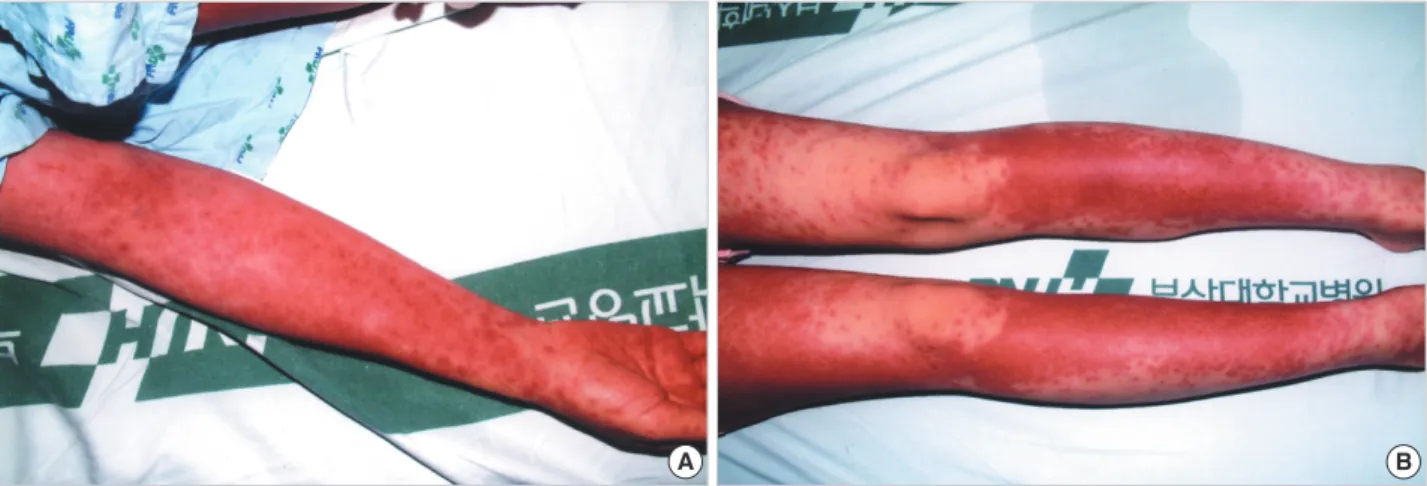
On admission, her temperature was 38℃, blood pressure was 90/60 mmHg, and heart rate was 90 beats per min. She had an exanthematous rash on her trunk and limbs with some pustules (Fig. 1), decreased bibasilar lung sound, icteric sclera, hepatosplenomegaly, cervical lymphadenopathy, and posterior pharyngeal wall injection. Blood cell counts showed hemoglobin 12.4 g/dL, leukocyte count 19,990/μL (polymorphs 45.6%, lymphocytes 28.4%, and eosinophils 12.4% [upper limit of
521
Joo Ho Lee, Hye-Kyung Park, Jeong Heo, Tae Oh Kim, Gwang Ha Kim, Dae Hwan Kang, Geun Am Song, Mong Cho, Dae Sung Kim*, Hwal Woong Kim�, and Chang Hun Lee�
Departments of Internal Medicine, Neurology*, and Pathology�, Pusan National University College of Medicine, Busan, Korea
Address for correspondence Mong Cho, M.D.
Department of Internal Medicine, Gastroenterology, Pusan National University Hospital, 1-10 Ami-dong, Seo-gu, Busan 602-739, Korea
Tel : +82.51-240-7516, Fax : +82.51-244-8180 E-mail : [email protected]
*This work was supported by Pusan National University Research Grant.
DOI: 10.3346/jkms.2008.23.3.521
Drug Rash with Eosinophilia and Systemic Symptoms (DRESS) Syndrome Induced by Celecoxib and Anti-tuberculosis Drugs
Drug Rash with Eosinophilia and Systemic Symptoms (DRESS) syndrome reflects a serious hypersensitivity reaction to drugs, characterized by skin rash, fever, lymph node enlargement, and internal organ involvement. So far, numerous drugs such as sulfonamides, phenobarbital, sulfasalazine, carbamazepine, and phenytoin have been reported to cause the DRESS syndrome. We report a case in a 29-yr-old female patient who had been on celecoxib and anti-tuberculosis drugs for one month to treat knee joint pain and pulmonary tuberculosis. Our patient’s clinical manifesta- tions included fever, lymphadenopathy, rash, hypereosinophilia, and visceral involve- ment (hepatitis and pneumonitis). During the corticosteroid administration for DRESS syndrome, swallowing difficulty with profound muscle weakness had developed.
Our patient was diagnosed as DRESS syndrome with eosinophilic polymyositis by a histopathologic study. After complete resolution of all symptoms, patch tests were positive for both celecoxib and ethambutol. Although further investigations might be needed to confirm the causality, celecoxib and ethambutol can be added to the list of drugs as having the possibility of DRESS syndrome.
Key Words : Drug Hypersensitivity; Celecoxib; Ethambutol; Myositis; Korea, Female
Received : 23 November 2006 Accepted : 17 August 2007
normal (ULN) 6%]), and platelet count 261,000/μL. On her peripheral blood smear, neutrophilic leukocytosis with eosi- nophilia was noted without atypical lymphocytosis. Labora- tory data at the patient’s first admission are summarized in Table 1. Serologic tests for viral infections including hepati- tis A and B, Epstein-Barr virus, human immunodeficiency virus, and cytomegalovirus were negative. Auto-antibody screening revealed negative antinuclear antibody (ANA) and anti-smooth-muscle antibody (SMA). A skin biopsy (Fig. 2) showed intraepidermal eosinophil infiltration and spongio- sis with pustule formation. Perivascular inflammatory cell cuffing was also noted. The chest radiography showed right pleural effusion with pneumonic consolidation. The previ- ous nodule in the left upper lung showed no interval change.
DHS was suspected and all anti-Tb drugs and celecoxib were stopped. Intravenous methylprednisolone (1,000 mg daily) for DHS and antimicrobial therapy (intravenous ceftriaxone 2 g daily and amikacin 1 g daily) for pneumonia were admin- istered for 5 days, followed by oral prednisone 75 mg daily and ursodeoxycholic acid 200 mg three times daily. Fever and rash gradually resolved and liver function started to improve. She was discharged on day 19 (17 May).
Seven days later (24 May), the patient was readmitted. She took her medicine intermittently after discharge. She present- ed with a rash on forearm, sore throat, myalgia, swallowing difficulty, and dyspnea. Over the next 3 days, she was febrile up to 38℃, and the rash extended to whole body with vesi- cle and pustule formation. Laboratory findings at second admission are also outlined in Table 1. The CT scan of ab- domen showed hepatomegaly with perihepatic fluid collec- tion. A bone marrow biopsy disclosed moderate hypercellu- lar marrow with diffuse infiltration of eosinophils.
The diagnosis of a recurrent DRESS syndrome was made, and methylprednisolone 1,000 mg daily was infused intra- venously for 3 days. On day 4 of readmission, myalgia and swallowing difficulty became more profound and muscle weakness developed. Right biceps muscle biopsy (Fig. 3) showed diffuse endomysial and perimysial infiltration of eosinophils with myonecrosis. Her serum creatine kinase (CK) increased up to 18,943 IU/L (ULN 217 IU/L), and elec- tromyography showed typical myopathic changes. Tests were negative for SMA and anti Jo-1 antibodies. A diagnosis of eosinophilic polymyositis was made. Intravenous cyclosporine 100 mg daily and oral methylprednisolone 60 mg daily were
Fig. 1. Diffuse erythema on the patient’s right arm (A) and both legs (B).
B A
Admission date (yr. month. day)
Before admission 2004. 3. 17
1st admission 2004. 4. 28
2nd admission 2004. 5. 24
3rd admission 2004. 9. 13
Outpatient ward 2005. 6. 30
Leukocyte (cell count/μL) 11,670 19,990 20,350 17,020 5,680*
Eosinophil (cell count/μL) 140 2,478 4,477 1,361 278*
ALT (IU/L) (ULN 40 IU/L) 13 327 211 166 10*
AST (IU/L) (ULN 40 IU/L) 20 621 383 196 28*
ALP (IU/L) (ULN 280 IU/L) 306 788 324 3,314 288*
TB (mg/dL) (ULN 1.3 mg/dL) 0.50 3.63 1.58 7.34 0.97*
CRP (mg/dL) (ULN 0.5 mg/dL) 5.81 8.64 3.41 4.20 0.33*
CK (IU/L) (ULN 217 IU/L) Not checked 70 18,943 18 Not checked
Table 1. Laboratory values at each admission time-point
*Laboratory values at the end of steroid tapering.
ULN, upper limit of normal; ALT, alanine transaminase; AST, aspartate transaminase; ALP, alkaline phosphatase; TB, total bilirubin; CRP, C-reactive protein; CK, creatine kinase.
initiated. However, respiratory muscle weakness exacerbat- ed requiring mechanical ventilatory support with intravenous immunoglobulin (IVIG) infusion (1 g/kg/day for 2 days) on day 8 of readmission. After 2 weeks of mechanical ventila- tion, her respiratory function improved and the ventilator was weaned. At that time, a trans bronchial lung biopsy dis- closed chronic granulomatous inflammation without signif- icant eosinophilic infiltrate and a sputum AFB stain revealed a positive finding. Anti-Tb treatment with second-line drugs (cycloserine 500 mg daily, ofloxacin 400 mg daily, prothion- amide 250 mg daily, and streptomycin 1 g five times week- ly) was restarted on June 12th, and cyclosporine was discon- tinued on June 27th. After two more cycles (each cycle includ- ed 2 days of immunoglobulin infusion [1 g/kg/day]) of IVIG, skin lesions and liver function improved. The prednisone was gradually tapered to 40 mg daily, and the patient was
discharged on July 9th.
Over the next two months, the prednisone dosage was reduced to 20 mg daily and an azathioprine (AZT) 50 mg daily was added on August 27th because her serum alanine aminotransferase (ALT) level was fluctuating and we worried about the side effect of long-term steroid therapy in the patient with Tb. Two weeks after initiation of AZT, she had a return of fever, up to 37.6℃, jaundice, and a tender liver. Labora- tory findings at the third admission showed a cholestatic pattern, which was common in AZT toxicity (Table 1). AZT was stopped on September 12th, and only oral prednisone was maintained at a dosage of 10 to 20 mg daily with one more cycle of IVIG. Afterwards, the serum ALT level became normalized and complete resolution of all symptoms was achieved 14 months after discontinuation of the celecoxib and first line anti-Tb drugs. Prednisone was completely taper- ed in June 2005.
Four weeks after discontinuation of the prednisone, patch- testing was performed with the celecoxib and first-line anti- Tb drugs to evaluate a causal relationship. Tablets were crush- ed and incorporated at 10% and 50% in white petrolatum.
The results showed diffuse erythematous rash around the celecoxib, rifampicin, and ethambutol at day 2. Then, the rash was localized to the celecoxib and ethambutol at day 4, and it was more prominent near the celecoxib (Fig. 4). Taken together, her episode was more likely induced by the cele- coxib which probably played a major contributory role, and other first-line anti-Tb drugs played a minor contributory role. Second-line anti-Tb drugs were administered until Octo- ber 2005. Her liver function had been completely normal-
Fig. 4. Patch test results to celecoxib and anti-Tb drugs.
50% in petrolatum
Patch test on day 4
Celecoxib INH RFP EMB PZA
10% in petrolatum
Fig. 2. Histologic examination shows intraepidermal eosinophil infiltration and spongiosis. Perivascular inflammatory cell cuffing is also noted. Hematoxylin and eosin stain (H&E), ×400.
Fig. 3. On histologic examination, myofibers show atrophy and degenerative changes. Interstitial eosinophilic and lymphocytic infiltration is noted. H&E, ×400.
DISCUSSION
Our patient was diagnosed as DRESS syndrome as defined by Bocquet et al. (1). Clinical features were typical: fever, lymphadenopathy with pharyngitis, rash followed by exfo- liative dermatitis, hypereosinophilia >1,500/μL, and visceral involvement (hepatitis and pneumonitis). The symptoms began 34 and 42 days after the introduction of anti-Tb drugs and celecoxib, respectively, in our patient.
The side effects reported with celecoxib have been gener- ally benign exanthemas. Recently, two cases of severe drug hypersensitivity syndrome due to celecoxib have been report- ed (3). In both cases, the celecoxib patch tests were positive.
In the first 2 yr of marketing, the reporting rate for Stevens- Johnson syndrome/toxic epidermal necrolysis with celecox- ib was 6 cases per million person-years of use (4). The report- ing rate was somewhat higher than the background rate of 1.9 cases per million population per year. In our patient, celecoxib was not suspected at first as the causative drug, but in the patch test it showed stronger reaction than other anti-Tb drugs.
Celecoxib, a selective cyclo-oxygenase-2 inhibitor, is a diaryl-substituted pyrazole derivative containing a sulfon- amide substituent. Sulfonamide is one of the most frequent- ly incriminated drugs in DRESS syndrome. The aromatic amine portion of the sulfonamide is considered to be critical in the development of hypersensitivity syndrome. Since cele- coxib does not contain the aromatic amine, adverse reactions such as hypersensitivity syndrome and toxic epidermal necrol- ysis would not be expected to occur at the same frequency as they do with sulfonamides. Reports showing lack of cross- reactivity balance the few case reports suggesting cross-reac- tivity (5). In the present case, we also considered the possi- bility of transferring the aromatic amine portion from anti- Tb drugs to celecoxib, but we did not verify such a reaction in vitro.
Our patient’s patch tests were positive to both celecoxib and ethambutol. In the test, rifampicin also showed positive reaction on day 2 but disappeared on day 4, then interpret- ed as an irritant reaction. However, the patch test result is not a confirmative one, and the rifampicin allergy with a negative patch test also has been reported previously (6).
Ethambutol is a relatively safe drug. In a study by Pitt (7), there were less than 2% of adverse reactions in the 2,000 patients who received 15 mg/kg ethambutol. Skin reactions due to ethambutol included hair loss, urticaria, erythema multiforme, angioedema, hyperhidrosis, skin striae, bullous eruptions, and exfoliative dermatitis (8). But a severe cuta- neous reaction of toxic epidermal necrolysis associated with ethambutol has been reported (9). In a review of the litera-
myositis is a clinically and pathologically diverse group of inflammatory muscle diseases associated with blood and/or tissue eosinophilia (10). Clinical presentation of EM is dis- tinct from other eosinophilic myositis. Tender muscle swelling associated with proximal weakness accompanies a systemic illness. The etiologies of eosinophilic myopathy include par- asitic infection, vasculitis, malignancies, and idiopathic hyper- eosinophilic syndrome. The pathogenesis remains unclear.
An increase in eosinophil production and activation mediat- ed by cytokines like interleukin (IL)-5 are thought to play an important role. Elevated muscle IL-5 induces local accu- mulation of eosinophils and the subsequent release of eosi- nophilic granular proteins. This eosinophilic degranulation is blocked by cyclosporin A and prednisone (11). In the same way, internal organ involvement by eosinophil infiltration in DRESS syndrome is also thought to be induced by IL-5.
Systemic corticosteroids can inhibit the effect of IL-5 on eosi- nophil accumulation and reduce the symptoms of DRESS syndrome (12, 13).
In the present case, respiratory muscle weakness progressed resulting in the respiratory failure despite the cyclosporine infusion. Such a fulminant EM following DRESS syndrome is a rare association. IVIG with prednisone was administer- ed after the onset of myositis, and the respiratory function resumed with the resolution of DRESS syndrome and poly- myositis. In the previous reports on recurrent DRESS syn- drome, IVIG administration showed improvement (14).
After complete resolution of our patient’s symptoms, lab- oratory tests for anti-HHV 6 IgG antibody showed positive reaction but the polymerase chain reaction for HHV6 DNA was negative. So the confirmation of exact association with HHV6 was not made. If HHV6 reactivation was a possibil- ity, our patient’s recovery after IVIG therapy could be exp- lained. Although the mechanism of IVIG treatment in DRESS remains unknown, the therapeutic effects might be depen- dent on functional capabilities of anti-virus IgG contained in IVIG. So far, the only undisputed way to treat severe DHS is prompt withdrawal of the offending drug. Systemic cor- ticosteroid administration is classically reported in the case of organ- or life-threatening disease (15).
In a severe DHS as in present case, provocation test is not ethically recommended. Also, in such a case which involves multiple complexed drugs, patch test may be a useful method for detecting the culprit drugs (16). This approach has been advocated in previous reports on DRESS syndrome (17, 18).
In conclusion, we report here a case of DRESS accompa- nying EM, the cause of which might be associated with both celecoxib and ethambutol according to the patch test. Cele- coxib and ethambutol can be added to the list of drugs caus- ing DRESS syndrome, but further investigations including
lymphocyte toxicity assay might be needed to confirm the causality.
REFERENCES
1. Bocquet H, Bagot M, Roujeau JC. Drug-induced pseudolymphoma and drug hypersensitivity syndrome (Drug Rash with Eosinophilia and Systemic Symptoms: DRESS). Semin Cutan Med Surg 1996; 15:
250-7.
2. Sullivan JR, Shear NH. The drug hypersensitivity syndrome: what is the pathogenesis? Arch Dermatol 2001; 137: 357-64.
3. Marques S, Milpied B, Foulc P, Barbarot S, Cassagnau E, Stalder JF. Severe cutaneous drug reactions to celecoxib (Celebrex). Ann Dermatol Venereol 2003; 130: 1051-5.
4. La Grenade L, Lee L, Weaver J, Bonnel R, Karwoski C, Governale L, Brinker A. Comparison of reporting of Stevens-Johnson syndrome and toxic epidermal necrolysis in association with selective COX-2 inhibitors. Drug Saf 2005; 28: 917-24.
5. Knowles S, Shapiro L, Shear NH. Should celecoxib be contraindi- cated in patients who are allergic to sulfonamides? Revisiting the meaning of ‘sulfa’ allergy. Drug Saf 2001; 24: 239-47.
6. Strauss RM, Green ST, Gawkrodger DJ. Rifampicin allergy con- firmed by an intradermal test, but with a negative patch test. Con- tact Dermatitis 2001; 45: 108.
7. Pitt FW. Tuberculosis, prevention and therapy. In: Hook EW, Man- dell GL, Gwaltney JM eds. Current concepts of infectious disease.
New York: John Wiley & Sons 1977: 181-94.
8. Holdiness MR. Adverse cutaneous reactions to antituberculosis drugs.
Int J Dermatol 1985; 24: 280-5.
9. Pegram PS Jr, Mountz JD, O’Bar PR. Ethambutol-induced toxic epidermal necrolysis. Arch Intern Med 1981; 141: 1677-8.
10. Kaufman LD, Kephart GM, Seidman RJ, Buhner D, Qvarfordt I, Nassberger L, Gleich GJ. The spectrum of eosinophilic myositis. Clin- ical and immunopathogenic studies of three patients, and review of the literature. Arthritis Rheum 1993; 36: 1014-24.
11. Meng Q, Ying S, Corrigan CJ, Wakelin M, Assoufi B, Mogbel R, Kay AB. Effects of rapamycin, cyclosporine A, and dexamethasone on interleukin 5-induced eosinophil degranulation and prolonged survival. Allergy 1997; 52: 1095-101.
12. Ahn CM, Moon JH, Moon JG, Lee KM, Lee JH, Hong CS, Park JW.
A case of cephalosporin-induced DRESS (Drug Rash with Eosinophil- ia and Systemic Symptoms) syndrome with acute renal failure. J Asthma Allergy Clin Immunol 2005; 25: 69-72.
13. Valencak J, Ortiz-Urda S, Heere-Ress E, Kunstfeld R, Base W. Car- bamazepine induced DRESS syndrome with recurrent fever and exanthema. Int J Dermatol 2004; 43: 51-4.
14. Kano Y, Inaoka M, Sakuma K, Shiohara T. Virus reactivation and intravenous immunoglobulin (IVIG) therapy of drug-induced hyper- sensitivity syndrome. Toxicology 2005; 209: 165-7.
15. Tas S, Simonart T. Management of drug rash with eosinophilia and systemic symptoms (DRESS syndrome): an update. Dermatology 2003; 206: 353-6.
16. Kim CW, Choi GS, Yun CH, Kim DI. Drug hypersensitivity to pre- viously tolerated phenytoin by carbamazepine-induced DRESS syn- drome. J Korean Med Sci 2006; 21: 768-72.
17. Lachapelle JM, Maibach HI. Patch testing. Prick testing. A practi- cal guide. Berlin: Springer, 2003.
18. Arellano F, Sacristan JA. Allopurinol hypersensitivity syndrome: a review. Ann Pharmacother 1993; 27: 337-43.