http://dx.doi.org/10.3988/jcn.2013.9.3.157 J Clin Neurol 2013;9:157-164
Effect of the Refrigerator Storage Time on the Potency of Botox for Human Extensor Digitorum Brevis Muscle Paralysis
Mee Young Park,a Ki Young Ahnb
aDepartment of Neurology, College of Medicine, Yeungnam University, Daegu, Korea
bAhn’s Plastic and Reconstructive Surgery Clinic and Botulinum Center, Daegu, Korea
Received December 4, 2012 Revised March 26, 2013 Accepted March 26, 2013 Correspondence Mee Young Park, MD, PhD Department of Neurology, College of Medicine, Yeungnam University, 170 Hyeonchung-ro, Nam-gu, Daegu 705-703, Korea Tel +82-53-620-3682 Fax +82-53-627-1688 E-mail [email protected]
Background and PurposezzIt is recommended that Botox be used within 5 hours of reconsti- tution, which results in substantial quantities being discarded. This is not only uneconomic, but also inconvenient for treating patients. The aim of this study was to determine the potencies of Botox used within 2 hours of reconstitution with unpreserved saline, the same Botox refrigerat- ed (at +4ºC) 72 hours after reconstitution, and during the next 4 consecutive weeks (weeks 1, 2, 3, and 4). This comparison was used to determine the length of refrigeration time during which reconstituted Botox will maintain the same efficacy as freshly reconstituted toxin.
MethodszzIndividual paralysis rates in the extensor digitorum brevis (EDB) compound muscle action potential (CMAP) amplitude and area were measured 1 week after injecting fresh recon- stituted 2.5 MU of Botox on one side of the foot, and when the same quantity of Botox that had been refrigerated for a designated time (i.e., 72 h, or 1, 2, 3, or 4 weeks) into the other side of the foot. The EDB CMAP amplitude and area at 12 and 16 weeks postinjection were also mea- sured to compare the efficacy durations in all five comparative groups.
ResultszzNinety-four volunteers were divided into five groups according to the refrigerator storage time of the second Botox injection. The paralysis of the EDBs was significant for each injection of Botox, both fresh and refrigerated, with no statistically significant differences be- tween them, regardless of the refrigeration time. There was a tendency toward increased CMAP amplitude and area at 12 or 16 weeks postinjection (p<0.0001). The duration of effective mus- cle paralysis did not differ significantly throughout the 16-week follow-up period between all five groups.
ConclusionszzThe potency of reconstituted Botox is not degraded by subsequent refrigeration for 4 weeks. However, there are definite concerns regarding its sterility, and hence its safety, since multiple withdrawals from the same vial over long periods can introduce bacterial con-
tamination. J Clin Neurol 2013;9:157-164
Key Wordszz botox, potency, refrigeration.
Open Access
cc This is an Open Access article distributed under the terms of the Cre- ative Commons Attribution Non-Commercial License (http://creative- commons.org/licenses/by-nc/3.0) which permits unrestricted non-com- mercial use, distribution, and reproduction in any medium, provided the ori- ginal work is properly cited.
Introduction
Botulinum toxin type A (BoNT-A), an exotoxin that is generat- ed by the anaerobic bacteria Clostridium botulinum, produces muscle paralysis by interacting with synaptosomal-associated protein 251,2 on the neuromuscular junction, blocking the se-
cretion of acetylcholine. This effect may last for several mon- ths.3,4 The injection of a large amount of BoNT-A may lead to death due to paralysis of the respiratory muscles; however, if a small dose of refined BoNT-A is injected into specific muscles, its muscle-relaxing and paralyzing effects can be used as a re- medy for areas of excessive muscle tension. Indeed, BoNT-A has been used for more than 20 years in treating patients with disorders related to excessive muscle contraction.5 A commer- cialized BoNT-A, Botox (Allergan Pharmaceuticals, Irvine, CA, USA), was imported into Korea in 1996, since when it has
been widely used in the fields of plastic surgery, dermatology, neurology, and rehabilitation medicine. Its applications are also expected to increase in other areas.6-10
While Botox has been used in various fields, there some dis- advantages to be considered with regards to its storage. The package insert says that Botox should be kept at below -5ºC in a frozen dry state and should be used immediately after it is re- constituted. Furthermore, it is strongly recommended that re- freezing be avoided, and that any remaining solution should be stored in the refrigerator and used within 5 hours to prevent de- generation of its potency. Therefore, once it is reconstituted, any solution remaining of the diluted vial [which is typically 50 or 100 Mouse Units (MU)] should be discarded if it is not used in 5 hours. This may result in large financial losses, requiring clinicians to follow appropriate protocols to consume all of the 50 or 100 MU reconstituted at a time; one such protocol is to wait until they have sufficient patients to use the entire amount.
In fact, except for special cases such as torticollis or cerebral palsy, most patients only need 10-30 MU. Therefore, five or more patients might be needed to consume all 50 or 100 MU at a time, which results in most clinicians storing it for more than 4 hours, possibly for up to 2-4 weeks after mixing, and using the refrigerated, reconstituted Botox without any accurate stan- dards or guidelines.11 If the potency of the Botox is reduced, its efficacy would also be affected, and the treatment dose and the effective period should thus be changed. It is therefore critical to have information regarding any change in the potency of this toxin with refrigeration storage to enable a more accurate esti- mation of the required treatment dose and its effective period.
Few studies have investigated the effects of storage methods and times on Botox potency,12-18 and they have yielded incon- sistent findings, making it very difficult to obtain coherent in- formation. The Institutional Review Board of our hospital ap- proved the present prospective study, which aimed to deter- mine how long reconstituted Botox can be stored in a refri- gerator and maintain the same efficacy as if it had been used within 5 hours of its initial reconstitution in saline solution. To this end, experimental periods that are commonly used in nor- mal clinical studies were used, such that the potency of Botox was tested after refrigerator storage for 72 hours and then 1, 2, 3, and 4 weeks after reconstitution. The same amounts of fre- shly reconstituted Botox and the same sample but after a peri- od of refrigeration was injected into each subject’s opposing extensor digitorum brevis muscles (EDBs; i.e., on opposite feet) at regular intervals, and the paralysis rates of each subject were measured at 1, 12, and 16 weeks postinjection to allow comparison of fresh and refrigerated Botox.
The findings of this study will contribute to effective Botox treatments and should resolve some of the current disadvantag- es related to its use, as well as achieving cost effectiveness by
determining the maximum refrigerator storage period that en- sures the same effect of freshly reconstituted Botox.
Methods
Subjects
This was a rater-blinded randomized study. In total, 94 healthy volunteers (67 men and 27 women) were divided into 5 groups.
To avoid the age-related differences in paralysis rates between subjects, only subjects in their twenties were allowed to enroll.
None of the enrolled healthy subjects had any previous experi- ence with BoNT-A and were free of both central and peripher- al nervous system diseases, and had no history of musculosk- eletal injuries. Their EDB muscles were confirmed as being normal before the study, with subjects exhibiting a more than 50% difference in the amplitude of mean compound muscle action potential (CMAP) between the EDBs on the two feet during the nerve conduction study (NCS) performed simulta- neously before Botox injection were excluded.
Subjects were randomly assigned to one of five groups, and each EDB was also randomly assigned to either freshly recon- stituted (control group) or refrigerator-stored (test group) Bo- tox in all subjects. Each subject in each of the five study groups was injected with fresh toxin into the EDB on one side and re- frigerated toxin from the same vial into the EDB on the oppo- site foot (Fig. 1). To avoid any differences attributable to the specific vial, the same vial was used in each study group, thus limiting the number of subjects 20 for each study group (20 subjects×2.5 MU×2 sides EDB=100 MU).
Dilution and injection
The EDB was used as a test muscle because it is readily dif- ferentiated from the other foot muscles and is not normally used as much as other foot muscles so that even if it is para- lyzed, it would be asymptomatic or cause only minor inconve- nience. In addition, NCSs on the EDB are generally considered reliable.
Botox (Allergan Pharmaceuticals) was injected into a spot marked on the EDB muscle where the amplitude and area of the CMAP would be measured before and after injection; the mark placed on the EDB was maintained for a further week to minimize any errors in the subsequent NCS tests for assessing EDB paralysis. The injection was given with a 29-gauge insu- lin needle with the foot in the same posture as in the NCS.
The EDB muscle on one foot was injected with 2.5 MU/0.1 mL Botox that had been immediately reconstituted with 4 mL of normal saline (fresh toxin; control side), and that on the con- tralateral foot was injected with the same amount of the same toxin, from the same vial, but which had been stored in a re- frigerator (below +4ºC) for a designated test period (i.e., 72
hours, or 1, 2, 3, or 4 weeks) after first reconstitution.
Measurement and analysis
To measure the effect of refrigerator storage time on the poten- cy of Botox, muscle paralysis rates-as assessed by the CMAP amplitude and area-were compared with baseline measure- ments using NCSs at 1 week postinjection, which was the maximum time point of the effect. In addition, the effect of Bo- tox refrigerator storage time on the duration of the paralysis was evaluated by measuring the CMAP of each of the five sto- rage time groups at 12 and 16 weeks postinjection and com- pared to those measured preinjection (Fig. 1).
The EDBs were considered to have been paralyzed if there was a decrease of more than 20% in the CMAP amplitude and area. Conversely, the effect was considered to have faded if these parameters had recovered to more than 80%. The degree of paralysis of the EDB was calculated using the following for- mula:
Paralysis (%)=
CMAP amplitude (area) of EDB before injection-CMAP amplitude
(area) of EDB after injection CMAP amplitude (area) of EDB ×100
before injection
In the NCS, Counterpoint MK2 (Dantec, Skorlunde, Den- mark) electromyography was used with filter settings of 5 Hz and 5 kHz. A ground electrode (a 10-mm-diameter surface electrode) was placed on the anterior tibialis, and a reference electrode was placed on the outside of the foot about 6 cm
from a recording electrode (recording site). A supramaximal stimulus was applied to the ankle area about 6-8 cm from the recording site to stimulate the peroneal nerve, yielding a maxi- mum CMAP. For the test reliability, NCSs were repeated five times and the maximum duplicable value was accepted. The skin temperature was maintained at ≥32ºC during the test. All NCSs were performed by same investigator who was blinded to the injection condition.
SPSS (version 10.0, Chicago, IL, USA) software was used for statistical analysis of the results. Changes in the paralysis rate over time and comparison of paralysis rates between the control and test groups were detected using repeated-measure- ment two-factor analysis. Comparison analysis for age, stimu- lus intensity, and paralysis rate among the five refrigeration pe- riod groups was achieved by ANOVA verification. The data are presented as mean±SD values, and the level of statistical sig- nificance was set at p<0.05.
Results
The 72-hour, and 1-, 2-, 3-, and 4-week Botox refrigeration groups comprised 20 (18 men and 2 women), 18 (12 men and 6 women), 20 (11 men and 9 women), 19 (13 men and 6 wom- en), and 17 (13 men and 4 women) subjects, respectively. Thus, 94 subjects (67 men and 27 women) participated in this study.
The age of the entire cohort was 24.0±2.3 years, and the electrical stimulation intensity did not differ significantly be- tween the fresh-toxin group (61.2±2.7 mV) and the refrigerat- ed-toxin group (61.3±3.3 mV) (Table 1). Representative NCS
Fig. 1. Study design. EDB CAMP: extensor digitorum brevis compound muscle action potential, hrs: hours, Lt.: left, Rt.: right, wk: week.
Group 1 (n=20)
Fresh toxin (control) Lt. n=11 Rt. n=9
72 hrs refrigerated toxin Lt. n=9
Rt. n=11
Fresh toxin (control) Lt. n=9 Rt. n=9
1 wk refrigerated toxin Lt. n=9
Rt. n=9
Fresh toxin (control) Lt. n=10 Rt. n=10
2 wks refrigerated toxin Lt. n=10
Rt. n=10
Post-injection EDB CMAP at 1 wk Botox® pre-injection EDB CMAP total (n=94)
Post-injection EDB CMAP at 12 wks
Post-injection EDB CMAP at 16 wks
Fresh toxin (control) Lt. n=10 Rt. n=9
3 wks refrigerated toxin Lt. n=9
Rt. n=10
Fresh toxin (control) Lt. n=8 Rt. n=9
4 wks refrigerated toxin Lt. n=9
Rt. n=8
Group 2 (n=18) Group 3 (n=20) Group 4 (n=19) Group 5 (n=17)
CMAP results before and after Botox injection are presented in Fig. 2. The mean EDB CMAP amplitudes in the fresh-toxin and refrigerated-toxin groups at baseline were 9.8±3.6 mV (range, 8.9-10.7 mV) and 10.4±3.9 mV (9.6-10.7 mV), respec- tively; the difference between the groups was not significant.
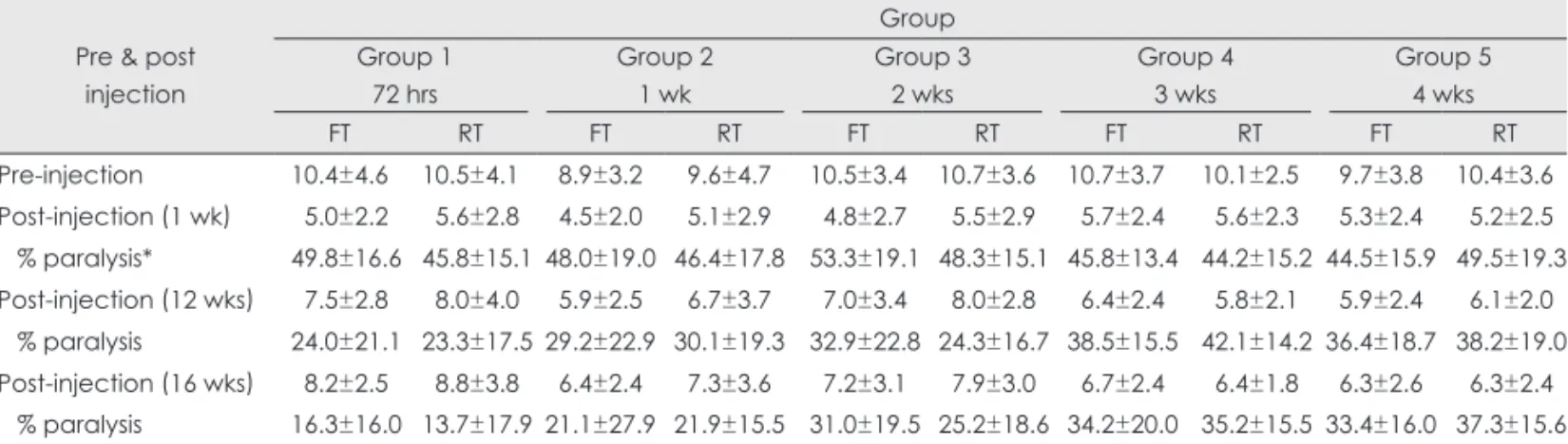
The mean EDB CMAP amplitudes and areas at baseline, and weeks 1, 12, and 16 postinjection for paralysis rating of both the fresh toxin (control) and toxin refrigerated for 72 hours, or 1, 2, 3, or 4 weeks (test) are listed in Table 2.
There was no difference in the individual paralysis rates of the CMAP amplitude at 1 week postinjection between the fresh-toxin group (control, 48.5±17.1%) and all of the refriger- ated-toxin groups (test, 48.4±15.7%). Furthermore, there were no statistical differences between the control and all five test groups, which shows that there was meaningful EDB paralysis with both the fresh toxin and the variously refrigerated toxin at 1 week post-Botox injection (p<0.0001). Similarly, testing of the paralysis rate the fresh-toxin control group and all of the in-
dividual test groups (i.e., 72 hours, and 1, 2, 3, and 4 weeks of refrigeration) revealed no significant differences between group pairs (p>0.05), decreasing equally over time, with recovery from muscle paralysis beginning after 16 weeks. However, with the exception of group 1 (Table 2), most of the EDBs were still paralyzed by a decrease of more than 20% at 16 weeks compared with the baseline (Table 2). Nevertheless, the paralysis rate did not differ significantly between the control groups and all five test groups, and thus it appears that the po- tency of Botox was not affected even after refrigeration at +4ºC for 4 weeks after initial reconstitution in normal saline solution.
Indeed, not only was the potency of the reconstituted, 4-week refrigerated Botox the same as that of freshly reconstituted Bo- tox with respect to the EDB paralysis rate, but also the effect of the refrigerated toxin appears to have lasted as long as that of the freshly diluted toxin. Furthermore, since the 1-, 2-, 3-, and 4-week refrigerated-toxin groups exhibited a paralysis rate of more than 20% in the 16th week postinjection, the effect last- ed for up to 16 weeks (Table 2).
The average paralysis rates of the CMAP area yielded simi- lar results (Table 3). None of the subjects experienced any par- ticular side effects or reported any subjective symptoms or muscle pain throughout the test.
Discussion
BoNT-A is a neurotoxin that can be generated by rotten canned food, and causes botulism. In 1895, 34 persons in Belgium who had eaten “off” ham exhibited muscle paralysis. Profes- sor Ermengem isolated the bacteria from the remaining food
Fig. 2. Extensor digitorum brevis (EDB) muscle compound muscle action poten- tial amplitudes and areas of representa- tive subject who was injected 2.5 MU/0.1 mL fresh Botox and 1 week refrigerated Botox on each side of the EDB muscles.
There are meaningful EDB paralysis with both fresh and refrigerated toxins at 1, 12, and 16 weeks post injection.
Fresh Botox
Amplitude (mV) Area (ms×mV) Paralysis (%)
5 ms/D
Base line 1 week 12 weeks 16 weeks
1 week refrigerated Botox
Amplitude (mV) Area (ms×mV) Paralysis (%)
Table 1. Mean values of age of the entire cohort and electrical stimulation intensities
Group
Volunteer Age (years) Stimulation intensity (mV)
Control Test
72 hrs 23.7±1.1 63.0±6.4 64.0±7.1
1 wk 26.4±3.2 62.0±3.4 61.7±3.0
2 wks 22.3±1.6 60.3±1.1 60.0±2.5
3 wks 23.1±1.2 60.0±1.2 61.0±2.1
4 wks 24.6±2.0 60.0±1.3 60.0±1.9
Mean 24.0±2.3 61.1±2.7 61.3±3.3
Control: fresh toxin, hrs: hours, Test: refrigerated toxin, wk: week.
and dead bodies, and 2 years later disclosed that it was botu- lism caused by the bacteria Clostridium botulinum.19 Since then, crystallized BoNT-A has been isolated and refined for medical applications. Clinically, after animal experiments con- ducted by Dr. Scott in 1973, it was first used for treating pa- tients with extraocular muscle strabismus, and later mainly for neurological diseases. Finally, in 1989, Botox, a form of BoNT- A, was formally approved by the United States Food and Drug Administration (US FDA) as a treatment for strabismus, facial spasm, blepharospasm, and facial nerve disorders. The Unit- ed States Food and Drug Administration approved the toxin for
the treatment of cervical dystonia in 2000, glabellar frown lines in 2002, hyperhydrosis in 2004, upper limb spasticity in adults and chronic migraine in 2010, and more recently (in 2011), uri- nary incontinence in adults with neurological conditions includ- ing multiple sclerosis and spinal cord injury. Botox is current- ly approved for clinical use in more than 70 countries in the world, and has various medical and cosmetic indications.
Botulinum toxin type A blocks the neuromuscular junction to produce muscle paralysis by inhibiting acetylcholine release in the vesicular membrane, but its degree of reaction may dif- fer according to the clinical issue. Several factors affect the po- Table 2. Mean CMAP amplitudes at baseline, and weeks 1, 12, and 16 post Botox injection (2.5 MU/0.1 mL) for paralysis rating of both the fresh toxin (control) and toxin refrigerated for 72 hours, or 1, 2, 3, or 4 weeks (test) (mean mV±SD)
Group Pre & post
injection
Group 1 72 hrs
Group 2 1 wk
Group 3 2 wks
Group 4 3 wks
Group 5 4 wks
FT RT FT RT FT RT FT RT FT RT
Pre-injection 10.4±4.6 10.5±4.1 8.9±3.2 9.6±4.7 10.5±3.4 10.7±3.6 10.7±3.7 10.1±2.5 9.7±3.8 10.4±3.6 Post-injection (1 wk) 5.0±2.2 5.6±2.8 4.5±2.0 5.1±2.9 4.8±2.7 5.5±2.9 5.7±2.4 5.6±2.3 5.3±2.4 5.2±2.5 % paralysis* 49.8±16.6 45.8±15.1 48.0±19.0 46.4±17.8 53.3±19.1 48.3±15.1 45.8±13.4 44.2±15.2 44.5±15.9 49.5±19.3 Post-injection (12 wks) 7.5±2.8 8.0±4.0 5.9±2.5 6.7±3.7 7.0±3.4 8.0±2.8 6.4±2.4 5.8±2.1 5.9±2.4 6.1±2.0 % paralysis 24.0±21.1 23.3±17.5 29.2±22.9 30.1±19.3 32.9±22.8 24.3±16.7 38.5±15.5 42.1±14.2 36.4±18.7 38.2±19.0 Post-injection (16 wks) 8.2±2.5 8.8±3.8 6.4±2.4 7.3±3.6 7.2±3.1 7.9±3.0 6.7±2.4 6.4±1.8 6.3±2.6 6.3±2.4 % paralysis 16.3±16.0 13.7±17.9 21.1±27.9 21.9±15.5 31.0±19.5 25.2±18.6 34.2±20.0 35.2±15.5 33.4±16.0 37.3±15.6 There was no difference in the individual paralysis rates of the CMAP amplitude 1 week post injection between the fresh-toxin groups (control) and all of the refrigerated-toxin groups (test). Furthermore, there were no statistical differences between the control and all five test groups, which shows that meaningful EDB paralysis with both the fresh toxin and the variously refrigerated toxin at 1 week post Botox injection (p<0.0001). Similarly, testing of the paralysis rate the fresh toxin control group and all of the individual test groups (i.e., 72 hours, and 1, 2, 3, and 4 weeks of refrigeration) revealed no significant differences between group pairs (p>0.05), decrease equally over time, with recovery from muscle paralysis beginning after 16 weeks. % paralysis is average value of individual percent paralysis of EDB CMAP amplitude in each subject.
*p<0.0001.
EDB CMAP: extensor digitorum brevis compound muscle action potential, FT: fresh toxin, hrs: hours, RT: refrigerated toxin, wk: week.
Table 3. EDB CMAP areas at baseline, and weeks 1, 12, and 16 post Botox injection (2.5 MU/0.1 mL) for paralysis rating of both the fresh toxin (control) and toxin refrigerated for 72 hours, or 1, 2, 3, or 4 weeks (test) (mean ms×mV±SD)
Group Pre & post
injection
Group 1 72 hrs
Group 2 1 wk
Group 3 2 wks
Group 4 3 wks
Group 5 4 wks
FT RT FT RT FT RT FT RT FT RT
Pre-injection 18.3±7.2 20.3±7.6 16.3±6.0 18.0±8.6 20.6±6.9 20.6±7.1 21.4±8.4 18.8±4.5 17.1±5.9 20.1±6.5 Post-injection (1 wk) 8.5±3.8 10.1±4.5 6.9±4.0 9.2±5.6 9.0±5.5 10.7±5.2 10.4±5.1 8.9±4.5 8.6±3.8 9.0±4.7 % paralysis* 50.9±21.6 46.0±24.3 55.2±25.1 46.6±30.0 57.2±21.0 49.4±16.4 53.0±15.8 46.4±19.7 47.5±19.4 54.6±18.3 Post-injection (12 wks) 13.4±5.1 15.6±7.0 10.7±5.5 13.2±7.6 13.2±7.3 15.8±5.9 11.7±4.7 9.9±4.0 9.7±3.7 10.2±3.3 % paralysis 21.5±30.2 19.1±26.9 29.2±31.3 26.5±35.0 36.7±26.2 27.5±16.1 42.6±21.0 46.4±19.7 40.7±20.8 47.0±16.1 Post-injection (16 wks) 14.3±3.9 16.9±6.5 12.1±4.9 13.7±6.4 13.6±6.1 14.3±5.6 12.7±5.1 10.8±4.4 11.0±3.6 11.4±3.2 % paralysis 14.7±24.6 13.9±17.9 16.4±33.8 20.5±23.2 31.7±27.5 28.1±23.8 36.6±24.8 40.5±27.1 33.1±18.1 41.9±10.6 There was no difference in the individual paralysis rates of the CMAP area 1 week post injection between the fresh-toxin groups (con- trol) and all of the refrigerated-toxin groups (test). Furthermore, there were no statistical differences between the control and all five test groups, which shows that meaningful EDB paralysis with both the fresh toxin and the variously refrigerated toxin at 1 week post Botox injection (p<0.0001). Similarly, testing of the paralysis rate the fresh toxin control group and all of the individual test groups (i.e., 72 hours, and 1, 2, 3, and 4 weeks of refrigeration) revealed no significant differences between group pairs (p>0.05), decrease equal- ly over time, with recovery from muscle paralysis beginning after 16 weeks. % paralysis is average value of individual percent paralysis of EDB CMAP area in each subject.
*p<0.0001.
EDB CMAP: extensor digitorum brevis compound muscle action potential, FT: fresh toxin, hrs: hours, RT: refrigerated toxin, wk: week.
tency of BoNT-A: the number or type of receptors against BoNT-A in the presynapse,20-23 the degree of dilution,24 the method of injection,25,26 the presence of antibodies against BoNT-A,27,28 and the actual potency of the toxin in the vial.29-31 In addition, the status of the muscle to be injected can affect the degree of response. When an electrical stimulus is applied to the muscles in animals32-34 or humans33 that have been injected with BoNT-A to raise the activity of muscle, the degree of pa- ralysis is actually increased. Thus, BoNT-A is more effective in hyperactive spastic or dystonic abnormal muscle than in nor- mal muscle.35,36 Thus, patients with hyperactive muscles im- prove more after the first treatment than after the second.
It is therefore clear that studies into the precise measurement of potency under similar conditions are needed to determine ef- fective treatments. There are objective methods of measuring the potency of BoNT-A in both animals (e.g., glycogen dye- ing,24 a method of comparing the contraction power of the white mouse gastrocnemius,37 and LD50 studies12) and humans (e.g., measuring M-wave amplitude and CMAP using electro- myography33,38).
In one study, injection of Botox into the abdominal cavity of Swiss Webster mice and subsequent measurement of LD50 re- vealed no difference in potency with up to 6 hours of refriger- ator storage (+6ºC) after mixing with saline. However, after 12 hours, the potency of the toxin had reduced by 43.9%, and af- ter 2 weeks of freezing storage (-70ºC), it had decreased by 69.8%.12 Nonetheless, the findings of animal experiments on BoNT-A potency regarding LD50 cannot be extrapolated to ver- ify the degree of clinical responses in humans. Since the LD50
method uses fatal amounts of the toxin and provides informa- tion about toxicity, it cannot definitively reflect muscle paraly- sis. In addition, the sensitivity to BoNT-A may vary between species.13 Furthermore, because the LD50 dose differs according to the location of the BoNT-A injection, for example abdomi- nally or intradermally,39 the muscle paralysis rate does not nec- essarily increase in proportion to the LD50 dose.39-41 Moreover, the LD50 dose of Botox and another form of BoNT-A, Dys- port, did not produce the same clinical responses.42,43
It is therefore clearly desirable to use human muscle for the analysis of BoNT-A potency. Among the studies in which hu- man subjects were tested, NCSs have been used to measure pa- ralysis rates on the EDB muscle. Another two inconsistent find- ings have been reported regarding EDB paralysis rates when Botox was kept in the refrigerator or freezer. In one study, mean CMAP amplitudes expressed as a percentage of the baseline amplitude were more reduced on sides injected with immedi- ately reconstituted Botox than on sides injected with reconsti- tuted Botox stored for 1 week or more,14 while another study found no difference in the potency after 2 weeks between re- constituted Botox stored in a refrigerator or a freezer.15 The
NCS is a good and objective method of assessing potency, but both of these NCSs had limitations. For example, Sloop et al’s15 study included a sample that was too small (four subjects) to enable the findings to be generally accepted, and failed to compare consecutively and consistently by refrigeration peri- od, since it compared freshly mixed toxins at only one time pe- riod without monitoring their effective duration.14
In other potency studies looking at the effect of BoNT-A on facial wrinkle elimination, the reports stated no change of po- tency after 2 weeks,16 1 month,17 and even up to 6 weeks18 of refrigeration. However, these three studies16-18 also pose their own limits, for example by making only subjective measure- ments based on the clinical effects on facial wrinkles (improve- ments), not implementing a double-blind study,16,17 or by mea- suring the effect on removal of forehead wrinkles relative to the refrigeration period, but without using a control group us- ing same vial.18 It has therefore been difficult to obtain consis- tent information.
On the other hand, the BoNT-A responsiveness test designed by Sloop et al.13,14 using NCSs on the EDB analyzes the rela- tionship between dose-response and potency. This is consid- ered an easy and reliable test, as it is used for diagnosing pa- tients who do not respond to the treatment because they possess antibodies against BoNT-A,44,45 or to analyze potency accord- ing to the serotype of BoNT-A.15,46
Accordingly, the present study used a minimum dose of Bo- tox (2.5 MU) to paralyze human EDBs;38 the toxin was inject- ed into the midbelly of the EDB, close to the motor endplate, in order to maximize the paralysis rate of the muscle.47 The trac- ing test was conducted 1 week postinjection, which is consid- ered to be the time point of maximum paralysis.4,38 Due to the possibility that each vial has a slightly different potency [there is thought to be a potential 80-125% difference (corresponding to the 95% confidence interval) in potency from vial to vial (2.2.9. Botox validation assay for KFDA approval)], the same vial was used for each group to improve the accuracy of the experiment.
The tracing tests performed 1 week postinjection in the pres- ent study revealed that all control and test groups exhibited sig- nificant EDB paralysis. According to Hamjian and Walker,48 there was no muscle atrophy for 42 days after injecting BoNT- A into the EDB, and so muscle atrophy might not affect the CMAP of the tested muscle just 1 week postinjection. If elimi- nation of wrinkles is the direct effect of the paralysis of muscle contraction, the correction of the square-shaped mandible or calf muscle hypertrophy49 is based on the secondary muscle at- rophy that occurs after muscle paralysis. According to previous reports8,49 the effect of removing facial wrinkles was found within 2 weeks, while the thickness of the masseter muscle was maximally reduced after 3 months. This may support the pos-
sibility of differential mechanisms of action, such as disuse at- rophy, being responsible for the observed results.
In the present study the maximum individual paralysis rates ranged from 44.5±15.9% to 53.3±19.1%. However, any slig- htly difference in the potency of the drug in each vial or the diffusion effect from the volume increase after dilution may cause differences in the paralysis rates between the groups.33 As found in the present study, the SD of the EDB paralysis rate, as assessed by measuring the CMAP area, was larger than that of the CMAP amplitude. Thus, the CMAP amplitude is a more subjective measure than the CMAP area (Table 2 and 3); this is because of mechanical limitations.
The manufacturer recommends that Botox be reconstituted in unpreserved saline and used within 5 hours of dilution, after which it should be disposed of. In real applications it is nor- mally re-deep-frozen or refrigerated from 8 hours to 2 weeks, or up to 4 weeks after dilution, with uncertainty regarding any possible reduction of potency or contamination.11 Moreover, toxin reuse should be avoided since the chemical structure may have changed, and proteins can be denatured during the storage and the re-freezing process.12 Clearly, then, accurate analyses of Botox potency with refrigeration storage are required.
The results of the present study demonstrate that if Botox is diluted with unpreserved normal saline solution and kept in the refrigerator at below +4ºC, its potency can be ensured for at least 4 weeks. There is thus no need to increase the dose of the toxin within that 4-week period, and it can be used with the confidence that its potency will not have decreased during that time, since we have shown that the response to refrigerated so- lutions lasted for 16 weeks, the same as for freshly diluted so- lutions. However, it is important that the refrigerator is main- tained at a temperature of no more than +4ºC, because higher temperatures may influence the potency.
The possibility of contamination should also be considered when storing and reusing the same Botox vials. In my own ex- perience of 10 years in medical practice I have never had a case in which a patient has been infected from a refrigerated solu- tion from which I have distributed several doses from the same vial to different patients. Therefore, if it is stored in a refriger- ator at below +4ºC without removing the rubber lid from the bottle, and appropriate care is taken after it is diluted to prevent it from being contaminated by organisms, Botox diluted with unpreserved normal saline can be considered to be fresh and safe for at least 4 weeks.
We anticipate that the results of this study will be helpful in various clinical treatment fields where Botox is used, and that they will act as guidelines for clinicians to build economic and effective protocols.
Conflicts of Interest
The authors have no financial conflicts of interest.
Acknowledgements
This research was supported by the Yeungnam University research grants in 2011.
REFERENCES
1. Blasi J, Chapman ER, Link E, Binz T, Yamasaki S, De Camilli P, et al.
Botulinum neurotoxin A selectively cleaves the synaptic protein SNAP- 25. Nature 1993;365:160-163.
2. Schiavo G, Santucci A, Dasgupta BR, Mehta PP, Jontes J, Benfenati F, et al. Botulinum neurotoxins serotypes A and E cleave SNAP-25 at dis- tinct COOH-terminal peptide bonds. FEBS Lett 1993;335:99-103.
3. Duchen LW. An electron microscopic study of the changes induced by botulinum toxin in the motor end-plates of slow and fast skeletal mus- cle fibres of the mouse. J Neurol Sci 1971;14:47-60.
4. Molgo J, Comella JX, Angaut-Petit D, Pecot-Dechavassine M, Tabti N, Faille L, et al. Presynaptic actions of botulinal neurotoxins at vertebrate neuromuscular junctions. J Physiol (Paris) 1990;84:152-166.
5. Brin MF. Botulinum toxin: new and expanded indications. Eur J Neu- rol 1997;4:S59-S65.
6. Ahn KY, Park MY, Park DH, Han DG. Botulinum toxin A for the treat- ment of facial hyperkinetic wrinkle lines in Koreans. Plast Reconstr Surg 2000;105:778-784.
7. Carruthers J, Carruthers A. Botulinum toxin (botox) chemodenervation for facial rejuvenation. Facial Plast Surg Clin North Am 2001;9:197- 204, vii.
8. Park MY, Ahn KY, Jung DS. Botulinum toxin type A treatment for contouring of the lower face. Dermatol Surg 2003;29:477-483; discus- sion 483.
9. Brin MF, Binder WJ, Blitzer A, Schenrock L, Pogoda JM. Botulinum toxin type A for pain and headache. In: Brin MF, Hallett M, Jankovic J.
Scientific and Therapeutic Aspects of Botulinum Toxin. Philadelphia, PA: Lippincott Williams & Wilkins, 2002.
10. Naumann M, Lowe NJ. Botulinum toxin type A in treatment of bilater- al primary axillary hyperhidrosis: randomised, parallel group, double blind, placebo controlled trial. BMJ 2001;323:596-599.
11. Klein AW. Dilution and storage of botulinum toxin. Dermatol Surg 1998;24:1179-1180.
12. Gartlan MG, Hoffman HT. Crystalline preparation of botulinum toxin type A (Botox): degradation in potency with storage. Otolaryngol Head Neck Surg 1993;108:135-140.
13. Sloop RR, Cole BA, Escutin RO. Human response to botulinum toxin injection: type B compared with type A. Neurology 1997;49:189-194.
14. Paik NJ, Seo K, Eun HC. Reduced potency after refrigerated storage of botulitum toxin A: human extensor digitorum brevis muscle study.
Mov Disord 2006;21:1759-1763.
15. Sloop RR, Cole BA, Escutin RO. Reconstituted botulinum toxin type A does not lose potency in humans if it is refrozen or refrigerated for 2 weeks before use. Neurology 1997;48:249-253.
16. Yang GC, Chiu RJ, Gillman GS. Questioning the need to use Botox within 4 hours of reconstitution: a study of fresh vs 2-week-old Botox.
Arch Facial Plast Surg 2008;10:273-279.
17. Garcia A, Fulton JE Jr. Cosmetic denervation of the muscles of facial expression with botulinum toxin. A dose-response study. Dermatol Surg 1996;22:39-43.
18. Hexsel DM, De Almeida AT, Rutowitsch M, De Castro IA, Silveira VL, Gobatto DO, et al. Multicenter, double-blind study of the efficacy of injections with botulinum toxin type A reconstituted up to six con- secutive weeks before application. Dermatol Surg 2003;29:523-529;
discussion 529.
19. Dolman CE. Botulism as a world problem. In: Lewis KH, Cassel K Jr.
Botulism. Cincinnati, OH: U.S. Dept. of Health, Education, and Wel- fare, Public Health Service, 1964.
20. Hambleton P. Clostridium botulinum toxins: a general review of in- volvement in disease, structure, mode of action and preparation for clinical use. J Neurol 1992;239:16-20.
21. Jessell TM, Kandel ER. Synaptic transmission: a bidirectional and self-modifiable form of cell-cell communication. Cell 1993;72 Sup- pl:1-30.
22. Montecucco C, Schiavo G. Tetanus and botulism neurotoxins: a new group of zinc proteases. Trends Biochem Sci 1993;18:324-327.
23. Schiavo G, Rossetto O, Benfenati F, Poulain B, Montecucco C. Teta- nus and botulinum neurotoxins are zinc proteases specific for compo- nents of the neuroexocytosis apparatus. Ann N Y Acad Sci 1994;710:
65-75.
24. Shaari CM, Sanders I. Quantifying how location and dose of botuli- num toxin injections affect muscle paralysis. Muscle Nerve 1993;16:
964-969.
25. Borodic GE, Cozzolino D, Ferrante R, Wiegner AW, Young RR. In- nervation zone of orbicularis oculi muscle and implications for botuli- num A toxin therapy. Ophthal Plast Reconstr Surg 1991;7:54-60.
26. Borodic GE, Pearce LB, Smith K, Joseph M. Botulinum a toxin for spasmodic torticollis: multiple vs single injection points per muscle.
Head Neck 1992;14:33-37.
27. Hambleton P, Cohen HE, Palmer BJ, Melling J. Antitoxins and botuli- num toxin treatment. BMJ 1992;304:959-960.
28. Zuber M, Sebald M, Bathien N, de Recondo J, Rondot P. Botulinum antibodies in dystonic patients treated with type A botulinum toxin: fre- quency and significance. Neurology 1993;43:1715-1718.
29. Greene P. Potency of frozen/thawed botulinum toxin type A in the treat- ment of torsion dystonia. Otolaryngol Head Neck Surg 1993;109:968- 30. First ER, Pearce LB, Borodic GE. Dose standardisation of botulinum 969.
toxin. Lancet 1994;343:1035.
31. Pickett AM, Hambleton P. Dose standardisation of botulinum toxin.
Lancet 1994;344:474-475.
32. Hughes R, Whaler BC. Influence of nerve-ending activity and of drugs on the rate of paralysis of rat diaphragm preparations by Cl. botulinum type A toxin. J Physiol 1962;160:221-233.
33. Eleopra R, Tugnoli V, De Grandis D. The variability in the clinical ef- fect induced by botulinum toxin type A: the role of muscle activity in humans. Mov Disord 1997;12:89-94.
34. Kim HS, Hwang JH, Jeong ST, Lee YT, Lee PK, Suh YL, et al. Effect of muscle activity and botulinum toxin dilution volume on muscle pa- ralysis. Dev Med Child Neurol 2003;45:200-206.
35. Glocker FX, Guschlbauer B, Lücking CH, Deuschl G. Effects of local
injections of botulinum toxin on electrophysiological parameters in pa- tients with hemifacial spasm: role of synaptic activity and size of mo- tor units. Neurosci Lett 1995;187:161-164.
36. Hesse S, Jahnke MT, Luecke D, Mauritz KH. Short-term electrical stimulation enhances the effectiveness of Botulinum toxin in the treat- ment of lower limb spasticity in hemiparetic patients. Neurosci Lett 1995;201:37-40.
37. Holds JB, Fogg SG, Anderson RL. Botulinum A toxin injection. Fail- ures in clinical practice and a biomechanical system for the study of toxin-induced paralysis. Ophthal Plast Reconstr Surg 1990;6:252-259.
38. Sloop RR, Escutin RO, Matus JA, Cole BA, Peterson GW. Dose-re- sponse curve of human extensor digitorum brevis muscle function to intramuscularly injected botulinum toxin type A. Neurology 1996;46:
1382-1386.
39. Kauffman JA, Way JF Jr, Siegel LS, Sellin LC. Comparison of the ac- tion of types A and F botulinum toxin at the rat neuromuscular junction.
Toxicol Appl Pharmacol 1985;79:211-217.
40. Frueh BR, Felt DP, Wojno TH, Musch DC. Treatment of blepharo- spasm with botulinum toxin. A preliminary report. Arch Ophthalmol 1984;102:1464-1468.
41. Borodic GE, Cozzolino D. Blepharospasm and its treatment, with em- phasis on the use of botulinum toxin. Plast Reconstr Surg 1989;83:
546-554.
42. Pearce LB, Borodic GE, First ER, MacCallum RD. Measurement of botulinum toxin activity: evaluation of the lethality assay. Toxicol Appl Pharmacol 1994;128:69-77.
43. Pearce LB, Borodic GE, Johnson EA, First ER, MacCallum R. The median paralysis unit: a more pharmacologically relevant unit of bio- logic activity for botulinum toxin. Toxicon 1995;33:217-227.
44. Kessler KR, Benecke R. The EBD test--a clinical test for the detection of antibodies to botulinum toxin type A. Mov Disord 1997;12:95-99.
45. Gordon PH, Gooch CL, Greene PE. Extensor digitorum brevis test and resistance to botulinum toxin type A. Muscle Nerve 2002;26:828-831.
46. Houser MK, Sheean GL, Lees AJ. Further studies using higher doses of botulinum toxin type F for torticollis resistant to botulinum toxin type A. J Neurol Neurosurg Psychiatry 1998;64:577-580.
47. Inagi K, Schultz E, Ford CN. An anatomic study of the rat larynx: es- tablishing the rat model for neuromuscular function. Otolaryngol Head Neck Surg 1998;118:74-81.
48. Hamjian JA, Walker FO. Serial neurophysiological studies of intra- muscular botulinum-A toxin in humans. Muscle Nerve 1994;17:1385- 1392.
49. Park MY, Ahn KY. Botulinum toxin a for the treatment of hyperkinet- ic wrinkle lines. Plast Reconstr Surg 2003;112(5 Suppl):148S-150S.