Novel Combination Markers for Predicting Survival in Patients with Muscle Invasive Bladder Cancer: USP18 and DGCR2
We performed gene expression profiling in bladder cancer patients to identify cancer- specific survival-related genes in muscle invasive bladder cancer (MIBC) patients. Sixty-two patients with MIBC were selected as the original cohort and another 118 MIBC patients were chosen as a validation cohort. The expression of USP18, DGCR2, and ZNF699 genes were measured and we analyzed the association between gene signatures and survival.
USP18 and DGCR2, were significantly correlated to cancer-specific death (P = 0.020, P = 0.007, respectively). Cancer-specific survival in the low USP18 or DGCR2 expression group was significantly longer than the high expression group (P = 0.018, P = 0.006, respectively). In multivariate Cox regression analysis, a combination of USP18 and DGCR2 mRNA expression levels were significant risk factors for cancer-specific death (HR, 2.106;
CI, 1.043-4.254, P = 0.038). Overall survival and cancer-specific survival rates in the low- combination group were significantly longer than those in the high-expression group (P = 0.001, both). In conclusion, decreased expressions of USP18 and DGCR2 were significantly associated with longer cancer-specific survival, and also the combination of two genes was correlated to a longer survival for MIBC patients. Thus, the combination of USP18 and DGCR2 expression was shown to be a reliable prognostic marker for cancer- specific survival in MIBC.
Keywords: Urinary Bladder Neoplasms; USP18 Protein, Human; DGCR2; Survival; Gene Expression Profiling
Ye-Hwan Kim,1 Won Tae Kim,1 Pildu Jeong,1 Yun-Sok Ha,1,4 Ho Won Kang,1 Seok Joong Yun,1 Sung-Kwon Moon,2 Yung Hyun Choi,3 Isaac Yi Kim,4 and Wun-Jae Kim1
1Department of Urology, College of Medicine, Chungbuk National University, Cheongju;
2Department of Food and Biotechnology, Chung- Ang University, Seoul; 3Department of Biomaterial Control, Dong-Eui University, Busan, Korea; 4Section of Urological Oncology, The Cancer Institute of New Jersey, Robert Wood Johnson Medical School, New Brunswick, NJ, USA
Received: 10 October 2013 Accepted: 16 December 2013 Address for Correspondence:
Wun-Jae Kim, MD
Department of Urology, Chungbuk National University, College of Medicine and Institute for Tumor Research, 776 1 Sunhwan- ro, Heungduk-gu, Cheongju 361-763, Korea
Tel: +82.43-269-6371, Fax: +82.43-269-6144 E-mail: [email protected]
This research was supported by Basic Science Research Program through the National Research Foundation of Korea (NRF) funded by the Ministry of Education, Science and Technology (2013R1A1A2004740) and by a grant from the Next-Generation BioGreen 21 Program (No.PJ009621), Rural Development Administration, Republic of Korea.
http://dx.doi.org/10.3346/jkms.2014.29.3.351 • J Korean Med Sci 2014; 29: 351-356
INTRODUCTION
In the USA, more than 70,000 new cases of bladder cancer were diagnosed and at least 14,000 patients died from bladder can
cer (1). Almost 25% of newly diagnosed patients have muscle invasive bladder cancer (MIBC) and nearly 50% of these pati
ents already have occult distant metastases at the time of diag
nosis. The standard mode of treatment for MIBC is radical cys
tectomy. However, despite improvement in surgical techniques, 5yr diseasefree survival after radical cystectomy remains be
tween 55% and 65% (2, 3). The reason for such a low 5yr sur
vival rate for radical cystectomy is presumably due to clinical understaging and micrometastasis (4).
Stage and grade are well established predictors for survival in MIBC (5). Hence, clinicians have usually used these parameters for counseling of patients and decision of treatment. However, despite the same treatment, there are differences in survival out
comes for patients with the same stages and grades. Therefore, various studies for molecular markers have attempted to im
prove the survival rates and predicted outcomes.
Recently, interest has grown in the use of microarraybased gene expression profiling for predicting the survival and out
comes for individual cancer patients (6). Highthroughput mi
croarray technology can be used to investigate the RNA expres
sion levels of hundreds of thousands of genes, and it can pro
vide comprehensive insight for molecular levels of human can
cer (7). Using this technology, numerous genetic markers have been found and validated as diagnostic and prognostic indica
tors. Already, microarraybased breast cancer analysis is a use
ful tool in predicting the response to hormonal treatment, the response to target therapy, and in estimating survival for breast cancer patients (8). For cases of MIBC, however, there have been only a few reports of the use of microarrays to successfully pre
dict survival rates (9).
In a previous study, we investigated gene expression profiling in bladder cancer patients, and uploaded the full microarray data set at http://www.ncbi.nlm.nih.gov/geo/ with the data se
ries accession number GSE13507. Using this data, we selected 3 Oncology & Hematology
candidate genes (USP18, DGCR2, ZNF699) and evaluated whe
ther their identification by microarraybased gene expression profiling could be associated with cancerspecific survival in MIBC patients.
MATERIALS AND METHODS Bladder cancer micro-array data
Microarray geneexpression profiling techniques have been described in previous reports (10). Briefly, we used 165 primary bladder cancer samples, 23 recurrent nonmuscle invasive tu
mor tissues, 58 normalappearing bladder mucosa surround
ing cancer, and 10 normal bladder mucosa for microarray anal
ysis. Unsupervised hierarchical clustering analysis was used to stratify the prognosisrelated gene classifiers. The full microar
ray data set is available online at http://www.ncbi.nlm.nih.gov/
geo/ under the data series accession number GSE13507.
Patients and tissue samples
Sixtytwo patients with MIBC were selected by microarray pro
filing (original cohort). We collected new tumor specimens from 118 MIBC patients with histologically verified urothelial cell carcinoma (UCC) as a validation cohort. To reduce confound
ing factors affecting the analyses, and to delineate a more ho
mogenous study population, we excluded patients diagnosed with a concomitant carcinoma in situ (CIS), or for whom data collection was incomplete. All tumors were macrodissected, typically within 15 min of surgical resection. Each bladder can
cer specimen was confirmed by pathological analysis of a part of the tissue sample in freshfrozen sections from cystectomy and transurethral resection (TUR) specimens, then frozen in liquid nitrogen and stored at 80°C until use.
Tumors were staged and graded according to the 2002 TNM classification and the 1973 WHO grading system, respectively (11, 12). Patients with localized or locally advanced tumors and good ECOG performance status (0 or 1) underwent radical cys
tectomy and complete pelvic lymph node dissection. Patients who were not eligible for radical cystectomy due to metastatic disease, poor life expectancy, or poor ECOG performance sta
tus (= 2) underwent TUR for histopathological diagnosis. Pa
tients with pT3, pT4 or nodepositive disease based on the anal
ysis of radical cystectomy specimens, or with metastatic disease but good performance status, received at least four cycles of cis
platinbased chemotherapy. Each patient was followed and ma
naged according to standard protocol (13).
RNA extraction and construction of cDNA
Total RNA was isolated from tissue using 1 mL of TRIzol (Invit
rogen, Carlsbad, CA, USA) and homogenization in a 5 mL glass tube. The homogenate was transferred to a 1.5 mL tube and was mixed with 200 µL chloroform. After incubation for 5 min at 4°C,
the homogenate was centrifuged for 13 min at 13,000 g and 4°C.
The upper aqueous phase was transferred to a clean tube and 500 µL isopropanol was added, followed by incubation for 60 min at 4°C. The tube was then centrifuged for 8 min at 13,000 g and 4°C. Then, the upper aqueous phase was removed, mixed with 500 µL of 75% ethanol, and centrifuged for 5 min at 13,000 g and 4°C. After the upper aqueous layer was discarded, the pel
let was dried at room temperature, dissolved with diethylpyro
carbonate (DEPC)treated water, and stored at 80°C. The qual
ity and integrity of the RNA were confirmed by agarose gel elec
trophoresis and ethidium bromide staining, followed by visual examination under ultraviolet light. cDNA was then prepared from 1 µg of total RNA using a FirstStrand cDNA Synthesis Kit (Clontech, TAKARA, Otsu, Japan) according to the manufactur
er’s protocol.
Real-time PCR
To quantify the mRNA expression levels, realtime PCR amplifi
cation was performed using a Rotor Gene 6000 instrument (Cor
bett Research, Mortlake, Australia). Realtime PCR assays using SYBR Premix EX Taq (TAKARA BIO INC., Otsu, Japan) were car
ried out in microreaction tubes (Corbett Research). Primers were used to amplify USP18, DGCR2, and ZNF699. PCR reac
tion was performed in a final volume of 10 µL, consisting of 5 µL of 2 × SYBR premix EX Taq buffer, 0.5 µL each of 5´ and 3´
primer (10 pM/µL), and 2 µL of the sample cDNA. The product was purified with a QIAquick Extraction kit (QIAGEN, Hilden, Germany), quantified with a spectrometer (Perkin Elmer MBA
2000, Fremont, CA, USA), and sequenced with an automated laser fluorescence sequencer (ABI PRISM 3100 Genetic Ana
lyzer, Foster City, CA, USA). The known concentration of the product was 10fold serially diluted from 100 pg/µL to 0.1 pg/
µL. The dilution series of PCR products was used for establish
ing the standard curve of realtime PCR. The realtime PCR con
ditions were 1 cycle at 96°C for 20 sec, followed by 40 cycles of 3 sec at 96°C for denaturation, 15 sec at 60°C for annealing, and 15 sec at 72°C for extension. The melting program was perform
ed at 7295°C with a heating rate of 1°C per 45 sec. Spectral data were captured and analyzed using RotorGene RealTime Anal
ysis Software 6.0 Build 14 (Corbett Research). All samples were run in triplicate. Glyceraldehyde-3-phosphate dehydrogenase (GAPDH) was applied as an endogenous RNA reference gene.
Gene expression was normalized to the expression of GAPDH.
Statistical analysis
To normalize the highly skewed distribution of the mRNA ex
pression of each gene, the data were naturallog transformed and then backtransformed for an interpretation of the results.
The association between cancerspecific survival and the gene signatures was evaluated using univariate Cox regression analy
sis. Cancerspecific and overall survival was calculated accord
ing to the KaplanMeier method, with differences between the times assessed using logrank statistics. After univariate Cox analysis of the three candidate genes, two were used to calcu
late a risk score of cancerspecific death for each patient, de
fined as the sum of the levels of expression of each gene multi
plied by the corresponding regression coefficient (14, 15). Re
ceiver operating characteristic (ROC) curves were used to iden
tify the optimal cutoff point of each risk score that yielded the highest combined sensitivity and specificity for cancerspecific survival. Based on these values, patients were classified into ei
ther a goodprognostic or a poorprognostic gene signature group. The prognostic value of the combination of gene expres
sion was determined by univariate and multivariate Cox pro
portional hazard regression models. Statistical analyses were performed using SPSS ver. 19.0 (SPSS Inc., Chicago, IL, USA), and P values of less than 0.05 were considered statistically sig
nificant.
Ethics statement
The study protocol was approved by the institutional review board of Chungbuk National University (IRB approved number 200601001). Informed consent was obtain ed from each sub
ject.
The biospecimens for this study were provided by the Chun
gbuk National University Hospital, a member of the National Biobank of Korea, which is supported by the Ministry of Health, Welfare and Family Affairs. All samples derived from the Nation
al Biobank of Korea were obtained with informed consent un
der institutional review boardapproved protocols.
RESULTS
Cancer-specific survival-related gene classifiers
In microarray analysis, we chose 21 candidate genes that showed highly significant differences between low and high mRNA ex
pression groups in 62 patients with MIBC. And then, candidate genes were selected using KaplanMeier analysis and a log rank test (P < 0.01, respectively). Finally, 3 candidate genes (USP18, DGCR2, ZNF699) were selected (P = 0.002, P = 0.008, and P = 0.002, respectively).
Baseline characteristics
The mean age of the 118 subjects with primary MIBC was 67.3 (3887) yr, and the median followup period was 16.9 (2.1180.9) months. Eighteen patients (15.3%) had metastases. Other base
line characteristics of the patients are presented in Table 1.
Identification of genes associated with cancer-specific death in MIBC patients
Univariate Cox regression analysis was performed for three genes (USP18, DGCR2, ZNF699), which were previously selected by
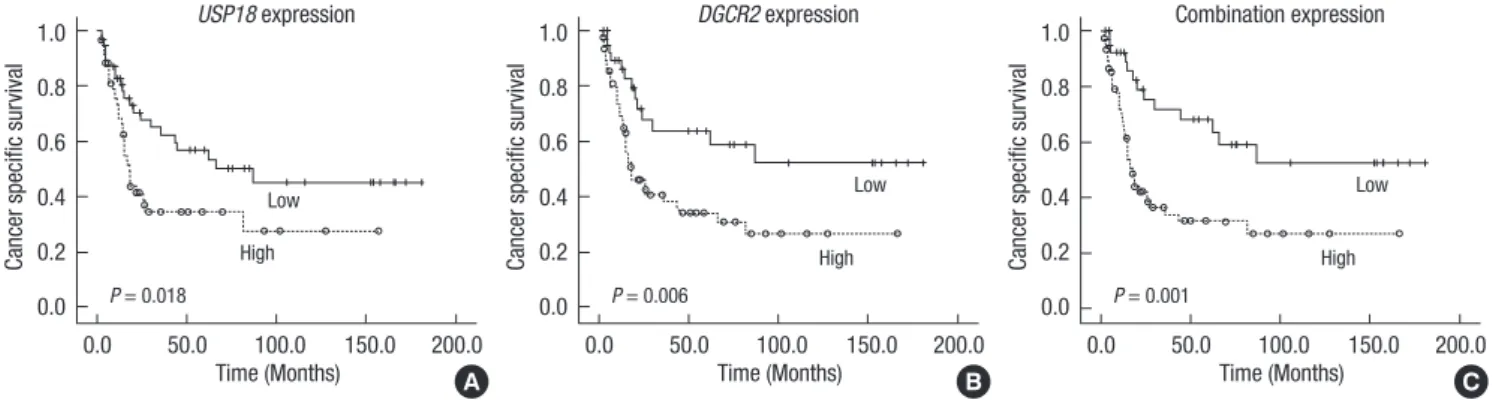
microarray analysis. Two of them, USP18 and DGCR2, were significantly correlated to cancerspecific death (P = 0.020, P = 0.007, respectively). Cancerspecific survival was significantly different between the high and low USP18 or DGCR2 mRNA expression groups, in that cancerspecific survival in the low USP18 or DGCR2 expression group was significantly longer than that in the high expression group (P = 0.018, P = 0.006, re
spectively) (Fig. 1). Also, overall survival in the low USP18 or DGCR2 expression group was significantly longer than that in the high expression group (P = 0.015, P = 0.008, respectively) (Fig. 2).
USP18 and DGCR2 mRNA expression level according to clinicopathological parameters
The mRNA expression of USP18 was significantly higher in pa
tients with lymph node involvement (P < 0.001) or grade 3 (P = 0.013). The mRNA expression of DGCR2 was significantly high
er in patients with lymph node involvement (P = 0.034) (Table 2). There were no significant differences between USP18 and DGCR2 for other clinicopathological parameters such as T stage and M stage.
The value of the combination of USP18 and DGCR2 mRNA expression level as a prognostic marker for cancer- specific survival
These two genes were then used to calculate a risk score for cancerspecific death in MIBC patients. The risk score identi
fied two groups of patients. A goodprognostic signature group represented relatively low expression levels of the two genes, while a poorprognostic signature group had a significantly high
er expression. Using a ROC curve, a cutoff value (46.6093) was determined for cancerspecific death with the highest combin
Table 1. Baseline characteristics of muscle invasive bladder cancer patients
Parameters Incidence (%) or value
Mean ± SD age (yr) 67.3 (38-87)
Median follow-up period (months, range) 16.9 (2.1-180.9) Gender
Male
Female 98 (83.1)
20 (16.9) Grade
G2
G3 37 (31.4)
81 (68.6) T stage
T2 T3 T4
58 (49.2) 33 (28.0) 27 (22.9) N stage
N0 N1 N2 N3
88 (74.6) 17 (14.4) 11 (9.3)
2 (1.7) M stage
M0 M1
100 (84.7) 18 (15.3)
Fig. 1. Kaplan-Meier curve for prediction of cancer specific survival by USP18 expression (A), DGCR2 expression (B), and combined expression (C).
Cancer specific survival
Time (Months)
0.0 50.0 100.0 150.0 200.0 1.0
0.8 0.6 0.4 0.2 0.0
USP18 expression
Low
High P = 0.018
Cancer specific survival
Time (Months)
0.0 50.0 100.0 150.0 200.0 1.0
0.8 0.6 0.4 0.2 0.0
DGCR2 expression
Low
High P = 0.006
Cancer specific survival
Time (Months)
0.0 50.0 100.0 150.0 200.0 1.0
0.8 0.6 0.4 0.2 0.0
Combination expression
Low
High P = 0.001
A B C
Fig. 2. Kaplan-Meier estimate curves predict overall survival according to the expression of USP18 (A), DGCR2 (B), and combined expression (C).
Overall survival
Time (Months)
0.0 50.0 100.0 150.0 200.0 1.0
0.8 0.6 0.4 0.2 0.0
USP18 expression
Low P = 0.015 High
Overall survival
Time (Months)
0.0 50.0 100.0 150.0 200.0 1.0
0.8 0.6 0.4 0.2 0.0
DGCR2 expression
Low
High P = 0.008
Overall survival
Time (Months)
0.0 50.0 100.0 150.0 200.0 1.0
0.8 0.6 0.4 0.2 0.0
Combination expression
Low P = 0.009 High
A B C
Table 2. USP18 and DGCR2 mRNA expression stratified by clinicopatholgical param- eters
Parameters mRNA expression of USP18
( × 106 copies/µL) P mRNA expression of DGCR2 ( × 106 copies/µL) P T stage
2 3 4
1.45 (1.06-1.99) 1.62 (1.07-2.45) 1.73 (1.21-2.49)
0.772*
1.26 (0.95-1.68) 1.19 (0.80-1.78) 1.63 (1.27-2.10)
0.449*
N stage 0
1-3 1.23 (0.98-1.54) 3.13 (2.16-4.53)
< 0.001†
1.18 (0.94-1.46) 1.85 (1.32-2.58)
0.034†
M stage 0
1 1.43 (1.15-1.78) 2.49 (1.34-4.61)
0.055†
1.22 (1.00-1.50) 2.01 (1.28-3.17)
0.055†
Grade 2
3 1.07 (0.73-1.55) 1.85 (1.45-2.35)
0.013†
1.21 (0.83-1.78) 1.37 (1.11-1.69)
0.552†
*ANOVA; †2-samples t test.
ed sensitivity (77.6%) and specificity (50.0%). In univariate Cox regression analysis of clinicopathological variables, age, T4, pos
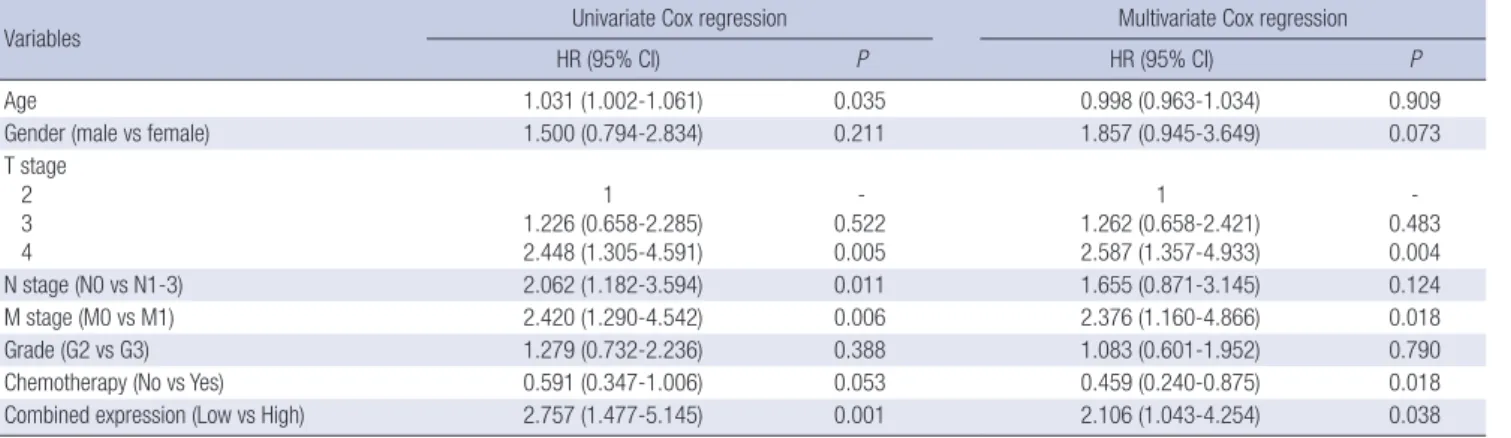
itive lymph node, metastasis, and a combination of USP18 and DGCR2 mRNA expression levels were significant risk factors for cancerspecific death (P = 0.035, P = 0.005, P = 0.011, P = 0.006, and P = 0.001, respectively). In multivariate Cox regression anal
ysis, T4, metastasis, chemotherapy, and a combination of USP18 and DGCR2 mRNA expression levels were significant prognos
tic factors for cancerspecific death (HR, 2.587; CI, 1.3574.933, P = 0.004; HR, 2.376; CI, 1.1604.866, P = 0.018; HR,0.459; CI, 0.2400.875, P = 0.018, and HR, 2.106; CI, 1.0434.254, P = 0.038, respectively) (Table 3). Overall survival and cancerspecific sur
vival in the low expression group was significantly longer than that in the high expression group (P = 0.001, both) (Fig. 1C and Fig. 2C).
DISCUSSION
In the present study, the combined expressions of USP18 and DGCR2 were used to predict cancerspecific survival in patients with MIBC, which was reconfirmed by validation in different cohorts. In MIBC, pathological tumor characteristics such as lymph node involvement, tumor stage, grade, and histological subtype have been established as significant predictors of out
comes (16). Also, clinical factors such as time from diagnosis to surgery, patient age, and gender are considered to be important predictors of outcome (16). To improve the accuracy of predict
ing outcomes, several nomograms that include pathological tu
mor characteristics and clinical factors have been used (17, 18).
However, the heterogeneity of the biological behaviors of tu
mors may limit the accuracy of predicting the outcome of no
mograms based on clinical and pathological characteristics.
Accordingly, there is growing interest in a molecular biomarker
Table 3. Univariate and multivariate Cox regression analysis cancer specific survival in muscle invasive bladder cancer
Variables Univariate Cox regression Multivariate Cox regression
HR (95% CI) P HR (95% CI) P
Age 1.031 (1.002-1.061) 0.035 0.998 (0.963-1.034) 0.909
Gender (male vs female) 1.500 (0.794-2.834) 0.211 1.857 (0.945-3.649) 0.073
T stage 2 3 4
1 1.226 (0.658-2.285) 2.448 (1.305-4.591)
- 0.522 0.005
1 1.262 (0.658-2.421) 2.587 (1.357-4.933)
- 0.483 0.004
N stage (N0 vs N1-3) 2.062 (1.182-3.594) 0.011 1.655 (0.871-3.145) 0.124
M stage (M0 vs M1) 2.420 (1.290-4.542) 0.006 2.376 (1.160-4.866) 0.018
Grade (G2 vs G3) 1.279 (0.732-2.236) 0.388 1.083 (0.601-1.952) 0.790
Chemotherapy (No vs Yes) 0.591 (0.347-1.006) 0.053 0.459 (0.240-0.875) 0.018
Combined expression (Low vs High) 2.757 (1.477-5.145) 0.001 2.106 (1.043-4.254) 0.038
HR, hazard ratio; CI, confidence interval.
for predicting tumor aggressiveness and patient outcomes. p53 expression has been associated with tumor stage, grade, lymph node metastasis, and cancerspecific death (19). Also, p27 and Ki67 could be used as predictive markers for recurrence and survival in MIBC patients who have undergone radical cystec
tomy (19). Bcl2, caspase3 and survivin were found to be asso
ciated with grade, stage, metastasis, and survival (20). Vascular endothelial growth factor (VEGF), basic fibroblast growth factor (FGF) and thrombospondin1 have been used as independent predictors of clinical outcomes in bladder cancer patients (21, 22). However, a single molecular biomarker cannot reflect tu
mor biology due to the complexity of tumorigenesis. Therefore, the trend for predicting prognostic value has changed to the si
multaneous assessment of multiple biomarkers in cancer pa
tients (23). Similarly, this study was carried out to predict out
comes after the assessment of 2 biomarkers (USP18 and DGCR2) in MIBC.
Ubiquitin specific peptidase 18 (USP18) is a cysteine protease that is known to remove interferon stimulated gene 15 (ISG15), a ubiquitinlike protein family member, from conjugated pro
teins (24, 25). Duex et al. (26) reported that USP18 regulates epidermal growth factor Receptor (EGFR) expression and can
cer cell survival. Inhibition of USP18 reduces the levels of EGFR and other oncogenic proteins and inhibits the tumorigenic ac
tivity of cancer cells. Interestingly, in bladder cancer, elevated EGFR expression has been strongly associated with a decrease in the rate of relapsefree survival (27). Certainly, low USP18 re
duced the levels of EGFR and inhibited the tumorigenic activity of cancer cells, and then, increased the survival of cancer pati
ents. In the present study, we also demonstrated that compared with a high expression group, a low USP18 expression group was indicative of significantly longer rates of overall and cancer
specific survival. DGCR2 (DiGeorge syndrome critical region gene 2) is a putative adhesion receptor that is expressed in the embryo during early development and is believed to play a role in the development of the nervous system (28). Generally, mu
tations in this gene are associated with DiGeorge syndrome and
velocardiofacial syndrome. The manifestations of this syndrome are immune deficiencies, cardiac anomalies, renal anomalies, eye anomalies, hypoparathyroidism, skeletal defects, and de
velopmental delay (29). Recently, additional reports have asso
ciated this gene with schizophrenia and shown it to be a novel marker for pancreatic beta cellspecific proteins (30). Thus far, there has been no report about the relationship between DGCR2 and cancer biology. In the present study, we showed that DGCR2 expression is associated with survival in MIBC. DGCR2 is likely to be associated with neuroendocrine differentiation of bladder tumors, which would mean it could be associated with poor prognosis in cancer patients. Interestingly, the present study is the first to examine the relationship between DGCR2 and sur
vival in cancer patients.
Taken together, USP 18 and DGCR2 are associated with sur
vival in cancer patients. Our results show that these two genes could be important prognostic markers in MIBC. Further stud
ies, including a functional study, are necessary to consolidate these results.
In conclusion, decreased expressions of USP18 and DGCR2 were significantly associated with a longer rate of cancerspe
cific survival, and also the combination of these two genes was correlated with longer survival rates in MIBC. Thus, the combi
nation of USP18 and DGCR2 expression is a reliable predictor for cancerspecific survival in MIBC.
DISCLOSURE
The authors have no conflicts of interest to disclose.
ORCID
YeHwan Kim http://orcid.org/0000-0002-8676-7119 Won Tae Kim http://orcid.org/0000-0002-7482-4550 Pildu Jeong http://orcid.org/0000-0002-5602-5376 YunSok Ha http://orcid.org/0000-0003-3732-9814 Ho Won Kang http://orcid.org/0000-0002-8164-4427
Seok Joong Yun http://orcid.org/0000-0001-7737-4746 SungKwon Moon http://orcid.org/0000-0002-4514-3457 Yung Hyun Choi http://orcid.org/0000-0002-1454-3124 Isaac Yi Kim http://orcid.org/0000-0002-1967-5281 WunJae Kim http://orcid.org/0000-0002-8060-8926
REFERENCES
1. Jemal A, Siegel R, Ward E, Hao Y, Xu J, Thun MJ. Cancer statistics, 2009.
CA Cancer J Clin 2009; 59: 225-49.
2. Ghoneim MA, AbdelLatif M, elMekresh M, AbolEnein H, Mosbah A, Ashamallah A, elBaz MA. Radical cystectomy for carcinoma of the blad- der: 2,720 consecutive cases 5 years later. J Urol 2008; 180: 121-7.
3. Shariat SF, Karakiewicz PI, Palapattu GS, Lotan Y, Rogers CG, Amiel GE, Vazina A, Gupta A, Bastian PJ, Sagalowsky AI, et al. Outcomes of radical cystectomy for transitional cell carcinoma of the bladder: a contempo- rary series from the Bladder Cancer Research Consortium. J Urol 2006;
176: 2414-22.
4. Shariat SF, Palapattu GS, Karakiewicz PI, Rogers CG, Vazina A, Bastian PJ, Schoenberg MP, Lerner SP, Sagalowsky AI, Lotan Y. Discrepancy be- tween clinical and pathologic stage: impact on prognosis after radical cystectomy. Eur Urol 2007; 51: 137-49.
5. Türkölmez K, Tokgöz H, Reşorlu B, Köse K, Bedük Y. Muscle-invasive bladder cancer: predictive factors and prognostic difference between pri- mary and progressive tumors. Urology 2007; 70: 477-81.
6. Shim UJ, Lee IS, Kang HW, Kim J, Kim WT, Kim IY, Ryu KH, Choi YH, Moon SK, Kim YJ, et al. Decreased DBC1 expression is associated with poor prognosis in patients with non-muscle-invasive bladder cancer. Ko- rean J Urol 2013; 54: 631-7.
7. Quackenbush J. Microarray analysis and tumor classification. N Engl J Med 2006; 354: 2463-72.
8. Győrffy B, Benke Z, Lánczky A, Balázs B, Szállási Z, Timár J, Schäfer R.
RecurrenceOnline: an online analysis tool to determine breast cancer re- currence and hormone receptor status using microarray data. Breast Cancer Res Treat 2012; 132: 1025-34.
9. Riester M, Taylor JM, Feifer A, Koppie T, Rosenberg JE, Downey RJ, Bo
chner BH, Michor F. Combination of a novel gene expression signature with a clinical nomogram improves the prediction of survival in high- risk bladder cancer. Clin Cancer Res 2012; 18: 1323-33.
10. Kim WJ, Kim SK, Jeong P, Yun SJ, Cho IC, Kim IY, Moon SK, Um HD, Choi YH. A four-gene signature predicts disease progression in muscle invasive bladder cancer. Mol Med 2011; 17: 478-85.
11. Babjuk M, Oosterlinck W, Sylvester R, Kaasinen E, Böhle A, PalouRe
dorta J; European Association of Urology (EAU). EAU guidelines on non- muscle-invasive urothelial carcinoma of the bladder. Eur Urol 2008; 54:
303-14.
12. Greene FL. The American Joint Committee on Cancer: updating the strat- egies in cancer staging. Bull Am Coll Surg 2002; 87: 13-5.
13. Stenzl A, Cowan NC, De Santis M, Jakse G, Kuczyk MA, Merseburger AS, Ribal MJ, Sherif A, Witjes JA. The updated EAU guidelines on mus- cle-invasive and metastatic bladder cancer. Eur Urol 2009; 55: 815-25.
14. Lossos IS, Czerwinski DK, Alizadeh AA, Wechser MA, Tibshirani R, Bot
stein D, Levy R. Prediction of survival in diffuse large-B-cell lymphoma based on the expression of six genes. N Engl J Med 2004; 350: 1828-37.
15. Paik S, Shak S, Tang G, Kim C, Baker J, Cronin M, Baehner FL, Walker MG, Watson D, Park T, et al. A multigene assay to predict recurrence of tamoxifen-treated, node-negative breast cancer. N Engl J Med 2004; 351:
2817-26.
16. Youssef RF, Lotan Y. Predictors of outcome of non-muscle-invasive and muscle-invasive bladder cancer. ScientificWorldJournal 2011; 11: 369-81.
17. Bochner BH, Kattan MW, Vora KC, International Bladder Cancer No
mogram Consortium. Postoperative nomogram predicting risk of recur- rence after radical cystectomy for bladder cancer. J Clin Oncol 2006; 24:
3967-72.
18. Karakiewicz PI, Shariat SF, Palapattu GS, Gilad AE, Lotan Y, Rogers CG, Vazina A, Gupta A, Bastian PJ, Perrotte P, et al. Nomogram for predict- ing disease recurrence after radical cystectomy for transitional cell carci- noma of the bladder. J Urol 2006; 176: 1354-61.
19. Shariat SF, Bolenz C, Godoy G, Fradet Y, Ashfaq R, Karakiewicz PI, Is
barn H, Jeldres C, Rigaud J, Sagalowsky AI, et al. Predictive value of com- bined immunohistochemical markers in patients with pT1 urothelial carcinoma at radical cystectomy. J Urol 2009; 182: 78-84.
20. Karam JA, Lotan Y, Karakiewicz PI, Ashfaq R, Sagalowsky AI, Roehr
born CG, Shariat SF. Use of combined apoptosis biomarkers for predic- tion of bladder cancer recurrence and mortality after radical cystectomy.
Lancet Oncol 2007; 8: 128-36.
21. Shariat SF, Youssef RF, Gupta A, Chade DC, Karakiewicz PI, Isbarn H, Jeldres C, Sagalowsky AI, Ashfaq R, Lotan Y. Association of angiogenesis related markers with bladder cancer outcomes and other molecular mark- ers. J Urol 2010; 183: 1744-50.
22. Zu X, Tang Z, Li Y, Gao N, Ding J, Qi L. Vascular endothelial growth fac- tor-C expression in bladder transitional cell cancer and its relationship to lymph node metastasis. BJU Int 2006; 98: 1090-3.
23. Kang HW, Yoon HY, Ha YS, Kim WT, Kim YJ, Yun SJ, Lee SC, Kim WJ.
FAM70B as a novel prognostic marker for cancer progression and can- cer-specific death in muscle-invasive bladder cancer. Korean J Urol 2012;
53: 598-606.
24. Baek KH. Conjugation and deconjugation of ubiquitin regulating the destiny of proteins. Exp Mol Med 2003; 35: 1-7.
25. Malakhov MP, Malakhova OA, Kim KI, Ritchie KJ, Zhang DE. UBP43 (USP18) specifically removes ISG15 from conjugated proteins. J Biol Chem 2002; 277: 9976-81.
26. Duex JE, Comeau L, Sorkin A, Purow B, Kefas B. Usp18 regulates epi- dermal growth factor (EGF) receptor expression and cancer cell survival via microRNA-7. J Biol Chem 2011; 286: 25377-86.
27. Nicholson RI, Gee JM, Harper ME. EGFR and cancer prognosis. Eur J Cancer 2001; 37: S9-15.
28. Taylor C, Wadey R, O’Donnell H, Roberts C, Mattei MG, Kimber WL, WynshawBoris A, Scambler PJ. Cloning and mapping of murine Dgcr2 and its homology to the Sez-12 seizure-related protein. Mamm Genome 1997; 8: 371-5.
29. McDonaldMcGinn DM, Sullivan KE. Chromosome 22q11.2 deletion syndrome (DiGeorge syndrome/velocardiofacial syndrome). Medicine (Baltimore) 2011; 90: 1-18.
30. Shifman S, Levit A, Chen ML, Chen CH, Bronstein M, Weizman A, Ya
kir B, Navon R, Darvasi A. A complete genetic association scan of the 22q11 deletion region and functional evidence reveal an association be- tween DGCR2 and schizophrenia. Hum Genet 2006; 120: 160-70.