© 2017 The Korean Academy of Medical Sciences.
This is an Open Access article distributed under the terms of the Creative Commons Attribution Non-Commercial License (http://creativecommons.org/licenses/by-nc/4.0) which permits unrestricted non-commercial use, distribution, and reproduction in any medium, provided the original work is properly cited.
pISSN 1011-8934 eISSN 1598-6357
Comparison of Early and Late Tuberculosis Deaths in Korea
The cause of death in patients with tuberculosis (TB) may differ according to the phase of anti-tuberculosis treatment. However, there are limited data regarding this issue in Korea.
We compared the cause of death of TB patients who died during the early intensive and late continuation phase of treatment. Twenty (56%) of the 36 early deaths were due to TB- related causes, whereas 34 (89%) of the 38 late deaths were due to TB-unrelated causes.
This finding suggests that TB-related early deaths mainly attributable to delayed diagnosis should be improved to further reduce the overall TB deaths.
Keywords: Tuberculosis; Early Deaths; Late Deaths; Drug Susceptibility Test Jaehee Lee, Hyun Woo Nam, Sun Ha Choi,
Seung Soo Yoo, Shin Yup Lee, Seung Ick Cha, Jae Yong Park, and Chang Ho Kim
Department of Internal Medicine, Kyungpook National University, School of Medicine, Daegu, Korea
Received: 20 September 2016 Accepted: 20 January 2017 Address for Correspondence:
Chang Ho Kim, MD
Department of Internal Medicine, Kyungpook National University School of Medicine, 680 Gukchaebosang-ro, Jung-gu, Daegu 41944, Republic of Korea
E-mail: [email protected]
Funding: This work was supported by a grant of National Research Foundation of Korea, funded by the Korea government (2015R1C1A2A01052502).
https://doi.org/10.3346/jkms.2017.32.4.700 • J Korean Med Sci 2017; 32: 700-703
Tuberculosis (TB) remains a significant cause of mortality world- wide. TB deaths are one of the crucial indicators in TB program monitoring (1), especially in areas with intermediate or high TB prevalence. In Korea, TB is a major health problem, with a mor- tality rate of 3.8/100,000 persons reported in 2014 (1). Data on TB deaths provide us with a better understanding of the cause of death and help guide interventions aimed at reducing mor- tality. The majority of identified studies have addressed TB deaths occurring at any time during anti-tuberculosis treatment (ATT) (2). Few studies have focused on early deaths, defined as death occurring during the initial 2-month intensive phase of ATT.
The cause of death in TB patients may differ according to the phase of ATT. However, there are limited data regarding this is- sue in Korea. This study compared the clinical characteristics, results of drug susceptibility testing (DST), and cause of death between patients with TB who died during the intensive and continuation phases of ATT.
Patients who were diagnosed with Mycobacterium tuberculo- sis culture-positive TB at Kyungpook National University Hos- pital in Korea between January 2013 and December 2015 and who died during ATT were included in the study. Those who had human immunodeficiency virus infection were excluded.
The World Health Organization’s definition of TB death (3) was used in this study, defined as patients with TB who died from any cause during treatment. These patients were divided into 2 groups according to whether death occurred within the initial 2-month intensive phase or during the continuation phase of ATT, the early and late death groups, respectively. The clinical
characteristics, DST results, and cause of death were retrospec- tively reviewed and compared between the early and late death groups. Comorbid conditions were defined as previously de- scribed (4). DST was routinely performed even in cases with culture-positive results identified after early death. The specific causes of death were identified, and some of them were defined as follows: TB-related respiratory failure as a condition requir- ing mechanical ventilator support due to TB progression; TB- related septic shock as hypotension persisting despite adequate fluid resuscitation, which was induced by TB without other eti- ology of infection; TB-unrelated septic shock as that due to oth- er new infection in the absence of TB progression.
A standard regimen consisting of isoniazid, rifampicin, eth- ambutol, and pyrazinamide was administered during the in- tensive phase, as recommended by the National Tuberculosis Program (5), unless drug modification was necessary due to drug adverse reactions or drug resistance detected by rapid mo- lecular diagnostic methods. The subsequent continuation regi- men was modified according to the DST results when they be- come available; ethambutol and pyrazinamide were discontin- ued in patients confirmed to have no resistance to any first-line drug. Outpatient therapy was self-administered with the support of trained nurses in a Public-Private Mix project in both groups (6).
During the study period, 760 patients were diagnosed with culture-positive TB and 74 (10%) died during ATT. Thirty-six (5%) patients died during the intensive phase of ATT; their me- dian time from ATT initiation to death was 21 (interquartile range BRIEF COMMUNICATION
Infectious Diseases, Microbiology & Parasitology
Lee J, et al. • Deaths in Tuberculosis
http://jkms.org 701
https://doi.org/10.3346/jkms.2017.32.4.700
[IQR] 7–38) days. Another 38 (5%) patients died during the con- tinuation phase of ATT, before completion of treatment; their median time from ATT initiation to death was 131 (IQR 99–226) days. The clinical characteristics, DST results, and cause of death between the 2 groups are given in Table 1. The median age in the early and late groups was 78 and 76 years, respectively, and approximately 80% of patients in both groups were > 70 years old. Men accounted for 26 (72%) and 25 (66%) cases in the early and late groups, respectively. The frequency of a body mass in- dex < 18.5 kg/m2 and history of previous TB was not significant- ly different between the 2 groups. In both groups, approximate- ly 70% of patients had a chronic illness and 80% were anemic.
There were more patients with malignancy in the late group (P = 0.005). More than 80% of cases in both groups had pulmonary TB alone. The frequency of severe pulmonary TB according to the classification of National Tuberculosis Association (7) was higher in the early death group with a marginal trend (P = 0.065).
The proportion of patients with smear positive sputum was sim- ilar in both groups. The time from presentation to hospital to initiation of ATT was significantly shorter in the early group than in the late group (P < 0.001).
DST results were available for all but one case in the late group.
In the early group, 30 (83%) patients had M. tuberculosis sensi- tive to all anti-TB drugs tested, 6 (17%) showed resistance to at least one first-line anti-TB drug; 4 (11%) had resistance to isoni- azid, and 2 (6%) had multidrug resistant M. tuberculosis, defined as resistance to at least isoniazid and rifampicin. One patient with multidrug resistance received a second-line anti-TB drugs regimen based on GeneXpert MTB/RIF test (Cepheid, Sunny- vale, CA, USA) results that identified rifampicin resistance. The other died of respiratory failure on the day of admission. The overall DST results in the late group were comparable to those of the early group.
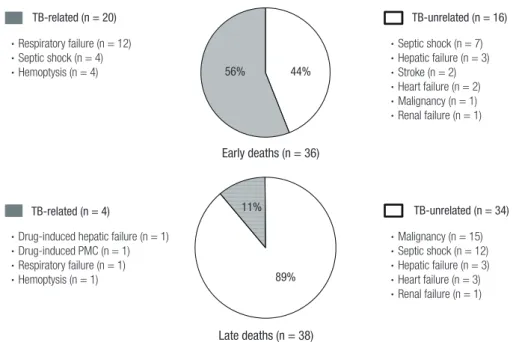
In terms of the cause of death, there were 20 (56%) TB-relat- ed and 16 (44%) TB-unrelated deaths in the early group. In con- trast, most patients in the late group died due to TB-unrelated causes (n = 34, 89%); thus, the cause of death between the 2 groups differed significantly (P < 0.001). In the early group, re- spiratory failure (n = 12) was the most common cause of TB-re- lated death, followed by TB-related septic shock (n = 4), and massive hemoptysis (n = 4) (Fig. 1). Regarding TB-unrelated deaths of the early group, TB-unrelated septic shock (n = 7) was Table 1. Clinical characteristics, causes of death, and DST results of patients with early and late death during ATT
Variables Early death (n = 36) Late death (n = 38) P value
Age, yr 78 (71–85) 76 (71–83) 0.327
Age > 70 yr, No. (%) 28 (78) 30 (79) 0.903
Male, No. (%) 26 (72) 25 (66) 0.550
Low BMI ( < 18.5 kg/m2, No. (%)) 12 (33) 9 (24) 0.357
Prior TB history, No. (%) 3 (8) 5 (13) 0.712
Comorbidities, No. (%) None
Diabetes mellitus Chronic heart disease Chronic lung disease Chronic liver disease Chronic kidney disease Neurologic disease Malignancy
12 (33) 10 (28) 5 (14) 5 (14) 5 (11) 2 (6) 3 (8) 4 (11)
10 (26) 8 (21) 6 (16) 1 (3) 1 (3) 5 (13) 1 (3) 15 (40)
0.509 0.500 0.818 0.103 0.103 0.431 0.351 0.005
Anemia (male < 13 g/dL, female < 12 g/dL, No. (%)) 28 (78) 29 (76) 0.881
Site of TB, No. (%) Pulmonary alone
Pulmonary + extrapulmonary Extrapulmonary alone
29 (81) 6 (17) 1 (3)
31 (82) 4 (11) 3 (8)
0.602
Severe degree of pul-TB on chest X-ray, No. (%) 19 (53) 12 (32) 0.065
Smear-positive sputum, No. (%) 19/34 (56) 20/32 (63) 0.585
Time from presentation to hospital to ATT, day 1 (1–3) 5 (1–14) < 0.001
Time from ATT to death, day 21 (7–38) 131 (99–226) < 0.001
DST to first-line drugs, No. (%) 0.707
All sensitive 30 (83) 32/37 (86) -
Any resistance 6 (17) 5/37 (14) 1.000
Isoniazid resistance 4 (11) 5/37 (14) 0.240
Multi-drugs resistance 2 (6) 0/37 (0) -
Cause of death < 0.001
TB-related 20 (56) 4 (11)
TB-unrelated 16 (44) 34 (89)
Data are presented as median (IQR) or number (%). Differences were analyzed by Mann-Whitney test and χ2 or Fisher’s exact tests.
BMI = body mass index, TB = tuberculosis, pul-TB = pulmonary tuberculosis, ATT = anti-tuberculosis treatment, DST = drug susceptibility test, IQR = interquartile range.
Lee J, et al. • Deaths in Tuberculosis
702 http://jkms.org https://doi.org/10.3346/jkms.2017.32.4.700 the most common cause, followed by hepatic failure (n = 3),
and stroke (n = 2). In the late group, underlying malignancy (n = 15) was the most common cause of TB-unrelated death, followed by TB-unrelated septic shock (n = 12). As the cause of TB-related deaths of the late group, there were anti-TB drug-in- duced hepatic failure (n = 1), anti-TB drug-induced pseudo- membranous colitis (n = 1), respiratory failure (n = 1), and he- moptysis (n = 1).
Fig. 2 shows the monthly distribution of the 74 TB deaths that occurred in 760 TB patients. The TB mortality was the highest within the first month after ATT. In addition, 15 (75%) of 20 pa- tients with early TB-related death died within the first month.
The present study shows that TB deaths occurred in patients with advanced age and comorbid illness in both groups. The
clinical characteristics and DST results were not significantly different between the early and late death groups. However, more than half of the early deaths were due to TB-specific causes, where- as the majority of late deaths were due to TB-unrelated causes.
Advanced age and underlying comorbid illnesses are well known risk factors for TB deaths (2); these are unavoidable fac- tors. However, despite available effective therapy, many TB-re- lated deaths occurred during the intensive phase, particularly within the first month. Our results are consistent with previous studies performed in African countries (8,9). These early deaths imply delayed diagnosis and treatment of TB. In fact, delayed treatment has been linked to higher mortality rates in patients with TB (9-13). TB diagnosis after presentation to hospital was not delayed in our patients with early TB death. This suggests that, in the early death group, elderly patients likely delayed seek- ing medical care and were thus sicker at presentation. Although the burden of TB has improved over the last decade in Korea (1), the National Tuberculosis Program should address this prob- lem to further reduce the TB mortality rate.
While rapid diagnosis and treatment of patients with infec- tious TB remain the cornerstones of TB control, targeted screen- ing and treatment of high-risk subjects with latent TB infection (LTBI) is becoming increasingly important (14). As part of an ongoing effort, DST results in index cases are crucial for success- ful treatment of high-risk close contacts with LTBI (5), especial- ly in areas with a high prevalence of drug resistance. The DST results in patients with early TB death have not been fully inves- tigated in Korea (4,15,16); studies have focused mainly on risk factors for TB mortality. In the present study, the rate of isonia- Fig. 1. Specific causes of TB-related and TB-unrelated deaths in patients with early and late deaths during anti-TB treatment.
TB = tuberculosis, PMC = pseudomembranous colitis.
TB-related (n=20)
• Respiratory failure (n=12)
• Septic shock (n=4)
• Hemoptysis (n=4)
TB-unrelated (n=16)
• Septic shock (n=7)
• Hepatic failure (n=3)
• Stroke (n=2)
• Heart failure (n=2)
• Malignancy (n=1)
• Renal failure (n=1)
Early deaths (n=36)
Late deaths (n=38)
TB-related (n=4)
• Drug-induced hepatic failure (n=1)
• Drug-induced PMC (n=1)
• Respiratory failure (n=1)
• Hemoptysis (n=1)
TB-unrelated (n=34)
• Malignancy (n=15)
• Septic shock (n=12)
• Hepatic failure (n=3)
• Heart failure (n=3)
• Renal failure (n=1)
Figure 1. Specific causes of tuberculosis (TB)-related and TB-unrelated deaths in patients with early and late deaths during anti-TB treatment. PMC = pseudomembranous colitis.
TB-related (n = 20) TB-unrelated (n = 16)
56% 44%
Early deaths (n = 36)
• Respiratory failure (n = 12)
• Septic shock (n = 4)
• Hemoptysis (n = 4)
• Septic shock (n = 7)
• Hepatic failure (n = 3)
• Stroke (n = 2)
• Heart failure (n = 2)
• Malignancy (n = 1)
• Renal failure (n = 1) TB-related (n=20)
• Respiratory failure (n=12)
• Septic shock (n=4)
• Hemoptysis (n=4)
TB-unrelated (n=16)
• Septic shock (n=7)
• Hepatic failure (n=3)
• Stroke (n=2)
• Heart failure (n=2)
• Malignancy (n=1)
• Renal failure (n=1)
Early deaths (n=36)
Late deaths (n=38)
TB-related (n=4)
• Drug-induced hepatic failure (n=1)
• Drug-induced PMC (n=1)
• Respiratory failure (n=1)
• Hemoptysis (n=1)
TB-unrelated (n=34)
• Malignancy (n=15)
• Septic shock (n=12)
• Hepatic failure (n=3)
• Heart failure (n=3)
• Renal failure (n=1)
Figure 1. Specific causes of tuberculosis (TB)-related and TB-unrelated deaths in patients with early and late deaths during anti-TB treatment. PMC = pseudomembranous colitis.
TB-related (n = 4) 11% TB-unrelated (n = 34)
89%
Late deaths (n = 38)
• Drug-induced hepatic failure (n = 1)
• Drug-induced PMC (n = 1)
• Respiratory failure (n = 1)
• Hemoptysis (n = 1)
• Malignancy (n = 15)
• Septic shock (n = 12)
• Hepatic failure (n = 3)
• Heart failure (n = 3)
• Renal failure (n = 1)
Fig. 2. The monthly distribution of 74 deaths that occurred in 760 patients with tu- berculosis.
Frequency (%)
Duration of anti-tuberculosis treatment (month)
0-1 1-2 2-3 3-4 4-5 5 <
35 30 25 20 15 10 5 0
Lee J, et al. • Deaths in Tuberculosis
http://jkms.org 703
https://doi.org/10.3346/jkms.2017.32.4.700
zid resistance was high; all 6 patients with early death and any drug resistance had resistance to isoniazid, which is the most commonly used drug for the treatment of subjects with LTBI.
Furthermore, the GeneXpert test does not detect isoniazid re- sistance. Currently, while the national government supports all the costs of TB management, DST should be considered, even in TB cases with positive culture identified after early death.
This study was limited by the followings: its retrospective de- sign, small sample size, and that it was performed in a single center. Thus, prospective studies with larger sample sizes are warranted.
In conclusion, our study provides the difference of cause of death between early and late TB deaths. These results suggest that TB-related early deaths mainly attributable to delayed di- agnosis should be improved to further reduce the overall TB mor- tality rate.
Ethics statement
Permission was obtained from the Institutional Review Board (IRB) of Kyungpook National University Hospital to review and publish patient records retrospectively (IRB No. 2016-08-029).
The need for informed consent was waived due to the retrospec- tive nature of the study.
DISCLOSURE
The authors have no potential conflicts of interest to disclose.
AUTHOR CONTRIBUTION
Conceptualization: Lee J, Kim CH. Data curation: Lee J, Nam HW, Choi SH, Yoo SS, Lee SY, Cha SI, Kim CH, Park JY. Investi- gation: Lee J, Kim CH. Writing - original draft: Lee J, Kim CH. Writ- ing - review & editing: Lee J, Nam HW, Choi SH, Yoo SS, Lee SY, Cha SI, Park JY, Kim CH.
ORCID
Jaehee Lee http://orcid.org/0000-0001-8111-7320 Hyun Woo Nam http://orcid.org/0000-0003-0648-2023 Sun Ha Choi http://orcid.org/0000-0002-9665-7466 Seung Soo Yoo http://orcid.org/0000-0002-7309-9254 Shin Yup Lee http://orcid.org/0000-0002-2121-7335 Seung Ick Cha http://orcid.org/0000-0002-7246-0909 Jae Yong Park http://orcid.org/0000-0001-7993-4495 Chang Ho Kim http://orcid.org/0000-0002-1550-5752 REFERENCES
1. World Health Organization. Global tuberculosis report 2015 [Internet].
Available at http://www.who.int/tb/data [accessed on 9 February 2017].
2. Waitt CJ, Squire SB. A systematic review of risk factors for death in adults during and after tuberculosis treatment. Int J Tuberc Lung Dis 2011; 15:
871-85.
3. World Health Organization. WHO Global Tuberculosis Programme: Frame- work for Effective Tuberculosis Control. Geneva, World Health Organiza- tion, 1994.
4. Kwon YS, Kim YH, Song JU, Jeon K, Song J, Ryu YJ, Choi JC, Kim HC, Koh WJ. Risk factors for death during pulmonary tuberculosis treatment in Korea: a multicenter retrospective cohort study. J Korean Med Sci 2014;
29: 1226-31.
5. Joint Committee for the Development of Koran Guidelines for Tubercu- losis; Korean Centers for Disease Control and Prevention. Korean guide- lines for tuberculosis. 2nd ed [Internet]. Available at http://www.lungkorea.
org/thesis/file/korean_guidelines_for_tuberculosis_2014.pdf [accessed on 9 February 2017].
6. Kim HJ, Bai GH, Kang MK, Kim SJ, Lee JK, Cho SI, Lew WJ. A public-pri- vate collaboration model for treatment intervention to improve outcomes in patients with tuberculosis in the private sector. Tuberc Respir Dis 2009;
66: 349-57.
7. National Tuberculosis Association (US). Diagnostic Standards and Clas- sification of Tuberculosis. 11th ed. New York, NY, National Tuberculosis Association, 1961.
8. Garin B, Glaziou P, Kassa-Kelembho E, Yassibanda S, Mbelesso P, Morvan J. High mortality rates among patients with tuberculosis in Bangui, Cen- tral African Republic. Lancet 1997; 350: 1298.
9. Harries AD, Hargreaves NJ, Gausi F, Kwanjana JH, Salaniponi FM. High early death rate in tuberculosis patients in Malawi. Int J Tuberc Lung Dis 2001; 5: 1000-5.
10. Hansel NN, Merriman B, Haponik EF, Diette GB. Hospitalizations for tu- berculosis in the United States in 2000: predictors of in-hospital mortali- ty. Chest 2004; 126: 1079-86.
11. Asch S, Leake B, Anderson R, Gelberg L. Why do symptomatic patients delay obtaining care for tuberculosis? Am J Respir Crit Care Med 1998;
157: 1244-8.
12. Greenaway C, Menzies D, Fanning A, Grewal R, Yuan L, FitzGerald JM;
Canadian Collaborative Group in Nosocomial Transmission of Tubercu- losis. Delay in diagnosis among hospitalized patients with active tuber- culosis--predictors and outcomes. Am J Respir Crit Care Med 2002; 165:
927-33.
13. Pablos-Méndez A, Sterling TR, Frieden TR. The relationship between de- layed or incomplete treatment and all-cause mortality in patients with tuberculosis. JAMA 1996; 276: 1223-8.
14. Targeted tuberculin testing and treatment of latent tuberculosis infection.
This official statement of the American Thoracic Society was adopted by the ATS Board of Directors, July 1999. This is a Joint Statement of the Amer- ican Thoracic Society (ATS) and the Centers for Disease Control and Pre- vention (CDC). This statement was endorsed by the Council of the Infec- tious Diseases Society of America. (IDSA), September 1999, and the sec- tions of this statement. Am J Respir Crit Care Med 2000; 161: S221-47.
15. Kim CW, Kim SH, Lee SN, Lee SJ, Lee MK, Lee JH, Shinet KC, Yong SJ, Lee WY. Risk factors related with mortality in patient with pulmonary tuber- culosis. Tuberc Respir Dis (Seoul) 2012; 73: 38-47.
16. Kim HJ, Lee CH, Shin S, Lee JH, Kim YW, Chung HS, Han SK, Shim YS, Kim DK. The impact of nutritional deficit on mortality of in-patients with pul- monary tuberculosis. Int J Tuberc Lung Dis 2010; 14: 79-85.