pISSN 2288-0585⋅eISSN 2288-6850
Taxonomic Identification of Bacillus Species Using Matrix-Assisted Laser Desorption/Ionization-Time
of Flight Mass Spectrometry
Won Seon Yu, Kyeong Min Lee, Kyu Jam Hwang
Pathogen Resource TF, Center for Infectious Diseases, Korea National Institute of Health, Korea Centers for Disease Control and Prevention, Cheongju, Korea
Background: In this study, we compared various methods of taxonomic identification of Bacillus strains:
biochemical methods, 16S rRNA gene sequencing, and matrix-assisted laser desorption/ionization-time of flight mass spectrometry (MALDI-TOF MS). We also developed a pathogen- isolate resource database, thus increasing the identification rate when using MALDI-TOF MS.
Methods: Thirty Bacillus strains were obtained from the NCCP (National Culture Collection for Pathogens) and were identified using the VITEK 2 system (bio- Mérieux, France), API kit (bioMérieux, France), 16S rRNA gene sequencing, and MALDI-TOF MS. The pathogenicity of Bacillus cereus was confirmed thro- ugh the identification of virulent genes using a multi- plex PCR, and both protein extraction for protein profiling in MALDI-TOF MS and repetitive-sequence fingerprinting were performed.
Results: The identification rates at the species level
were 40%, 80%, and 76.3% for the VITEK 2 system (bioMérieux), 16S rRNA gene sequencing, and MALDI- TOF MS, respectively. When the major spectrum- profiling dendrogram was compared with the phylo- genetic tree, which was constructed based on the 16S rRNA gene sequences and rep-PCR finger- printing, the classifications were confirmed to be effective.
Conclusion: Identification of Bacillus strains using MALDI-TOF MS was more effective than that using the VITEK 2 system (bioMérieux), but was similar to that using 16S rRNA gene sequencing. Continual ad- dition to a proteome-based database can result in in- creased identification rates for MALDI-TOF MS. (Ann Clin Microbiol 2016;19:110-120)
Key Words: Bacillus speciess, Identification, MALDI- TOF MS
110
Received 8 November, 2016, Revised 14 December, 2016, Accepted 15 December, 2016
Correspondence: Kyu Jam Hwang, Pathogen Resource TF, Center for Infectious Diseases, Korea National Institute of Health, Korea Centers for Disease Control and Prevention, 187 Osongsaengmyeong 2-ro, Osong-eup, Heungdeok-gu, Cheongju 28159, Korea. (Tel) 82-43-719-6870, (Fax) 82-43-719-6680, (E-mail) [email protected]
ⓒ The Korean Society of Clinical Microbiology.
This is an Open Access article distributed under the terms of the Creative Commons Attribution Non-Commercial License (http://creativecommons.org/licenses/by-nc/4.0) which permits unrestricted non-commercial use, distribution, and reproduction in any medium, provided the original work is properly cited.
INTRODUCTION
Bacillus 속은 자연계에서 주요 부패 원인균으로서 물, 토양, 공기 중에도 부유하고 자연계에 널리 존재 한다[1]. 이 균속은 포자를 형성하기 때문에 음식을 조리하는 과정 중에 열처리에 의해 사멸되지 않으므로 우유, 인스턴트 식품 그리고 가정에서 조리하는 음식에서도 생존한다[2]. Bacillus 속은 카탈레이즈 양성을 나타내는 막대균으로 포자를 형성하는 절대산소성 혹 은 조건무산소성균으로 현재 약 318개의 종으로 분류되고 있 다. 이 속에는 유전학적특성을 통하여 크게 B. cereus group과 B. subtilis group으로 분류할 수 있으며 기타 group으로는 B.
pumilus, B. licheniformis 등이 있다[3]. B. cereus group에 속하 는 종은 분자유전학적으로 아주 밀접한 7종으로 구성되어있는 데 B. cereus sensu stricto, B. thuringiensis, B. anthracis, B. my- coides, B. weihenstephanensis가 포함된다[4]. 대표적인 식중독 병원체인 B. cereus sensu stricto는 인체에 감염된 후 크게 두 가지 증상을 유발하게 되는데, 설사 증상을 야기하는 설사형과 구토를 유발하게 하는 구토형이 있다[5]. B. thuringiensis는 해 충의 생물학적 방제용으로 널리 사용되는 독소를 만들기 때문 에 주로 곤충병원체이다[6]. B. subtilis와 B. licheniformis도 흔 하지는 않지만 인체감염 사례가 보고되고 있는 병원체이다 [7-9].
세균병원체의 전통적인 동정방법 실험에 소요되는 시간과 실험자의 숙련도에 따라 결과의 판정에 오류가 포함될 수 있고 업무의 효율적인 면에서도 미생물 자동화 동정기기를 활용한 방식이 현 추세이다[10]. 미생물의 기질 분해능을 근거로 하여 동정하는 VITEK 2 system (bioMérieux, Marcy l’Eltoile, France) 방법은 상대적으로 16S rRNA 유전자 염기서열 분석 보다 신 속하고 간편하게 분석할 수 있다는 장점을 가지고 있으나 기존 에 동정된 미생물의 결과를 기초로 구축된 데이터베이스를 이 용하기 때문에 분석 가능한 미생물의 범위에 한계가 있어 300 여 종에 불과하다. 또한 일부 균종은 2종 이상을 포함하는 병원 체 그룹으로 동정이 되기도 한다. 이러한 자동화동정시스템의 동정한계를 보완하기 위한 병원체 동정시스템이 필요하다. 16S rRNA 염기서열분석은 세균의 동정에서 가장 널리 사용되고 있지만 일부 균종에서는 이 부위의 균종 간 유전자 일치도가 높아 변별력이 떨어지기 때문에 16S rRNA 유전자만으로는 병 원체의 정확한 분류 및 동정에 한계가 있다. 16S rRNA 염기서 열분석의 경우 Clinical and Laboratory Standards Institute (CLSI) guideline MM18-A에서 동정시 균종별로 표적유전자를 제시하고 있다[11].
Matrix-assisted laser desorption/ionization-time of flight mass spectrometry (MALDI-TOF MS)는 검체를 이온화하여 진공관 에서 검출기에 도달하는 시간을 근거로 구성 물질의 질량을 측 정하는 방법이다. 최근 개발된 MALDI Biotyper 3.0 (Bruker Daltonics, Bremen, Germany)는 MALDI-TOF MS 기법을 이용 하여 얻은 세균의 단백질 정보를 이미 구축된 각 균종의 정보 와 비교 분석하여 균종을 동정한다. MALDI-TOF MS는 생체 에서의 단백 발현에 대한 대표 프로파일을 만들 수 있기 때문 에 바이오마커 개발 연구에 다방면으로 사용되고 있다. MALDI- TOF MS는 생체에서의 단백 발현에 대한 대표 프로파일을 만 들 수 있기 때문에 바이오마커 개발연구에 널리 사용되고 있 다. SARAMIS (bioMérieux, Marcy l’Eltoile, France)나 Biotyper (Bruker Daltonics, Bremen, Germany) 같은 분석 소프트웨어는 속 수준의 세균동정에서 매우 뛰어난 기능을 보이지만, 혈청형 또는 종 수준 동정에는 한계가 있다. 이러한 한계를 극복하기 위하여 최근에는 혈청형 또는 종 수준에서의 분류 방법들이 여 러 분야에서 연구되고 있다[12-14].
본 연구는 국가병원체자원은행(NCCP)에서 보유 중인 자원 중에서 분양증가가 예상되는 식중독관련 Bacillus srain을 대상 으로 MALDI-TOF MS를 이용한 동정결과를 VITEK 2 system (bioMérieux), 16S rRNA 염기서열 분석결과와 비교하고 MALDI- TOF MS 동정률을 높이기 위한 단백체 기반 국내임상분리주 데이터베이스를 제작하고자 하였다.
MATERIALS AND METHODS
1. 대상 균주
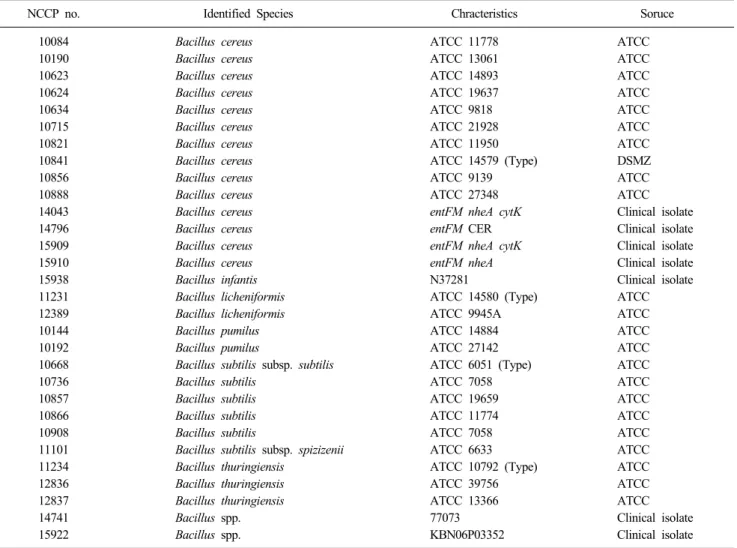
세균의 동정 및 MALDI-TOF MS 분석을 위해 이 연구에 사 용된 균주는 6종 30주 Bacillus 균주로 구성되어 있다. 각 균주 들은 질병관리본부 국립보건연구원 내에 있는 국가병원체자원 은행에(NCCP) 수집된 자원들로 국내임상분리주 7주, ATCC (American Type Culture Collection) 및 DSMZ (German Collec- tion of Microorganisms and Cell cultures) 도입균주 23주로 이 루어져있다. 각 균주간의 독소형, 혈청형, 유전형 등의 특징은 Table 1과 같다.
2. 세균 배양 및 유전자 추출
Bacillus 균주들이 보존된 동결건조 앰플 또는 동결 튜브의 재생은 국가병원체자원은행(NCCP) 업무지침서의 병원체 재생 절차에 따라 수행하였다. 앰플 재생의 경우 동결 건조 앰플에 멸균된 증류수 100 μL를 넣고 균체를 현탁 후 그 현탁액을 5% 면양혈액이 포함된 trypticase soy agar (한일코메드, 성남, 대한민국), CHROMagar B. cereus (진성메디텍, 서울, 대한민 국)에 도말하여 30oC에 24시간 배양하여 단일 집락을 획득하였 다. UltraClean Microbial DNA isolation kit (Mo Bio Laborato- ries, Carlsbad, CA, USA)를 사용하여 chromosomal DNA를 추 출하였다.
3. 형태학적 특성 및 생화학적 특성 확인
Bacillus 균주들은 5% 면양혈액이 포함된 Trypticase soy agar에 접종하고 30oC에서 24시간 2회 계대 배양한 후 그람염 색 후 막대균을 확인하였고 B. cereus의 경우 단일집락을 CHROMagar B. cereus에 계대 배양하여 특유의 흰 테두리를 가지고 있는 B. cereus 특유의 푸른색 집락을 확인하여 형태학 적 특성을 확인하였다. 동정은 VITEK 2 system (bioMérieux)과 API 50CH/B (bioMérieux, Marcy l’Eltoile, France)를 이용하여 생화학적특성을 확인하였다. 생화학적 동정법의 종 수준 동정 한계치(cut off)는 Jamal 등[10]의 보고를 참고하여 90%로 선택 하였다.
4. 16S rRNA 유전자 염기서열분석 및 계통분석
16S rRNA 유전자 염기서열 분석은 CLSI의 MM18A 지침 [11]을 참고하여 수행하였다. UltraClean Microbial DNA iso- lation kit를 사용하여 chromosomal DNA를 추출한 후 l 시발체 (primer) 27F (5'-AGA GTTTGATCMTGGCTCAG-3')와 1492R (5'-TACGGYTACCT TGTTACGACTT-3')를 사용하여 중합효 소연쇄반응(PCR)을 수행하였다(DE/Master cycler proS, Eppen- dorf, Hamburg, Germany). 중합효소연쇄반응 반응조건은 95oC 5분으로 DNA를 변성시키고, 95oC 45초, 55oC 45초, 72oC 1분
Table 1. Bacillus strains used in this study. Pathotypes and serotypes were determined by performing agglutination tests and PCR
NCCP no. Identified Species Chracteristics Soruce
10084 Bacillus cereus ATCC 11778 ATCC
10190 Bacillus cereus ATCC 13061 ATCC
10623 Bacillus cereus ATCC 14893 ATCC
10624 Bacillus cereus ATCC 19637 ATCC
10634 Bacillus cereus ATCC 9818 ATCC
10715 Bacillus cereus ATCC 21928 ATCC
10821 Bacillus cereus ATCC 11950 ATCC
10841 Bacillus cereus ATCC 14579 (Type) DSMZ
10856 Bacillus cereus ATCC 9139 ATCC
10888 Bacillus cereus ATCC 27348 ATCC
14043 Bacillus cereus entFM nheA cytK Clinical isolate
14796 Bacillus cereus entFM CER Clinical isolate
15909 Bacillus cereus entFM nheA cytK Clinical isolate
15910 Bacillus cereus entFM nheA Clinical isolate
15938 Bacillus infantis N37281 Clinical isolate
11231 Bacillus licheniformis ATCC 14580 (Type) ATCC
12389 Bacillus licheniformis ATCC 9945A ATCC
10144 Bacillus pumilus ATCC 14884 ATCC
10192 Bacillus pumilus ATCC 27142 ATCC
10668 Bacillus subtilis subsp. subtilis ATCC 6051 (Type) ATCC
10736 Bacillus subtilis ATCC 7058 ATCC
10857 Bacillus subtilis ATCC 19659 ATCC
10866 Bacillus subtilis ATCC 11774 ATCC
10908 Bacillus subtilis ATCC 7058 ATCC
11101 Bacillus subtilis subsp. spizizenii ATCC 6633 ATCC
11234 Bacillus thuringiensis ATCC 10792 (Type) ATCC
12836 Bacillus thuringiensis ATCC 39756 ATCC
12837 Bacillus thuringiensis ATCC 13366 ATCC
14741 Bacillus spp. 77073 Clinical isolate
15922 Bacillus spp. KBN06P03352 Clinical isolate
1회로 하여 30회 반응한 후, 72oC에서 10분간 반응시켰다. 합성 유전자는 Qiaquick PCR Purification Kit (QIAGEN, GmbH Hilden, Germany)를 사용하여 정제한 후 염기서열 분석업체(제 노텍, 대전, 대한민국)에 의뢰하여 염기서열을 해독하였다.
CLSI 지침에 따라 PHRED score 20 이상의 염기해독 결과만 선 별한 후 EZBIOCLOUD (https://www.ezbiocloud.net)를 사용하 여 동정결과를 확인하였다[15]. 16S rRNA 유전자 염기서열 데 이터의 계통분석은 Molecular Evolutionary Genetics Analysis (MEGA) Version 6.0 (https://www.megasoftware.net)을 이용하 여 수행하였다[16,17]. 유전자들의 거리는 Jukes-Cantor model 을 사용하였고 Neighbor-Joining 방법으로 계통수를 작성하였 다. 작성된 계통수의 신뢰도를 부여하기 위하여 1,000회 boot- strap을 반복하여 수행하였다[18,19].
5. 병원성(Virulence) 유전자의 확인
B. cereus의 설사형과 구토형 독소유전자는 PowerChek Bacillus cereus Toxin 6-plex Detection Kit (CER, hblC, bceT,
entFM, nheA, cytK) (코젠바이오텍, 서울, 대한민국)를 사용하 여 확인하였다. PCR 반응조건은 95oC 12분으로 DNA를 변성 시키고, 95oC 30초, 60oC 30초, 72oC 30초를 1회로 하여 35회 반응한 후, 72oC에서 10분간 반응시켰다.
6. MALDI-TOF MS 분석
MALDI-TOF MS 장비를 이용한 균주 동정의 전처리 과정은 이전의 Haigh 등[20]의 보고를 참고하여 수행하였다. 직접 도 말법의 경우 MALDI target plate에 배양된 세균의 집락을 얇게 도말하고 1 μL의 70% formic acid를 넣어준 후 실온에서 건조 하였다. 건조된 세균에 50% acetonitrile-2.5% trifluoroacetic acid (Sigma-Aldrich, St. Louis, MO, USA)에 완전용해 한 a-cy- ano-4-hydroxycinnamic acid (HCCA) matrix를 1 μL 넣어준 후 실온에서 건조하였다. Ethanol-formic acid 추출 방법의 경우 세 균 집락을 300 μL의 멸균증류수에 900 μL의 absolute ethanol 에 현탁한 후 건조시켰다. 건조한 pellet에 20 μL의 formic acid (Sigma-Aldrich, St. Louis, MO, USA)를 첨가하여 1분 이상
vortex하고, 다시 20 μL의 acetonitrile (Sigma-Aldrich, St, Louis, USA)을 첨가한 후 원심분리하였다. 상층액 1 μL를 MALDI target plate에 옮기고 완전히 건조시킨 후 matrix 용액 1 μL를 첨가하고 완전히 건조시킨 후 MALDI-TOF MS 장비 로 분석을 실시하였다. 각 균주에 대하여 2회 반복하여 분석하 였다. 동정은 Microflex LT mass spectrometer (Bruker Daltonics, Bremen, Germany)를 사용하여 수행하였다. 분석소프트웨어는 MALDI Biotyper version 3.1 (Bruker Daltonics)로서 5,627 strains 세균 데이터베이스가 포함되어 있다. Bacterial test standard (BTS, Bruker Daltonics, Bremen, Germany)는 제조사 의 지침에 따라서 calibration 수행용으로 사용하였다. 각 균주 별로 2회 반복하여 집락 또는 균체 단백질을 채취하여 분석하 였다. 동정을 위한 Score 값은 Schulthess 등[21]의 보고를 참고 하였다. Score 값 2.0 이상일 경우 그 종에 해당하고 Score 값이 1.7 이상 2.0 미만일 경우 속 수준 동정에 해당하는 것으로 해 석하였고, Score 값이 1.7 미만일 경우 믿을 수 없는 것으로 간 주하였다.
7. Repetitive-sequence-based PCR (REP PCR)을 이용한 DNA fingerprinting 분석
REP PCR을 이용한 DNA fingerprinting 분석의 전체과정은 Healy 등[22] 보고를 참고하여 DiversiLab system (bioMérieux, Marcy l’Eltoile, France)을 사용하여 수행하였다. REP PCR용 주형 DNA의 확보는 UltraClean Microbial DNA isolation kit를 사용하였고 각 DNA 농도는 35 ng/μL로 표준화하였다. 추출 된 DNA는 DiversiLab DNA Fingerprinting kit_Bacillus (bio- Mérieux)을 사용하여 rep-PCR을 수행하였다. 전체 35 μL 기준 으로 70 ng의 genomic DNA, 18 μL의 rep-PCR MM1, 2.5 μL 의 GeneAmp 10X PCR buffer, 2 μL의 primer mix, 0.5 μL의 AmpliTaq DNA polymerase (Invitrogen, Carlsbad, CA, USA)을 PCR 조성액으로 사용하였다. PCR 반응조건은 94oC 2분으로 DNA를 변성시키고, 94oC 30초, 55oC 30초, 72oC 1분 30초를 1회로 하여 35회 반응한 후, 72oC에서 3분간 반응시켰다. 유전 자 증폭산물은 DiversiLab Chips에 옮긴 후 B 2100 bioanalyer (bioMérieux)장비를 사용하였다. Data는 DiversiLab software version 3.6.14 (bioMérieux)를 이용하여 분석하였다(https://nccp.
diversilab.com). Dendrogram제작을 위한 알고리즘은 짝짓기 클 러스터링(Unweighted pair group method, UPGMA)방법을 사용 하였다.
RESULTS
1. VITEK 2 system, 16S rRNA 유전자, MALDI-TOF MS를 이 용한 세균의 동정
Bacillus 균주 6종 30주의 동정을 위하여 MALDI-TOF MS
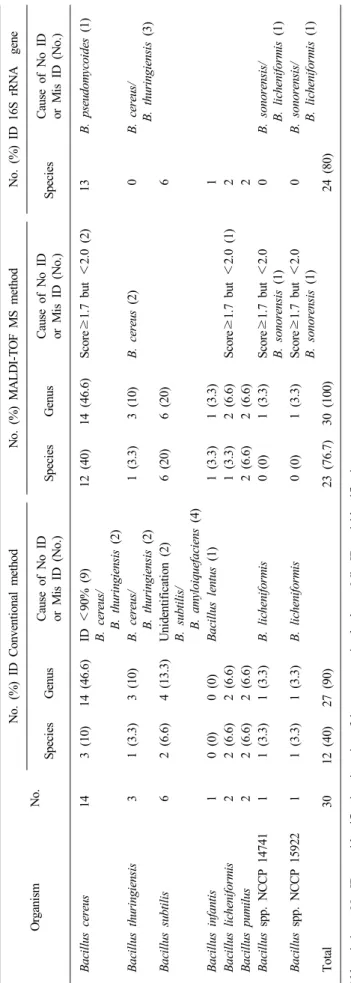
분석, 통상적인 생화학적 동정과, 16S rRNA 유전자 염기서열 분석을 수행하였고 동정률을 Table 2와 같이 비교하여 나타내 었다. VITEK 2 system (bioMérieux)과 MALDI-TOF MS의 동 정결과가 불일치한 균주는 16S rRNA 유전자 염기서열 기반 계통분석을 수행하여 동정하고 오동정 사유를 Table 2에 나타 냈다. VITEK 2 system (bioMérieux)을 이용한 동정결과 데이터 베이스에 동정정보가 없어서 미동정된 경우는 B. subtilis 2주, 다른종으로 동정된 B. infantis 1주였고 동정은 되었으나 90%
미만인 경우는 B. cereus 9주였고 다수의 종을 포함하는 그룹으 로 동정된 경우는 B. cereus/thuringiensis 4주, B. subtilis/amylo- liquefaciens 4주로 총 8주였다. 따라서 전체 30주 중 통상적인 생화학적 동정방법인 VITEK 2 system (bioMérieux)의 종 수준 동정확인은 12주(12/30, 40%), 속 수준 동정확인은 27주(27/30, 90%)였다. 반면 MALDI-TOF MS를 이용한 동정결과 미동정된 경우는 없었으며 속 수준 동정 한계치(cut off) Score 값 2.0 미 만 1.7 이상인 균주는 B. cereus 2주, B. licheniformis 1주, Bacillus spp. 2주로 총 5주였다. 다른 종으로 동정된 경우는 B.
thuringiensis 2주였다. 따라서 전체 30주중 MALDI-TOF MS의 종 수준 동정확인은 23주(23/30, 76.7%), 속 수준 동정확인은 30주(30/30, 100%)였다. 16S rRNA 유전자 염기서열 분석으로 종동정이 확인된 균주는 24주(24/30, 80.0%)였다. 균종별로 살 펴보면 B. cereus의 경우 14주 중 VITEK 2 system (bioMérieux)으로는 11주가 종동정률 한계치인 90% 미만 또는 다수 종을 포함하는 그룹으로 동정되었고 MALDI-TOF MS 결 과는 2주가 종 수준 동정 한계 Score 값 1.7 이상 2.0 미만이었 다. 16S rRNA 계통분석결과 NCCP 14043은 같은 계통군에 속 하는 B. cereus임을 확인하였고 NCCP 10715는 B. pseudomy- cides와 가장 근연한 종(closed related species)으로 확인하였다.
B. subtilis의 경우 6주 중 VITEK 2 system (bioMérieux)으로는 2주가 미동정 되었고 4주는 다수 종을 포함하는 그룹으로 동정 되었다. MALDI-TOF MS와 16S rRNA 유전자 염기서열분석은 6주 모두 B. subtilis임을 확인하였다. B. licheniformis 2주의 경 우 VITEK 2 system (bioMérieux)과 16S rRNA 유전자 염기서 열분석으로는 모두 B. licheniformis임을 확인하였으나 MALDI- TOF MS는 NCCP 12389 1주가 동정 한계 Score 값 1.7 이상 2.0 미만이었다. B. infantis 1주는 VITEK 2 system (bio- Mérieux)에서는 다른 종인 B. lentus로 동정되었으나 MALDI- TOF MS와 16S rRNA 유전자 염기서열분석의 경우 B. infantis 로 확인되었다. B. pumilus 2주는 3가지 동정방법 모두 동일한 동정결과를 나타냈다. Bacillus spp. NCCP 14741과 Bacillus spp. NCCP 15922의 VITEK 2 system (bioMérieux)의 동정결과 는 B. licheniformis로 확인되었으나 MALDI-TOF MS의 동정결 과는 B. sonorensis로 확인되어 불일치 하였다. 다만 MALDI- TOF MS의 Score 값이 1.7 이상 2.0 미만이었다. 16S rRNA 유 전자 기반 계통분석 결과로는 B. sornorensis와 B. licheniformis
Table 2. Comparative identification rates of Bacillus strains by conventional method, 16S rRNA gene and MALDI-TOF MS OrganismNo.
No. (%) ID Conventional methodNo. (%) MALDI-TOF MS methodNo. (%) ID 16S rRNA gene SpeciesGenusCause of No ID or Mis ID (No.)SpeciesGenusCause of No ID or Mis ID (No.)SpeciesCause of No ID or Mis ID (No.) Bacillus cereus143 (10)14 (46.6)ID <90% (9) B. cereus/ B. thuringiensis (2)
12 (40)14 (46.6)Score≥1.7 but <2.0 (2)13B. pseudomycoides (1) Bacillus thuringiensis31 (3.3)3 (10)B. cereus/ B. thuringiensis (2)1 (3.3)3 (10)B. cereus (2)0B. cereus/ B. thuringiensis (3) Bacillus subtilis62 (6.6)4 (13.3)Unidentification (2) B. subtilis/ B. amyloiquefaciens (4)
6 (20)6 (20)6 Bacillus infantis10 (0)0 (0)Bacillus lentus (1)1 (3.3)1 (3.3)1 Bacillus licheniformis22 (6.6)2 (6.6)1 (3.3)2 (6.6)Score≥1.7 but <2.0 (1)2 Bacillus pumilus22 (6.6)2 (6.6)2 (6.6)2 (6.6)2 Bacillus spp. NCCP 1474111 (3.3)1 (3.3)B. licheniformis0 (0)1 (3.3)Score≥1.7 but <2.0 B. sonorensis (1)0B. sonorensis/ B. licheniformis (1) Bacillus spp. NCCP 1592211 (3.3)1 (3.3)B. licheniformis0 (0)1 (3.3)Score≥1.7 but <2.0 B. sonorensis (1)0B. sonorensis/ B. licheniformis (1) Total3012 (40)27 (90) 23 (76.7)30 (100) 24 (80) Abbreviations: No ID, no identification in spite of its presence in database; Mis ID, misidentification.
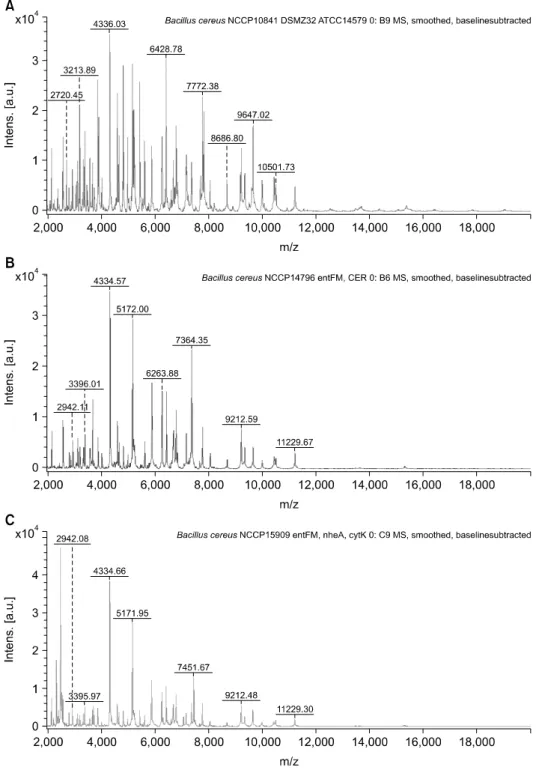
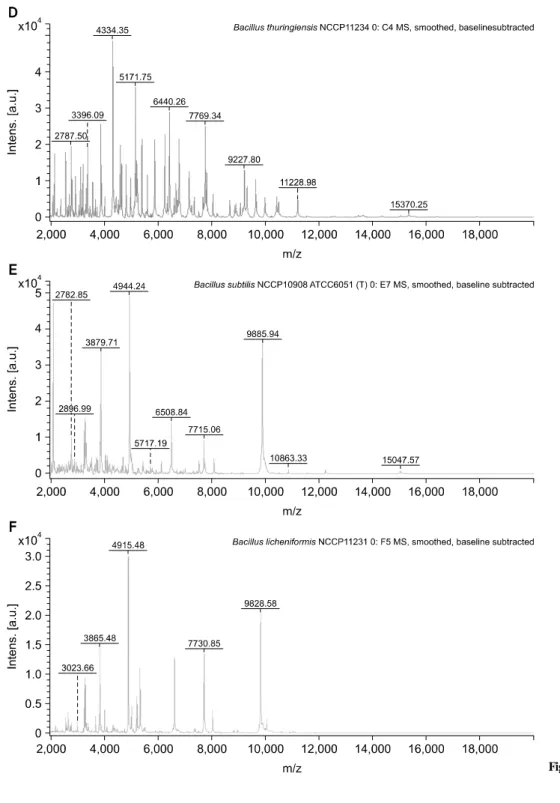
Fig. 1. Representative spectra from Bacillus strains supplemented in the database by MALDI-TOF MS. The intensity is shown as a percentage of the total intensity on the y-axis, and the mass to charge ration (m/z) is shown on the x-axis. (A) Bacillus cereus NCCP10841 DSMZ32. (B) B.
cereus NCCP14796 entFM, CER. (C) B. cereus NCCP15909 entFM, nheA, cytK. (D) B. thuringiensis NCCP11234.
(E) B. subtillis NCCP10908. (F) B.
licheniformis NCCP11231.
와 진화적인 거리가 가깝지만 다른 계통군에 속했다. 각 균주 들의 상관관계를 단백질과 DNA 수준에서 상호 비교하기 위한 MALDI-TOF MS를 단백체 기반 데이터베이스를 제작하고자 중합효소 연쇄반응(PCR)방법을 이용하여 식중독 병원성 유전 자를 확인하였다. B. cereus group의 설사형과 구토형 독소유전 자의 분석은 PowerChek Bacillus cereus Toxin 6-plex Detection Kit (코젠바이오텍)를 사용하여 특성을 확인하였다.
2. MALDI-TOF MS 분석
MALDI-TOF MS, 16S rRNA 유전자 염기서열, 생화학적 특 성, 면역학적 특성 및 병원성확인이 끝난 Bacillus 균주의 상관 관계를 단백질수준에서 분석하기 위하여 각각의 단백체 프로 파일을 추출하였다. 각 균주들은 최소 20개 이상의 mass spec- tra를 확보한 후 Stanford 등[23]의 보고를 참고하여 processing 과정을 거쳐 단일의 주스펙트럼(major spectrum profile, MSP) 를 제작하였다. 균종별로 제작된 MSP의 예시는 Fig. 1와 같이
Fig. 1. Continued.
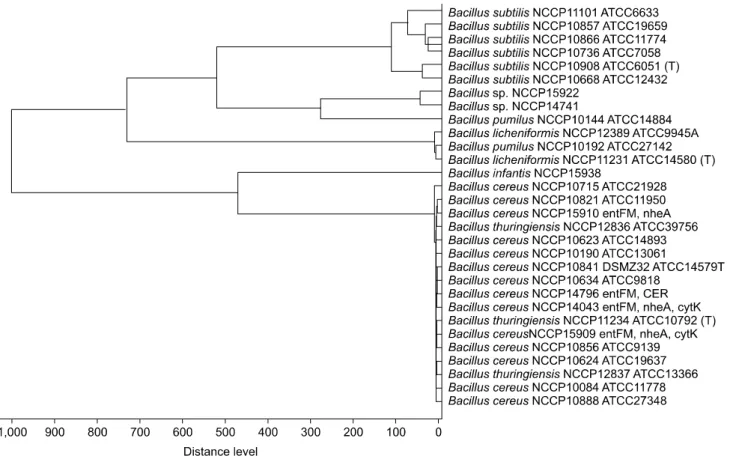
나타내었다. 이를 이용하여 국내임상분리병원체 데이터베이스 를 제작하였고 단백체 프로파일기반 MSP dendrogram을 Fig. 2 과 같이 제작하였다. Bacillus strain 간의 상관관계를 확인결과 각종별로 단일 계통군에 속하는 것을 확인하였다. 제작된 데이 터베이스를 단백체, 유전체 수준의 비교를 위하여 DNA finger- printing 방법과의 비교 실험을 수행하였다.
3. Repetitive-sequence-based PCR을 이용한 DNA fingerprinting 분석
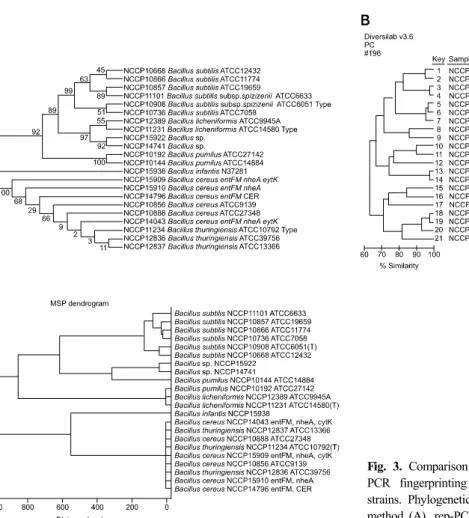
Bacillus strain의 경우 UPGMA 방법으로 제작한 16S rRNA 유전자 기반 계통수(Fig. 3A), 유전자 기반 rep-PCR finger- printing 계통수(Fig. 3B), 단백체 기반 MALDI-TOF MS den- drogram (Fig. 3C)를 비교하여 Fig. 3과 같이 나타내었다. 16S rRNA 유전자기반 계통수와 MALDI-TOF MS dendrogram의 결과는 rep-PCR fingerprinting 결과에 비하여 전체 종별 구분이
Fig. 2. Major spectrum profile (MSP) dendrogram of Bacillus strains supplemented in the database.
가장 효과적으로 이루어졌음을 확인할 수 있었다. 또한 이결과 를 통하여 Bacillus spp. NCCP 15922과 Bacillus spp. NCCP 14741 2주의 경우 B. licheniformis와 B. pumilus와 유연관계가 가까운 새로운 계통군일 가능성이 확인되었다.
DISCUSSION
본 연구에서는 국가병원체자원은행(NCCP)에서 보유 중인 그람양성 세균에서 가장 자원수가 분양증가가 예상되는 식중 독관련 Bacillus 균주를 대상으로 MALDI-TOF MS를 이용한 동정결과를 VITEK 2 system (bioMérieux), 16S rRNA 염기서 열 분석결과와 비교하고자 하였다. 또한 MALDI-TOF MS 동 정률을 높이기 위한 단백체 기반 국내임상분리주 데이터베이 스를 제작하고자 하였다.
MALDI-TOF MS 분석의 가장 큰 장점은 16-20시간 소요되 는 VITEK 2 system (bioMérieux)을 포함한 생화학적 동정방법 에 비하여 10분 이내 최소시간으로 신속한 동정이 이루어진다 는 점이다. Dupont 등[24], Jamal 등[10]의 보고를 참고하면 MALDI-TOF MS의 동정결과가 VITEK2 (bioMérieux)보다 오 동정도 낮고 속 및 종 수준의 동정률도 좋은 것으로 평가되었 다. 이들 3가지 방법을 사용하여 얻은 동정결과를 Table 2에 비
교하여 나타내었고 각 동정방법의 종동정률은 40% (VITEK 2 system), 76.7% (MALDI-TOF MS), 80% (16S rRNA 유전자 염 기서열분석)의 순서였다. 따라서 Bacillus strain의 경우 MALDI- TOF MS의 동정결과가 VITEK 2 system (bioMérieux) 동정결 과보다 매우 높은 동정률을 나타내는 것을 확인할 수 있었다.
반면 16S rRNA 유전자 염기서열분석과 비교시 MALDI-TOF MS 동정결과 동정한계 Score 값인 1.7 이상 2.0 미만인 B. cer- eus NCCP 14043과 B. licheniformis NCCP 12389의 Score 값은 각각 1.999와 1.980이었다. Schulthess 등[21]은 그람양성 막대 균(Gram positive rods)들의 동정결과를 MALDI-TOF MS의 Score 값을 0.1간격으로 비교하여 동정한계 Score 값을 2.0 이 상으로 정하였는데 Bacillus strain은 포함되어 있지 않다. 따라 서 동정한계 Score 값과 인접한 값의 동정결과가 종동정이 이 루어지지 않았다고 판단하는 것은 문제가 있다고 생각되었다.
종동정이 되었다고 가정하면 MALDI-TOF MS의 동정률(83.3%) 이 16S rRNA 염기서열분석의 종동정률(80%)보다 높다. 이것 은 16S rRNA 유전자기반 계통분석결과 B. cereus와 B. thur- ingiensis가 같은 계통군에 속하여 서로 구별할 수 없기 때문이 었다. 이와 같이 16S rRNA 유전자 기반 유전자 일치도가 매우 높은 B. cereus와 B. thuringiensis 등의 B. cereus group, B. li- cheniformis group 등의 분류를 단백질 수준에서 확인해보고자
Fig. 3. Comparison of 16S rRNA gene, repetitive-sequence based PCR fingerprinting and MALDI-TOF MS analysis in Bacillus strains. Phylogenetic tree based by 16S rRNA gene with UPGMA method (A), rep-PCR fingerprinting (B) and MALDI-TOF MS (C).
하였다. Benagli 등[25]과 Lista 등[26]은 균주 간의 유전자적 관 계에 근거하여 균주를 선정하고 신뢰성이 있는 종 수준 동정용 래퍼런스 라이브러리를 만들 수 있다는 것을 보고하였다. 이를 참고하여 B. cereus와 B. licheniformis의 낮은 Score 값의 결과 는 등록되어있는 병원체 데이터베이스의 수가 적기 때문에 생 길 수 있다고 가정해보았다. 실제로 Bacillus strain의 경우 기존 Burker사의 데이터베이스는 B. cereus 3주, B. thuringiensis 1주, B. licheniformis 3주, B. pumilus 6주, B. infantis 1주, B. subtilis 9주가 등록 되어 있었다. Bacillus 균주의 동정방법을 단백질 수준에서 분석하기 위하여 MALDI-TOF MS를 이용한 mass spectrum 추출 및 단백체 기반 데이터베이스 제작을 수행하였 다. 제작된 데이터베이스는 Fig. 3과 같이 MSP dendrogram을 제작하여 16S rRNA 유전자 기반 계통수, 유전자 기반 rep-PCR fingerprinting 계통수와 비교하였을 때 종별구분이 가장 효과적 으로 이루어졌음을 확인할 수 있었다. B. pseudomycides와 가 장 근연한종으로 확인된 B. cereus NCCP 10715의 경우 16S rRNA 유전자 염기서열분석으로는 동정이 되지 않았는데 MALDI-TOF MS dendrogram의 경우도 분류학적으로 가장 바 깥쪽 그룹에 위치하고 있다. Lasch 등[27]은 기존의 B. cereus와 계통학적 거리가 있는 B. cereus 균주가 있음을 보고하고 있기
때문에 B. cereus NCCP 10715 경우 기존의 알려진 B. cereus와 다른 특성의 균주일 가능성이 있다. Bacillus spp. NCCP 14741 과 Bacillus spp. NCCP 15922의 MALDI-TOF MS dendrogram 경우도 16S rRNA 유전자 계통수와 마찬가지로 다른 기존의 알려진 B. licheniformis와는 다른 계통군에 속하는 것을 알 수 있었고 향후 신종의 가능성을 연구할 필요가 있었다.
이 연구를 통하여 기존에 알려진 MALDI-TOF MS 동정방법 의 신속성과 함께 Bacillus 균주들의 동정에서 VITEK 2 system (bioMérieux)보다 효과적으로 동정할수 있다는 것을 확인하였 고 단백체 기반 국내임상분리주 데이터베이스를 지속적으로 확보하면 보다 향상된 동정률을 얻을 수 있을 것으로 판단되었 다.
ACKNOWLEDGMENTS
이 연구는 질병관리본부 2016년도 감염병표준실험실운영 병 원체연구자원관리사업(4800-4837-301) 지원에 의해 수행되었음.
REFERENCES
1. Oguntoyinbo FA. Monitoring of marine bacillus diversity among the bacteria community of sea water. Afr J Biotechnol 2007;6:
163-6.
2. Durak MZ, Fromm HI, Huck JR, Zadoks RN, Boor KJ.
Development of molecular typing methods for Bacillus spp. and Paenibacillus spp. isolated from fluid milk products. J Food Sci 2006;71:M50-6.
3. Fritze D. Taxonomy of the genus bacillus and related genera: the aerobic endospore-forming bacteria. Phytopathology 2004;94:
1245-8.
4. Bavykin SG, Lysov YP, Zakhariev V, Kelly JJ, Jackman J, Stahl DA, et al. Use of 16S rRNA, 23S rRNA, and gyrB gene sequence analysis to determine phylogenetic relationships of Bacillus cereus group microorganisms. J Clin Microbiol 2004;42:3711-30.
5. Granum PE. Bacillus cereus. In: Doyle MP, ed. Food Microbiology: Fundamental and Frontiers. 2nd ed, Washington DC; ASM Press, 2001:373-81.
6. Schnepf E, Crickmore N, Van Rie J, Lereclus D, Baum J, Feitelson J, et al. Bacillus thuringiensis and its pesticidal crystal proteins. Microbiol Mol Biol Rev 1998;62:775-806.
7. Salkinoja-Salonen M, Vuorio R, Andersson M, Kampfer P, Honkanen-Buzalski T. Toxigenic strains of Bacillus licheniformis related to food poisoning. Appl Environ Microbiol 1999;65:
4637-45.
8. Sorokulova IB, Reva ON, Smirnov VV, Pinchuk IV, Lapa SV, Urdaci MC. Genetic diversity and involvement in bread spoilage of Bacillus strains isolated from flour and ropy bread. Lett Appl Microbiol 2003;37:169-73.
9. Pavic S, Brett M, Petric I, Lastre D, Smoljanovic M, Atkinson M, et al. An outbreak of food poisoning in a kindergarten caused by milk powder containing toxigenic Bacillus subtilis and Bacillus licheniformis. Archiv für Lebensmittelhygiene 2005;56:20-2.
10. Jamal W, Albert MJ, Rotimi VO. Real-time comparative evalua- tion of bioMerieux VITEK MS versus Bruker Microflex MS, two matrix-assisted laser desorption-ionization time-of-flight mass spectrometry systems, for identification of clinically significant bacteria. BMC Microbiol 2014;14:289.
11. CLSI. Interpretative criteria for identification of bacteria and fungi by DNA target sequencing; approved guideline. CLSI document MM18-A. Pennsylvania: Clinical and Laboratory Standards Institute; 2008:1-71.
12. Christner M, Trusch M, Rohde H, Kwiatkowski M, Schlüter H, Wolters M, et al. Rapid MALDI-TOF mass spectrometry strain typing during a large outbreak of Shiga-toxigenic Escherichia coli.
PLoS One 2014;9:e101924.
13. Josten M, Reif M, Szekat C, Al-Sabti N, Roemer T, Sparbier K, et al. Analysis of the matrix-assisted laser desorption ionization- time of flight mass spectrum of Staphylococcus aureus identifies mutations that allow differentiation of the main clonal lineages. J Clin Microbiol 2013;51:1809-17.
14. Khot PD and Fisher MA. Novel approach for differentiating
Shigella species and Escherichia coli by matrix-assisted laser desorption ionization-time of flight mass spectrometry. J Clin Microbiol 2013;51:3711-6.
15. Kim OS, Cho YJ, Lee K, Yoon SH, Kim M, Na H, et al.
Introducing EzTaxone-e: a prokaryotic 16S rRNA gene sequence database with phylotypes that represent uncultured species. Int J Syst Evol Microbiol 2012;62:716-21.
16. Tamura K, Stecher G, Peterson D, Filipski A, Kumar S. MEGA6:
molecular evolutionary genetics analysis version 6.0. Mol Biol Evol 2013;30:2725-9.
17. Kumar S, Tamura K, Nei M. MEGA3: intergrated software for molecular evolutionary genetics analysis and sequence alignment.
Brief Bioinform 2004;5:150-63.
18. Jukes TH and Cantor CR. Evolution of Protein Molecules. In:
Munro HN, ed. Mammalian Protein Metabolism. New York;
Academic Press, 1969:21-132.
19. Saitou N and Nei M. The neighbor-joining method: a new method for reconstructing phylogenetic trees. Mol Biol Evol 1987;4:
406-25.
20. Haigh J, Degun A, Eydmann M, Millar M, Wilks M. Improved performance of bacterium and yeast identification by a commercial matrix-assisted laser desorption ionization-time of flight mass spectrometry system in the clinical microbiology laboratory. J Clin Microbiol 2011;49:3441.
21. Schulthess B, Bloemberg GV, Zbinden R, Böttger EC, Hombach M. Evaluation of the bruker MALDI biotyper for identification of gram-positive rods: development of a diagnostic algorithm for the clinical laboratory. J Clin Microbiol 2014;52:1089-97.
22. Healy M, Huong J, Bittner T, Lising M, Frye S, Raza S, et al.
Microbial DNA typing by automated repetitive-sequence-based PCR. J Clin Microbiol 2005;4:199-207.
23. Stanford TE, Bagley CJ, Solomon PJ. Informed baseline sub- traction of proteomic mass spectrometry data aided by a novel sliding window algorithm. Proteome Sci 2016;14:19.
24. Dupont C, Sivadon-Tardy V, Bille E, Dauphin B, Beretti JL, Alvarez AS, et al. Identification of clinical coagulase-negative staphylococci, isolated in microbiology laboratories, by matrix- assisted laser desorption/ionization-time of flight mass spectrometry and two automated systems. Clin Microbiol Infect 2010;16:998- 1004.
25. Benagli C, Demarta A, Caminada A, Ziegler D, Petrini O, Tonolla M. A rapid MALDI-TOF MS identification database at geno- species level for clinical and environmental Aeromonas strains.
PLoS One 2012;7:e48441.
26. Lista F, Reubsaet FA, De Santis R, Parchen RR, de Jong AL, Kieboom J, et al. Reliable identification at the species level of Brucella isolates with MALDI-TOF-MS. BMC Microbiol 2011;
11:267.
27. Lasch P, Beyer W, Nattermann H, Stämmler M, Siegbrecht E, Grunow R, et al. Identification of Bacillus anthracis by using matrix-assisted laser desorption ionization-time of flight mass spectrometry and artificial neural networks. Appl Environ Microbiol 2009;75:7229-42.
=국문초록=
MALDI-TOF 질량분석기를 이용한 바실러스균의 동정
질병관리본부 국립보건연구원 감염병센터 병원체자원관리TF 유원선, 이경민, 황규잠
배경: 본 연구에서는 그람양성세균 식중독관련 Bacillus 균주를 대상으로 MALDI-TOF MS를 이용한 동정결과를 VITEK 2 system (bioMérieux, France), 16S rRNA 염기서열 분석결과와 비교하고 MALDI-TOF MS 동정률을 높이기 위한 단백체 기반 국내임상분리주 데이터베이스를 제작하고자 하였다.
방법: 세균의 동정은 VITEK 2 system (bioMérieux), API kit (bioMérieux, France), 16S rRNA 유전자 염기서열, MALDI-TOF MS 분석을 이용하였다. 병원성확인을 위하여 multiplex PCR 방법을 이용하여 독성 유전자를 확인하였다. 세균의 단백체 프로파일의 추출 및 데이터베이스는 제작은 MALDI BioTyper 3.0 (Bruker Daltonics, Germany)을 이용하여 수행하였고 16S rRNA 유전자 기반 계통수, repetitive-sequence fingerprinting 계통분석결과와 비교분석을 수행하였다.
결과: Bacillus 균주 30주에 대한 생화학적 동정법, 16S rRNA 유전자 염기서열분석 및 MALDI-TOF MS 방법에 의한 종 수준 동정률은 40%, 80%, 76.3%였다. 제작된 단백체 기반 MSP dendrogram을 16S rRNA 유전자기반 계통수 및 rep-PCR fingerprinting 계통수와 비교하였을 때 종별 구분이 효과적으로 이루어졌음을 확인할 수 있었다.
결론: Bacillus 균주들의 동정에서 MALDI-TOF MS는 VITEK 2 system (bioMérieux)보다 효과적인 동정방법이었다. MALDI- TOF MS는 16S rRNA 유전자 기반 동정법과도 비슷한 수준의 동정률을 나타냈으며 단백체 기반 국내임상분리주 데이터 베이스를 지속적으로 확보한다면 동정률이 훨씬 높아질 것으로 기대되었다. [Ann Clin Microbiol 2016;19:110-120]
교신저자 : 황규잠, 28159, 충북 청주시 오송읍 오송생명2로 187 질병관리본부 국립보건연구원 감염병센터 병원체자원관리TF Tel: 043-719-6870, Fax: 043-719-6680
E-mail: [email protected]