Aminophylline Partially Prevents the Decrease of Body Temperature during Laparoscopic Abdominal Surgery
Aminophylline can elicit thermogenesis in rats or increase metabolic rate during cold stress in lambs. We tested the hypothesis that aminophylline would reduce the change in core body temperature during laparoscopic abdominal surgery requiring pneumoperitoneum.
Fifty patients were randomly divided into an aminophylline group (n = 25) and a saline control group (n = 25). Esophageal temperature, index finger temperature, and
hemodynamic variables, such as mean blood pressure and heart rate, were measured every 15 min during sevoflurane anesthesia. In the aminophylline group, esophageal
temperatures at T45 (36.1 ± 0.38 vs. 35.7 ± 0.29, P = 0.024), T60 (36.0 ± 0.39 vs.
35.6 ± 0.28, P = 0.053), T75 (35.9 ± 0.34 vs. 35.5 ± 0.28, P = 0.025), T90 (35.8 ± 0.35 vs. 35.3 ± 0.33, P = 0.011), and T105 (35.8 ± 0.36 vs. 35.1 ± 0.53, P = 0.017) and index finger temperatures at T15 (35.8 ± 0.46 vs. 34.9 ± 0.33, P < 0.001), T30 (35.7 ± 0.36 vs.
35.0 ± 0.58, P = 0.029), T45 (35.8 ± 0.34 vs. 35.2 ± 0.42, P = 0.020), T60 (35.7 ± 0.33 vs. 34.9 ± 0.47, P = 0.010), T75 (35.6 ± 0.36 vs. 34.8 ± 0.67, P = 0.028), T90 (35.4 ± 0.55 vs. 34.4 ± 0.89, P = 0.042), and T105 (34.9 ± 0.53 vs. 33.9 ± 0.85, P = 0.024) were significantly higher than in the saline control group. Aminophylline is effective in maintaining the core temperature through a thermogenic effect, despite reduced peripheral thermoregulatory vasoconstriction.
Keywords: Aminophylline; Core Body Temperature; Thermogenic Effect Dae Woo Kim, Jung Ah Lee,
Hong Soo Jung, Jin Deok Joo, Jang Hyeok In, Yeon Soo Jeon, Ga Young Chun, and Jin Woo Choi Department of Anesthesiology and Pain Medicine, St. Vincent Hospital, College of Medicine, The Catholic University of Korea, Suwon, Korea Received: 12 November 2013
Accepted: 20 May 2014 Address for Correspondence:
Jin Woo Choi, MD
Department of Anesthesiology and Pain Medicine, St. Vincent Hospital, College of Medicine, The Catholic University of Korea, 93 Jungbu-daero, Paldal-gu, Suwon 442-723, Korea
Tel: +82.31-249-7211, Fax: +82.31-258-4212 E-mail: [email protected]
Funding: This study was supported by the Research Fund from the Research Institute of Medical Science, St. Vincent’s Hospital, Suwon, Korea.
http://dx.doi.org/10.3346/jkms.2014.29.8.1161 • J Korean Med Sci 2014; 29: 1161-1165
INTRODUCTION
Intraoperative hypothermia is common because anesthetics impair thermoregulatory control (1, 2). This effect is associated with adverse outcomes including impaired coagulation (3), in- creased incidence of surgical wound infections, prolonged hos- pitalization (4), and myocardial ischemia (5). Despite the ab- sence of environmental exposure of a wound or abdominal vis- cera, hypothermia has been reported to occur during laparo- scopic surgery (6, 7). Exposure of the abdominal cavity to large volumes of cold, dry carbon dioxide gas used for insufflation has been implicated as a potential source of heat loss during laparoscopy (6-8).
Theophylline is an active stimulant metabolite from caffeine.
Therefore, the effects of aminophylline (85% theophylline, 15%
ethylendiamine) are similar to those of caffeine. Aminophylline has been shown to elicit thermogenesis and improve cold toler- ance in rats (9, 10) and increase the metabolic rate in lambs during cold stress (11).
Since there have been no reports on the thermogenic effects of aminophylline in humans, we tested the hypothesis that aminophylline reduces the decrease in core body temperature during laparoscopic vaginal hysterectomy (LVH) requiring pneumoperitoneum.
MATERIALS AND METHODS
This was a prospective, randomized, blinded clinical trial. After obtaining written informed consent from all patients, fifty pa- tients scheduled for elective LVH were enrolled between 40 to 60 yr of aged with American Society of Anesthesiologists (ASA) physical status I or II. Patients with a history of cardiovascular, pulmonary, or thyroid disease; dysautonomia; fever; amino- phylline intake within a day before surgery; or who were trans- fused were excluded from this study.
The patients were randomly divided into an aminophylline group (n = 25) and a saline control group (n = 25) using a com- puter-generated randomization list. The ambient operating room (OR) temperature was maintained around 21°C (12). No premedication was given. Upon arrival in the operating room, standard anesthetic monitors were applied, including ECG, a non-invasive blood pressure monitor, and pulse oximetry. To evaluate the depth of anesthetization, BIS monitor (A-3000 BIS monitor, Aspect Medical System, Covidien, MA, USA) sensors (BISTM Quatro, Aspect Medical System, Norwood, MA, USA) were attached to the patient’s forehead and temple. A skin tem- perature probe was attached to the index finger of the non-in- fused arm. After induction, a urinary catheter was inserted to measure hourly urine output.
To prepare the study drug, aminophylline (10 mg/kg) was mixed with saline in a syringe to a volume of 100 mL by an in- dependent researcher. Saline alone (100 mL) was used as a control. Fifteen minutes before inducing anesthesia, 10 mL (1 mg/kg) of the study drug was administered intravenously over 1 min as an initial infusion. An esophageal temperature probe was inserted into the lower esophagus immediately after intu- bation in order to measure the core temperature. The remain- ing 90 mL of the study drug was administered intravenously at a rate of 50 mL/hr for next 108 min using a syringe pump.
Induction was accomplished with fully preoxygenation, 1% li- docaine 40 mg and 1% propofol 2 mg/kg, followed by rocuroni- um 0.6 mg/kg. Anesthesia was maintained with 1-3 vol% of sevoflurane and 2 L/min each of nitrous oxide and oxygen to obtain BIS values between 45 and 55. The lungs were ventilated with a tidal volume of 7-10 mL/kg and a respiratory rate of 8-12 breaths/min to maintain an end-tidal carbon dioxide (ETCO2) value between 30 and 35 mmHg. The pneumoperitoneal pres- sure was maintained at 12 mmHg to decrease the risk of venous carbon dioxide embolism. The average temperature of inflow gas was 21°C, and the temperature of the outflow was 32°C. The tidal volume and respiratory rate were set to maintain an ETCO2
between 35-40 mmHg after pneumoperitoneum. None of the fluids were warmed but were maintained at room temperature.
When the systolic blood pressure fell below 80 mmHg, 5 mg i.v.
ephedrine was given slowly, and additional doses were given at 10 min intervals, as needed. Lactated Ringer’s solution and 6%
hydroxyethyl starch in normal saline (NS) solution (VoluvenTM, Fresenius Kabi, Bad Homberg, Germany) were administered at a maximum dose of 50 mL/kg. Lactated Ringer’s solution was infused at a constant rate of 6 mL/kg/hr. Body temperature was measured in the post-anesthesia care unit (PACU) using a tym- panic thermometer (ThermoScan IRT 1020, Braun, Germany).
In the PACU, a Bair Hugger forced-air warmer (Augustine Medi- cal Inc., Eden Prairie, MN, USA) was applied to patients who had a tympanic temperature below 36°C.
The skin temperature, mean blood pressure, and heart rate were recorded 15 min before inducing anesthesia (T-15), imme- diately after intubation (Tintu), and at 15 min intervals (T15- T105) after intubation. Esophageal temperature was recorded immediately after intubation (Tintu) and at 15 min intervals (T15-T105) afterward. The room temperature, fluid intake, urine output, and estimated blood loss were recorded at T105.
To estimate the sample size needed, a pilot study was con- ducted measuring core body temperature of ten control pa- tients. The standard deviation of core body temperature at T15 was 0.34. For the power calculation, we assumed an equal stan- dard deviation for the aminophylline infusion group. A sample size of 22 patients per group provided 80% power with a two- tailed α = 0.05 to show a difference of 0.3°C between groups. To compensate for an estimated dropout rate of 10%, 25 patients
per group were recruited.
Data are expressed as mean and SD. Continuous data within the groups, such as temperature and hemodynamic variables, were compared with repeated measures of ANOVA followed by paired t-tests with Bonferroni correction for multiple compari- sons. Student’s t-test or Chi-square test was used to compare variables between the groups, where appropriate.
In all tests, P < 0.05 was considered significant.
Ethics statement
The study protocol was approved by the institutional review board for human research at the Catholic University of Korea St.
Vincent Hospital, Suwon, Republic of Korea (VC12OISI0078).
The nature of the study was explained to all patients, each of whom provided written informed consent before the beginning of the study, in accordance with the principles of the Declara- tion of Helsinki (revision of Edinburgh, 2000).
RESULTS
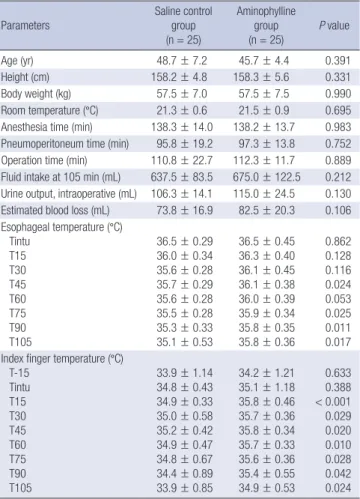
The patient characteristics and perioperative data are listed in Table 1. Patient characteristics and perioperative data, includ-
Table 1. Patient characteristics and perioperative data Parameters
Saline control group (n = 25)
Aminophylline group
(n = 25) P value
Age (yr) 48.7 ± 7.2 45.7 ± 4.4 0.391
Height (cm) 158.2 ± 4.8 158.3 ± 5.6 0.331
Body weight (kg) 57.5 ± 7.0 57.5 ± 7.5 0.990
Room temperature (°C) 21.3 ± 0.6 21.5 ± 0.9 0.695 Anesthesia time (min) 138.3 ± 14.0 138.2 ± 13.7 0.983 Pneumoperitoneum time (min) 95.8 ± 19.2 97.3 ± 13.8 0.752 Operation time (min) 110.8 ± 22.7 112.3 ± 11.7 0.889 Fluid intake at 105 min (mL) 637.5 ± 83.5 675.0 ± 122.5 0.212 Urine output, intraoperative (mL) 106.3 ± 14.1 115.0 ± 24.5 0.130 Estimated blood loss (mL) 73.8 ± 16.9 82.5 ± 20.3 0.106 Esophageal temperature (°C)
Tintu T15 T30 T45 T60 T75 T90 T105
36.5 ± 0.29 36.0 ± 0.34 35.6 ± 0.28 35.7 ± 0.29 35.6 ± 0.28 35.5 ± 0.28 35.3 ± 0.33 35.1 ± 0.53
36.5 ± 0.45 36.3 ± 0.40 36.1 ± 0.45 36.1 ± 0.38 36.0 ± 0.39 35.9 ± 0.34 35.8 ± 0.35 35.8 ± 0.36
0.862 0.128 0.116 0.024 0.053 0.025 0.011 0.017 Index finger temperature (°C)
T-15 Tintu T15 T30 T45 T60 T75 T90 T105
33.9 ± 1.14 34.8 ± 0.43 34.9 ± 0.33 35.0 ± 0.58 35.2 ± 0.42 34.9 ± 0.47 34.8 ± 0.67 34.4 ± 0.89 33.9 ± 0.85
34.2 ± 1.21 35.1 ± 1.18 35.8 ± 0.46 35.7 ± 0.36 35.8 ± 0.34 35.7 ± 0.33 35.6 ± 0.36 35.4 ± 0.55 34.9 ± 0.53
0.633 0.388
< 0.001 0.029 0.020 0.010 0.028 0.042 0.024 Values are expressed as mean ± SD.
ing room temperature, fluid intake, urine output, and blood loss, did not differ significantly between the groups.
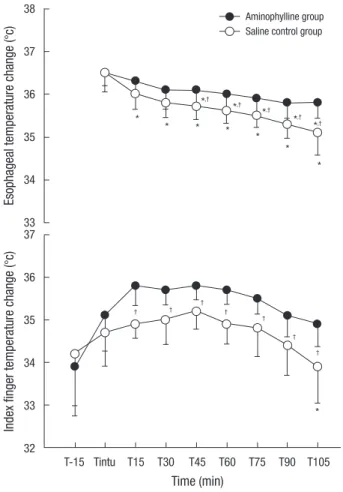
In the aminophylline group, esophageal temperatures at T45, T60, T75, T90, T105 (P values are in the order of 0.024, 0.053, 0.025, 0.011, 0.017) and index finger temperatures at T15, T30, T45, T60, T75, T90, T105 (P values are in the order of 0.001, 0.029, 0.020, 0.010, 0.028, 0.042, 0.024) were significantly higher than in the saline control group (Table 1) (Fig. 1). The esopha- geal temperatures decreased significantly from Tintu at T15- T105 in the saline control group (P values were in the order of 0.040, 0.006, < 0.001, < 0.001, < 0.001, < 0.001, < 0.001) and at T45-T105 in the aminophylline group (P values were in the order of 0.039, 0.011, 0.002, < 0.001, < 0.001) (Fig. 1). The index finger temperature at T105 in the saline control group de- creased significantly from Tintu (P = 0.045) (Fig. 1).
Heart rates in both groups were significantly higher at Tintu than at T-15 (P = 0.025 in the saline control group, P = 0.014 in aminophylline group). Mean blood pressures in the amino- phylline group were significantly lower at T45-T105 than at T-15 (P < 0.001) (Fig. 2).
DISCUSSION
This study demonstrated that an aminophylline infusion re- duced the changes in core and skin temperature compared to a saline control during LVH requiring pneumoperitoneum. Ami- nophylline, like caffeine, is a methylxanthine that has been shown to elicit thermogenesis and improve cold tolerance in rats (9, 10). It has also significantly improved cold tolerance in lean Sprague-Dawley rats, regardless of age or thermogenic ca- pacity. Aminophylline (18.7 mg/kg intraperitoneal) significantly improved thermogenesis and cold tolerance in both lean and corpulent rats without any age-related difference (13). Zimmer- mann et al. (11) reported that aminophylline has potential as a treatment for hypothermia or to improve recovery from hypo- thermia in lambs by increasing metabolic rate during cold stress at 16 and 32 mg/kg doses.
Vestal et al. (14) reported that methylxanthine derivatives, such as caffeine and theophylline, stimulated epinephrine and norepinephrine release from the sympathoadrenal system. In six healthy males, a 262% increase in plasma epinephrine and a
Esophageal temperature change (°c)Index finger temperature change (°c)
Time (min)
T-15 Tintu T15 T30 T45 T60 T75 T90 T105 38
37 36 35 34 3337
36 35 34 33 32
Aminophylline group Saline control group
* * * * *
*
*
*,† *,† *,†
† † †
† †
†
†
*,† *,†
Fig. 1. Changes in the esophageal and index finger temperatures. The error bars in- dicate SD. *P < 0.05 compared to the value at Tintu; †P < 0.05 compared to the sa- line control group. T-15: 15 min before anesthesia induction and aminophylline 1 mg/
kg initial bolus i.v. infusion, Tintu: immediately after intubation and initiation of amino- phylline 9 mg/kg continuous i.v. infusion, T15-105: 15 to 105 min after initiation of aminophylline 9 mg/kg continuous i.v. infusion.
Fig. 2. Changes in heart rate and mean blood pressure. The error bars indicate SD.
*P < 0.05 compared to T-15. T-15: 15 min before anesthesia induction and amino- phylline 1 mg/kg initial bolus i.v. infusion, Tintu: immediately after intubation and initi- ation of aminophylline 9 mg/kg continuous i.v. infusion, T15-105: 15 to 105 min after initiation of aminophylline 9 mg/kg continuous i.v. infusion.
Heart rate (bpm)Mean blood pressure (mmHg)
Time (min)
T-15 Tintu T15 T30 T45 T60 T75 T90 T105 100
90 80 70 60 13050
120 110 100 90 80 70
Aminophylline group Saline control group
**
* *
*
*
*
*
64% increase in plasma norepinephrine during a high-dose in- fusion of theophylline (plasma theophylline level of 20 μg/mL) resulted in dose-dependent cardiovascular and metabolic ef- fects. Plasma concentrations of glucose and free fatty acids (FFAs) also increased, but insulin secretion was inhibited (14).
Caffeine (15) and aminophylline also block adenosine recep- tors (16), which is an effect that may have a greater impact on metabolism than the inhibition of phosphodiesterase (17). The combined effects are expected to enhance lipolysis, glycoge- nolysis and gluconeogenesis and hence contribute to enhanced maximal thermogenesis (10).
After anesthesia is induced, core hypothermia is largely caused by a redistribution of body heat from the core to the pe- riphery (1). Most anesthetics cause arterial and venous dilation as well as thermoregulatory vasodilation in the arteriovenous shunt (18, 19). Ikeda et al. (20) stated that hypothermia during general anesthesia develops in three distinct phases: 1) an ini- tial, rapid decrease in core temperature, resulting largely from an internal core-to-peripheral redistribution of body heat; 2) a slower, linear decrease in core temperature that results from heat loss exceeding metabolic heat production (21); and 3) a core-temperature plateau resulting from decreased cutaneous heat loss (22) and metabolic heat constrained to the core ther- mal compartment in patients becoming sufficiently hypother- mic to trigger thermoregulatory vasoconstriction (23).
In this study, the core temperature gradients in the amino- phylline group during sevoflurane anesthesia decreased signifi- cantly less than in the saline control group. Skin temperature gradients followed a similar trend. These data suggest that ami- nophylline effectively maintained the core temperature through a thermogenic effect despite reduced peripheral thermoregula- tory vasoconstriction.
Since there are no data on the thermogenic effect in humans, we cannot determine the therapeutic range of aminophylline infusion doses. Zimmermann et al. (11) reported that, in lambs, a dose of more than 16 mg/kg of aminophylline can improve recovery from hypothermia by increasing metabolic rate during cold stress, whereas 8 mg/kg of aminophylline did not affect metabolic rate. Although this was the first study to report the thermogenic effect of aminophylline in humans, we hoped positive results. Therefore, we chose an aminophylline dose high in the therapeutic range (10 mg/kg). The optimal dose should be determined in further investigation. For safety, 1 mg/
kg of aminophylline was administered as an initial infusion at 15 min before inducing anesthesia, and the remaining 9 mg/kg was administered intravenously after intubation at a rate of 50 mL/hr for 108 min using a syringe pump.
This study had some limitations. One limitation is the lack of a preoperative esophageal temperature. An esophageal tem- perature probe was not inserted before inducing anesthesia to ensure patient comfort. Another limitation is that the study was
performed only in women that underwent laparoscopic gyne- cologic surgery requiring pneumoperitoneum. Other types of surgeries in both sexes should be investigated further.
In summary, this is the first study to report the thermogenic effect of aminophylline in humans. We found that an intraoper- ative infusion of aminophylline reduced the decreases in core and skin temperature during LVH requiring pneumoperitone- um. These data suggest that aminophylline maintains core tem- perature through a thermogenic effect despite reduced periph- eral thermoregulatory vasoconstriction. Aminophylline, there- fore, may be a useful and supplemental thermogenic agent to prevent hypothermic conditions when limited facilities are available to provide supplemental heat.
ACKNOWLEDGMENTS
The statistical analyses performed in this study were advised by the Catholic Medical Center Clinical Research Coordinating Center.
DISCLOSURE
The authors have no conflicts of interest to disclose.
ORCID
Dae Woo Kim http://orcid.org/0000-0002-0270-0727 Jung Ah Lee http://orcid.org/0000-0001-6107-1484 Hong Soo Jung http://orcid.org/0000-0001-7690-7969 Jin Deok Joo http://orcid.org/0000-0001-9035-3288 Jang Hyeok In http://orcid.org/0000-0001-6206-0103 Yeon Soo Jeon http://orcid.org/0000-0002-7677-2002 Ga Young Chun http://orcid.org/0000-0001-8587-7183 Jin Woo Choi http://orcid.org/0000-0003-0444-4015 REFERENCES
1. Matsukawa T, Sessler DI, Sessler AM, Schroeder M, Ozaki M, Kurz A, Cheng C. Heat flow and distribution during induction of general anes- thesia. Anesthesiology 1995; 82: 662-73.
2. Annadata R, Sessler DI, Tayefeh F, Kurz A, Dechert M. Desflurane slightly increases the sweating threshold but produces marked, nonlin- ear decreases in the vasoconstriction and shivering thresholds. Anesthe- siology 1995; 83: 1205-11.
3. Valeri CR, Feingold H, Cassidy G, Ragno G, Khuri S, Altschule MD. Hy- pothermia-induced reversible platelet dysfunction. Ann Surg 1987; 205:
175-81.
4. Kurz A, Sessler DI, Lenhardt R. Perioperative normothermia to reduce the incidence of surgical-wound infection and shorten hospitalization:
Study of Wound Infection and Temperature Group. N Engl J Med 1996;
334: 1209-15.
5. Frank SM, Beattie C, Christopherson R, Norris EJ, Perler BA, Williams
GM, Gottlieb SO. Unintentional hypothermia is associated with postop- erative myocardial ischemia: the Perioperative Ischemia Randomized Anesthesia Trial Study Group. Anesthesiology 1993; 78: 468-76.
6. Nguyen NT, Fleming NW, Singh A, Lee SJ, Goldman CD, Wolfe BM.
Evaluation of core temperature during laparoscopic and open gastric bypass. Obes Surg 2001; 11: 570-5.
7. Bessell JR, Karatassas A, Patterson JR, Jamieson GG, Maddern GJ. Hy- pothermia induced by laparoscopic insufflation: a randomized study in a pig model. Surg Endosc 1995; 9: 791-6.
8. Kwak HJ, Min SK, Yi IK, Chang YJ, Kim JY. Comparison of the effects of sevoflurane and propofol on core body temperature during laparoscopic abdominal surgery. Korean J Anesthesiol 2011; 61: 133-7.
9. Wang LC. Effects of feeding on aminophylline induced supra-maximal thermogenesis. Life Sci 1981; 29: 2459-66.
10. Wang LC, Anholt EC. Elicitation of supramaximal thermogenesis by aminophylline in the rat. J Appl Physiol Respir Environ Exerc Physiol 1982; 53: 16-20.
11. Zimmermann B, Diebold G, Galbraith J, Whitmore W, Okamoto M, Robinson JB, Young BA, Murdoch G, Mosenthin R, Christopherson RJ.
Effect of aminophylline on metabolic and thermoregulatory responses during hypothermia associated with cold exposure in lambs. Can J Anim Sci 2003; 83: 739-48.
12. Brock L. The importance of environmental conditions, especially tem- perature, in the operating room and intensive care ward. Br J Surg 1975;
62: 253-8.
13. Lee TF, Wang LC, Russell JC. Enhancement of cold-stimulated thermo- genesis in the corpulent rat (LA/N cp) by aminophylline. Am J Physiol 1987; 252: R737-42.
14. Vestal RE, Eiriksson CE Jr, Musser B, Ozaki LK, Halter JB. Effect of intra-
venous aminophylline on plasma levels of catecholamines and related cardiovascular and metabolic responses in man. Circulation 1983; 67:
162-71.
15. Dulloo AG, Seydoux J, Girardier L. Peripheral mechanisms of thermo- genesis induced by ephedrine and caffeine in brown adipose tissue. Int J Obes 1991; 15: 317-26.
16. Wang LC, Lee TF. Enhancement of maximal thermogenesis by reducing endogenous adenosine activity in the rat. J Appl Physiol (1985) 1990; 68:
580-5.
17. Wang LC, Jourdan ML, Lee TF. Mechanisms underlying the supra-max- imal thermogenesis elicited by aminophylline in rats. Life Sci 1989; 44:
927-34.
18. Schwinn DA, McIntyre RW, Reves JG. Isoflurane-induced vasodilation:
role of the alpha-adrenergic nervous system. Anesth Analg 1990; 71: 451-9.
19. Sellgren J, Pontén J, Wallin BG. Percutaneous recording of muscle nerve sympathetic activity during propofol, nitrous oxide, and isoflurane an- esthesia in humans. Anesthesiology 1990; 73: 20-7.
20. Ikeda T, Ozaki M, Sessler DI, Kazama T, Ikeda K, Sato S. Intraoperative phenylephrine infusion decreases the magnitude of redistribution hypo- thermia. Anesth Analg 1999; 89: 462-5.
21. Hynson JM, Sessler DI. Intraoperative warming therapies: a compari- son of three devices. J Clin Anesth 1992; 4: 194-9.
22. Sessler DI, McGuire J, Hynson J, Moayeri A, Heier T. Thermoregulatory vasoconstriction during isoflurane anesthesia minimally decreases cuta- neous heat loss. Anesthesiology 1992; 76: 670-5.
23. Kurz A, Sessler DI, Christensen R, Dechert M. Heat balance and distri- bution during the core-temperature plateau in anesthetized humans.
Anesthesiology 1995; 83: 491-9.