INTRODUCTION
Despite current combination chemotherapy, 50% of the
acute lymphoblastic leukemia (ALL) patients relapse after achieving initial remission, 20% of acute myeloid leukemia (AML) do not respond to induction chemotherapy, and 40-60% of responsive AML relapse[1]. Drug resistance is considered to be a major cause of these chemotherapy failures. It is unknown to which drugs and to what extent resistance occurs. It is difficult to isolate a single drug that causes the resistance, because of the multidrug regimen.
Cell culture drug resistance assay would facilitate the iden- tification of a single resistant drug.
89 89
급성백혈병 103명의 환자에서 MTT검사를 이용한 화학요법제의 체외감수성검사결과와 임상결과의 연관성
Relationship between In Vitro Chemosensitivity assessed with MTT Assay and Clinical Outcomes in 103 Patients with Acute Leukemia
Kyung Ran Jun, M.D.
1, Seongsoo Jang, M.D.
1, Hyun Sook Chi, M.D.
1, Kyoo Hyung Lee, M.D.
2, Je Hwan Lee, M.D.
2, Seong Jun Choi, M.D.
2, Jong Jin Seo, M.D.
3, Hyung Nam Moon, M.D.
3, Ho Joon Im, M.D.
3, and Chan Jeoung Park, M.D.
1전경란
1∙장성수
1∙지현숙
1∙이규형
2∙이제환
2∙최성준
2∙서종진
3∙문형남
3∙임호준
3∙박찬정
1울산대학교 의과대학 서울아산병원 진단검사의학과1, 내과2, 소아과3
89 89
접 수: 2006년 10월 12일 접수번호:KJLM1992 수정본접수: 2006년 12월 6일
게재승인일: 2007년 1월 11일 교 신저 자: 박 찬 정
우 138-736 서울시 송파구 풍납2동 388-1 울산의대 서울아산병원 진단검사의학과 전화: 02-3010-4508, Fax: 02-478-0884 E-mail : [email protected]
*본연구는 아산생명과학연구소의 연구비 지원을 받아 시행되었습니다.
Departments of Laboratory Medicine1, Internal Medicine2, and Pediatrics3, Asan Medical Center, University of Ulsan College of Medicine, Seoul, Korea
Background :Cellular drug resistance is supposed to play a major role in chemotherapy failure or relapse. The purpose of this study was to analyze the relationship between in vitro chemosensitivity test results using a 3-(4,5-Dimethylthiazol-2-yl)-2,5-diphenyltetrazolium bromide (MTT) assay and clin- ical response on chemotherapy, and to find the possibility of optimizing the treatment protocol for indi- vidual patients according to their actual drug resistance.
Methods :For MTT assay, we obtained bone marrow aspirates from 103 patients with acute leuke- mia at the time of initial diagnosis or relapse. The following drugs were tested: cytarabine, vincristine, methotrexate, daunorubicin, dexamethasone, L-asparaginase, and mitoxantrone. To evaluate clini- cal responses after induction chemotherapy, we followed up on their bone marrow study.
Results :In our study, in vitro chemosensitivity test with the MTT assay significantly predicted whether patients with AML remained continuous complete remission or went into relapse. It also predicted whether or not child patients with ALL would acquire complete remission after induction chemotherapy.
Conclusions :Although it does not provide the insight into the mechanisms that cause drug resis- tance, the MTT assay may be a useful tool in individually optimizing the chemotherapy of patients with acute leukemia. (Korean J Lab Med 2007;27:89-95)
Key Words :Leukemia, MTT tetrazolium, Drug therapy
Many studies on in vitro chemosensitivity assays have been performed with established cell lines[2]. The clono- genic assays have successfully been used to predict initial response to chemotherapy in AML patients, but techni- cal problems and the long culturing time have limited the clinical use of the method[2]. Most assays in use are short term total cell killing assays, where the culturing proce- dure is essentially the same but the methods to determine viable cells after culturing are different. In the 3-(4,5-Di- methylthiazol-2-yl)-2,5-diphenyltetrazolium bromide (MTT) assay, the surviving cells convert MTT into formazan, which can be quantified by spectrophotometry[2, 3]. Com- pared with other in vitro chemosensitivity tests, the MTT assay is a short-term assay (2-4 days) and uses a very low number of cells in suspension. Because of its high efficiency, the assay is currently used in determining the chemosensitivity of cell lines[4-9].
The purpose of this study was to evaluate whether the MTT assay can be utilized as an in vitro chemosensitiv- ity test, and to optimize the treatment protocol according to the actual drug resistance in acute leukemia patients.
MATERIALS AND METHODS
1. Patients
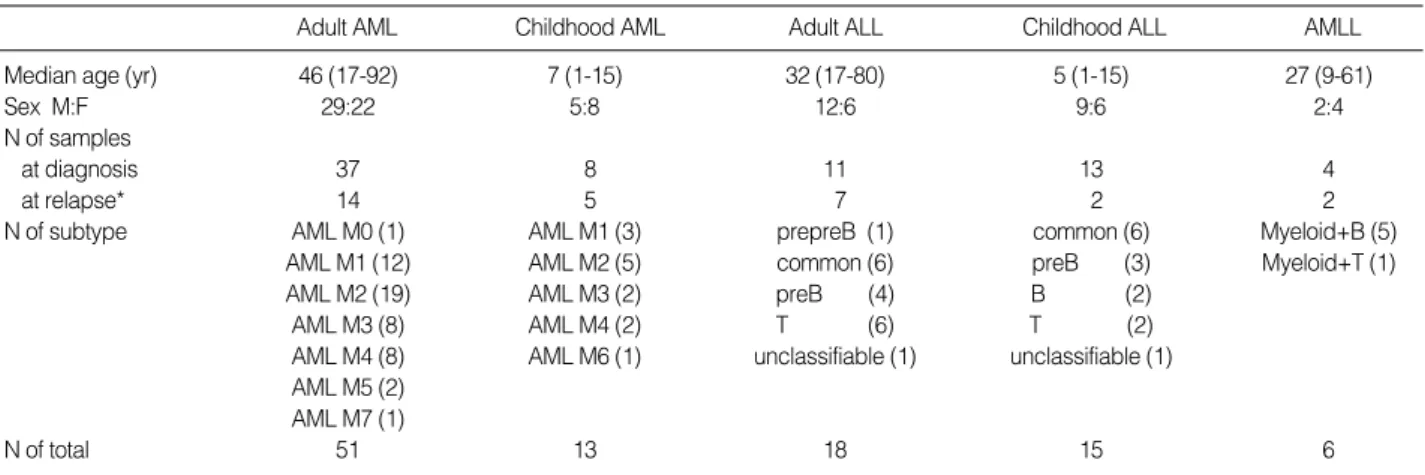
The bone marrow samples were collected from 103 pa- tients with acute leukemia in Asan Medical Center, in- cluding AML (N=64), ALL (N=33) and acute mixed lineage leukemia (AMLL) (N=6) (Table 1). Among
them, 72 patients were newly diagnosed, and 31 patients were either in relapse, transformed from myelodysplastic syndrome, or treated with chemotherapeutic agents due to small cell lung cancer or rectal cell cancer. The diag- nosis of acute leukemia was based on cytomorphology, immunophenotype, and cytogenetics. AML and ALL were diagnosed according to French-American-British (FAB) classification, and AMLL was diagnosed according to the criteria of Grand and Robillard[10]. Patients with AMLL and AML except AML M3 were treated with cytosine arabinoside (AraC) for 7 days and daunorubicin (DNR) for 3 days. Patients with AML M3 were treated with all- trans-retinoic acid (ATRA), AraC, and DNR[11]. ALL patients were treated with vincristine (VCR), dexametha- sone (Dexa), prednisolone, daunorubicin (DNR), and L-as- paraginase (L-ASP) with or without methotrexate (MTX) for induction chemotherapy. Further treatments were done according to the protocol of Craddok et al.[11].
For evaluation of clinical response, we reviewed the medical records of patients for the chemotherapeutic effects, immunophenotyping, and clinical courses. The follow-up period ranged from 0.7 to 67 months. Based on the clin- ical outcomes of induction chemotherapy, patients were divided into three categories: complete remission (CR), non-CR, and no follow-up. The ‘CR’ category included patients who were in CR after induction chemotherapy, the ‘non-CR’ category included patients who did not reach CR, and the ‘no follow-up’ categories included patients who did not receive chemotherapy or died during treat- ment.
Adult AML Childhood AML Adult ALL Childhood ALL AMLL
Median age (yr) 46 (17-92) 7 (1-15) 32 (17-80) 5 (1-15) 27 (9-61)
Sex M:F 29:22 5:8 12:6 9:6 2:4
N of samples
at diagnosis 37 8 11 13 4
at relapse* 14 5 7 2 2
N of subtype AML M0 (1) AML M1 (3) prepreB (1) common (6) Myeloid+B (5)
AML M1 (12) AML M2 (5) common (6) preB (3) Myeloid+T (1)
AML M2 (19) AML M3 (2) preB (4) B (2) AML M3 (8) AML M4 (2) T (6) T (2) AML M4 (8) AML M6 (1) unclassifiable (1) unclassifiable (1) AML M5 (2)
AML M7 (1)
N of total 51 13 18 15 6
Table 1.Patients characteristics
*They were relapsed, transformed from myelodysplastic syndrome, or treated with chemotherapeutic agents due to small cell lung cancer or rectal cell cancer.
2. Separation of mononuclear cells from bone marrow
Freshly obtained bone marrow aspirates were diluted 1:1 or more with RPMI-1640 medium (Gibco Co, Grand Island, NY, USA). Mononuclear cells were separated on Ficoll-Hypaque gradient (density; 1.077 g/mL; Sigma, St.
Louis, MO, USA) at 540 g for 20 min at room tempera- ture. After centrifugation, mononuclear cells were washed twice with RPMI-1640.
Leukemic cell percentages in bone marrow aspirates ranged from 32% to 99% at initial diagnosis, and 31%
to 94% at relapse. The mean percent of leukemic cells were 66.1% (±22.2 SD, range 31-98%) for patients with AML, 74.0% (±22.0 SD, range 33-97%) for adult pati- ents with ALL, and 86.0% (±10.5 SD, range 64-99%) for child patients with ALL.
3. Culture medium and culture suspension
The samples were finally resuspended in culture medi- um containing RPMI-1640, 15% fetal calf serum, 1% L- glutamine, 100 IU/mL penicillin, and 100 g/mL strep- tomycin (Gibco Co, Grand Island, NY, USA). The cell concentration for the MTT assay was finally adjusted to 1×10⁶ cells/mL.
4. MTT assay
The in vitro chemosensitivity tests already established with the HL-60 cell line and SUP-B15 cell line were per- formed. Cell suspension (80 L) was incubated with each drug concentration in 20 L RPMI in duplicate wells of a 96-well round-bottomed microculture plate. Control tumor cells were cultured in the absence of drugs. Plates were then wrapped in cling film and incubated for 2 days (48 hr) at 37℃ in humidified air containing 5% CO2. After 2 days, 50 g (10 L of a solution of 5 mg/mL) of MTT
(Sigma Co, St. Louis, MO, USA) was added to each well.
Plates were shaken and incubated for another 5 hr at 37
℃. During exposure, yellow MTT was reduced into pur- ple formazan by viable cells. The formazan crystals were dissolved with 100 L of dimethylsulfoxide (DMSO) (Sig- ma Co, St. Louis, MO, USA), and the quantity of reduced product was measured by microplate spectrophotometer at 540 nm (CODA Automated EIA Analyzer, Bio-rad, Hercules, CA, USA). The leukaemic cell viability was calculated using the following equation: (OD of drug ex- posed well/mean OD of control wells)×100%. The OD of both control and test wells were adjusted by the OD of blank wells. Next, the dead cell percentage was obtained from the equation of ‘100 minus viability percentage’.
5. Drugs tested
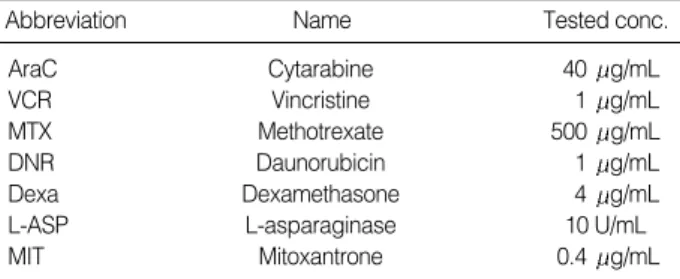
Cytarabine (AraC), vincristine (VCR), methotrexate (MTX), daunorubicin (DNR), dexamethasone (Dexa), L-asparaginase (L-ASP), and mitoxantrone (MIT) were tested. These drugs were selected because AraC, DNR, and MIT are usually given to AML patients and VCR, Dexa, DNR, L-ASP, and MTX are given to ALL patients according to protocol. Dexa was dissolved in saline, and DNR was dissolved in distilled water. The other drugs were dissolved in solutions ready for use. All drugs were further diluted with RPMI-1640. The concentrations of drugs are given in Table 2. In this study, drug concentra- tions were chosen to mimic the in vivo situation[12, 13].
6. Criteria for the response of in vitro chemosensitivity using MTT assay
For each single drug, the result of in vitro chemosen- sitivity was determined to be sensitive ( 50% MTT dead cell) or resistant (<50% MTT dead cell). Based on the chemotherapeutic regimen, patients were classified into three categories according to the combination of two or four drug sensitivities. For AML and AMLL, the sensi- tive (S) category was defined as sensitive to both drugs (AraC and DNR), the intermediate (I) as sensitive to only one drug, and resistant (R) as sensitive to no drugs. For ALL, the S category was defined as sensitive to all or three of the four drugs (VCR, Dexa, DNR, and L-ASP), I as sensitive to two of the four drugs, and R as sensitive to one or none of the drugs.
Abbreviation Name Tested conc.
AraC Cytarabine 40 g/mL
VCR Vincristine 1 g/mL
MTX Methotrexate 500 g/mL
DNR Daunorubicin 1 g/mL
Dexa Dexamethasone 4 g/mL
L-ASP L-asparaginase 10 U/mL
MIT Mitoxantrone 0.4 g/mL
Table 2.Tested concentration of each drug
7. Statistics
The relationship between the MTT assay results and the clinical responses was tested for statistical significance using appropriate t-test and chi-square test. The Kaplan- Meier method was used to estimate survival distribution, and a log rank test was used to analyze differences bet- ween groups. A P value less than 0.05 was considered to be significant. All analyses were performed using the SPSS 11.5 software package (SPSS, Chicago, IL, USA).
RESULTS
1. Clinical course of patients
Among 103 patients, 90 received induction chemother- apy and 13 did not receive chemotherapy (9 patients at initial diagnosis and 4 at relapse). Five patients died dur- ing induction chemotherapy (2 patients at initial diagno- sis and 3 at relapse). Of the 90 treated patients, 62 ac- quired CR within 4 weeks of induction chemotherapy, 2 acquired delayed CR (1.5 and 2.0 months after induction chemotherapy), and the others had partial remission, per- sistence, hypocellular or hypocellular marrow with persis- tence of blasts (Table 3).
2. MTT sensitivity test and clinical outcomes after chemotherapy
For both adult and childhood ALL, patients showing
sensitivity to DNR had a higher CR rate. However, the mean MTT dead cell percentages for each drug were not significantly related to the CR rate in patients with AML.
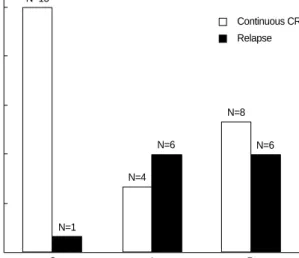
The relationship between the MTT assay results of combination drugs and the clinical response of induction chemotherapy is summarized in Table 4 and Fig. 1. For childhood ALL, many patients with MTT results in the S category achieved CR after induction chemotherapy (Table 4, P=0.011). For AML, patients with results in the S category tended to maintain continuous CR, and patients in the I and R categories tended to undergo relapse (Fig. 1, P=0.010).
The MTT assay results and the period of disease free survivals or overall survivals were not significantly relat- ed. Differences of mean MTT dead cell percentages bet- ween samples at initial diagnosis and those at relapse were not statistically significant.
DISCUSSION
This study was designed to evaluate the predictive value of an MTT in vitro assay for the assessment of leukemic
*S, sensitive to all of two drugs (AraC, DNR); I, sensitive to one of two drugs; R, sensitive to none of two drugs. �S, sensitive to three or all of the four drugs (VCR, Dexa, DNR, LASP); I, sensitive to two of the four drugs; R, sensitive to one or none of the four drugs. �>5% blasts in bone marrow study after induction chemotherapy. �P=0.011.
Abbreviations: CR, complete remission; CTx, chemotherapy; F-U, follow- up; AraC, cytosine arabinoside; DNR, daunorubicin; VCR, vincristine;
Dexa, dexamethasone; LASP, L-asparaginase.
Clinical response
CR Non-CR� No CTx or F-U MTT results
AML (N=64) S* 16 7 5
I* 10 1 4
R* 14 2 5
Adult ALL (N=18) S� 4 2 0
I� 3 1 1
R� 5 1 1
Childhood ALL� S� 9 0 0
(N=15) I� 2 2 0
R� 1 0 1
AMLL (N=6) S* 0 4 0
I* 0 1 0
R* 0 0 1
Table 4.Relationship between MTT assay results of drugs and the clinical response of induction chemotherapy in patients with acute leukemia
*including two patients with delayed complete remission (>4 weeks after induction chemotherapy). �number of patients with continuous complete remission until last follow-up.
Abbreviations: CR, complete remission; CTx, chemotherapy; F-U, follow-up.
AML Adult ALL Childhood AMLL ALL
Samples at diagnosis
CR (CCR�) 32* (21) 8 (6) 11 (10) -
Non-CR 4 2 1 3
No CTx or F-U 8 1 1 1
Samples at relapse
CR (CCR�) 8 (6) 4 (4) 1 (1) -
Non-CR 6 2 1 2
No CTx or F-U 6 1 - -
Total No. 64 18 15 6
Table 3.Long-term outcomes of patients with acute leukemia (N=103)
cell susceptibility to 7 chemotherapeutic drugs, and to com- pare these results with clinical response in 103 cases of acute leukemia.
In many patients, a temporary phase of clinical remis- sion is followed by a relapse primarily consisting of chemo- resistant tumor cells, which is frequently associated with clinically refractory disease. This may be caused by unfa- vorable cytogenetic of leukemic cells, lack of expected pharmacokinetics, cellular drug resistance, pharmacological resistance, and the persistence of minimal residual disease [5, 14, 15]. Cellular drug resistance is supposed to play a major role in chemotherapy failures of both newly diag- nosed cases and relapse cases of acute leukemia[8, 9]. A more detailed insight regarding drug resistance may be used as a rationale to develop more effective treatment regimens for such patients.
In spite of the fact that in vitro chemosensitivity test- ing in acute leukemia has been studied for many years and that good positive correlations have been observed between the chemosensitivity results and both short term and long term outcome, these techniques have not been established in clinical practice. Although the low in vitro proliferative capacity of leukemic cells limited their use, this problem can be bypassed via short-term cell culture drug-resistance assays, such as the MTT assay[2]. These assays are based on measuring total cell killing of both
proliferating and nonproliferating cells, and measuring the end effect of actual resistance mechanisms. The MTT assay cannot discriminate between malignant and nonma- lignant cells and may lead to an overestimation of drug resistance, because the latter are significantly more drug resistant. However, because of the high efficiency of the MTT assay, it is commonly used for determining chemo- sensitivity of cell lines and suggesting the chemosensitiv- ity of leukemic cells obtained from patients.
In several previous studies, the association between val- ues of MTT sensitivity and clinical response to chemo- therapy was shown[16, 17]. Moreover, the chemosensitivi- ty of samples at diagnosis of ALL was identified to be as an important prognostic factor for disease free survival [18, 19]. In this study, it was also found that a relation- ship between in vitro chemosensitivity of drug and clini- cal response after induction chemotherapy in patients with childhood ALL exists (Table 4, P=0.011). Another find- ing showed that in vitro sensitivity of lymphoblasts to DNR is significantly related to the clinical response in both adult and childhood ALL.
For AML, high in vitro drug resistance could partially explain unfavorable clinical results of therapy, when com- pared to ALL[1, 20]. One of the reasons for the poor therapeutic outcomes may be cellular drug resistance to chemotherapy. In this study, in vitro chemosensitivity is significantly related to continuous complete remission or relapse (Fig. 1, P=0.010). However, differences in each drug sensitivity were not significant between clinical res- ponder and nonresponder in both this study and other studies[20].
It is commonly assumed that relapsed patients are more drug resistant than those initially diagnosed. The results of this study showed that there were no differences in MTT assay results between samples taken at diagnosis and at relapse for both AML and ALL. In other studies for AML[5, 14], no significant differences were reported as well. In general, relapsed AML has a dismal progno- sis, which is largely associated to the length of the time- interval between initial diagnosis and relapse. It seems that factors other than cellular drug resistance can play a key role in failure of relapsed AML therapy. However, in other ALL studies, lymphoblasts from children with relapsed ALL were more resistant in vitro to most front line drugs when compared with those of a historical control group of children with newly diagnosed ALL[6].
Fig. 1.The relation between the MTT sensitivity and the long-term outcome of patients who acquired the initial complete remission (N=40) in acute myeloid leukemia (P=0.010). S was defined as sensitive to all of two drugs (AraC, DNR); I, sensitive to one of two drugs; R, sensitive to none of two drugs.
Abbreviations: AraC, cytosine arabinoside; DNR, daunorubicin.
N of patients
MTT sensitivity 15
12
9
6
3
0 S I R
N=15
N=1
N=4
N=6 N=6
N=8
Continuous CR Relapse
In conclusion, in vitro chemosensitivity test with MTT assay significantly predicted whether patients remain con- tinuous complete remission or undergo relapse in AML, and whether patients acquire complete remission or not after induction chemotherapy in childhood ALL. There- fore, although it does not provide insights into the mech- anisms that cause drug resistance, the MTT assay may be a useful tool for optimizing individual chemotherapy in patients with acute leukemia.
요 약
배경 : 세포성 약물내성은 화학요법의 실패나 재발에 중요한 역할을 하는 것으로 생각되고 있어 본연구에서는 3-(4,5-Dime- thylthiazol-2-yl)-2,5-diphenyltetrazolium bromide (MTT)법을 이용한 체외 화학요법제 감수성검사결과와 화학요법에 대한 임상 적 반응과의 연관성을 분석함으로써, 환자마다 각자의 약물내성 에 따른 적절한 치료를 시행할 수 있는 가능성을 찾고자 하였다.
방법 : 급성백혈병을 진단받았거나 재발한 103명의 환자로부터 골수흡입액을 채취하여 cytarabine, vincristine, methotrexate, daunorubicin, dexamethasone, L-asparaginase 및 mitoxantrone 의 화학요법제에 대하여 MTT법을 이용한 감수성검사를 시행하 였으며, 유도요법후의 골수검사 결과로 임상반응을 평가하였다.
결과 : MTT법을 이용한 체외 화학요법제 감수성검사에서 내 성이 있는 환자군에서 급성골수성백혈병의 경우는 재발률이 통계 적으로 유의하게 높았으며, 소아 급성림프구성백혈병의 경우는 유도요법 후 완전관해에 도달하는 환자의 비율이 통계적으로 유 의하게 낮았다.
결론 : 본 연구에서 MTT법을 이용한 화학요법제 감수성검사 는 약물내성 발생의 원인에 대한 정보를 제공할 수는 없으나, 화 학요법에 대한 치료반응 예측에 유용한 방법인 것으로 생각되며, 약제감수성에 따른 화학요법의 개인별 사전조절의 가능성을 보여 주었다.
REFERENCES
1. Creutzig U, Ritter J, Zimmermann M, Hermann J, Gadner H, Sawatz- ki DB, et al. Idarubicin improves blast cell clearance during induc- tion therapy in children with AML: results of study AML-BFM 93.
AML-BFM Study Group. Leukemia 2001;15:348-54.
2. Veerman AJ and Pieters R. Drug sensitivity assays in leukaemia and lymphoma. Br J Haematol 1990;74:381-4.
3. Kim HK, Kim YK, Kim DW, Paik SY. Study on the Optimal Storage Condition for Granulocyte Transfusion using MTT assay. Korean J
Clin Pathol 1990;10:461-9. (김혜경, 김영기, 김대원, 백승룡. MTT 측정 검사를이용한과립구수혈의시한에관한연구. 대한임상병리학회지1990;
10:461-9.)
4. Morabito F, Stelitano C, Callea I, Dattola A, Console G, Pucci G, et al.
In vitro drug-induced cytotoxicity predicts clinical response to flu- darabine in B-cell chronic lymphocytic leukaemia. Br J Haematol 1998;102:528-31.
5. Styczynski J and Wysocki M. Ex vivo drug resistance in childhood acute myeloid leukemia on relapse is not higher than at first diag- nosis. Pediatr Blood Cancer 2004;42:195-9.
6. Klumper E, Pieters R, Veerman AJ, Huismans DR, Loonen AH, Ha- hlen K, et al. In vitro cellular drug resistance in children with relaps- ed/refractory acute lymphoblastic leukemia. Blood 1995;86:3861-8.
7. Klumper E, Pieters R, Kaspers GJ, Huismans DR, Loonen AH, Rot- tier MM, et al. In vitro chemosensitivity assessed with the MTT assay in childhood acute non-lymphoblastic leukemia. Leukemia 1995;9:
1864-9.
8. Styczynski J, Pieters R, Huismans DR, Schuurhuis GJ, Wysocki M, Veerman AJ. In vitro drug resistance profiles of adult versus child- hood acute lymphoblastic leukaemia. Br J Haematol 2000;110:813-8.
9. Zwaan CM, Kaspers GJ, Pieters R, Hahlen K, Janka-Schaub GE, van Zantwijk CH, et al. Different drug sensitivity profiles of acute myeloid and lymphoblastic leukemia and normal peripheral blood mononu- clear cells in children with and without Down syndrome. Blood 2002;
99:245-51.
10. Garand R and Robillard N. Immunophenotypic characterization of acute leukemias and chronic lymphoproliferative disorders: practi- cal recommendations and classifications. Hematol Cell Ther 1996;38:
471-86.
11. Craddock C, Tauro S, Moss P, Grimwade D. Biology and manage- ment of relapsed acute myeloid leukaemia. Br J Haematol 2005;129:
18-34.
12. Hongo T, Yajima S, Sakurai M, Horikoshi Y, Hanada R. In vitro drug sensitivity testing can predict induction failure and early relapse of childhood acute lymphoblastic leukemia. Blood 1997;89:2959-65.
13. Mollgard L, Tidefelt U, Sundman-Engberg B, Lofgren C, Paul C. In vitro chemosensitivity testing in acute non lymphocytic leukemia using the bioluminescence ATP assay. Leuk Res 2000;24:445-52.
14. Zwaan CM, Kaspers GJ, Pieters R, Hahlen K, Huismans DR, Zim- mermann M, et al. Cellular drug resistance in childhood acute mye- loid leukemia is related to chromosomal abnormalities. Blood 2002;
100:3352-60.
15. Guerrasio A, Pilatrino C, De Micheli D, Cilloni D, Serra A, Gottardi E, et al. Assessment of minimal residual disease (MRD) in CBFbe- ta/MYH11-positive acute myeloid leukemias by qualitative and quantitative RT-PCR amplification of fusion transcripts. Leukemia
2002;16:1176-81.
16. Mihal V, Hajduch M, Noskova V, Janostakova A, Safarova M, Orel M, et al. The analysis of correlations between drug resistance and clinical/laboratory measures found in a group of children with all treated by ALL-BFM 90 protocol. Bull Cancer 2004;91:80-9.
17. Mihal V, Hajduch M, Noskova V, Feketova G, Jess K, Gojova L, et al.
Differential antileukemic activity of prednisolone and dexametha- sone in freshly isolated leukemic cells. Adv Exp Med Biol 1999;457:
461-71.
18. Pieters R, den Boer ML, Durian M, Janka G, Schmiegelow K, Kaspers GJ, et al. Relation between age, immunophenotype and in vitro drug
resistance in 395 children with acute lymphoblastic leukemia--impli- cations for treatment of infants. Leukemia 1998;12:1344-8.
19. Kaspers GJ, Pieters R, Van Zantwijk CH, Van Wering ER, Van Der Does-Van Den Berg A, Veerman AJ. Prednisolone resistance in child- hood acute lymphoblastic leukemia: vitro-vivo correlations and cross- resistance to other drugs. Blood 1998;92:259-66.
20. Styczynski J, Wysocki M, Debski R, Juraszewska E, Malinowska I, Stanczak E, et al. Ex vivo drug resistance profile in childhood acute myelogenous leukemia: no drug is more effective in comparison to acute lymphoblastic leukemia. Leuk Lymphoma 2002;43:1843-8.