TCP
Transl Clin Pharmacol http://dx.doi.org/10.12793/tcp.2017.25.1.10 2017;25(1):10-14Comparative pharmacokinetic and tolerability evaluation of two simvastatin 20 mg formula- tions in healthy Korean male volunteers
Seol Ju Moon
1, SeungHwan Lee
1, Kyungho Jang
1, Kyung-Sang Yu
1, Sung-Vin Yim
2and Bo-Hyung Kim
2*
1Department of Clinical Pharmacology and Therapeutics, Seoul National University College of Medicine and Hospital, Seoul 03080, Ko- rea, 2Department of Clinical Pharmacology and Therapeutics, Kyung Hee University College of Medicine and Hospital, Seoul 02447, Korea
*Correspondence: B.H. Kim; Tel: +82-2-958-9567, Fax: +82-2-958-9559, E-mail: [email protected]
Simvastatin is used to reduce plasma cholesterol by inhibiting 3-hydroxy-3-methylglutaryl coen- zyme A (HMG-CoA) reductase and is primarily used to treat hypercholesterolemia. This study was conducted to assess the bioequivalence between the generic formulation of simvastatin 20 mg and the branded formulation of simvastatin 20 mg. A generic formulation of simvastatin 20 mg tablet was developed and the pharmacokinetics of the generic formulation were compared with those of the branded formulation of simvastatin 20 mg tablet in 33 healthy male volunteers after a single oral dose in a randomized, open-label, two-period, two-sequence, crossover study. The reference (Zocor®, MSD Korea LTD.) and test (Simvarotin®, Korea Arlico Pharm Co., Ltd.) formulations, two 20 mg tablets each, were administered to all subjects in fasting status. The serial blood samples for pharmacokinetic analysis were collected before dosing and up to 24 hours post-dose, and plasma concentrations of simvastatin were determined by liquid chromatography-tandem mass spectrom- etry. The pharmacokinetic parameters including Tmax, Cmax, AUClast, AUCinf and t1/2 were calculated for both formulations by non-compartmental method, and the log-transformed Cmax and AUClast were compared statistically. Geometric mean ratios (90% confidence intervals) of the test to the reference formulation in Cmax and AUClast were 0.9652 (0.8302–1.1223) and 0.9891 (0.8541–1.1455), respectively. No significant differences in tolerability profiles were noted between the two formula- tions. The two formulations of simvastatin 20 mg tablets exhibited comparable pharmacokinetic profiles and 90% confidence intervals were within the acceptable range of bioequivalence criteria.
Received 5 Dec 2016 Revised 5 Jan 2017 Accepted 5 Jan 2017
Keywords
Simvastatin, Pharmacokinetics, Bioequivalence pISSN: 2289-0882 eISSN: 2383-5427
BE REPORT
Copyright © 2017 Translational and Clinical Pharmacology
It is identical to the Creative Commons Attribution Non-Commercial License (http://creativecommons.org/licenses/by-nc/3.0/).
This paper meets the requirement of KS X ISO 9706, ISO 9706-1994 and ANSI/NISO Z.39.48-1992 (Permanence of Paper).
Introduction
Simvastatin is an anti-hyperlipidemic agent primarily used to treat hypercholesterolemia. It specifically inhibits the enzyme 3-hydroxy-3-methylglutaryl coenzyme A (HMG-CoA) reduc- tase. Inhibition of this enzyme results in plasma cholesterol level reduction by inhibiting cholesterol biosynthesis and increasing the number of low-density lipoprotein (LDL) receptors on both hepatic and extrahepatic tissues. The elevation of the number of LDL receptors enhances sequestering of LDL from blood circu-
lation and promotes its catabolism in the liver resulting in low- ering of plasma LDL level. Simvastatin is also known to reduce the level of triglyceride and increase high-density lipoprotein cholesterol level.[1]
Simvastatin is an inactive prodrug that is absorbed well through the oral route and undergoes extensive first-pass he- patic metabolism, resulting in its low oral bioavailability (ap- proximately 5%). Simvastatin is hydrolyzed into simvastatin β-hydroxyacid by esterases or paraoxonases in the liver and this metabolite competes for and specifically inhibits HMG-CoA re- ductase. Simvastatin and simvastatin β-hydroxyacid both exhib- it high (approximately 95%) human plasma protein binding;[2]
simvastatin β-hydroxyacid is metabolized by cytochrome P450 enzyme. In the 14C-labeled simvastatin study, 13% of the ad-
TCP
Transl Clin Pharmacol
ministered dose is excreted through urine whereas 60% of the administered dose is excreted via fecal route.[3] The elimination half-life of simvastatin is 2 hours, which is similar to that of sim- vastatin β-hydroxyacid (1.9 hours). Owing to its short elimina- tion half-life, long-term administration of simvastatin did not result in accumulation of simvastatin or its metabolite.
The anti-hyperlipidemic drug market is continuously expand- ing in Korea and is expected to be over US $500 million. A number of simvastatin generic products have been introduced to the market by various manufacturers. One such new generic tablet formulation of simvastatin 20 mg (Simvarotin®) was de- veloped by Korea Arlico Pharm Co., Ltd., Korea. The objective of this study was to evaluate and compare the pharmacoki- netic profile and the tolerability of Simvarotin® with that of the branded formulation Zocor® (MSD Korea LTD.).
Methods
Investigational products
Simvarotin® (simvastatin 20 mg tablet, Korea Arlico Pharm Co., Ltd.) and Zocor® (simvastatin 20 mg tablet, MSD Korea LTD.) were used as the test and reference investigational prod- ucts, respectively.
Subjects
Thirty-four healthy adult male volunteers were enrolled in this study and informed consent was obtained from each prior to the commencement of study. The study was performed ac- cording to the Declaration of Helsinki for biomedical research involving human subjects and the rules of Korean Good Clini- cal Practices were followed. All subjects were in good physical condition as determined by clinical laboratory tests and physi- cal examination. Subjects who took the drugs that might affect the pharmacokinetics of simvastatin 10 days prior to the com- mencement of study, who participated in other clinical studies within 3 months prior to the commencement of study, or who experienced hypersensitivity to simvastatin were excluded from the study.
Study design
This study was designed as a randomized, open-label, two- sequence, two-period crossover study under fasting conditions.
Subjects were admitted to the Kyung Hee University Hospital one day prior to the day of dosing and were discharged from the hospital 24 hours after dosing. Subjects were abstained from excessive exercise, smoking, and consuming alcohol or caffeine- containing drinks and kept under fasting state for more than 10 hours before dosing. Subjects in sequence A received two tab- lets of the reference product (simvastatin, 40 mg) first and after a 7-day washout interval then received two tablets of the test product (simvastatin, 40 mg), whereas subjects in sequence B were administered test product first and after the same washout interval, the reference product. The subjects were randomly as-
signed to either of the two groups (i.e. A and B, in the ratio of 1:1) and administered the test or reference product along with 240 mL water orally.
Blood samples were obtained from the antecubital vein of the forearm at the following time points: 0 (pre-dose), 0.33, 0.67, 1, 1.33, 1.67, 2, 2.5, 3, 3.5, 4, 5, 6, 8, 10, 12 and 24 hours after administration of investigational products. Blood samples were centrifuged at 1,800 g for 10 minutes at 4°C, the separated plasma transferred to Eppendorf tubes, and stored below -70°C until the determination of simvastatin concentration.
Determination of plasma simvastatin concentration Simvastatin concentrations in plasma were measured by a validated liquid chromatography-tandem mass spectrometry (LC-MS/MS) method. The internal standard, lovastatin 100 μg/
mL, were used in calibration. For each plasma sample, 100 μL of internal standard was added to the 0.5 mL plasma and vortexed thoroughly for 10 seconds. The mixture was extracted with 3 mL of methyl-t-butyl ether. The ether mix was vortexed for 3 minutes and centrifuged at 4,000 rpm for 5 minutes. The ether layer (approximately 2.5 mL) was transferred to another tube and evaporated under a stream of nitrogen gas. Then 200 μL of acetonitrile:methanol:2 mM ammonium formate = 50:20:30 (v/
v/v, pH=4.5) mixture was added to solubilize the residue, and 10 μL of this solution was injected into the LC-MS/MS system for analysis. Within the concentrations of 0.2 to 20.0 ng/mL, intra-day variation in precision (%CV, coefficient of variation) was ≤ 6.39% which was within 98.25% to 110.00 % in accuracy;
inter-day variation in precision was ≤ 8.86% which was within 98.64% to 101.86% in accuracy.
Pharmacokinetic analysis
A non-compartmental method using Phoenix® WinNonlin®
software version 6.3 (Certara, St. Louis, MO, USA) was em- ployed to calculate the pharmacokinetic parameters of simv- astatin. The maximum observed concentration (Cmax) and the time to reach Cmax (Tmax) were determined. The area under the concentration-time curve from time zero to time of last quan- tifiable concentration (AUClast) was determined by the linear trapezoidal rule. The AUC from the last measurable time to infinity (AUCextra) was calculated as Clast/λz, (Clast: last measur- able concentration, λz: elimination rate constant), and the AUC from time zero to infinity (AUCinf) was calculated as AUClast
+ AUCextra. The percentage of AUCextra (%) represented as 100×[(AUCinf - AUClast)/AUCinf]. The elimination rate constant (λz) was obtained as the slope of the linear regression of the log- transformed concentration versus time data in the terminal phase and the elimination half-life (t1/2) was calculated as ln 2/
λz.
Statistical analysis
The pharmacokinetic parameters were statistically analyzed using SPSS® software version 21.0 (IBM® SPSS® Statistics for Seol Ju Moon, et al.
TCP
Transl Clin PharmacolWindows, Armonk, NY). Log-transformed Cmax and AUClast
were compared between the test and reference formulations by analysis of variance as a mixed model. It was explained by con- sidering the sequence, treatment, and period as the fixed effects and the subjects nested within the sequence as a random ef- fect. The 90% confidence intervals (CIs) of the geometric mean ratios of test/reference formulations for Cmax and AUClast were estimated to assess the bioequivalence of the two formulations.
The products were considered bioequivalent if the 90% CIs for these parameters were within the range of
0.80-1.25.
Tolerability assessment
Tolerability was assessed based on vital signs, physical examinations, and adverse events. Vital signs were monitored im- mediately prior to dosing and before discharge. Adverse events were recorded through interviews which include direct questionings throughout the study.
Results
A total of 34 subjects were recruited to the current study and one subject was dropped out due to consent withdrawal. Demo- graphic information and pharmacokinetics were analyzed for 33 subjects who com- pleted the study. Average age of subjects was 23.3 ± 2.6 (mean ± standard deviation) years, mean height was 174.8 ± 6.3 cm and average weight was 68.2 ± 9.2 kg.
Both formulations showed comparable concentration-time profiles as shown in Figure 1. Cmax of the reference and test
formulations were 6.21 ± 3.70 μg/L and 5.56 ± 2.39 μg/L, respec- tively. AUClast of the reference and test formulations were 28.52
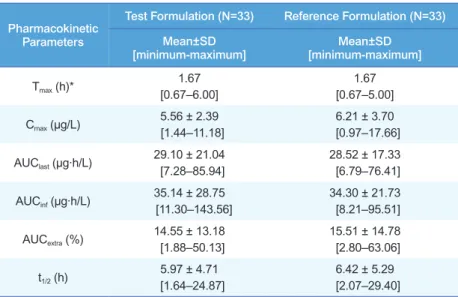
± 17.33 μg·h/L and 29.10 ± 21.04 μg·h/L, respectively. Other cal- culated pharmacokinetic parameters are summarized in Table 1.
Individual concentration-time profiles for each formulation were presented in Figure 2, and individual Cmax and AUClast were com- pared between the formulations in Figure 3.
The values of the log-transformed Cmax and AUClast were com- pared between the reference and test formulations; the geo-
Table 1. Pharmacokinetic parameters of simvastatin 40 mg (20 mg tablet x 2 tablets) after a single oral administration of the reference and test formulations
Pharmacokinetic Parameters
Test Formulation (N=33) Reference Formulation (N=33) Mean±SD
[minimum-maximum] Mean±SD
[minimum-maximum]
Tmax (h)* 1.67
[0.67–6.00]
1.67 [0.67–5.00]
Cmax (μg/L) 5.56 ± 2.39 [1.44–11.18]
6.21 ± 3.70 [0.97–17.66]
AUClast (μg·h/L) 29.10 ± 21.04 [7.28–85.94]
28.52 ± 17.33 [6.79–76.41]
AUCinf (μg·h/L) 35.14 ± 28.75 [11.30–143.56]
34.30 ± 21.73 [8.21–95.51]
AUCextra (%) 14.55 ± 13.18
[1.88–50.13]
15.51 ± 14.78 [2.80–63.06]
t1/2 (h) 5.97 ± 4.71 [1.64–24.87]
6.42 ± 5.29 [2.07–29.40]
All values are expressed as mean ± standard deviation, except of Tmax values expressed as median (minimum-maximum). Tmax, time to reach Cmax; Cmax, peak plasma concentration of simvastatin; AUClast, area under the plasma concentration-time curve from time zero to last measurable time; AUCinf, AUC from time zero to infinity; AUCextra (%), percentage of AUC from the last measurable time to infinity; t1/2, elimination half-life.
Figure 1. Mean plasma simvastatin concentration versus time profile of the reference and test formulations after a single oral administration of sim- vastatin 40 mg (20 mg x 2 tablets) in linear (left) and semi-logarithmic (right) scale.
Comparative pharmacokinetic and tolerability evaluation of two simvastatin 20 mg formulations
TCP
Transl Clin Pharmacol
Seol Ju Moon, et al.
metric mean ratios (90% CIs) of Cmax and AUClast were 0.9652 (0.8302–1.1223) and 0.9891 (0.8541–1.1455), respectively. The 90% CI values were within the range of 0.80 – 1.25 and were ac- cordant with the bioequivalence criteria (Table 2).
Both the reference and test formulations were well tolerated with no serious adverse events reported; there were no clinically relevant findings in the evaluation of tolerability.
Discussion
The Cmax and AUClast of simvastatin after a single oral adminis- tration of the reference and test formulations were comparable and both formulations of simvastatin were well tolerated in all subjects who completed the study.
Simvastatin is marketed as various formulations and in vari- ous strengths in Korea. While simvastatin is available as 10 mg to 40 mg tablets, a starting dose of 20 mg is recommended for patients with hypercholesterolemia, coronary vessel disease and who are at low risk of developing coronary events. Meanwhile,
Table 2. Comparison of Cmax, AUClast and AUCinf of simvastatin after a single oral administration of the 2 reference tablets and 2 test tablets Geometric Mean (N=33) Geometric Mean Ratio
(Test / Reference) 90% Confidence Interval Test Reference
Cmax (μg/L) 5.05 5.25 0.9652 0.8302 – 1.1223
AUClast (μg·h/L) 23.38 23.72 0.9891 0.8541 – 1.1455
AUCinf (μg·h/L) 27.76 28.67 0.9726 0.8148 – 1.1608
Figure 2. Individual plasma simvastatin concentration versus time pro- file of the reference (upper) and test formulations (lower) after a single oral administration in linear scale.
Figure 3. Comparison of the individual Cmax (upper) and AUClast (lower) between the reference and test formulations after a single oral admin- istration.
TCP
Transl Clin Pharmacolit was reported that a daily dose of simvastatin 40 mg efficiently reduced serum LDL by 41%, reduced serum triglyceride by 18%, and increased serum HDL by 12%.[4] Therefore, two tablets of simvastatin 20 mg (i.e. a total of 40 mg) were used to assess the bioequivalence of the two formulations in the current study.
Since simvastatin is a prodrug that is hydrolyzed to its active form, it is customary to measure the concentrations of simvas- tatin and its metabolite simvastatin β-hydroxyacid for bioequiv- alence studies.[5,6] However, in the current study, only simv- astatin concentrations were measured and compared between the two formulations. The guidance outlined by the Ministry of Food and Drug Safety of Korea does not require the measure- ment and comparison of active metabolites, and the European Medicines Agency (EMA) guideline on the investigation of bioequivalence suggests that the assessment of bioequivalence for parent compound is recommended for inactive prodrugs.[7]
Also, the U.S. FDA indicated in the Draft Guidance for Industry that for the bioequivalence studies, measurement of only the parent drug release from the dosage form is generally recom- mended and that the rationale for this recommendation is that the concentration-time profiles of the parent form is more sen- sitive to changes in formulation performance than the metabo- lites.[8,9]
Meanwhile, although these regulatory guidelines targeted on the bioequivalence of the parent drug, it is possible that the plas- ma concentrations of simvastatin are not proportionally related to the concentrations of active simvastatin β-hydroxyacid me- tabolites. However, according to a previous study that measured the AUC of simvastatin metabolites after oral administration of a radiolabeled dose of simvastatin, the AUC of active inhibitors (simvastatin metabolites) generally increased in linear correla- tion with increasing oral simvastatin doses over the range of 5 to 120 mg in healthy volunteers.[9,10] Also, another literature reported that the increment of simvastatin from 5 to 120 mg increases the pharmacological activity in a linear pattern.[9]
Hence, the measurement of simvastatin concentration without measuring its active metabolite would not limit the bioequiva- lence evaluation.
In the current study, the mean values of t1/2 were reported to be 6.42 h (reference) and 5.97 h (test), which indicates that the pharmacokinetic sampling time of up to 24 hours post dose, ap- proximately four times the half-life, was adequate in this study.
In previous studies, the inter-subject CVs were 52~53% for simvastatin Cmax and 48~76% for simvastatin AUC.[5,11] Con- sidering these large inter-subject variabilities, the intra-subject CVs for Cmax and AUC were assumed to be approximately 30%
in the current study. With this information, a sample size of 32 subjects was required to attain the 80% power at a 5% signifi- cance level, assuming a mean ratio (test/reference) of Cmax or
AUC of 1 and a 30% intra-subject CV for Cmax or AUC. There- fore, a total of 34 subjects were deemed as an adequate sample size based on the dropout rate of 5%.[12]
Double peaks of the simvastatin concentration were reported in this study, which was consistent with the findings from other bioequivalence studies of simvastatin.[5,6] The individual plots (Fig. 2, 3) show that there are considerable individual variations in the plasma concentrations of simvastatin, and this may have resulted in the double peaks in the mean concentration-time profile in part.
In conclusion, the two formulations of the simvastatin 20 mg tablets exhibited comparable pharmacokinetic profiles and the 90% CIs were within the acceptable range of bioequivalence criteria. These two formulations, therefore, are expected to be administered to patients interchangeably without pharmacoki- netic or tolerability concerns.
Acknowledgements
This study was sponsored by Korea Arlico Pharm Co., Ltd., Seoul, Korea.
Conflict of interest
The authors declare no conflict of interest.
References
1. Plosker GL, McTavish D. Simvastatin. A reappraisal of its pharmacology and therapeutic efficacy in hypercholesterolaemia. Drugs 1995;50:334-363.
2. Vickers S, Duncan CA, Chen IW, Rosegay A, Duggan DE. Metabolic disposi- tion studies on simvastatin, a cholesterol-lowering prodrug. Drug Metab Dis- pos 1990;18:138-145.
3. Mauro VF, MacDonald JL. Simvastatin: a review of its pharmacology and clinical use. DICP 1991;25:257-264.
4. Schachter M. Chemical, pharmacokinetic and pharmacodynamic properties of statins: an update. Fundam Clin Pharmacol 2005;19:117-125.
5. Najib NM, Idkaidek N, Adel A, Admour I, Astigarraga RE, Nucci GD, et al.
Pharmacokinetics and bioequivalence evaluation of two simvastatin 40 mg tablets (Simvast and Zocor) in healthy human volunteers. Biopharm Drug Dis- pos 2003;24:183-189.
6. Tseng CM, Huang CC, Ho MC, Chen YA, Shieh YH, Chen IK. Bioequivalence assessment of two simvastatin tablets in healthy Taiwanese volunteers. J Food Drug Anal 2007;15:15-19.
7. Guideline on the Investigation of Bioequivalence. http://www.ema.europa.eu/
docs/en_GB/document_library/Scientific_guideline/2009/09/WC500003011.
pdf Accessed Novermber 1 2016
8. FDA Guidance for Industry: Bioavailability and Bioequivalence Studies for Orally Administered Drug Products - General Considerations. CDER/FDA, Washington, March 2003 http://www.fda.gov/ohrms/dockets/ac/03/briefing/
3995B1_07_GFI-BioAvail-BioEquiv.pdf Accessed Novermber 1 2016 9. Midha KK, Rawson MJ, Hubbard JW. The role of metabolites in bioequiva-
lence. Pharma Res 2004;21:1331-1344.
10. Mauro VF. Clinical pharmacokinetics and practical applications of simvastatin.
Clin Pharmacokinet 1993;24:195-202.
11. Yun H, Kang W, Kwon K. Evaluation of the bioequivalence of simvastatin 20 mg tablets in healthy volunteers. Kor J Clin Pharm 2005;15:41-45.
12. Chow SC, Wang H. On sample size calculation in bioequivalence trials. J Pharmacokinet Pharmacodyn 2001;28:155-169.
Comparative pharmacokinetic and tolerability evaluation of two simvastatin 20 mg formulations