Received: September 26, 2019 Accepted: October 31, 2019
Address for Correspondence: Hee Dong Chae, Department of Obstetrics and Gynecology, Asan Medical Center, University of Ulsan College of Medicine, 88 Olympic-ro 43-gil, Songpa-gu, Seoul 05505, Korea
Tel: 82-2-3010-3649, E-mail: [email protected], ORCID: https://orcid.org/0000-0002-6601-6174
ORIGINAL ARTICLE
INTRODUCTION
Breast cancer is the most commonly diagnosed cancer in South Korean women [1]. Due to improvements in early diagnosis and treatment, the mortality rate has declined over the past few years. Approximately 93% of female breast cancer patients survive for more than 5 years [2]. The majority of women diagnosed are post- menopausal, but numbers of young women with breast
cancer have been steadily increasing [3].
The prognosis for young women diagnosed with breast cancer appears to be less favorable than that for older women because many young patients tend to have more biologically aggressive forms of the disease [4,5]. However, if they are diagnosed in the early stages, young female patients are more likely to survive their disease because of improved treatment options. The majority of anticancer treatments, including surgery,
The Importance of Education regarding the Effects of Anticancer Treatment on Fertility and Ovarian Function in the Female Patients with Breast Cancer
Sunah Shin1, Juhee Kim1, Doyoung Kim1, Hyunjin Kim1, Sara Lee1, Sung Hoon Kim1, Hee Dong Chae1, Byung Moon Kang1, Min Kyeong Kim2, Eun Young Chae3, Jeong Eun Kim4, Il Young Chung5, Hee Jeong Kim5
1Department of Obstetrics and Gynecology, Asan Medical Center, University of Ulsan College of Medicine, Seoul, Korea, 2Department of Cancer Center, Asan Medical Center, Seoul, Korea, 3Department of Radiology, Asan Medical Center, University of Ulsan College of Medicine, Seoul, Korea, 4Department of Oncology, Asan Medical Center, University of Ulsan College of Medicine, Seoul, Korea,
5Department of Surgery, Asan Medical Center, University of Ulsan College of Medicine, Seoul, Korea
Objectives: Female breast cancer patients generally have limited knowledge regarding issues related to preservation of ovarian function and fertility. The present study aimed to explore the change in the understanding of these issues when female breast cancer patients are educated and counseled about ovarian function and fertility after anticancer treatment.
Methods: One hundred nine young female breast cancer patients completed a questionnaire, which revealed their thoughts and opinions before and after receiving the education about ovarian function and fertility. Their responses were analyzed to determine the impact of the education on their perception and understanding of the aforementioned issues.
Results: The objective survey had four main themes: planning and desire for children, degree of baseline understanding of the effects of anticancer therapy on fertility and ovarian function, resultant change in cognition after education about cancer treatment and its relationship with fertility, and need for education regarding the types of therapies received and their effects on subsequent ovarian function and fertility before treatment.
Conclusions: The preservation of ovarian function and fertility is an important factor that must be included in the discussion prior to initiation of anticancer therapy. Although the study results do not have high educational effectiveness or a high satisfaction with education, there is a need for information and education regarding the impact of anticancer treatment on preservation of ovarian function and fertility.
Key Words: Breast cancer, Education, Preservation of fertility and ovarian function
chemotherapy, radiotherapy, and endocrine therapy, have substantial effects on gonadal function and may lead to loss of fertility and early menopause [6]. Many breast cancer patients younger than 40 years recover menses within one year from cessation of treatment.
The incidence of permanent amenorrhea after antican- cer treatment is estimated to be between 33% and 76%
in women aged 50 years or younger [7]. Thus, many young female breast cancer survivors have concerns for fertility and ovarian function.
Unfortunately, premenopausal women with breast cancer are not well informed or fully aware of the adverse effects of breast cancer treatment on fertil- ity and ovarian function [8,9]. Previous studies have demonstrated that patients’ knowledge of options for preservation of fertility and ovarian function prior to consultation is generally poor [10,11]. Some oncology professionals do not engage in discussion with cancer patients about the preservation of fertility and ovarian function after completion of cancer treatment or even before the onset of therapy, which would have allowed for the consideration of different treatment options [12- 14]. This may be because of insufficient knowledge of the options and time constraints with premenopausal patients.
In the context of efforts to improve the information provided after cancer diagnosis, the aim of our study is to measure the effects of education on topics of fertility and ovarian function among premenopausal women with breast cancer and to support strategies for deliv- ering that information to young female breast cancer patients. Increased knowledge of the issues related to fertility may influence pre- and post-education deci- sions.
MATERIALS AND METHODS
Data collection and analysis
The study participants were under 35 years of age female patients with a biopsy-proven breast cancer di- agnosis immediately. And they were going to be treated including surgical or medical therapy at Asan Medical Center between the years 2016 and 2017.
The participants were 119 patients and given a ques- tionnaire (Supplementary Material 1, available online), which revealed their thoughts and opinions before and after receiving education. Because there were par- ticipants who have not completed or submitted the answers, the actual number of people who responded
to the questions before and after the watching video is different. Before watching video, only 92 participants were expressed their opinions. After watching video, 109 participants were completed the questionnaire.
Most of the young female with breast cancer partici- pants had a poor level of knowledge regarding preser- vation of fertility and ovary function [15]. They had had very little or no opportunity to communicate with health professionals regarding the impact of breast cancer treatment on ovarian function and subsequent challenges with fertility.
Before and after watching the audiovisual material each, participants expressed their opinions via survey questionnaires. The video for education of the young female with breast cancer was made by fertility special- ist, radiologist, and oncologist at Asan Medical Center.
This video was 15 minutes audiovisual material for education and training about overall breast cancer di- agnosis and treatment. The complications of anticancer therapy, especially effects on ovarian function and fer- tility, were significant. To overcome these side effects, preserving therapies of ovarian function and fertility were presented in the video.
Topics covered in the questionnaires included: marital status and planning childbirth, degree of understand- ing about the side effects of anticancer treatment on ovarian function and fertility, cognitive change after re- ceiving education on the above topic, and the need for information regarding the impact of cancer treatment on fertility and the preservation of ovarian function.
The questionnaire answer choices included yes or no, yes - absolutely, yes - maybe, no - not really, and no - not at all.
We analyzed the questionnaires and used descriptive statistics to calculate results. We have adapted a Mi- crosoft Excel 2016 (Microsoft, Redmond, WA, USA) which reflected as a percentage of categorical data. This study was approved by the Institutional Review Board (IRB) of Asan Medical Center (No. 2019-0810).
RESULTS
Analysis of survey responses resulted in four main themes: 1) planning for children, 2) degree of baseline understanding of the effects anticancer therapy has on fertility and ovarian function, 3) resultant change in cognition after education about cancer treatment and its relationship to fertility, and 4) ascertaining the need for education regarding the types of therapy received
and their effects on subsequent ovarian function and fertility.
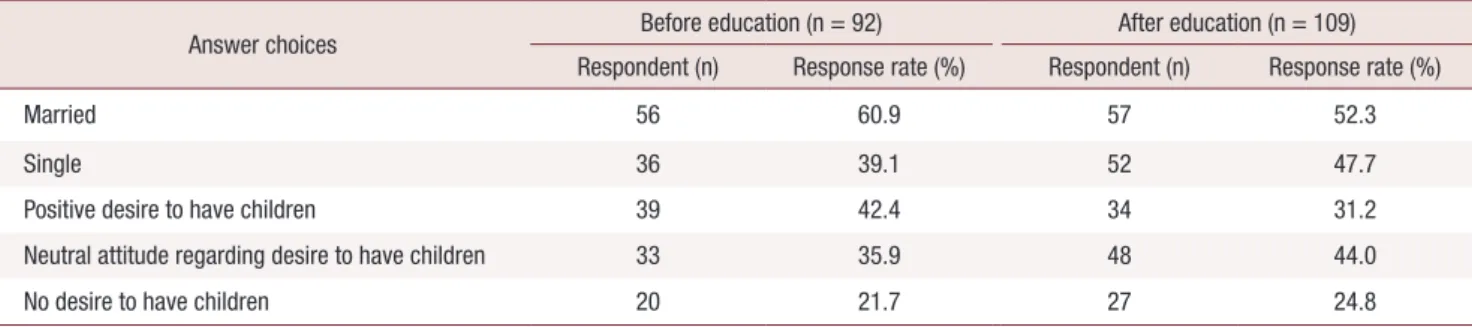
Do you want children after diagnosis? (Table 1) Before receiving video education about the impact of anticancer treatment on ovarian function and fertility, 92 young female breast cancer patients responded to the survey questionnaire which queried them to ex- press their opinion about future plans for pregnancy. In total, 42.4% (n = 39) of participants reported a desire to have children in the future and 35.9% (n = 33) re- sponded in the negative. A neutral attitude was taken by 21.7% (n = 20) of participants.
After viewing educational videos, likewise 109 young female breast cancer patients responded to the ques- tions regarding a desire to have children in the future.
Only 31.2% (n = 34) of participants reported a desire to have children in the future and 44.0% (n = 48) re- sponded in the negative. A neutral attitude was taken by 24.8% (n = 27) of participants.
Do you have knowledge of the side effects of an- ticancer therapy on ovarian function and fertility?
(Table 2)
Prior to viewing educational videos, a total of 56.5%
(52 out of 92) of patients answered that they had no knowledge of the impact of breast cancer therapy on ovarian function and fertility. But after viewing educa-
tional videos, only 1.8% (2 of 109) of patients respond- ed that they had absolutely no knowledge of these ef- fects.
Only 3.3% (n = 3) of uneducated patients answered that they had clear knowledge of the effect of breast cancer treatment on ovarian function and fertility. On the other hand, 22.0% (n = 24) of patients after educa- tion by health professionals responded that they had good understanding of the impact of breast cancer treatment on ovarian function and fertility.
Do you have an interest in changing your cancer therapy in order to preserve ovarian function and fertility? And how long would you be willing to delay anticancer treatment in order to undergo a procedure for preserving fertility?
If there were any way to cure breast cancer while preserving ovarian function and fertility, would you wish to try and change your cancer treatment meth- od or not? (Table 3)
There are several ways to prevent ovarian function and reproductive deterioration that can occur with breast cancer therapy. The ways to ovarian function preservation are ovarian transposition (oophoropexy) and Gonadotropin-releasing hormone agonist before anticancer therapy. Embryo or oocyte of cryopreserva- tion is a treatment for preserving fertility before anti-
Table 1. Marital status and plan for children
Answer choices Before education (n = 92) After education (n = 109)
Respondent (n) Response rate (%) Respondent (n) Response rate (%)
Married 56 60.9 57 52.3
Single 36 39.1 52 47.7
Positive desire to have children 39 42.4 34 31.2
Neutral attitude regarding desire to have children 33 35.9 48 44.0
No desire to have children 20 21.7 27 24.8
Table 2. Knowledge of side effects of anticancer therapy on ovarian function and fertility
Answer choices Before education (n = 92) After education (n = 109)
Respondent (n) Response rate (%) Respondent (n) Response rate (%)
Unknown absolutely 52 56.5 2 1.8
Known slightly 32 34.8 48 44.0
Known generally 5 5.4 35 32.1
Known absolutely 3 3.3 24 22.0
cancer therapy.
Before receiving education, 2.2% (2 of 92) of patients responded they absolutely did not wish to change an- ticancer therapy and 7.6% (n = 7) of patients did not;
45.6% (42 of 92) of patients responded that they would choose to change anticancer therapy and 16.3% (n = 15) of patients changes enough the therapy method for ovarian function.
After viewing educational videos, surveys by 109 young females with breast cancer reflected that 4.6% (n
= 5) of patients responded that they absolutely would not choose to change the anticancer therapy and 16.5%
(n = 18) of patients did not. 31.2% (n = 34) of patents responded that they would choose to change the anti- cancer therapy and 12.8% (n = 14) of patients changes enough the therapy method to preserve ovarian func- tion.
Before receiving education, 92 participants expressed their opinion regarding the intention to change anti- cancer treatment in order to preserve fertility; 6.5% (n
= 6) of patients chose that they did not want to change anticancer therapy absolutely; 12.0% (n = 11) of pa- tients did not; 40.2% (n = 37) of patents chose that they could change anticancer therapy; and 16.3% (n = 15) of patients changes enough the therapy method for fertil-
ity.One hundred nine young breast cancer women who got a video education express that 7.3% (n = 8) of pa- tient choose that they do not change anticancer therapy absolutely and 22.0% (n = 24) of patient does not. On the other hand, 30.3% (n = 33) of patents choose that they can change anticancer therapy and 9.2% (n = 10) of patients changes enough the therapy method for fer- tility.
How long would you agree to delay anticancer treat- ment in order to undergo a procedure to preserve fertility? (Table 4)
Before receiving education, 20.7% (19 of 92) of pa- tients responded that that they would not wish to delay their breast cancer therapy to undergo a procedure which would preserve fertility. But after viewing educa- tional videos, 44.0% (48 of 109) of patients responded that they would not delay treatment.
Do you have a need for education regarding thera- peutic options that would help to preserve ovar- ian function and fertility associated with breast cancer therapy? (Table 5)
Before receiving education, 2.2% (2 of 92) of patients Table 3. Wish to change breast cancer treatment method or not for ovarian function and fertility
Answer choices
Before education (n = 92) After education (n = 109)
Ovary preservation therapy Fertility preservation therapy Ovary preservation therapy Fertility preservation therapy Respondent (n) Response
rate (%) Respondent (n) Response
rate (%) Respondent (n) Response
rate (%) Respondent (n) Response rate (%)
Absolutely would not change 2 2.2 6 6.5 5 4.6 8 7.3
Would not change 7 7.6 11 12.0 18 16.5 24 22.0
Neutral to change 26 28.3 27 29.3 38 34.9 34 31.2
Change 42 45.7 37 40.2 34 31.2 33 30.3
Change enough 15 16.3 11 12.0 14 12.8 10 9.2
Table 4. Wish to delay anticancer treatment for procedure to preserve fertility
Procedure Before education (n = 92) After education (n = 109)
Respondent (n) Response rate (%) Respondent (n) Response rate (%)
Do not delay 19 20.7 48 44.0
1–2 weeks 47 51.1 36 33.0
3–4 weeks 14 15.2 16 17.4
5–6 weeks 4 4.3 5 4.6
7–8 weeks 8 8.7 1 0.9
responded that they did not need education absolutely, 1.1% (1 of 92) of patients responded only that they did not. However, 81.5% (75 of 92) of patients responded that they did need education regarding therapeutic op- tions to preserve ovarian function and fertility.
After viewing videos, 0.0% (n = 0) responded that they did not need education absolutely and 11.9% (13 of 109) of patients responded only that they did not.
61.5% (67 of 109) of patients responded that they did have a need for education regarding therapeutic op- tions for preserving ovarian function and fertility.
Although these results do not adequately demonstrate the degree of satisfaction experienced when education is provided, it is inferred that young female breast can- cer patients do not derive a great benefit and need from education and counseling with health professionals.
DISCUSSION
Concerns about ovarian function and fertility are key issues in young female breast cancer patients and have become more important over time as the numbers of breast cancer patients and survivors in that demo- graphic increase.
In recent studies, the potential loss of ovarian func- tion and fertility has been found to have a profound impact on young female cancer patients and in some ways may be more stressful than the cancer diagnosis itself [16,17].
This study demonstrates that 36 persons of young breast cancer patient have not yet married and 39 par- ticipants have not completed their families out of 92 who have not had education. The 52 persons of young breast cancer patient have not yet married and 34 par- ticipants have not completed their families out of 109 who have had education. Most breast cancer treatments are gonadotoxic [18]. However, many young breast cancer patients are given little information or support
around these issues.
This research aims to support the discussion between young breast cancer patients and health professionals about the impact of treatment on ovarian function and fertility prior to its initiation.
Before receiving education by health professionals, 56.5% of research participants did not have knowledge about the impact of breast cancer treatment on ovarian function and fertility. After viewing educational videos, only 1.8% of participants responded that they had no knowledge. Having knowledge and understanding of the impact of anticancer treatment on fertility is very important to many of the young breast cancer patients before planning to start multimodality treatment be- cause they can then choose an appropriate course of therapy depending upon current life circumstances and plans for future children.
In addition to having a greater understanding of the effects of therapy, it certainly will help them to choose the most appropriate breast cancer treatment as well as the start time. Fertility preservation techniques require a period of the time to be accomplished, for example oocyte or embryo cryopreservation takes a couple of weeks from the beginning of the menstrual cycle, with the consequence that initiation of anticancer therapy can be delayed.
Before being educated, study participants who had no intention to change the therapeutic method to preserve ovarian function and fertility represented 9.8% and 18.5%. After viewing educational videos, participants who had no intention to change the therapeutic meth- od in order to preserve ovarian function and fertility represented 21.1% and 29.3%. Participants’ answers reflected their feeling that the importance of fertility concerns and preserving ovary function was secondary to survival. This result is meaningful that patients can understand the time, methods, and side effect required to performed anticancer treatment delay through edu- Table 5. Need for education and instructions
Answer choices Before education (n = 92) After education (n = 109)
Respondent (n) Response rate (%) Respondent (n) Response rate (%)
Do not need absolutely 2 2.2 0 0.0
Do not need 1 1.1 13 11.9
Neutral need 14 15.2 29 26.6
Need 47 51.1 39 35.8
Need enough 28 30.4 28 25.7
cation. In addition, the health professionals can actively consult the patient’s opinions in the course of the treat- ment.
Also, the responses regarding the amount of time that patients would allow for the delaying of anticancer treatment in order to undergo a procedure to preserve fertility are different before and after receiving educa- tion. These changes reflect an attitude that may influ- ence their treatment decisions.
A previous study showed that all participants an- swered that education was helpful and 73% made their decision about treatment after education [19].
In our study, none of participants who had video edu- cation responded that they did not need education ab- solutely. Only 2 participants who had not yet received training answered that they do not need education ab- solutely.
Though not considered in the interpretation of pa- tient’s satisfaction with and perceived helpfulness of in- formation about cancer treatment related to the preser- vation of ovarian function, the majority of participants preferred as much information as possible. This result indicates that all patients with diagnosed breast can- cer should receive an assessment and communication regarding risk of treatment related to ovarian function and fertility. This education should be given in associa- tion with a clinical expert with discussion of options for ovary and fertility preservation methods.
Most young female breast cancer patients are wor- ried about their fertility, the impact of pregnancy on recurrence, and having a healthy future life. Therefore, patients should be directed to take a profound inter- est in their anticancer treatment. They should be given the opportunity to discuss with clinicians the various therapeutic methods and their impact on ovarian func- tion. Our study indicates a need and opportunity to develop patient education material regarding the effects of treatment on fertility and help these young patients to make informed decisions about their future.
CONFLICT OF INTEREST
No potential conflict of interest relevant to this article was reported.
REFERENCES
1. National Cancer Information Center. Incidence by cancer type.
Il-san: National Cancer Information Center [cited 2016 Dec 27].
Available from: https://www.cancer.go.kr/lay1/S1T639C641/con- tents.do.
2. National Cancer Information Center. 5-year relative cancer survival rate. Il-san: National Cancer Information Center [cited 2016 Dec 27]. Available from: https://www.cancer.go.kr/lay1/
S1T648C650/contents.do.
3. Merlo DF, Ceppi M, Filiberti R, Bocchini V, Znaor A, Gamulin M, et al. Breast cancer incidence trends in European women aged 20- 39 years at diagnosis. Breast Cancer Res Treat 2012; 134: 363-70.
4. Anders CK, Johnson R, Litton J, Phillips M, Bleyer A. Breast can- cer before age 40 years. Semin Oncol 2009; 36: 237-49.
5. Azim HA Jr, Partridge AH. Biology of breast cancer in young women. Breast Cancer Res 2014; 16: 427.
6. Lee SJ, Schover LR, Partridge AH, Patrizio P, Wallace WH, Hager- ty K, et al. American Society of Clinical Oncology recommenda- tions on fertility preservation in cancer patients. J Clin Oncol 2006; 24: 2917-31.
7. Hulvat MC, Jeruss JS. Maintaining fertility in young women with breast cancer. Curr Treat Options Oncol 2009; 10: 308-17.
8. Loren AW, Mangu PB, Beck LN, Brennan L, Magdalinski AJ, Partridge AH, et al. Fertility preservation for patients with cancer:
American Society of Clinical Oncology clinical practice guideline update. J Clin Oncol 2013; 31: 2500-10.
9. Dizon DS, Suzin D, McIlvenna S. Sexual health as a survivorship issue for female cancer survivors. Oncologist 2014; 19: 202-10.
10. King L, Quinn GP, Vadaparampil ST, Gwede CK, Miree CA, Wil- son C, et al. Oncology nurses' perceptions of barriers to discussion of fertility preservation with patients with cancer. Clin J Oncol Nurs 2008; 12: 467-76.
11. Quinn GP, Vadaparampil ST, King L, Miree CA, Wilson C, Raj O, et al. Impact of physicians' personal discomfort and patient prog- nosis on discussion of fertility preservation with young cancer patients. Patient Educ Couns 2009; 77: 338-43.
12. Ellis SJ, Wakefield CE, McLoone JK, Robertson EG, Cohn RJ. Fer- tility concerns among child and adolescent cancer survivors and their parents: a qualitative analysis. J Psychosoc Oncol 2016; 34:
347-62.
13. Zebrack BJ, Casillas J, Nohr L, Adams H, Zeltzer LK. Fertility is- sues for young adult survivors of childhood cancer. Psychooncol- ogy 2004; 13: 689-99.
14. Tschudin S, Bitzer J. Psychological aspects of fertility preservation in men and women affected by cancer and other life-threatening diseases. Hum Reprod Update 2009; 15: 587-97.
15. Balthazar U, Fritz MA, Mersereau JE. Fertility preservation: a pilot study to assess previsit patient knowledge quantitatively. Fertil Steril 2011; 95: 1913-6.
16. Schover LR. Patient attitudes toward fertility preservation. Pediatr Blood Cancer 2009; 53: 281-4.
17. Partridge AH, Gelber S, Peppercorn J, Sampson E, Knudsen K,
Laufer M, et al. Web-based survey of fertility issues in young women with breast cancer. J Clin Oncol 2004; 22: 4174-83.
18. Wallace WH, Smith AG, Kelsey TW, Edgar AE, Anderson RA.
Fertility preservation for girls and young women with cancer:
population-based validation of criteria for ovarian tissue cryo-
preservation. Lancet Oncol 2014; 15: 1129-36.
19. Kim J, Deal AM, Balthazar U, Kondapalli LA, Gracia C, Mersereau JE. Fertility preservation consultation for women with cancer: are we helping patients make high-quality decisions? Reprod Biomed Online 2013; 27: 96-103.