Received: January 19, 2017 Revised: February 15, 2017 Accepted: March 6, 2017
Address for Correspondence: Ensiyeh Jenabi, Mother and Child Care Research Center, Hamadan University of Medical Sciences, Hamadan 65178-38695, Iran
Tel: +98-81-3838-0090, Fax: +98-81-3838-0509, E-mail: [email protected]
Original Article
pISSN: 2288-6478, eISSN: 2288-6761 https://doi.org/10.6118/jmm.2017.23.2.91 Journal of Menopausal Medicine 2017;23:91-95
J MM
Introduction
Natural menopause is the permanent cessation of peri- ods which is determined one year after the last menstrual period.1 The number of postmenopausal women has been increasing in recent years due to the increase of life expec- tancy.2 Nowadays, most women spend more than one-third of their life after of menopause.3,4 Menopause is due to the cessation of ovaries function and the hormonal changes.5
The concept of quality of life (QOL) includes satisfaction
and wellbeing, multi-dimensional characteristics and com- prising subjective.6,7 Menopause especially in symptomatic women has the most dramatic effect on QOL during the postmenopausal stages.4,8
In recent years, medical professions have been focus- ing on training and education programs for improve QOL in women. Women in menopause period need care of health providers for education, awareness for improvement of their health. Yazdkhasti et al.9 in Iran conducted the effect of support group on quality of and in the study three month
The Effect of Educational Program on Quality of Life in Menopausal Women: A Clinical Trial
Fatemeh Shobeiri1, Ensiyeh Jenabi1, Mahnaz Khatiban1, Seyyed Mohammad Mahdi Hazavehei2, Ghodratollah Roshanaei3
1Mother and Child Care Research Center, Hamadan University of Medical Sciences, Hamadan, Iran, 2Research Center for Health Sciences, Department of Health Education, Hamadan University of Medical Sciences, Hamadan, Iran, 3Modeling of Non-Communicable Diseases Research Center, Department of Epidemiology and Biostatistics, School of Public Health, Hamadan University of Medical Sciences, Hamadan, Iran
Objectives: This study aimed to investigate the effect of Educational program on quality of life (QOL) in menopausal women in 2016 in Hamadan, Iran.
Methods: In this clinical trial study, 100 postmenopausal women were randomly selected and allocated to case and control group (50 per group). Data collection tool included questionnaires of demographic information and Menopause QOL, which were completed by the samples before the intervention. In the case group, education program was run during 5 sessions for 45 to 60 minutes. Immediately and Three months after intervention, information were collected using questionnaire in both groups and they were analyzed using SPSS 16 software.
Results: The menopause women in both intervention and control groups had similar demographics. There was not a significant difference in the QOL mean scores in before of the intervention between the two groups of intervention and control in all dimension of QOL. There was a significantly difference in the mean of QOL scores between the two groups in immediately after the intervention and 3 months after the intervention in dimension of vasomotor, psychosocial, sexual and physical (P < 0.001).
Conclusions: This study recommend that a unit in health and treatment centers be established for training menopausal women about health care by holding didactic classes. (J Menopausal Med 2017;23:91-95)
Key Words: Clinical trial · Education · Menopause · Quality of life
Journal of Menopausal Medicine 2017;23:91-95
J MM
after training sessions in the intervention group, scores of vasomotor, psychological, mental, physiological and sexual domains in menopause women were improved (P < 0.001).
Ueda et al.10 in Japan conducted study of a 6 weeks health education program in menopause women. The results showed that the education program was improved QOL in menopause women.10
Up to date, the study in this field was not conducted in the west of Iran. Therefore, this study was performed to assess the effect of an educational program on QOL in menopausal women.
Materials and Methods
This randomized clinical trial was conducted in 2016. We enrolled eligible postmenopausal women in Hamadan city located in the west of Iran from February 2016 to March 2016. This research was approved in the Ethics Committee of Hamadan University of Medical Sciences.
The study was registered at the Iranian Registry of Clini- cal Trials under the number IRCT2013011912188N1. A writ- ten informed consent was obtained from all the study par- ticipants.
Inclusion criteria consisted of women (a) married women (b) from whose last menstrual period at least 1 year had passed (c) had intact uterus and ovaries (d) had no history of physical and mental disorders (e) and had not used hor- mone replacement therapy. Exclusion criteria consisted of (a) women who unwillingness to continue and (b) women who be disorder during intervention.
Regarding the results of a similar study conducted by Mohammadi Zeidi et al.11 in Iran, the standard deviation (SD) QOL score in postmenopausal women in control and intervention was 2.8 and 3.3, respectively. Based on these results, we arrived at a total sample size of 45 in every group of control and intervention at 95% significance level and power 80%. Anticipating a 10%, rejection due to lost or follows up, we increased the sample size to a maximum of 50 women in every group of control and intervention. The sampling method was multi-stage. In first stage, the total of health centers based on socio-economic situation divided in to 4 sections then from every section was selected ran-
domly a health center. In next stage, participates was listed based on Inclusion criteria than from every health center was selected randomly 25 participants and participants ran- domly categorized to two groups of control and intervention.
The present single-blind randomized controlled trial al- located participants to two groups using a balanced block randomization method. Block randomizations work by ran- domizing participants within block so that an equal number of participants are assigned to each group. An important advantage of blocked randomization is that the treatment groups organized will be equal in size and tend to be dis- tributed according to the main outcome-related character- istics.12
We prepare an educational program for this women in 5 session. Educational program was conducted for 3 week in intervention group. The mean of education duration for each session was between 45 to 60 minutes. The education program not was used in control group. The questionnaires were filled before intervention, immediately after interven- tion and 3 months after intervention in intervention group.
In addition, the questionnaires were filled in these times in control group.
In this study, the resources of educational program in- cluded educational booklet, educators, educational classes, educational photos and slide about menopausal. Table 1 de- scribes the curriculum of the health education program. The following tools were used to collect data.
The demographic scale was including effective factors in menopause women QOL.
On the most tools used to assess QOL in menopausal women is Menopause-Specific QOL (MENQOL) question- naire MENQOL questionnaires. MENQOL questionnaires published in English in 1996. We used the MENQOL for measuring the QOL in postmenopausal women. This ques- tionnaire consists of 29 items in vasomotor (3 items), psy- chosocial (7 items), physical (16 items) and sexual (3 items) domains. The validity and reliability tests for this question- naire were conducted in Iran.13,14 This questionnaire has seven-point Likert scale and ranges from 0 to 7. A “zero”
is equivalent to a woman responding “no”, meaning she has not experienced this symptom in the past month. Score
“one” shows that the woman experienced the symptom, but it was not bothersome at all. Scores “two” through “seven”
Journal of Menopausal Medicine 2017;23:91-95 Fatemeh Shobeiri, et al. Educational Program on Quality of Life
show increasing levels of bother experienced from the symptom and correspond to “1” through “6” check boxes on the MENQOL. Hence, the average for each domain was calculated between 0 and 7. Test-retest by intraclass corre- lation coefficients was used for the MENQOL questionnaire reliability. The scores were 0.93, 0.88, 0.87, and 0.92 for the physical, psychological, sexual and vasomotor domains, respectively.
The data were analyzed by SPSS version 16 software (SPSS Inc., Chicago IL, USA). The participants’ characteristics were analyzed by descriptive statistics including frequency tables, mean and SD. The t-test was used to compare groups for qualitative variables, and independent and paired t-tests were used for quantitative variables. The t-test conducted for comparing Scores of menopause QOL in intervention and control groups. All P values of less than 0.05 were consid- ered to indicate statistical significance.
Results
Of 128 menopause women identified and assessed for eli- gibility, 28 menopause women did not meet inclusion criteria in this study and 100 menopause women randomized for in-
tervention and control groups. Five women in the interven- tion group and two women in the control group did not re- turn for follow-up and finally were excluded from the study.
The analysis conducted based on data from the remaining 93 menopause women, including 45 in the intervention group and 48 menopause women in the control group.
The menopause women in both intervention and control groups had similar demographics (Table 2).
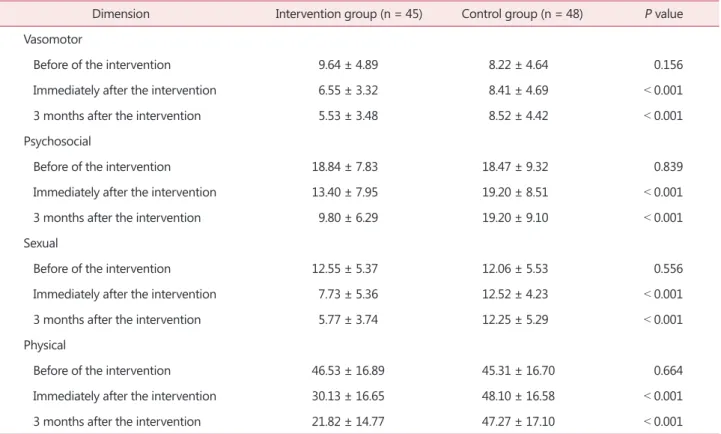
There was not a significant difference in the QOL mean scores in before of the intervention between the two groups of intervention and control in all dimension of QOL. There was a significant difference in the QOL mean scores between the two groups in immediately after the intervention and 3 months after the intervention in dimension of vasomotor, psychosocial, sexual and physical (P < 0.001) (Table 3).
Discussion
The results of this study showed that the education pro- gram improved scores of QOL in menopause women in im- mediately and 3 months after the intervention.
Yazdkhasti et al.9 conducted similar study in Iran and in the study three month after training sessions in the inter- Table 1. Curriculum of the health education program
Session Brief summary
1 Program introduction, definition of menopausal characteristics
2 Definition of menopausal symptoms (vasomotor, psychosocial, physical, and sexual) 3 Education for performance in menopause (exercise, pap smear, and mammography)
4 Education for control and prevention of menopausal symptoms (return to physician, using of drugs regular prescribed by physician and calcium-vitamin D supplement)
5 Education to their spouse and the best of friend about menopausal symptom and action plan for health care in menopause
Table 2. Base characteristics in menopausal women
Characteristics Intervention group (n = 45) Control group (n = 48) P value
Age 55.11 ± 4.05 55.70 ± 4.19 0.448
Age in menopause 48.06 ± 6.57 47.58 ± 8.69 0.764
No. of live children 3.84 ± 1.52 4.33 ± 1.81 0.164
The data is presented as mean ± standard deviation
Journal of Menopausal Medicine 2017;23:91-95
J MM
vention group, scores of vasomotor, psychological, mental, physiological and sexual domains in menopause women were improved (P < 0.001).
In the study by Farokhi et al.15, total score of QOL was improved after holding life skill training sessions, but no significant difference was observed in terms of psychosocial dimension. Ueda et al.10 in Japan conducted study of a 6 weeks health education program in menopause. The results showed that the program was improved QOL in menopause women.
Senba and Matsuo16 showed that the health education program in 6 sessions changed the cognitive actions of cli- macteric women which resulted in improved QOL and au- tonomic nervous system activity. Esposito Sorpreso et al.17 reported that health education for seven 2-hour sessions in the clinic at 45-day intervals in early and late postmeno- pausal women decrease domain depression mode in the early and late postmenopausal groups.
According to the results of this study, after the meno- pausal period women need to be consulted and trained about
control of menopausal symptoms. In Iran, most women have appropriate access to health and treatment centers. Hence, we recommend that a unit in health and treatment centers be established for training menopausal women about health care by holding didactic classes.
One of the limitations in this study was small sample size which may not be generalizable to other groups and com- munities. Therefore, we suggested that this study is con- ducted at wider range.
Conclusion
The results of this study showed that the education pro- gram in 5 sessions improved scores of QOL in menopause women in immediately and 3 months after the intervention.
Table 3. Scores of menopause quality of life in intervention and control groups
Dimension Intervention group (n = 45) Control group (n = 48) P value
Vasomotor
Before of the intervention 9.64 ± 4.89 8.22 ± 4.64 0.156
Immediately after the intervention 6.55 ± 3.32 8.41 ± 4.69 < 0.001
3 months after the intervention 5.53 ± 3.48 8.52 ± 4.42 < 0.001
Psychosocial
Before of the intervention 18.84 ± 7.83 18.47 ± 9.32 0.839
Immediately after the intervention 13.40 ± 7.95 19.20 ± 8.51 < 0.001
3 months after the intervention 9.80 ± 6.29 19.20 ± 9.10 < 0.001
Sexual
Before of the intervention 12.55 ± 5.37 12.06 ± 5.53 0.556
Immediately after the intervention 7.73 ± 5.36 12.52 ± 4.23 < 0.001
3 months after the intervention 5.77 ± 3.74 12.25 ± 5.29 < 0.001
Physical
Before of the intervention 46.53 ± 16.89 45.31 ± 16.70 0.664
Immediately after the intervention 30.13 ± 16.65 48.10 ± 16.58 < 0.001
3 months after the intervention 21.82 ± 14.77 47.27 ± 17.10 < 0.001
The data is presented as mean ± standard deviation
Journal of Menopausal Medicine 2017;23:91-95 Fatemeh Shobeiri, et al. Educational Program on Quality of Life
Acknowledgement
This article is part of a PhD thesis supported by Hamadan University of Medical Sciences. We would like to thank the University’s vice-chancellor of education and vice-chancellor of research and technology for their financial support to carry out the study.
Conflict of Interest
No potential conflict of interest relevant to this article was reported.
References
1. Izetbegovic S, Stojkanovic G, Ribic N, Mehmedbasic E.
Features of postmenopausal uterine haemorrhage. Med Arch 2013; 67: 431-4.
2. de Souza Santos CA, Dantas EE, Moreira MH. Correlation of physical aptitude; functional capacity, corporal balance and quality of life (QoL) among elderly women submitted to a post-menopausal physical activities program. Arch Gerontol Geriatr 2011; 53: 344-9.
3. Silva Filho CR, Baracat EC, Conterno Lde O, Haidar MA, Ferraz MB. Climacteric symptoms and quality of life:
validity of women's health questionnaire. Rev Saude Publica 2005; 39: 333-9.
4. Direkvand-Moghadam A, Delpisheh A, Montazeri A, Sayehmiri K. Quality of life among Iranian infertile women in postmenopausal period: a cross-sectional study. J Menopausal Med 2016; 22: 108-13.
5. Roush K. What nurses know... Menopause: the answers you need from the people you trust. New York, NY: Demos Health; 2011.
6. Lima MG, Barros MB, Cesar CL, Goldbaum M, Carandina
L, Ciconelli RM. Health related quality of life among the elderly: a population-based study using SF-36 survey. Cad Saude Publica 2009; 25: 2159-67.
7. Jenabi E, Shobeiri F, Hazavehei SM, Roshanaei G.
Assessment of questionnaire measuring quality of life in menopausal women: a systematic review. Oman Med J 2015; 30: 151-6.
8. Jafari F, Hadizadeh MH, Zabihi R, Ganji K. Comparison of depression, anxiety, quality of life, vitality and mental health between premenopausal and postmenopausal women. Climacteric 2014; 17: 660-5.
9. Yazdkhasti M, Keshavarz M, Khoei EM, Hosseini A, Esmaeilzadeh S, Pebdani MA, et al. The effect of support group method on quality of life in post-menopausal women. Iran J Public Health 2012; 41: 78-84.
10. Ueda M, Matsuda M, Okano K, Suenaga H. Longitudinal study of a health education program for Japanese women in menopause. Nurs Health Sci 2009; 11: 114-9.
11. Mohammadi Zeidi E, Pakpour A, Mohammadi Zeidi B. The impact of educational interventions based on individual empowerment model on knowledge, attitude, self-efficacy, self esteem and quality of life of postmenopausal women.
Iran J Nurs 2013; 26: 21-31.
12. Efird J. Blocked randomization with randomly selected block sizes. Int J Environ Res Public Health 2011; 8: 15-20.
13. Fallahzadeh H. Quality of life after the menopause in Iran:
a population study. Qual Life Res 2010; 19: 813-9.
14. Shobeiri F, Jenabi E, Hazavehei SM, Roshanaei G. Quality of life in postmenopausal women in Iran: a population- based study. J Menopausal Med 2016; 22: 31-8.
15. Farokhi F, Narenji F, Salehi B, Mehrabi F, Rafiei M. Effect of skill life training in quality of life in menopausal women.
Sci J Hamadan Nurs Midwifery Fac 2015; 23: 54-64.
16. Senba N, Matsuo H. Effect of a health education program on climacteric women. Climacteric 2010; 13: 561-9.
17. Esposito Sorpreso IC, Laprano Vieira LH, Longoni Calio C, Abi Haidar M, Baracat EC, Soares JM, Jr. Health education intervention in early and late postmenopausal Brazilian women. Climacteric 2012; 15: 573-80.