Printed in the Republic of Korea
http://dx.doi.org/10.5012/jkcs.2012.56.4.401
Study on Corrosion Inhibition Efficiency of Stem Alkaloid Extract of Different Varieties of Holy Basil on Aluminium in HCl Solution
Nutan Kumpawat, Alok Chaturvedi*, and R. K. Upadhyay Synthetic and Surface Science Laboratory, Department of Chemistry, Govt. College, Ajmer (Raj.) - INDIA. *E-mail: [email protected]
(Received January 10, 2012; Accepted June 3, 2012)
ABSTRACT. Corrosion inhibition efficiencies of holy basil on Al in HCl solution were studied by weight loss and ther- mometric methods in presence and in absence of stem extract of three different varieties of holy basil viz. ocimum basilicum (EB), ocimum canum (EC) and ocimum sanctum (ES). Inhibition efficiency increases with the increasing concentration of stem extract and decreases with increases in acid strength. Results show that all varieties under study are good corrosion inhibitors, among which, EB is most effective. Maximum inhibition efficiency was found 97.09% in 0.5N HCl solution with 0.6% stem extract. The Langmuir adsorption isotherm indicates that surface coverage also increases with increasing in the concentration of extract of stem in HCl solution.
Key words: Inhibitors, Aluminium metal, Weight loss, Surface coverage
INTRODUCTION
Aluminium, being an industrially important metal, is subjected to corrosion in service by various corrosive agents of which the aqueous acids are the most danger- ous. The corrosion of aluminium and its alloys in HCl solution has been extensively studied.1-4 Pure aluminium is very soft and weak but it can be alloyed to increase its mechanical properties. For example, high strength alu- minium alloy containing about 4% copper. Hence alu- minium alloy are used for building purpose, motors and in cement products. It is also widely used as the structural material for various internal fitting in various industries.
The corrosion inhibitive properties of ocimum sanc- tum,5 ricinus communis6 and ficus virens7 were studied on mild steel. Some other naturally occurring substances like argemone maxicana,8 delonix regia,9 caparis deciduas,10 prosopis julifforar,11 sansevieria trifascinata,12 phylanthus amarus,13 have been evaluated as effective corrosion inhibi- tors.
In the present investigation the inhibitive effect of three varieties of holy basil viz. ocimum basilicum (EB), ocimum canum (EC) and ocimum sanctum (ES) have been studied.
EXPERIMENTAL
The extract of stem of all three species of holy basil obtained by refluxing the dried stem in soxhelt in ethanol.
Resulting extract was dried and collected. Rectangular
specimens of aluminium of dimensions 2.0 cm×2.0 cm×
0.045 cm containing a small hole of about 2 mm diameter near the upper edge were used for studying the corrosion rate. The chemical composition of the test specimen was 98.5% Al, 0.2% Fe, 0.2% Cu, 0.08% Zn, 0.08% Ti. Speci- mens were cleaned by buffing to produce a mirror finish and were then degreased. The solutions of HCl were pre- pared using double distilled water. All chemical used were of analytical reagent grade.
Each specimen was suspended by glass hook made of fine capillary tube in a beaker containing 50 mL of the test solution at 273±0.1K. After the sufficient exposure, of time specimens were cleaned by running water. Duplicate experiments were performed in each case and mean val- ues of the weight loss were calculated.
The percentage inhibition efficiency was calculated16 as
Where, ∆Wu and ∆Wi are the weight loss of the metal in uninhibited acid and in inhibited acidic solution, respec- tively.
The corrosion rate (CR) in mm/yr can be obtained by the following equation.
Corrosion rate (mm/yr) =
Where, ∆W is weight loss in mg, A is area of specimen in cm2, T is time of exposure in hours and d is density of
η% ∆Wu–∆Wi
∆Wu
--- 100×
=
∆W 87.6× A T× ×d ---
metal in g/cm3
The degree of surface coverage q can be calculated as17
Where, ∆Wu and ∆Wi are the weight loss of the metal in uninhibited acid and in inhibited acidic solution, respec- tively.
Inhibition efficiencies were also determined by using thermometric technique. This involved the immersion of single specimen measuring 2.0 cm×2.0 cm×0.045 cm in a reaction chamber containing 50 mL of solution at an ini- tial temperature of 273±0.1K. Temperature changes were measured at intervals of 5 min. using a thermometer with a precision of 273±0.1K. The temperature increased slowly at first, then rapidly and attained a maximum value before falling. The maximum temperature was recorded.
Percentage inhibition efficiencies (η%) were calculated18 as
Where RNf and RNi are the reaction number in free and in presence of inhibitor, respectively and RN (Kmin-1) is defined as
Where Tm and Ti are the maximum and initial temperature
respectively and t is the time (in min.) required to reach the maximum temperature.
RESULT AND DISCUSSION
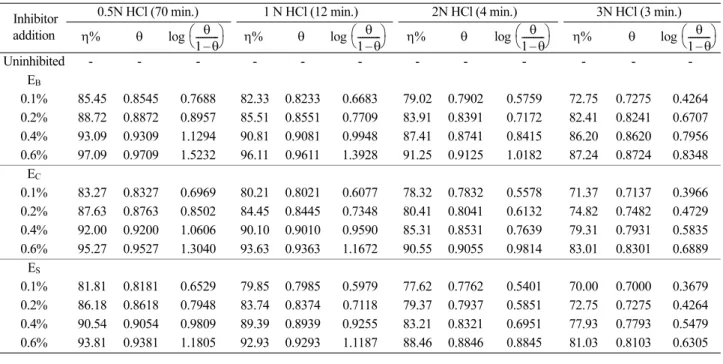
Loss in weight and percentage inhibition efficiency for various concentrations of acid and inhibitors are given in Table 1. It can be seen that the inhibition efficiency increases with increase in concentration of inhibitor. It is also evident from the Table 1 that inhibition efficiency decreases with increasing concentration of acid strength and that all inhibitors display maximum efficiency at the lower concentration of acid used (i.e. 0.5N). All the inhibi- tors reduce corrosion rate to a significant extent. The high- est efficiency was shows by EB for which a maximum value of 97.09% was obtained at an inhibitor concentra- tion of 0.6% in 0.5N HCl. The corresponding values of surface coverage are shown in Table 2. The variation of inhibition efficiency with inhibitor concentration pre- sented graphically in Fig. 1 for 0.5N HCl which shows almost linear behaviour with the positive slope indicating that the inhibition efficiency increases with increasing inhibitor concentration.
Generally, the adsorption of organic molecules on metallic surface involves oxygen, nitrogen and sulphur atom and in some cases selenium and phosphorus. In the present investigation plant extract contains oxygen atom which is responsible for the adsorption. This process may block active sites on metallic surface and hence decreases θ ∆Wu–∆Wi
∆Wu ---
=
η% 100 RN( f–RNi) RNf ---
=
RN Tm Ti– ---t
⎝ ⎠
⎛ ⎞
=
Table 1. Weight loss (∆W) and percentage inhibition efficiency (η%) for Aluminium in HCl solution with given inhibitor addition at 273±0.1K
Inhibitor addition
0.5N HCl (70 min.) 1 N HCl (12 min.) 2 N HCl (4 min.) 3 N HCl (3 min.)
∆W, mg η% ∆W, mg η% ∆W, mg η% ∆W, mg η%
Uninhibited 275 - 283 - 286 - 290 -
EB
0.1% 40 85.45 50 82.33 60 79.02 79 72.75
0.2% 31 88.72 41 85.51 46 83.91 51 82.41
0.4% 19 93.09 26 90.81 36 87.41 40 86.20
0.6% 8 97.09 11 96.11 25 91.25 37 87.24
EC
0.1% 46 83.27 56 80.21 62 78.32 83 71.37
0.2% 34 87.63 44 84.45 56 80.41 73 74.82
0.4% 22 92.00 28 90.10 42 85.31 60 79.31
0.6% 13 95.27 18 93.63 27 90.55 49 83.01
ES
0.1% 50 81.81 57 79.85 64 77.62 87 70.00
0.2% 38 86.18 46 83.74 59 79.37 97 72.75
0.4% 26 90.54 30 89.39 48 83.21 64 77.93
0.6% 17 93.81 20 92.93 33 88.46 55 81.03
the corrosion of the metal. The oxygen atom of terpenoids present in extract of holy basil acts as the reaction centre (polar function) because of its higher electron density resulting in the formation of a monolayer on the metal sur- face.
The -OCH3 group present in ursolic acid exerts a posi- tive mesomeric effect (+M>-I), which increases the elec- tron density at the oxygen atom. This explains the higher inhibition efficiencies displayed by ocimum basilicum
(EB). It has been observed that the inhibition efficiency increasse as the inhibitor concentration increases.
Adsorption plays an important role in the inhibition of metallic corrosion by organic inhibitors. Many investiga- tors have used the Langmuir adsorption isotherm to study inhibitor characteristics.14,15 Assuming that the inhibitors adsorbed on the metal surface decrease the surface area available for cathodic and anodic reaction to take place.
Hoar and Holliday14 have shown that the Langmuir iso- therm,
Log [θ/1-θ] = log A+log C–[Q/2.303 RT]
should give a straight line of unit gradient for the plot of log [θ/1-θ] versus log C, where A is a temperature inde- pendent constant, C is the bulk concentration of the inhibi- tor (percentage) and Q is the heat evolved during adsorption.
The corresponding plots, shown in Fig. 2 for 0.5N HCl are linear but the gradients are not equal to unity as would be expected for the ideal Langmuir adsorption isotherm equation. This deviation from unity may be explained on the basis of the interaction among the adsorbed species on the metal surface. It has been postulated in the derivation of the Langmuir isotherm equation that the adsorbed mole- cules do not interact with one another, but this is not true in the case of organic molecule having polar atoms or groups which are adsorbed on the anodic and cathodic sites of the metal surface. Such adsorbed species may interact by mutual repulsion or attraction. Thus, it is also possible for Table 2. Percentage inhibition efficiency (η%) and surface coverage (θ) for Aluminium in HCl solution with given inhibitor addition at 273±0.1K
Inhibitor addition
0.5N HCl (70 min.) 1 N HCl (12 min.) 2N HCl (4 min.) 3N HCl (3 min.)
η% θ log η% θ log η% θ log η% θ log
Uninhibited - - - - - - - - - - - -
EB
0.1% 85.45 0.8545 0.7688 82.33 0.8233 0.6683 79.02 0.7902 0.5759 72.75 0.7275 0.4264 0.2% 88.72 0.8872 0.8957 85.51 0.8551 0.7709 83.91 0.8391 0.7172 82.41 0.8241 0.6707 0.4% 93.09 0.9309 1.1294 90.81 0.9081 0.9948 87.41 0.8741 0.8415 86.20 0.8620 0.7956 0.6% 97.09 0.9709 1.5232 96.11 0.9611 1.3928 91.25 0.9125 1.0182 87.24 0.8724 0.8348
EC
0.1% 83.27 0.8327 0.6969 80.21 0.8021 0.6077 78.32 0.7832 0.5578 71.37 0.7137 0.3966 0.2% 87.63 0.8763 0.8502 84.45 0.8445 0.7348 80.41 0.8041 0.6132 74.82 0.7482 0.4729 0.4% 92.00 0.9200 1.0606 90.10 0.9010 0.9590 85.31 0.8531 0.7639 79.31 0.7931 0.5835 0.6% 95.27 0.9527 1.3040 93.63 0.9363 1.1672 90.55 0.9055 0.9814 83.01 0.8301 0.6889
ES
0.1% 81.81 0.8181 0.6529 79.85 0.7985 0.5979 77.62 0.7762 0.5401 70.00 0.7000 0.3679 0.2% 86.18 0.8618 0.7948 83.74 0.8374 0.7118 79.37 0.7937 0.5851 72.75 0.7275 0.4264 0.4% 90.54 0.9054 0.9809 89.39 0.8939 0.9255 83.21 0.8321 0.6951 77.93 0.7793 0.5479 0.6% 93.81 0.9381 1.1805 92.93 0.9293 1.1187 88.46 0.8846 0.8845 81.03 0.8103 0.6305
θ 1–θ ---
⎝ ⎠
⎛ ⎞ θ
1–θ ---
⎝ ⎠
⎛ ⎞ θ
1–θ ---
⎝ ⎠
⎛ ⎞ θ
1–θ ---
⎝ ⎠
⎛ ⎞
Fig. 1. Variation of inhibition efficiency with stem extract for Al in 0.5N HCl.
inhibitor molecule those are adsorbed on anodic and cathodic sites to interact with metallic surface as well as with each other.
Inhibition efficiencies were also determined using the thermometric method. Temperature change for Al in 1N, 2N and 3N HClwere recorded both in presence and in absence of the different concentration of inhibitors. How- ever, no significant temperature changes were recorded in 0.5N concentration. Results summarized in Table 3 for HClshow a good agreement with the results obtained by weight loss method. The maximum inhibition efficiency was obtained with highest concentration (0.6%) of inhibi- tor and with highest concentration of HCl (1.0N). The variation of reaction number (RN) with inhibitor concen- tration is depicted graphically in Fig. 3 for HCl. Figures
show a linear deviation which indicates that the reaction number decreases with increasing inhibitor concentration.
CONCLUSION
A study of three different varieties (EB, EC and ES) has shown them to be effective corrosion inhibitors for alu- minium in HCl solution. Weight loss method has shown that the inhibition efficiency of holy basil increases with increasing concentration of inhibitor.
Among the extract of different varieties of Holy Basil under investigation, the highest inhibition efficiencies (up to 97.09% in 0.5N HCl) were shown by EB at a concen- tration of 0.6%. Both methods (weight loss as well as ther- mometric) show same trends in corrosion efficiency and Fig. 2. Langmuir adsorption isotherm for aluminium in 0.5N
HCl with inhibition addition.
Table 3. Reaction Number (RN) and percentage inhibition efficiency (η%) for Aluminium in HCl solution with given inhibitor addition at 273±0.1 K
Inhibitor addition
1N HCl (12 min.) 2N HCl (4 min.) 3N HCl (3 min.)
RN, Kmin-1 η% RN, Kmin-1 η% RN, Kmin-1 η%
Uninhibited 1.266 - 4.400 - 6.8 -
EB
0.1% 0.433 65.79 1.770 59.77 3.066 54.91
0.2% 0.341 73.06 1.450 68.96 2.700 60.29
0.4% 0.241 80.96 0.975 77.84 2.166 68.14
.0.6% 0.166 86.88 0.875 80.11 1.800 73.52
EC
0.1% 0.483 61.84 1.875 57.38 3.300 51.47
0.2% 0.383 69.74 1.575 64.20 2.933 56.86
0.4% 0.283 77.64 1.175 73.29 2.533 62.75
0.6% 0.200 84.20 1.000 77.27 2.000 70.58
ES
0.1% 0.516 59.24 1.975 55.11 3.500 48.52
0.2% 0.416 67.14 1.750 60.22 3.133 53.92
0.4% 0.300 76.30 1.425 67.61 2.733 59.80
0.6% 0.225 82.22 1.150 73.86 2.233 67.16
Fig. 3. Variation of reaction number with stem extract for Al in 1.0N HCl.
results are in good agreement with each others.
Acknowledgments. One of authors (Nutan Kumpa- wat) is greatful to R.G.N. fellowship from U.G.C. Govt. of India as J.R.F.
REFERENCES
1. Talati, J. D.; Patel, G. A. Corrosion prevention and con- trol 1978, 25, 7.
2. Talati, J. D.; Pandaya, J. M.; Patel, G. A. Proc. Semin.
Electrochem. India 1974, 14, 362.
3. Sampat, S. S.; Vogra, J. C. Corros. Sci. 1974, 14, 591.
4. Talati, J. D.; Patel, C. A. Transaction of the SAEAST 1978, 13, 139.
5. Kumpawat, N.; Chaturvedi, A.; Upadhyay, R. K. Protec- tion of Metals and Physical Chemistry of Surface 2010, 46, 267.
6. Ananda Louise Salheyanathan R.; Maruthamuthu S.; Sel- vanayagan M.; Indian Journal of Chemical Technology
2005, 12, 356.
7. Jain, T.; Choudhary, R.; Mathur, S. P. Materials and Cor- rosion 2006, 57, 422.
8. Sharma, P., Upadhyay, R. K.; Chaturvedi, A.; Parashar, R.
J.T.R. Chem. 2008, 15(1), 21.
9. Abiola, O. K.; Okafor, N. C.; Ebenso, E. E.; Nwinuka, N.
M. Anti-corrosion Methods and Materials 2007, 54, 219.
10. Arora, P.; Kumar, S.; Sharma, M. K.; Mathur, S. P. E- Journal of Chemistry 2007, 4, 45.
11. Choudhary, R.; Jain, T.; Mathur, S. P. Bull. Electrochem.
2004, 67, 20.
12. Oguzei, E. E.; Corros. Sci. 2007, 49, 1527.
13. Okafor, P. C.; Ikpi, M. E.; Uwah, I. E.; Ebenso, E. E.;
Elcpe, U. J.; Umoren, S. A. Corros. Sci. 2008, 50.
14. Hoar, T. P.; Holliday, R. D. J. Appl. Chem. 1953, 3, 582.
15. Meakins, J. R. J. Appl. Chem. 1963, 13, 330.
16. Talati, J. D.; Gandhi, D. K. Indian Journal of Technology 1991, 29, 277.
17. Dubey, R. S.; Upadhyay, S. N. J. Electrochem. Soc. (India) 1993, 43, 239.
18. Aziz, K.; Shams, El-Din A. M. Corros. Sci. 1993, 5, 4.