REVIEW ARTICLE
급성 담낭염의 치료
이승옥, 임성균
전북대학교 의과대학 전북대학교병원 내과, 의생명연구원
Management of Acute Cholecystitis
Seung-Ok Lee and Sung Kyun Yim
Department of Internal Medicine, Biomedical Research Institute, Chonbuk National University Hospital, Chonbuk National University Medical School, Jeonju, Korea
Acute cholecystitis is a common serious complication of gallstones. The reported mortality of acute cholecystitis is approximately 3%, but the rate increases with age or comorbidity of the patient. If appropriate treatment is delayed, complications can develop as a consequence with a grave prognosis. The current standard of care in acute cholecystitis is an early laparoscopic cholecystectomy with the appropriate administration of fluid, electrolyte, and antibiotics. On the other hand, the severity of the disease and patient’s operational risk must be considered. In those with high operational risks, gall bladder drainage can be performed as an alternative.
Currently percutaneous and endoscopic drainage are available and show clinical success in most cases. After recovering from acute cholecystitis, the patients who have undergone drainage should be considered for cholecystectomy as a definitive treatment.
However, in elderly patients or patients with significant comorbidity, operational risks may still be high, making cholecystectomy inappropriate. In these patients, gallstone removal using the percutaneous tract or endoscopy may be considered. (Korean J Gastroenterol 2018;71:264-268)
Key Words: Cholecystitis, acute; Drainage; Cholecystectomy
Received April 20, 2018. Revised May 1, 2018. Accepted May 1, 2018.
CC This is an open access article distributed under the terms of the Creative Commons Attribution Non-Commercial License (http://creativecommons.org/licenses/
by-nc/4.0) which permits unrestricted non-commercial use, distribution, and reproduction in any medium, provided the original work is properly cited.
Copyright © 2018. Korean Society of Gastroenterology.
교신저자: 이승옥, 54907, 전라북도 전주시 덕진구 건지로 20, 전북대학교 의과대학 전북대학교병원 내과
Correspondence to: Seung-Ok Lee, Department of Internal Medicine, Chonbuk National University Hospital, Chonbuk National University Medical School, 20 Geonji-ro Deokjin-gu, Jeonju 54907, Korea. Tel: +82-63-250-1289, Fax: +82-63-254-1609, E-mail: [email protected]
Financial support: None. Conflict of interest: None.
서 론
급성 담낭염은 주로 담석의 감돈과 이로 인한 염증으로 발 생하게 된다. 이는 담석에 의한 합병증 중 가장 흔한 질환으 로, 증상이 있는 담석 환자를 7년에서 11년간 추적 관찰하였 을 때 6-11%의 환자에서 발생하는 것으로 알려져 있다.1또한 World Society of Emergency Surgery에 의하면 합병증이 있는 복강내 감염증 중 두 번째로 많은 18.5%로 보고되었다.2 진단 당시 대부분의 경우 담석이 관찰되나 약 10%의 경우 담석 없이 발생할 수 있으며, 이 경우 상대적으로 높은 이환율 과 사망률을 보인다.3
급성 담낭염은 다양한 중증도를 보이며 단순한 담낭벽의 염증에서부터 국소적인 합병증, 심한 경우 다발성 장기부전까 지 유발할 수 있다. 전체 사망률은 약 3% 정도로 보고되나 이는 환자의 나이나 기저질환으로 인하여 상승하게 된다.4,5 특히 이른 시기에 적절한 치료를 하지 않을 경우 합병증이 발생하는 경우가 많으며 천공이 발생하여 범복막염이 발생할 경우 30%의 높은 사망률을 보이게 된다.6현재 급성 담낭염의 주된 치료방법은 조기의 복강경수술이다. 그러나 담낭염의 중 증도나 환자의 수술 위험도가 높은 경우 수술을 시행하는 것 이 적절하지 않은 경우가 많다. 따라서 상황에 따른 적절한 치료방법을 숙지하는 것이 중요하며 본 종설에서는 급성 담낭
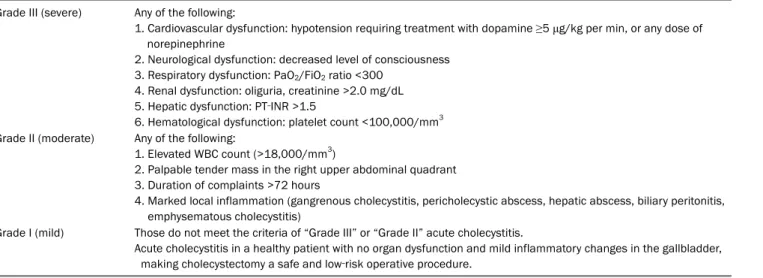
Table 1. Severity Grading of Acute Cholecystitis Grade III (severe) Any of the following:
1. Cardiovascular dysfunction: hypotension requiring treatment with dopamine ≥5 μg/kg per min, or any dose of norepinephrine
2. Neurological dysfunction: decreased level of consciousness 3. Respiratory dysfunction: PaO2/FiO2 ratio <300
4. Renal dysfunction: oliguria, creatinine >2.0 mg/dL 5. Hepatic dysfunction: PT‐INR >1.5
6. Hematological dysfunction: platelet count <100,000/mm3 Grade II (moderate) Any of the following:
1. Elevated WBC count (>18,000/mm3)
2. Palpable tender mass in the right upper abdominal quadrant 3. Duration of complaints >72 hours
4. Marked local inflammation (gangrenous cholecystitis, pericholecystic abscess, hepatic abscess, biliary peritonitis, emphysematous cholecystitis)
Grade I (mild) Those do not meet the criteria of “Grade III” or “Grade II” acute cholecystitis.
Acute cholecystitis in a healthy patient with no organ dysfunction and mild inflammatory changes in the gallbladder, making cholecystectomy a safe and low‐risk operative procedure.
PT-INR, prothrombin time-international normalized ratio; WBC, white blood cell.
염의 치료방법에 대해 논하도록 하겠다.
본 론
급성 담낭염이 발생한 경우 우선 금식과 함께 적절한 수액 공급, 전해질교정, 통증조절 및 항생제 사용 등의 보존적 치료 를 시작하게 되고, 이후 담낭절제술을 시행하여 담낭을 제거할 필요성이 있다. 그러나 환자의 수술 위험도 및 담낭염의 중증 도 및 합병증의 유무에 따라 시행시기가 달라질 수 있으며 담 낭배액술 등의 다른 치료방법을 수술 전에 시행할 수도 있다.
따라서 보존적 치료와 함께 환자의 수술 위험도, 담낭염의 중 증도 등을 평가하여 치료방침을 결정해야 한다(Table 1).7
1. 급성 담낭염의 항생제 치료
급성 담낭염은 담낭관 폐쇄나 담즙정체로 인해 이차 감염 이 자주 발생한다.8 한 연구에서 증상이 있는 담석 환자의 22%, 급성 담낭염이 있는 환자의 46%에서 담즙에 세균이 관 찰되었음을 보고 하였다(n=467).9경도의 담낭염의 경우 항생 제 치료를 요하지 않을 수 있으나 중등도 이상의 담낭염에서 는 항생제는 치료에 있어서 중요한 역할을 하며 담낭절제술 전까지 유지해야 할 수 있다.10 다른 질환과 마찬가지로 원인 균의 동정은 매우 중요하며 감염이 의심되는 경우 혈액배양검 사를 시행하고 담낭배액술 등 담즙을 얻을 수 있는 시술을 시행한 경우 담즙배양검사를 실시해야 한다. 급성 담낭염에서 주로 발견되는 세균은
Escherichia coli
이며Enterococcus
,Klebsiella
등도 자주 발견된다.11 따라서 확실한 원인균이 동 정되지 않은 상태에서의 항생제 사용은 가능성이 높은 흔한 원인균을 치료함과 동시에 담낭에 잘 침투하는 항생제를 선택해야 한다. 경증에서 중등도의 경우 주로 cefazolin, cefuroxime, ceftriaxone 등이 추천되며 중증이거나 병원내 감염이 의심될 경우 imipenem-cilastatin, meropenem, doripenem, piper- acillin-tazobactam, ciprofloxacin과 metronidazole, levo- floxacin과 metronidazole, cefepime과 metronidazole이 추 천된다.12
급성 담낭염의 근본적인 치료는 담낭절제술이며, 이후의 항 생제 유지 기간에 대해서는 이견이 있을 수 있고 아직 명확하 게 정립되지는 않았다. 항생제 유지 기간은 환자의 전신상태 나 염증 정도, 합병증의 유무 등 임상적 상황에 따라 달라진 다. 최근 발표된 414명의 경도에서 중등도의 급성 담낭염 환 자를 대상으로 담낭절제술 후의 항생제 효용성에 대한 다기관 연구에서 항생제를 수술 후에도 유지한 군과 바로 중단한 군 에서 임상적으로 유의한 차이가 관찰되지 않았으며 이에 따라 2018 Tokyo guideline에서도 경도나 중등도의 경우 수술 후 항생제 사용을 중지할 것을 권고하고 있다.11,13 중증이나 합병 증이 동반된 경우의 항생제 유기 기간에 대해서는 연구자료가 적은 상태이나 최소한 환자의 임상증상(발열, 복통 등), 검사 소견(백혈구 등의 염증 수치)이 정상화될 때까지 사용함이 바 람직하다.
2. 담낭절제술의 시행방법과 시기
담낭절제술은 현재 복강경을 통하여 시행하는 것이 원칙이 다. 복강경 수술은 개복 수술에 비하여 수술 부위의 통증이 적고, 입원 기간 및 회복 기간도 짧으며, 삶의 질 또한 우월한 것으로 나타났으며, 비용적으로는 복강경 수술이 더 비싸지만 입원 기간 및 회복 기간 단축으로 인하여 종합적인 비용은 비슷한 것으로 알려져 있다.14-16 단 몇몇 연구에서 복강경 수
술시 담관 손상의 가능성이 개복 수술에 비하여 높을 수 있음 이 보고되었다.17,18 수술 시기의 결정은 환자가 갖고 있는 담 낭염의 중증도 및 수술 위험도를 고려하여 결정되어야 하며, 수술 위험도가 높지 않다면 최대한 빨리 수술을 시행하는 것 이 좋다. 수술 위험도에 대한 지표로는 Charlson comorbidity index와 American Society of Anesthesiologists physical status classification system 등이 사용되고 있다.19,20 현재 권장되는 방법은 가능하다면 최대한 빨리 수술을 시행하는 것 이며, 일반적으로 72시간 내에 수술할 것이 권장된다. 15,000명 을 대상으로 한 데이터베이스 연구에서 72시간 이내에 수술 을 시행할 경우 이후에 시행하는 것보다 더 낮은 담즙누출 발생률과 사망률을 보임을 보고하였다.21 증상 발생 후 72시 간이 경과할 경우 국소적 염증반응이 심해져 수술이 어려워질 수 있으나, 72시간 이후에 수술할 경우 개복 수술 전환율은 상승되는 경향을 보이지만 합병증 등에 있어서는 큰 차이가 나지 않음이 보고되었다.22,23 또한 72시간이 경과된 환자에서 조기에 수술을 시행한 환자와 지연하여 6주 이후 수술을 시행 한 환자를 비교한 전향적 연구에서 조기에 수술을 시행한 군 에서 더 적은 이환율, 재원 기간, 항생제 사용 기간을 보임을 보고하였다.24최근 발표된 메타분석에서는 일주일 이내에 수 술을 시행할 경우에 6주 이후에 시행하는 것에 비하여 더 적 은 창상감염(relative risk 0.65, 95% confidence interval 0.47-0.91; p=0.01), 더 짧은 입원일수(mean difference -3.38 [-4.23 to -2.52] days; p<0.001), 더 짧은 직업에 복귀할 때까 지의 시간(mean difference -11 days, 95% confidence in- terval -16 to -6 days; p<0.001) 등의 장점을 보이며 사망률, 담도 손상, 담즙누출, 개복 수술로의 전환율 등의 합병증 등에 서는 차이를 보이지 않음이 보고되었다.25
환자의 수술 위험도가 높아 수술 시행이 어려울 경우에는 먼저 보존적 치료를 유지하게 되며 이후 담낭염이 조절되지 않을 경우 경피경간담낭배액술(percutaneous transhepatic gallbladder drainage, PTGBD) 등의 추가 처치를 시행하게 된다. 일반적으로 담낭염이 호전된 이후 다시 위험도를 평가 하여 수술이 가능하다고 판단되는 경우 최종적으로 담낭절제 술을 시행함이 목표이다.26그러나 고령이거나 여러 만성 질환 이 동반되어 있는 경우 급성 담낭염에서 회복된 후에도 수술 로 인한 이환율, 사망률이 높게 나타날 수 있어 이러한 환자에 서 수술의 시행 여부는 신중하게 결정되어야 한다.27
3. 담낭배액술
담낭배액술은 주로 PTGBD를 시행하나 최근에는 내시경적 담낭배액술을 시행하기도 한다. 배액술을 시행함으로서 폐쇄 된 담낭 내의 화농성 물질들을 배액하고, 이를 통해 담낭의 부종과 염증이 호전되어 담낭의 폐쇄 역시 호전되며, 동시에
전신상태 또한 호전될 수 있다. 배액술의 접근방법은 환자의 기저질환과 각 기관에 충분한 경험을 가진 전문가가 존재하는 지 여부에 따라 달라질 수 있다.
PTGBD는 즉각 수술을 시행하지 못하는 수술 고위험 환자 나 중증의 담낭염 환자, 발병 후 시간이 지연되어 수술이 적절 치 않다고 판단되는 경우 그리고 보존적 치료에 반응하지 않 을 때 시행하게 된다.28 PTGBD는 초음파나 컴퓨터단층촬영 유도 하에서 시행하게 되며, 약 90%의 환자가 치료에 호전된 다. 주된 단점으로는 환자가 느끼는 불편감이나 통증, 삶의 질 저하 등이 있으며, 합병증으로 출혈이나 배액관의 폐쇄나 이탈이 발생할 수 있다.29,30합병증 중 특히 위험한 경우는 배 액관이 치료 초기에 이탈되는 경우로 담즙누출이 발생하여 복 막염을 일으킬 가능성이 있다. 일반적으로 배액관은 담낭염이 완전히 호전되고 삽입된 부위가 충분히 성숙된 3주에서 6주 후에 제거해 볼 수 있다.31 상술하였듯이 담낭염의 최종적인 치료는 담낭절제술이지만 PTGBD를 시행한 상당수의 환자 (50-60%)가 회복 후에도 위험도가 높아 수술을 시행하지 못
한다.32,33이런 경우 약 절반 정도의 환자에서 1년 안에 담석
과 연관된 증상으로 응급실을 방문하는 것으로 보고되었으며, 이런 경우 배액관을 통한 경피적 담석제거도 고려해 볼 수 있다.34 PTGBD를 시행한 환자에서의 적절한 수술 시기는 정 립되어 있지 않다. 이에 대한 무작위 대조 연구는 시행되지 않았으며 몇몇 관찰 연구만 발표되었는데, PTGBD 시행 후 수술을 빨리 시행하는 경우, 지연하여 시행하는 것에 비해 합 병증 발생 가능성이 상승하거나 비슷한 것으로 보고되어 있 다.35-37
내시경적 담낭배액술은 유두경유(transpapillary) 접근방법 과 벽경유(transmural) 접근방법이 있으며 응고장애, 복수 등 으로 인하여 PTGBD를 통한 접근이 용이하지 않을 때 시행되 게 된다.28 바터유두를 통한 접근법은 내시경역행성 담췌조영 술을 사용하여 담낭관을 통하여 담낭 안에 작은 크기의 플라 스틱 스텐트를 거치하게 되는데, 상대적으로 비침습적이라는 장점이 있으며 심한 간질환 환자에서도 사용이 안전할 수 있 음이 보고되었다.38 그러나 담낭관은 매우 굴곡이 심하고 긴 길이를 가진 관이며 담낭염의 원인인 담석이 관을 폐쇄할 수 도 있는 등 접근이 용이하지 않은 경우가 있을 수 있으며(보고 된 시술 성공률은 약 76%에서 94%), 내시경역행성 담췌조영 술의 부작용인 췌장염 등이 발생할 수 있고 스텐트로 인한 담관염이 발생할 가능성이 존재한다.38,39 또한 담낭관의 크기 상 작은 크기의 플라스틱 스텐트만 삽입할 수 있기 때문에 배액관 폐쇄가 발생할 가능성이 있다. 벽경유 접근법은 초음 파내시경을 사용하여 담낭을 확인하고 세침천자 후 풍선을 이 용한 확장 및 스텐트 삽입을 시행하게 된다. 간경화 환자나 복수가 동반된 경우에도 적절한 치료방법으로 보고되었으며,
시술 성공률은 97% 정도로 경피적담낭배액술과 비슷한 정도 를 보였고 효과 및 합병증 측면에서도 비슷한 결과를 보였
다.40,41 합병증으로 출혈 및 천공, 담즙누출 등이 발생할 수 있
으며 경피적 접근에 비해 통증이 적은 것으로 보고되었다.40
결 론
급성 담낭염은 담석과 연관된 합병증 중 가장 흔한 질환이 며 다양한 중증도를 보인다. 현재 추천되고 있는 가장 좋은 치료법은 조기의 복강경적 담낭절제술이나 수술의 시행 여부 는 환자의 수술 위험도를 고려하여 결정하여야 한다. 위험도 가 높아 수술을 시행하기 어려운 환자에서는 담낭배액술을 시 행할 수 있으며 PTGBD가 가장 흔하게 사용되나 내시경적 접근을 통하여서도 가능하다. 배액술의 접근방법은 환자의 기 저질환과 시술을 시행할 수 있는 전문가의 존재 여부에 따라 달라질 수 있다. 배액술의 효과는 일반적으로 좋으나 근본적 으로는 담낭절제술을 시행해야 하는데, 고령이거나 기저질환 이 많은 경우 수술 위험도를 고려하여 시행 여부를 신중히 결정하여야 한다. 수술이 힘든 경우에는 배액관을 통한 담석 제거도 고려해 볼 수 있다. 급성 담낭염은 적절한 치료가 지연 되거나 고령이거나 기저질환이 많은 경우에 합병증 이환율과 사망률이 증가하게 되므로 치료방법에 대해 숙지하고 적절한 치료를 제공해야겠다.
REFERENCES
1. Friedman GD. Natural history of asymptomatic and symptomatic gallstones. Am J Surg 1993;165:399-404.
2. Sartelli M, Abu-Zidan FM, Catena F, et al. Global validation of the WSES Sepsis Severity Score for patients with complicated in- tra-abdominal infections: a prospective multicentre study (WISS Study). World J Emerg Surg 2015;10:61.
3. Barie PS, Eachempati SR. Acute acalculous cholecystitis.
Gastroenterol Clin North Am 2010;39:343-357, x.
4. Houghton PW, Jenkinson LR, Donaldson LA. Cholecystectomy in the elderly: a prospective study. Br J Surg 1985;72:220-222.
5. Karamanos E, Sivrikoz E, Beale E, Chan L, Inaba K, Demetriades D. Effect of diabetes on outcomes in patients undergoing emer- gent cholecystectomy for acute cholecystitis. World J Surg 2013;
37:2257-2264.
6. Indar AA, Beckingham IJ. Acute cholecystitis. BMJ 2002;325:
639-643.
7. Yokoe M, Takada T, Strasberg SM, et al. New diagnostic criteria and severity assessment of acute cholecystitis in revised Tokyo guidelines. J Hepatobiliary Pancreat Sci 2012;19:578-585.
8. Strasberg SM. Clinical practice. Acute calculous cholecystitis. N Engl J Med 2008;358:2804-2811.
9. Csendes A, Burdiles P, Maluenda F, Diaz JC, Csendes P, Mitru N.
Simultaneous bacteriologic assessment of bile from gallbladder
and common bile duct in control subjects and patients with gall- stones and common duct stones. Arch Surg 1996;131:389-394.
10. Sawyer RG, Claridge JA, Nathens AB, et al. Trial of short-course antimicrobial therapy for intraabdominal infection. N Engl J Med 2015;372:1996-2005.
11. Gomi H, Solomkin JS, Schlossberg D, et al. Tokyo guidelines 2018: antimicrobial therapy for acute cholangitis and cholecystitis.
J Hepatobiliary Pancreat Sci 2018;25:3-16.
12. Solomkin JS, Mazuski JE, Bradley JS, et al. Diagnosis and man- agement of complicated intra-abdominal infection in adults and children: guidelines by the Surgical Infection Society and the Infectious Diseases Society of America. Clin Infect Dis 2010;
50:133-164.
13. Regimbeau JM, Fuks D, Pautrat K, et al. Effect of postoperative antibiotic administration on postoperative infection following cholecystectomy for acute calculous cholecystitis: a randomized clinical trial. JAMA 2014;312:145-154.
14. Johansson M, Thune A, Nelvin L, Stiernstam M, Westman B, Lundell L. Randomized clinical trial of open versus laparoscopic cholecystectomy in the treatment of acute cholecystitis. Br J Surg 2005;92:44-49.
15. Soper NJ, Stockmann PT, Dunnegan DL, Ashley SW. Laparoscopic cholecystectomy. The new ‘gold standard’? Arch Surg 1992;127:
917-921; discussion 921-923.
16. Wilson RG, Macintyre IM, Nixon SJ, Saunders JH, Varma JS, King PM. Laparoscopic cholecystectomy as a safe and effective treat- ment for severe acute cholecystitis. BMJ 1992;305:394-396.
17. Landman MP, Feurer ID, Moore DE, Zaydfudim V, Pinson CW. The long-term effect of bile duct injuries on health-related quality of life: a meta-analysis. HPB (Oxford) 2013;15:252-259.
18. Booij KA, de Reuver PR, Yap K, et al. Morbidity and mortality after minor bile duct injury following laparoscopic cholecystectomy.
Endoscopy 2015;47:40-46.
19. Charlson ME, Pompei P, Ales KL, MacKenzie CR. A new method of classifying prognostic comorbidity in longitudinal studies: de- velopment and validation. J Chronic Dis 1987;40:373-383.
20. ASA Physical Status Classification System. [Internet]. Schaumburg (IL) : American Society of Anesthesiologists; 2014 Oct 15 [updated 2014 Oct 15; cited 2018 Apr 2]. Available from: https://www.asahq.org/
resources/clinical-information/asa-physical-status-classification- system.
21. Blohm M, Österberg J, Sandblom G, Lundell L, Hedberg M, Enochsson L. The sooner, the better? the importance of optimal timing of cholecystectomy in acute cholecystitis: data from the national swedish registry for gallstone surgery, GallRiks. J Gastrointest Surg 2017;21:33-40.
22. Pessaux P, Tuech JJ, Regenet N, Fauvet R, Boyer J, Arnaud JP.
Laparoscopic cholecystectomy in the treatment of acute cholecystitis. Prospective non-randomized study. Gastroenterol Clin Biol 2000;24:400-403.
23. Farooq T, Buchanan G, Manda V, Kennedy R, Ockrim J. Is early laparoscopic cholecystectomy safe after the "safe period"? J Laparoendosc Adv Surg Tech A 2009;19:471-474.
24. Roulin D, Saadi A, Di Mare L, Demartines N, Halkic N. Early versus delayed cholecystectomy for acute cholecystitis, are the 72 hours still the rule?: a randomized trial. Ann Surg 2016;264:
717-722.
25. Wu XD, Tian X, Liu MM, Wu L, Zhao S, Zhao L. Meta-analysis com- paring early versus delayed laparoscopic cholecystectomy for acute cholecystitis. Br J Surg 2015;102:1302-1301.
26. Morse BC, Smith JB, Lawdahl RB, Roettger RH. Management of acute cholecystitis in critically ill patients: contemporary role for cholecystostomy and subsequent cholecystectomy. Am Surg 2010;76:708-712.
27. McGillicuddy EA, Schuster KM, Barre K, et al. Non-operative man- agement of acute cholecystitis in the elderly. Br J Surg 2012;
99:1254-1261.
28. Baron TH, Grimm IS, Swanstrom LL. Interventional approaches to gallbladder disease. N Engl J Med 2015;373:357-365.
29. Ito K, Fujita N, Noda Y, et al. Percutaneous cholecystostomy ver- sus gallbladder aspiration for acute cholecystitis: a prospective randomized controlled trial. AJR Am J Roentgenol 2004;183:
193-196.
30. Byrne MF, Suhocki P, Mitchell RM, et al. Percutaneous chol- ecystostomy in patients with acute cholecystitis: experience of 45 patients at a US referral center. J Am Coll Surg 2003;197:
206-211.
31. McKay A, Abulfaraj M, Lipschitz J. Short- and long-term outcomes following percutaneous cholecystostomy for acute cholecystitis in high-risk patients. Surg Endosc 2012;26:1343-1351.
32. Cherng N, Witkowski ET, Sneider EB, et al. Use of cholecystostomy tubes in the management of patients with primary diagnosis of acute cholecystitis. J Am Coll Surg 2012;214:196-201.
33. de Mestral C, Gomez D, Haas B, Zagorski B, Rotstein OD, Nathens AB. Cholecystostomy: a bridge to hospital discharge but not de- layed cholecystectomy. J Trauma Acute Care Surg 2013;74:
175-179; discussion 179-180.
34. Kim YH, Kim YJ, Shin TB. Fluoroscopy-guided percutaneous gall- stone removal using a 12-Fr sheath in high-risk surgical patients with acute cholecystitis. Korean J Radiol 2011;12:210-215.
35. Han IW, Jang JY, Kang MJ, Lee KB, Lee SE, Kim SW. Early versus delayed laparoscopic cholecystectomy after percutaneous transhepatic gallbladder drainage. J Hepatobiliary Pancreat Sci 2012;19:187-193.
36. Choi JW, Park SH, Choi SY, Kim HS, Kim TH. Comparison of clinical result between early laparoscopic cholecystectomy and delayed laparoscopic cholecystectomy after percutaneous transhepatic gallbladder drainage for patients with complicated acute cholecystitis.
Korean J Hepatobiliary Pancreat Surg 2012;16:147-153.
37. Jung WH, Park DE. Timing of cholecystectomy after percutaneous cholecystostomy for acute cholecystitis. Korean J Gastroenterol 2015;66:209-214.
38. Tujios SR, Rahnama-Moghadam S, Elmunzer JB, et al. Transpapillary gallbladder stents can stabilize or improve decompensated cir- rhosis in patients awaiting liver transplantation. J Clin Gastroenterol 2015;49:771-777.
39. Lee TH, Park DH, Lee SS, et al. Outcomes of endoscopic trans- papillary gallbladder stenting for symptomatic gallbladder dis- eases: a multicenter prospective follow-up study. Endoscopy 2011;43:702-708.
40. Peñas-Herrero I, de la Serna-Higuera C, Perez-Miranda M. Endoscopic ultrasound-guided gallbladder drainage for the management of acute cholecystitis (with video). J Hepatobiliary Pancreat Sci 2015;22:35-43.
41. Jang JW, Lee SS, Song TJ, et al. Endoscopic ultrasound-guided transmural and percutaneous transhepatic gallbladder drain- age are comparable for acute cholecystitis. Gastroenterology 2012;142:805-811.