Ⅰ. Introduction
Juvenile ossifying fibroma (JOF) is an expansive intraosseous lesion of the bones, comprising fibrous cell tissue that contains spheroid calcifications and randomly oriented mineralized structures. It is presented by patients under 15 years old. They are non-odontogenic lesions that imitate odon- togenic lesions1. The differential diagnosis is fibro-osseous lesions of the jaw, such as cemento-ossifying fibroma, osteoid osteoma or bone dysplasia2.
Clinically, it is a large asymptomatic tumor of aggressive appearance due to the bone destruction it produces. The lesion is not encapsulated, although it is well demarcated from the surrounding bone. The essential characteristics of this clinical entity are as follows: the early age of onset, the bone pattern, the high tendency to recurrence and the aggressive local behavior2.
The treatment consists of surgical excision. A minimum 5- year follow-up of these patients is essential.
In this article we describe a case of expanded juvenile ossify- ing fibroma in right maxilla in a 12-year old boy.
Ⅱ. Case report
A 12-year old boy with no general history of interest was referred to the Department of Oral and Maxillofacial Surgery of the School of Dentistry of Pontifl′cia Universidade Cato′lica de Minas Gerais (PUC-MG) for a unilateral tumor localized in the right maxillary region with an evolution of five months.
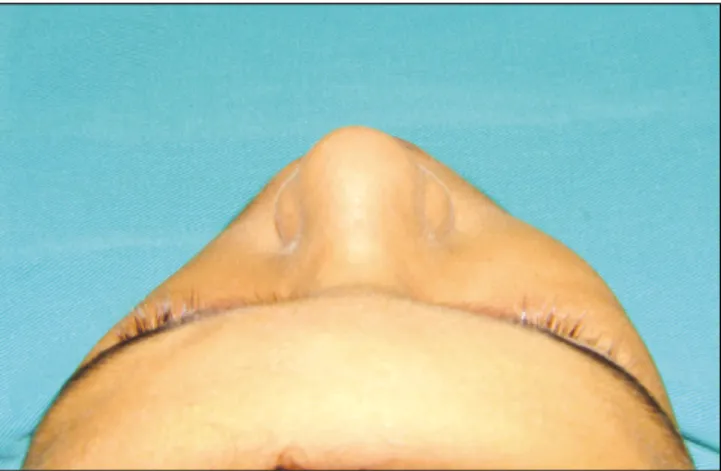
The clinical examination revealed a unilateral swelling of the right middle-face (Fig. 1), which produced a facial asymme- try.(Fig. 2) It was painful to palpation, but with no pain in mas- tication. An intraoral exam revealed an expanded right palate.(Fig. 3) He had a partial right nasal obstruction and some blurring vision of the right eye.
Initially, a panoramic X-ray was taken, which showed a mul- ti-locular lesion in the right maxilla, and the extensive disloca- tion of second and third right upper molars.(Fig. 4) A benign fibro-osseous lesion was the initial impression. A biopsy was made to confirm the suspicion.
Histological sections showed a cellular, fibroblastic stroma containing spindle-shaped cells and numerous osseous spicules.(Fig. 5A) A few giant cells were presented adjacent to the bony spicules. The bony trabeculae were lined by lightly eosinophilic material, suggestive of osteoid, which was in turn rimmed by osteoblasts.(Fig. 5B) The final diagnosis was juve- nile ossifying fibroma.
A computed tomography (CT) scan without contrast material with axial and coronal sections and tridimensional reconstruc- tion was carried out to show the true extent of the lesion. The axial section (Fig. 6) showed a large, well circumscribed mass Bruno Ramos Chrcanovic
Av. Raja Gabaglia 1000 / 1209, Gutierrez, Belo Horizonte, Minas Gerais-CEP 30441-070, Brazil
TEL: +55-31-91625090 FAX: +55-31-25151579 E-mail: [email protected]
article describes a case of expanded juvenile ossifying fibroma in the right maxilla in a 12-year old boy. The lesion was removed totally by surgery under general anesthesia. The patient showed no radiological signals of recurrence approximately two years after surgery.
Key words:Juvenile ossifying fibroma, Benign neoplasm, Maxillary sinus
[paper submitted 2009. 7. 14 / revised 2011. 1. 21 / accepted 2011. 2. 6]
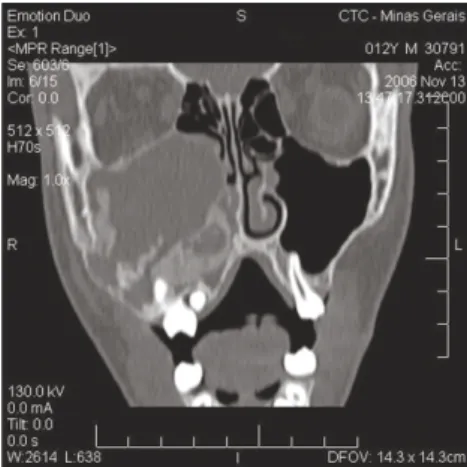
involving the maxillary sinus, with expansion to the nasal cavi- ty and the infratemporal fossa, without destruction of the bony margins. The coronal section (Fig. 7) showed expansion to the right nasal cavity, the ethmoid sinuses, the infra-zygomatic
crest and orbital floor, also without destruction of the bony margins. The three-dimensional reconstruction showed the right expanded maxillary area (Figs. 8, 9), and the extensive dislocation of second and third right upper molars.(Fig. 10)
Fig. 1. Frontal view revealing a unilateral swelling of the right middle-face.
Fig. 2.Upper view of the face.
Fig. 3.Expanded right palate. Fig. 4. Panoramic X-ray showing a multi-locular lesion appearance.
Fig. 5.Histological sections. A: Numerous osseous spicules. B: Giant cells adjacent to the bony spicules, which are lined by lightly eosinophilic material, suggestive of osteoid.
A B
Under general anesthesia a Weber-Fergusson incision was made to expose the whole aspect of the lesion.(Fig. 11) The surgical plan was try to remove the complete lesion without extensive free margins followed by curettage with spherical drill. The periosteum was elevated and the thinned anterior
maxillary wall was exposed. The large size and unyielding nature of the mass made removal in one piece impossible.
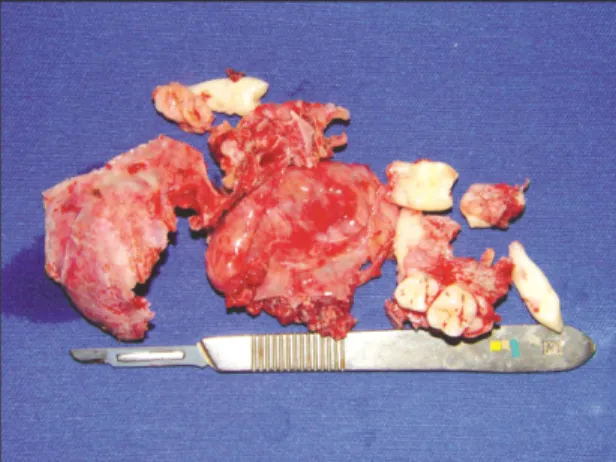
Therefore the gritty tumor was removed piecemeal.(Fig. 12) All teeth from right upper canine to right upper third molar were removed together with the lesion.
Fig. 6.Computed tomography. Axial section. Fig. 7.Computed tomography. Coronal section.
Fig. 8.Three-dimensional computed tomography. Frontal view. Fig. 9.Three-dimensional computed tomography. Lateral view.
Fig. 10. Three-dimensional computed tomography showing
the extensive dislocation of second and third molars. Fig. 11.A Weber-Fergusson approach was made to expose the external part of the lesion.
After complete removal of the mass, the cavity borders were carefully osteotomized with a large spherical drill (including the anterior aspect of the pterygoid plates and the zygoma body), to minimize the recurrence chance. The pterygoid plates were preserved, in order to avoid a direct communication with the cranial base and injury to important structures at the superi- or part of the pterygopalatine fossa, as the maxillary nerve and artery. The nasal content of the right nasal cavity was enucleat- ed and then the remaining content was electrocauterized. The vomer bone was left in place. Two titanium miniplates was placed to avoid complete collapse of the right cheek.(Fig. 13) There were no surgical complications. The patient was doing well, with good vision, no systemic or ocular problems and no radiological signals of recurrence approximately two years after the surgery.(Fig. 14) A removable prosthesis was made for oral rehabilitation, and he still going to periodical physio- therapy sessions.
Ⅲ. Discussion
The main characteristics of juvenile ossifying fibroma are the early age of onset, the localization of the tumor, the radiologi- cal pattern and a tendency to recurrence3. JOF usually grows relatively slowly4. There is a tendency to aggressive growth with cortical disruption and involvement of many adjacent anatomical structures5. Clinically, the symptoms are variable and include facial swelling, enlarging hard mass, sinusitis, nasal obstruction, teeth displacement, eye proptosis and pain1,6. The present patient was 12 years-old and the lesion had an evolution history of five months. The patient also demonstrat- ed unilateral hard swelling of the right middle-face, which pro- duced a facial asymmetry. There was partial right nasal obstruction. An aggressive growth was present, and the ipsilat- eral nasal cavity and ethmoid sinuses was involved. The CT showed expansion of the lesion to the nasal cavity, the infratemporal fossa, the ethmoid sinuses, the infra-zygomatic crest and orbital floor. These clinical signs and symptoms and the patient history, together with the histopathologic results were important to the definitive and final diagnosis in our case.
The tumor largely develops in children, 79% of whom are under 15 years old7,8. The tumor usually does not occur or recur during puberty9.
In most patients (85%), the tumors are located in the facial bones, but they also involve the calvaria (12%) and extra-cra- nial sites (4%)3. Among facial lesions, 90% arise from paranasal sinuses and the remaining 10% arise from the mandible3. The ethmoid sinuses are most commonly involved, followed by the frontal sinuses, the maxillary sinuses, and the sphenoid sinus. The tumor erodes bone partitions and encroaches on adjacent orbital, nasal, and cranial compart-
Fig. 12.The tumor was removed in several pieces. Fig. 14.Follow-up of two years.
Fig. 13. Titanium miniplates were placed to avoid complete collapse of the right cheek.
ated cells of the periodontal ligament, most often in the mandibular premolar-molar region. Lawton et al.6described cases with cranial fossa involvement.
JOF consists of a cell-rich fibrous tissue containing bands of cellular osteoid without osteoblastic rimming together with tra- beculae of more typical woven bone. Small foci of giant cells may be present, and in some parts, there may be abundant osteoclasts related to the woven bone. The nature of the hard tissue varies from scattered ossicles to irregular trabeculae of woven immature bone, although lamellar bone may also be present11. The peripheral osteoid rims surrounding the mineral components are an important feature in JOF8,11. The highly cel- lular nature of the fibrous matrix and woven bone reflects the more aggressive behavior of the tumor14. When compared with the adult form of ossifying fibroma, the juvenile form is more vascular with a richer cellular stroma13,15.
The distinction between other fibro-osseous lesions (ie, cementifying fibroma and fibrous dysplasia) is mainly based on the nature of the calcified product of the tumor. The differ- ential diagnosis is fibro-osseous lesions of the jaw, such as cemento-ossifying fibroma, osteoid osteoma or bone dysplasia2.
In general, JOF has a more aggressive growth compared with ossifying fibroma, which chiefly appears in the third and fourth decades of life4. Most cases of JOF are asymptomatic, as is reflected in the present case, and the first clinical manifesta- tion is a swelling of the maxillary cortical layer, which pro- duces a marked extra-oral facial asymmetry.
Radiographically, the demarcation of the tumor from the sur- rounding bone is well-defined by a radio-opaque border, and this characteristic is important in the differential diagnosis between JOF and fibrous dysplasia. The radiolucency of the lesion varies, depending on the maturation stage and amount of calcification16. In contrast to juvenile ossifying fibroma, fibrous dysplasia has a typical ground-glass appearance, expands the bone throughout its length and has poorly defined borders as it blends with the surrounding normal bone5.
es in the bone metabolism9. Nevertheless, it is important to per- form a clinical and radiological follow-up for as many years as possible, because of the possibility of recurrence in this type of neo-formation.
Some authors removed the tumor by careful excision fol- lowed by curettage9, though a more extensive therapy is usual- ly recommended for JOF, at the earliest possible stage6,16. Because they are well-differentiated lesions, they are not radiosensitive and radiotherapy is contraindicated because it can cause malignant change. The correct treatment is an en bloc resection with free surgical margins18, but we try to avoid a very aggressive resection in order to preserve surrounding important structures, as the vomer bone in the nasal cavity.
The pterygoid plates were also not removed, in order to avoid a direct communication with the cranial base and injury to important structures at the superior part of the pterygopalatine fossa, as the maxillary nerve and artery.
Its aggressive local behavior and high recurrence rate mean that it is important to make an early diagnosis, apply the appro- priate treatment and, especially, follow the patient up over the long term.
References
1. Scholl RJ, Kellett HM, Neumann DP, Lurie AG. Cysts and cystic lesions of the mandible: clinical and radiologic-histopathologic review. Radiographics 1999;19:1107-24.
2. Knox GW, Roth M, Saleh H, Stiles W. A unique temporal bone lesion resembling juvenile active ossifying myxoma. Am J Otol 1996;17:297-300.
3. Johnson LC, Yousefi M, Vinh TN, Heffner DK, Hyams VJ, Hartman KS. Juvenile active ossifying fibroma. Its nature, dy- namics and origin. Acta Otolaryngol Suppl 1991;488:1-40.
4. Bendet E, Bakon M, Talmi YP, Tadmor R, Kronenberg J.
Juvenile cemento-ossifying fibroma of the maxilla. Ann Otol Rhinol Laryngol 1997;106:75-8.
5. Khoury NJ, Naffaa LN, Shabb NS, Haddad MC. Juvenile ossify- ing fibroma: CT and MR findings. Eur Radiol 2002;12 Suppl 3:S109-13.
6. Lawton MT, Heiserman JE, Coons SW, Ragsdale BD, Spetzler RF. Juvenile active ossifying fibroma. Report of four cases. J Neurosurg 1997;86:279-85.
7. Slootweg PJ, Mu¨ller H. Juvenile ossifying fibroma. Report of four cases. J Craniomaxillofac Surg 1990;18:125-9.
8. Kramer IRH, Pindborg JJ, Shear M. Histological typing of odon- togenic tumours. 2nd ed. Berlin: Springer-Verlag; 1992.
9. Leimola-Virtanen R, Va¨ha¨talo K, Syrja¨nen S. Juvenile active os- sifying fibroma of the mandible: a report of 2 cases. J Oral Maxillofac Surg 2001;59:439-44.
10. Ferris NJ, Tien RD. Ethmoid mucocele in an infant with a benign fibroosseous lesion. AJNR Am J Neuroradiol 1995;16:473-5.
11. Slootweg PJ, Panders AK, Koopmans R, Nikkels PG. Juvenile ossifying fibroma. An analysis of 33 cases with emphasis on histopathological aspects. J Oral Pathol Med 1994;23:385-8.
12. Brannon RB, Fowler CB. Benign fibro-osseous lesions: a review of current concepts. Adv Anat Pathol 2001;8:126-43.
13. Bertrand B, Eloy P, Cornelis JP, Gosseye S, Clotuche J, Gilliard
C. Juvenile aggressive cemento-ossifying fibroma: case report and review of the literature. Laryngoscope 1993;103:1385-90.
14. Cawson RA, Binnie WH, Eveson JW. Color atlas of oral disease:
clinical and pathologic correlations. 2nd ed. London: Wolfe Publishing; 1994.
15. Kuta AJ, Worley CM, Kaugars GE. Central cementoossifying fi- broma of the maxillary sinus: a review of six cases. AJNR Am J Neuroradiol 1995;16:1282-6.
16. Regezi JA, Sciubba JJ, ed. Oral pathology: clinical pathologic correlations. 2nd ed. Philadelphia: Saunders; 1993.
17. Fakadej A, Boynton JR. Juvenile ossifying fibroma of the orbit.
Ophthal Plast Reconstr Surg 1996;12:174-7.
18. Zama M, Gallo S, Santecchia L, Bertozzi E, de Stefano C.
Juvenile active ossifying fibroma with massive involvement of the mandible. Plast Reconstr Surg 2004;113:970-4.