Received:June 24, 2016, Revised:August 9, 2016, Accepted:September 2, 2016
Corresponding to:Chang-Hee Suh, Department of Rheumatology, Ajou University School of Medicine, 164 WorldCup-ro, Yeongtong-gu, Suwon 16499, Korea. E-mail:[email protected]
Copyright ⓒ 2017 by The Korean College of Rheumatology. All rights reserved.
This is a Free Access article, which permits unrestricted non-commerical use, distribution, and reproduction in any medium, provided the original work is properly cited.
Pulmonary Arterial Hypertension is Normalized Following Six Years of Inhaled Iloprost Treatment in a Patient with Systemic Sclerosis
So-Young Yoon, Eun-Soo Yoo, Eun-Jung Yoo, Ju-Yang Jung, Hyoun-Ah Kim, Chang-Hee Suh
Department of Rheumatology, Ajou University School of Medicine, Suwon, Korea
Pulmonary arterial hypertension is a critical manifestation of systemic sclerosis (SSc) and is a main cause of death. Several treat- ment modalities for SSc have been identified, with effects that improve quality of life and mortality rates. However, whether these drugs can also normalize pulmonary arterial pressure, remains unclear. Here, we report the case of a woman with diffuse SSc with pulmonary arterial hypertension, who had a functional status equivalent to the New York Heart Association class III.
The patient was treated with inhaled iloprost. After six years of inhaled iloprost therapy, echocardiography showed that pulmo- nary arterial pressure normalized, accompanied by improvement in functional capacity. Inhaled iloprost might not only nor- malize pulmonary arterial pressure, but also improve the functional status of patients with SSc with pulmonary arterial hypertension. (J Rheum Dis 2017;24:114-118)
Key Words. Systemic sclerosis, Pulmonary hypertension, Iloprost
INTRODUCTION
Systemic sclerosis (SSc) is an autoimmune disease char- acterized by inflammation, vasculopathy, and excessive fibrosis of the internal organs and skin. Injury to vascular endothelial cells and microvessels is an important factor in the initiation of SSc. Diffuse SSc affects the skin as well as the heart, lungs, gastrointestinal tract, and kidneys.
Raynaud’s phenomenon, sclerodactyly, interstitial pneu- monitis, and pulmonary arterial hypertension (PAH) are major manifestations of SSc. PAH is one of the most seri- ous complications of SSc, with nonspecific symptoms such as dyspnea on exertion, peripheral edema, and he- modynamic instability. Elevated pulmonary arterial pres- sure (PAP) is common in both limited and diffuse SSc, oc- curring in 21% of patients with limited and 26% of pa- tients with diffuse SSc [1]. A consensus statement from the American College of Cardiology, the American College of Chest Physicians, the American Thoracic Society, and
the Pulmonary Hypertension Association recommends yearly echocardiography for patients with SSc to screen for PAH [2]. Echocardiography is an appropriate screen- ing tool for PAH in symptomatic patients with SSc. When PAP is elevated on echocardiography, right heart catheter- ization (RHC) is needed to confirm PAH. However, PAH is strongly suggested when PAP measurements are over 40 mmHg on echocardiography.
Patients with SSc-associated PAH are reported to have worse prognosis than patients with idiopathic PAH.
Recently, the pharmacological management of PAH has been advanced by the development of new therapeutic drugs. Intravenous, subcutaneous, oral, and inhaled pros- tanoids and endothelin receptor antagonists, such as bo- sentan, have been utilized as a therapy for PAH. In the Aerosolized Iloprost Randomized study, 203 patients with PAH who were treated with inhaled iloprost demon- strated an increase in their 6-minute walking distance (6MWD) compared to those receiving a placebo, and ap-
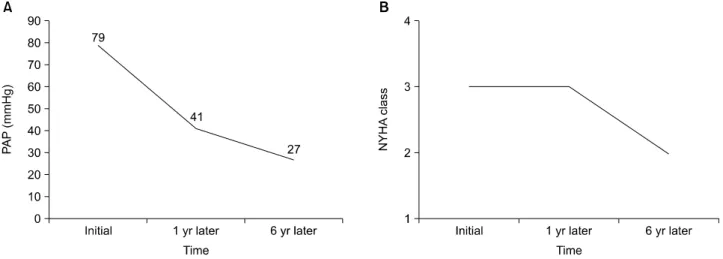
Figure 2. Improvement in pulmonary arterial hypertension. (A) Reduction in pulmonary arterial pressure (PAP) on echocardiography. (B) Improvement in New York Heart Association (NYHA) class.
Figure 1. Chest computed tomography. Interstitial pneumo- nitis and bilateral pleural effusion.
proximately 24% of the patients demonstrated improved functional capacity according to their World Health Organization functional class [3].
CASE REPORT
A 58-year-old woman, who had had Raynaud’s phenom- enon, bilateral knee arthralgia, reflux esophagitis, and dyspnea on exertion for 2 years, visited our hospital in September of 2008. According to the laboratory data, her antinuclear antibody test result was positive, with a titer of 1:2,560 and cytoplasmic type antibodies. Anti-Scl-70 antibody and anti-Ro antibody test results were positive, whereas anti-centromere, anti-ribonucleoprotein, and anti-Sm antibody test results were negative. Inflammatory marker levels were elevated; her erythrocyte sedimen- tation rate was 82 mm/hr and C-reactive protein level was 1.81 mg/dL. On chest computed tomography, ground glass opacity was noted in both lower lobes, representing interstitial pneumonitis and bilateral pleural effusion (Figure 1). Reflux esophagitis was revealed by esophago- gastroduodenoscopy. On echocardiography, moderate amount of pericardial effusion was observed and the pa- tient was diagnosed with severe PAH, with a PAP of 79 mmHg. The severity of her dyspnea was classified as New York Heart Association (NYHA) class III. On spirometry, forced vital capacity was 49% and forced expiratory vol- ume at the end of the first second of exhalation was 50%, but testing of the diffusing capacity of the lung for carbon monoxide (DLCO) was not performed due to dyspnea.
The 6MWD of the patient was 370 m. We assessed PAP by echocardiography without RHC. In cases with PAP >40
mmHg on echocardiography, the values obtained during RHC are always abnormal [4]. Therefore, we did not pro- ceed to invasive RHC because of the patient’s condition.
The patient was diagnosed with SSc with interstitial pneumonitis and PAH. We initiated calcium channel blocker of the dihydropyridine type, low-dose steroids, azathioprine and bucillamine for the treatment of SSc.
According to the previous study, immunosuppressive therapy was ineffective in patients with systemic scle- rosis-associated PAH [5]. So, we initiated inhaled ilo- prost for PAH. We could not choose endothelin receptor antagonists, because the liver function test in initial labo- ratory data was elevated; her aspartate aminotransferase was 102 U/L and alanine aminotransferase was 43 U/L.
There was no liver parenchymal disease on abdominal computed tomography, we reasoned that was due to car-
Figure 3. No significant change in interstitial lung disease dur- ing the treatment. (A) Chest ra- diography at diagnosis. (B) Chest radiography 6 years later.
diogenic congestion. Within a short time, there was a beneficial effect on the patient’s general condition and physical exercise capacity. And there was no aggravation of Raynaud’s phenomenon, bilateral knee arthralgia, and reflux esophagitis. After 8 months of treatment, her PAP improved to 41 mmHg, and only mild pericardial effusion was observed on echocardiography. And the liver func- tion test was improved; her aspartate aminotransferase and alanine aminotransferase in follow-up laboratory da- ta was below 40 U/L. About 6 years later, we were able to normalize her PAH, as shown by PAP values of 27 mmHg on echocardiography, and there was no pericardial effu- sion (Figure 2). She was classified as having NYHA class II condition, according to the improvement in dyspnea (Figure 2), and her 6MWD improved to 408 m compared to the initial distance of 370 m. Although there was no significant change in interstitial lung disease (ILD) on fol- low-up chest radiography (Figure 3), overall, she experi- enced marked improvements in hemodynamic stability and sustained functional capacity.
DISCUSSION
When compared to patients with idiopathic PAH (IPAH), patients with connective tissue disease-associated PAH (CTD-APAH) have worse prognosis, with lower 6MWD, pericardial effusion, and elevated brain natriuretic pep- tide (BNP) levels. Compared to other patients with CTD-APAH, patients with systemic sclerosis-associated PAH (SSc-APAH) have a unique phenotype characterized by markedly elevated BNP levels, reduced DLCO, and poor short-term survival rates. More specifically, the one-year survival rates are reported to be 93% for patients
with IPAH, 86% for patients with CTD-APAH, and 82%
for patients with SSc-APAH [6].
A study was reported that compared patients with SSc, whose PAH was identified during an early detection pro- gram, to patients with SSc whose PAH was detected dur- ing routine clinical practice [7]. The results of that in- dicated that 6% of patients whose PAH was detected by the early detection program were in NYHA class I and 44% were in NYHA class II. In contrast, 0% of patients whose PAH was detected by routine practice were in NYHA class I and only 2% were in NYHA class II [7].
Subsequently, patients in the screening program had sig- nificantly greater survival rates than patients whose PAH was identified during routine clinical practice. Thus, early detection is very important.
RHC is the gold standard for the assessment of car- diopulmonary hemodynamics. However, it is too invasive to use for all patients and as a repeat procedure for fol- low-up. Echocardiography is a noninvasive tool for the evaluation of right-sided heart structure and hemody- namics. According to the study by Denton et al. [4], echo- cardiographic measures correlate significantly with in- vasive hemodynamic assessment. Several newer echo- cardiographic variables have also been closely associated with RHC measurements [8]. Therefore, echocardiog- raphy can play a clinical role in detecting PAH and right ventricular dysfunction noninvasively. However, it cannot yet replace RHC for the definitive diagnosis of PAH, and we need further studies in a large population.
PAH is one of the serious manifestations of SSc, al- though effective drugs have been developed. Based on im- proved understanding of the pathogenesis of PAH, new therapies have been developed focusing on endothelial
function and remodeling. Prostacyclin and endothelin re- ceptor antagonists have been approved for the treatment of PAH. Endothelin receptor antagonists are the first oral therapy approved for PAH that has been demonstrated to improve NYHA functional class, 6MWD, and hemody- namics [9]. Epoprostenol has been proven effective for the management of PAH, improving exercise capacity, cardiopulmonary hemodynamics, functional classification, and survival in a randomized clinical trial. However, in pa- tients with PAH with SSc, continuous intravenous epo- prostenol improved exercise capacity and hemody- namics, but failed to improve survival [10]. Intravenous prostacyclin has many complications, such as flushing, headache, jaw pain, diarrhea, nausea, and erythematous rash, and requires an access port that can become a source of infection for immunosuppressed patients with SSc.
Inhaled iloprost is a useful alternative therapy, especially when intravenous prostacyclin and bosentan is con- traindicated. Iloprost is stable at room temperature and has a pH of 7.4. Moreover, inhaled iloprost dilates the pul- monary arteries selectively. Therefore, the systemic side effects are less than with intravenous or subcutaneous drugs. However, the effect of inhaled iloprost terminates between 6.4 to 9.5 minutes after inhalation, and it is nec- essary to use inhaled iloprost 6 to 12 times a day. The usu- al dosage is 2.5 μg per inhalation although it can be in- creased to 5 μg per inhalation [11].
PAH is characterized by the elevation of PAP as well as by early mortality. A previous study has shown that an es- timated PAP <30 mmHg results in an increased risk of death with a hazard ratio (HR) of 1.67 [12]. Study results showed that for PAP >30 and <36 mmHg, the HR was 2.31; for PAP >36 and <40 mmHg, the HR was 2.79; and for PAP >40 and <50 mmHg, the HR was 8.39 [12].
Patients with SSc with PAP >36 mm Hg had a poorer prognosis. Survival rates at 1, 2, and 3-year follow-up in patients with PAP >36 mmHg were 98.0%, 92.5%, and 80.6%, respectively. Comparatively, the survival rates for patients with PAP <36 mmHg were 99.4%, 97.0%, and 93.8%, respectively [12]. Therefore, improving PAP means increasing survival rates significantly.
In this case report, we demonstrated the normalization of PAH, with concomitant improvement in symptoms and functional capacity after treatment with inhaled iloprost. Although the patient has ILD, the possibility that her PAH was related to the ILD is low because ILD was not severe and was limited in both basal lung.
Moreover, PAH can occur in patients with SSc, unrelated
to ILD. And the PAP was normalized without changes in ILD (Figure 3). Also, the incidence of PAH did not differ according to the presence of ILD in Korean patients with connective tissue disease (unpublished material). Nor- malizing PAH means improving patient survival rates.
We can expect additional improvements in the survival of patients with SSc-APAH through further studies of ther- apy for PAH.
SUMMARY
We believe this to be a rare case of SSc-APAH in which PAP was normalized by targeted treatment. We wish to share this experience of the normalization of PAH, im- provement in patient symptoms, and functional capacity with the use of inhaled iloprost. Patients with PAH and SSc have a poor prognosis despite advances in treatment;
however, we can achieve higher survival of patients with SSc-APAH through further studies of PAH therapy.
CONFLICT OF INTEREST
No potential conflicts of interest relevant to this article were reported.
REFERENCES
1. Pope JE, Lee P, Baron M, Dunne J, Smith D, Docherty PS, et al. Prevalence of elevated pulmonary arterial pressures measured by echocardiography in a multicenter study of pa- tients with systemic sclerosis. J Rheumatol 2005;32:1273-8.
2. Mathai SC, Hassoun PM. Therapy for pulmonary arterial hy- pertension associated with systemic sclerosis. Curr Opin Rheumatol 2009;21:642-8.
3. Olschewski H, Simonneau G, Galiè N, Higenbottam T, Naeije R, Rubin LJ, et al. Inhaled iloprost for severe pulmo- nary hypertension. N Engl J Med 2002;347:322-9.
4. Denton CP, Cailes JB, Phillips GD, Wells AU, Black CM, Bois RM. Comparison of Doppler echocardiography and right heart catheterization to assess pulmonary hyper- tension in systemic sclerosis. Br J Rheumatol 1997;36:239- 43.
5. Miyamichi-Yamamoto S, Fukumoto Y, Sugimura K, Ishii T, Satoh K, Miura Y, et al. Intensive immunosuppressive ther- apy improves pulmonary hemodynamics and long-term prognosis in patients with pulmonary arterial hypertension associated with connective tissue disease. Circ J 2011;
75:2668-74.
6. Chung L, Liu J, Parsons L, Hassoun PM, McGoon M, Badesch DB, et al. Characterization of connective tissue dis- ease-associated pulmonary arterial hypertension from REVEAL: identifying systemic sclerosis as a unique phe- notype. Chest 2010;138:1383-94.
7. Humbert M, Yaici A, de Groote P, Montani D, Sitbon O, Launay D, et al. Screening for pulmonary arterial hyper- tension in patients with systemic sclerosis: clinical charac- teristics at diagnosis and long-term survival. Arthritis Rheum 2011;63:3522-30.
8. Gopal DM, Doldt B, Finch K, Simms RW, Farber HW, Gokce N. Relation of novel echocardiographic measures to invasive hemodynamic assessment in scleroderma-associated pulmonary arterial hypertension. Arthritis Care Res (Hobo- ken) 2014;66:1386-94.
9. Rubin LJ, Badesch DB, Barst RJ, Galie N, Black CM, Keogh A, et al. Bosentan therapy for pulmonary arterial hypertension.
N Engl J Med 2002;346:896-903.
10. Badesch DB, Tapson VF, McGoon MD, Brundage BH, Rubin LJ, Wigley FM, et al. Continuous intravenous epoprostenol for pulmonary hypertension due to the scleroderma spec- trum of disease. A randomized, controlled trial. Ann Intern Med 2000;132:425-34.
11. Krug S, Sablotzki A, Hammerschmidt S, Wirtz H, Seyfarth HJ. Inhaled iloprost for the control of pulmonary hyper- tension. Vasc Health Risk Manag 2009;5:465-74.
12. Hachulla E, Clerson P, Airò P, Cuomo G, Allanore Y, Caramaschi P, et al. Value of systolic pulmonary arterial pressure as a prognostic factor of death in the systemic scle- rosis EUSTAR population. Rheumatology (Oxford) 2015;
54:1262-9.