Received:January 27, 2015, Revised:February 3, 2015, Accepted:February 3, 2015
Corresponding to:Geun-Tae Kim, Division of Rheumatology, Department of Internal Medicine, Kosin University College of Medicine, 262 Gamcheon-ro, Seo-gu, Busan 602-702, Korea. E-mail:[email protected]
pISSN: 2093-940X, eISSN: 2233-4718
Copyright ⓒ 2015 by The Korean College of Rheumatology. All rights reserved.
This is a Free Access article, which permits unrestricted non-commerical use, distribution, and reproduction in any medium, provided the original work is properly cited.
류마티스 질환에서의 식품과 민간요법
김 근 태
고신대학교 의과대학 내과학교실 류마티스내과
Diet and Folk Medicines for Rheumatic Diseases
Geun-Tae Kim
Division of Rheumatology, Department of Internal Medicine, Kosin University College of Medicine, Busan, Korea
Notwithstanding recent advances in the field of treatment of rheumatic diseases, patients still have a significant interest in com- plementary and alternative medicine for various reasons. The purpose of this review is to investigate the effect of certain dietary components or folk medicines on the pathogenesis or outcome of rheumatic diseases. The data used in the study were mainly selected from the references searched by MEDLINE. Among the variety of dietary components and folk medicines investigated, omega-3 fatty acid, alcohol, and vitamin D showed negative correlation with the risk of rheumatoid arthritis. Specifically, ome- ga-3 fatty acids appeared to be somewhat helpful for treatment of rheumatoid arthritis. Although some of the items showed a positive effect through this study, it failed to establish definitive evidence for the overall effect of diet and folk medicines in rheu- matic diseases. In the future, further understanding of mechanisms and clinical utility should be acquired through numerous systematic and scientific research studies. (J Rheum Dis 2015;22:10-18)
Key Words. Diet, Traditional medicine, Rheumatic diseases
서 론
진료 중에 환자들로부터 가장 많이 받은 질문 중의 하나 가 바로 자신의 질환에 도움이 되는 식품이나 민간요법은 어떤 것들이 있는가에 대해서이다.
류마티스관절염의 발병에는 많은 유전적 및 환경적 인자 들이 중요한 역할을 담당하는 것으로 알려져 있다. 환경적 인자들 중에서는 흡연이 가장 널리 인정되고 있으며[1], 식품도 잠재적 위험인자로 주목받고 있지만, 한편으로는 특정 식품이 류마티스 질환의 증상 완화나 치유에 도움을 준다는 보고들도 있다[2].
현재 이러한 식품이나 민간요법의 역할에 대해서는 과학 적 근거가 많이 부족하기 때문에 대부분의 의사들은 상대 적으로 관심을 적게 가지는 반면, 환자들은 혹시나 하는
마음에 자신들의 질환에 도움이 될만한 것들을 찾게 되고, 검증되지 않은 많은 정보들에 노출이 되며, 그로 인해 불 필요한 비용 문제, 때로는 환자를 위험에 빠뜨릴 수 있는 안정성 문제 등이 야기되기도 한다.
그러므로 류마티스 질환들에서의 식품이나 민간요법에 대한 의학적 근거를 정립하고, 이를 토대로 의사의 적절한 조언이 이루어질 때에 여러 문제점들로부터 환자를 보호 하고 도움을 줄 수 있을 것으로 기대된다. 이에 류마티스 관절염과 골관절염과 같은 대표적인 류마티스 질환에서 현재 관절에 좋다고 일반인들에게 널리 알려진 식품들과 민간요법들의 효능에 대해 문헌고찰을 통한 근거를 바탕 으로 요약하였다.
Figure 1. Anti-inflammatory ef- fect of omega-3 fatty acid. APC:
antigen-presenting cell, DHA:
docosahexaenoic acid, EPA: ei- cosapentaenoic acid, MHC: ma- jor histocompatibility complex.
본 론
오메가-3 지방산(omega-3 or n-3 fatty acid)
다가불포화지방산들 중 가장 대표적인 것이 오메가-6와 오메가-3 지방산이다. 가장 단순한 형태의 오메가-3 지방 산인 α-linolenic acid는 오메가-6 지방산인 linoleic acid 로부터 delta-15 desaturase에 의해 합성된다. 식물들과는 달리 척추동물에서는 이 효소가 없기 때문에 α-linolenic acid를 합성할 수 없으며, 반드시 식이로 섭취하는 것이 필요하다. Linoleic acid는 홍화씨, 야자, 콩, 평지씨, 해바 라기씨 등에서 추출한 식물성 기름에 상대적으로 많이 함 유되어 있고, 대사되면 아라키돈산으로 전환된다. 반면에 α-linolenic acid는 치아씨, 키위씨, 들깨, 아마씨, 올리브, 포도씨 등에서 추출한 식물성 기름에 더 많이 함유되어 있으 며, 대사되어 eicosapentaenoic acid (EPA), docosahexaenoic acid (DHA)로 전환된다. EPA와 DHA는 전염증성 작용이 적 은 아이코사노이드인 프로스타글란딘(prostaglandin, PG) E3, 트롬복산(thromboxane, TX) A3, 류코트리엔(leukotriene) B5 등을 합성하고, 종양괴사인자(tumor necrosis factor, TNF)-α, 인터루킨(interleukin, IL)-1β 등의 시토카인 합 성 억제 및 E-resolvin 생성 등의 다양한 경로를 통해 항염 증작용에 관여하는 것으로 밝혀졌다(Figure 1). 사람에서 는 α-linolenic acid에서 EPA, DHA로의 전환이 제한적이 기 때문에 EPA, DHA를 많이 함유한 음식 등을 통해 직접 섭취해주는 것이 도움이 되는데, EPA와 DHA가 가장 많 이 함유된 식품은 연어, 고등어, 참치와 같은 기름진 생선 들이다.
류마티스관절염 동물모델에서는 오메가-3 지방산이 관 절염의 발생을 억제하고 염증을 감소시키는 것이 관찰되 었다[3,4]. 일부 임상 연구들은 류마티스관절염 발병에 오 메가-3 지방산이 연관없음을 보고하고 있으나[5,6], 다른
많은 연구들에서는 역상관관계가 관찰되었다[7,8]. 최근 스웨덴의 중년 여성을 대상으로 한 대규모 전향적 연구인 Swedish Mammography Cohort에서도 오메가-3 지방산 섭취와 류마티스관절염의 발병 간의 연관성을 조사하였 다. 평균 7.5년의 관찰기간 동안 32,232명의 여성 중 205 명의 류마티스관절염 환자가 발생되었으며, 10년 이상 오 메가-3 지방산을 0.21 g/d 이상 식품으로 섭취한 군에서 그 이하로 섭취한 군보다 류마티스관절염의 발병이 35%
정도 감소됨이 관찰되었다(relative risk [RR] 0.65, 95%
confidence interval [CI] 0.48∼0.90) [9].
한편, 류마티스관절염의 치료 측면에서 오메가-3 지방산 의 역할에 대해서도 비교적 많은 연구들이 진행되었다. 메 타분석들을 살펴보면, 한 연구에서는 환자의 통증평가, 조 조강직, 압통관절 수, 비스테로이드소염제(Nonsteroidal anti-inflammatory drugs, NSAIDs) 소비량에 있어서 fish oil군에서 유의하게 낮음을 보고하였고[10], 국내 연구에 서는 fish oil군에서 NSAIDs 소비량이 의미있게 감소됨을 보고하였다[11]. 최근 류마티스관절염 환자를 대상으로 한 이중맹검 무작위 연구에서 fish oil (고용량, 5.5 g/d)군 이 control (저용량, 0.4 g/d)군보다 유의하게 질병완화제 의 3제 병합요법 실패율이 낮았고(hazard ratio [HR]
0.24, 95% CI 0.10∼0.54, p=0.0006), American College of Rheumatology 관해 도달률의 개선이 관찰되었다(HR 2.09, 95% CI 1.02∼4.30; p=0.04) [12]. 이상의 연구결과 들에서 오메가-3 지방산은 류마티스관절염의 예방과 치료 에 어느 정도 도움이 될 수 있을 것으로 추정된다.
골관절염에서는 오메가-3 지방산이 우연골에서 IL-1α에 의한 matrix metalloproteinase (MMP)-3, MMP-13 및 a disintegrin and metalloproteinase with thrombospondin motifs (ADAMTs)와 같은 기질분해효소의 발현을 억제하 는 것이 확인되었으며[13], 골관절염 환자를 대상으로 한
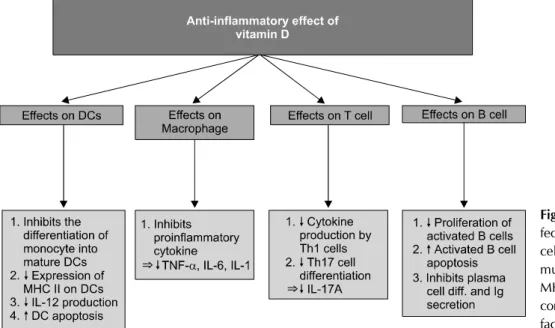
Figure 2. Anti-inflammatory ef- fect of vitamin D. DC: dendritic cell, diff.: differentiation, Ig: im- munoglobulin, IL: interleukin, MHC: major histocompatibility complex, TNF-α: tumor necrosis factor-α.
multicentre osteoarthritis study에서 오메가6 및 오메가3 지방산의 혈중 농도와 무릎 자기 공명 영상상에서 활막염 과의 연관성을 조사하였는데, 오메가-3 지방산은 슬개-대 퇴 연골 손상과 역상관관계를, 오메가-6 지방산은 활막염 과 양의 상관관계를 보였다[14]. 하지만 골관절염에서의 전반적인 근거는 매우 빈약한 상태이다.
비타민 D
비타민 D는 지용성 세코스테로이드계 호르몬으로 비타민 D1∼D5로 분류할 수 있으며, 비타민 D2 (ergocalciferol)와 비타민 D3 (cholecalciferol)가 주된 형태이다. 체내에서 활성 형인 calcitriol (1,25-dihydroxycholecalciferol, 1,25(OH)2D) 으로 전환되어 뼈와 칼슘 대사에 주로 관여하며, 이외에도 면역 시스템, 암, 심혈관계에 다양한 영향을 미치는 것이 밝혀졌다. 1형 당뇨병, 다발성경화증 및 염증성장질환과 같은 만성 질환에서 비타민 D의 면역조절 효과는 비교적 잘 알려져 있으며, 비타민 D 결핍 시 류마티스관절염, 전 신경화증, 전신홍반루푸스과 같은 자가면역질환의 발생과 도 연관 있다는 보고가 있다[15,16]. 비타민 D의 면역조절 기능은 수지상세포, 대식세포, T 세포, B 세포와 같은 면역 세포에 대한 작용과, 전염증성 시토카인 합성 억제 등의 경로를 통해 항염증 작용을 나타내게 된다(Figure 2). 자 외선에 충분히 노출되지 못하는 경우에는 보충제나 식품 을 통한 비타민 D 섭취를 보완하는 것이 필요하며, 식품 중에서는 기름진 생선이 가장 좋은 공급원으로 연어 80 g에는 하루 권장섭취량의 75% 정도가 함유되어 있다.
임상 연구에서 비타민 D 섭취가 전신홍반루푸스나 류마티 스관절염의 발생과는 연관이 없다는 보고들이 있다[17,18].
하지만 29,368명의 여성을 대상으로 한 전향적 코호트 연 구(Iowa Women’s Health Study)에서 처음으로 비타민 D
와 류마티스관절염 발병 사이에 역상관관계가 확인되었는 데(RR 0.67, 95% CI 0.44∼1.00, for a daily intake of vita- min D of ≥467.7 IU/d vs. <221.4 IU/d), 이러한 역상관 관계는 식이 섭취보다는 비타민 D 보충제에서 좀 더 뚜렷 하게 관찰되었다[19]. 메타분석에서는 비타민 D 총섭취량 (RR 0.758, 95% CI 0.577∼0.937 for the highest group vs. the lowest group; p=0.047)과 보충제(RR 0.764, 95%
CI 0.628∼0.930; p=0.007) 모두 류마티스관절염의 발병 을 의미있게 감소시킴을 보고하였다[20].
류마티스관절염의 치료에서 비타민 D의 역할은 다소 회 의적이다. 동물모델에서는 관절염 진행을 억제하는 것이 관찰되었으나[21], 환자를 대상으로 한 임상 연구들에서는 엇갈린 결과들을 보이고 있다. 초기 연구들에서는 류마티 스관절염 환자들에서 비타민 D 보충이 질병 활성도 개선 에 도움이 되는 것으로 알려졌지만[22,23], 117명의 환자 를 대상으로 진행된 이중맹검 무작위 대조연구에서는 비 타민 D (50,000 IU/wk) 투여군과 위약군 사이에 유의한 차이가 없었으며[24], 최근 발표된 단면연구에서도 비타민 D 섭취가 혈중 비타민 D 농도를 상승시키지만 류마티스관 절염의 질병 활성도와는 상관관계가 관찰되지 않았다[25].
골관절염에서도 혈중 비타민 D 와의 연관성에 대해 연구 들이 진행되었으나 마찬가지로 일관된 결과를 보여주지는 못하였다[26,27].
항산화제
염증이 있는 류마티스관절염 환자의 관절액에서 프리라 디칼의 산화가 증가되는 것이 관찰되었는데, 이는 염증이 활성산소에 의해 매개될 수 있음을 시사한다[28]. 활성산 소들은 염증 환경 내에서 자가 단백의 항원성을 변화시키 고 면역 반응을 초래하여 자가항체 생성 등에 관여하고,
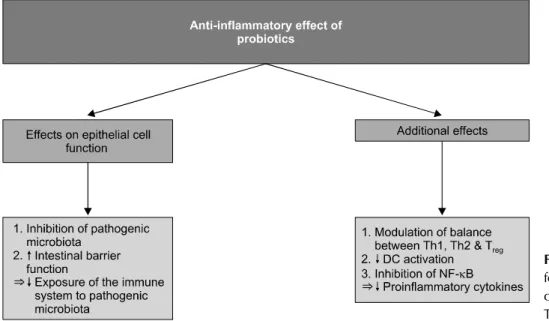
Figure 3. Anti-inflammatory ef- fect of probiotics. DC: dendritic cell, NF-κB: nuclear factor-κB, Treg: regulatory T cells.
nuclear factor-κB (NF-κB)와 같은 전사인자에 작용하여 전염증성 아이코사노이드와 시토카인들의 생산을 증가시 켜 염증반응을 촉진시키는 등 많은 염증성 자가면역 질환 에서 중요한 역할을 수행한다[29]. 증가된 자가면역 반응 은 다시 유해산소의 생산을 촉진하여 악순환 고리를 형성 하게 되는데, 항산화제가 활성 산소 제거기로 작용하여 산 화적 손상을 억제함으로써 이와 같은 악순환의 고리를 끊 는 데 도움이 될 것으로 추정된다.
하지만 류마티스관절염 발병에서 비타민 E, 비타민 C, β-카로텐 및 셀레늄과 같은 항산화제의 역할에 대한 연구 들에서는 일관된 결과를 볼 수 없다. 산화적 스트레스와 활성산소가 류마티스관절염의 발병과 연관 있으며[30], 항산화제의 섭취가 류마티스관절염 발병과 역상관관계를 보인다는 연구 결과가 있는 반면[31], 이와는 반대되는 연 구들도 많이 있다. 비타민 E 600 IU를 격일로 사용한 이중 맹검 무작위 대조연구에서는 류마티스관절염의 발병과는 의미 있는 연관성이 관찰되지 않았으며(RR 0.89, 95% CI 0.61∼1.31) [32], Nurses’ Health Study (NHS)와 NHS II 코호트 연구에서도 마찬가지로 유의한 연관성이 보고되 지 않았다[33].
또한 항산화제가 류마티스관절염 치료에 도움이 되는가 에 대해서도 부정적인 견해가 우세하다. 류마티스관절염 에서 비타민 E 600 mg 2회/일 복용군과 위약군을 12주간 비교한 이중맹검 무작위 대조연구에서 염증 지수는 양 군 간에 차이가 없었으며[34], 셀레늄의 효과를 평가한 다른 무 작위 대조연구에서도 selenium-enriched yeast (200 μg/d) 군에서 유의한 임상적 이득이 관찰되지 않았다. 이 연구에 서는 특이하게도 양 군 모두 압통 관절, 조조강직 및 삶의 질이 유의하게 개선되었으나 양 군 간의 통계적인 유의성이 관찰되지 않아 위약 효과에 의한 개선으로 추정되었다[35].
또 다른 무작위 대조연구에서도 류마티스관절염 환자를
세 군으로 나눈 후 각각 quercetin+vitamin C (166 mg+133 mg/capsule), alpha-lipoic acid (300 mg/capsule) 그리고 위약을 투여하였으나 염증에 대한 생화학적 표지자나 질 병활성도에 유의한 차이가 관찰되지 않았다[36].
한편 항산화제가 슬관절 골관절염의 진행을 억제시킨다 는 보고가 있지만[37], 매우 제한적인 연구 수로 인해 결 론 도출하기가 어려운 상태다.
프로바이오틱스
장내 미생물(microbiome)들이 숙주의 생체대사 조절, 소 화 능력, 면역 시스템 등에 중요한 역할을 하는 것으로 밝 혀져 있으며 이러한 미생물의 미세환경이 치료에도 응용 될 수 있다. 프로바이오틱스란 숙주의 건강에 도움을 주는 미생물로 정의되며 여러 균주들 중 lactobacilli와 bifido- bacteria가 가장 많이 연구되고 있다. 보통은 요구르트와 같은 유제품에 많이 함유되어 있으며, lyophilized 형태의 보충제도 사용되고 있다. 프로바이오틱스는 장점막 상피 세포에 주로 작용하는데 병적인 미생물을 억제하여 장내 정상균무리를 유익한 방향으로 조절하고, 장점막 장벽 기 능 강화를 통해 면역계가 미생물에 노출되는 것을 감소시 키며 그 외에도 염증 부위에 regulatory T cell의 축적, 수 지상 세포의 활성화 억제, NF-κB 억제 등을 통하여 항염 증 작용을 나타낸다(Figure 3).
동물모델에서는 프로바이오틱스가 관절염의 진행을 억 제함이 관찰되었지만[38], 환자를 대상으로 한 대부분의 무작위 대조연구들에서는 류마티스관절염이나 척추관절 염의 질병활성도나 경과에 영향을 미치지 않는 것으로 밝 혀졌다[39-41]. 최근에 발표된 일부 무작위 대조연구들에 서는 다른 결과를 보고하고 있다. 45명의 류마티스관절염 환자를 대상으로 한 연구에서 Bacillus coagulans GBI-30, 6086 LAB 프로바이오틱스를 사용한 군이 위약군보다 통
증이 의미 있게 개선되었고(p=0.046) [42], 아시아인들을 대상으로 한 연구에서도 위약군보다 Lactobacillus casei 보 충제 투여군에서 유의하게 the European League Against Rheumatism 반응률과 DAS28의 개선이 관찰되었다[43].
하지만 프로바이오틱스의 긍정적인 역할을 기대하기에는 근거가 많이 부족하기 때문에 이를 뒷받침해줄 더 많은 연 구가 필요할 것으로 생각된다.
기타 식품 및 민간요법 1) 육류
육류, 특히 빨간 고기에 함유된 다량의 아미노산들과 류 마티스관절염 발병 사이에는 상반된 연구 결과들이 관찰 된다. 초기 연구들에서는 육류 섭취가 류마티스관절염의 유병률과 연관된 것으로 보고되었으나[44], 이후에 발표 된 전향적 코호트 연구들에서는 연관성이 관찰되지 않았 다[6,45,46]. 육류뿐만 아니라 철분이나 유제품 섭취도 마 찬가지로 연관성이 없는 것으로 보고되고 있다[45].
2) 음료(beverages, 커피와 차)
매일 다량의 커피를 마실 경우 류마티스관절염의 발병이 증가된다는 연구결과가 한동안 언론에 자주 등장한 적이 있다. 핀란드에서 진행된 전향적 코호트 연구에서 처음으 로 류마티스관절염과 커피와의 연관성에 대해 조사하였는 데, 하루 4잔 이상 마실 경우 그 이하로 마실 때보다 류마티 스관절염 발병이 증가되었고(RR 2.20, 95% CI 1.13∼4.27 for ≥4 cups/d vs. ≤3 cups/d) [47], Iowa Women’s Health Study에서는 4잔 이상의 카페인 제거 커피를 마실 경우 커피를 마시지 않는 군에 비해 류마티스관절염의 발 병이 증가되어, 카페인 자체는 중요한 역할을 하지 않는 것으로 추정되었다(RR 2.58, 95% CI 1.63∼4.06) [48]. 하 지만 다른 전향적 코호트 연구들에서는 의미있는 연관성 이 보고되지 않았다[49,50]. 연구 방법에 따른 메타분석에 서 하루 4잔 이상의 커피섭취가 환자-대조군 연구들에서는 류마티스관절염의 발생을 증가시켰지만(RR 1.201, 95%
CI 1.058∼1.361; p=0.005), 코호트 연구들에서는 유의한 소견을 보여주지 못했다(RR 4.148, 95% CI 0.792∼21.73;
p=0.092). 자가항체 유무에 따른 메타분석에서는 커피 섭취 가 혈청양성 류마티스관절염의 발생을 의미있게 증가시키지 만(RR 1.329, 95% CI 1.162∼1.522; p=3.5×10⁻⁵), 혈청 음 성의 경우 연관성이 없었다(RR 1.093, 95% CI 0.884∼
1.350; p=0.411) [51].
커피와는 달리 차에는 항산화 및 항염증 작용을 가지는 폴리페놀(catechin)이란 성분이 관절염 동물모델에서 발 병과 진행을 억제하는 것으로 밝혀졌으나 임상연구에서는 일관된 결과를 보여주지 못하고 있다[48,50,52].
3) 술(drinks)
동물모델에서 알코올이 콜라겐 유발 관절염의 발생을 억
제하는 것이 관찰되었지만[53], 염증에 미치는 영향은 그 용량에 따라 다를 수 있다. 과도한 알코올 섭취 시 TNF-α, IL-1, IL-6와 같은 전염증성 시토카인이 증가되지만[54], 장기간 경도에서 중등도의 알코올 섭취는 오히려 TNF-α, IL-1, IL-6, C-반응단백, NF-κB 활성화를 억제시키고 항 염증성 시토카인인 IL-10 등의 생성을 촉진시켜 항염증 작 용을 나타낸다고 알려져 있다[55,56].
873명의 류마티스관절염 환자와 1,004명의 건강인을 대 상으로 한 연구에서 처음으로 음주와 류마티스관절염 발 병 및 중증도 사이에 용량 의존적인 역상관관계가 확인되 었으며[57], 이후 전임상 단계의 여성 류마티스관절염 환 자에서의 IL-6 수치와 음주 사이에 U-형태의 상관관계가 보고되었다[58]. 다른 연구에서는 류마티스관절염 환자에 서 알코올 섭취가 J-형태의 용량-반응 효과를 보였는데, 간 헐적 음주(p=0.01)와 매일 음주(p=0.0001)하는 경우 모 두 비음주자보다 의미있게 방사선학적인 진행을 억제하였 으나 과도한 음주자의 경우 오히려 악화되는 것이 관찰되 었다[59]. 최근에 나온 메타분석들에서도 중등도 이하 (<15 g/d)의 음주와 류마티스관절염 발병 사이에 역상관 관계가 있음을 보고하였다[60,61].
중등도 음주를 명확히 정의하기는 어렵지만, 일반적으로 1회 음주 시 3∼4 standard drink 이하 또는 여성의 경우 주당 9 standard drink 이하, 남성에서는 12∼14 standard drink 이하로 마시는 양으로 정의되고 있으며, 1 standard drink는 12 g의 알코올 절대량을 의미하는데, 각각 맥주 1병(355 ml), 와인 1잔(150 ml), 양주 1잔(45 ml)에 해당 된다. 비록 적절한 음주가 류마티스관절염의 발병에 있어 서 예방 효과를 보인다고 할지라도 다른 여러 가지 문제점 들도 유발할 수 있기 때문에 이러한 목적으로는 적극 추천 되지는 않는다.
4) 녹색홍합(New Zealand green-lipped mussel, Perna canal- iculus)
뉴질랜드 원주민인 마오리족에 대한 역학조사 중, 내륙 에 사는 경우보다 해변에 사는 인구에서 관절염의 빈도가 낮은 것이 밝혀졌는데, 이는 녹색홍합의 정기적인 섭취와 관련 있을 것으로 추정되었다. 실험실 연구와 관절염 동물 모델에서 TNF-α, IL-1, IL-2, IL-6이나 IL-12의 합성을 억 제하는 것이 관찰되었으며[62,63], 이후 류마티스관절염 과 골관절염에서 임상연구들이 진행되었지만[64], 대부분 의미 있는 결과를 보여주지 못하였다.
5) 달맞이꽃 종자유(seed oil of evening primrose, Oenothera biennis)
γ-Linolenic acid는 달맞이꽃, 서양까치밥나무, 보리지 종자유 등에 많이 함유되어 있다. 이 γ-Linolenic acid는 오메가-6 지방산임에도 불구하고, 항염증 작용을 가지는 PGE1 and TXA1의 전구체로 사용되며, 단핵구에서 IL-1β
생산을 차단하여 항염증 특성을 나타낸다[65].
1990년대 류마티스관절염 환자를 대상으로 한 3개의 이 중맹검 무작위 대조연구들에서 γ-Linolenic acid를 사용 한 군이 위약군보다 의미 있는 압통 및 부종 점수의 개선 을 보여주었다[66-68]. 최근 진행된 무작위 대조연구에서 는 γ-Linolenic acid가 풍부한 보리지 종자유와 EPA 및 DHA가 많이 함유된 어유를 사용한 군에서 모두 질병활성 도가 의미있게 개선됨이 관찰되었다[69]. γ-Linolenic acid 는 오메가-3 지방산에서처럼 류마티스관절염에서 그 효능 이 기대되지만, 현재 이와 관련된 연구가 많지 않아, 전반 적인 근거는 부족한 것으로 보인다.
6) 프로폴리스(propolis)
프로폴리스는 꿀벌이 나무의 싹이나 수액으로부터 수집 하여 벌집을 지을 때 사용하는 수지질의 혼합물로 유해한 미생물들로부터 꿀벌들을 보호하는 역할을 한다. 고대 이 집트에서는 미라를 만들 때 방부목적으로 사용되었으며 예로부터 강장제, 살균, 항염, 면역조절 등의 효과가 있는 것으로 알려져 서양의 민간요법으로 많이 사용되고 있다.
류마티스 영역에서는 동물 모델에서 프로폴리스가 Th1 cell과 Th17 cell의 분화를 억제하여 관절염 및 장염 등을 완화시켰다는 연구결과가 있으나[70,71], 아직 임상연구 에 적용되지는 않았다.
7) 강황(Curcuma longa)
강황은 생강과에 속하는 열대아시아가 원산인 다년생식 물로 turmeric이라고도 불리며, 흔히 울금(C. aromatic)과 혼용해서 많이 사용되고 있다. 뿌리 줄기만을 쓰는데, 맵 고 쓴맛을 내어 카레와 같은 음식의 재료 및 염료와 약제로 도 사용되며, turmeric의 구성성분 중의 하나인 curcumin 이 항염증, 항암, 항균작용에 주된 역할을 한다. 관절염 동 물모델에서 curcumin이 NF-κB의 활성화를 억제할 뿐만 아니라, NF-κB 연관유전자의 발현을 억제하여 활성산소, 시토카인, 케모카인, cyclooxygenase-2 및 receptor activa- tor of nuclear factor kappa-B ligand (RANKL) 등의 생성 을 감소시키고, 이로 인해 관절염증 및 파괴를 완화시키는 것으로 알려져 있다[72,73]. 하지만 류마티스 질환에서는 환자를 대상으로 한 임상연구들은 진행되지 않았고 동물 연구 수준에 머물러 있다.
8) 기타 한방약제
오가피(acanthopanax, thorny ginseng)는 잎이 다섯 개 로 갈라져 있고 줄기에 가시가 돋아있어 가시오가피라고 도 불린다. 한방에서는 기력회복, 고지혈증, 풍병치료, 협 심증 등 광범위하게 사용되고 있다. 관절염 동물모델 연구 에서 가시오가피 추출물을 사용한 군이 대조군보다 유의 하게 TNF-α, IL-6와 같은 전염증성 시토카인 및 발부종 을 감소시킴을 보고하였다[74].
홍화(safflower, 紅花)의 노란색 꽃은 주로 염색재료로 사용되고, 그 씨는 사료나 식물성 기름을 추출하여 식용으 로 사용한다. 류마티스관절염 환자에서 아마씨(오메가-3) 와 홍화씨(오메가-6)를 3개월간 사용 후 비교한 연구에서 는 양군 모두 의미 있는 치료효과가 관찰되지 않았다[75].
백수오(Cynanchi wilfordii Radix)는 백하수오라고도 하 며, 한방에서는 자양, 강장, 관절통에 사용된다. 갱년기 증 상 완화 등의 효능이 알려져 있으며, 생체 외 실험에서 RANKL에 의한 파골세포의 분화를 억제하는 것이 밝혀졌 다[76].
그 밖에도 어성초(Houttuynia cordata Thunb), 우슬초 (Achyranthes bidentata Blume)와 황칠나무(Dendropanax morbifera)도 민간요법에 자주 등장하는 한방약재이다. 어 성초는 잎에서 고기 비린내가 나기 때문에 붙여진 이름이 고 우슬초는 모양이 꼭 소 무릎과 닮았다고 하여 우슬 또 는 쇠무릎지기라고도 불리며 황칠나무는 거풍습(祛風濕) 이라 하여 세 가지 약재 모두 한방에서는 관절통에 도움이 되는 것으로 알려져 있다. 하지만 이들 약재 대부분이 류마 티스 질환 환자를 대상으로 한 임상연구는 없는 상태이다.
결 론
류마티스관절염의 예방적 측면에서 보면 오메가-3 지방 산, 중등도 이하의 적당한 음주, 비타민 D가 어느 정도 도 움이 될 것으로 추정되지만, 아직은 좀 더 많은 연구의 보 완이 필요하다.
치료에 있어서는 가장 근거가 뚜렷한 건강 식품으로 오 메가-3 지방산을 들 수가 있겠다. 여러 연구들을 통해서 염증과 질병활성도 조절에 도움이 되고, 최소한 NSAID의 요구량은 줄일 수 있을 것으로 보이며, 특히 알려진 심각 한 부작용이 없기 때문에 NSAID 사용의 금기이거나 장기 간 사용해야 하는 경우에 더 유용할 것으로 추정된다. 하 지만 최근 해산물들의 중금속이나 방사능 오염 등의 가능 성으로 인해 실제로 고용량의 오메가-3 지방산을 장기간 사용하는 것에 대해서는 신중히 고민을 해봐야 할 것이다.
그 밖에 항산화제, 프로바이오틱스, 그리고 여러 민간 요 법들에 대해서는 대부분 근거가 부족하기 때문에 권장할 만한 것은 아니라고 생각된다.
홍수처럼 쏟아지고 있는 수많은 건강식품과 민간요법들 사이에서 환자뿐만 아니라 의료인들도 당연히 혼란스러울 수 밖에 없다. 입증이 되지 않았다고 해서 무조건 금기시 할 필요는 없겠지만, 환자를 진료하는 의사 입장에서는 현 재까지 나와있는 근거에 입각하여 비용, 효과 및 안정성 측면에서 접근하는 것이 가장 타당한 방법일 것이다. 또한 향후 이러한 분야에서도 지속적이고 활발한 연구가 이루 어져 환자들에게 좀 더 많은 도움이 될 수 있기를 기대한 다.
CONFLICT OF INTEREST
No potential conflict of interest relevant to this article was reported.
REFERENCES
1. Sugiyama D, Nishimura K, Tamaki K, Tsuji G, Nakazawa T, Morinobu A, et al. Impact of smoking as a risk factor for de- veloping rheumatoid arthritis: a meta-analysis of ob- servational studies. Ann Rheum Dis 2010;69:70-81.
2. Choi HK. Diet and rheumatoid arthritis: red meat and beyond. Arthritis Rheum 2004;50:3745-7.
3. Volker DH, FitzGerald PE, Garg ML. The eicosapentaenoic to docosahexaenoic acid ratio of diets affects the patho- genesis of arthritis in Lew/SSN rats. J Nutr 2000;130:
559-65.
4. Ierna M, Kerr A, Scales H, Berge K, Griinari M.
Supplementation of diet with krill oil protects against ex- perimental rheumatoid arthritis. BMC Musculoskelet Disord 2010;11:136.
5. Linos A, Kaklamanis E, Kontomerkos A, Koumantaki Y, Gazi S, Vaiopoulos G, et al. The effect of olive oil and fish consumption on rheumatoid arthritis: a case control study.
Scand J Rheumatol 1991;20:419-26.
6. Pedersen M, Stripp C, Klarlund M, Olsen SF, Tjønneland AM, Frisch M. Diet and risk of rheumatoid arthritis in a pro- spective cohort. J Rheumatol 2005;32:1249-52.
7. Shapiro JA, Koepsell TD, Voigt LF, Dugowson CE, Kestin M, Nelson JL. Diet and rheumatoid arthritis in women: a possible protective effect of fish consumption. Epidemiology 1996;7:256-63.
8. Rosell M, Wesley AM, Rydin K, Klareskog L, Alfredsson L;
EIRA study group. Dietary fish and fish oil and the risk of rheumatoid arthritis. Epidemiology 2009;20:896-901.
9. Di Giuseppe D, Wallin A, Bottai M, Askling J, Wolk A.
Long-term intake of dietary long-chain n-3 polyunsaturated fatty acids and risk of rheumatoid arthritis: a prospective co- hort study of women. Ann Rheum Dis 2014;73:1949-53.
10. Goldberg RJ, Katz J. A meta-analysis of the analgesic effects of omega-3 polyunsaturated fatty acid supplementation for inflammatory joint pain. Pain 2007;129:210-23.
11. Lee YH, Bae SC, Song GG. Omega-3 polyunsaturated fatty acids and the treatment of rheumatoid arthritis: a meta-analysis.
Arch Med Res 2012;43:356-62.
12. Proudman SM, James MJ, Spargo LD, Metcalf RG, Sullivan TR, Rischmueller M, et al. Fish oil in recent onset rheuma- toid arthritis: a randomised, double-blind controlled trial within algorithm-based drug use. Ann Rheum Dis 2015;74:
89-95.
13. Zainal Z, Longman AJ, Hurst S, Duggan K, Caterson B, Hughes CE, et al. Relative efficacies of omega-3 polyunsaturated fatty acids in reducing expression of key proteins in a model system for studying osteoarthritis. Osteoarthritis Cartilage 2009;17:
896-905.
14. Baker KR, Matthan NR, Lichtenstein AH, Niu J, Guermazi A, Roemer F, et al. Association of plasma n-6 and n-3 poly- unsaturated fatty acids with synovitis in the knee: the MOST study. Osteoarthr Cartil 2012;20:382-7.
15. Cutolo M, Otsa K, Uprus M, Paolino S, Seriolo B. Vitamin D in rheumatoid arthritis. Autoimmun Rev 2007;7:59-64.
16. Doria A, Arienti S, Rampudda M, Canova M, Tonon M, Sarzi-Puttini P. Preventive strategies in systemic lupus erythematosus. Autoimmun Rev 2008;7:192-7.
17. Costenbader KH, Feskanich D, Holmes M, Karlson EW, Benito-Garcia E. Vitamin D intake and risks of systemic lu- pus erythematosus and rheumatoid arthritis in women.
Ann Rheum Dis 2008;67:530-5.
18. Hiraki LT, Munger KL, Costenbader KH, Karlson EW.
Dietary intake of vitamin D during adolescence and risk of adult-onset systemic lupus erythematosus and rheumatoid arthritis. Arthritis Care Res (Hoboken) 2012;64:1829-36.
19. Merlino LA, Curtis J, Mikuls TR, Cerhan JR, Criswell LA, Saag KG; Iowa Women’s Health Study. Vitamin D intake is inversely associated with rheumatoid arthritis: results from the Iowa Women’s Health Study. Arthritis Rheum 2004;
50:72-7.
20. Song GG, Bae SC, Lee YH. Association between vitamin D intake and the risk of rheumatoid arthritis: a meta-analysis.
Clin Rheumatol 2012;31:1733-9.
21. Cantorna MT, Hayes CE, DeLuca HF. 1,25-Dihydroxychol- ecalciferol inhibits the progression of arthritis in murine models of human arthritis. J Nutr 1998;128:68-72.
22. Brohult J, Jonson B. Effects of large doses of calciferol on pa- tients with rheumatoid arthritis. A double-blind clinical trial. Scand J Rheumatol 1973;2:173-6.
23. Andjelkovic Z, Vojinovic J, Pejnovic N, Popovic M, Dujic A, Mitrovic D, et al. Disease modifying and immunomodulatory effects of high dose 1 alpha (OH) D3 in rheumatoid arthritis patients. Clin Exp Rheumatol 1999;17:453-6.
24. Salesi M, Farajzadegan Z. Efficacy of vitamin D in patients with active rheumatoid arthritis receiving methotrexate therapy. Rheumatol Int 2012;32:2129-33.
25. Matsumoto Y, Sugioka Y, Tada M, Okano T, Mamoto K, Inui K, et al. Relationships between serum 25-hydroxycalciferol, vitamin D intake and disease activity in patients with rheu- matoid arthritis: TOMORROW study. Mod Rheumatol 2014 Sep 11 [Epub]. DOI: http://dx.doi.org/10.3109/
14397595.2014.952487.
26. Felson DT, Niu J, Clancy M, Aliabadi P, Sack B, Guermazi A, et al. Low levels of vitamin D and worsening of knee osteo- arthritis: results of two longitudinal studies. Arthritis Rheum 2007;56:129-36.
27. Ding C, Cicuttini F, Parameswaran V, Burgess J, Quinn S, Jones G. Serum levels of vitamin D, sunlight exposure, and knee cartilage loss in older adults: the Tasmanian older adult cohort study. Arthritis Rheum 2009;60:1381-9.
28. Merry P, Winyard PG, Morris CJ, Grootveld M, Blake DR.
Oxygen free radicals, inflammation, and synovitis: and syn- ovitis: the current status. Ann Rheum Dis 1989;48:864-70.
29. Halliwell B. Oxygen radicals, nitric oxide and human in- flammatory joint disease. Ann Rheum Dis 1995;54:505-10.
30. Karatas F, Ozates I, Canatan H, Halifeoglu I, Karatepe M, Colakt R. Antioxidant status & lipid peroxidation in pa- tients with rheumatoid arthritis. Indian J Med Res 2003;
118:178-81.
31. Pattison DJ, Silman AJ, Goodson NJ, Lunt M, Bunn D, Luben R, et al. Vitamin C and the risk of developing inflammatory polyarthritis: prospective nested case-control study. Ann Rheum Dis 2004;63:843-7.
32. Karlson EW, Shadick NA, Cook NR, Buring JE, Lee IM.
Vitamin E in the primary prevention of rheumatoid arthri- tis: the Women’s Health Study. Arthritis Rheum 2008;59:
1589-95.
33. Costenbader KH, Kang JH, Karlson EW. Antioxidant intake and risks of rheumatoid arthritis and systemic lupus eryth- ematosus in women. Am J Epidemiol 2010;172:205-16.
34. Edmonds SE, Winyard PG, Guo R, Kidd B, Merry P, Langrish-Smith A, et al. Putative analgesic activity of re- peated oral doses of vitamin E in the treatment of rheuma- toid arthritis. Results of a prospective placebo controlled double blind trial. Ann Rheum Dis 1997;56:649-55.
35. Peretz A, Siderova V, Nève J. Selenium supplementation in rheumatoid arthritis investigated in a double blind, place- bo-controlled trial. Scand J Rheumatol 2001;30:208-12.
36. Bae SC, Jung WJ, Lee EJ, Yu R, Sung MK. Effects of anti- oxidant supplements intervention on the level of plasma in- flammatory molecules and disease severity of rheumatoid arthritis patients. J Am Coll Nutr 2009;28:56-62.
37. Wang Y, Hodge AM, Wluka AE, English DR, Giles GG, O’Sullivan R, et al. Effect of antioxidants on knee cartilage and bone in healthy, middle-aged subjects: a cross-sectional study. Arthritis Res Ther 2007;9:R66.
38. Nowak B, Ciszek-Lenda M, Sróttek M, Gamian A, Kontny E, Górska-Frączek S, et al. Lactobacillus rhamnosus exopoly- saccharide ameliorates arthritis induced by the systemic in- jection of collagen and lipopolysaccharide in DBA/1 mice.
Arch Immunol Ther Exp (Warsz) 2012;60:211-20.
39. Hatakka K, Martio J, Korpela M, Herranen M, Poussa T, Laasanen T, et al. Effects of probiotic therapy on the activity and activation of mild rheumatoid arthritis: a pilot study.
Scand J Rheumatol 2003;32:211-5.
40. Jenks K, Stebbings S, Burton J, Schultz M, Herbison P, Highton J. Probiotic therapy for the treatment of spondy- loarthritis: a randomized controlled trial. J Rheumatol 2010;37:2118-25.
41. Pineda Mde L, Thompson SF, Summers K, de Leon F, Pope J, Reid G. A randomized, double-blinded, placebo-controlled pilot study of probiotics in active rheumatoid arthritis. Med Sci Monit 2011;17:CR347-54.
42. Mandel DR, Eichas K, Holmes J. Bacillus coagulans: a viable adjunct therapy for relieving symptoms of rheumatoid ar- thritis according to a randomized, controlled trial. BMC Complement Altern Med 2010;10:1.
43. Alipour B, Homayouni-Rad A, Vaghef-Mehrabany E, Sharif SK, Vaghef-Mehrabany L, Asghari-Jafarabadi M, et al. Effects of Lactobacillus casei supplementation on disease activity and inflammatory cytokines in rheumatoid arthritis pa- tients: a randomized double-blind clinical trial. Int J Rheum Dis 2014;17:519-27.
44. Grant WB. The role of meat in the expression of rheumatoid arthritis. Br J Nutr 2000;84:589-95.
45. Benito-Garcia E, Feskanich D, Hu FB, Mandl LA, Karlson EW. Protein, iron, and meat consumption and risk for rheu- matoid arthritis: a prospective cohort study. Arthritis Res Ther 2007;9:R16.
46. Pattison DJ, Symmons DP, Lunt M, Welch A, Luben R, Bingham SA, et al. Dietary risk factors for the development of inflammatory polyarthritis: evidence for a role of high level of red meat consumption. Arthritis Rheum 2004;50:
3804-12.
47. Heliövaara M, Aho K, Knekt P, Impivaara O, Reunanen A, Aromaa A. Coffee consumption, rheumatoid factor, and the risk of rheumatoid arthritis. Ann Rheum Dis 2000;59:631-5.
48. Mikuls TR, Cerhan JR, Criswell LA, Merlino L, Mudano AS, Burma M, et al. Coffee, tea, and caffeine consumption and risk of rheumatoid arthritis: results from the Iowa Women’s Health Study. Arthritis Rheum 2002;46:83-91.
49. Formica MK, Palmer JR, Rosenberg L, Mcalindon TE.
Lifestyle factors associated with the development of rheu- matoid arthritis (RA): results for the Black Women’s Health Study (BWHS). Arthritis Rheum 2001;44 Suppl 9:S376.
50. Karlson EW, Mandl LA, Aweh GN, Grodstein F. Coffee con- sumption and risk of rheumatoid arthritis. Arthritis Rheum 2003;48:3055-60.
51. Lee YH, Bae SC, Song GG. Coffee or tea consumption and the risk of rheumatoid arthritis: a meta-analysis. Clin Rheumatol 2014;33:1575-83.
52. Ahmed S. Green tea polyphenol epigallocatechin 3-gallate in arthritis: progress and promise. Arthritis Res Ther 2010;
12:208.
53. Jonsson IM, Verdrengh M, Brisslert M, Lindblad S, Bokarewa M, Islander U, et al. Ethanol prevents develop- ment of destructive arthritis. Proc Natl Acad Sci U S A 2007;104:258-63.
54. Khoruts A, Stahnke L, McClain CJ, Logan G, Allen JI.
Circulating tumor necrosis factor, interleukin-1 and inter- leukin-6 concentrations in chronic alcoholic patients.
Hepatology 1991;13:267-76.
55. Szabo G, Mandrekar P, Girouard L, Catalano D. Regulation of human monocyte functions by acute ethanol treatment:
decreased tumor necrosis factor-alpha, interleukin-1 beta and elevated interleukin-10, and transforming growth fac- tor-beta production. Alcohol Clin Exp Res 1996;20:900-7.
56. Imhof A, Froehlich M, Brenner H, Boeing H, Pepys MB, Koenig W. Effect of alcohol consumption on systemic mark- ers of inflammation. Lancet 2001;357:763-7.
57. Maxwell JR, Gowers IR, Moore DJ, Wilson AG. Alcohol consumption is inversely associated with risk and severity of rheumatoid arthritis. Rheumatology (Oxford) 2010;49:
2140-6.
58. Lu B, Solomon DH, Costenbader KH, Keenan BT, Chibnik LB, Karlson EW. Alcohol consumption and markers of in- flammation in women with preclinical rheumatoid arthritis.
Arthritis Rheum 2010;62:3554-9.
59. Nissen MJ, Gabay C, Scherer A, Finckh A; Swiss Clinical Quality Management Project in Rheumatoid Arthritis. The effect of alcohol on radiographic progression in rheumatoid arthritis. Arthritis Rheum 2010;62:1265-72.
60. Jin Z, Xiang C, Cai Q, Wei X, He J. Alcohol consumption as a preventive factor for developing rheumatoid arthritis: a dose-response meta-analysis of prospective studies. Ann Rheum Dis 2014;73:1962-7.
61. Scott IC, Tan R, Stahl D, Steer S, Lewis CM, Cope AP. The protective effect of alcohol on developing rheumatoid arthri- tis: a systematic review and meta-analysis. Rheumatology (Oxford) 2013;52:856-67.
62. Mani S, Lawson JW. In vitro modulation of inflammatory cy- tokine and IgG levels by extracts of Perna canaliculus. BMC Complement Altern Med 2006;6:1.
63. Lawson BR, Belkowski SM, Whitesides JF, Davis P, Lawson JW. Immunomodulation of murine collagen-induced arthri-
tis by N, N-dimethylglycine and a preparation of Perna canaliculus. BMC Complement Altern Med 2007;7:20.
64. Cobb CS, Ernst E. Systematic review of a marine nu- triceutical supplement in clinical trials for arthritis: the ef- fectiveness of the New Zealand green-lipped mussel Perna canaliculus. Clin Rheumatol 2006;25:275-84.
65. Furse RK, Rossetti RG, Zurier RB. Gammalinolenic acid, an unsaturated fatty acid with anti-inflammatory properties, blocks amplification of IL-1 beta production by human monocytes. J Immunol 2001;167:490-6.
66. Leventhal LJ, Boyce EG, Zurier RB. Treatment of rheuma- toid arthritis with gammalinolenic acid. Ann Intern Med 1993;119:867-73.
67. Leventhal LJ, Boyce EG, Zurier RB. Treatment of rheuma- toid arthritis with blackcurrant seed oil. Br J Rheumatol 1994;33:847-52.
68. Zurier RB, Rossetti RG, Jacobson EW, DeMarco DM, Liu NY, Temming JE, et al. Gamma-Linolenic acid treatment of rheumatoid arthritis. A randomized, placebo-controlled trial. Arthritis Rheum 1996;39:1808-17.
69. Reed GW, Leung K, Rossetti RG, Vanbuskirk S, Sharp JT, Zurier RB. Treatment of rheumatoid arthritis with marine and botanical oils: an 18-month, randomized, and dou- ble-blind trial. Evid Based Complement Alternat Med 2014;2014:857456.
70. Okamoto Y, Hara T, Ebato T, Fukui T, Masuzawa T.
Brazilian propolis ameliorates trinitrobenzene sulfonic
acid-induced colitis in mice by inhibiting Th1 differentiation.
Int Immunopharmacol 2013;16:178-83.
71. Tanaka M, Okamoto Y, Fukui T, Masuzawa T. Suppression of interleukin 17 production by Brazilian propolis in mice with collagen-induced arthritis. Inflammopharmacology 2012;20:19-26.
72. Funk JL, Frye JB, Oyarzo JN, Kuscuoglu N, Wilson J, McCaffrey G, et al. Efficacy and mechanism of action of tur- meric supplements in the treatment of experimental arthritis.
Arthritis Rheum 2006;54:3452-64.
73. Funk JL, Oyarzo JN, Frye JB, Chen G, Lantz RC, Jolad SD, et al. Turmeric extracts containing curcuminoids prevent ex- perimental rheumatoid arthritis. J Nat Prod 2006;69:351-5.
74. Takahashi Y, Tanaka M, Murai R, Kuribayashi K, Kobayashi D, Yanagihara N, et al. Prophylactic and therapeutic effects of Acanthopanax senticosus Harms extract on murine colla- gen-induced arthritis. Phytother Res 2014;28:1513-9.
75. Nordström DC, Honkanen VE, Nasu Y, Antila E, Friman C, Konttinen YT. Alpha-linolenic acid in the treatment of rheu- matoid arthritis. A double-blind, placebo-controlled and randomized study: flaxseed vs. safflower seed. Rheumatol Int 1995;14:231-4.
76. Ahn YH, Oh JM, Lee MS, Jung JH, Chae SU, Moon SY, et al.
Effect of water extract of Cynanchi wilfordii Radix in RANKL-induced osteoclast differentiation. Korean J Orient Physiol Pathol 2012;26:160-5.