• 검색 결과가 없습니다.

Extracorporeal Membrane Oxygenation Support in a Patient with Status Asthmaticus

N/A
N/A
Protected

Academic year: 2021

Share "Extracorporeal Membrane Oxygenation Support in a Patient with Status Asthmaticus"

Copied!
3
0
0

로드 중.... (전체 텍스트 보기)

전체 글

(1)

Korean J Thorac Cardiovasc Surg 2012;45:186-188 □ Case Report □ http://dx.doi.org/10.5090/kjtcs.2012.45.3.186 ISSN: 2233-601X (Print) ISSN: 2093-6516 (Online)

− 186 −

Departments of

1

Thoracic and Cardiovascular Surgery and

2

Pediatrics, Asan Medical Center, University of Ulsan College of Medicine,

3

Department of Thoracic and Cardiovascular Surgery, Konkuk University Medical Center, Konkuk University School of Medicine Received: August 19, 2011, Revised: January 10, 2012, Accepted: January 25, 2012

Corresponding author: Jeong-Jun Park, Department of Thoracic and Cardiovascular Surgery, Asan Medical Center, University of Ulsan College of Medicine, 88 Olympic-ro 43-gil, Songpa-gu, Seoul 138-736, Korea

(Tel) 82-2-3010-3587 (Fax) 82-2-3010-6966 (E-mail) [email protected]

C

The Korean Society for Thoracic and Cardiovascular Surgery. 2012. All right reserved.

CC
This is an open access article distributed under the terms of the Creative Commons Attribution Non-Commercial License (http://creative- commons.org/licenses/by-nc/3.0) which permits unrestricted non-commercial use, distribution, and reproduction in any medium, provided the original work is properly cited.

Extracorporeal Membrane Oxygenation Support in a Patient with Status Asthmaticus

Min Ho Ju, M.D.

1

, Jeong-Jun Park, M.D.

1

, Won Kyoung Jhang, M.D.

2

, Seong Jong Park, M.D.

2

, Hong Ju Shin, M.D.

3

Status asthmaticus is a rare, fatal condition, especially in children. Sometimes respiratory support is insufficient with a mechanical ventilator or medical therapy for patients with status asthmaticus. In such situations, early ex- tracorporeal membrane oxygenation application is a useful method for treating refractory respiratory failure. We re- port on a case of a six-year-old, male child who underwent venovenous extracorporeal membrane oxygenation sup- port for refractory status asthmaticus.

Key words: 1. Extracorporeal circulation 2. Asthma

CASE REPORT

A six-year-old, male child with intubation status was trans- ferred to us from another hospital. The patient had no medi- cal history except for having had atopic dermatitis. He had been admitted to the previous hospital five days earlier due to fever and dyspnea. He was diagnosed with asthma and suspected pneumonia and was treated with antibiotics, bron- chodilator nebulizers, and steroids. However, these treatments were ineffective. The patient was transferred to the intensive care unit after intubation was performed as his dyspnea had intensified with carbon dioxide (CO

2

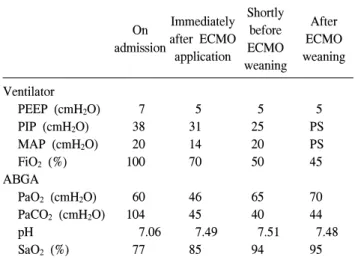
) retention, as seen on arterial blood gas analysis (ABGA). Following admission to our hospital, the patient experienced severe respiratory failure even though he was on conventional ventilator support (Table 1). We decided to perform an early application of venove- nous extracorporeal membrane oxygenation (ECMO) for res-

piratory support. The patient's body weight was 20 kg, and his height was 119 cm. An outflow catheter (22 Fr; DLP, Medtronic Inc., Minneapolis, MN, USA) was inserted via the right internal jugular vein, and an inflow catheter (16 Fr;

RMI, Edwards Lifesciences LLC, Irvine, CA, USA) was in-

serted via the right femoral vein (Fig. 1). Pump flow was

maintained at 100% to 120% of the cardiac index (2.4

L/min/m

2

), and ECMO operated smoothly during the entire

time of its use. A chest X-ray and the ABGA results showed

marked improvement two days after application of the

ECMO. The ECMO weaning was possible due to the sig-

nificant improvement in the ABGA results along with the

fact that the ventilator was on the moderate setting three days

following the application of the ECMO (Fig. 2). The total

support time was 62 hours. Due to the patient’s continued

improvement, extubation was performed the day after wean-

ing from the ECMO was complete. The patient made a full

(2)

Extracorporeal Membrane Oxygenation Support in a Patient with Status Asthmaticus

− 187 − Table 1. Arterial blood gas analysis and ventilator profiles

On admission

Immediately after ECMO application

Shortly before ECMO weaning

After ECMO weaning

Ventilator PEEP (cmH

2

O) PIP (cmH

2

O) MAP (cmH

2

O) FiO

2

(%) ABGA

PaO

2

(cmH

2

O) PaCO

2

(cmH

2

O) pH

SaO

2

(%)

7 38 20 100

60 104 7.06 77

5 31 14 70

46 45 7.49 85

5 25 20 50

65 40 7.51 94

5 PS PS 45

70 44 7.48 95 ECMO, extracorporeal membrane oxygenation; PEEP, peak end expiratory pressure; PIP, peak inspiratory pressure; MAP, mean airway pressure; FiO

2

, fraction of inspired oxygen; ABGA, ar- terial blood gas analysis; PaO

2

, partial pressure of oxygen;

PaCO

2

, partial pressure of arterial carbon dioxide; SaO

2

, satura- tion of arterial blood; PS, pressure support mode.

Fig. 1. Chest X-ray immediately after application of extracorporeal membrane oxygenation. There was consolidation in the left upper lung zone, and an outflow catheter was inserted into the right in- ternal jugular vein (arrows). R, right.

Fig. 2. Chest X-ray obtained immediately after weaning of ex- tracorporeal membrane oxygenation. The outflow catheter was re- moved, and consolidation of the left upper lung zone was mildly improved. R, right.

Fig. 3. Chest X-ray obtained on the day of discharge.

Consolidation of the left upper lung zone was resolved. R, right.

mental recovery, and no neurological deficit was noted on clinical evaluation. A brain computed tomography and elec- troencephalography revealed no specific abnormalities. A Doppler sonography was performed on the catheter insertion

sites, which revealed smooth luminal narrowing but showed

patent vascular flow in the right internal jugular vein. The

right femoral vein showed luminal narrowing and mild wall

thickening, but it had patent vascular flow at the catheter in-

sertion site. The patient's transfer to the general ward was

possible on the next day following extubation. Because of the

continued improvement in his general condition, the patient

(3)

Min Ho Ju, et al

− 188 − was discharged without other complications (Fig. 3).

DISCUSSION

Status asthmaticus is a rare, often fatal condition, especially in children. It generally requires mechanical ventilation for acute respiratory failure [1,2]. However, occasionally CO

2

re- moval and respiratory support are insufficient. In such sit- uations, ECMO has been used to treat refractory respiratory failure [3-5]. The Extracorporeal Life Support Organization (ELSO) has reported a significant increase in use of ECMO for status asthmaticus since 1995. This rise could be the re- sult of an increasing number of centers performing ECMO, an increasing regional incidence or severity of asthma, or an overall increasing severity of the illness [4]. According to the ELSO registry, 2% (n=72) of the pediatric patients treated with ECMO were diagnosed as status asthmaticus between 1993 and 2007. Their survival rate was excellent (83%) com- pared to the survival rates of other diseases requiring ECMO [5]. However, there are some problems with the use of ECMO in young children. When possible, ECMO should be avoided in small children because it requires percutaneous catheter insertion, which in turn requires skin incision and major vessel exposure. Small children have small vessels, which presents the difficultly of determining accurate vessel sizing and avoiding vessel injury during this procedure [3,4].

However, despite the difficulty in accessing vessels, ECMO has several advantages for treating respiratory failure in children. The use of ECMO in asthmatic children allows their lungs to rest, thereby providing time for bronchiolar relaxa- tion, aggressive pulmonary toilet, and even a controlled bron- choscopy, if needed for the treatment of plastic bronchitis [6].

In particular, venovenous ECMO offers the advantages of

preserved pulmonary blood flow, carotid artery preservation, improved oxygenation of the myocardium, and physiological left ventricular cardiac output to provide pulsating blood flow and normal cerebral blood flow velocities [7]. In addition, the internal jugular and femoral veins are readily accessible even in small children.

In conclusion, early ECMO application is a useful method for treating pediatric patients with refractory status asthmati- cus despite the necessity of treating them with a mechanical ventilator and conventional medical therapies. In our case, we performed early ECMO and obtained positive results.

REFERENCES

1. Werner HA. Status asthmaticus in children: a review. Chest 2001;119:1913-29.

2. Chiang BL, Hsieh CT, Wang LC, et al. Clinical course and outcome of children with status asthmaticus treated in a pe- diatric intensive care unit: a 15-year review. J Microbiol Immunol Infect 2009;42:488-93.

3. Shapiro MB, Kleaveland AC, Bartlett RH. Extracorporeal life support for status asthmaticus. Chest 1993;103:1651-4.

4. Hebbar KB, Petrillo-Albarano T, Coto-Puckett W, Heard M, Rycus PT, Fortenberry JD. Experience with use of extracor- poreal life support for severe refractory status asthmaticus in children. Crit Care 2009;13:R29.

5. Zabrocki LA, Brogan TV, Statler KD, Poss WB, Rollins MD, Bratton SL. Extracorporeal membrane oxygenation for pediatric respiratory failure: survival and predictors of mortality. Crit Care Med 2011;39:364-70.

6. Nussbaum E. Pediatric fiberoptic bronchoscopy: clinical ex- perience with 2,836 bronchoscopies. Pediatr Crit Care Med 2002;3:171-6.

7. Pettignano R, Fortenberry JD, Heard ML, et al. Primary use

of the venovenous approach for extracorporeal membrane

oxygenation in pediatric acute respiratory failure. Pediatr

Crit Care Med 2003;4:291-8.

수치

Fig. 2. Chest X-ray obtained immediately after weaning of ex- ex-tracorporeal membrane oxygenation

참조

관련 문서

• Hormone Therapy With or Without Combination Chemotherapy in Treating Women Who Have Undergone Surgery for Node-Negative Breast Cancer (The TAILORx Trial)..

Intermittent hemodialysis(IDH) and Continuous renal replacement therapy (CRRT) has been used widely for treating critically ill patients with acute renal failure, We

(2003), Nosocomial Infection of Malnourished Patients in an Intensive Care Unit. Anal ysis of Nutritional Support Status in the Intensive Care Unit. Korean J crit Ca re Med.

To maximize the benefit of treating hallux valgus with foot orthotics, researchers should furthur conduct studies with other groups of people in order to uncover

Therefore, this research is trying to deal with investigation on color status and problem of usage of color status on street furnitures installed in city

purpose of introducing the representative lawsuits in such a trend, it is necessary to review the status of representative cases and judicial issues in

The clinical outcome and complication for treating proximal femoral shaft fracture were compared and analyzed through the group treated with closed

Comparison of mean and standard deviation of capnographic I:E ratio between normal breathing status and respiratory depression status in 21 patients experienced