www.journalomp.org
pISSN 2288-9272 eISSN 2383-8493 J Oral Med Pain 2014;39(4):152-155 http://dx.doi.org/10.14476/jomp.2014.39.4.152
The Effectiveness of Occlusal Splint for the Treatment of Temporomandibular Joint Dislocation
Hyun-Dae Lim 1,3 , You-Mee Lee 1,3 , Jin-Kyu Kang 2,3
1 Department of Oral Medicine, School of Dentistry, Wonkwang University, Iksan,
2 Department of Orofacial Pain and Oral Medicine, Wonkwang University Daejeon Dental Hospital, Daejeon,
3 Wonkwang Dental Research Institute, School of Dentistry, Wonkwang University, Iksan, Korea
Received September 29, 2014 Revised October 11, 2014 Accepted October 22, 2014
Temporomandibular joint (TMJ) dislocation is defined that the disc-condyle complex is posi- tioned anterior to the articular eminence in the open mouth position, and is unable to return to a normal closed mouth position without a manipulative maneuver. TMJ dislocation can recur habitually and result several problems to patients such as discomfort, pain, fear, and anxiety.
The only definitive treatment for TMJ dislocation is surgical alteration of the joint itself. In most cases, however, a surgical procedure is far too aggressive for the symptoms experienced by the patient. In addition, the effect of surgical treatment may be insufficient, and the recurrence have been reported. It is also possible to develop several complications after surgical treatment.
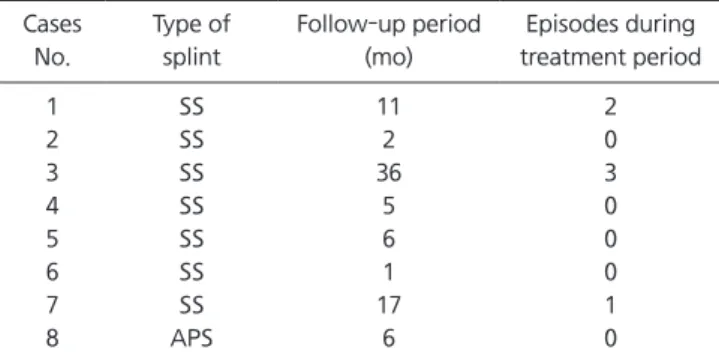
Therefore much effort should be directed at supportive therapy in an attempt to eliminate the disorder or at least reduce the symptom to tolerable levels. Through this cases the authors pres- ent favorable treatment outcome using occlusal splint with the patient of TMJ dislocation. Oc- clusal splint therapy can be considered as easy, safe, and useful non-invasive modality to treat- ment of TMJ dislocation.
Key Words: Conservative treatment; Occlusal splints; Temporomandibular joint dislocation;
Temporomandibular joint openlock
Correspondence to:
Jin-Kyu Kang
Department of Orofacial Pain and Oral Medicine, Wonkwang University Daejeon Dental Hospital, 77, Dunsan- ro, Seo-gu, Daejeon 302-120, Korea Tel: +82-42-366-1125
Fax: +82-42-366-1114 E-mail: [email protected] This paper was supported by Wonkwang University in 2012.
preauricular depression of the skin, prognathism of the low- er jaw, tense, spasmatic masticatory muscles, anterior cross bite and open bite, and excessive salivation. 2,3)
The etiology of TMJ dislocation is mainly trauma such as fall, road traffic accident, interpersonal violence, and other possible causes including excessive mouth opening from yawning, laughing, singing, prolonged mouth opening from oral and ENT procedures, and forceful mouth opening from anaesthetic and endoscopic procedures. 3)
TMJ dislocation is considered to be caused by the mor- phological problem such as slope of articular eminence, shape of condyle, and the regulation of masticatory muscles and ligaments around TMJ.
TMJ dislocation occurs more frequently in patients with TMJ internal derangement, eminential erosion and flattening,
INTRODUCTION
Temporomandibular joint (TMJ) dislocation is defined that the disc-condyle complex is positioned anterior to the articular eminence in the open mouth position, and is un- able to return to a normal closed mouth position without a manipulative maneuver. 1) According to newly revised di- agnostic criteria for temporomandibular disorder, when the patient can reduce the dislocation himself/herself, this condition is referred to as subluxation. If the patient needs the assistance of the clinician to reduce the dislocation and normalize jaw movement, this is referred to as luxation, relatively.
The patient with the dislocated joint is unable to close the mouth with or without pain. The classical features are
Case Report
JOMP Journal of Oral Medicine and Pain
Copyright Ⓒ 2014 Korean Academy of Orofacial Pain and Oral Medicine. All rights reserved.
CC