Metastatic colorectal cancer is a common can- cer for which significant advances in treatment have been made. The integration of oxaliplatin or irinotecan to combination with 5-fluorouracil (5-FU) and leucovorin as front-line therapy for treatment of metastatic colorectal cancer has been associated with significant improvements in progression-free survival (PFS) and overall surviv-
al (OS), compared with 5-FU and leucovorin chemotherapy.1-4
In the last decade highly promising new molec- ular target agents, such as bevacizumab, cetux- imab, or panitumumab, have been introduced in- to treatment of metastatic colon cancer for more improved outcomes.5-7 The integration of bev- acizumab, which is a recombinant, humanized
Original Article
Retrospective analysis on the clinical efficacy of
bevacizumab combined with FOLFOX4 in the first line treatment of metastatic colorectal cancer
Eun Mi Lee, Lee Chun Park, Ho Sup Lee, Seong Hoon Shin, Yang Soo Kim Department of Internal Medicine, College of Medicine, Kosin University, Busan, Korea
Objectives: The addition of bevacizumab to standard chemotherapy has been improved survival outcomes in patients with metastatic colorectal cancer. However, the combination of bevacizumab with oxaliplatin-based chemotherapy as first-line treatment showed limited survival benefit. The purpose of this study was to investigate the clinical efficacy and toxicity of the combination of bevacizumab to oxaliplatin and leucovorin (FOLFOX4) in the first-line treatment of patient with metastatic colorectal cancer.
Methods: Between December 2004 and September 2009, medical records of patients who were diagnosed with metastatic colorectal cancer and received the first line chemotherapy with bevacizumab and FOLFOX4, were retrospectively reviewed.
Results: A total of forty patients were analyzed. The median age of the patients was 55 years (range, 33-80), and 55% was male. The patients received a total of 206 cycles of therapy (median 4 cycles per patient; range 1 – 15 cycles). Of these 40 patients, none achieved complete response (CR) and 15 achieved a partial response (PR), for the overall response rate (ORR) 37.5% (95% CI, 22.5-52.5). Median progression free survival (PFS) was 6.9 months (95% CI, 3.4-10.5) and median overall survival (OS) was 22.6 months (95% CI, 17.3-27.8The most common grade 3 or 4 hematologic toxicity and non-hematologic toxicity were neutropenia (10.0%) and diarrhea (10.0%), respectively. Two patients experienced gastrointestinal perforation.
Conclusions: In this study, the combination bevacizumab with FOLFOX4 was associated with favorable OS, but did not showed favorable PFS and ORR.
Key Words: Bevacizumab, Colorectal cancer, FOLFOX
Corresponding Author: Yang Soo Kim, Department of Internal Medicine, College of Medicine, Kosin University, 262, Gamcheon-ro, Seo-gu, Busan 49267, Korea
Tel: +82-51-990-5820 Fax: +82-51-990-5820 E-mail: [email protected]
Received:
Revised:
Accepted:
Apr. 08, 2015 Apr. 28, 2015 Sep. 09, 2015
monoclonal antibody against vascular endothelial grow factor, to 5-FU-based combination chemo- therapy has clearly led to additional improve- ments of survivals in the both first-line and sec- ond-line treatment of patients with metastatic colorectal cancer.5,8-10 Recently, however, the combination of bevacizumab to oxaliplatin-based regimen for the first-line treatment conferred on- ly a marginal improvement of survival. The NO16966 trial, which is a large randomized phase III study to evaluate the efficacy of bevacizumab combined oxaliplatin based chemotherapy (capecitabine [CapeOX] or 5-FU/leucovorin [FOLFOX]) as the first-line chemotherapy, dem- onstrated that the addition of bevacizumab to ox- aliplatin-based chemotherapy was associated with improved PFS, but did not reached statistical significance in overall survival.5 Two meta-analy- ses showed, although the use of bevacizumab in first-line treatment for metastatic colon cancer was associated with improvement of survival outcomes, the advantage of survival was not evident when com- bined with oxaliplatin-based chemotherapy.11,12 Consequently, there is some debate that ox- aliplatin-based chemotherapy regimen may not be optimal partner for bevacizumab in practice or clinical trials.
This retrospective study was designed to inves- tigate the clinical efficacy of bevacizumab com- bined to oxaliplatin and leucovorin (FOLFOX4) in patient with metastatic colorectal cancer.
MATERIALS AND METHODS
Patients
We obtained all the clinical data from the medi- cal records retrospectively. Between December 2004 and September 2009, a total of 40 patients, who were newly diagnosed with metastatic color- ectal cancer, was received the combination che- motherapy with FOLFOX4 plus bevacizumab.
There were no limitations on the Eastern Cooperative Oncology Group (ECOG) perform- ance status. The Institutional Review Board (IRB) of the Kosin Medical Center approved this retro- spective study (91961-ABG-15-029).
Treatment schedule and toxicity and response assessment
FOLFOX4 chemotherapy was given every 2 weeks and consisted of intravenous (IV) ox- aliplatin (85 ㎎/㎡) over 2 hours, IV leucovorin (200
㎎/㎡) over 2 hours, followed by bolus 5-FU (400
㎎/㎡) and infusion 5-FU (600 ㎎/㎡) over 22 hours, and 5-FU and leucovorin were repeated in day 2. Bevacizumab was administered IV 5 mg/kg over 30–90 minutes every 2 weeks, prior to FOLFOX4.
Treatment was continued until tumor pro- gression, unacceptable toxicity or refusal by patients. Toxicity was evaluated according to the Common Terminology Criteria for Adverse Events (CTC-AE) of the National Cancer Institute (NCI), version 3.0. Only grade 3 or 4 toxicities were col- lected by retrospective medical record review.
The dose and schedule of FOLFOX4 and bev-
acizumab was modified according to the physi- cian’s discretion according to toxicity profiles.
Tumor response was assessed every three cycles by Response Evaluation Criteria in Solid Tumor (RECIST) guideline. Progressive disease was de- fined as a 20% increase from tumor size at the time of best response after chemotherapy.
Statistics
The primary objective of this study was to inves- tigate the efficacy of the combination of bev- acizumab and FOLFOX4 as the first-line treatment in patients with metastatic colorectal cancer.
Efficacy measures included overall response rate (ORR), progression-free survival (PFS), and overall survival (OS). OS was defined as the time from initiation of study therapy to date of death from any cause. PFS was defined as time from initiation of study therapy to date of progressive disease (PD) or death due to any cause. Patients who died without documented PD were considered to have
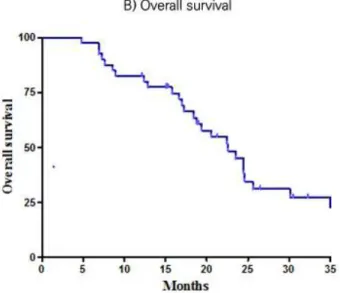
had PD at the time of death. Survival curves were estimated using the Kaplan–Meier method (Fig.
1). A Cox proportional hazard model was used to determine factors independently prognostic for PFS and OS.
RESULTS
Patient Characteristics
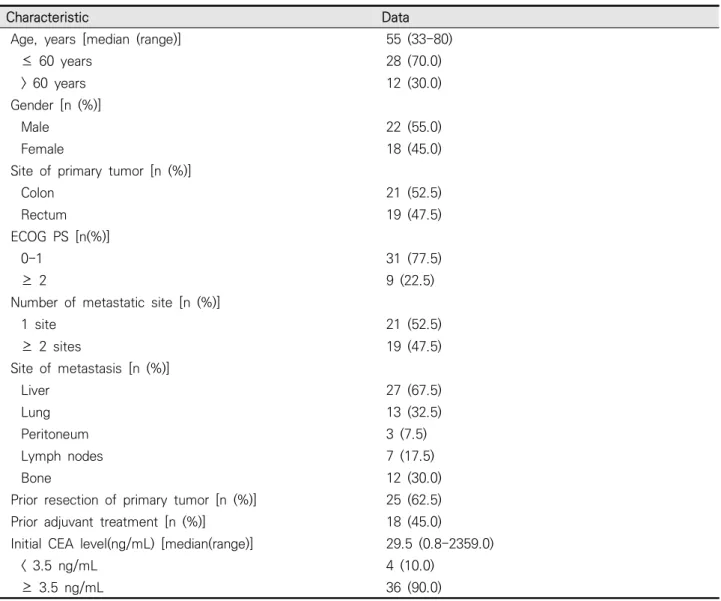
Patient characteristics are summarized in Table 1. The median age of the patients was 55 years (range, 33-80), and 55% of the patients were male.
Most of the patients had good ECOG performance status scores of 0 or 1 (77.5%). Twenty one patients (52.5%) had primary colon cancer, and the most common metastatic organ was the liver (67.5%).
Twenty five patients (62.5%) had history of prior resection of primary tumor, and 18 (45.0%) re- ceived adjuvant treatment.
Fig. 1. Survival curves by the Kaplan–Meier method.
Treatment and Toxicity profile
The 40 patients received a total of 206 cycles of chemotherapy with bevacizumab plus FOLFOX4.
The median of cycles was 4 (range, 2-13), 14 pa- tients (35.0%) received more than 6 cycles of chemotherapy. Five patients (12.5%) discontinued chemotherapy due to toxicities. Ten patients (75%) received second-line chemotherapy after disease progressed.
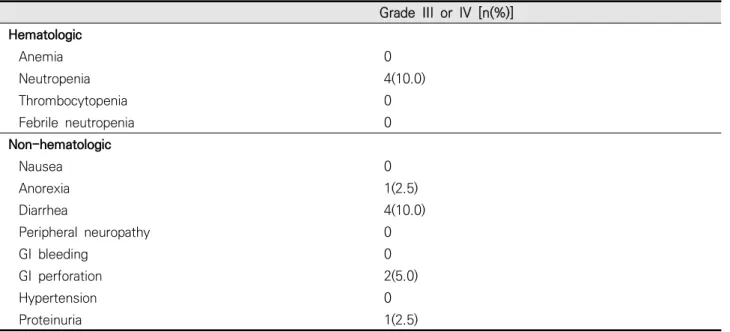
The most common grade 3 or 4 hematologic toxicity and non-hematologic toxicity were neu- tropenia (10.0%) and diarrhea (10.0%), respectively. Febrile neutropenia and peripheral neuropathy more than grade 3 were not observed.
However, two patients (5.0%) experienced gastro- intestinal perforation and 1 patient died from that.
Characteristic Data
Age, years [median (range)] 55 (33-80)
≤ 60 years 28 (70.0)
> 60 years 12 (30.0)
Gender [n (%)]
Male 22 (55.0)
Female 18 (45.0)
Site of primary tumor [n (%)]
Colon 21 (52.5)
Rectum 19 (47.5)
ECOG PS [n(%)]
0-1 31 (77.5)
≥ 2 9 (22.5)
Number of metastatic site [n (%)]
1 site 21 (52.5)
≥ 2 sites 19 (47.5)
Site of metastasis [n (%)]
Liver 27 (67.5)
Lung 13 (32.5)
Peritoneum 3 (7.5)
Lymph nodes 7 (17.5)
Bone 12 (30.0)
Prior resection of primary tumor [n (%)] 25 (62.5)
Prior adjuvant treatment [n (%)] 18 (45.0)
Initial CEA level(ng/mL) [median(range)] 29.5 (0.8-2359.0)
< 3.5 ng/mL 4 (10.0)
≥ 3.5 ng/mL 36 (90.0)
ECOG: Eastern Cooperative Oncology Group PS: performance status
CEA: carcinoembryonic antigen
Table 1. Patient characteristics (n = 40)
Tumor response & Survival
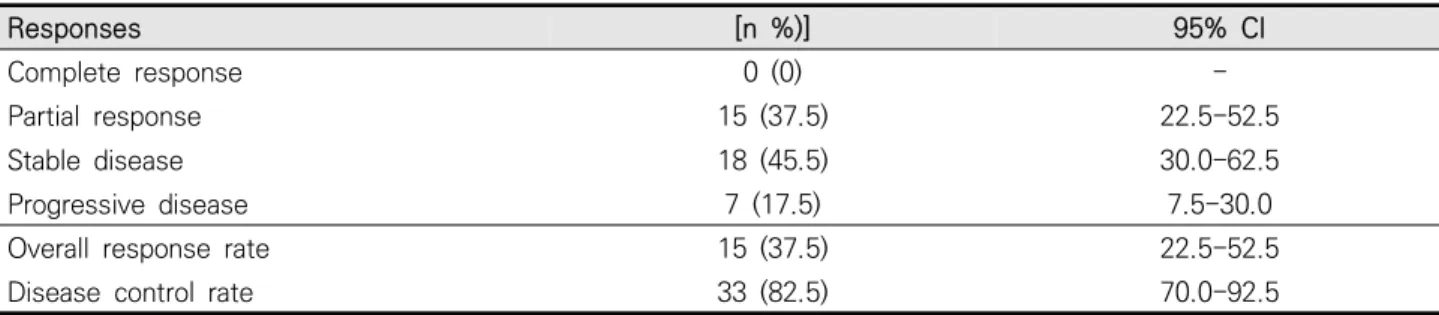
All 40 patients had measurable lesions and were assessable for response. None of these patients achieved a complete response (CR), and 15 pa- tients had partial response (PR), for the overall response rate (ORR) 37.5% (95% CI, 22.5-52.5).
Eighteen patients had stable disease (SD), and the disease control rate (CR+PR+SD) was 82.5% (95%
CI, 70.0-92.5) (Table 2).
The median duration of follow-up was 32.3 months (95% CI, 29.7-34.8 months). The median PFS and OS were 6.9 (95% CI, 3.4-10.5 months) and 22.6 months (95% CI, 17.3-27.8 months), respectively. The 1-year survival rate was 82.5%, and the 2-year was 44.8%.
DISCUSSION
Unprecedented advances in survival have been recognized during past decade with systemic che- motherapy in patients with metastatic colorectal cancer. The combination chemotherapy of three active drugs (5-FU/leucovorin/irinotecan or ox- aliplatin) demonstrated significant advantages in survival,13 and the corporation of molecular target agents in first-line treatment has shown more im- proved outcomes.5-7 Our study was to evaluate the efficacy and safety of the combination chemo- therapy of bevacizumab and FOLFOX4 in meta- static colorectal cancer patients as front-line chemotherapy. Although our study did not show favorable ORR and median PFS, median OS of 22.6 months was comparable with the results of others studies of the combination of bevacizumab with oxaliplatin-based regimen.
Bevacizumab was initially studied in colorectal Grade III or IV [n(%)]
Hematologic
Anemia 0
Neutropenia 4(10.0)
Thrombocytopenia 0
Febrile neutropenia 0
Non-hematologic
Nausea 0
Anorexia 1(2.5)
Diarrhea 4(10.0)
Peripheral neuropathy 0
GI bleeding 0
GI perforation 2(5.0)
Hypertension 0
Proteinuria 1(2.5)
NCI-CTCAE: National Cancer Institute Common Terminology Criteria for Adverse Events GI: gastrointestinal
Table 2. Toxicity profile (According to NCI-CTCAE1)version3.0)
cancer, and approved by US Food and Drug Administration (FDA) in 2004 as first-line treat- ment of metastatic colorectal cancer. The pivotal trial demonstrated that the combination of bev- acizumab to irinotecan, 5-FU, and leucovorin im- proved median OS from 15.6 months to 20.3 months (P < 0.001).9 Subsequently, in the NO16966 phase III trial, 1401 patients with metastatic col- orectal cancer were randomized to receive FOLFOX or CapeOX, with bevacizumab or placebo. Median PFS was significantly increased when bevacizumab was added to FOLFOX or CapeOx (9.4 months in bevacizumab group vs.
8.0 months in placebo group, HR 0.83, 97.5% CI 0.72-0.95, P = 0.0023), however, there was no sig- nificant OS improvement (21.3 months in bev- acizumab group vs. 19.9 months in placebo group, HR 0.89, 97.5% CI 0.76-1.03, P = 0.077). The au- thors suggested that no difference in OS between two groups potentially was influenced by higher early withdrawal rate in bevacizumab group be- cause of unacceptable toxicities.5 However, two meta-analyses demonstrated that the bev- acizumab in first-line treatment chemotherapy in
metastatic colorectal cancer improved overall survival (Macedo et al., HR 0.84, 95% CI 0.77-0.91, and Meyerhardt et al., HR 0.85, 95% CI 0.78-0.93) but the survival benefit was diminished in ox- aliplatin-based regimen (Macedo et al., HR 0.89, 95% CI 0.79-1.00, and Meyerhardt et al., HR 0.96, 95% CI 0.66-0.97).11,12 Therefore, the addition of bevacizumab to oxaliplatin-based chemotherapy as first line chemotherapy has not evidently shown overall survival benefit. Consequently, further studies are required to confirm of the combina- tion of bevacizumab and oxaliplatin-based regi- men as the first-line chemotherapy.
Nevertheless, the addition of bevacizumab to first-line chemotherapy has improved survival to almost 2 years. In a pooled analysis of 25 pub- lished trials, the combination of bevacizumab to oxaliplatin-based chemotherapy as first-line treatment demonstrated that median PFS and OS were 10.3 (range, 7.8-13.8 months) and 23.7 months (range 17.2-32.0 months), respectively.14 These results were comparable to those of a 29 pooled analysis of the combination of bev- acizumab to irinotecan/5-FU/leucovorin (FOLFIRI)
Responses [n %)] 95% CI
Complete response 0 (0) -
Partial response 15 (37.5) 22.5-52.5
Stable disease 18 (45.5) 30.0-62.5
Progressive disease 7 (17.5) 7.5-30.0
Overall response rate 15 (37.5) 22.5-52.5
Disease control rate 33 (82.5) 70.0-92.5
CI: confidence interval
Table 3. Tumor responses and results of treatment
that demonstrated median PFS and OS were 10.8 (95% CI, 8.9-12.8 months) and 23.7 months (95%
CI, 18.1-31.6 months), respectively.15 Our study showed similar median OS of 22.6 months with these results. However, it is unclear if this survival is due to the additional effect of bevacizumab, be- cause median PFS of 6.9 months was lower than results of other studies. Because of small number of patients in this study and a retrospective na- ture, we should caution to interpret these results.
VEGF is a diffusible, homodimeric glycoprotein produced by healthy and neoplastic cells, and is a key promoter of angiogenesis under both phys- iological and pathological conditions, including tumor progression.16 Because of the important role of VEGF in vascular function and physio- logical angiogenesis, its inhibition by bev- acizumab has been noted to cause serious adverse events, including wound dehiscence, bleeding, thromboembolic events, bowel perforation, and neutropenia.17 A recent meta-analysis of 16 randomized control trials showed that bev- acizumab in combination with chemotherapy in patients with a variety of advanced solid tumors was associated with a higher incidence of treat- ment-related mortality than chemotherapy alone, with relative risk of 1.33 (95% CI, 1.02-1.73, P
= 0.04). In that study, the most common causes of death were hemorrhage (23.5%), neutropenia (12.2%), and gastrointestinal track perforation (7.1%).18 Another meta-analysis of 17 randomized trial to determine the risk of gastrointestinal per- foration associated with bevacizumab reported
that the addition of bevacizumab significantly in- creased the risk of gastrointestinal perforation compared with chemotherapy alone (Relative risk: 2.14, 95% CI 1.19-3.85, P = 0.011) and the incidence of gastrointestinal perforation was 0.9%
(95% CI, 0.7-1.2) among patients receiving bev- acizumab, with a mortality or 21.7% (95% CI, 11.5-37.0). Among patients with various tumor types, notably, the relative risk was 3.10 (95% CI, 1.26-7.63, P = 0.013) for colorectal cancer.19 The risk of gastrointestinal perforation in patients with colorectal cancer may be enhanced because of predisposing gastrointestinal toxicity (e.g.
bowel perforation) from chemotherapy regimens and/or pelvic radiation in patients with an intact tumor, and bevacizumab-induced changes in tu- mor vasculature.20-22 In our study, two of a total of 40 patients (5.0%) experienced gastrointestinal perforation, and one of both was died from that event. However, both patients had no history of previous pelvic irradiation. Because gastro- intestinal perforation is a fetal outcome in pa- tients who are receiving with bevacizumab con- taining chemotherapy, clinicians need to pay for this complication to occur.
In conclusion, our results showed that the addi- tion of bevacizumab to FOLFOX4 as first-line che- motherapy was associated with favorable overall survival in patients with metastatic colorectal cancer. However, because PFS of our study was not comparable with that of other studies, the de- finitive role of bevacizumab should be explored further investigations.
REFERENCES
1. de Gramont A, Figer A, Seymour M, Homerin M, Hmissi A, Cassidy J, et al. Leucovorin and fluorouracil with or without oxaliplatin as first-line treatment in advanced colorectal cancer. J Clin Oncol 2000;18:2938-47.
2. Douillard JY, Cunningham D, Roth AD, Navarro M, James RD, Karasek P, et al. Irinotecan com- bined with fluorouracil compared with fluorour- acil alone as first-line treatment for metastatic colorectal cancer: a multicentre randomised trial. Lancet 2000;355:1041-7.
3. Saltz LB, Cox JV, Blanke C, Rosen LS, Fehrenbacher L, Moore MJ, et al. Irinotecan plus Fluorouracil and Leucovorin for Metastatic Colorectal Cancer. Irinotecan Study Group. N Engl J Med 2000;343:905-14.
4. Goldberg RM, Sargent DJ, Morton RF, Fuchs CS, Ramanathan RK, Williamson SK, et al. A randomized controlled trial of fluorouracil plus leucovorin, irinotecan, and oxaliplatin combi- nations in patients with previously untreated metastatic colorectal cancer. J Clin Oncol 2004;22:23-30.
5. Saltz LB, Clarke S, Diaz-Rubio E, Scheithauer W, Figer A, Wong R, et al. Bevacizumab in combi- nation with oxaliplatin-based chemotherapy as first-line therapy in metastatic colorectal can- cer: a randomized phase III study. J Clin Oncol 2008;26:2013-9.
6. Van Cutsem E, Köhne CH, Hitre E, Zaluski J, Chang Chien CR, Makhson A, et al. Cetuximab
and chemotherapy as initial treatment for meta- static colorectal cancer. N Engl J Med 2009;360:
1408-17.
7. Douillard JY, Siena S, Cassidy J, Tabernero J, Burkes R, Barugel M, et al. Randomized, phase III trial of panitumumab with infusional fluo- rouracil, leucovorin, and oxaliplatin (FOLFOX4) versus FOLFOX4 alone as first-line treatment in patients with previously untreated metastatic colorectal cancer: the PRIME study. J Clin Oncol 2010;28:4697-705.
8. Kabbinavar F, Hurwitz HI, Fehrenbacher L, Meropol NJ, Novotny WF, Lieberman G, et al.
Phase II, randomized trial comparing bev- acizumab plus fluorouracil (FU)/leucovorin (LV) with FU/LV alone in patients with metastatic colorectal cancer. J Clin Oncol 2003;21:60-5.
9. Hurwitz H, Fehrenbacher L, Novotny W, Cartwright T, Hainsworth J, Heim W, et al.
Bevacizumab plus irinotecan, fluorouracil, and leucovorin for metastatic colorectal cancer. N Engl J Med 2004;350:2335-42.
10. Kabbinavar FF, Schulz J, McCleod M, Patel T, Hamm JT, Hecht JR, et al. Addition of bev- acizumab to bolus fluorouracil and leucovorin in first-line metastatic colorectal cancer: results of a randomized phase II trial. J Clin Oncol 2005;23:3697-705.
11. Macedo LT, da Costa Lima AB, Sasse AD. Addition of bevacizumab to first-line chemotherapy in advanced colorectal cancer: a systematic review and meta-analysis, with emphasis on chemo- therapy subgroups. BMC cancer 2012;12:89.
12. Meyerhardt JA, Li L, Sanoff HK, Carpenter W 4th, Schrag D. Effectiveness of bevacizumab with first-line combination chemotherapy for Medicare patients with stage IV colorectal cancer. J Clin Oncol 2012;30:608-15.
13. Grothey A, Sargent D, Goldberg RM, Schmoll HJ. Survival of patients with advanced colorectal cancer improves with the availability of fluo- rouracil-leucovorin, irinotecan, and oxaliplatin in the course of treatment. J Clin Oncol 2004;22:1209-14.
14. Petrelli F, Coinu A, Ghilardi M, Cabiddu M, Zaniboni A, Barni S. Efficacy of oxaliplatin-based chemotherapy + bevacizumab as first-line treat- ment for advanced colorectal cancer: a systematic review and pooled analysis of published trials.
Am J Clin Oncol 2015;38:227-33.
15. Petrelli F, Borgonovo K, Cabiddu M, Ghilardi M, Lonati V, Maspero F, et al. FOLFIRI-bev- acizumab as first-line chemotherapy in 3500 patients with advanced colorectal cancer: a pooled analysis of 29 published trials. Clin Colorectal Cancer 2013;12:145-51.
16. Dvorak HF. Discovery of vascular permeability factor (VPF). Exp Cell Res 2006;312:522-6.
17. Gressett SM, Shah SR. Intricacies of bevacizumab-in- duced toxicities and their management. Ann Pharmacother 2009;43:490-501.
18. Ranpura V, Hapani S, Wu S. Treatment-related mortality with bevacizumab in cancer patients:
a meta-analysis. JAMA 2011;305:487-94.
19. Hapani S, Chu D, Wu S. Risk of gastrointestinal perforation in patients with cancer treated with bevacizumab: a meta-analysis. Lancet Oncol 2009;10:559-68.
20. Heinzerling JH, Huerta S. Bowel perforation from bevacizumab for the treatment of metastatic co- lon cancer: incidence, etiology, and management.
Curr Surg 2006;63:334-7.
21. Saif MW, Elfiky A, Salem RR. Gastrointestinal perforation due to bevacizumab in colorectal cancer. Ann Surg Oncol 2007;14:1860-9.
22. Hochster HS, Hart LL, Ramanathan RK, Childs BH, Hainsworth JD, Cohn AL, et al. Safety and efficacy of oxaliplatin and fluoropyrimidine regimens with or without bevacizumab as first-line treatment of metastatic colorectal cancer: results of the TREE Study. J Clin Oncol 2008;26:3523-9.