• 검색 결과가 없습니다.

Extra-anatomic Aortic Bypass for the Management of Mid-Aortic Syndrome Caused by Takayasu arteritis

N/A
N/A
Protected

Academic year: 2021

Share "Extra-anatomic Aortic Bypass for the Management of Mid-Aortic Syndrome Caused by Takayasu arteritis"

Copied!
4
0
0

로드 중.... (전체 텍스트 보기)

전체 글

(1)

ISSN: 2233-601X (Print) ISSN: 2093-6516 (Online)

− 70 −

Department of Thoracic and Cardiovascular Surgery, Asan Medical Center, University of Ulsan College of Medicine Received: April 1, 2014, Revised: June 30, 2014, Accepted: July 18, 2014, Published online: February 5, 2015

Corresponding author: Joon Bum Kim, Department of Thoracic and Cardiovascular Surgery, Asan Medical Center, University of Ulsan College of Medicine, 88 Olympic-ro 43-gil, Songpa-gu, Seoul 138-736, Korea

(Tel) 82-2-3010-5416 (Fax) 82-2-3010-6966 (E-mail) [email protected]

C

The Korean Society for Thoracic and Cardiovascular Surgery. 2015. All right reserved.

CC
This is an open access article distributed under the terms of the Creative Commons Attribution Non-Commercial License (http://creative- commons.org/licenses/by-nc/3.0) which permits unrestricted non-commercial use, distribution, and reproduction in any medium, provided the original work is properly cited.

Extra-anatomic Aortic Bypass for the Management of Mid-Aortic Syndrome Caused by Takayasu arteritis

Jae Kwang Yun, M.D., Joon Bum Kim, M.D., Ph.D.

Lower limb ischemia caused by multiple stenosis of the thoracoabdominal aorta is one of the rare clinical manifes- tations of Takayasu arteritis. The optimal management of such mid-aortic syndrome related with Takayasu arteritis has not been established to date. Here we report a case of extra-anatomic aortic bypass through minimally in- vasive techniques to treat lower limb ischemia caused by Takayasu arteritis.

Key words: 1. Takayasu arteritis 2. Aorta

3. Bypass surgery

CASE REPORT

A 38-year-old woman was admitted due to claudication of the legs that had been sustained for 2 years. Eight months ago, she was diagnosed as having Takayasu arteritis during the work ups for chronic headache in primary clinic. Immuno- suppressive medication with methotrexate was followed due to glucocorticoid resistance. Two months ago, embolic in- farction of the kidney and the spleen resulted in anti- coagulation therapy with warfarin. Her past medical history included hypertension requiring medication 10 years ago and a surgical history of appendectomy 9 years ago. On admis- sion, physical examination revealed that the pulse over the right femoral area was absent. Asymmetrical systolic blood pressure of 142 mmHg in the arms and 88 in the right legs and 94 mmHg in the left leg was found. Thus, ankle-brachial index was 0.62 in right and 0.66 in left. The findings obtained from a central nervous system examination were unremar- kable. The patient’s C-reactive protein level and erythrocyte

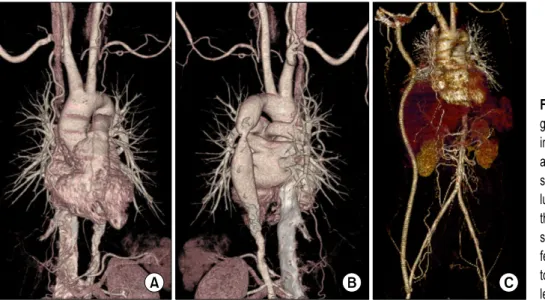
sedimentation rate were within normal range. Three-dimen- sional computed tomography (CT) revealed multifocal severe luminal narrowing of descending thoracic and abdominal aor- ta (Fig. 1A, B). In addition, significant stenosis of the right carotid artery, brachiocephalic trunk, proximal celiac trunk os- tium and total occlusion at left subclavian artery ostium with collateral development were observed. Whole body positron emission tomography-CT revealed no hypermetabolic lesions in the arterial system indicating that the vasculitis was not active. Cardiac evaluations including echocardiography and coronary angiography revealed normal cardiac function (left ventricular ejection fraction, 60%) without any stenotic le- sions in coronary arteries. In order to relieve ischemic symp- toms of the lower extremities, the patient underwent axillo-fem- oral bypass surgery in the right side using a 10 mm-ringed pol- ytetrafluoroethylene graft (Fig. 1C). After the surgery, the dif- ference in arterial blood pressure between the upper and low- er extremities disappeared, and the symptom of claudication was relieved. Anticoagulation therapy was started on the first

Korean J Thorac Cardiovasc Surg 2015;48:70-73 □ Case Report □

http://dx.doi.org/10.5090/kjtcs.2015.48.1.70

(2)

Extra-anatomic Aortic Bypass for Mid-Aortic Syndrome Caused by Takayasu Arteritis

− 71 −

Fig. 1. Preoperative computed tomo- graphy angiography. (A) The ascend- ing aorta, aortic arch and supra aortic arteries are relatively well pre- served in anterior view. (B) Multifocal luminal narrowing of the descending thoracic and abdominal aorta are shown in posterior view. (C) Axillo- femoral bypass surgery was untaken to relieve ischemic symptoms of the legs.

postoperative day and continued once daily.

Two years later, she was re-admitted with recurred claudi- cation in the lower extremities. Systolic blood pressure was 136 mmHg and 74 mmHg in the arms and in the legs, respectively. CT angiography revealed complete occlusion of the axillo-femoral bypass graft. At this point, extra-anatomic ascending aorta-to-infra-renal aorta bypass surgery was plan- ned to restitute reliable blood supply in the lower extremities.

At operation, a median upper hemi-sternotomy down to the level of 4th intercostal space through a limited skin incision and an additional small midline laparotomy (6 cm) around the umbilicus level were made. Through the sternotomy in- cision, the ascending aorta was exposed through pericardial incision and tenting, and the infra-renal abdominal aorta was exposed through the laparotomy facilitated by Alexis wound retractor (Applied Medical, Rancho Santa Margarita, CA, USA). In order to create a route for the passage of a pros- thetic graft, a small incision (3−4 cm) was made in the mid-anterior portion of the diaphragm, the lesser omentum was cut, and a hole was made in the transverse mesocolon.

An 18 mm-Gelweave graft (Vascutek Terumo, Glasgow, Scotland) was chosen for the bypass conduit. After systemic heparinization, graft was anastomosed proximally to the mid ascending aorta in an end-to-side fashion after partial aortic clamping. Then the graft was passed through the route made previously, and was anastomosed to the infrarenal abdominal aorta in the same fashion (Fig. 2).

Postoperatively, vital signs were stable and the arterial blood pressure in the upper and lower extremities equalized.

The patient was transferred from intensive care unit to gen- eral word at postoperative day 1 and was discharged without complication at 8 days. During her 5 months of follow-up, the patient remained completely free of limb claudication with excellent exertional tolerance. Postoperative CT showed excellent graft configuration without architectural distortion (Fig. 3). Then the patient was given warfarin for 2 months with continued immunosuppressive medication.

DISCUSSION

In the early phase of Takayasu arteritis, systemic symptoms such as fatigue, weight loss, and low-grade fever usually present which indicate active inflammation in the body. As the disease progresses, evidence of vascular insufficiency be- comes clinically apparent due to dilation, narrowing, or occlu- sion of the proximal or distal branches of the aorta. In ad- vanced cases, occlusion of the vessels to the extremities may result in ischemic ulcerations or gangrene [1]. Collateral cir- culation usually develops in the areas involved by vasculitis because of the chronic nature of the disease [2].

Treatment of Takayasu arteritis should therefore be tailored

in individual patients depending on the phase [1,3]. During

the active phase of the disease, steroids have been used to

improve systemic inflammatory symptoms within a few days

(3)

Jae Kwang Yun and Joon Bum Kim

− 72 −

Fig. 2. (A) An operative photograph showing an incision of upper hemi- sternotomy and mini-laparotomy. The ascending aorta-to-infrarenal abdomi- nal aorta bypassing with the use of a Gelweave graft was performed. (B) The graft was anastomosed prox- imally to the ascending aorta and (C) distally to the infrarenal abdomi- nal aorta.

Fig. 3. Follow-up computed tomography showing a widely patent bypass graft without any structural abnormality.

to weeks. Immunosuppressive drugs such as methotrexate or cyclophosphamide are usually added due to steroid resistance or relapse of the disease during steroid dosage reduction. In the chronic stage, revascularization of the affected organ may be needed either by surgery or endovascular treatment. Although endovascular treatment is less invasive than surgical repair, restenosis in the treated lesions still remains as a common complication [4]. Surgical revascularization has shown superi- or long-term artery patency than the endovascular treatment with the cost of increased risks of procedural complications [5].

Importantly, it has been reported that the revascularization ther-

apy should be avoided during an active phase of Takayasu ar-

teritis to avoid anastomotic dehiscence or restenosis. According

to Fields et al. [6], performing surgery in patients with ac-

tive-stage of Takayasu arteritis increases the risk of early

graft revision and the procession of symptomatic disease in

(4)

Extra-anatomic Aortic Bypass for Mid-Aortic Syndrome Caused by Takayasu Arteritis

− 73 − other arterial beds. It is also important to maintain graft pa- tency, as frequent vascular restenosis may lead to serious complications and a decrease in quality of life. Park et al. [7]

reported restenosis occurred in 31.7% of Takayasu arteritis patients after revascularization intervention and a lower reste- nosis rate was observed when post-interventional immunosup- pressive treatment was implenmented.

In the present case, CT findings revealed multifocal lumi- nal narrowing of descending thoracic and abdominal aorta constituting namely ‘mid-aortic syndrome’ which is not usual manifestation of Takayasu arteritis. Two years following the axillo-femoral bypass surgery, occlusion of bypass graft caused recurred claudication, and this let us to consider more durable solution to relieve ischemic symptoms. Considering the higher probability of graft occlusion in long and small bypass conduits, especially in arteries with projected poor dis- tal runoff, we should have chosen a larger bypass conduit that are connected to larger arteries distally. An important consideration in the plan of aorta bypass was the site of proximal anastomosis. We undertake the proximal anasto- mosis on the ascending aorta for excellent anatomic exposure, easy bleeding control and reducing afterload. Anatomic repair surgery such as thoracoabdominal aorta replacement could have been another consideration, however, it was regarded too extensive a surgery carrying high risks of morbidity only to treat limb ischemia. Although the effect of anticoagulation therapy in Takayasu arteritis after surgical treatment was not reported in previous literature, we used short term anti- coagulation therapy to maintain graft patency.

Matsuno et al. [8] reported an extra-anatomic aortic bypass surgery which involved inserting a bypass graft between the ascending aorta and the infra-renal abdominal aorta to treat the mid-aortic syndrome. An important issue in this technique is the creation of a tunnel through which the graft passes through the diaphrargm, lesser omentum and transverse mesocolon. Since the route allows the shortest course of the bypass graft, it can be advantageous to improve the graft pa- tency while minimizing the risk of potential injuries of ad- jacent visceral organs. Basic concepts of the procedure per- formed in the present case go along with that of case of Matsuno et al. [8] with the only exception of ‘minimally in-

vasive approach.’ Cosmetic issue was particularly important in the present case, since this patient was unmarried young woman who was strongly willing to minimize surgical in- cision for cosmetic purposes. With the use of current mini- mally invasive surgical techniques, such extra-anatomic by- pass surgery of the aorta could be successfully performed with excellent surgical outcomes.

In conclusion, we report a case of extra-anatomic aortic bypass through minimally invasive techniques to treat lower limb ischemia caused by mid aortic syndrome related with Takayasu arteritis.

CONFLICT OF INTEREST

No potential conflict of interest relevant to this article was reported.

REFERENCES

1. Ogino H, Matsuda H, Minatoya K, et al. Overview of late outcome of medical and surgical treatment for Takayasu arteritis. Circulation 2008;118:2738-47.

2. Kerr GS, Hallahan CW, Giordano J, et al. Takayasu arteritis.

Ann Intern Med 1994;120:919-29.

3. Ishikawa K. Effects of prednisolone therapy on arterial an- giographic features in Takayasu’s disease. Am J Cardiol 1991;68:410-3.

4. Saxena A, Kothari SS, Sharma S, Juneja R, Srivastava S.

Percutaneous transluminal angioplasty of the aorta in chil- dren with nonspecific aortoarteritis: acute and follow-up re- sults with special emphasis on left ventricular function.

Catheter Cardiovasc Interv 2000;49:419-24.

5. Novick AC, Ziegelbaum M, Vidt DG, Gifford RW Jr, Pohl MA, Goormastic M. Trends in surgical revascularization for renal artery disease: ten years’ experience. JAMA 1987;257:

498-501.

6. Fields CE, Bower TC, Cooper LT, et al. Takayasu’s arter- itis: operative results and influence of disease activity. J Vasc Surg 2006;43:64-71.

7. Park MC, Lee SW, Park YB, Lee SK, Choi D, Shim WH.

Post-interventional immunosuppressive treatment and vascular restenosis in Takayasu’s arteritis. Rheumatology (Oxford) 2006;45:600-5.

8. Matsuno Y, Mori Y, Umeda Y, Imaizumi M, Takiya H. A

successful case of ascending aorta: abdominal aorta bypass for

middle aortic syndrome. Vasc Endovascular Surg 2009;43:96-9.

수치

Fig. 1. Preoperative computed tomo- tomo-graphy angiotomo-graphy. (A) The  ascend-ing aorta, aortic arch and supra  aortic arteries are relatively well  pre-served in anterior view
Fig. 2. (A) An operative photograph  showing an incision of upper hemi-  sternotomy and mini-laparotomy

참조

관련 문서

That is, the expansion of material by high temperature and distortion by cooling during welding process is caused by tensile and compressive residual stresses in welding

Haemorragic fever with renal syndrome (HFRS) caused by Hantanvirus has been one of the principal acute febrile disease in Korea. Hantaviruses are carried by numerous

After listening to the opinions of firemen in field activities, we confirmed that the firepower can be secured by reducing the loss of firepower caused

– extra half-plane of atoms inserted in a crystal structure – b perpendicular (⊥) to dislocation line..

Higher open conversion rate and prolonged postoperative hospital stay in LATE group were not caused by the delayed operation in this study it seems to be caused by that

• DFTL incurs extra overheads due to its translation mechanism – The address translation accounts for 90% of the extra overhead. • DFTL yields a 3-fold reduction

70 per cent of the overall burden is caused by regulations in the Ministry of Finance, the Ministry of Justice and the Ministry for Economics and Labour.. Planning measurement

In order to decrease the deaths caused by cancer that is a serious threat to the health of many individuals living in Jejudo, it is important to