2008;22:169-176 □ 종 설 □
169
Mammalian Target of Rapamycin Inhibitor의 임상적 유용성
연세대학교 의과대학 외과학교실 및 장기이식연구소 김명수ㆍ김순일ㆍ김유선
책임저자:김명수, 서울시 서대문구 신촌동 134번지 연세대학교 의과대학 외과학교실, 120-752 Tel: 02-2228-2123, Fax: 02-313-8289 E-mail: [email protected]
*Mammalian target of rapamycin (mTOR)을 억제하는 약제로는 si- rolimus (RapamuneⓇ, Wyeth Pharmaceuticals, USA)와 everolimus (CerticanⓇ, Novartis Pharma AG, Basel, Switzerland)이 대표적이다.
이러한 약제에 대한 통칭으로 mammalian target of rapamycin in- hibitor (mTOR-I)이나 proliferation signal inhibitor (PSI)가 사용되고 있으나, 본 논문에서는 mTOR-I로 통일하기로 한다.
접수일:2008년 10월 6일, 게재승인일:2008년 10월 29일
Clinical Application of Mammalian Target of Rapamycin Inhibitor in Kidney Transplantation
Myoung Soo Kim, M.D., Soon Il Kim, M.D. and Yu Seun Kim, M.D.
Department of Surgery and The Research Institute for Trans- plantation, Yonsei University College of Medicine, Seoul, Korea
Mammalian target of rapamycin inhibitors (mTOR-I)* is a novel immunosuppressive agent that has the variable action mode, such as anti-fibroblastic, anti-tumor and anti-atherosclerotic effect, but doesn’t have a nephrotoxicity. Since March 2006, two types of mTOR-I, sirolimus and everolimus, are clinically available in Korea. In this article, we summarize the pharma- cologic characteristics of mTOR-I and review the clinical appli- cation of mTOR-I as the component of immunosuppressive regimen after kidney transplantation. Sirolimus and everolimus share the same action mode resulting in an arrest of cell cycle (G1 to S phase arrest). Despite the similarities of chem- ical structure between sirolimus and everolimus, there are remarkable pharmacokinetic differences between the two molecules. In summary, the half-life and time to reach steady state of everolimus is shorter than those of sirolimus.
Therefore, there are significant difference in administration in- terval and mode. Four types of clinical application of mTOR-I were tried in de Novo renal transplant recipients; (1) for re- placement of calcineurin inhibitor (CNI), (2) for replacement of antimetabolites, (3) in combination CNI with low dose
mTOR-I versus high dose mTOR-I, (4) standard dose CNI plus low dose mTOR-I versus low dose CNI plus high dose mTOR-I. Generally, mTOR-I shows superior results in graft survival rate, acute rejection free rate and graft renal function (eGFR), but shows inferior results in maintenance rate of regi- men and occurrence of side effect (such as proteinuria, wound healing problem and dyslipidemia). Conversion from CNI to mTOR-I was tried in recipients with de Novo post- transplant malignancy or chronic allograft dysfunction. These clinical trial data suggest that mTOR-I may be useful in man- agement of selective type of post-transplant malignancy (such as non-melanoma skin cancer, Kaposi’s sarcoma and post- transplant lymphoproliferative disease) or chronic allograft dysfunction with CNI nephrotoxicity. Clinical application of mTOR-I makes variable combination of immunosuppressive agent possible. Therefore, it is possible to make the selective or tailored immunosuppressive regimen that yields the best outcome with minimal adverse effect. (J Korean Soc Trans- plant 2008;22:169-176)
Key Words: Mammalian target of rapamycin inhibitor, Pro- liferation signal inhibitor, Kidney transplantation 중심 단어: 라파마이신 수용체, 증식신호억제제, 신
장이식
만성이식신신증(chronic allograft nephropathy)는 후기 이 식신 소실의 주요 원인으로 면역학적인 기전은 물론 비면 역학적 기전이 작용한다.(1) 이러한 만성이식신신증을 초래 하는 원인 중 칼시뉴린 억제제(calcineurin inhibitor, CNI)의 신독성은 이미 널리 알려진 사실로 10년 이상 경과된 이식 신 생검의 대부분에서 만성이식신신증과 CNI 신독성이 동 시에 발견되었다.(2) CNI 신독성을 피하기 위한 면역억제요 법으로 최초로 시도된 것은은 CNI를 배제하고 기존의 면역 억제제(mycophenolate mofetil (MMF)와 스테로이드)만을 사 용하는 것이었다. 그러나 이러한 CNI을 배제한 면역억제요 법은 1년 내 급성거부반응이 53%에 달하여, 신독성이 없는 제 3의 면역억제제가 추가로 필요하게 되었다.(3) Sirolimus 와 everolimus (통칭하여 mammalian target of rapamycin in-
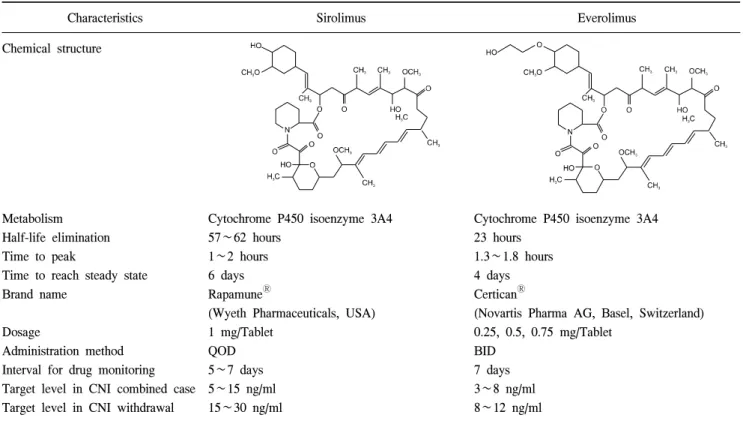
Table 1. Pharmacodynamic characteristics of mammalian target of rapamycin inhibitors
Characteristics Sirolimus Everolimus
Chemical structure
Metabolism Half-life elimination Time to peak
Time to reach steady state Brand name
Dosage
Administration method Interval for drug monitoring Target level in CNI combined case Target level in CNI withdrawal
Cytochrome P450 isoenzyme 3A4 57∼62 hours
1∼2 hours 6 days RapamuneⓇ
(Wyeth Pharmaceuticals, USA) 1 mg/Tablet
QOD 5∼7 days 5∼15 ng/ml 15∼30 ng/ml
Cytochrome P450 isoenzyme 3A4 23 hours
1.3∼1.8 hours 4 days CerticanⓇ
(Novartis Pharma AG, Basel, Switzerland) 0.25, 0.5, 0.75 mg/Tablet
BID 7 days 3∼8 ng/ml 8∼12 ng/ml Abbreviation: CNI, calcineurin inhibitor, such as, cyclosporine or tacrolimus.
hibitor, mTOR-I이라 함)는 이러한 조건을 만족하는 새로운 면역억제제로서, 본 논문에서는 2006년 3월부터 국내시판 이 허용된 mTOR-I의 약리학적 특징과 임상적 적용을 고찰 해 보고자 한다.
mTOR-I의 약리학적 특징 1) 작용기전
Sirolimus와 everolimus는 화학적으로 유사하며, 같은 작용 기전을 가지고 있다. Sirolimus와 everolimus는 세포질 내로 흡수되어 FK binding protein과 결합하여 mammalian target of rapamycin (mTOR)를 선택적으로 억제한다. mTOR의 억제 는 세포주기의 진행과 세포의 성장을 결정하는 세포 내 신 호전달체계(cell signaling pathway)에 지대한 영향을 미친다.
따라서 mTOR-I는 궁극적으로 G1에서 S phase로 넘어가는 T 림프구의 세포주기를 차단함으로써 면역억제효과를 가진 다.(4,5) 동시에 mTOR-I는 endothelial cell, fibroblast, 및 smooth muscle cell 등의 다양한 세포의 성장을 억제한다.(6) 이는 창상치유 장애라는 mTOR-I의 합병증이나 관상동맥질환에 대한 예방으로 mTOR-I가 사용되는 이론적 배경이 된다.(7)
2) 약동학적인 특징
Sirolimus와 everolimus의 화학적 구조의 매우 유사하나,
이에 따른 약동학적인 특성에는 많은 차이를 보인다.
Sirolimus는 반감기(60시간)와 적정농도에 도달하는 시간이 비교적 길다(6일). 따라서 초기 부하용량이 필요하며, 일일 1회 복용을 선호한다. 반면에 sirolimus보다 최근에 개발된 everolimus는 약제의 일부 구조를 변화시킴으로써 약제의 흡수력을 향상시켜 반감기(23시간)는 물론 적정농도에 도 달하는 시간(4일)을 단축하였다.(8) Everolimus는 초기 부하 용량이 필요치 않으며 일일 2회 분복이 적절하다. 두 가지 약제 모두 적정농도 유지를 위하여 혈중 약물농도의 측정 이 필요하다(Table 1).(8,9)
3) 약제간의 상호작용; 혈중 약물농도의 측정
Sirolimus와 everolimus는 공히 cytochrome P450 isoenzyme 3A4을 통하여 대사된다. 따라서 cytochrome P450를 억제하 거나 촉진하는 약제와 같이 투여하는 경우에는 mTOR-I의 혈중농도가 변할 수 있다. mTOR-I의 혈중 농도를 낮출 수 있는 약제로는 aminoglutethimide, carbamazepine, nafcillin, nevirapine, phenobarbital, phenytoin, rifamycins 등이 있다. 자 몽주스(Grapefruit juice)는 mTOR-I의 흡수를 억제하므로 같 이 복용하는 것을 피하여야 한다. 반면에 azole계통의 anti- fungals, ciprofloxacin, clarithromycin, diclofenac, doxycycline, er- ythromycin, imatinib, isoniazid, nefazodone, calcium channel blocker 중 verapamil, diltiazem, nicardipine와 propofol, protease
inhibitors, quinidine 등은 mTOR-I 혈중 농도를 높인다.
mTOR-I와 다른 면역억제제간의 상호작용은 다양하여, 같이 투여하는 면역억제제에 따른 mTOR-I의 농도 및 용량 조절이 필수적이다.(10) mTOR-I을 사이크로스포린과의 같 이 투여하는 경우에는 상승효과(synergic effect)가 생긴다.
이는 사이크로스포린과 mTOR-I 모두가 cytochrome P450 효 소계에 의해 대사되므로 mTOR-I의 대사가 억제되어 area under the concentration-time curve (AUC)가 증가하기 때문이 다. 이런 이유로 사이크로스포린의 농도를 갑자기 낮추게 되는 경우에는 mTOR-I의 혈중농도가 급격히 감소하며, 이 를 보완하기 위하여 mTOR-I의 용량을 2-3배로 증량하여야 한다.(11,12) 이러한 사이크로스포린과의 상호작용 때문에 사이크로스포린 투여 후 4시간의 간격을 두고 sirolimus를 투여할 것을 권장하고 있다.(13) 사이크로스포린과 달리 타 크로리무스는 sirolimus와 동시 투여가 가능하다.(14) 그러 나 sirolimus를 중지하는 경우 타크로리무스의 AUC, 최고농 도와 최저농도가 증가하므로 이에 대한 용량조절이 필요하 다.(15) Everolimus는 사이크로스포린은 물론 타크로리무스 와의 동시 투여가 가능하다. 일반적으로 CNI와 병행 투여 하는 경우 everolimus의 권장 혈중농도는 3∼8 ng/ml로 제시 되고 있다.(16,17)
Sirolimus는 mycophenolic acid (MPA)의 enterohepatic recirculation 을 억제하지 않으므로 MPA의 AUC와 최저농도가 상대적으 로 높게 유지된다.(18) 따라서 사이크로스포린과 병행투여 하는 경우보다 sirolimus와 같이 투여하는 경우 mycophenolate mofetil (MMF) 또는 MPA을 적게 사용할 것을 권장하고 있 다.(19)
4) 약물의 부작용
지질대사장애는 mTOR-I의 대표적인 부작용으로, 38∼
53%의 환자에서 hypercholesterolemia나 hyperlipidemia가 발 생한다. 백혈구, 적혈구 및 혈소판의 감소는 mTOR-I의 합 병증으로, 특히 신기능장애가 동반되는 경우에는 빈혈이 심각해 진다.(20) 피부 발적, 여드름 및 구강 내 궤양 등은 epithelial growth factor의 억제결과로, 구강 내 궤양은 myco- phenolic acid와 동시에 사용하는 경우 빈번하게 발생하며 혈중 농도에 비례하여 영향을 받는다.(21) 호흡기 합병증은 폐실질염(interstitial pneumonitis)이 대표적으로 mTOR-I의 용량 을 줄이거나 중단하는 경우 호전된다.(22,23) CNI에서 mTOR-I로 전환한 환자에서 단백뇨는 흔히 발생하는 합병 증으로, mTOR-I을 중단하는 경우 단백뇨가 호전된다.(24) 일부 연구에서는 면역억제제에 따른 창상치유과정의 합 병증에는 차이가 없다고 보고 되었으나,(25) 대부분의 전향 적 비교연구에서 창상치유 장애는 mTOR-I을 사용하는 면 역억제요법에서 발생하는 심각한 합병증의 하나로, 신이식 환자 경우의 55%까지 발생하는 것으로 보고되고 있다.(26, 27) 이러한 창상치유 장애는 mTOR-I가 가지는 fibroblast에 대
한 성장장애효과에 기인하며, mTOR-I의 사용량이 증가함 에 따라서 창상관련 합병증이 증가한다.(28) 그러나 창상관 련 합병증은 mTOR-I의 효과 뿐만 아니라 수여자의 비만 정 도, 연령 및 당뇨병 유병여부에도 영향을 받는다는 점을 고 려하여야 할 것이다.(27,28)
mTOR-I의 임상적인 적용
현재까지 시도된 mTOR-I를 이용한 면역억제요법은 ① CNI의 대체, ② 항대사제제(anti-metabolites, azathioprine or MMF or MPA)의 대체, ③ 정상 용량의 CNI와 병합 투여되 는 고용량 혹은 저용량 mTOR-I 요법, ④ 정상용량의 CNI+
저용량 mTOR-I 또는 저용량의 CNI+고용량의 mTOR-I 등 이 시도되었다.(29,30)
1) 새로운 신장이식 환자를 대상으로 한 연구
mTOR-I의 초창기 연구는 다른 면역억제제의 용량조절 없이 mTOR-I를 CNI 혹은 항대사제를 대체하는 방법으로 시도되었다. 새로운 신이식후 CNI를 대체한 mTOR-I 경험 은 sirolimus에서만 시도되었다. 사이크로스포린과 비교한 sirolimus 투여군은 높은 이식신 기능정도(estimated glomerular filtration rate, eGFR)을 보였으며, 만성이식신증(chronic al- lograft nephropathy; CAN)의 발생빈도도 낮았다.(31) 그러나 sirolimus 투여군에서 약제관련 부작용에 의한 투약중단의 비율이 높았으며, 창상관련 합병증(예를 들어 lymphocele 등), 골수억제 및 지질대사장애의 위험도가 증가하였다.(32) CNI와 스테로이드를 정상용량으로 유지하면서 MPA 혹 은 azathioprine 대신에 mTOR-I를 사용한 연구는 sirolimus와 everolimus 모두에서 시도되었다. 항대사제를 포함한 면역 억제군에 비하여 mTOR-I을 포함한 면역억제군은 급성거부 반응의 발생이 낮았으며, 감염은 차이가 없거나 거대세포 바이러스 감염이 감소하였다.(33,34) 그러나 mTOR-I 면역 억제군에서의 이식신기능이 대조군에 비하여 유의하게 불 량하였다.(35,36) 이는 mTOR-I와 병행 투여되는 CNI의 용 량을 줄임으로써 해결되어, 이후 연구에서 CNI 용량을 결 정하는 데 반영되었다.(35,37)
정상 용량의 사이크로스포린과 병행 투여되는 sirolimus 의 용량을 혈중 농도에 관계없이 2 mg/day(저용량)과 5 mg/day (고용량)으로 구분하여 연구를 시행한 시기도 있었 으나,(38) 최근에는 혈중 농도에 따라서 저용량(8∼12 ng/ml)과 고용량(15∼20 ng/ml)으로 구분하고 있다.(39) Meta- analysis에 의하면 sirolimus 고용량군에서 급성거부반응의 빈도는 낮으나, 이식신기능의 장애 및 합병증의 빈도는 증 가하는 것으로 알려졌다.(29,30) Sirolimus를 타크로리무스 와 같이 투여하는 경우에도 고용량군(2 mg/day, 4.57 ng/ml C0)은 저용량군(0.5 mg/day, 1.43 ng/ml)에 비하여 급성거부 반응의 빈도는 낮았으나, 부작용의 빈도는 높았다.(40) 그럼
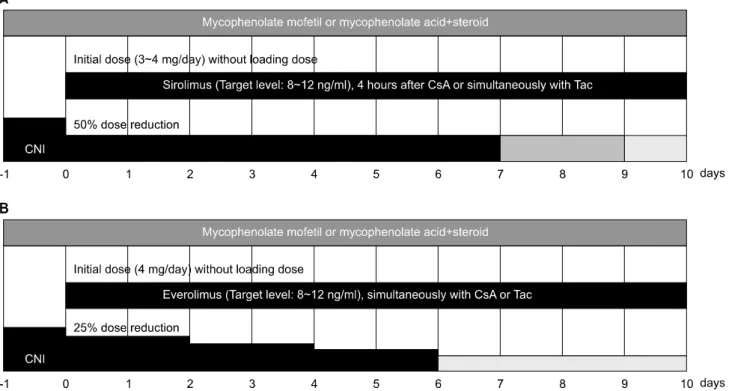
Fig. 1. Conversion protocol from CNI-based to sirolimus (A) or everolimus (B)-based immunosuppression in maintenance renal transplant recipients. A protocol waas adapted from the proposal of Diekmann F et al(51), and B protocol from CRAD001A2413-ASCERTAIN study by Novartis Korea Co.
에도 불구하고 타크로리무스와의 병행 투여에 관한 효과는 아직은 충분히 입증되지는 않은 상태이다.(41)
Everolimus의 혈중 농도가 3 ng/ml 이하인 경우에는 급성 거부반응의 빈도가 증가하므로, 최소유지용량인 3 ng/ml 이 상을 요구한다.(42) Kahan 등이 시행한 초기 연구(43)를 제 외한 정상 용량의 사이크로스포린과의 병합투여 연구에서 everolimus 1.5 mg/day는 저용량군으로, 3.0 mg/day군은 고용 량군으로 구분하였다.(44) Everolimus 고용량군이 저용량군 에 비하여 급성거부반응의 빈도에서는 유리한 반면에 이식 신기능과 합병증 발생에서는 상대적으로 불리한 성적을 보 였다.(44) 그러나 meta-analysis에서는 everolimus 용량에 따 라 급성거부반응 등에 미치는 영향은 sirolimus와 달리 미미 하였다.(29,30)
CNI의 용량과 mTOR-I의 용량을 다양하게 구성하는 면역 억제요법으로는 정상용량의 CNI+저용량 mTOR-I와 저용 량의 CNI+고용량의 mTOR-I의 비교연구로 많이 시행되었 다. Sirolimus와 사이크로스포린을 병합 투여하는 연구에서 는 두 군간의 이식신 생존율과 급성거부반응의 빈도에는 차이가 없으나, 저용량의 사이크로스포린+고용량의 siroli- mus군의 이식신 기능이 정상용량의 사이크로스포린+저용 량 sirolimus에 비하여 우수하였다.(45,46) 고용량의 everolimus (3.0 mg/day)를 정상용량 혹은 저용량의 사이크로스포린과 병합 투여한 연구에서도 저용량 사이크로스포린 군에서 급
성거부반응을 포함한 치료실패의 빈도가 낮고, 이식신 기 능이 우수한 것으로 보고하고 있다.(47) 저용량의 ever- olimus (1.5 mg/day)를 정상용량 혹은 저용량의 타크로리무 스와 병합 투여한 연구에서는 두 군간의 성적에 차이를 보 이지 않아, 저용량의 타크로리무스군도 그 효과가 우수한 것으로 보고되고 있다.(48)
2) 신이식후 유지요법의 변경
여러 이식기관에서 만성이식신증(chronic allograft nephropathy, CAN) 이나 만성이식신 기능장애(chronic allograft dysfunction, CAD) 혹은 CNI독성을 보이는 이식신 환자를 대상으로 주 면역억제제를 CNI에서 mTOR-I로 변경을 시도하여 왔다.
많은 연구에서 mTOR-I로의 전환은 이식신 기능을 향상시 키며, 이식신 소실의 가능성을 줄이는 것으로 보고하고 있 다.(49) 그러나 20∼46%의 환자는 mTOR-I로의 전환에 반응 하지 않으며, 이러한 무반응군은 전환 당시에 이미 유의한 높은 단백뇨량, 높은 혈중 크레이티닌의 농도, CAN의 병리 학적인 진행 특히 혈관변화(arteriosclerosis)의 소견이 있는 경우가 많으며, 이중 단백뇨량의 정도가 치료에 대한 반응 을 예측할 수 있는 가장 강력한 예측인자이었다.(50) Diekmann 등(51)은 가능하면 조기에 전환할 것을 권유하여, 혈중 크 레아티닌 농도가 2.5 mg/dl 이하, 일일 뇨단백량이 800 mg 이하인 경우 전환을 시도하고, 33%에서는 단백뇨가 발생하
므로 항고혈압제로 angiotensin converting enzyme inhibitor (ACE-I)나 angiotensin receptor blocker (ARB)를 사용할 것을 권하고 있다.
CNI에서 mTOR-I로의 전환과정은 다양하나, 두 가지 약 제가 중복되는 기간이 10일을 넘기지 않도록 하는 것이 원 칙이다. Sirolimus로 전환하는 경우에는 첫날 CNI용량을 절 반으로 줄임과 동시에 부하용량 없이 3∼4 mg/day을 투여 한 후 sirolimus 혈중 농도가 8∼12 ng/ml에 이르도록 한다.
사이크로스포린과는 4시간 간격을 두고, 타크로리무스는 동시에 투여한다.(51) Everolimus는 4 mg/day로 투여 후 혈 중농도가 8∼13 ng/dl에 이르도록 용량을 조절하며, CNI는 첫날부터 20%씩 2일 간격으로 용량을 감소시킨다. Sirolimus 와 달리 everolimus는 사이크로스포린이나 타크로리무스와 같이 복용하여도 무방하다(Fig. 1).
3) 신이식후 발생하는 악성종양에서의 mTOR-I의 역할
mTOR-I는 면역억제제로 사용하는 임상농도에서 항종양 효과를 보인다. 이는 mTOR-I가 신생혈관 생성과정을 억제 하기 때문으로, 실험적으로 rapamycin 투여군에서 vascular endothelial growth factor (VEGF)의 생성과 조직발현이 현저 하게 억제됨이 보고된 바가 있다.(52) 특히 Kaposi’s sarcoma 는 종양 내에서 혈관생성 유도물질인 vascular endothelial growth factor (VEGF), Flk-1/KDR protein, phosphorylated Akt 및 p70S6 kinase 등의 발현이 증가되며,(53) 이러한 유도물 질을 억제하는 sirolimus를 투여함으로써 Kaposi’s sarcoma 의 완전관해(complete remission)를 보고하였다.(54) 이밖에 악성흑색종을 제외한 피부암의 치료에 mTOR-I로의 전환은 도움이 되었다.(55)
mTOR-I를 이용한 면역억제제의 조절이 항종양효과를 보 인다는 것은 mTOR-I가 가지는 항종양효과와 종양유발효과 가 있는 CNI의 제거 혹은 감량효과가 복합적으로 작용한 것이다.(56) 따라서 mTOR-I의 항종양효과를 항암치료의 일 차적인 치료방법으로 간주해서는 곤란하다. 아직은 Karposi’s sarcoma, 악성흑색종을 제외한 피부암과 PTLD (Post-trans- plant lymphoproliferative disease)와 같은 제한적인 종양에 대 하여만 그 효과가 보고되었으며, 예후가 불량한 고형장기의 악성종양에 대한 항종양 효과는 일정하지는 않다.(57,58) 그 럼에도 불구하고 악성종양이 발생한 이식환자를 대상으로 악성종양의 종류, 종양의 예후, 현재 이식신의 기능정도에 따라서 면역억제제의 변경을 고려할 수 있다. 이식신 기능이 양호한 경우(GFR >40 ml/hour, 단백뇨 <800 mg/day)에는 CNI의 중단, mTOR-I로의 전환, MMF의 중단, 스테로이드의 유지 등의 면역억제요법이 하나의 임상지침으로 제시되고 있다.(59)
Sirolimus나 everolimus을 이식 직후부터 장기적인 면역억 제유지요법으로 사용하는 경우 이식 후 발생하는 악성종양 의 발생이 현저하게 감소한다는 보고는 2005년부터 있어
왔다.(60,61) 특히 CNI와 병합하는 경우보다 단독으로 사용 하는 경우가 보다 악성종양의 발생이 적다.(62) 이러한 악 성종양에 대한 예방효과는 피부암은 물론 모든 종류의 악 성종양에서 그 효과가 보고되고 있으나, 아직은 단기성적 만이 보고된 상태이다. 간세포암으로 간이식을 시행 받은 환자에 대한 sirolimus를 근간으로 하는 치료에서도 장기적 인 항암효과에 대하여서는 아직은 그 효과가 불분명하 다.(63)
결 론
mTOR-I의 등장으로 다양한 조합의 면역억제요법의 시도 가 가능하게 되었고, 이는 각 개인의 상태에 따른 맞춤형 면역억제요법(tailored immunosuppression)으로 구현될 수 있 을 것이다. mTOR-I는 충분한 면역억제효과를 가지면서 높 은 이식신 기능을 유지할 수 있으며 동시에 항암효과를 가 진다는 장점이 있는 반면에 골수억제, 지질대사장애 및 창 상지연과 같은 단점을 동시에 가지고 있다. 기존의 CNI, 스 테로이드 및 항대사성 면역억제제와의 다양한 조합이 시도 되고 있으며, 각각의 면역억제요법에 따른 이득과 손해에 대한 객관적이며 장기적인 평가가 아직은 진행 중이다.
감사의 글
본 논문은 2008년도 연세대학교 의과대학 장기이식연구 소 연구비 지원으로 이루어졌음.
REFERENCES
1) Pascual M, Theruvath T, Kawai T, Tolkoff-Rubin N, Cosimi B. Strategies to improve long-term outcomes after renal trans- plantation. N Engl J Med 2002;346:580-90.
2) Nankivell BJ, Borrows RJ, Fung CL, O'Connell PJ, Allen RD, Chapman JR. The natural history of chronic allograft nephro- pathy. N Engl J Med 2003;349:2326-33.
3) Vincenti F, Ramos E, Brattstrom C, Cho S, Ekberg H, Grinyo J, et al. Multicenter trial exploring calcineurin inhibitors avoid- ance in renal transplantation. Transplantation 2001;71: 1282-7.
4) Sehgal SN. Rapamune (RAPA, rapamycin, sirolimus): mecha- nism of action immunosuppressive effect results from blockade of signal transduction and inhibition of cell cycle progression.
Clin Biochem 1998;31:335-40.
5) Hardinger, KL, Koch, MJ, Brennan, DC. Current and future immunosuppressive strategies in renal transplantation. Pharma- cotherapy 2004;24:1159.
6) Mohacsi PJ, Tuller D, Hulliger B, Wijngaard PL. Different in- hibitory effects of immunosuppressive drugs on human and rat aortic smooth muscle and endothelial cell proliferation stimu- lated by platelet-derived growth factor or endothelial cell growth
factor. J Heart Lung Transplant 1997;16:484-92.
7) Morice MC, Serruys PW, Sousa JE, Fajadet J, Ban Hayashi E, Perin M, et al. RAVEL Study Group. Randomized Study with the Sirolimus-Coated Bx Velocity Balloon-Expandable Stent in the Treatment of Patients with de Novo Native Coronary Artery Lesions. A randomized comparison of a siro- limus-eluting stent with a standard stent for coronary reva- scularization. N Engl J Med 2002;346:1773-80.
8) Kirchner GI, Meier-Wiedenbach I, Manns MP. Clinical pharma- cokinetics of everolimus. Clin Pharmacokinet 2004;43:83-95.
9) Mahalati K, Kahan BD. Clinical pharmacokinetics of sirolimus.
Clin Pharmacokinet 2001;40:573-85.
10) Cattaneo D, Merlini S, Pellegrino M, Carrara F, Zenoni S, Murgia S, et al. Therapeutic drug monitoring of sirolimus: effect of concomitant immunosuppressive therapy and optimization of drug dosing. Am J Transplant 2004;4:1345-51.
11) MacDonald A, Scarola J, Burke JT, Zimmerman JJ. Clinical pharmacokinetics and therapeutic drug monitoring of sirolimus.
Clin Ther 2000;22:B101-21.
12) Kovarik JM, Kalbag J, Figueiredo J, Rouilly M, Frazier OL, Rordorf C. Differential influence of two cyclosporine for- mulations on everolimus pharmacokinetics: a clinically relevant pharmacokinetic interaction. J Clin Pharmacol 2002;42:95-9.
13) Kaplan B, Meier-Kriesche HU, Napoli KL, Kahan BD. The effects of relative timing of sirolimus and cyclosporine micro- emulsion formulation coadministration on the pharmacokinetics of each agent. Clin Pharmacol Ther 1998;63:48-53.
14) McAlister VC, Mahalati K, Peltekian KM, Fraser A, MacDonald AS. A clinical pharmacokinetic study of tacrolimus and sirolimus combination immunosuppression comparing simultaneous to separated administration. Ther Drug Monit 2002;24:346-50.
15) Baldan N, Rigotti P, Furian L, Margani G, Ekser B, Frison L, et al. Co-administration of sirolimus alters tacrolimus phar- macokinetics in a dose-dependent manner in adult renal trans- plant recipients. Pharmacol Res 2006;54: 181-5.
16) Lorber MI, Ponticelli C, Whelchel J, Mayer HW, Kovarik J, Li Y, et al. Therapeutic drug monitoring for everolimus in kid- ney transplantation using 12-month exposure, efficacy, and safety data. Clin Transplant 2005;19:145-52.
17) Kovarik JM, Tedesco H, Pascual J, Civati G, Bizot MN, Geissler J, et al. Everolimus therapeutic concentration range defined from a prospective trial with reduced-exposure cyclo- sporine in de novo kidney transplantation. Ther Drug Monit 2004;26:499-505.
18) Cattaneo D, Merlini S, Zenoni S, Baldelli S, Gotti E, Remuzzi G, et al. Influence of co-medication with sirolimus or cyclo- sporine on mycophenolic acid pharmacokinetics in kidney transplantation. Am J Transplant 2005;5:2937-44.
19) El Haggan W, Ficheux M, Debruyne D, Rognant N, Lobbedez T, Allard C, et al. Pharmacokinetics of mycophenolic acid in kidney transplant patients receiving sirolimus versus cyclosporine. Transplant Proc 2005;37:864-6.
20) Augustine, JJ, Knauss, TC, Schulak, JA, Bodziak KA, Siegel C, Hricik DE. Comparative effects of sirolimus and mycophe- nolate mofetil on erythropoiesis in kidney transplant patients.
Am J Transplant 2004;4:2001-6.
21) Van Gelder T, Ter Meulen CG, Hene R, Weimar W, Hoitsma A. Oral ulcers in kidney transplant recipients treated with siroli- mus and mycophenolate mofetil. Transplantation 2003;75:788-91.
22) Morelon E, Stern M, Kreis H. Interstitial pneumonitis asso- ciated with sirolimus therapy in renal-transplant recipients. N Engl J Med 2000;343:225-6.
23) Garrean S, Massad MG, Tshibaka M, Hanhan Z, Caines AE, Benedetti E. Sirolimus-associated interstitial pneumonitis in solid organ transplant recipients. Clin Transplant 2005;19:698-703.
24) Letavernier E, Pe'raldi MN, Pariente A, Morelon E, Legendre C. Proteinuria following a switch from calcineurin inhibitors to sirolimus. Transplantation 2005;80:1198-203.
25) Flechner SM, Zhou L, Derweesh I, Mastroianni B, Savas K, Goldfarb D, et al. The impact of sirolimus, mycophenolate mo- fetil, cyclosporine, azathioprine, and steroids on wound healing in 513 kidney-transplant recipients. Transplantation 2003;76:
1729-34.
26) Dean PG, Lund WJ, Larson TS, Prieto M, Nyberg SL, Ishitani MB, et al. Wound-healing complications after kidney trans- plantation: a prospective, randomized comparison of sirolimus and tacrolimus. Transplantation 2004;77:1555-61.
27) Valente JF, Hricik D, Weigel K, Seaman D, Knauss T, Siegel CT, et al. Comparison of sirolimus vs. mycophenolate mofetil on surgical complications and wound healing in adult kidney transplantation. Am J Transplant 2003;3:1128-34.
28) Knight RJ, Villa M, Laskey R, Benavides C, Schoenberg L, Welsh M, et al. Risk factors for impaired wound healing in sirolimus-treated renal transplant recipients. Clin Transplant 2007;21:460-5.
29) Webster AC, Lee VW, Chapman JR, Craig JC. Target of rapa- mycin inhibitors (sirolimus and everolimus) for primary im- munosuppression of kidney transplant recipients: a systematic review and meta-analysis of randomized trials. Transplantation 2006;81:1234-48.
30) Webster AC, Lee VW, Chapman JR, Craig JC. Target of rapa- mycin inhibitors (TOR-I; sirolimus and everolimus) for primary immunosuppression in kidney transplant recipients. Cochrane Database Syst Rev 2006;2:CD004290.
31) Flechner SM, Kurian SM, Solez K, Cook DJ, Burke JT, Rollin H, et al. De novo kidney transplantation without use of calcineur- in inhibitors preserves renal structure and function at two years.
Am J Transplant 2004;4:1776-85.
32) Buchler M, Caillard S, Barbier S, Thervet E, Toupance O, Mazouz H, et al. SPIESSER Group. Sirolimus versus cyclo- sporine in kidney recipients receiving thymoglobulin, mycophe- nolate mofetil and a 6-month course of steroids. Am J Transplant 2007;7:2522-31.
33) Kahan BD. Efficacy of sirolimus compared with azathioprine
for reduction of acute renal allograft rejection: a randomised multicentre study. The Rapamune US Study Group. Lancet 2000;356:194-202.
34) Vitko S, Margreiter R, Weimar W, Dantal J, Kuypers D, Winkler M, et al; RAD B201 Study Group. Three-year efficacy and safety results from a study of everolimus versus mycophenolate mofetil in de novo renal transplant patients. Am J Transplant 2005;5:2521-30.
35) Lorber MI, Mulgaonkar S, Butt KMH, Elkhammas E, Mendez R, Rajagopalan PR, et al. Everolimus versus mycophenolate mofetil in the prevention of rejection in de novo renal trans- plant recipients: a 3-year randomized, multicenter, phase III study. Transplantation 2005;80:244-52.
36) Mendez R, Gonwa T, Yang HC, Weinstein S, Jensik S, Steinberg S. Prograf Study Group. A prospective, randomized trial of tacrolimus in combination with sirolimus or mycophe- nolate mofetil in kidney transplantation: results at 1 year.
Transplantation 2005;80:303-9.
37) Bhattaram VA, Bonapace C, Chilukuri DM, Duan JZ, Garnett C, Gobburu JV, et al. Impact of pharmacometric reviews on new drug approval and labeling decisions-a survey of 31 new drug applications submitted between 2005 and 2006. Clin Pharmacol Ther 2007;81:213-21.
38) MacDonald AS. RAPAMUNE Global Study Group. A world- wide, phase III, randomized, controlled, safety and efficacy study of a sirolimus/cyclosporine regimen for prevention of acute re- jection in recipients of primary mismatched renal allografts.
Transplantation 2001;71:271-80.
39) Ferreira AN, Machado PG, Felipe CR, Motegi SA, Hosaka BH, Tanaka MK, et al. Casarini DE, Tedesco-Silva H Jr, Medina- Pestana JO. Concentration-controlled use of sirolimus associated with reduced exposure of cyclosporine in black recipients of primarily living renal allograft donors: 12-month results. Clin Transplant 2005;19:607-15.
40) Vitko S, Wlodarczyk Z, Kyllonen L, Czajkowski Z, Margreiter R, Backman L, et al. Tacrolimus combined with two different dosages of sirolimus in kidney transplantation: results of a multicenter study. Am J Transplant 2006;6:531-8.
41) Ribes D, Kamar N, Esposito L, Rostaing L. Combined use of tacrolimus and sirolimus in de novo renal transplant patients:
current data. Transplant Proc 2005;37:2813-6.
42) Kovarik JM, Kaplan B, Tedesco Silva H, Kahan BD, Dantal J, Vitko S, et al. Exposure-response relationships for ever- olimus in de novo kidney transplantation: defining a ther- apeutic range. Transplantation 2002;73:920-5.
43) Kahan BD, Kaplan B, Lorber MI, Winkler M, Cambon N, Boger RS. RAD in de novo renal transplantation: comparison of three doses on the incidence and severity of acute rejection.
Transplantation 2001;71:1400-6.
44) Vitko S, Tedesco H, Eris J, Pascual J, Whelchel J, Magee JC, et al. Everolimus with optimized cyclosporine dosing in renal transplant recipients: 6-month safety and efficacy results of
two randomized studies. Am J Transplant 2004;4:626-35.
45) Gonwa TA, Hricik DE, Brinker K, Grinyo JM, Schena FP.
Sirolimus Renal Function Study Group. Improved renal func- tion in sirolimus-treated renal transplant patients after early cy- closporine elimination. Transplantation 2002;74:1560-7.
46) Kahan BD, Julian BA, Pescovitz MD, Vanrenterghem Y, Neylan J. Sirolimus reduces the incidence of acute rejection episodes despite lower cyclosporine doses in caucasian recipi- ents of mismatched primary renal allografts: a phase II trial.
Rapamune Study Group. Transplantation 1999;68:1526-32.
47) Nashan B, Curtis J, Ponticelli C, Mourad G, Jaffe J, Haas T.
on behalf of the 156 Study Group. Everolimus and reduced exposure cyclosporine in de novo renal-transplant recipients:
a three-year phase II, randomized, multicenter, open-label study. Transplantation 2004;78:1332-40.
48) Chan L, Greenstein S, Hardy MA, Hartmann E, Bunnapradist S, Cibrik D, et al. CRADUS09 Study Group. Multicenter, randomized study of the use of everolimus with tacrolimus after renal transplantation demonstrates its effectiveness. Transplantation 2008;85:821-6.
49) Bumbea V, Kamar N, Ribes D, Esposito L, Modesto A, Guitard J, et al. Long-term results in renal transplant patients with allograft dysfunction after switching from calcineurin in- hibitors to sirolimus. Nephrol Dial Transplant 2005;20:2517- 23.
50) Diekmann F, Budde K, Oppenheimer F, Fritsche L, Neumayer HH, Campistol JM. Predictors of success in conversion from calcineurin inhibitor to sirolimus in chronic allograft dysfunction.
Am J Transplant 2004;4:1869-75.
51) Diekmann F, Campistol JM. Conversion from calcineurin in- hibitors to sirolimus in chronic allograft nephropathy: benefits and risks. Nephrol Dial Transplant 2006;21:562-8.
52) Guba M, von Breitenbuch P, Steinbauer M, Koehl G, Flegel S, Hornung M, et al. Rapamycin inhibits primary and meta- static tumor growth by antiangiogenesis: involvement of vas- cular endothelial growth factor. Nat Med 2002;8:128-35.
53) Stallone G, Schena A, Infante B, Di Paolo S, Loverre A, Maggio G, et al. Sirolimus for Kaposi's sarcoma in re- nal-transplant recipients. N Engl J Med 2005;352:1317-23.
54) Campistol JM, Schena FP. Kaposi's sarcoma in renal trans- plant recipients-the impact of proliferation signal inhibitors.
Nephrol Dial Transplant 2007;22:i17-22.
55) de Fijter JW. Use of proliferation signal inhibitors in non-mel- anoma skin cancer following renal transplantation. Nephrol Dial Transplant 2007;22:i23-6.
56) Dantal J, Soulillou JP. Immunosuppressive drugs and the risk of cancer after organ transplantation. N Engl J Med 2005;352:
1371-3.
57) Boraty-ska M, Watorek E, Smolska D, Patrzałek D, Klinger M. Anticancer effect of sirolimus in renal allograft recipients with de novo malignancies. Transplant Proc 2007;39:2736-9.
58) Gomez-Camarero J, Salcedo M, Rincon D, Lo Iacono O,
Ripoll C, Hernando A, et al. Use of everolimus as a rescue immunosuppressive therapy in liver transplant patients with neoplasm. Transplantation 2007;84:786-91.
59) Campistol JM, Albanell J, Arns W, Boletis I, Dantal J, de Fijter JW, et al. Use of proliferation signal inhibitors in the management of post-transplant malignancies--clinical guidance. Nephrol Dial Transplant 2007;22:i36-41.
60) Kauffman HM, Cherikh WS, Cheng Y, Hanto DW, Kahan BD. Maintenance immunosuppression with target-of-rapamy- cin inhibitors is associated with a reduced incidence of de no- vo malignancies. Transplantation 2005;80:883-9.
61) Kahan BD, Yakupoglu YK, Schoenberg L, Knight RJ, Katz
SM, Lai D, et al. Low incidence of malignancy among sirolimus/
cyclosporine-treated renal transplant recipients. Transplantation 2005;80:749-58.
62) Campistol JM, Eris J, Oberbauer R, Friend P, Hutchison B, Morales JM, et al. Sirolimus therapy after early cyclosporine withdrawal reduces the risk for cancer in adult renal trans- plantation. J Am Soc Nephrol 2006;17:581-9.
63) Zimmerman MA, Trotter JF, Wachs M, Bak T, Campsen J, Skibba A, et al. Sirolimus-based immunosuppression following liver transplantation for hepatocellular carcinoma. Liver Transpl 2008;14:633-8.