INTRODUCTION
In 1945, atomic bombs were detonated over Hiroshima and Nagasaki, Japan, toward the end of World War II. These bombs resulted in an estimated 140,000±10,000 casual- ties in Hiroshima and 70,000±10,000 in Nagasaki (1). At that time, Korea was occupied by Japan, and the Japanese Imperial Government had drafted numerous Koreans as sol- diers and workers in munitions factories in Japan. Koreans also moved to Japan to earn a living. Thus, the atomic bombs dropped on Hiroshima and Nagasaki killed or injured numer- ous Koreans along with Japanese. Ichiba Junko has estimat- ed that 30,000 Koreans died and 20,000 survived at Hiroshi- ma and that 10,000 died and 10,000 survived at Nagasaki.
Of the 30,000 total Korean survivors, about 23,000 returned to Korea, and 7,000 stayed in Japan (2). Hard times for the survivors did not end after their return. They not only suf- fered from poor health but also experienced hardships such as the Korean War and poverty. Many of the survivors have since died, while others are reluctant to reveal that they are, in fact, survivors owing to concerns about social prejudice.
The Korean atomic bomb survivors were not recognized by the Japanese government until the 1990s and only then as
the result of prolonged efforts by the survivors. In 2004, 2,235 Koreans were registered as atomic bomb survivors in Republic of Korea (3).
The association between atomic bomb exposure and malig- nant diseases is well established (4-6). In addition, recent studies have demonstrated that atomic bomb exposure also affects non-cancer diseases, such as myocardial infarction, thyroid disease, and chronic liver disease (7, 8).
While many studies have examined the health of Japanese atomic bomb survivors, no previous study has been conducted on the health of Korean A-bomb survivors. The objectives of this study were to examine non-cancer diseases of Korean A-bomb survivors who were in residence at Hapcheon and to evaluate whether this prevalence was significantly higher than that in people not exposed to the A-bomb.
MATERIALS AND METHODS Study population and health examination
Health examinations were conducted in 2004 at Hapcheon, Republic of Korea, because a large number of Korean A-bomb
Young-Su Ju, Hyung-Joon Jhun*, Jung-Bum Kim�, Jin-Kook Kim�
Department of Occupational and Environmental Medicine, Sacred Heart Hospital, Hallym University, Anyang; Department of Occupational and Environmental Medicine*, Hangang Sacred Heart Hospital, Hallym University, Seoul; Association of Physicians for Humanism�, Seoul; Department of Neurology�, Daegu Red Cross Hospital, Daegu, Korea
Address for correspondence Hyung-Joon Jhun, M.D.
Department of Occupational and Environmental Medicine, Hangang Sacred Heart Hospital, Hallym University, 94-195 Yeongdungpo-dong, Yeongdungpo-gu, Seoul 150-719, Korea Tel : +82.2-2639-5796, Fax : +82.2-2675-5191 E-mail : [email protected]
*This study was supported by the National Human Rights Commission of Korea.
385
Non-cancer Diseases of Korean Atomic Bomb Survivors in Residence at Hapcheon, Republic of Korea
Many Koreans, in addition to Japanese, were killed or injured by the atomic bombs detonated over Hiroshima and Nagasaki, Japan, in 1945. Our study examined non- cancer diseases of Korean A-bomb survivors in residence at Hapcheon, Republic of Korea and evaluated whether they had significantly higher prevalence of non- cancer diseases than non-exposed people. We evaluated a number of tests, includ- ing anthropometric measurements, blood pressure, blood chemistry, hepatitis B surface antigen, and urinalysis, of survivors (n=223) and controls (n=372). Univari- ate analysis revealed significantly lower fasting glucose and creatinine, and higher diastolic blood pressure, aspartate aminotransferase, alanine aminotransferase, and blood urea nitrogen levels in the survivors than in the controls. The calculation of crude prevalence ratios (PRs) revealed that A-bomb survivors had a significantly higher prevalence of hypertension (PR, 1.16; 95% CI, 1.00-1.35) and chronic liver disease (2.20; 1.59-3.06) than controls. After adjusting for covariates (age, sex, body mass index, marital status, education, alcohol consumption, and smoking), A-bomb survivors had a significantly higher prevalence of hypertension (1.24; 1.06-1.44), chronic liver disease (2.07; 1.51-2.84), and hypercholesterolemia (1.79; 1.11-2.90) than controls. This study suggests that A-bomb exposure is associated with a higher prevalence of non-cancer diseases in Korean survivors.
Key Words : Accidents, Radiation; Radiation Injuries; Abnormalities, Radiation-Induced; Atomic Bomb; Korean Survivors; Non-cancer Diseases
Received : 27 June 2005 Accepted : 2 November 2005
survivors currently reside at Hapcheon. A total of 223 Korean A-bomb survivors, 10.0% of all the Korean A-bomb survivors alive in the Republic of Korea in 2004, participated in the health examination. Individual atomic bomb exposure histo- ries of Korean A-bomb survivors who participated in the health examination and lived at Hapchoen were collected using a self-administered questionnaire. Physicians and medical stu- dents interviewed the survivors to confirm the validity of their statements. Reference was also made to the atomic bomb sur- vivor registry cards issued by the Japanese government.
The controls in this study were recruited from participants in the second Korea National Health and Nutrition Exami- nation Survey (K-NHANES). The K-NHANES surveys a random sample of the general Korean population to assess the health and nutrition status of the population through interviews and health examinations (9). Of the total 37,769 Koreans who provided information about their health and nutrition in the second K-NHANES, 6,786 participated in a health examination, and 1,233 of these were of the same age as the participants in the 2004 Korean atomic bomb survivors’ health examination in Hapcheon. Given that Ha- pcheon is a rural area, we selected residents of rural areas (n=
463) from among the 1,233 candidates, to exclude the socio- economic effect of residency. As the proportion of female con- trols was higher than that of survivors, we randomly elimi- nated 91 females to balance the sex ratio between the two groups. In the end, 372 persons were selected as controls.
The clinical indicators of non-cancer diseases evaluated in this study were anthropometric measurements (height and weight), systolic and diastolic blood pressures, blood chem- istry (aspartate aminotransferase, alanine aminotransferase, fasting glucose, total cholesterol, blood urea nitrogen, and creatinine), hepatitis B surface antigen, and urinalysis (urine glucose, protein, and occult blood).
A participant with high systolic (≥140 mm Hg) or dias- tolic blood pressure (≥90 mm Hg) was classified as having hypertension, in line with the guidelines of the Joint National Committee on Prevention, Detection, Evaluation, and Treat- ment of High Blood Pressure (10). A participant taking anti- hypertensive medications was also classified as having hyper- tension. Individuals with a serum aspartate aminotransferase (AST) or alanine aminotransferase (ALT) level higher than 0.58 kat/L (>35 IU/L) were considered to have chronic liver disease. Those with a fasting glucose value higher than 6.1 mM/L (>110 mg/dL) and those undergoing medical treat- ment for diabetes mellitus (DM) or impaired glucose toler- ance (IGT) were considered to have DM+IGT. Individuals with a total serum cholesterol level of 6.2 mM/L or higher (≥240 mg/dL) were considered to have hypercholesterolemia.
Participants with a serum blood urea nitrogen (BUN) level higher than 7.1 mM/L (>20 mg/dL) or creatinine higher than 106 M/L (>1.2 mg/dL) were considered to have renal func- tion abnormality. The National Human Rights Commission of Korea approved the study protocol, and all the survivors
who participated in the health examination gave their inform- ed consent.
Statistical analysis
The univariate analysis between the survivors and controls used Student’s t-test and the Wilcoxon rank-sum test for con- tinuous variables or the chi-square test for discrete variables.
Crude and adjusted prevalence ratios (PRs) of non-cancer diseases were obtained using both PROC PHREG and PROC GENMOD with binomial distribution and log link func- tion in SAS version 9.0 (11). Age, body mass index, gender (male/female), marital status (married/unmarried, separated, bereaved, and divorced), education (at least a high school education/educated below high school level), usual alcohol consumption (drinks at least 1-2 times per week/drinks fewer than 1-2 times per week), and smoking status (non-smoker/
ex-smoker/current smoker) were included as covariates for obtaining adjusted PRs.
RESULTS
Nearly all (96.9%) survivors were residing in Hiroshima when the bomb was dropped. The majority of the partici- pants were exposed to the atomic bomb during their child- hood or adolescence: 1.3% were in utero, 57.8% were less than 10 yr old, and 31.4% were between 10 and 19 yr at the time of the bombing. We identified the distances from the hypo- center for 122 (54.7%) survivors at the time of the bombing,
Number 223
Location of exposure
Hiroshima 216 (96.9%)
Nagasaki 7 (3.1%)
Age at the time of the bombing (yr)
In utero 3 (1.3%)
0-9 129 (57.8%)
10-19 70 (31.4%)
20-30 21 (9.4%)
Distance from hypocenter (km)
<1.5 21 (9.4%)
1.5-2.5 55 (24.7%)
>2.5 46 (20.6%)
Unknown 101 (45.3%)
Shielding conditions Indoor
Wooden building 97 (43.5%)
Concrete building 8 (3.6%)
Other 22 (9.9%)
Outdoor
In shade 36 (16.1%)
Unsheltered 18 (8.1%)
Unable to recall 42 (18.8%)
Table 1.Atomic bomb exposure histories of Korean A-bomb survivors who participated in the health examination
based on the A-bomb survivor registry cards issued by the Japanese government: 21 (9.4%) were within 1.5 km, 55 (24.7%) were between 1.5 and 2.5 km, and 46 (20.6%) were beyond 2.5 km from the hypocenter. Unfortunately, we were unable to identify the distances for 101 (45.3%) survivors.
Of the survivors, 57.0% responded that they were indoors (43.5% in wooden building, 3.6% in concrete building, and
9.9% in other structures such as shelters, trains, or uniden- tified buildings), 27.8% responded that they were outdoors (16.1% were in the shade of buildings or trees and 8.1% were unsheltered), and 18.8% were unable to recall their place at the time of the bombing (Table 1).
No significant differences in average age, gender ratio, and alcohol consumption frequency occurred between the survivors and controls. However, marital status (p<0.05), education (p<0.01), and smoking status (p<0.01) differed significantly between the two groups. More of the survivors were married and less well educated than the controls, but there were fewer current smokers among the survivors.
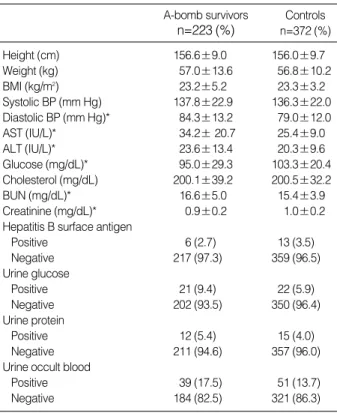
The univariate analysis revealed significantly lower fasting glucose and creatinine levels in the survivors. Conversely, diastolic blood pressure (DBP), serum AST, ALT, and BUN were higher in the survivors (Table 3).
Except for DM+IGT, A-bomb survivors had a higher pre- valence of non-cancer diseases than controls. The calculation of crude PRs revealed that A-bomb survivors had a signifi- cantly higher prevalence of hypertension (PR, 1.16; 95% CI, 1.00-1.35) and chronic liver disease (2.20; 1.59-3.06) than controls. After adjusting for covariates, A-bomb survivors had a significantly higher prevalence of hypertension (1.24;
1.06-1.44), chronic liver disease (2.07; 1.51-2.84), and hyper- cholesterolemia (1.79; 1.11-2.90) than controls (Table 4).
A-bomb survivors n=223 (%)
Controls n=372 (%)
Age (yr) 68.3±6.6 68.4±7.2
Gender
Male 105 (47.1) 175 (47.0)
Female 118 (52.9) 197 (53.0)
Marital status*
Married 166 (76.1) 251 (67.5)
Unmarried/Bereaved/Divorced 52 (23.9) 121 (32.5) Education�
Uneducated/Elementary/ 216 (97.3) 332 (89.2) Middle school
High school/ College/University 6 (2.7) 40 (10.8) Smoking�
Non-smoker 148 (66.7) 180 (51.4)
Ex-smoker 28 (12.6) 53 (15.1)
Current smoker 46 (20.7) 117 (33.4)
Usual alcohol drinking
Yes 46 (20.6) 98 (26.3)
No 177 (79.4) 274 (73.7)
Table 2.General characteristics of the study population
*p<0.05, �p<0.01.
A-bomb survivors n=223 (%)
Controls n=372 (%)
Height (cm) 156.6±9.0 156.0±9.7
Weight (kg) 57.0±13.6 56.8±10.2
BMI (kg/m2) 23.2±5.2 23.3±3.2
Systolic BP (mm Hg) 137.8±22.9 136.3±22.0 Diastolic BP (mm Hg)* 84.3±13.2 79.0±12.0
AST (IU/L)* 34.2±20.7 25.4±9.0
ALT (IU/L)* 23.6±13.4 20.3±9.6
Glucose (mg/dL)* 95.0±29.3 103.3±20.4 Cholesterol (mg/dL) 200.1±39.2 200.5±32.2
BUN (mg/dL)* 16.6±5.0 15.4±3.9
Creatinine (mg/dL)* 0.9±0.2 1.0±0.2 Hepatitis B surface antigen
Positive 6 (2.7) 13 (3.5)
Negative 217 (97.3) 359 (96.5)
Urine glucose
Positive 21 (9.4) 22 (5.9)
Negative 202 (93.5) 350 (96.4)
Urine protein
Positive 12 (5.4) 15 (4.0)
Negative 211 (94.6) 357 (96.0)
Urine occult blood
Positive 39 (17.5) 51 (13.7)
Negative 184 (82.5) 321 (86.3)
Table 3.Univariate analysis of clinical indicators of non-cancer diseases between A-bomb survivors and controls
BMI, body mass index; BP, blood pressure; AST, aspartate aminotrans- ferase; ALT, alanine aminotransferase; BUN, blood urea nitrogen.
*p<0.01.
Prevalence
Survivors n=223 (%)
Controls n=372 (%)
Prevalence ratio (Survivors vs. controls)
Crude (95% CI)
Adjusted for covariates*
(95% CI) Hypertension 131 (58.7) 188 (50.5) 1.16 1.24
(1.00-1.35) (1.06-1.44)
CLD 66 (29.6) 50 (13.4) 2.20 2.07
(1.59-3.06) (1.51-2.84)
DM+IGT 46 (20.6) 101 (27.2) 0.76 0.81
(0.56-1.03) (0.59-1.11)
CHO 35 (15.7) 39 (10.5) 1.50 1.79
(0.98-2.30) (1.11-2.90)
RFA 39 (17.5) 62 (16.7) 1.05 1.14
(0.73-1.51) (0.79-1.65) Table 4.Prevalence and prevalence ratios of non-cancer dis- eases between A-bomb survivors and controls
CLD, chronic liver disease; DM, diabetes mellitus; IGT, impaired glucose tolerance; CHO, hypercholesterolemia; RFA, renal function abnormality.
*Covariates: Age, body mass index, gender (male/female), marital sta- tus (married/unmarried, separated, bereaved, and divorced), education (at least a high school education/educated below high school level), usual alcohol consumption (drinks at least 1-2 times per week/drinks fewer than 1-2 times per week), and smoking status (non-smoker/ex- smoker/current smoker).
DISCUSSION
U.S.A. and Japanese scientists have consecutively developed dosimetry systems, i.e., T65D (Tentative 1965 Radiation Dose Estimates for Atomic Bomb Survivors), DS86 (Dosime- try System 1986), and DS02 (Dosimetry System 2002), to determine the radiation doses of Japanese A-bomb survivors (12). In Japan, information regarding individual A-bomb exposure histories, such as each survivor’s location and detailed shielding situation at the time of the bombing, was obtained through interviews conducted during the late 1950s and early 1960s. Based on these data and dosimetry systems derived from theories of modern nuclear physics, individual radia- tion dose estimates are presently available for 92% of the approximately 100,000 Japanese A-bomb survivor cohort and about 80% of those who were exposed within 2 km of the hypocenters (13). On the contrary, a scientific and sys- tematic survey of A-bomb exposure histories of Korean sur- vivors has never been conducted in Korea. The majority of survivors were exposed to the A-bomb during childhood or adolescence, and 59 yr had passed before we conducted this study. Thus, survivors had difficulty in accurately recalling their location and situation at the time of the bombing despite our efforts to stimulate their memory, which inevitably led the exposure assessment of this study to contrast A-bomb survivors with non-exposed controls.
The clinical indicators of non-cancer diseases evaluated in this study were well standardized and easily measured at a majority of the hospitals and clinics in Korea. Thus, discrep- ancy between examiners and examining methods of the clin- ical indicators of the survivors and controls did not violate the comparability of the two groups.
In the analysis of data from cross-sectional studies, two ratio measures of effect have been used: the prevalence odds ratio (POR) and the prevalence ratio (PR). Although there is no dispute that the PR and POR will be similar for a rare disease, they may produce a discrepancy for a common dis- ease. When analyzing common diseases, the POR generally produces higher estimates with wider confidence intervals than the PR (14). Therefore, we calculated the PRs of non- cancer diseases in this study.
Shimizu et al. reported that mortality from hypertensive heart disease among Japanese A-bomb survivors increased with the radiation dose (15), and Sasaki et al. reported that atomic bomb exposure was related to elevated blood pressure (16). Akahoshi et al. reported that the atomic-bomb radia- tion dose was positively related to fatty liver identified by abdominal ultrasonography, low HDL-cholesterol, and hyper- triglyceridemia and that these relationships were indepen- dent of age, sex, BMI, smoking, and drinking habits (17).
In the Japanese A-bomb survivor cohort, the mean growth curve of serum cholesterol levels from 1958 to 1986 for irra- diated individuals was significantly higher than that for non- irradiated controls, in both men and women (18). In addi-
tion, an excess risk of non-cancer diseases after exposure to radiation has also been reported. Patients who received radio- therapy for Hodgkin’s disease (19) or breast cancer (20) have shown an increased risk of mortality from cardiovascular disease. The analysis of Russian workers involved in the clean- up following the Chernobyl accident provides some indica- tion of the increase in the incidence of, but not mortality from, non-cancer diseases (21). In this study, atomic bomb exposure had a positive association with prevalence of hyper- tension, chronic liver disease, and hypercholesterolemia. These results concur with previous findings of non-cancer diseases in those exposed to radiation. Target organ damage and the induction of atherogenesis or inflammatory markers, such as C-reactive protein, interleukin-6, and other markers, have been hypothesized as mechanisms of non-cancer diseases by radiation exposure (22-24). However, the possible biologi- cal mechanisms that cause excess risk of non-cancer diseases are still unclear.
We found no significant association between atomic bomb exposure and impaired glucose metabolism (DM+IGT). Nor has any correlation been reported between the prevalence of DM and the radiation dose at Hiroshima and Nagasaki (25, 26). However, in a study using unpublished data, Wong et al.
reported that the prevalence of DM, diagnosed on the basis of medical history and measurements of blood glucose and glycosylated hemoglobin (hemoglobin A1c), was significantly higher among Hiroshima females under the age of 20 yr who were exposed to high doses of radiation (18). Thus, further studies are needed to confirm the association between radia- tion and glucose metabolism.
The Korean survivors were less educated than the controls (Table 2). A low level of education is generally related to low socioeconomic status (SES), and low SES is related to poor health. Both atomic bomb exposure and low SES may have contributed to the health status of the survivors. Most of the survivors were exposed to the atomic bomb during child- hood, which means that their parents were also exposed. The poor health of both the survivors and their parents caused by atomic bomb exposure may have contributed to their lack of education. We believe that the low level of education of the survivors is inseparable from atomic bomb exposure.
Our study was limited to the survivors in residence at Ha- pcheon. Although this was not a random sample of Korean survivors, it is unlikely that residing at Hapcheon caused an unusual selection of survivors with non-cancer diseases and distorted the relationship between A-bomb exposure and prevalence of non-cancer diseases. Further study evaluating the health of all Korean survivors needs to be conducted. We did not evaluate the nutritional status of the survivors. The clinical indicators evaluated in this study are related to nutri- tion, but further nutritional evaluations are needed. As this study was cross-sectional, future trends in the health of the survivors cannot be predicted without longitudinal follow- ups. Finally, this study did not investigate malignancy in the
survivors, and further study of this is also needed.
This study suggests that A-bomb exposure is associated with a higher prevalence of non-cancer diseases in Korean survivors. Although many years have passed since the deto- nation of the atomic bombs, health concerns related to atomic bomb exposure are still being raised (27-29). Additional stud- ies investigating the health of Korean A-bomb survivors are needed.
ACKNOWLEDGMENTS
The authors thank Daegu Red Cross Hospital for provid- ing facilities during the health examination; Jin-Tae Shim (Head of the Hapcheon Branch of the Korea Atomic Bomb Casualty Association); Hee-Kyung Lee and Mi-Jin Rha (Exec- utive Secretaries of the Association of Physicians for Human- ism); the physician and medical student volunteers for their help with the health examinations, data collection, and data processing; Dr. Masazumi Akahoshi (Department of Clinical Studies, Radiation Effects Research Foundation, Nagasaki, Japan) for providing useful advice on this study; and the Na- gasaki Association for Hibakusyas’ Medical Care (NASHIM) for providing information on research and medical care of Japanese atomic bomb survivors.
REFERENCES
1. Atomic Bomb Survivors Relief Department, Social Affairs Bureau, The City of Hiroshima. Summary of relief measures for atomic bomb survivors. 2003. http://www.city.hiroshima.jp/shimin/heiwa/relief.
pdf. (accessed 30 September 2005).
2. Ichiba J. Hiroshima in Korea. Seoul: Yeok Sa Bi Pyeong Sa, 2003.
3. Kwon HK. Painful memories of Korean atomic bomb survivors. The Ohmynews Dec 10, 2004. http://www.ohmynews.com/articleview/
article_view.asp?menu=c10100&no=200931&rel_no=1. (accessed 30 September 2005).
4. Shimizu Y, Schull WJ, Kato H. Cancer risk among atomic bomb survivors. The RERF Life Span Study. Radiation Effects Research Foundation. JAMA 1990; 264: 601-4.
5. Mabuchi K, Soda M, Ron E, Tokunaga M, Ochikubo S, Sugimoto S, Ikeda T, Terasaki M, Preston DL, Thompson DE. Cancer inci- dence in atomic bomb survivors. Part I: Use of the tumor registries in Hiroshima and Nagasaki for incidence studies. Radiat Res 1994;
137 (Suppl 2): 1-16.
6. Preston DL, Shimizu Y, Pierce DA, Suyama A, Mabuchi K. Studies of mortality of atomic bomb survivors. Report 13: Solid cancer and noncancer disease mortality: 1950-1997. Radiat Res 2003; 160:
381-407.
7. Little MP. Risks of non-cancer disease incidence and mortality in the Japanese atomic bomb survivors. J Radiol Prot 2004; 24: 327-8.
8. Yamada M, Wong FL, Fujiwara S, Akahoshi M, Suzuki G. Non- cancer disease incidence in atomic bomb survivors, 1958-1998. Radi-
at Res 2004; 161: 622-32.
9. Korea Institute for Health and Social Affairs. Korea National Health and Nutrition Examination Survey 2001. Seoul: Ministry of Health and Welfare of Korea, 2001.
10. Chobanian AV, Bakris GL, Black HR, Cushman WC, Green LA, Izzo JL Jr, Jones DW, Materson BJ, Oparil S, Wright JT Jr, Roccel- la EJ. Seventh report of the joint national committee on prevention, detection, evaluation, and treatment of high blood pressure. Hyperten- sion 2003; 42: 1206-52.
11. Spiegelman D, Hertzmark E. Easy SAS calculations for risk or pre- valence ratios and differences. Am J Epidemiol 2005; 162: 199-200.
12. Preston DL, Pierce DA, Shimizu Y, Cullings HM, Fujita S, Funamo- to S, Kodama K. Effect of recent changes in atomic bomb survivor dosimetry on cancer mortality risk estimates. Radiat Res 2004; 162:
377-89.
13. Radiation Effects Research Foundation. Survivor Dose Estimates.
2005. http://www.rerf.or.jp/eigo/radefx/dosereco/doseesti.htm. (acce- ssed 30 September 2005).
14. Thompson ML, Myers JE, Kriebel D. Prevalence odds ratio or preva- lence ratio in the analysis of cross sectional data: what is to be done?
Occup Environ Med 1998; 55: 272-7.
15. Shimizu Y, Pierce DA, Preston DL, Mabuchi K. Studies of the mor- tality of atomic bomb survivors. Report 12, part II. Noncancer mor- tality: 1950-1990. Radiat Res 1999; 152: 374-89.
16. Sasaki H, Wong FL, Yamada M, Kodama K. The effects of aging and radiation exposure on blood pressure levels of atomic bomb survivors. J Clin Epidemiol 2002; 55: 974-81.
17. Akahoshi M, Amasaki Y, Soda M, Hida A, Imaizumi M, Nakashima E, Maeda R, Seto S, Yano K. Effects of radiation on fatty liver and metabolic coronary risk factors among atomic bomb survivors in Nagasaki. Hypertens Res 2003; 26: 965-70.
18. Wong FL, Yamada M, Sasaki H, Kodama K, Hosoda Y. Effects of radiation on the longitudinal trends of total serum cholesterol levels in the atomic bomb survivors. Radiat Res 1999; 151: 736-46.
19. Hancock SL, Tucker MA, Hoppe RT. Factors affecting late mortal- ity from heart disease after treatment of Hodgkin’s disease. JAMA 1993; 270: 1949-55.
20. Darby S, McGale P, Peto R, Granath F, Hall P, Ekbom A. Mortality from cardiovascular disease more than 10 years after radiotherapy for breast cancer: nationwide cohort study of 90 000 Swedish women.
BMJ 2003; 326: 256-7.
21. Ivanov VK, Maksioutov MA, Chekin SY, Kruglova ZG, Petrov AV, Tsyb AF. Radiation-epidemiological analysis of incidence of non- cancer diseases among the Chernobyl liquidators. Health Phys 2000;
78: 495-501.
22. Carr ZA, Land CE, Kleinerman RA, Weinstock RW, Stovall M, Griem ML, Mabuchi K. Coronary heart disease after radiotherapy for peptic ulcer disease. Int J Radiat Oncol Biol Phys 2005; 61: 842- 50.
23. Neriishi K, Nakashima E, Delongchamp RR. Persistent subclinical inflammation among A-bomb survivors. Int J Radiat Biol 2001; 77:
475-82.
24. Hayashi T, Kusunoki Y, Hakoda M, Morishita Y, Kubo Y, Maki M, Kasagi F, Kodama K, Macphee DG, Kyoizumi S. Radiation dose-
dependent increases in inflammatory response markers in A-bomb survivors. Int J Radiat Biol 2003; 79: 129-36.
25. Ito C, Hasegawa K, Kato M, Kumazawa T. Clinical investigation of proximately exposed group: a study of the prevalence rate of dia- betes mellitus. J Nagasaki Med Assoc 1984; 59: 349-55.
26. Sawada H, Kodama K, Shimizu Y, Kato H. Adult Health Study Report 6, Results of Six Examination Cycles, 1968-80, Hiroshima and Naga- saki. Radiation Effects Research Foundation, TR 3-86, Hiroshima.
1986.
27. Kamada N. Biological dosimetry of atomic bomb survivors exposed
within 500 meters from the hypocenter and the health consequences.
J Radiat Res 1999; 40 (Suppl): 155-64.
28. Yamada M, Izumi S. Psychiatric sequelae in atomic bomb survivors in Hiroshima and Nagasaki two decades after the explosions. Soc Psychiatry Psychiatr Epidemiol 2002; 37: 409-15.
29. Preston DL, Ron E, Yonehara S, Kobuke T, Fujii H, Kishikawa M, Tokunaga M, Tokuoka S, Mabuchi K. Tumors of the nervous sys- tem and pituitary gland associated with atomic bomb radiation expo- sure. J Natl Cancer Inst 2002; 94: 1555-63.