396
©The Korean Society of Food Science and Technology
삼종실유의 항돌연변이 효과
전정애·조희준·전희진·이지혜·가요요·조경상
1·김은수
1·이성준*
고려대학교 식품공학부, 1건국대학교 생명과학과
Mutagenic and Antimutagenic Effects of Hemp Seed Oil Evaluated by
Ames
Salmonella Testing
Jungae Jeun, Hee Joon Cho, Hee-jin Jun, Ji Hae Lee, Yaoyao Jia, Kyoung Sang Cho1, Eun Soo Kim1, and Sung-Joon Lee*
Division of Food Bioscience & Technology, College of Life Sciences and Biotechnology, Korea University
1Department of Biological Science, Konkuk University
Abstract We examined the in vitro mutagenic and antimutagenic effects of hexane-extracted hemp (Cannabis sativa L. subsp. sativa var. sativa) seed oil (HO) with and without S9-mediated metabolic activation, using the TA98 and TA100 Salmonella Typhimurium strains. The MTT assay revealed no cytotoxicity in HepG2 cells for HO quantities <400 g/mL. In the mutagenicity test, revertant colonies did not exceed spontaneous colonies in number. Colony numbers did not increase in either strain after HO treatment, with or without metabolic activation. HO showed no mutagenic effects and did not induce a mutation in either strain. In the antimutagenicity test, HO reduced the number of mutated colonies induced by 4NQO in both strains. The inhibition rates of HO (TA98, 21-91%; TA100, 21-85%) indicated a potent reduction in mutagenicity induced by 4NQO. HO showed no significant mutagenicity and may have antimutagenic effects, as assessed by Ames testing.
Keywords: hemp seed oil, Ames test, mutagenicity, antimutagenicity
서
론
대마라고도 불리는 삼은 섬유소재 및 식물성 유지의 생산자원 으로 세계적으로 수백 년 간 재배되어 온 작물이며, 특히 삼의 섬유소는 의류 및 종이 제조에 중요한 원료로 이용되어 왔다(1, 2). 삼종실은 단백질(20-25%), 탄수화물(20-30%), 지방(25-35%) 및 식이섬유 함량이 높으며(10-15%)(1,3), 특히 삼종실에서 추출한 삼종실유(hemp seed oil, HO)는 리놀레산과 리놀렌산의 비율이 3:1로 이상적인 함량비를 가지고 있는 등 영양학적으로 매우 높 은 가치를 지니고 있다. 삼종실 유래 단백질인 edestin과 albumin 도 필수아미노산 함량이 높아 영양가치가 높고 소화흡수가 용이 한 것으로 알려지고 있다(2,4). 보고된 바에 의하면 세포계에서 삼종실이 항콜레스테롤 및 항고혈압 효능을 보인다는 사실도 알 려지고 있다(3). 삼종실이 여러 가지 주목할 만한 활용성을 가지 고 있으므로 최근 유럽지역을 중심으로 삼종실과 삼종실유의 소 비가 증가되고 있는 추세여서 국내에서도 관심이 증가하고 있다. 그러나 아직까지 삼종실유의 잠재적 독성에 대한 연구가 보고된 바 없다. 따라서 본 연구팀은 삼종실의 헥산 추출물인 삼종실유 의 돌연변이 유도능과 관련된 독성 및 항돌연변이 효과를Salmo-nella Typhimurium strains(TA98, TA100)을 이용한 Ames test로 연구하였다. 또한 간조직 대사과정에 의해 생성되는 대사산물에 의한 잠재적인 돌연변이 형성 가능성도 함께 연구하였다(5-8). 잘 알려진 바대로 Ames test는 돌연변이원이나 발암물질을 검 출하는 비교적 간단하고 신속한 연구법이며, 신물질의 돌연변이 발생 가능성을 검사하는 데 있어서 광범위하게 사용되는 연구방 법이다(9,10). 이 실험법은 유전적으로 변형된 S. Typhimurium (TA98, TA100, TA102, TA1535, TA1537) 균주를 사용하는데, 균 주의 종류에 따라 frameshift mutants 종(TA98, TA1537) 및 base-pair substitution mutants 종(TA100, TA102, TA1535)의 2개 그룹 으로 나뉘어 진다. 일반적으로 연구에 따라 2종 또는 4종의 균 주를 사용하여 화합물의 돌연변이성을 측정하는데, TA98 종 및 TA100 종이 연구에 광범위하게 이용 되고 있다(11-17).
본 연구에서는 S. Typhimurium strain TA98과 TA100 종을 이 용하여 in vitro상에서 삼종실유의 돌연변이 및 항돌연변이 효과 를 규명하였다. 실험결과 삼종실유가 돌연변이 효과를 나타내지 않음은 물론 항돌연변이 효과도 가지고 있음을 관찰하였다.
재료 및 방법
재료
본시험에 사용한 Dulbecco’s modified Eagle’s medium(DMEM), fetal bovine serum(FBS), penicillin-streptomycin solution(PEST), trypsin-EDTA solution은 WelGENE Inc.(Daegu, Korea) 제품을 구 입하여 사용하였다. Nutrient broth는 Difco(Detroit, MI, USA) 제 품을 사용하였으며, 3-[4,5-dimetho-thiazol-2-yo]-2,5-diphenyl tetra-*Corresponding author: Sung-Joon Lee, Division of Food
Bio-science & Technology, College of Life Sciences and Biotechnology, Korea University, Seoul 136-713, Korea
Tel/Fax: 82-2-3290-3029 E-mail: [email protected]
Received February 24, 2011; revised March 5, 2011; accepted March 6, 2011
zolium bromide(MTT), nicotinamide adenine dinucleotide phos-phate(NADP) 및 기타 시약은 Sigma Chemical Co.(St. Louis, MO, USA) 제품을 사용하였다. 독성실험에 사용한 미생물 균주 는 S. Typhimurium TA98 종과 TA100 종을 사용하였다. 삼종실유
보성에서 재배한 삼종실을 실험에 사용하였다. 세척한 삼종실 을 건조한 후에 전기 믹서기를 이용하여 분쇄하고 삼종실 무게 의 3배 중량의 헥산(hexane)을 첨가한 후 24시간 동안 교반추출 하였다. 순수한 오일을 획득하기 위해 추출물을 Whatman filter pater No. 2(Whatman International Ltd., Madistone, UK)와 나일 론 여과필터(0.45 mm, Whatman International Ltd.)를 이용하여 순 차적으로 여과하였다. 추출 후 남은 잔여물은 동일한 방법으로 2 회 재 추출하였으며, 추출물에 함유된 헥산은 회전식 증발기(Eyla, Tokyo, Japan)를 이용하여 35oC, 감압조건에서 제거하였다. 잔여 용 매를 제거하기 위해 70oC, 감압조건에서 10분간 재 증발하였으 며, 제조된 삼종실유를 실험에 사용하였다.
Gas chromatography-mass spectrometry analysis
각 시료는 1 mL의 추출용매[methanol:chloroform:distilled water =2.5:1:1(v/v/v)]를 이용하여 추출하였다. 화합물은 −20oC에서 30분 간 균질하게 혼합한 후 14,000 rpm에서 15분간 원심분리를 실시 하였다. 물을 첨가한 후 원심분리를 시행하여 상을 분리하고 극 성 상을 1.5-mL 튜브에 분주한 후 감압농축기를 이용하여 건조 하였다. 건조된 시료는 trimethylsilylation으로 유도체화 하였으며, 삼종실유가 함유한 지방산 분석을 위해 mass selective detector (MSD) system을 장착한 Agilent 6890 N gas chromatography (Agilent Technologies, Wilmington, DE, USA)를 이용하였다. 각 샘플은 1 L를 주입했으며(split (20:1) mode), HB-5MS capillary column(30 m×0.25 mm, 0.25 m film thickness)으로 검출하였다. Helium carrier gas의 용출속도는 분당 1 mL이며, 컬럼은 50oC에 서 5분간 예열 후 280oC까지 분당 5oC씩 280oC까지 온도를 상승
시킨 후 5분간 머무름 시간을 주고, 이후 다시 분당 20oC의 비
율로 320oC까지 재 상승시킨 후 320oC에서 5분간 유지하도록 프
로그램하였다. 주입 시 온도는 230oC이며, 화합물의mass spectra
는 230oC에서 electron ionization(EI) positive ion source(70 eV)
를 이용하여 측정하였다(mass range of 50 to 550 m/z). 총 플라보노이드 및 총 페놀화합물 함량측정 시험관에 시료 0.5, 0.1 mL의 10% aluminum nitrate, 0.1 mL의 potassium acetate(1 M), 및 4.3 mL 에탄올(80%)을 혼합한 후 실온 에서 40분간 반응시켰다. 총 플라보노이드 농도는 415 nm에서 흡 광도를 측정하여 쿼세틴을 이용한 표준곡선을 사용하여 정량하 였다(18). 총 페놀화합물은 Folin-Ciocalteu 용액을 이용한 흡광도 측정법에 의해 정량하였다. 즉, 시료(0.2 mL)에 2 N Folin-Ciocalteu 용액(1.0 mL)과 7.5% 탄산나트륨 용액(0.8 mL)을 넣고 30분간 반 응시킨 후, 765 nm에서 흡광도를 측정하여 gallic acid를 이용한 표준곡선을 사용하여 정량하였다. 조직세포 배양
HepG2 세포주는 한국 세포주 은행에서(Seoul, Korea) 구매하였 다. 세포는 24-well plates에서 10% FBS와 1% PEST를 함유한 DMEM 배지를 이용하여 37oC에서 5% 이산화탄소 배양기를 이 용하여 배양하였다. MTT assay 삼종실유의 세포독성을 연구하기 위해 MTT assays를 수행하 였다. 10배 희석한 멸균 MTT 용액을 DMEM 배지에 혼합하였 다. HepG2 세포를 1.5×10⁵ cells/well의 농도로 분주하고 24시간
배양하였다. 배양액을 제거한 후 phosphate buffered saline(PBS) 완충용액으로 세척하고, serum-free DMEM에 농도 별 삼종실유 를 용해하여(6.25, 12.5, 25, 50, 100, 200, 400 mg/mL dose) 24 시간 배양하고 500L 의 MTT 용액을 첨가한 후 37oC에서 3시간
배양하였다. 배양액을 96-well plate에 일정량 씩 분주한 후 dim-ethyl sulfoxide(DMSO; 500 L)를 첨가한 후 차광상태에서 1시간 추가 배양하고, 540 nm에서 흡광도를 측정하였다.
간조직 대사 활성제
간조직 대사 활성제로 사용 될 Rat liver S9은 Moltox, Inc. (Boone, NC USA)로부터 구입하였다. 활성혼합물은 S9 fraction (2 mL), 0.4-M magnesium chloride(MgCl2, 5 mL), 1.65-M potas-sium chloride (KCl, 5 mL), 1-M glucose-6-phosphate(0.25 mL), 0.1-M NADP(2 mL), 0.2-M sodium phosphate buffer(pH 7.4, 25 mL), 및 증류수(19.75 mL)를 혼합하여 제조하였다.
Salmonella 돌연변이능 테스트
돌연변이능 테스트는 위에 언급한 바와 같이 S. Typhimurium TA98와 TA100를 사용하여 S9 mixture(간조직 대사 활성체)의 존 재 유무에 따른 경향을 살펴보았다(19,20). 삼종실유(3.125-25 mg) 과 100 µL의 S. Typhimurium 배양액을 시험관에 혼합한 후 최종 용량이 700 µL가 되도록 500 µL의 S9 mixture 또는 PBS를 첨가 하였다. 이 혼합물을 37oC에서 20분간 120 rpm으로 교반하면서
배양한 후 히스티딘/비오틴을 함유한 4 mL top agar를 시험관에 분주한 후 시험액을 minimal glucose agar plates에 분주하였다. 각 평판배지를 37oC에서 48시간 배양한 후 His+-revertant colonies의
개수를 측정하여 삼종실의 돌연변이능을 판단하였다. 간조직 대 사 활성제를 첨가하지 않을 경우 2-Nitrofluorene(2NF; 1.0 mg/ plate)과 sodium azide(NaN3; 1.0 mg/plate)가 TA98와 TA100에 대 한 양성 대조군으로 각각 사용되었으며, 간조직 대사 활성제를 첨가할 경우 2-aminoanthracene(2AA; 1.0 mg/plate)가 TA98 및 TA100의 양성대조군으로 사용되었다.
Salmonella 항돌연변이 테스트
삼종실유의 항돌연변이 효능을 연구하기 위해 돌연변이 유도 화합물인 4-nitroquinoline-1-oxide(4NQO; Sigma-Aldrich, St. Louis, MO, USA)를 이용한 항돌연변이 테스트를 선행 연구자의 실험방 법을 따라 실시하였다(21). 삼종실(3.125-25 mg)과 4NQO(0.15 µg) 를 37oC에서 48시간 동안 배양한 후 His+-revertant colonies의 갯
수를 측정하여 시료의 항돌연변이 효과를 결정하였다. 항돌연변 이능은 돌연변이유도제에 대한 저해율(inhibition rate (%))로 나타 내며, 다음과 같이 계산한다.
Inhibition rate (%)=(M−S1)/(M−S0)×100
M: 돌연변이 유도제 처리한 양성대조군의 His+-revertant colonies 의 개수
S1: 돌연변이 유도제 처리한 삼종실유 처리군의 His+-revertant colonies 개수
S0: 음성대조군의 His+-revertant colonies(spontaneous revertants) 개수
통계 분석 Student’s t-test를 통하여 대조군과 시험물질 처리군의 유의성 검증을 위한 통계처리를 실시하였으며 p<0.05이다. 모든 수치는 평균±표준오차 나타내었다.
결과 및 고찰
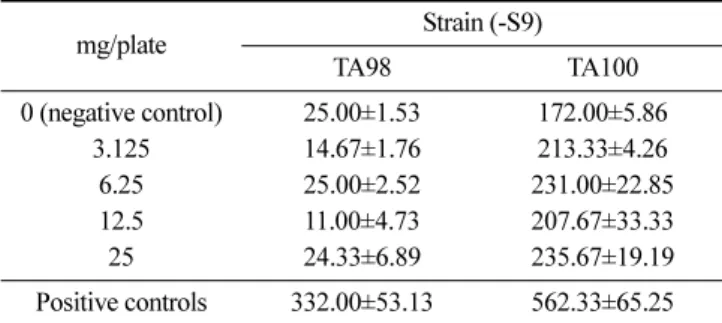
삼종실유의 지방산 함량 삼종실유 분석결과 주요 지방산은 올레산(oleic acid, 228 mg/g) 과 리놀레산(linoleic acids, 536 mg/g)이었다. 또한 총 53.2 mg의 gallic acid 당량(GAEs)/g의 페놀화합물과 72.8 쿼세틴 당량(QEs)/ g의 플라보노이드가 검출되었다(Table 1). 이 결과로부터 삼종실 유의 주요한 기능이 올레산과 리놀레산의 불포화지방산 함량이 높은 데서 기인함을 알 수 있으며, 이 외에도 삼종실유가 함유한 페놀화합물 및 플라보노이드 화합물이 건강기능성을 증진시키는 것으로 생각되어진다. MTT assay 먼저 삼종실유의 잠재적 세포독성을 평가하기 위해 MTT assay 를 시행하였다. MTT assay는 세포 내 미토콘드리아 효소에 의해 무색의 MTT가 보라색의 MTT-formazan crystal로 변색되는 원리 를 이용한 방법으로 광범위하게 사용되는 세포독성 시험법이다. MTT는 살아있는 세포에서만 대사작용을 하므로, MTT assay는 세포 사멸을 간단하고 효과적으로 측정할 수 있는 방법이다. 농도별 삼종실유(6.25-400 mg/mL)를 HepG2 배양세포계에 처리 한 후 37oC에서 24시간 배양하였다. 본 연구 결과 모든 처리 농 도의 삼종실유에서 세포성장 저해효과를 관찰할 수 없었으며(Fig. 1), 이로부터 삼종실유가 간조직 배양세포계에서 세포성장에 영 향을 주지 않는 안전한 식품소재임을 확인할 수 있었다. Ames test 삼종실유는 항산화, 항고지혈 효과 등의 건강기능을 가지고 있 어 잠재적인 기능성 물질로 평가 받고 있으나 삼종실유의 독성 에 대한 연구가 보고된 바 없다. 따라서 본 연구진은 Salmonella TA98과 TA100균주를 이용한 Salmonella 돌연변이는 테스트로 삼 종실유의 돌연변이 효과를 실험하였다. 결과는 Table 2와 Table 3 에 나타내었다. 간조직 대사 활성제인 S9 mixture의 존재 유무와 무관하게 대조군의 양성 colony수는 정상범위 이내였으며, 삼종 실유 첨가에 의한 conoly 수의 증가도 나타나지 않았다. 삼종실 유를 첨가한 간조직 대사활성제 처리군 및 비처리군 모두 TA98 과 TA100 균주를 이용한 실험에서 conoly수의 유의적인 차이를 보이지 않았으나, 양성대조군의 경우 유의적인 증가를 나타내었 다. 본 연구결과 삼종실유는 각각 frameshift 및 base-pair substi-tution에 의한 히스티딘 영양요구체 균주인 S. Typhimurium TA98 균주와 TA100균주를 정상종으로 전환하는 돌연변이를 유발하지 않음을 확인할 수 있었으며 이러한 결과로 인해 삼종실유가 식 품소재로 안전하다는 실험적 증거를 추가적으로 확보할 수 있었다. Table 1. Composition of hemp seed oilFatty acids (mg/g)
Palmitic acid methyl ester 101.5 Stearic acid methyl ester 33.6 Oleic acid methyl ester 228.1 Linoleic acid methyl ester 536.1 Linolenic acid methyl ester 94.1
Total fatty acids 993.3
Total phenolics and flavonoids
Polyphenolics (mg GAEs1)/g extract) 53.2 Flavonoids (mg QEs2)/g extract) 72.8 General components (%)
Crude protein 0.9
Crude fat 99.1
Carbohydrate 0.0
1)gallic acid equivalents 2)quercetin equivalents
Fig. 1. Cell viability after hemp seed oil treatment in HepG2 cells. Cell viability was assessed with MTT assay described in Method section. Results are presented as a percentage of absorbance relative to controls (concentration 0, 100%). The data are means± standard errors (n=3 per group).
Table 2. Summary of revertants with HO without metabolic activation mg/plate Strain (-S9) TA98 TA100 0 (negative control) 25.00±1.53 172.00±5.86 3.125 14.67±1.76 213.33±4.26 6.25 25.00±2.52 231.00±22.85 12.5 11.00±4.73 207.67±33.33 25 24.33±6.89 235.67±19.19 Positive controls 332.00±53.13 562.33±65.25
Mean±standard error of three plates.
2NF, positive control for TA98; NaN3, positive control for TA100.
Table 3. Summary of revertants with HO with metabolic activation mg/plate Strain (+S9) TA98 TA100 0 (negative control) 24.33±2.40 204.33±2.19 3.125 24.00±6.66 203.33±0.67 6.25 19.67±2.73 177.67±8.29 12.5 23.67±6.89 252.00±5.03 25 19.33±4.37 181.67±7.97 Positive controls 142.00±31.79 421.33±8.51
Mean±standard error of three plates. 2AA, positive control for bacteria.
또한 간조직 대사활성제인 S9 mixture를 처리하지 않은 조건 에서 2NF(TA98균주)와 NaN3(TA100균주)의 처리에 의한 돌연변
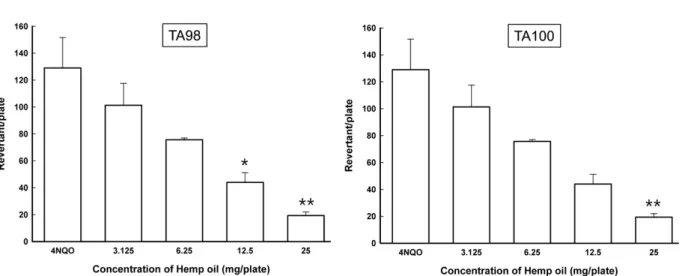
이능을 크게 감소시켰으며, S9 mixture를 처리한 실험에서 2AA(TA98 및 TA100균주)에 대한 항돌연변이 효과를 나타내었 다. 모든 시험 농도에서 삼종실유는 TA98균주와 TA100균주에 대 한 돌연변이능을 보이지 않았다. 추가적으로 본 연구팀은 4NQO에 대한 항돌연변이 테스트를 수행하였다(Fig. 2). 삼종실유의 돌연변이 저해율은 농도의존성인 결과를 뚜렷이 보였으며(TA98: 20.87-90.63%; TA100: 21.27-84.65%), TA98 균주에 대한 저해율이 TA100 균주보다 우수하였 다. 그러나 삼종실유를 저농도로 처리했을 경우 항돌연변이 효과 는 TA98 균주에서 더 낮게 나타났다. 이 실험 결과 삼종실유가 TA98과 TA100 균주에 대해서 강한 항돌연변이 효과를 나타냄을 알 수 있었다(Fig. 2).
Tognolini 등(22)은 삼(Cannabis sativa)는 monoterpenes, ses-quiterpenes 및 phenols과 같은 생리활성 물질은 함유하고 있다고 보고한 바 있는데, 삼종실유가 나타내는 항돌연변이 효과는 이러 한 터펜계열 화합물에서 기인하는 것으로 생각되어진다. 이전에 발표된 연구결과에 의하면 Monoterpenes, sesquiterpenes 및 phe-nols이 세포계 및 동물실험에서 항돌연변이 효과를 나타낸다고 보고되어 있다(23-27). 또한 다른 많은 연구결과에서 이들 화합물 이 항산화효과를 나타낸다고 보고하고 있으며, 이로 인해 항돌연 변이 효과를 유발할 수 있다는 연구결과도 보고되어있다(28-31). 따라서, 본 연구에서 밝혀진 삼종실유의 항돌연변이 효과는 삼종 실에 존재하는 터펜계열 화합물에 기인하는 것으로 생각 되며, 다른 연구자의 보고와 같이, 이러한 효능은 항산화 효과와 관련 이 깊은 것으로 사려된다.
본 연구결과 삼종실유는 S. Typhimurium strain TA98 및 TA100에 대한 돌연변이를 유발하지 않으며, 이러한 Ames test결 과 안전한 식품소재라 할 수 있다. 아울러 삼종실유가 항돌연변 이능을 가지는 것으로 보아 이러한 안전성과 건강기능성을 활용 한 식품소재로서 사용될 수 있을 것으로 사료된다.
감사의 글
본 연구는 농림수산식품부에서 시행한 농림기술개발사업 (project no.S120909L130110)의 연구비 지원에 의해 수행된 과제로 이에 감사 드립니다.문
헌
1. Oomah BD, Busson M, Godgrey DV, Drover JCG. Characteristics of hemp (Cannabis sativa L.) seed oil. Food Chem. 76: 33-43 (2002)
2. Wang XS, Tang CH, Yang XQ, Gao WR. Characterization, amino acid composition and in vitro digestibility of hemp (Cannabis sativa L.) proteins. Food Chem. 107: 11-18 (2008)
3. Saclik K, Ozturk R, Keskin R. Some physical properties of hemp seed. Biosystems Eng. 86: 191-198 (2003)
4. Tang CH, Wang XS, Yang XQ. Enzymatic hydrolysis of hemp (Cannabis sativa L.) protein isolate by various proteases and anti-oxidant properties of the resulting hydrolysates. Food Chem. 114: 1484-1490 (2009)
5. Arni P, Luth A, Deparade E, Muller D. Studies of the metaboliz-ing effect of the S9 liver fraction, hepatic microsomes and microsomal supernatant in the Ames test. Mutat. Res. 74: 154-154 (1980)
6. Peak MJ, Dornfeld SS, Venters D. Liver-microsome S9 enzyme increases spontaneous background mutation frequency in the Ames Salmonella test system in the absence of any added mutagen. Mutat. Res. Lett. 103: 263-265 (1982)
7. Rivrud GN. Mutagenicity testing of seminal fluid: Seminal fluid increases the mutagenicity of the precursor mutagen benzo[a]pyrene in the presence of S9 mix. Mutat. Res. Lett. 208: 195-200 (1988)
8. Roldan-Arjona T, Ruiz-Rubio M, Pueyo C. Influence of S9 mix on the expression of mutants in the l-arabinose resistance test of Salmonella Typhimurium. Mutat. Res. Lett. 243: 303-308 (1990) 9. Maron DM, Ames BN. Revised methods for the Salmonella
mutagenicity test. Mutat. Res. 113: 173-215 (1983)
10. Mortelmans K, Zeiger E. The Ames Salmonella/microsome mutagenicity assay. Mutat. Res. 455: 29-60 (2000)
11. Connor TH, Sadagopa-Ramanunjam VM, Rinkus SJ, Legator S, Norman M, Trieff M. The evaluation of mutagenicities of 19 structurally related aromatic amines and acetamides in Salmonella Typhimurium TA98 and TA100. Mutat. Res. 118: 49-59 (1983) 12. Dionigi CP, Lawlor TE, McFarland JE, Johnsen PB. Evaluation
of geosmin and 2-methylisoborneol on the histidine dependence of TA98 and TA100 Salmonella Typhimurium tester strains. Water Res. 27: 1615-1618 (1993)
13. Haack T, Erdinger L, Boche G. Mutagenicity in Salmonella Typh-imurium TA98 and TA100 of nitroso and respective hydroxy-lamine compounds. Mutat. Res. 491: 183-193 (2001)
14. Ipek E, Zeytinoglu H, Okay S, Tuylu BA, Kurkcouglu M, Baser KHC. Genotoxicity and antigenotoxicity of Origanum oil and carvacrol evaluated by Ames Salmonella/microsomal test. Food Chem. 93: 551-556 (2005)
15. Sargent AW, Regnier AP. Fluctuation test data on
4-chloromethyl-Fig. 2. Antimutagenic effect of hemp seed oil against 4-nitroquinoline 1-oxide (4NQO). The 4NQO was included 0.15 g per plate. *p<0.05, **p<0.01.
biphenyl (4CMB), 4-hydroxymethylbiphenyl (4HMB), and benzyl chloride (BC) using Salmonella Typhimurium TA98 and TA100. Mutat. Res. 100: 87-90 (1982)
16. Vaughan DJ, Baptista JA, Perdomo GR, Krepinsky JJ. The involvement of dimethyl sulfoxide in a bacteriotoxic response of the Ames assay tester strains TA98 and TA100. Mutat. Res. Lett. 226: 39-42 (1989)
17. Zhang Z, Che W, Liang Y, Wu M, Li N, She Y, Liu F, Wu D. Comparison of cytotoxicity and genotoxicity induced by the extracts of methanol and gasoline engine exhausts. Toxicol. in Vitro 21: 1058-1065 (2007)
18. Khatwora E, Adsul VB, Kulkarni MM, Deshpande NR, Kashalkar RV. Spectroscopic determination of total phenol and flavonoid contents of Ipomoea carnea. Int. J. Chem. Tech. Res. 2: 1688-1701 (2010)
19. Ames BN, McCann J, Yamasaki E. Methods for detecting carcin-ogens and mutagens with the Salmonella/mammalian-microsome mutagenicity test. Mutat. Res. 31: 347-364 (1975)
20. Verschaeve L, Van Staden J. Mutagenic and antimutagenic prop-erties of extracts from South African traditional medicinal plants. J. Ethnopharmacol. 119: 575-587 (2008)
21. Wang LE, Hsu TC, Xiong P, Strom SS, Duvic M, Clayman GL, Weber RS, Lippman SM, Goldberg LH, Wei Q. 4-Nitroquinoline-1-oxide-induced mutagen sensitivity and risk of nonmelanoma skin cancer: a case-control analysis. J. Invest. Dermatol. 127: 196-205 (2007)
22. Tognolini M, Barocelli E, Ballabeni V, Bruni R, Bianchi A, Chi-varini M, Impicciatore M. Comparative screening of plant essen-tial oils: Phenylpropanoid moiety as basic core for antiplatelet activity. Life Sci. 78: 1419-1432 (2006)
23. Gardeli C, VassilikiI P, Athanasios M, Kiboutis T, Komaitis M. Essential oil composition of Pistacia lentiscus L. and Myrtus communis L.: Evaluation of antioxidant capacity of methanolic extracts. Food Chem. 107: 1120-1130 (2008)
24. Grabmann J, Hippeli S, Spitzenberger R, Elstner EF. The monot-erpene terpinolene from the oil of Pinus mugo L. in concert with -tocopherol and -carotene effectively prevents oxidation of LDL. Phytomedicine 12: 416-423 (2005)
25. Ng TB, Liu F, Lu Y, Cheng CHK, Wang Z. Antioxidant activity of compounds from the medicinal herb Aster tataricus. Comp. Biochem. Phys. C 136: 109-115 (2003)
26. Singh HP, Mittal S, Kaur S, Batish DR, Kohli RK. Chemical composition and antioxidant activity of essential oil from residues of Artemisia scoparia. Food Chem. 114: 642-645 (2009)
27. Tepe B, Sihoglu-Tepe A, Daferera D, Polissiou M, Sokmen A. Chemical composition and antioxidant activity of the essential oil of Clinopodium vulgare L. Food Chem. 103: 766-770 (2007) 28. Fragoso V, Nascimento NACD, Moura DJ, Silva ACRE, Richter
MFI, Saffi J, Fett-Neto AG. Antioxidant and antimutagenic prop-erties of the monoterpene indole alkaloid psychollatine and the crude foliar extract of Psychotria umbellata Vell. Toxicol. in Vitro 22: 559-566 (2008)
29. Marin-Martinez R, Veloz-Garc R, Veloz-Rodriguez R, Guzman-Maldonado SH, Loarca-Pina G, Cardador-Martinez A, Guevara-Olvera L, Miranda-Lopez R, Torres-Pacheco I, Perez CPE, Her-rera-Hernandez G, Villasenor-Ortega F, Gonzalex-Chavira M, Guevara-Gonzalez RG. Antimutagenic and antioxidant activities of quebracho phenolics (Schinopsis balansae) recovered from tan-nery wastewaters. Bioresource Technol. 100: 434-439 (2009) 30. Rocha-Guzm NE, Herzog A, Gonzalez-Laredo RF, Ibarra-Perez
FJ, Zambra-Galv G, Gallegos-Infante JA. Antioxidant and antimu-tagenic activity of phenolic compounds in 3 different colour groups of common bean cultivars (Phaseolus vulgaris). Food Chem. 103: 521-527 (2007)
31. Shon MY, Choi SD, Kahng GG, Nam SH, Sung NJ. Antimu-tagenic, antioxidant and free radical scavenging activity of ethyl acetate extracts from white, yellow, and red onions. Food. Chem. Toxicol. 42: 659-666 (2004)