Anti-Helicobacter pylori Activity of Methanol Extracts from Korean Native Plant Species in Jeju Island
Hyun-Kyung Lee, Haeng-Byoung Lee, Cheol-Soo Kim1 and Young-Joon Ahn*
School of Agricultural Biotechnology, Seoul National University, Seoul 151-742, Korea
1Halla Botanical Garden, Jeju City, Jeju 690-816, Korea Received April 19, 2004; Accepted June 10, 2004
The antibacterial activity of methanol extracts from 124 Korean native plant species in Jeju Island toward Helicobacter pylori ATCC 43504 was examined using a paper disk diffusion bioassay and compared with those of the widely used antibiotics amoxicillin, metronidazole, and tetracycline. At 1 mg · disk−1, potent antibacterial activity (zone diameter, ≥20 mm) was obtained from methanol extracts from the leaves of Elaeocarpus sylvestris var. ellipticus, Juglans sinensis, Ligularia fisheri, Magnolia sieboldii, Platycarya strobilacea, Rhus succedanea, Rhus trichocarpa, Sapium japonicum, Saururus chinensis, and Styrax japonica. At 0.01 mg · disk−1, L. fischeri and S. chinensis leaf extracts were more effective toward H. pylori than metronidazole but less active than amoxicillin and tetracycline. These plants described merit further study as potential antibacterial agents for H. pylori.
Key words: Helicobacter pylori, natural antibacterial agent, Korean plants, Ligularia fisheri, Saururus chinensis
In humans, Helicobacter pylori is a microaerophilic Gram- negative bacterium that colonizes the stomachs of an estimated half of the worlds populations.1) H. pylori infection is highly associated with a number of the most important diseases of the upper gastrointestinal tract including gastric inflammation, chronic superficial gastritis, duodenal and gastric ulcers, gastric adenocarcinoma, and non-Hodgkins lymphomas of the stomach.1-3) In developing countries, 70- 90% of population carries H. pylori, whereas the prevalence of infection in developed countries is lower, ranging from 25 to 50%.3) Most infections by H. pylori are acquired in childhood and persist lifelong if not eradicated properly. The eradication of H. pylori infection is primarily dependent on continued applications of triple therapies consisting of mixture of two antibiotics such as amoxicillin, clarithromycin, and/or metronidazole with bismuth or a proton pump inhibitor, which are still the most effective drugs.1) Repeated use of chemical drugs has sometimes resulted in the development of resistance1,4-6) and has undesirable effects on nontarget organisms such as intestinal microorganisms.7,8) These problems have highlighted the need for the development of new strategies for selective H. pylori eradication.
Plants, particularly higher plants, may be an alternative source of materials for H. pylori eradication because they constitute a potential source of bioactive chemicals.9) Because of this, much effort has been focused on plant extracts or phytochemicals as potential sources of commercial anti-H.
pylori agents. Little work has been done in relation to anti-H.
pylori activity of Korean native plants in Jeju Island, where is a volcanic island located in the southwest sea of the Korean Peninsula (between Long. 126'10" and 126'58", Lat. 33'12"
and 33'34") and the North Sea of east part of China, and is a subtropical distribution of plants caused by the oceanic climate and the subtropical climate.
This paper describes a laboratory study to assess the potential of plant extracts for use as commercial antibacterial agents. Anti-H. pylori activity of methanol extracts from 124 plant species in 52 families collected in Jeju Island was assessed and compared with those of the widely used antibiotics amoxicillin, metronidazole, and tetracycline.
Materials and Methods
Helicobacter pylori strain. H. pylori ATCC 43504 was obtained from the American Type Culture Collection (ATCC) (Rockville, MD, USA). Stock cultures of the strain were routinely stored at −60oC on Brucella broth (Difco, Detroit, MI, USA) containing 5% bovine calf serum (Hyclone, Longan, UT, USA) and 20% glycerol.
Plants and sample preparation. Leaves of a total of 124 plant species in 52 families were collected at Halla Botanical Garden in Jeju Island in mid-June 2001 and are listed in Table 1. Voucher specimens (HBG-1 to HBG-124) were deposited at the herbarium of Halla Botanical Garden. They were dried in an oven at 40oC for 2 days and finely powdered. Each 50 g sample of test plants was extracted with 300 ml of methanol twice at room temperature for 2 days and filtered. The combined filtrate was concentrated to dryness by rotary
*Corresponding author
Phone: +82-2-880-4702; Fax: +82-2-873-2319 E-mail: [email protected]
Table 1. List of 124 plant species collected in Jeju Island for anti-H. pylori activity
Family Plant speciesa Family Plant speciesa
Aceraceae Acer mono Neolitsea aciculate
Acer pseudo- sieboldianum Neolitsea sericea
Anacardiaceae Rhus succedanea Liliaceae Allium schoenoprasmum var. orientale
Rhus trichocarpa Lythraceae Lagerstroemia indica
Apocynaceae Trachelospermum asiaticum Magnoliaceae Cinnamomum camphora
Aquifoliaceae Ilex crenata Kadsura japonica
Ilex crenata var. microphylla Magnolia denudata
Ilex integra Magnolia sieboldii
Ilex rotunda Malvaceae Hibiscus hamabo
Araliaceae Acanthopanax koreanum Moraceae Broussonetia papyrifera
Asteraceae Aster spathulifolius Myricaceae Myrica rubra
Farfugium japonicum Myrtaceae Callistemon citrinus
Ligularia fischeri Oleaceae Chionanthus retusus
Balsaminaceae Meliosma oldhamii Fraxinus rhynchophylla
Betulaceae Carpinus cordata Ligustrum japonicum
Carpinus coreana Ligustrum lucidum
Carpinus laxiflora Pinaceae Pinus koraiensis
Corylus hallaisanensis Ranunculaceae Paeonia suffruticosa
Corylus sieboldiana Rhamnaceae Paliurus ramosissimus
Ostrya japonica Sageretia theezans
Caprifoliaceae Lonicera maackii Rosaceae Amelanchier asiatica
Lonicera praeflorens Geum japonicum
Sambucus sieboldiana Kerria japonica for. plena
Viburnum awabuki Potentilla fragarioides var. major
Celastraceae Euonymus alatus Pourthiaea villosa
Cornaceae Cornus controversa Prunus leveilleana
Cornus macrophylla Prunus sargentii
Cornus walteri Prunus yedoensis
Elaeagnaceae Elaeagnus maritime Rhaphiolepis umbellate
Elaeagnus submacrophylla Rosa maximowicziana
Elaeocarpaceae Elaeocarpus sylvestris var. ellipticus Rosa multiflora
Ericaceae Hugeria japonica Rubus coreanus
Rhododendron mucronulatum var. cliatum Sorbus alnifolia
Vaccinium bracteatum Sorbus alnifolia var. hirtella
Euphorbiaceae Mallotus japonicus Rubiaceae Adina rubella
Daphniphyllum macropodum Rutaceae Evodia danielii
Sapium japonicum Phellodendron amurense
Fabaceae Albizzia julibrissin Zanthoxylum piperitum
Desmodium caudatum Salicaceae Populus maximowiczii
Lespedeza bicolor var. japonica Salix blinii
Maackia fauriei Sapindaceae Sapindus mukorossi
Fagaceae Castanopsis cuspidata var. sieboldii Saururaceae Saururus chinensis
Quercus acuta Saxifragaceace Ribes fasciculatum var. chinense
Quercus gilva Hydrangea macrophylla var. acuminata
Quercus glauca Staphyleaceae Euscaphis japonica
Quercus myrsinaefolia Staphylea bumalda
Quercus salicina Styracaceae Styrax japonica
Flacourtiaceae Idesia polycarpa Symplocaceae Symplocos prunifolia
Xylosma congestum Theaceae Cleyera japonica
Gramineae Phyllostachys pubescens Eurya japonica
Sasa borealis Ternstroemia japonica
Sasa coreana Tiliaceae Tilia taquetii
evaporation at 40oC.
Microbiological assay. H. pylori ATCC 43504 was incubated on Brucella agar supplemented with 5% bovine calf serum at 37oC for 3 days in a microaerobic atmosphere consisting of 80% N2, 15% CO2, and 5% O2 in anaerobic jars (Hirayama, Tokyo, Japan). Colonies were suspended in 10 ml of Brucella broth. The inoculum (0.1 ml) was prepared to contain 1 × 10⁷-8 CFU·l−1 by adjusting the turbidity of the suspension.
A paper disk diffusion bioassay was used for anti-H. pylori activity of the test materials. The plant samples were tested at doses of 5, 1, 0.5, 0.1, 0.05, and 0.01 mg·disk−1. A sample in 0.1 ml of methanol was applied by micropipette to paper disks (ADVANTEC, 8-mm diameter and 1-mm thickness, Toyo Roshi, Japan). After drying in a fume hood, the disks were placed on the Brucella agar surface inoculated with H. pylori.
All plates were incubated at 37oC for 3 days under microaerophilic conditions in anaerobic jars. Diameters of inhibition zones were recorded. Control disks received 0.1 ml of methanol. The antibiotics amoxicillin, metronidazole, and tetracycline (Sigma, St. Louis, MO, USA) served as standards for comparison in antibacterial activity tests. All tests of inhibition were replicated at least three times.
The antibacterial activity was classified as follows: very strong response, zone diameter ≥30 mm; strong response, zone diameter 21-29 mm; moderate response, zone diameter 16-20 mm; weak response, zone diameter 11-15 mm; and little or no response, zone diameter ≤10 mm.10)
Results and Discussion
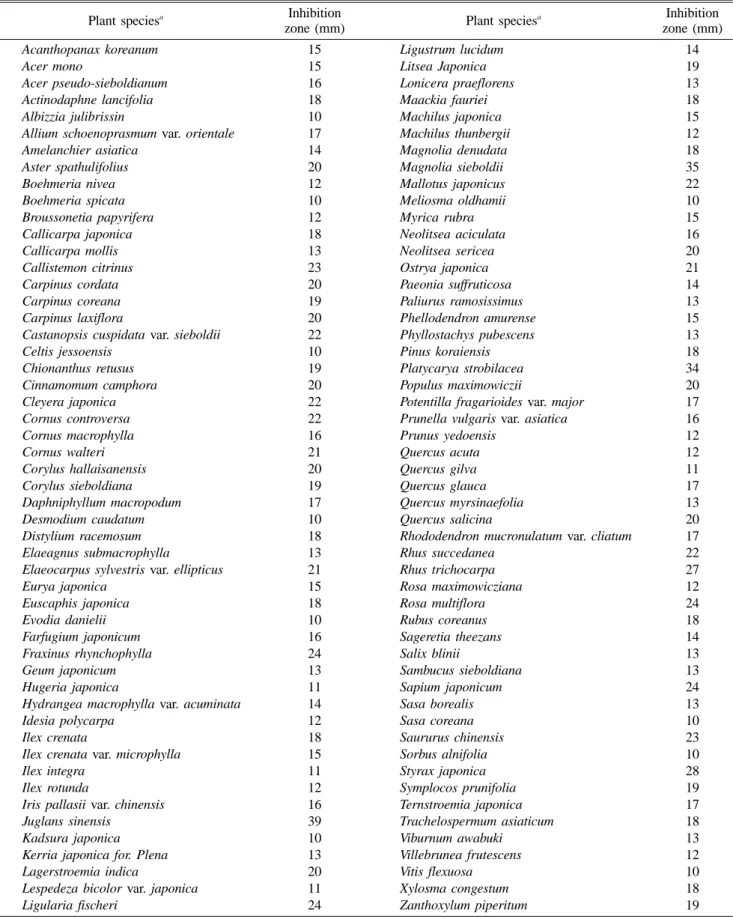
The antibacterial activity of 124 plant leaf extracts toward H. pylori was examined by the paper disk diffusion bioassay at 5 mg·disk-1 (Table 2). Very strong antibacterial activity was observed with methanol extracts from the leaves of Juglans sinensis, Magnolia sieboldii, and Platycarya strobilacea.
Strong antibacterial activity was observed with methanol extracts of 16 plant species. Moderate anti-H. pylori activity was obtained from 38 plant extracts, whereas the other 67 plant extracts showed weak or little antibacterial activity.
Because of the potent activity (zone diameter, ≥20 mm) of 27 plant extracts in Table 2, anti-H. pylori activity of the plants along with standard compounds amoxicillin, metronidazole, and tetracycline was examined at 1, 0.5, 0.1, 0.05, and 0.01 mg·disk−1 (Table 3). At 1 mg·disk−1, methanol extract of M.
sieboldii leaves exhibited very strong antibacterial activity toward H. pylori. Strong anti-H. pylori activity was obtained from methanol extracts from the leaves of J. sinensis, Ligularia fischeri, P. strobilacea, and Styrax japonica, whereas moderate antibacterial activity was oserved with Aster spathulifolius, Carpinus laxiflora, Elaeocarpus sylvestris var. ellipticus, Mallotus japonicus, Rhus succedanea, Rhus trichocarpa, Rosa multiflora, Sapium japonicum, and Saururus chinensis. At 0.1 mg·disk-1, moderate activity was observed with extracts from the leaves of L. fischeri and S. shinensis, whereas M. sieboldii leaf extract showed weak activity. The other 13 plant extracts showed no antibacterial activity. At 0.01 mg·disk-1, the leaf extracts of L. fischeri and S. chinensis were more effective toward H. pylori than metronidazole but less active than amoxicillin and tetracycline.
Plant extracts or phytochemicals have potential as natural products for H. pylori eradication because many of them are selective, often biodegrade to nontoxic products, and can be applied to humans in the same way as other conventional chemical drugs.11-14) Additionally, some plant-derived materials can be highly effective against drug resistant H.
pylori.15) Relatively few have been surveyed systematically to any extent for anti-H. pylori activity of Korean native plants in Jeju Island. It has been reported that the promising botanical anti-H. pylori agents are in the families Apiaceae (formerly Umbelliferae), Aristolochiaceae, Asteraceae (formerly Compositae), Cupressaeceae, Eucommiaceae, Fabaceae (formerly Leguminosae), Lamiaceae (formerly Labiatae), Lauraceae, Myristicaceae, Oleaceae, Palmae, Polygonaceae, Rutaceae, Solanaceae, and Zingiberaceae.10) In the present study, potent anti-H. pylori activity was observed for extracts from plants in the Anacardiaceae, Asteraceae, Betulaceae, Cornaceae, Elaeocarpacea, Euphorbiaceae, Fabaceae, Juglandaceae, Lythraceae, Magnoliaceae, Myrtaceae, Table 1. Continued
Family Plant speciesa Family Plant speciesa
Hamamelidaceae Distylium racemosum Ulmaceae Aphananthe aspera
Iridaceae Iris pallasii var. chinensis Celtis jessoensis
Juglandaceae Juglans sinensis Celtis sinensis var. japonica
Platycarya strobilacea Urticaceae Boehmeria nivea
Lamiaceae Prunella vulgaris var. asiatica Boehmeria spicata
Lardizabalaceae Stauntonia hexaphylla Urtica thunbergiana
Lauraceae Actinodaphne lancifolia Villebrunea frutescens
Litsea Japonica Verbenaceae Callicarpa japonica
Machilus japonica Callicarpa mollis
Machilus thunbergii Vitaceae Vitis flexuosa
aLeaves were sampled.
Table 2. Anti-H. pylori activities of methanol extracts from the leaves of 124 plant species collected in Jeju Island using the paper disk diffusion bioassay, exposed at 5 mg · disk−1
Plant speciesa Inhibition
zone (mm) Plant speciesa Inhibition
zone (mm)
Acanthopanax koreanum 15 Ligustrum lucidum 14
Acer mono 15 Litsea Japonica 19
Acer pseudo-sieboldianum 16 Lonicera praeflorens 13
Actinodaphne lancifolia 18 Maackia fauriei 18
Albizzia julibrissin 10 Machilus japonica 15
Allium schoenoprasmum var. orientale 17 Machilus thunbergii 12
Amelanchier asiatica 14 Magnolia denudata 18
Aster spathulifolius 20 Magnolia sieboldii 35
Boehmeria nivea 12 Mallotus japonicus 22
Boehmeria spicata 10 Meliosma oldhamii 10
Broussonetia papyrifera 12 Myrica rubra 15
Callicarpa japonica 18 Neolitsea aciculata 16
Callicarpa mollis 13 Neolitsea sericea 20
Callistemon citrinus 23 Ostrya japonica 21
Carpinus cordata 20 Paeonia suffruticosa 14
Carpinus coreana 19 Paliurus ramosissimus 13
Carpinus laxiflora 20 Phellodendron amurense 15
Castanopsis cuspidata var. sieboldii 22 Phyllostachys pubescens 13
Celtis jessoensis 10 Pinus koraiensis 18
Chionanthus retusus 19 Platycarya strobilacea 34
Cinnamomum camphora 20 Populus maximowiczii 20
Cleyera japonica 22 Potentilla fragarioides var. major 17
Cornus controversa 22 Prunella vulgaris var. asiatica 16
Cornus macrophylla 16 Prunus yedoensis 12
Cornus walteri 21 Quercus acuta 12
Corylus hallaisanensis 20 Quercus gilva 11
Corylus sieboldiana 19 Quercus glauca 17
Daphniphyllum macropodum 17 Quercus myrsinaefolia 13
Desmodium caudatum 10 Quercus salicina 20
Distylium racemosum 18 Rhododendron mucronulatum var. cliatum 17
Elaeagnus submacrophylla 13 Rhus succedanea 22
Elaeocarpus sylvestris var. ellipticus 21 Rhus trichocarpa 27
Eurya japonica 15 Rosa maximowicziana 12
Euscaphis japonica 18 Rosa multiflora 24
Evodia danielii 10 Rubus coreanus 18
Farfugium japonicum 16 Sageretia theezans 14
Fraxinus rhynchophylla 24 Salix blinii 13
Geum japonicum 13 Sambucus sieboldiana 13
Hugeria japonica 11 Sapium japonicum 24
Hydrangea macrophylla var. acuminata 14 Sasa borealis 13
Idesia polycarpa 12 Sasa coreana 10
Ilex crenata 18 Saururus chinensis 23
Ilex crenata var. microphylla 15 Sorbus alnifolia 10
Ilex integra 11 Styrax japonica 28
Ilex rotunda 12 Symplocos prunifolia 19
Iris pallasii var. chinensis 16 Ternstroemia japonica 17
Juglans sinensis 39 Trachelospermum asiaticum 18
Kadsura japonica 10 Viburnum awabuki 13
Kerria japonica for. Plena 13 Villebrunea frutescens 12
Lagerstroemia indica 20 Vitis flexuosa 10
Lespedeza bicolor var. japonica 11 Xylosma congestum 18
Ligularia fischeri 24 Zanthoxylum piperitum 19
aPlants showing ≥10 mm of inhibition zone diameter are presented.
Oleaceae, Rosaceae, Salicaceae, Saururaceae, Styracaceae, and Theaceae.
Variation in H. pylori response to the extracts related to the same plant genus was observed (Tables 2 and 3). Of five Quercus species, Q. glauca and Q. salicina leaf extracts exhibited moderate anti-H. pylori activity at 5 mg·disk−1, whereas weak activity was observed with methanol extracts from the leaves of Q. acuta, Q. gliva, and Q. myrsinaefolia.
Similar differences in the response of H. pylori to two Callicarpa species (C. japonica and C. mollis), three Carpinus species (C. cordata, C. coreana, and C. laxiflora), three Cornus species (C. controversa, C. macrophylla, and C.
walteri), two Corylus species (C. hallaisanensis and C.
sieboldiana), four Ilex species (I. crenata, I. crenata var microphylla, I. integra, and I. rotunda), two Magnolia species (M. denudata and M. sieboldii), two Neolitsea species (N.
aciculate and N. sericea), two Rhus species (R. succedancea and R. trichocarpa), and two Rosa species (R. maximowicziana
and R. multiflora) were likewise observed. These results suggest that quantitative and/or qualitative chemical composition among the plant species may be different.
Differences in the antibacterial effects on H. pylori have been reported in the methanol extracts of two Angelica species (A.
tenuissima and A. gigas), two Artemisia species (A. capillaries and A. princeps var. orientalis), and two Artractylodes species (A. lancea and A. ovata).10)
Results of this study indicate that some plant extracts described herein could be good candidates for naturally occurring anti-H. pylori agents. For practical use of the plant extracts as novel antibacterial agents to proceed, further research is necessary to establish whether the anti-H. pylori activity is exerted in vivo after consumption of these materials by humans and to develop effective formulations for improving the antibacterial potency and stability in human gastrointestinal tract.
Table 3. Antibacterial activities of 27 selected plant leaf extracts and antibiotics toward H. pylori ATCC 43504 using the paper disk diffusion bioassay
Plant species
Inhibition zone (mm) Dose (mg/disk)
1 0.5 0.1 0.05 0.01
Aster spathulifolius 17 15 8
Callistemon citrinus 14 10 8
Carpinus cordata 8
Carpinus laxiflora 17 15 8
Castanopsis cuspidate var. sieboldii 14 12 8
Cinnamomum camphora 13 10 8
Cleyera japonica 13 8
Cornus controversa 11 8
Cornus walteri 11 9
Corylus hallaisanensis 11 9
Corylus sieboldiana 15 8
Elaeocarpus sylvestris var. ellipticus 20 19 8
Fraxinus rhynchophylla 14 11 8
Juglans sinensis 22 15 8
Lagerstroemia indica 12 8
Ligularia fischeri 22 20 20 20 16
Magnolia sieboldii 34 28 12 8
Mallotus japonicus 16 12 8
Platycarya strobilacea 23 16 8
Populus maximowiczii 13 12 8
Quercus salicina 8
Rhus succedanea 20 14 8
Rhus trichocarpa 20 13 8
Rosa multiflora 18 11 8
Sapium japonicum 20 16 8
Saururus chinensis 20 19 18 18 16
Styrax japonica 22 20 8
Amoxicillin 68 48 43
Metronidazole 16 14 8
Tetrcycline 63 30 21
Acknowledgments. This work was supported by grants from NaturoBiotech Co. Ltd. and the Ministry of Education and Human Resources Development for Brain Korea 21 Project of the Korean Government to YJA.
References
1. Dunn, B. E., Cohen, H. and Blaser, M. J. (1997) Helico- bacter pylori. Clin. Microbiol. Rev. 10, 720-741.
2. Blaser, M. J. (1992) Helicobacter pylori: its role in disease.
J. Clin. Infect. Dis. 15, 381-393.
3. Taylor, D. N. and Parsonnet, J. (1995) Epidemiology and natural history of H. pylori infections. In Infections of the Gastrointestinal Tract, Blaser, M. J., Smith, P. F., Ravdin, J., Greenberg, H. and Guerrant R. L. (eds.) pp. 551564, Raven Press, New York, USA.
4. Goddard, A. F. and Longan, R. P. H. (1996) Antimicrobial resistance and Helicobacter pylori. J. Antimicrob.
Chemother. 37, 639-643.
5. Graham, D. Y., de Boer, W. A. and Tytgat, G. N. (1996) Choosing the best anti-Helicibacter pylori theraphy: effect of antimicrobial resistance. Am. J. Gastroenterol. 91, 1072- 1076.
6. Karim, Q. N. and Logan, R. P. H. (1996) Emerging pat- terns of Helicobacter pylori (H. pylori) antimicrobial resis- tance In Europe. Gut 39, A51.
7. Ahn, Y. J., Park, S. J., Lee, S. G., Shin, S. C. and Choi, D.
H. (2000) Cordycepin: selective growth inhibitor derived from liquid culture of Cordyceps militaris against Clostrid-
ium spp. J. Agric. Food Chem. 48, 2744-2748.
8. Zoppi, G., Cinquetti, M., Benini, A., Bonamini, E. and Minelli, E. B. (2001) Modulation of the intestinal ecosys- tem by probiotics and lactulose in children during treat- ment with ceftriaxone. Curr. Ther. Res. Clin. E. 62, 418- 435.
9. Wink, M. (1993) Production and application of phytochemi- cals from an agricultural perspective. In Phytochemistry and Agriculture, van Beek, T. A. and Breteler, H. (eds.) pp.
171-213, Clarendon Press, Oxford, UK.
10. Lee, H. B., Lee, H. K. and Ahn, Y. J. (2003) Antibacterial activity of oriental medicinal plant extracts toward Helico- bacter pylori. Agric. Chem. Biotechnol. 46, 97-99.
11. Cowan, M. M. (1999) Plant product as antimicrobial agent.
Clin. Micorobiol. Rev. 12, 564-582.
12. Mitsher, L. A., Leu, R. P., Bathala, M. S., Wu, W. N., Beal, J. L. and White, R. (1972) Antimicrobial agents from higher plant. I: Introduction, rationale and methodology.
Lloydia 35, 157-166.
13. Fabry, W., Okemo, P. and Ansborg, R. (1996) Activity of East African medicinal plants against Helicobacter pylori.
Chemotherapy 42, 315-317.
14. Yesilada, E., Gurbuz, I. and Shibata, H. (1999) Screenning of Turkish anti-ulcerogenic folk remedies for Helicobacter pylor anti-activity. J. Ethnopharmacol. 66, 289-293.
15. Fukai, T., Marumo, A., Kaitou, K., Kanda, T., Terada, S.
and Nomura, T. (2002) Anti-Helicobacter pylori flavonoids from licorice extract. Life Sci. 71, 1449-1463.