200
J. Appl. Biol. Chem. 52(4), 200-204 (2009)
Article
냉동저장기간에 따른 멜론( Cucumis melo L.)의 생리활성 변화
조준구1·윤선주1·이은탁1·김태완2·권대준3*
1(주)바이오파머, 2안동대학교 식품생명공학과, 3아시아대학교 한약자원학과
Change of Biological Activity of Melon ( Cucumis melo L.)
according to Frozen Storage Period
Jun-Gu Cho
1, Sun-Joo Youn
1, Eun-Tag Lee
1, Tae-Wan Kim
2, and Dae-Jun Kwoen
3*1Biofarmer Co. Ltd, Gyeongsan, 712-714, Korea
2Department of Food Science & Biotechnology, Andong National University, Andong 760- 749, Korea
3Department of Oriental Medicine Resource, Asia University, Gyeongsan, 712-220, Korea Received July 6, 2009; Accepted December 1, 2009
The change of biological activities of melon were investigated during frozen storage. The total phe- nolic concentrations in melon juice and water extract were 296.25 and 433.25
µg/mL, respectively.
The total flavonoid contents in melon juice and water extract were 20.83 and 53.58
µg/mL, respec- tively. Antioxidant activities of melon juice and water extract were determined. The DPPH of water extract of melon (85.84%) was higher than the melon juice (60.58%). ABTS of melon juice and water extract were 94.50 and 99.30%, respectively. SOD-like activity and xanthine oxidase inhibi- tory activity of melon of water extracts were higher than those of melon juice.
α-Glucosidase inhib- itory activity of melon juice and water extract were 22.42 and 23.43%, respectively. The changes in the antioxidant activity of melon was insignificant until 6 months of frozen storage. Therefore, it was expected that frozen storage of melon was useful preservation expedient for consistent sup- ply of raw materials.
Key words: antioxidant activity, frozen storage, α-glucosidase inhibitory activity, melon
서 론
현대인들은연장된수명만큼이나건강하게살려고하는욕구 가점차로높아지고있으며, 이를반영하는사회현상으로건강 기능성 식품의 소비가 지속적으로 늘고 있다[Albertazzi 등,
2002]. 그러나식생활의서구화, 스트레스등으로인해여러가
지만성질병에위협을받고있으며, 다양한원인의누적으로발
생하는 성인병은인체 내 활성산소의 생성과 관련이 있다는 연구가 보고되고 있다[Cross 등, 1987; Kedziora와 Bortosz, 1988; Sozmen 등, 1994].따라서 활성산소는 생체내에서 에너 지생산을위한산화과정중에상당량이 생성된다. 활성산소를 조절할수 있는항산화제에는 superoxide dismutase 등의효소 계열의 항산화제와 phenol성 화합물, ascorbic acid 등의 천연 항산화제와 BHA(butylated hydroxyanisole), BHT(butylated hydroxytoluence) 등의합성화제가있다. 그런데 지금까지합성
항산화제인 BHA와 BHT 등은탁월한 항산화 효과와 경제성
때문에널리사용되어왔으나, 안정성에논란이있어천연물로 부터인체에안전하고항산화력이높은물질을 분리이용하려 는 연구가 활발히 이루어지고 있다[Kang 등, 2005]. 멜론
(Cucumis melo L.)은박과의덩굴성한해살이식물로아프리카
가원산지이고, 중앙아시아, 지중해연안에서북유럽및인도로 전파되어재배되어왔으며, 멜론재배는 일본과달리 1980년대
이후참외형 멜론을필두로네트(net)가있는머스크멜론도보
급되고 있으나, 아직도 재배면적은 그리 넓지 않으며, 참외의 인기는여전하다. 서양에서분화된멜론과동양에서분화된참 외는 여러가지 면에서커다란차이가있으나, 상호교잡이가 능하여최근에는상호 교잡에의하여여러 가지품종이육성되
고있다[Kang, 2002]. 멜론은독특한향기와풍미로과채류중
에최고급으로취급되며, 고품질이요구되는작물이라할수있
다. 우리나라에서교배종멜론이재배되기시작한것은 1970년 대 말경으로매년재배면적이 증가하고있으며, 최근의경제
발전에 따른식생활의변화와 소비자의기호의 다양화에따라 서멜론의수요는갈수록증가될것으로예상되므로그에 따른 품종의 다양화와품질의 고급화와안정화가중요한 과제라할 수 있다[Kim 등, 1997; Jun 등, 2002]. 멜론은 참외와 비슷하
*Corresponding author
Phone: +82-53-602-1829; Fax: +82-53-602-1898 E-mail: [email protected]
doi:10.3839/jabc.2009.034
게 당질의 함량이 높고, 철분, 나이아신, 비타민A, 비타민C도 많이함유되어있고, 혈액의점도를낮추어주어심장병이나뇌
졸중을막아주는항응고제로효과가 크며항암효과가있는 β-
carotene이풍부하게들어있다. 멜론의품질은네트의발생양
상, 향기, 맛, 당도 등으로판단되는데그 중에서도맛과당도 가가장중요시되고있으며, 최근에는 보건적기능성을 나타내
는항산화 성분이과실품질로주목받고있다[Choi 등, 2007].
또한저온에서생육장애를일으킴으로인해오랫동안저장및 유통하지못하기 때문에 적절한 가공을 통한 저장성 향상및 다양한상품으로의개발방안이필요하다[Lee와 Kim, 2000]. 따 라서본 연구에서는멜론의가공방안을높이고, 출하기에대량 수매하여연중멜론의안정된수급과식품소재로 활용하기위 해냉동저장기간에따른항산화 활성을지표로하여생리활성 의변화를검토하였다.
재료 및 방법
재료및 시료의 추출
.
본 실험에 사용된 멜론은 경남 합천농협에서구매한것을 −20oC에서급속 냉동시킨후 −20oC에서 3, 6개월 냉동 저장하면서 실험에 사용하였다. 멜론의 껍질을 제거한후 500 g를파쇄하여, 멜론즙은 Whatman No. 2 여과지 로감압여과한후이여액을시료로이용하였고, 열수추출물은
100oC에서 3시간추출하여각각 500 mL로정용하여사용하였다.
총
phenol
성물질 함량측정.
추출된각 phenol성물질의함량측정은 Rhee 등[1981]의 방법에준하여측정하였다. 즉, 각
phenol성시료용액 0.2 mL에 2% Na2CO3 2 mL를가하여충분
히 혼합하고 2분후에 50% Folin-Ciocalteu’s reagent 0.2 mL를
가하여 상온에서 30분 동안 방치한 후 750 nm에서 흡광도를
측정하였다. 함량은 gallic acid(0.5 mg/mL)를 표준물질로 이용 하여작성한표준곡선으로부터구하였다.
총
flavonoid
물질 함량측정.
총플라보노이드 함량은시료용액 1 mL에 diethylene glycol 10 mL, 1 N NaOH 1 mL를 넣고강하게진탕한후 37oC 항온기에서 1시간정치한후 420 nm에서흡광도를측정하였다. 총플라보노이드함량은 naringin
(0.5 mg/mL)을 표준물질로사용하여표준곡선을통하여계산하
였다.
전자공여능
(DPPH radical
소거능)
측정.
추출물의전자공여능(Electron donating abilities, EDA)은 Blois [1958]의 방법을 변형하여측정하였다. 각시료용액 1 mL에 0.2 mM 1-diphenyl- 2-picrylhydrazyl (DPPH) 1 mL를 넣고교반한 후 30분간방치
한다음 517 nm에서흡광도를측정하였다. 전자공여효과는시
료용액의첨가구와무첨가구의흡광도감소율로나타내었다.
ABTS radical cation decolorization
측정.
ABTS radical cation decolorization의 측정은 Pellegrin 등[1998]의 방법에 의 해 측정하였다. 즉, 7 mM ABTS [2,2'-azinobis(3-ethylbenzo- thiazoline-6-sulfonic acid)] 5 mL와 140 mM K2S2O8 88µL를 섞은용액 1 mL와 ethanol 88 mL를 혼합한 ABTS 용액 1 mL와 시료용액 50µL를 혼합하여 30초간 진탕한 후 2.5분간 incubation하고 734 nm에서흡광도를측정하였다. ABTS radical cation decolorization 효과는 시료용액의실험구와대조구의흡
광도감소율로나타내었다.
Superoxide dismutase(SOD)
유사활성 측정.
SOD 유사활성은 Marklund [1974]의 방법에 따라 실시하였다. 각 시료용액
0.2 mL에 Tris-HCI의완충용액(50 mM Tris+10 mM EDTA, pH 8.5) 2.6 mL과 7.2 mM pyrogallol 0.2 mL 가하여 25oC에서 10
분간반응시킨후 1 N HCI 0.1 mL를가하여 반응을정지시키
고 반응액 중 산화된 pyrogallol의 양을 420 nm에서 측정하였
다. SOD 유사활성은시료용액의실험구와대조구의흡광도감
소율로 나타내었다.
Xanthine oxidase
저해활성 측정.
Xanthine oxidase 저해활성 측정은 Stirpe와 Corte [1969]의방법에따라 측정하였다. 각시 료 용액 0.1 mL와 0.1 M potassium phosphate buffer(pH 7.5) 0.6 mL에 xanthine(2 mM)을 녹인 기질액 0.2 mL를 첨가하고 xanthine oxidase(0.2 U/mL) 0.1 mL를 가하여 37oC에서 5분간반응시킨 후 1 N HCl 1 mL를 가하여 반응을 종료시킨다음
반응액 중에 생성된 uric acid를 흡광도 292 nm에서 측정하였 다. Xanthine oxidase 저해활성은시료용액의 첨가구와무첨가
구의흡광도감소율로나타내었다.
α
-Glucosidase
저해활성 측정.
각시료용액 0.1 mL에 0.3 U/mL의 α-glucosidase 효소액 0.1 mL, 0.1 M PBS buffer(PH 7.0) 0.5 mL에 넣고혼합하여 37oC에서 15분간반응시킨후 3 mM pNPG(Sigma, St. Louis, MO) 0.2 mL를 가하여 37oC에서
10분간반응시켰다. 0.1 M Na2CO3 0.5 mL를가하여반응을정
지시킨후 405 nm에서흡광도를측정하여저해율을계산하였다.
결과 및 고찰
총
phenol
성물질함량.
식물이함유하고있는총 페놀성물질(phenolic compound)의양은 항산화력의간접적인지표가된 다. 페놀성화합물은식물계에널리분포되어있는 2차대사산
물의하나로서다양한구조와분자량을가지며, 이들은 phenolic
hydroxy기를가지고있기때문에단백질등의 거대분자들과결
합하는성질을가지며, 항산화, 항균효과등의 생리활성기능을
가진다[Kuhnau, 1976]. 냉동기간에 따른멜론즙과 열수추출물
에 함유된 phenol 함량을측정한결과 Table 1과 같이열수추
출물이 433.25µg/mL인 반면 생과 멜론즙은 296.47µg/mL로 열수추출물의 phenol 함량이높게나타났다. 이는 3, 6개월냉
동저장한 멜론에도같은경향을보여주었고, 멜론의총 phenol
성물질은열수추출물이멜론즙보다다소많이함유되어있었다.
총
flavonoid
성 물질 함량.
또 다른 항산화력의 지표인 총 flavonoid성물질함량은 Table 1과같이 naringin으로표준곡선을구하여 계산하였다. 그결과멜론즙은 20.83µg/mL을 함 유하고있었고, 열수추출물은 53.58µg/mL를함유하고있어 열 수추출물의 함량이 높게 나타났으며, 냉동저장기간 동안
flavonoid성물질함량의변화는차이가없었다. 이것은열수추
출에의하여친수성의 flavonoid계물질이추출되어열을가하
지 않은 멜론즙보다 flavonoid성 물질 함량이 많은것으로 사 료된다.
전자공여능 확인
.
전자 공여능 측정에 사용된 DPPH(α,α- diphenyl-β-picrylhydrazyl)는 안정한자유라디칼로서그것의비202 조준구·윤선주·이은탁·김태완·권대준
공유전자로인해 517 nm 부근에서 최대흡광도를나타내며전
자또는수소를받으면 517 nm 부근에서흡광도가감소하며각
추출물에서이러한 라디칼을환원시키거나상쇄시키는 능력이 크면높은항산화활성및활성산소를비롯한 다른라디칼에 대한소거활성을기대할 수있으며인체내에서활성라디칼 에 의한노화를억제하는척도로도이용할 수 있다. 멜론즙과
열수추출물에 대한 DPPH radical 소거 활성을 측정한 결과는
Fig. 1과 같이멜론즙은 60.58%의 전자공여능을보였으며, 열
수추출물은 85.84%의전자공여능을보였다. 냉동저장기간이길 어질수록전자공여능은 차이는없었고, 열수추출물이멜론즙보
다 비교적 높게 나타났다. Kang 등[1996]은 전자공여능이
phenolic acids와 flavonoids 및 기타 phenol성 물질에 대한항 산화작용의지표라하였으며, 이러한물질은환원력이 큰것일 수록전자공여능이 높다고하였다. DPPH는 아스코르빈산, 토 코페롤, polyhydroxy 방향족 화합물, 방향족 아민류에 의하여
환원되어짙은자색이탈색됨으로써전자공여능의 차이측정이 가능하다. 따라서 항산화물질의 전자공여능을 측정할 때는
DPPH 법이편리하다고 알려져있으나, 색소가함유된 추출물
의경우 DPPH법의적용에는많은경험이요구된다.
ABTS radical cation decolorization
확인.
물질의 친수성및 소수성 물질의 항산화력을 측정하기 위해 ABTS radical cation decolorization을냉동기간에 따라측정한 결과 Fig. 2와 같이 생과멜론즙의 inhibition이 94.5%로 나타났고, 열수추출
물도 99.3%로높은 저해율을나타내었다. 멜론즙과열수추출물
은 저해율의차이뿐만아니라냉동기간에 따라변화가없었다.
따라서 멜론즙과열수추출물이 친수성및 소수성물질에대한 항산화력이우수한 것으로사료된다.
Superoxide dismutase (SOD)
유사활성 검증.
Superoxidedismutase(SOD)는항산화효소로서세포에해로운환원 산소종
을 과산화수소로 전환시키는 반응(2O2•−+2H+→H2O2+O2)을 촉
매하는효소이며, SOD에 생성된 H2O2는 peroxidase나 catalase
에의하여무해한물분자와산소분자로전환되어산소상해로부
터 생체를 보호하는 기능으로 알려져 있다[Pryor, 1986; Saul
등, 1987]. 따라서산화방지는 물론노화억제와도 밀접한관계
가있는것으로 알려져있는 SOD유사활성측정을 pyrogallol의 자동산화 반응을이용하여 조사하였다. 멜론즙의 경우거의효 과를 나타내지않았고, 열수추출물은 27.5%로멜론즙보다높은
SOD 유사활성을나타내었고, 냉동기간에따른 SOD 유사활성 의 차이는없었다(Fig. 3). 이는 Youn 등[2007]의딸기의 SOD
유사활성에서 딸기즙의 경우 32.5%, 딸기열수추출액의 경우
38.0%의 활성과 멜론의 열수추출물은 비교적 유사한 SOD-유
사활성을 나타내었지만, 멜론즙은 거의효과를 나타내지않아 전혀다른경향을보였다.
Xanthine oxidase
저해활성확인.
Xanthine oxidase는 purine대사에관여하는효소로서 xanthine 또는 hypoxanthine으로부터 uric acid를 형성하며 uric acid가 혈장 내에 증가되면 골절에 축적되므로 통증을 동반하는 통풍을 일으키는 효소로 알려져
Table 1. Total phenol and Total flavonoid contents of melon juice and water extract during storage age at −20oC Storage time
(months) Total phenol (µg/mL) Total flavonoid (µg/mL)
Melon juice Melon extract Melon juice Melon extract
0 302.92±12.78 433.25±20.17 23.27±3.40 55.21±2.00
3 302.07± 5.11 423.53±13.11 21.52±1.51 54.13±1.09
6 296.47± 8.78 420.15± 8.55 20.83±1.23 53.58±1.43
Values are mean±SD of triplicate experiments.
Fig. 2. ABTS radical cation decolorization of melon juice and water extract during storage age at −20oC. Values are mean±SD of triplicate experiments.
Fig. 1. Electron donating ability of melon juice and water extract during storage age at −20oC. DPPH free radical scavenging activity for test sample was determined with 0.2 mM DPPH ethanolic solution.
Values are mean±SD of triplicate experiments.
왔다[Jonnes, 1973; Kelly 와 Wyngarden, 1974; Storch와
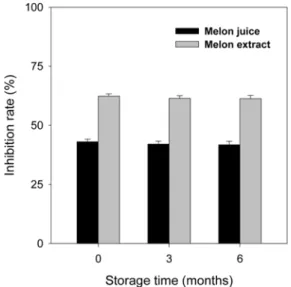
Ferber, 1988; Hatano 등, 1989]. Xanthine oxidase는 분자상의 산소를 수소(전자)수용체로 이용하여 xanthine을 uric acid형으 로산화하는반응을촉매하므로 xanthine oxidase의저해효과는 유리라디칼의생성억제와 더불어생물학적으로 중요한의의 를 가진다고할수 있다. 냉동저장기간에 따라멜론즙과열수 추출물의 xanthine oxidase의 저해활성을관찰한결과 Fig. 4와
같이 나타났다. 멜론즙의경우 41.76%의저해율을나타내었고,
열수추출물은 61.29%로 멜론즙보다 높은 저해율을 나타내었
고, 냉동기간에따라 xanthine oxidase의저해활성에큰차이가 없었다.
α-Glucosidase 저해효과. α-Glucosidase는 소장의 brush-
border membrane에 존재하는 소화효소이다. 이들은 이당류나
다당류는탄수화물이소화흡수되기위한상태인 단당류로가 수분해하는역할은 한다[Gua 등, 2006]. α-Glucosidase 저해제
는탄수화물식이 후혈당상승을올릴수있다. 그리하여냉동 기간에따른멜론즙과열수추출물의 α-Glucosidase 저해활성을
측정한 결과 Fig. 5와 같이 나타내었다. 생과 멜론즙의 경우
22.42%의 저해율을나타내었고, 열수추출물은 23.43%로 비교
적 유사한 저해율을 나타내었다. 또 냉동기간에 따른 α- Glucosidase 저해활성의차이는없었다.
초 록
멜론의 가공방안을 높이고, 안정된 수급과 식품소재로활용 하기위해냉동저장과추출방법에따른생리활성변화를조사 하였다. 냉동저장기간(3, 6개월)에 따른멜론의총 phenol 함량 은멜론즙이 296.25µg/mL, 열수추출물은 433.25µg/mL로나타 났다. 또한총 flavonoid성함량은 멜론즙이 20.83µg/mL로 나 타났고, 열수추출물은 53.58µg/mL로 나타났고, 냉동저장기간
동안 총 phenol 함량과 총 flavonoid성 함량은 비교적 차이가 없었다. 멜론의 항산화 효과는 전자공여능이 멜론즙과열수추
출물이 각각 60.58%, 85.84%로 나타났고, ABTS는 각각
94.50%, 99.30%로 높게나타났다. SOD 유사활성은 열수추출
물이 27.5%인 반면멜론즙의경우거의 효과를나타내지않았
다. Xanthine oxidase의 저해활성의경우멜론즙이 41.76%, 열 수추출물은 61.29%로높은저해율을나타내었고, 열수추출물이
다소 높게 나타났다. α-Glucosidase 저해활성은 멜론즙이
22.42%, 열수추출물은 23.43%로 비교적유사한저해율을 나타
내었다. 냉동기간에따른항산화효과는비교적차이가없었다.
이러한결과로냉동저장 시항산화활성의차이가거의 없음으 로연중 원료의안정적인수급과식품소재로활용이가능할것 으로사료된다.
Key words: 항산화활성, 냉동저장, α-glucosidase inhibitory activity, 멜론
Fig. 5. α-Glucosidase inhibition activity of melon juice and water extract during storage age at −20oC. Values are mean±SD of triplicate experiments.
Fig. 3. SOD-like activity of melon juice and water extract during storage age at −20oC. Values are mean±SD of triplicate experiments.
Fig. 4. Xanthine oxidase inhibition activity of melon juice and water extract during storage age at −20oC. Values are mean±SD of triplicate experiments.
204 조준구·윤선주·이은탁·김태완·권대준
참고문헌
Albertazzi P, Steel SA, Clifford E, and Bottazzi M (2002) Attitudes towards and use of dietary supplementation in a sample of postmenopausal women. Climacteric5, 374-382.
Blois MS (1958) Antioxidant determinations by the use of a stable free radical. Nature181, 1199-1202.
Choi YJ, Chun H, Choi YH, Yum SH, Lee SY, Kim HJ, Shin YS, and Chung DS (2007) Nutritional components content of oriental melon fruits cultivated under different greenhouse covering films. J Bio-Env Con16, 72-77.
Cross EE, Halliwell B, Borish ET, Pryor WA, Ames BN, Saul RL, and McCord JM (1987) Oxygen radicals and human disease.
Ann Intren Med 107, 536-545.
Gua J, Jin YS, Han W, Shim TH, Sa JH, and Wang MH (2006) Studies for component analysis, antioxidantive activity and α- glucosidase inhibitory activity from Equisetum arvense. J Korean Soc Appl Biol Chem49. 77-81.
Hatano T, Yasuhara T, Fukuda T, Noro T, and Okuda T (1989) Phenolic constituents of licorce. II. Structures of licopyranocoumarin, licoaryl-coumarin and glisoflavone, and inhibitory effects of licorice phenolics on xanthine oxidase. Chem Pharm Bull 37, 3005-3009.
Jonnes PH (1973) Iodinine as an antihypertensive agent. Ibid 3, 679-682.
Jun HJ, Kim DH, Hwang JG, and Choi MH (2002) Effects of foliar spray of magnesium sulfate on the quality of hydroponically grown melon (Cucumis melo L.). Life Sci Res
1, 50-56.
Kang IH, Cha JH, Han JH, Lee SW, Kim HJ, Kwon SH, Ham IH, Hwang BS, and Whang WK (2005) Isolation of antioxidant from domestic Crataegus pinnatifida Bunge leaves. Korean J Pharmacogn 36, 121-128.
Kang TS (2002) Studies of seed and fruit characteristics in melons (Cucumis melo L.). Research Collection of Institute of Life sciences & resources-Kyung Hee University. 22, 8-19.
Kang YH, Park YK, and Lee GD (1996) The nitrite scavenging and electron donating ability of phenolic compounds. Korean J Food Sci Technol28, 232-239.
Kedziora J and Bortosz G (1988) Down's syndrome: a pathway involving the lack of balance of reactive oxygen species. Free Radic Biol Med 4, 317-330.
Kelley WN and JB Wyngarden (1974) Enzymology of gout. Adv Enzymol Relat Mol Biol41, 1-33.
Kim MS, Chung HD, and Kim YK (1997) Inheritance of fruit color, and sugar and ascorbic acid content in melon (Cucumis melo L.). Korean J Breed Sci 29, 103-108.
Kuhnau J (1976) The flavonoids a class of semi-essential food components; their role in human nutrition. World Rev Nutr Diet
24, 117-120.
Lee HJ and Kim JG (2000) The changes of components and texture out of carrot and radish pickles during the storage.
Korean J Food Nutr13, 563-569.
Marklund S and Marklund G (1974) Involvement of the superoxide anion radical in the autoxidation of pyrogallol and a convenient assay for the superoxide dismutase. Eur J Biochem47, 469-474.
Pellegrin N, Roberta R, Min Y, and Catherine RE (1998) Screening of dietary carotenoids and carotenoid-rich fruit extract for antioxidant activites applying 2,2-azinobis(3- ethylenbenzothiazoline-6-sulfonic acid) radical cation decolorization assay. Method Enzymol 299, 379-389.
Pryor WA (1986) Oxy-radicals and related specied: their formation, lifetimes and reactions. Ann Rev Physiol 48, 657-667.
Rhee KS, Ziprin YA, and Rhee KC (1981) Antioxidant activity of methanolic extracts of various oilseed protein ingredient.
Korean J Food Sci46, 75-81.
Saul RI, Gee P, and Ames BN (1987) Free radicals. DNA damage, and aging, In Morden biological theoies aging, Warner HR, Butler RN, Sprott RL, and Schneider EL (eds.), pp. 113-129.
Raven Press, New York, NY, USA.
Sozmen EY, Tanyakin T, Onat T, Kufay F, and Erlacin S (1994) Ethanol-induced oxidative stress and membrane injury in rat erythrocytes. Eur J Clin Chem Clin Biochem32, 741-744.
Stirpe F and Corte ED (1969) The regulation of rat liver xanthine oxidase. J Biol Chem244, 3855-3861.
Storch H and Ferber E (1988) Detergent-amplified chemiluminescence of lucigenin for determination of superoxide anion production by NADPH oxidase and xanthine oxidase. Anal Biochem169, 262-267.
Youn SJ, Cho JG, Choi UK, andKwoen DJ(2007) Change of biological activity of strawberry by frozen storage and extraction method. J Life Sci17, 1734-1738.