Effects of Multi-mode Simulation Learning on Nursing Students' Critical Thinking Disposition, Problem Solving Process, and Clinical Competence
Ko, Eun1 · Kim, Hye Young2
1Department of Nursing, Nambu University, Gwangju
2College of Nursing, Chonbuk National University, Jeonju, Korea
Purpose: The purpose of this study was to identify the effects of multi-mode simulation learning on critical thinking disposition, on the problem solving process and on clinical competence of nursing students. Methods: A non- equivalent control group with pre-posttest was designed. The participants in this study were 65 students who were enrolled in an emergency and critical nursing course at N university. The treatment group consisted of 33 juniors in 2010 and the control group 32 juniors in 2011. Collected data were analyzed using chi-square, independent t-test, and ANCOVA with the SPSS/WIN 18.0 for Window Program. Results: There were significant increases in problem solving process and clinical competence in the treatment group who participated in the multi-mode simulation learning compared to the control group who did not (t=-2.39, p=.020; F=12.76, p=.001). However, there were no significant differences in critical thinking disposition between the treatment and control group (t=0.40, p=.692). Conclusion: Multi-mode simulation is an effective teaching and learning method to enhance the problem solving process and clinical competence of nursing students. Further exploration is needed to develop and utilize multi-mode simulation for diverse scenarios, depending on emergency nursing educational goals and environ- ments and to develop a universal method to measure outcomes.
Key Words: Patient simulation, Learning, Critical thinking, Problem solving, Clinical competence
Corresponding author: Kim, Hye Young
College of Nursing, Chonbuk National University, 20 GunJi-ro, Deokjin-gu, Jeonju 561-712, Korea.
Tel: +82-63-270-4618, Fax: +82-63-270-3127, E-mail: [email protected] Received: Aug 24, 2013 / Revised: Nov 18, 2013 / Accepted: Feb 15, 2014
INTRODUCTION
Since practical competency can determine the future of advanced practice nursing, clinical education is ex- tremely important (Gibbonset al., 2002). Through clin- ical practice, nursing students obtain professional nurs- ing knowledge and practical skills to deal with compli- cations, uncertainty, and conflicts in working situations, and learn to apply the critical thinking process to prob- lem solving (Yang, 2008). However the hospital envi- ronment nowadays has increased awareness for protect- ing the health rights of patients, and the importance of quality evaluations and safety at medical institutes is em- phasized, so there is less and less opportunities for nurs- ing students to actually perform nursing tasks on pati- ents. Cho & Kwon (2007) reported that from the overall nursing clinical practice course, only 12.0% of the nurs- ing activities, including nursing practice and professio- nal performance, were experienced by 70% or more of the nursing students. In addition, they reported that the
nursing activities with a high percentage of experience were simple and low risk activities even for students such as taking vital signs and ice pack therapy. Lee, Park, & Noh (2013) reported that from 180 students, 118 students observed urinary catheterization during the clinical practice period, and only 1 student performed the procedure. These results show the limitations of clinical practice in nursing, and it is considered that practice should be strengthened in schools and im- provement in the educational method is necessary for effective clinical practice.
Simulation-based learning is an educational course designed to simulate real clinical situations in a safe en- vironment (Cant & Cooper, 2010). It extends to wide- spread teaching and testing in many other healthcare fields. A high-fidelity simulator is a human simulator where the status of the subject can be objectively moni- tored in situations similar to clinical situations, and im- mediate response is possible regarding nursing inter- vention, so it is used in many nursing schools in simu-
lation-based learning (Rosen, McBride, & Drake, 2009;
Ryoo, Ha, & Cho, 2013). However, the initial cost for purchase is high, and there are problems such as secur- ing professional personnel to operate and manage the instrument, space to install the sound equipment and system, and cost to maintain the simulator (Seybert&
Kane-Gill, 2011). In addition, there are limitations such as the human simulator cannot accurately present symp- toms and changes as in actual clinical situations, so there is a need to consider integrating other teaching methods to heighten the reproducibility of clinical prac- tice (Hur et al., 2013). A standardized patient can be used as part of simulation-based learning, and actual communication is possible which is similar to real situ- ations. This enables students to be further immersed in the process and can help enhance their communication ability and interpersonal skills. In addition, compared to operating a human simulator, the cost is significantly lower. However, there are limits to creating various dis- ease situations or applying invasive nursing techniques such as injections or catheterization. The major principle of simulation-based learning is known that educational goals are to determine decisions about the acquisition and use of simulation technology for teaching and ex- amining (Isenberg, 2006). The effectiveness of simu- lation-based learning depends on a close match bet- ween education goals and simulation tools (McGaghie, Issenberg, Petrusa, & Scalese, 2010). Therefore, if a stan- dardized patient and medium or low-fidelity simulator are used together, it can be a cost effective teaching method which can utilize the advantages of standard- ized patients while overcoming various limitations of standardized patients, so this research investigated mul- ti-mode simulation in nursing education.
When precedent research regarding simulation-based learning is examined, most research used high-fidelity simulation when training nursing students or nurses, and there is only a small amount research on multi- mode simulation (Lee et al., 2010; Lee et al., 2013; Ryoo, Ha, & Cho, 2013). In addition, the applied scenarios were dyspnea of chronic obstructive pulmonary disease and asthma patients and advanced cardiac life support of acute coronary syndrome and myocardial infarction, which is different to foreign studies which applied sce- narios of emergency situations based on high authentic- ity such as septic shock and hypoxia (Lim, 2011). The results of simulation learning such as knowledge, skill, degree of satisfaction regarding practice, critical think- ing, problem solving skills, and confidence for learning can be utilized as teaching outcome indicators (Jeffries,
2005). Results from precedent studies reported that si- mulation-based education enhanced knowledge, nurs- ing clinical competency, and clinical competency (Kim
& Jang, 2011; Yang, 2008); however, there was no change in the problem solving process (Kim et al., 2012;
Kim & Jang, 2011; Lee & Hahn, 2011). Some studies re- ported that critical thinking disposition and problem solving skills increased (Ham, 2009; Hur et al., 2013) so the research results are not consistent.
Therefore, this study considered a condition for the simulation scenario in which immediate nursing inter- vention is required with this scenario being difficult for nursing students to perform the procedure in the clinical field (Ham, 2009). Hence, an emergency nursing scenar- io for a patient with upper gastrointestinal bleeding was developed, and multi-mode simulation learning was ap- plied to this scenario to verify the effect on critical think- ing disposition, problem solving process and clinical competence of the nursing students.
1. Purpose of the Study
The purpose of this study was to identify the effects of multi-mode simulation learning on critical thinking dis- position, problem solving process and clinical com- petence of nursing students.
2. Hypotheses of the Study
Hypothesis 1. The experimental group, who partici- pated in multi-mode simulation learning would show difference in critical thinking disposition compared to the control group.
Hypothesis 2. The experimental group, who partici- pated in multi-mode simulation learning would show difference in problem solving process compared to the control group.
Hypothesis 3. The experimental group, who partici- pated in multi-mode simulation learning would show difference in clinical competence compared to the cont- rol group.
3. Definition of terms
Multi-mode simulation is the combination of inani- mate models with standardized patient to provide a con- vincing learning environment. Standardized patient takes part in realistic quasi-clinical scenarios, where nursing procedures can be practiced on models attached to the standardized patient (Kneebone et al., 2002). In this
study, it means a simulation combining a standardized patient trained for an emergency care simulation scenario for upper gastrointestinal bleeding, and low-fidelity sim- ulators that included an adult venipuncture and injec- tion arm model and a female catheterization model.
METHODS
1. Study Design
This study was designed as a quasi-experimental study, using a nonequivalent control group and a pre- test-posttest design to identify the effects of multi-mode simulation learning on the critical thinking disposition, problem solving process and clinical competence of nursing students.
2. Participants
The participants of this research were juniors at a 4-year university located in G city, and the students had enrolled in ‘An emergency and critical nursing’ course in the second semester of the school year. These stu- dents had completed the theory class for gastrointestinal disorders in adult nursing during the second semester of the second year, and they had experienced ‘Adult nurs- ing practice’ course at medical-surgical nursing unit for 4 weeks during the first semester of the third year. But, they had no practical experiences in the emergency room or intensive care unit or previous learning experi- ences related to simulation. Neither did they have expe- riences of directly performing nursing techniques, such as urinary catheterization, intravenous injection, and oxygen therapy during their clinical practice period oth- er than basic nursing practice classes. In order to pre- vent spreading of the experiment, we assigned students who participated in 2010 to the experimental group and those who participated in 2011 to the control group. To determine the number of samples, G*power 3.1.3, a sample calculating program based on Cohen’s sampling formula, was used. As a result of calculating with a two- tailed significant level of ⍺=.05 for t-test, large effect size d=.80, and statistical power=.80, the minimum sam- ple number for each group was 26 (Faul, Erdfelder, Buchner, & Lang, 2009). As for the effect size, we set it to .80 for present study based on .80 of effect size of Hur and Park (2012)’s study, which was the closest to our study. At the beginning of the study, the experimental group size was 34 and the control group size was 34.
Excluding 3 students who gave insufficient answers to
the questionnaire, the final experimental group size was 33 and the control group size was 32, making 65 partic- ipants in total.,
3. Measurement
1) Critical thinking disposition
Critical thinking disposition was measured using a tool developed by Yoon (2004).E-mail approval was re- ceived from the original author (Yoon) for use of the tool. This tool contained a total of27 items with a 5-point scale: five questions about the intellectual eagerness/
curiosity, four questions about prudence, four questions about self-confidence, three questions about system- aticity, four questions about intellectual fairness, four questions about healthy skepticism and three questions about objectivity. The higher the score, the higher the level of critical thinking disposition. The Cronbach's ⍺ of this tool was .84 in Yoon’s study (2004) and .87 in this study.
2) Problem solving process
Problem solving process was measured using a tool developed by Woo (2000). This tool contained a total of 25 items with a 5-point scale: five questions about dis- covery of problem, five questions about definition of problem, five questions about designing problem sol- ution, five questions about running problem solution, and five questions about problem solution review. The higher the score, the higher the level of Problem solving process. The Cronbach's ⍺ of this tool was 90 in Woo’s study (2000) and .93 in this study.
3) Clinical competence
As for the evaluation of clinical competence, we used a tool, developed by Yang and Park (2004), by modify- ing and supplementing its contents to those related to nursing of upper gastrointestinal bleeding patients. E- mail approval was received from the original author (Yang) for use of the tool. By using 4-point scale of Index of Content Validity, we submitted it to a reliability examination of the tool’s contents executed by two adult nursing professors, one ER nurse, and one emer- gency medicine specialist, and all questions scored equal or above 3 points. The tool in question consisted of a total of 19 questions: 4 on nursing process, ability 4 on performing nursing interventions, 3 on psychosocial nursing, 3 on education for patients, 3 on basic nursing performance, and 2 on physical examination and pa- tient monitoring. Higher score signifies higher clinical
Preparation Pre-test Simulation running Post-test
Exp.
group ․ Development of scenario
․ SP training
․ Preparation of equipment
․ Critical thinking disposition
․ Problem solving process
․ Clinical competence
Prior learning
Multi-mode simulation learning:
A 48~year-old female patient with the chief complaint of severe abdominal pain and melena visited the emergen- cy room. She had history of peptic ulcer. Suddenly, pati- ent's blood pressure declin- ed and went into shock.
After providing emergency treatments, it is planned to perform gastroendoscopic li- gation.
Debriefing
․ Critical thinking disposition
․ Problem solving process
․ Clinical competence
Cont.
group Lecture on emergency care
Exp.=Experimental; Cont.=control; SP=standardized patient.
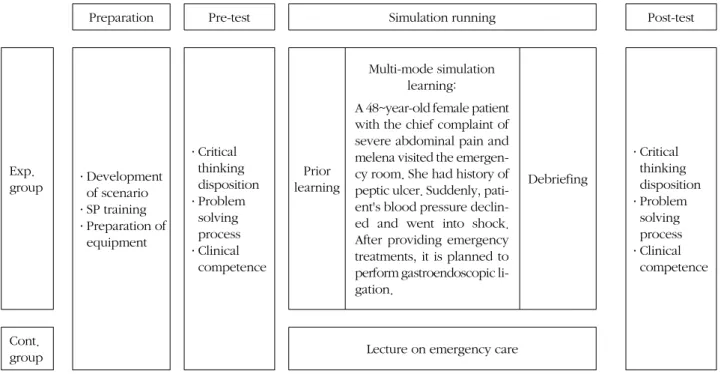
Figure 1. Research process.
competence. The validity of the original tool was Cron- bach's ⍺ value of .86 and the validity of this study was Cronbach's ⍺ value of .92.
4. Process
The process for this research was carried out in stages as follows: preparation, pretest, simulation running, and posttest (Figure 1).
1) Preparation
(1) Simulation scenario development
For scenario development, first the researchers of this study drew up a draft based on the upper gastrointes- tinal bleeding scenario of PNCI (Program for Nursing Curriculum Integration) provided by METI (Medical Education Technologies, Inc). Then, the content validity was verified by 2 professors of adult nursing, 1 professor of basic nursing, and 1 emergency room nurse from C University Hospital in G city with a Masters in nursing.
After modifications, the final scenario was developed.
The final scenario was on a 48-year-old female patient with a history of peptic ulcers who visited the emer- gency room with the chief complaint of severe abdomi- nal pain and melena. After visiting the hospital., bleed- ing became worse and blood pressure declined and the patient went into shock. After providing proper emer-
gency treatments to this patient, she was sent to the en- doscopic room for a gastroendoscopic ligation to con- trol bleeding from the upper gastrointestinal area.
(2) Standardized patient training
Based on the developed scenario and algorithm, a standardized patient training script was written up, and 1 standardized patient was recruited. The standardized patient was an ordinary citizen working as a teaching aid in a non-health care related department of our uni- versity, and there was no prior contact with the student participants of this study. The situation in the emer- gency room and practical room was explained to the standardized patient, and after the patient understood the training script of the standardized patient, prelimi- nary training was performed with the researcher and re- search assistant. During the preliminary training, the standardized patient was trained to describe the prob- lems from a patient’s perspective, and also to naturally respond to expected questions or behaviors. The train- ing time for the standardized patient was 2 hours per session for a total of 4 hours.
(3) Preparing facilities and equipment
Our university does not have a simulation practical room, so the station and 2 beds in the basic nursing practical room were used. A console, which enables
oxygen supply and absorption, and an oxygen satu- ration monitor were located next to the bed. The stand- ardized patient in a hospital gown was in a supine posi- tion on the bed and the venipuncture and injection arm model was put next to the patient’s left arm. The female catheterization model was covered with linen and put under the legs of the standardized patient so the models could be used when the students practiced. Two beds were used so when the practical of one group finished another group could start immediately on the other bed.
This was to reduce the amount of waiting time spent by students before and after simulation practice. At the bed station, there were anon per os (NPO) sign, oxygen ap- paratus, oxysensor, articles for practicing intravenous injection and catheterization, and a recording sheet for doctor prescriptions and nursing records. In addition, a camcorder was prepared so a research assistant could record the simulation practice process.
2) Pretest
A questionnaire regarding critical thinking disposi- tion, problem solving process, and clinical competence was received from the experiment group 2 weeks be- fore conducting the simulation practice, which was im- mediately after the midterm exams for the emergency and critical patient nursing course. The same ques- tionnaire was received from the control group immedi- ately after the midterm exams for the emergency and critical patient nursing course.
3) Simulation running (1) Prior learning
2 weeks before conducting the simulation for upper gastrointestinal bleeding in a patient, student guidelines containing the scenario outline, patient outline, pre- requisite nursing skills and nursing knowledge were dis- tributed to the students to study. One week before the simulation, the practical room was opened to the stu- dents to practice skills such as urinary catheterization, intravenous injection, and oxygen therapy.
(2) Multi-mode simulation learning
A total of 4 hours was spent on multi-mode simu- lation learning. An orientation regarding the multi-mode simulation practical was provided to all students and the standardized patient was introduced. Eight groups with 4 students per group were assigned to the simulation practical., but there were 2 students left over so 2 groups had 5 students. Prior to starting the simulation, we cast- ed lots to decide the roles of the doctor, nurse 1, nurse
2, and caregiver, and for the 2 groups with 5 students, the fifth student played the role of a nursing student.
The simulation running time was restricted to 20 mi- nutes, and while it was being conducted, the other groups waited in the waiting room next to the practical room reviewing the prerequisite learning. The groups who completed the practical moved to the debriefing area with the doctor diagnosis or nursing recording sheet to fill in the relevant document. For nursing records, the nursing process form, including from nursing assess- ment to evaluation, was used. They waited while recor- ding the simulation experience on prepared forms. The waiting room and debriefing room were separate so that students who had completed the practical did not have contact with students who had not. After the simulation practical was completed for all 8 groups, all the students gathered to conduct a debriefing. The debriefing was carried out in stages as follows: description, analysis, and application while watching the video of 2 groups who did well.
4) Posttest
The experiment group responded to the same ques- tionnaire as the pretest the next day after completing the simulation practical., and the control group also did the questionnaire at a similar period. After the posttest, the same multi-mode simulation learning as the experimen- tal group was conducted with the control group, after they had completed all the emergency and critical patient nursing classes in the second semester of the 3rd year.
5. Ethical considerations
To exclude the influence of the researcher’s position on the nursing students in this study, research partic- ipation consent and pre and post data collection were performed by a third party research assistant and not by the professor teaching the class. We obtained written consents from the participants after sufficient explana- tion about the objective of this study, made clear that they could withdraw from the study whenever they wanted, expressed our gratitude for their participation in the study by giving out gifts. In addition, we pub- lically notified that their abandonment in the middle of the study would not cause them any disadvantage. After data collection, the control group was executed the same multi-mode simulation learning that was provided to the experimental group in the second semester of their 3rd year.
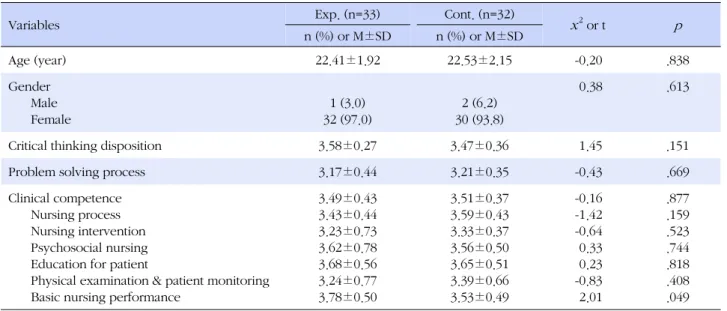
Table 1. Homogeneity Test for General Characteristics of Participants (N=65)
Variables Exp. (n=33) Cont. (n=32)
x2 or t p
n (%) or M±SD n (%) or M±SD
Age (year) 22.41±1.92 22.53±2.15 -0.20 .838
Gender Male Female
1 (3.0) 32 (97.0)
2 (6.2) 30 (93.8)
0.38 .613
Critical thinking disposition 3.58±0.27 3.47±0.36 1.45 .151
Problem solving process 3.17±0.44 3.21±0.35 -0.43 .669
Clinical competence Nursing process Nursing intervention Psychosocial nursing Education for patient
Physical examination & patient monitoring Basic nursing performance
3.49±0.43 3.43±0.44 3.23±0.73 3.62±0.78 3.68±0.56 3.24±0.77 3.78±0.50
3.51±0.37 3.59±0.43 3.33±0.37 3.56±0.50 3.65±0.51 3.39±0.66 3.53±0.49
-0.16 -1.42 -0.64 0.33 0.23 -0.83 2.01
.877 .159 .523 .744 .818 .408 .049 Exp.=experimental group; Cont.=control group.
6. Data analysis
The statistical analysis of the collected data was done by utilizing SPSS/WIN 18.0 Program. The preliminary homogeneity test of general characteristics and depend- ent variables of experimental and control groups was analyzed using x2 test and independent t-test. The dif- ference test between experimental and control group re- garding each variable for hypothesis test was analyzed by executing independent t-test and analysis of covari- ance (ANCOVA).
RESULTS
1. Homogeneity Test
The participants of this study were third-year nursing students at a nursing college with an experimental group size of 33 and a control group size of 32, for a total of 65 nursing students. The mean age of the experimental group was 22.41 and the control group was 22.53 years.
97.0% of the experimental group was female and 93.8%
of the control group was female. The ages and gender of the two groups were not significantly different.
As a result of testing homogeneity of dependent varia- bles in a preliminary investigation before experimental treatment, the average score of critical thinking dis- position for experimental group was 3.58±0.27 and for control group was 3.47±0.36, the average score of pro- blem solving process for experimental group was 3.17±
0.44 and for control group was 3.21±0.35, the average
score of clinical competence for experimental group was 3.49±0.43 and for control group was 3.51±0.37.
Homogeneity between the two groups was not signifi- cantly different (t=1.45, p=.151; t=-0.43, p=.669; t=-0.16, p =.877). The results of the homogeneity test for the 6 subareas of clinical competence showed that the score in 5 areas were homogenous, but the score for basic nurs- ing performance had a statistical difference, for which the experimental group had a score of 3.78±0.50 and the control group, a score of 3.53±0.49 (t=2.01, p=.049) (Table 1).
2. Hypotheses Test 1) Hypothesis 1
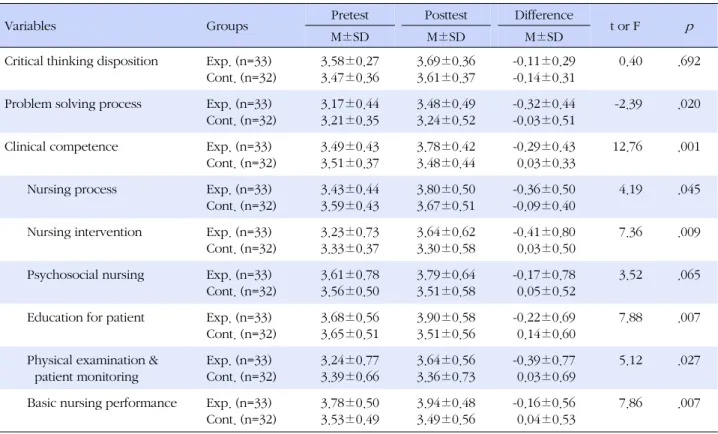
“The experimental group, who participated in mul- ti-mode simulation learning would show difference in critical thinking disposition compared to the control group.” The critical thinking disposition score of the ex- perimental group that participated in multi-mode simu- lation learning increased by 0.11 points from 3.58±0.27 to 3.69±0.36 and the score for the control group in- creased by 0.14 points from 3.47±0.36 to 3.61±0.37.
There was no significant difference between the two groups (t=0.40, p =.692).
Thus, hypothesis 1 was not supported (Table 2).
2) Hypothesis 2
“The experimental group, who participated in multi- mode simulation learning would show difference in pro- blem solving process compared to the control group.”
Table 2. Differences of the Outcome Variables between the Experimental and Control Group (N=65)
Variables Groups Pretest Posttest Difference
t or F p
M±SD M±SD M±SD
Critical thinking disposition Exp. (n=33) Cont. (n=32)
3.58±0.27 3.47±0.36
3.69±0.36 3.61±0.37
-0.11±0.29 -0.14±0.31
0.40 .692
Problem solving process Exp. (n=33) Cont. (n=32)
3.17±0.44 3.21±0.35
3.48±0.49 3.24±0.52
-0.32±0.44 -0.03±0.51
-2.39 .020
Clinical competence Exp. (n=33)
Cont. (n=32)
3.49±0.43 3.51±0.37
3.78±0.42 3.48±0.44
-0.29±0.43 0.03±0.33
12.76 .001
Nursing process Exp. (n=33)
Cont. (n=32)
3.43±0.44 3.59±0.43
3.80±0.50 3.67±0.51
-0.36±0.50 -0.09±0.40
4.19 .045
Nursing intervention Exp. (n=33) Cont. (n=32)
3.23±0.73 3.33±0.37
3.64±0.62 3.30±0.58
-0.41±0.80 0.03±0.50
7.36 .009
Psychosocial nursing Exp. (n=33) Cont. (n=32)
3.61±0.78 3.56±0.50
3.79±0.64 3.51±0.58
-0.17±0.78 0.05±0.52
3.52 .065
Education for patient Exp. (n=33) Cont. (n=32)
3.68±0.56 3.65±0.51
3.90±0.58 3.51±0.56
-0.22±0.69 0.14±0.60
7.88 .007
Physical examination &
patient monitoring
Exp. (n=33) Cont. (n=32)
3.24±0.77 3.39±0.66
3.64±0.56 3.36±0.73
-0.39±0.77 0.03±0.69
5.12 .027
Basic nursing performance Exp. (n=33) Cont. (n=32)
3.78±0.50 3.53±0.49
3.94±0.48 3.49±0.56
-0.16±0.56 0.04±0.53
7.86 .007
Exp.=experimental group; Cont.=control group.
The problem solving process score of the experimental group that participated in multi-mode simulation learn- ing increased by 0.32 points from 3.17±0.44 to 3.48±
0.49 and the score for the control group increased by 0.03 points from 3.21±0.35 to 3.24±0.52, indicating a significant difference between the two groups (t=-2.39, p =.020). Thus, hypothesis 2 was supported (Table 2).
3) Hypothesis 3
“The experimental group, who participated in multi- mode simulation learning would show difference in clinical competence compared to the control group.”
The clinical competence score of the experimental group that participated in multi-mode simulation learning in- creased by 0.29 points from 3.49±0.43 to 3.78±0.42 and the score for the control group decreased by 0.03 points from3.51±0.37 to 3.48±0.44, indicating a signifi- cant difference between the two groups (F=12.76, p = .001). Thus, hypothesis 3 was supported (Table 2).
To check the score differences in the subareas of clin- ical competence, the pretest score for each subarea was processed as a covariate to perform ANCOVA. In the 5 areas excluding psychosocial nursing (F=3.52, p =.065), there was difference in the score between the control group and experimental group who participated in mul-
ti-mode simulation-based learning (Table 2).
DISCUSSION
To solve nursing problems, critical thinking dispo- sition is required in students, in other words, the per- ceptive ability to observe nursing problems, technically conceptualize them through introspection and infer- ence, and be able to apply, analyze, integrate, and eval- uate them. In addition, by sharing the thinking process in nursing behavior as seen in detailed clinical cases with colleagues, a problem can be solved and clinical performance can be improved (Kim, 2012). This re- search conducted multi-mode simulation learning in juniors at a4 year nursing school enrolled in an emer- gency and critical patient nursing course, to examine the effect on critical thinking disposition, problem solving process, and clinical competence of nursing students.
First, the critical thinking disposition of the experi- mental group who participated in the multi-mode simu- lation learning and the control group were 3.69±0.36 and 3.61±0.37 so there was no statistically significant difference. This is similar to the results of Kim (2012) who used the same tool reporting values of 3.62±0.38 and 3.65±0.35 in a study that measured critical thinking
disposition after simulation practical with a standardized patient in 3rd year nursing students. The scores from nursing students at a university with an integrated nurs- ing education course (3rd year 3.55±0.32, 4th year 3.62
±0.40)(Yoon, 2008), and the critical thinking disposi- tion of nurses working at a general hospital (3.64± 0.28) (Choi & Cho, 2011) were also similar. The results of this research showed that the multi-mode simulation learn- ing did not increase the critical thinking disposition of the participants. This is similar to the research results of Shinnich & Woo (2012) and Yang (2008) in which crit- ical thinking disposition did not increase after high-fi- delity simulation practicals. However, it differed from the research results of Huret al.,(2013), Kim et al., (2012), and Son & Song (2012) in which the critical thinking dis- position of nursing students increased after applying simulation-based problem centered learning and simu- lation-based integrated practical system. This is consid- ered to be from the difference in class design. Critical thinking disposition is not formed over a short period but there is the tendency to increase according to prac- tical experience (Choi & Cho, 2011), so students should experience scenarios with various situations, and a thor- ough class design is necessary such as assigning the ap- propriate amount of time according to the purpose and student level of the simulation education. In addition, it is considered that integrating various teaching methods such as problem-centered learning into a simulation class will be helpful, and it is necessary to examine the change in critical thinking disposition over a long period of time.
Second, the problem solving process score of the ex- perimental group who participated in multi-mode simu- lation learning was 3.48±0.49 while the score for con- trol group was 3.24±0.52, so the scores of the experi- mental group significantly increased, which supports the research results of Huret at al.,(2013) and Yang (2008).
To enhance the problem solving process of nursing stu- dents through practicals, evaluative elements should be minimized, and before starting the practical., it should be operated so that students self-direct to perceive prob- lems and problems are solved through sufficient dis- cussion with group members (Kim et al., 2012). Con- sidering this point, the experiment was conducted after the midterm exams and before the second semester clin- ical practice of the juniors. During the 2 weeks after the midterm exams, group members had the opportunity for sufficient discussion, and the roles were chosen by drawing lots rather than pre-assignment before the mul- ti-mode simulation, so that the students would have to
practice for the various roles. However, numerous stud- ies, which applied a high-fidelity simulator (Kim et al., 2012; Kim & Jang, 2011; Lee & Hahn, 2011; Shepherd, McCunnis, Brown, & Hair, 2010), reported that a sig- nificant effect was not observed in cognitive areas such as decision making and problem solving process, so there is a need for further research to identify other fac- tors which influence the problem solving process.
Third, the score for clinical competence of the ex- perimental group who participated in multi-mode simul- ation learning was 3.78±0.42 while for the control group it was 3.48±0.44, so the score of the experimental group significantly improved. This is similar to numerous stud- ies including Cant & Cooper (2010), Kim et al.,(2012), Kim & Jang (2011), and Yang (2008) in which clinical competence improved after high-fidelity simulation ed- ucation, and it was verified that multi-mode simulation learning is an effective learning method to improve the clinical competence of nursing students. The results of this research showed that the clinical competence postt- est score of the control group had declined compared to the pretest score. This is considered to be because the juniors at the subject school have a block system where theory classes are conducted from September to Octo- ber of the second semester, and then 8 weeks of clinical practice is conducted. Hence, the students in the control group did not have any Lab practical experience during the 8 weeks of theory class. Therefore, to improve the clinical competence of students, classes should be de- signed so practice can be experienced simultaneously during theory class, and open labs can be operated to provide sufficient opportunity for students to repeatedly practice nursing skills. When the subareas for clinical competence were examined, the experimental group significantly improved in the 5 areas of nursing process, nursing intervention, education for patients, physical examination & patient monitoring, and basic nursing performance, but there was no difference between the groups in the area of psychosocial nursing. This differed from the report of Lee et al.,(2010) in which the nursing students felt the importance of empathy during mul- ti-mode simulation learning because the standardized patient realistically played the dyspnea situation like an actual patient. The scenario in this research was an emergency situation in which the upper gastrointestinal bleeding patient falls into shock, but most of the stu- dents knew of the situation by the caregiver explaining the condition of the patient. This was because the sub- ject students in the research had no experience with simulation learning so they may have been disconcerted
by the simulation situation and felt pressure to perform accurately the procedure within the given time. Meeting with actual people, such as a standardized patient, can increase the tension felt by students (Ryoo et al., 2013), so these situational elements should be considered be- fore the multi-mode simulation practice and process of familiarization of students with the environment through sufficient prior orientation before running simulation would be necessary.
Finally, our study has several limitations. First, we, re- searchers were not able to control experiences of nurs- ing techniques which participants observed, including urinary catheterization, intravenous injection, and oxy- gen therapy, etc. during the clinical practice period prior to participating in the multi-mode simulation. Conse- quently, there is a need to verify the existence of differ- ence in enhancing ability of clinical performance de- pending on the number of observation times of nursing techniques in future studies. Second, as a result of this research, the enhancement of clinical performance abil- ity was able to be verified by simply utilizing partic- ipants’ self-reported tools. During the course of simu- lation of the students, performance checklist was uti- lized, but the questions on the checklist were designed for yes-or-no answers, and its evaluation was carried out by only one professor, which made it difficult to guaran- tee its validity. Therefore, we think that designing of studies able to utilize more objective measuring tool for clinical performance ability evaluation in future re- searches would be necessary. Third, although utilizing professional actors, whose acting abilities are verified, as standardized patients would be the general rule, since this study was executed in a short period following a university’s curriculum, the teaching assistants of the same university were utilized as standardized patients.
Though standardized patients’ education was provided for sufficient time before simulation, since they were not professional actors, there were limitations in terms of re- ality surrounding patients’ roles.
CONCLUSION
This research applied multi-mode simulation to emer- gency care of a patient with upper gastrointestinal bleed- ing, and the results showed that it was effective in im- proving the clinical competence and problem solving process of nursing students, but there was no significant effect on critical thinking disposition. Multi-mode simu- lation considers economic, physical., and manpower sit- uations and it is an effective teaching and learning
method. It will be helpful in the suitable utilization of low or medium fidelity simulators retained in the prac- tical rooms of many nursing universities.
The following are suggested based on the results of this study.
First, We suggest that the scenario developed in this research be applied to education utilizing high-fidelity simulators to compare the effect.
Second, To improve critical thinking disposition, we suggest further studies that apply class design which in- tegrates simulation class and other teaching methods to examine the effect.
Third, We suggest that a diverse scenario is developed depending on educational goals and environments.
Fourth, In this study, the result variables were meas- ured through a self-report form by the students, so we suggest that a universal method to measure outcomes be developed and applied.
REFERENCES
Cant, R. P., & Cooper, S. J. (2010). Simulation-based learning in nurse education: systemic review. Journal of Advanced Nursing, 66(1), 3-15.
http://dx.doi.org/10.1111/j.1365-2648.2009.05240.x Cho, M. H., & Kwon, I. S. (2007). A study on the clinical practice
experiences on nursing activities of nursing students. The Journal of Korean Academic Society of Nursing Education, 13, 143-154.
Choi, H. R., & Cho, D. S. (2011). Influence of nurses’ perform- ance with critical thinking and problem solving process.
Korean Journal of Women’s Health Nursing, 17, 265-274.
http://dx.doi.org/10.4069/kjwhn.2011.17.3.265
Faul, F., Erdfelder, E., Buchner, A., & Lang, A. G. (2009). Statisti- cal power analyses using G*Power 3.1: Tests for correlation and regression analyses. Behavior Research Methods, 41, 1149-1160. http://dx.doi.org/10.3758/BRM.41.4.1149 Gibbons, S. W., Adamo, G. Padden, D., Ricciardi, R., Graziano, M.,
Levine, E., et al. (2002). Clinical evaluation in advanced practice nursing education: Using standardized patients in Health Assessment. Journal of Nursing Education, 41(5), 215-221.
Ham, Y. L. (2009). Development and evaluation of a simulation educational program using a high-fidelity patient simulator for undergraduate nursing students. Unpublished doctoral dissertation, Yonsei University, Seoul.
Hur, H. K., & Park, S. (2012). Effects of simulation based educa- tion, for emergency care of patients with dyspnea, on know- ledge and performance confidence of nursing students. The Journal of Korean Academic Society of Nursing Education,
18(1), 110-118.
http://dx.doi.org/10.5977/jkasne.2012.18.1.110
Hur, H. K., Park, S., Shin, Y. H., Lim, Y. M., Kim, G., Kim, K. K., et al. (2013). Development and applicability evaluation of an emergent care management simulation practicum for nursing students. The Journal of Korean Academic Society of Nursing Education, 19, 228-240.
http://dx.doi.org/10.5977/jkasne.2013.19.2.228
Isenberg, S. B. (2006). The scope of simulation-based healthcare education. Simulation in Healthcare, 1, 203-208.
http://dx.doi.org/10.1097/01.SIH.0000546607.36504.5a Jeffries, P. R. (2005). A framework for designing, implementing,
and evaluating simulations used as teaching strategies in nursing. Nursing Education Perspectives, 26(2), 96-103.
Kim, D. H., Lee, Y., Hwang, M. S., Park, J. H., Kim, H. S., & Cha, H. G. (2012). Effects of simulation-based integrated clinical practice program (SICPP) on the problem solving process, clinical competence and critical thinking in nurse students.
The Journal of Korean Academic Society of Nursing Educa- tion, 18, 499-509.
Kim, S. H. (2012). Effects of simulation-based practice using stan- dardized patients for the care of women with postpartum hemorrhage on nursing student’s clinical performance com- petence and critical thinking disposition. Korean Parent Child Health Journal, 15(2), 71-79.
Kim, Y. H., & Jang, K. S. (2011). Effect of a simulation-based edu- cation on cardio-pulmonary emergency care knowledge, clinical performance ability and problem solving process in new nurses. Journal of Korean Academy Nursing, 41, 245- 255. http://dx.doi.org/10.4040/jkan.2011.41.2.245
Kneebonee R., Kidd, J., Nestel, D., Asvall, S.,Paraskeva, P., &
Darzi, A. (2002). An innovative model for teaching and learning clinical procedures. Medical Education, 36, 628- 634.
Lee, M. S., & Hahn, S. W. (2011). Effect of simulation-based prac- tice on clinical performance and problem solving process for nursing students. The Journal of Korean Academic Society of Nursing Education, 17, 226-234.
Lee, S. J., Roh, Y. S., Kim, J. O., Jang, K. I., Ryoo, E. N., &Park, Y.
M. (2010). Comparison of multi-mode simulation and Sim- ManⓇ simulation on evaluation of nursing care for patients with dyspnea. The Journal of Korean Academic Society of Nursing Education, 16, 51-60.
Lee,S. J., Park, Y. M., & Noh, S. M. (2013). The effects of simu- lation training with hybrid model for nursing students on nursing performance ability and self-confidence. Korean Journal of Adult Nursing, 25, 170-183.
http://dx.doi.org/10.7475/kjan.2013.25.2.170
Lim, K. C. (2011). Direction of simulation-based learning in nurs-
ing practice education: A systemic review. The Journal of Korean Academic Society of Nursing Education, 17, 246- 256.
McGaghie, W. C., Issenberg, S. B., Petrusa, E. R., & Scalese, R. J.
(2010). A critical review of simulation-based medical educa- tion research: 2003-2009. Medical Education, 44, 50-63.
http://dx.doi.org/10.1111/j.1365-2923.2009.03547.x Rosen, K. R., Mcbride, J. M., & Drake, R. L. (2009). The use of
simulation in medical education to enhance students’ un- derstanding of basic science. Medical Teacher, 31 (9), 842- 845.
Ryoo, E. N., Ha, E. H., & Cho, J. Y. (2013). Comparison of learn- ing effects using high-fidelity and multi-mode simulation:
An application of emergency care for a patient with cardiac arrest. Journal of Korean Academy Nursing, 43, 185-193.
http://dx.doi.org/10.4040/jkan.2013.43.2.185
Seybert, A. L., & Kane-Gill, S. L. (2011). Elective course in acute care using online learning and patient simulation. American Journal of Pharmaceutical Education, 75(3), 54.
Shepherd, C. K., McCunnis, M., Brown, L., & Hair, M. (2010). In- vestigating the use of simulation as a teaching strategy.
Nursing Standard, 24(35), 42-48.
Shinnick, M. A., & Woo, M. A. (2012). The effects of human pa- tient simulation on critical thinking and its predictors in pre- licensure nursing students. Nurse Education Today, May 5.
Son, Y. J., & Song, Y. A. (2012). Effects of simulation and prob- lem-based learning courses on student critical thinking, pro- blem solving abilities and learning. The Journal of Korean Academic Society of Nursing Education, 18, 43-52.
http://dx.doi.org/10.5977/jkasne.2012.18.1.043
Woo, O. H. (2000). The effects of a PBL(Problem-based learning) on the problem solving process students by their meta-cog- nitive levels. Unpublished master’s thesis, Korea National University of Education, Cheongwon.
Yang, J. J, & Park, M. Y. (2004).The relationship of clinical com- petence and self-directed learning in nursing students.
Journal of Korean Academy Society Nursing Education, 10, 271-277.
Yang, J. J. (2008). Development and evaluation of a simulation- based education course for nursing students. Korean Jour- nal of Adult Nursing, 20, 548-560.
Yoon, J. (2004). Development of scale for critical thinking dis- position: Focused on nursing. Unpublished doctoral dis- sertation, The Catholic University of Korea, Seoul.
Yoon, J. (2008). A study on the critical thinking disposition of nursing students-Focusing on a school applying integrated nursing curriculum. Journal of Korean Academy of Nursing Administration, 14, 159-166.