INTRODUCTION
According to the 2013 World Health Organization (WHO) report, 21% of global adults were current smokers, which included 950 million men and 177 million women. Compared to the 2007 WHO report, smoking prevalence has declined worldwide. However, there are still 1.1 billion smokers globally.1) A previous cohort study revealed an increase in all health-related causes of death among smokers. Smoking increases the risk of death from lung cancer, chronic obstructive pulmonary disease, ischemic heart disease, and any type of stroke.2) Moreover, cigarette
smoking causes more than 480,000 deaths in the United States every year according to the 2014 Surgeon General’s report.3) The mortality and morbidity of diseases related to tobacco use could be reduced by quitting cigarette smoking. Many studies have proved that smoking cessation in- terventions including medications, consultations, and behavioral support are effective in stopping smoking.4)
Mobile phones are utilized worldwide. The number of mobile phone users was estimated to be 4.55 billion globally, including 1.75 billion smartphone users in 2014.5) Mobile phone users can share text messages and make calls; they also have wireless internet services. Thus, several Received September 6, 2017 Accepted October 1, 2017
Corresponding author Kyoung Jin Kim Tel: +82-2-2030-8140, Fax: +82-2-2030-5339 E-mail: [email protected]
ORCID: https://orcid.org/0000-0001-9951-5212
Copyright © 2019 The Korean Academy of Family Medicine
This is an open-access article distributed under the terms of the Creative Commons At- tribution Non-Commercial License (http://creativecommons.org/licenses/by-nc/4.0) which permits unrestricted noncommercial use, distribution, and reproduction in any medium, provided the original work is properly cited.
Brief
Communication
https://doi.org/10.21215/kjfp.2019.9.4.394 eISSN 2233-9116
Korean J Fam Pract. 2019;9(4):394-400
Korean Journal of Family Practice
KJFP
금연에 대한 문자 메시지 서비스 기법: 체계적 문헌고찰
차현진, 조윤성, 김경진*, 오은정, 박재민, 최재경, 권혁중, 조동영
건국대학교 의학전문대학원 가정의학교실
Mobile Text Messaging Interventions for Smoking Cessation: A Systematic Review
Hyun Jin Cha, Yun Sung Cho, Kyoung Jin Kim*, Eun Jung Oh, Jae Min Park, Jae Kyung Choi, Hyuk Jung Kweon, Dong Yung Cho Department of Family Medicine, Konkuk University Graduate School of Medicine, Seoul, Korea
Background: Smoking is one of the most serious health problems worldwide. The aim of this systematic review was to demonstrate the effect of text messaging-based interventions on smoking cessation.
Methods: Electronic databases were searched using specific key terms. The inclusion criteria were (1) articles that employed a randomized controlled trial and (2) articles that examined the effect of text messaging interventions on smoking cessation. However, studies employing multimedia messaging service and smartphone apps were excluded.
Results: In total, six randomized controlled trial studies with seven interventions were included in this systematic review. Of these six studies, almost all concluded that text-messaging interventions had no significant effect on smoking cessation. However, one study conducted in England revealed that text messaging intervention groups had a higher rate of six-month prolonged abstinence from smoking than did the control group.
Conclusion: Text messaging interventions could be effective for those who want to quit smoking. We aimed to determine the effectiveness of using text messaging interventions for smoking cessation. However, there were only six studies that employed randomized controlled trials to determine such effectiveness. More studies on the effect of text messaging interventions for smoking cessation using subjects from various age groups and socioeconomic backgrounds are needed in the future.
Keywords: Smoking Cessation; Text Messaging; Short Message Service
차현진 외. 금연에 대한 문자 메시지 서비스 기법: 체계적 문헌고찰 Korean Journal of Family Practice
KJFP
studies on various topics have investigated the effect of mobile technolo- gy-based treatment, especially focusing on text messaging intervention.
For instance, the effectiveness of text messaging interventions on weight loss,6) medication adherence of asthma or human immunodeficiency vi- rus patients,7,8) and diabetes patients’ glycemic control9,10) has been proven in previous randomized controlled trials. Smoking cessation is another one of such topics.11) Recently, Scott-Sheldon et al.12) conducted a system- atic review and meta-analysis on the effect of text messaging-based inter- ventions on smoking cessation. However, they also included video mes- saging-based interventions and smart phone applications.12)
Thus, the aim of this systematic review was to determine the effect of only text messaging-based interventions on smoking cessation. Because text messaging can be used by all mobile phone users, interventions us- ing text messaging may be more feasible (for various age groups ranging from adolescents to senior people) than using smartphone apps, a learn- ing management system (LMS), or a multimedia messaging service (MMS).
METHODS
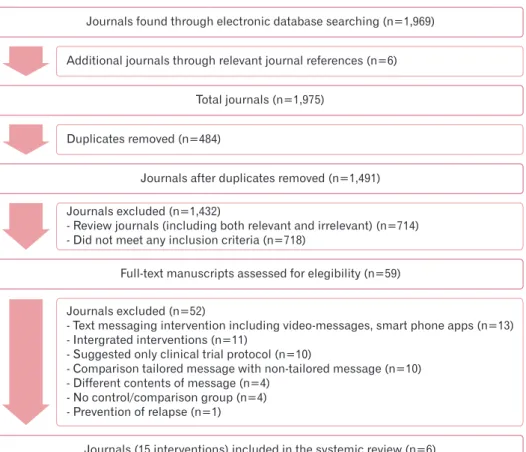
Studies that investigated the effect of text messaging intervention on smoking cessation and estimated smoking cessation outcomes in ran- domized controlled trials published as electronic publications or disser- tations until May 31, 2016 were included in this study. The following studies were excluded: (1) those that used text messaging interventions to help people who had already quit smoking,13) (2) those that investigated not only text messaging, but also other interventions, such as pamphlet- and booklet-based interventions, (3) those that supplemented text mes- saging interventions, including LMS and smartphone apps. However, studies on phone counseling interventions were not excluded because they were applied during outpatient interviews or cognitive behavioral therapy. This systemic review was conducted following the Preferred Re- porting Items for Systematic Reviews and Meta-Analyses (PRISMA) checklist (Figure 1).14)
1. Information sources and search strategy
The following electronic databases were searched: PubMed (n=655),
Brief
Communication
Korean Journal of Family Practice
Figure 1. Study retrieval and selection.
Hyun Jin Cha, et al. Mobile Text Messaging Interventions for Smoking Cessation
Korean Journal of Family Practice
KJFP
Cochrane Library (n=401), and Embase (n=913). Searches were conduct- ed repeatedly and independently between June 31 and August 31, 2016, by two authors with the purpose of including all publications that matched our eligibility criteria. In addition, all references related to previ- ous systematic reviews and meta-analyses of text messaging interven- tions for smoking cessation were searched. Search terms were set for the two major themes: tobacco (“tobacco,” and “smoke”) and types of cessa- tion interventions (“text message,” “cellular phones,” “phone,” “mobile,”
“mobile devices,” “short message service,” and “SMS”). Within each theme, the Boolean search term “OR” was used to combine terms and
“AND” was then used to find instances of intersections between the searched terms. We applied language restrictions and selected only those articles that were written in English. Our initial searching restriction was on titles and abstracts.
2. Study selection and quality assessment
First, we screened titles and abstracts that matched our inclusion crite- ria. Next, we reviewed the full texts of papers to determine whether they met our exclusion criteria. Following this, papers that fulfilled our inclu- sion criteria without meeting our exclusion criteria were included in this study.
Two independent coders then extracted the following characteristic information from each study: paper’s information (i.e., year of publica- tion and data collection), demographic information (i.e., race, gender), and intervention procedures (i.e., frequency of sending text message).
Full papers that fulfilled our inclusion criteria were assessed for quality according to the National Institutes for Health (NIH) quality assessment guidelines.15) Disagreements between the two coders were resolved by discussions following which they arrived at a consensus.
3. Study outcomes
Several randomized controlled trial studies were reviewed to evaluate the effectiveness of text-messaging intervention on smoking abstinence.
Individuals who received text-messaging interventions were assigned to the intervention group, while those who did not receive any text-messag- ing intervention were assigned to the control group.
The study outcomes for smoking cessation were assessed. Measure- ments of smoking cessation included the prevalence of smoking absti- nence and continuous abstinence from the quit date.
RESULTS
A total of 1,969 papers were extracted from electronic databases fol- lowing the search strategies. Another six papers were extracted after re- viewing the references of previous systematic review studies. Duplicate papers and those that did not meet our inclusion criteria at this stage were excluded. Finally, a total of 59 manuscripts were obtained. After re- viewing their full texts and excluding studies that did not meet our inclu- sion criteria—for example, those with randomized controlled trials that compared not only text messaging but also other multimedia interven- tions, such as smart phone apps or those that compared integrated inter- ventions including both text messaging interventions and pamphlets—a total of six studies reporting seven interventions were finally included for this systematic review (Figure 1).16-21)
Information was extracted from these six studies with seven interven- tions; the details are summarized in Table 1.16-21) The median year of pub- lication was 2013 (range: 2009–2016), but the data collection years varied.
The study by Shi et al.19) did not state the data collection year. Studies also varied in sample size, ranging from 174 to 42,717. Approximately 50% of the subjects were female. However, in one study,19) the number of female subjects was extremely low. Most studies targeted adolescents or young adults. The mean age of subjects in these studies ranged from 25 to 48.33 years. Among these six studies, three were conducted in Europe (i.e., Germany, Switzerland, and England), while the other three were con- ducted in the United States, Turkey, and China. The study duration ranged from 12 weeks to 6 months. The duration of interventions ranged from 3 months (90 days or 12 weeks) to 56 weeks. One study by Haug et al.17) recruited participants through an online screening, while the other five studies recruited participants offline.
In all studies, the intervention group received only text messages.
However, other interventions were added in two studies.18,19) The fre- quency of sending text messages varied from less than once a week to daily, at most. The total number of text messages ranged from 14 to 217.
In most studies, a two-way text messaging intervention was used. How- ever, in the study by Ybarra et al.,20) a one-way text messaging interven- tion was used.
The length of the follow-up period ranged from three to six months.
Outcomes had variable measures, including self-reported point preva- lence abstinence status, seven-day point prevalence, and change in quit- ting stage.
차현진 외. 금연에 대한 문자 메시지 서비스 기법: 체계적 문헌고찰 Korean Journal of Family Practice
KJFP
These six studies came to different conclusions about the effect of us- ing text messaging interventions on smoking cessation. The studies by Haug et al.16) and Ybarra et al. 20) showed no significant differences in the abstinence rate between the control group and the intervention group.
Boal et al.21) reported similar rates of seven-day abstinence in both groups. Haug et al.17) reported that the decrease in the mean number of cigarettes smoked per day was higher in the intervention group. However, attempts to quit and the stage of change were not significantly different between the two groups. Naughton et al.18) reported that there was no sig- nificant difference in the self-reported two-week point prevalence absti- nence at the eight-week follow up or in the smoking outcome four weeks after the quit date. However, a six-month prolonged abstinence was high- er in the intervention group than in the control group. Shi et al.19) report- ed that the intervention group had relatively higher rates of self-reported 7- and 30-day abstinence. However, the differences were not statistically significant. In contrast, smoking reduction and moving forward in the quitting stages had significantly higher rates in the intervention group than in the control group.
The two independent authors of this study reviewed and discussed the six extracted studies based on the NIH quality assessment guidelines us- ing 12 items (Table 2).16-21) Sample size justification was not determined for the study by Haug et al.16).
DISCUSSION
The aim of this study was to evaluate the effectiveness of text messag- ing interventions for smoking cessation. Several previous systematic re- views and meta-analytic studies have shown that mobile text messaging interventions are effective for smoking cessation.12,22,23) However, our study showed that the text-messaging intervention had no significant in- fluence on smoking cessation. There are many possible causes for such a difference in results. First, MMS and smartphone apps were included in previous studies. However, only mobile text messaging interventions were included in this study. Short message service (SMS) interventions were the easiest and the most accessible means to target subjects of all ages, including older people who did not use smartphones. For this rea- son, we limited the interventions to only text messaging. Second, the ran- domized controlled trials included in our study only investigated the ef- fect of text messaging intervention. However, previous systematic reviews and meta-analytic studies included many publications that investigated Table 1. The study, sample, and intervention characteristics of the six selected articles SampleLocation/ participantsRecruitment methodControlIntervention/ durationDeliveryFrequencyCommunication- on flowOutcomesF/U Haug et al.16)n=174; 56.9% F(99/174); 25 yGermany/ universityAssessment only controlSMS/3 moTextLowTwo-way text messagingQuit attempt, cigarettes per day3 m Haug et al.16)n=174; 56.9% F(99/174); 25 yGermany/ universityAssessment only controlSMS/3 moTextHighTwo-way text messagingQuit attempt, cigarettes per day3 m Haug et al.17)n=755; 51.9% F(392/755); 18.2 ySwitzerland/ adolescentsOnline screeningAssessment only controlSMS/6 moTextHighTwo-way text messaging7-d point prevalence smoking abstinence, 4-wk point prevalence smoking abstinence, cigarettes per day
6 m Naughton et al.18)n=602; 52.7% F(317/602); 41.8 yEngland/clinicsLocal GP surgeryRelevant content, not time-matchediQuit/3 moText, CBT, reportsVariedTwo-way text messagingSelf-reported 2-wk point prevalence abstinence at 8-wk follow-up2 m, 6 m Shi et al.19)n=179; 95.5% M(171/179); 17 yShanghai, China/ adolescents
With the help of health teachersRelevant content, not time-matchedNot reported/ 3 moText, pamphlet, communicationHighTwo-way text messagingChange in quitting stage, self- reported 7-d abstinence, 30-d abstinence 3 m Ybarra et al.20)n=151; 39% F; 36 yAnkara, Turkey/ adultsShopping malls& advertisementsRelevant content, not time-matchedSMS/3 moTextVariedOne-way text messaging7-d point prevalence, 30-d point prevalence, continuous abstinence, cigarettes per d/wk
3 m Boal et al.21)n=42,717; 51.9% F;40.84 yUnited StatesPhone callRelevant content, not time-matchedText/6 moTextVariedTwo-way text messagingSelf-reported 7-d abstinence at 6 mo6 m F/U, follow-up; F, female; M, male; GP, general practitioner; SMS, short message service; CBT, cognitive behavior therapy.
Hyun Jin Cha, et al. Mobile Text Messaging Interventions for Smoking Cessation
Korean Journal of Family Practice
KJFP
text messaging interventions as well as web-based or pamphlet interven- tions.” Therefore, although previous studies revealed the effectiveness of mobile text messaging interventions on smoking cessation, they also in- cluded interventions other than text messaging.
We reviewed a total of six studies with seven interventions that includ- ed a total of 7,423 subjects. The findings from these six studies showed that text messaging interventions had no significant effect on smoking cessation over a short period. However, such interventions may be effec- tive over a long period, although the effectiveness might not be statisti- cally significant.
The strength of this study was that it investigated only SMS interven- tions, assumed to be the most convenient way to support everyone who wants to quit smoking, including the elderly and those with a low socio- economic status. Smoking is one of the most important health problems in the world. It causes many disorders that can lead to death. Smoking cessation can thus lower the prevalence of several disorders. In the 2014 WHO report, the tobacco smoking prevalence among adults was 21%
globally, 25% in high-income countries, 21% in middle-income countries, and 16% in low-income countries.1) According to this data, high-income countries have the highest prevalence of smoking. However, monitoring the proportion of smokers in each country is needed before interpreting such data. Although the proportions of smokers in high-income coun- tries were higher than those in other countries, there were no data for 13 low-income countries. Therefore, the prevalence of smoking may be higher than reported in low-income countries. Although cognitive be- havioral therapy might be effective for smoking cessation, it is uncom- fortable for someone who does not like to receive medical support. In ad- dition, medical treatment might be more effective when it is combined with counseling by a physician and cognitive behavioral therapy. An SMS intervention is the most convenient way to support smoking cessa- tion. The only condition for anyone who wants to participate in this in- tervention is that they use cell phones. There is no reason to have a smart- phone or access to the Internet. They just need to be able to read SMS texts. Therefore, everyone (from low-income individuals to high-income individuals, from the young to the elderly) can benefit from this interven- tion. In addition, SMS texts are inexpensive compared to MMS, LMS, or voice messages.
When interpreting this systematic review, a few limitations should be considered. First, among the six publications included, all of them uti- lized tailored text messaging intervention—a system that sends messages Table 2. Quality assessment of 6 journals Journals
Quality assessment criteria Stated objectivePopulationSample size justification
Control selected from similar popullation Consistently implementation Differentiated cases from controls
Randomiza- tionCon-current controlsPrior exposure/risk Implemented consistently exposure/risk
Blind trial
Confounding variables measurement Haug et al.16)YYCDYYYYYYYYN Haug et al.16)YYYYYYYYYYYY Naughton et al.18)YYYYYYYYYYYY Shi et al.19)YYYYYYYYYYYN Ybarra et al.20)YYYYYYYYYYYY Boal et al.21)YYYYYYYYYYYN Y, yes; CD, cannot determined; N, no.
차현진 외. 금연에 대한 문자 메시지 서비스 기법: 체계적 문헌고찰 Korean Journal of Family Practice
KJFP
according to an individual’s status—which might be more effective than non-tailored text messaging. Several previous randomized controlled tri- als have investigated the effectiveness of tailored text messaging com- pared to non-tailored text messaging.24-28) First, the results of three studies revealed that tailored text-messaging was significantly more effective than non-tailored messaging. However, Skov-Ettrup et al.27) reported no significant difference in effectiveness between the two groups. Free et al.25) also revealed that tailored text-messaging had no significant effect on smoking cessation at six months, although it showed an improved ef- fect at four weeks.
Second, the six publications reviewed in this study employed bidirec- tional text messaging interventions, which can not only identify reactions of participants, but also help participants who have problems in smoking cessation. Bidirectional text messaging is also used to offer participants immediate help, such as if a user need any demand, then user send text message include on-demand keyword “CRAVE”.21) However, other stud- ies helped participants in different ways, such as by providing counseling by phone or in a medical office. Therefore, bidirectional text messaging intervention might not be as effective as other intervention methods for smoking cessation.
Third, the six publications included in our systematic review had dif- ferent outcome measurements. Previous investigations about variable measurements of smoking abstinence recommended different ways to measure it. Since none is superior to the others, clinical investigators se- lected a measurement that was suitable for each trial.29) Therefore, we could not compare the measurements for each other. The measurements of smoking cessation used in the six randomized controlled trials includ- ed in this study were subjective, not objective, tools. Therefore, further studies are needed to determine the best measurement tool for smoking cessation.
In conclusion, text messaging intervention is the most convenient in- tervention for anyone who wants to quit smoking anywhere in the world.
Therefore, several previous studies have aimed to determine the effec- tiveness of text messaging intervention for smoking cessation. Previous systematic reviews and meta-analyses have shown that text messaging intervention might be effective for people who want to quit smoking.
However, they included other interventions such as cognitive behavior therapy and pamphlets. In addition, they not only included SMS inter- ventions, but also smartphone apps and MMS. Therefore, in this study, we restricted the interventions to SMS-only interventions, which can be
received by people with low or high income and of different ages (from adolescents to the elderly). After investigating whether SMS interventions were effective for smoking cessation by reviewing previous publications, our results revealed that only SMS interventions had no significant effect on smoking cessation. However, just six publications that studied the ef- fect of SMS-only interventions on smoking cessation were included in our systematic review. Therefore, more studies are needed to investigate the effect of SMS-only interventions on smoking cessation. In addition, more studies are needed to determine the standard messaging strategy.
CONFLICT OF INTEREST
No potential conflict of interest relevant to this article was reported.
ORCID
Kyoung Jin Kim, http://orcid.org/0000-0001-9951-5212 Eun Jung Oh, http://orcid.org/0000-0001-6592-4579 Jae Min Park, http://orcid.org/0000-0001-8873-8832 Jae Kyung Choi, http://orcid.org/0000-0002-0875-7505 Hyuk Jung Kweon, http://orcid.org/0000-0001-6686-1303 REFERENCES
1. World Health Organization. WHO report on the global tobacco epidemic, 2015: raising taxes on tobacco [Internet]. Geneva: WHO; 2015. [cited 2017 Jun 8]. Available from: http://apps.who.int/iris/bitstream/10665/178574/1/
9789240694606_eng.pdf?ua=1&ua=1.
2. Thun MJ, Carter BD, Feskanich D, Freedman ND, Prentice R, Lopez AD, et al. 50-year trends in smoking-related mortality in the United States. N Engl J Med 2013; 368: 351-64.
3. U.S. Department of Health and Human Services. The health consequences of smoking: 50 years of progress: a report of the surgeon general. Atlanta:
Department of Health and Human Services, Centers for Disease Control and Prevention, National Center for Chronic Disease Prevention and Health Promotion, Office on Smoking and Health; 2014.
4. West R, McNeill A, Raw M. Smoking cessation guidelines for health profes- sionals: an update. Thorax 2000; 55: 987-99.
5. eMarketer. Smartphone users worldwide will total 1.75 billion in 2014. New York: eMarketer; 2014. [cited 2017 Jun 8]. Available from: https://www.
emarketer.com/Article/Smartphone-Users-Worldwide-Will-Total-175-Bil- lion-2014/1010536.
6. Patrick K, Raab F, Adams MA, Dillon L, Zabinski M, Rock CL, et al. A text message-based intervention for weight loss: randomized controlled trial. J Med Internet Res. 2009; 11: e1.
Hyun Jin Cha, et al. Mobile Text Messaging Interventions for Smoking Cessation
Korean Journal of Family Practice
KJFP
7. Petrie KJ, Perry K, Broadbent E, Weinman J. A text message programme de- signed to modify patients' illness and treatment beliefs improves self-report- ed adherence to asthma preventer medication. Br J Health Psychol 2012; 17:
74-84.
8. Lester RT, Ritvo P, Mills EJ, Kariri A, Karanja S, Chung MH, et al. Effects of a mobile phone short message service on antiretroviral treatment adherence in Kenya (WelTel Kenya1): a randomised trial. Lancet 2010; 376: 1838-45.
9. Franklin VL, Waller A, Pagliari C, Greene SA. A randomized controlled trial of Sweet Talk, a text-messaging system to support young people with diabe- tes. Diabet Med 2006; 23: 1332-8.
10. Yoon KH, Kim HS. A short message service by cellular phone in type 2 dia- betic patients for 12 months. Diabetes Res Clin Pract 2008; 79: 256-61.
11. Chow CK, Redfern J, Hillis GS, Thakkar J, Santo K, Hackett ML, et al. Effect of lifestyle-focused text messaging on risk factor modification in patients with coronary heart disease: a randomized clinical trial. JAMA 2015; 314:
1255-63.
12. Scott-Sheldon LA, Lantini R, Jennings EG, Thind H, Rosen RK, Salmoirago- Blotcher E, et al. Text messaging-based interventions for smoking cessation:
a systematic review and meta-analysis. JMIR Mhealth Uhealth 2016; 4: e49.
13. Snuggs S, McRobbie H, Myers K, Schmocker F, Goddard J, Hajek P. Using text messaging to prevent relapse to smoking: intervention development, practicability and client reactions. Addiction 2012; 107 Suppl 2: 39-44.
14. Moher D, Liberati A, Tetzlaff J, Altman DG; PRISMA Group. Preferred re- porting items for systematic reviews and meta-analyses: the PRISMA state- ment. PLoS Med 2009; 6: e1000097.
15. National Heart, Lung, and Blood Institute. Quality assessment of case-con- trol studies. Bethesda: National Heart, Lung, and Blood Institute; [cited 2017 Jun 8]. Available from : https://www.nhlbi.nih.gov/health-pro/guidelines/
in-develop/cardiovascular-risk-reduction/tools/case-control.
16. Haug S, Meyer C, Schorr G, Bauer S, John U. Continuous individual support of smoking cessation using text messaging: a pilot experimental study. Nico- tine Tob Res 2009; 11: 915-23.
17. Haug S, Schaub MP, Venzin V, Meyer C, John U. Efficacy of a text message- based smoking cessation intervention for young people: a cluster random- ized controlled trial. J Med Internet Res 2013; 15: e171.
18. Naughton F, Jamison J, Boase S, Sloan M, Gilbert H, Prevost AT, et al. Ran- domized controlled trial to assess the short-term effectiveness of tailored
web- and text-based facilitation of smoking cessation in primary care (iQuit in practice). Addiction 2014; 109: 1184-93.
19. Shi HJ, Jiang XX, Yu CY, Zhang Y. Use of mobile phone text messaging to de- liver an individualized smoking behaviour intervention in Chinese adoles- cents. J Telemed Telecare 2013; 19: 282-7.
20. Ybarra M, Bağci Bosi AT, Korchmaros J, Emri S. A text messaging-based smoking cessation program for adult smokers: randomized controlled trial.
J Med Internet Res 2012; 14: e172.
21. Boal AL, Abroms LC, Simmens S, Graham AL, Carpenter KM. Combined quitline counseling and text messaging for smoking cessation: a quasi-ex- perimental evaluation. Nicotine Tob Res 2016; 18: 1046-53.
22. Spohr SA, Nandy R, Gandhiraj D, Vemulapalli A, Anne S, Walters ST. Effica- cy of SMS text message interventions for smoking cessation: a meta-analy- sis. J Subst Abuse Treat 2015; 56: 1-10.
23. Whittaker R, McRobbie H, Bullen C, Rodgers A, Gu Y. Mobile phone-based interventions for smoking cessation. Cochrane Database Syst Rev 2016; 4:
CD006611.
24. Rodgers A, Corbett T, Bramley D, Riddell T, Wills M, Lin RB, et al. Do u smoke after txt? Results of a randomised trial of smoking cessation using mobile phone text messaging. Tob Control 2005; 14: 255-61.
25. Free C, Whittaker R, Knight R, Abramsky T, Rodgers A, Roberts IG. Txt- 2stop: a pilot randomised controlled trial of mobile phone-based smoking cessation support. Tob Control 2009; 18: 88-91.
26. Abroms LC, Boal AL, Simmens SJ, Mendel JA, Windsor RA. A randomized trial of Text2Quit: a text messaging program for smoking cessation. Am J Prev Med 2014; 47: 242-50.
27. Skov-Ettrup LS, Ringgaard LW, Dalum P, Flensborg-Madsen T, Thygesen LC, Tolstrup JS. Comparing tailored and untailored text messages for smok- ing cessation: a randomized controlled trial among adolescent and young adult smokers. Health Educ Res 2014; 29: 195-205.
28. Free C, Knight R, Robertson S, Whittaker R, Edwards P, Zhou W, et al. Smok- ing cessation support delivered via mobile phone text messaging (txt2stop):
a single-blind, randomised trial. Lancet 2011; 378: 49-55.
29. Hughes JR, Keely JP, Niaura RS, Ossip-Klein DJ, Richmond RL, Swan GE.
Measures of abstinence in clinical trials: issues and recommendations. Nico- tine Tob Res 2003; 5: 13-25.