THE EFFECT OF MONOMER TO POWDER RATIO ON POLYMERIZATION SHRINKAGE-STRAIN KINETICS OF POLYMER-BASED PROVISIONAL CROWN AND FIXED PARTIAL DENTURE
MATERIALS
Sung-Hun Kim, D.D.S., Ph.D.
Associate professor, Department of Prosthodontics and Dental Research Institute, College of Dentistry, Seoul National University, Seoul
Statement of problem. Although a number of previous investigations have been carried out on the polymerization shrinkage-strain kinetics of provisional crown and fixed partial denture (FPD) materials, the effect of the changes of liquid monomer to powder ratio on its polymerization shrinkage-strain kinetics has not been reported.
Purpose. The purpose of this study was to investigate the influence of liquid monomer to pow- der ratio of polymer-based provisional crown and FPD materials on the polymerization shrinkage-strain kinetics.
Material and methods. Chemically activated acrylic provisional materials (Alike, Jet, Snap) were investigated. Each material was mixed with different liquid monomer to powder ratios by volume (1.0:3.0, 1.0:2.5, 1.0:2.0, 1.0:1.5, 1.0:1.0). Time dependent polymerization shrinkage- strain kinetics of all materials was measured by the bonded-disk method as a function of time at 23 ℃. Five recordings were taken for each ratio. The results were statistically analyzed using one-way ANOVA and the multiple comparison Scheffe test at the significance level of 0.05. Trends were also examined by linear regression.
Results. At 5 minutes after mixing, the polymerization shrinkage-strains of all materials ranged from only 0.01% to 0.49 %. At 10 minutes, the shrinkage-strain of Alike was the highest, 3.45
% (liquid monomer to powder ratio = 1.0:3.0). Jet and Snap were 2.69 % (1.0:2.0) and 1.58 % (1.0:3.0), respectively (P > 0.05). Most shrinkage (94.3 % - 96.5 %) occurred at 30 minutes after mixing for liquid monomer to powder ratio, ranging from 1.0:3.0 to 1.0:1.0. The highest polymerization shrinkage-strain values were observed for the liquid monomer to powder ratio of 1.0:3.0. At 120 minutes after mixing, the shrinkage-strain values were 4.67 %, 4.18 %, and 3.07 % for Jet, Alike, and Snap, respectively. As the liquid monomer to powder ratio increased, the shrink- age-strain values tend to be decreased linearly (r = - 0.769 for Alike, - 0.717 for Jet, - 0.435 for Snap, r2= 0.592 for Alike, 0.515 for Jet, 0.189 for Snap; P < 0.05).
J Korean Acad Prosthodont : Volume 45, Number 6, 2007
※ This research was supported by Seoul National University Research Grant of 2005.
P
rovisional restorations are an integral part of dental therapy.1They can be used as a guide for definitive prosthetic treatment. Many materials can be used as a provisional prosthesis, but the most widely used materials for a provisional pros- thesis are tooth-colored, polymer-based materi- als, such as polymethyl methacrylate, higher (meth) acrylate and dimethacrylate. They are the materials of choice when esthetics is of primary concern. Among them, monomethacrylate-based provisional crown and fixed partial denture (FPD) materials have been widely used in dentistry because they are cheap and can be easily added on.2One of the inherent properties of mono- methacrylate-based provisional crown and FPD materials is a dimensional change during poly- merization. Monomers are converted into their cor- responding polymeric form during free radical polymerization processes, which results in a density changes as the liquid monomer, typi- cally lower density, converts to a polymer of higher density. It is this density change that is the primary source of shrinkage.3This is known as polymerization shrinkage, which may cause sev- eral clinical problems. The shrinkage may cause distortion that may jeopardize the accurate fit to the prepared teeth and also internal stress with- in the restorations, leading to poorly fitting pros- theses.2,4,5,6Poor marginal fit allows passage of oral fluids and bacteria into the gap, and also allows the deposition of bacterial plaque. This cancontribute to localized periodontal inflamma- tion. As a consequence, the periodontal health and the integrity of the prepared tooth structure may be damaged.7-13Hence, it is crucial to know that the polymerization shrinkage kinetics and the amount of shrinkage-strain of the polymer-based crown and FPD materials before using them to reduce the above clinical complications. Monomethacrylate- based provisional crown and FPD materials are presented as a liquid and a powder that can be mixed in room temperature. In many clinical cases, dentists tend to change the liquid monomer to powder ratio in the fabrication of polymer-based provisional crown and FPDs. Although a number of previous investigations have been carried out on the polymerization shrinkage-strain kinetics of provisional crown and FPD materials, the effect of the changes of liquid monomer to pow- der ratio on its polymerization shrinkage-strain kinetics has not been reported. Thus, the purposes of this study were (i) to measure the polymerization shrinkage kinetics and strain of three polymer- based provisional crown and FPD materials and (ii) to investigate the effect of liquid monomer to powder ratio on the polymerization shrinkage kinetics and strain of the materials investigat- ed. The null hypothesis to be tested was that there was no difference in the polymerization shrinkage-strain of polymer-based provisional crown and FPD materials with different liquid monomer to powder ratio.
Conclusion. The increase of the liquid monomer to powder ratio from 1.0:3.0 to 1.0:1.0 had a significant effect on the shrinkage-strain kinetics of polymer-based crown and FPD materials investigated. This increased the working time and decreased the shrinkage-strain during poly- merization.
Key Words
Polymerization shrinkage-strain kinetics, Monomer to powder ratio, the Bonded-disk method, Provisional crown and fixed partial denture material
MATERIAL AND METHODS
The materials used in this study are mono- methacrylate-based materials, and presented in Table I. All materials are chemically activated resins, and a powder and liquid system. They were mixed and initiated in accordance with manu- facturers’instructions. The powder component was added to the liquid in a polymeric bowl.
Then these components were stirred with a plas- tic spatula. Each material took a period of time, cir- ca 20 seconds to mix with different liquid monomer to powder ratios by volume (1.0:3.0, 1.0:2.5, 1.0:2.0, 1.0:1.5, 1.0:1.0). Each component was mixed manually until the powder was com- pletely wetted by the monomer.
Time dependent polymerization shrinkage- strain kinetics of all materials was measured by
‘Watts’method.14The device consisted of an aluminum stand and a horizontal table that was capable of clamping a Linear Variable Displacement Transformer (LVDT, GT 2000, RDP Electronics Ltd, Wolverhampton, UK). A brass anvil 40 mm in diameter was positioned beneath the horizontal table. Each mixed specimen was placed centrally within the center of the brass ring of 1 mm thickness and 16 mm internal diameter fixed on a glass plate (Fig. 1). A flexible, thin, com- pliant (25 mm × 25 mm × 0.1 mm) microscope glass cover-slip (Type 0, Chance-Propper Ltd, Warley, UK) was placed over the upper specimen and was supported on a brass ring. The cover-slip was flattened to ensure that it was in contact with the supporting ring and the specimen even- ly. As such, each specimen was shaped with the
same dimensions of 1 mm in thickness and circa 8 mm in diameter (50 mm3). The cover-slip was deflected as the specimen shrank during poly- merization. Its deflection at the center of the cover-slip was measured continuously by a pre- cision linear variable displacement transducer (LVDT, type GT 2000, RDP Electronics, Wolverhampton, UK) with a sensitivity of over 0.1 μm which was positioned vertically onto the center of the cover-slip. The axial dimensional change was monitored over time, up to 120 min after the completion of the mixing in units of voltage by the LVDT. The data was transferred to a signal conditioning unit (Type E307-3, RDP Electronics, Wolverhampton, UK), and then to a Picolog software (Version 5.03.2, Pico Technology Ltd, St Neots, Cambridgshire, UK). The dis- placement of the cover-slip (the amount of linear contraction: ΔL = Lo- L; where Lois the original specimen thickness and L is the final thickness) was determined with Fig.P software (The Scientific Fig.
Fig. 1.Bonded-disk measurement apparatus used in this study.
Table I. The polymer-based provisional materials investigated
Material Characteristics Lot No. Shade Manufacturer
Alike Monomethacrylates 401051 67/B3 COE, Alsip, Ill, USA
Snap Monomethacrylates 90306 65/D3 Parkell, Farmingdale, NY, USA
Jet Monomethacrylates 14302040 66/A3 Lang Dental Mfg. Co. Inc, Chicago, Ill, USA.
Processor, Version 2.98, Fig.P Software Corporation, Durham, NC, USA) via the calibration coeffi- cient of displacement/voltage (3.4 × 10⁻⁶mm/mV).
This displacement (ΔL) was divided by Lo and multiplied by 100 to get a percentage of shrinkage- strain as a function of time. All experiments were carried out in five times at 23 ± 0.5 ℃.
The results were statistically analyzed using one-way ANOVA and the multiple comparison Scheffe test at the significance level of 0.05.
Trends were also examined by linear regression.
SPSS software (Version 12.0, SPSS Inc., Chicago, Ill, USA) was used for these statistical analyses.
RESULTS
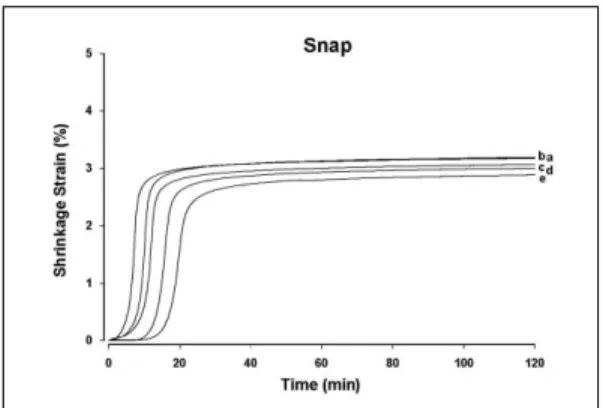
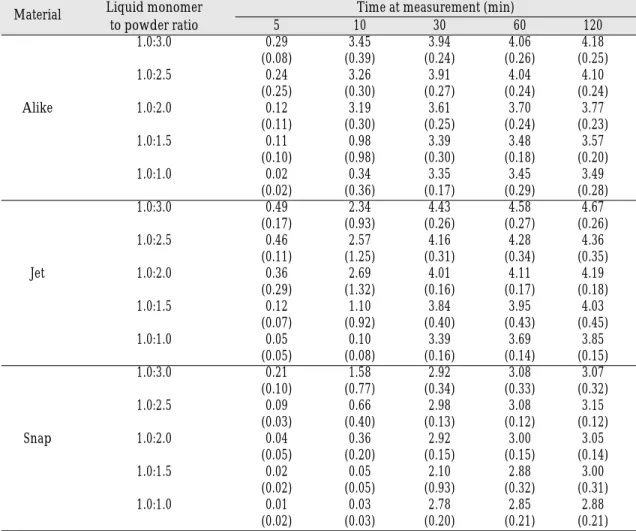
The polymerization shrinkage kinetic curves of each material are presented in Fig. 2-4. The results of the polymerization shrinkage-strain are given in Table II. The results showed an increase of polymerization shrinkage-strain in magnitude up to 120 minutes after the start of mixing.
At 5 minutes after mixing, the polymerization shrinkage-strains of all materials ranged from only 0.01% to 0.49 %. This was caused by the
slow onset of setting. At 10 minutes, the shrink- age-strain of Alike was the highest, 3.45 % (liquid monomer to powder ratio = 1.0:3.0). Jet and Snap were 2.69 % (1.0:2.0) and 1.58 % (1.0:3.0) respec- tively. The values between Jet and Snap were not significantly different (P > 0.05). Most shrink- age (94.3 % - 96.5 %) occurred at 30 minutes after mixing for liquid monomer to powder ratio, ranging from 1.0:3.0 to 1.0:1.0 except Snap (1:1.5), but the shrinkage continued up to 120 minutes after the start of mixing. The highest polymerization shrinkage-strain values were observed for the liquid monomer to powder ratio of 1.0:3.0. At 120 minutes after mixing, the shrinkage-strain values were 4.67 %, 4.18 %, and 3.07 % for Jet, Alike, and Snap, respectively. Both Jet and Alike showed sim- ilar shrinkage values (P = 0.049). The value of Snap was significantly different from that of Alike or Jet (P < 0.05).
As the liquid monomer to powder ratio increased, the shrinkage-strain values tend to be decreased linearly (Fig. 5) (r = - 0.769 for Alike, - 0.717 for Jet, - 0.435 for Snap, r2= 0.592 for Alike, 0.515 for Jet, 0.189 for Snap; P < 0.05). The shrinkage-strain values for the ratio of 1.0:1.0
Fig. 3. Polymerization shrinkage-strain kinetic curves of Jet. Each curve is for a different liquid monomer to powder ratio. a) 1.0:3.0, b) 1.0:2.5, c) 1.0:2.0, d) 1.0:1.5, e) 1.0:1.0.
Fig. 2. Polymerization shrinkage-strain kinetic curves of Alike. Each curve is for a different liquid monomer to powder ratio. a) 1.0:3.0, b) 1.0:2.5, c) 1.0:2.0, d) 1.0:1.5, e) 1.0:1.0.
Table II. The mean and standard deviation of the polymerization shrinkage-strain
Material Liquid monomer Time at measurement (min)
to powder ratio 5 10 30 60 120
1.0:3.0 0.29 3.45 3.94 4.06 4.18
(0.08) (0.39) (0.24) (0.26) (0.25)
1.0:2.5 0.24 3.26 3.91 4.04 4.10
(0.25) (0.30) (0.27) (0.24) (0.24)
Alike 1.0:2.0 0.12 3.19 3.61 3.70 3.77
(0.11) (0.30) (0.25) (0.24) (0.23)
1.0:1.5 0.11 0.98 3.39 3.48 3.57
(0.10) (0.98) (0.30) (0.18) (0.20)
1.0:1.0 0.02 0.34 3.35 3.45 3.49
(0.02) (0.36) (0.17) (0.29) (0.28)
1.0:3.0 0.49 2.34 4.43 4.58 4.67
(0.17) (0.93) (0.26) (0.27) (0.26)
1.0:2.5 0.46 2.57 4.16 4.28 4.36
(0.11) (1.25) (0.31) (0.34) (0.35)
Jet 1.0:2.0 0.36 2.69 4.01 4.11 4.19
(0.29) (1.32) (0.16) (0.17) (0.18)
1.0:1.5 0.12 1.10 3.84 3.95 4.03
(0.07) (0.92) (0.40) (0.43) (0.45)
1.0:1.0 0.05 0.10 3.39 3.69 3.85
(0.05) (0.08) (0.16) (0.14) (0.15)
1.0:3.0 0.21 1.58 2.92 3.08 3.07
(0.10) (0.77) (0.34) (0.33) (0.32)
1.0:2.5 0.09 0.66 2.98 3.08 3.15
(0.03) (0.40) (0.13) (0.12) (0.12)
Snap 1.0:2.0 0.04 0.36 2.92 3.00 3.05
(0.05) (0.20) (0.15) (0.15) (0.14)
1.0:1.5 0.02 0.05 2.10 2.88 3.00
(0.02) (0.05) (0.93) (0.32) (0.31)
1.0:1.0 0.01 0.03 2.78 2.85 2.88
(0.02) (0.03) (0.20) (0.21) (0.21)
Fig. 5.Linear regression relationship between shrink- age-strain and liquid monomer to powder ratio.
Fig. 4. Polymerization shrinkage-strain kinetic curves of Snap. Each curve is for a different liquid monomer to powder ratio. a) 1.0:3.0, b) 1.0:2.5, c) 1.0:2.0, d) 1.0:1.5, e) 1.0:1.0.
were significantly lower than those for the ratio of 1.0:3.0 (P < 0.05). Jet showed a 17.6 % decrease when the value at the ratio of 1.0:1.0 was compared with that at 1.0:3.0. This was followed by Alike (16.5
%) and Snap (6.2 %). Multiple comparison Scheffe test showed that the increase of the liquid monomer to powder ratio from 1.0:3.0 to 1.0:1.0 had a significant effect (P < 0.05) on the shrinkage- strain values of all materials except Snap.
DISCUSSION
Polymer-, especially acrylic-, based provision- al crown and FPD material is one of the most wide- ly used biomaterials, being used to serve a guide for definitive prosthetic treatment. Most acrylic- based provisional crown and FPD materials used in the above application are two-part products (liq- uid monomer and powder system). Chemically they are based on methyl methacrylate, and nearly all of them have the same functional con- stituents. The constituents of the powder are prepolymerized polymethyl methacrylate beads alone or with a copolymer, and an initiator (usu- ally, benzoyl peroxide) of the polymerization reaction. The liquid monomer constituents are methyl methacrylate, an accelerator/activa- tor/promoter (usually N,N-dimethyl-4-tolui- dine) of the free-radical polymerization reac- tion, and a stabilizer/inhibitor of that reaction (usu- ally hydroquinone). The shrinkage-strain of liq- uid methyl methacrylate upon polymerization is circa 21.1%. Such a high polymerization shrink- age-strain can be reduced by the introduction of liquid monomer (methyl methacrylate) and pow- der (prepolymerized polymethyl methacrylate) sys- tem, since only the methyl methacrylate com- ponent shrinks during polymerization.
This experiment was conducted with the bond- ed-disk method for measurement of the shrink- age-strain kinetics. Although there may be a possible source of error for rapid-setting bioma-
terials due to any shrinkage-strain prior to the start of measurement, many studies confirm that the bonded-disk method has determined volumetric shrinkage-strain with the required precision for polymethyl methacrylate/methacrylte self-cure system.6,14,15Most curing of the materials tested regardless of the mixing ratio occurred in the first 30 minutes after mixing. This is in well accordance with the previous study.16The results showed the increase of polymerization shrinkage- strain in magnitude continued up to 120 minutes after the start of mixing. It can be expected that an increase of the liquid monomer to powder ratio of the provisional crown and FPD biomaterials sig- nificantly increased the final polymerization shrinkage-strain values since the liquid monomer to be reacted in a given volume was increased. But, in fact, according to this result, the polymerization shrinkage-strain values at 120 minutes decreased from 4.67 % to 3.85 % for Jet, from 4.18 % to 3.49 % for Alike, and from 3.07 % to 2.88 % for Snap when the liquid monomer to powder mix- ing ratio was increased from 1.0:3.0 to 1.0:1.0.
For all materials, the correlations were quite lin- ear. Thus, the null hypothesis to be tested could be rejected. This trend noted in the result as a func- tion of mixing ratio was qualitatively similar to the previous study reported for acrylic bone cement.6 In dental practice when the polymer-based crown and FPD material is used, utilization of a higher liquid monomer to powder ratio has been fre- quently occurred because of easy mixing or lack of knowledge for ideal mixing ratio. It is known that the use of higher amounts of liquid monomer increases the working time of the mass and sub- sequently favors the wetting and swelling of polymethyl methacrylate powder beads by the methyl methacrylate liquid component, and improves handling characteristics of the mix- ture in the dough state.17Thus, it makes fabrica- tion of provisional prosthesis easier. However, alter- ing the recommended liquid monomer to powder
ratio can affect the material behavior of the pro- visional crown and FPD. There is an explanation for the change in material behavior as a function of liquid monomer to powder ratio. Increasing the liquid monomer content not only increases the liq- uid monomer to powder ratio and thereby the monomer matrix volume fraction, but effective- ly decreases the volume fraction of polymethyl methacrylate beads in the monomer matrix. As the monomer matrix volume fraction increases, so too may the volume fraction to react for shrinkage. But, the reason why the increase of the liquid monomer to powder ratio did not increase the polymerization shrinkage is that the increase in liquid monomer to powder ratio likely provides more monomer than can be reacted with the available initiators and thus, unreacted monomer remains in the polymerized materials.18This may induce a low level of polymerization and low degree of con- version throughout the provisional prosthesis, which has unwanted residual monomer. This may act as a plasticizer.19The increase of liquid monomer to powder ratio of polymer-based pro- visional prosthesis may induce several clinical prob- lems. Based on this test results, the increase of liq- uid monomer to powder ratio still leads to the poly- merization shrinkage-strain, which may increase the marginal discrepancy of polymer-based pro- visional prosthesis. There are many clinical stud- ies which have focused on the effect of restorations on periodontal tissues.11,12,13,20They reported that poor marginal adaptation, deeper intracrevicular margin placement, rougher restoration surfaces, and overcontoured restorations could contribute to periodontal problems such as localized gingival inflammation, increased probing depths, and bone resorption.21 Especially, there is a strong correlation existed between marginal discrep- ancy of the restoration and gingival index, and also a significant quantitative relationship existed between the marginal discrepancy and peri- odontal tissue inflammation for subgingivally
located crown margins.11-13In addition, the increase of liquid monomer to powder ratio may increase the formation of pores in the polymer-based provisional prosthesis. It would act as stress ris- ers and initiating sites for cracks, rendering the prosthesis susceptible to early fatigue fracture.3The increase of the liquid monomer to powder ratio also reduce the mechanical strength, such as ultimate compressive strength, yield strength and compressive modulus, and induce clinical fail- ures through stress and porosity.18This may also leads to increased setting times.17Hence, increased liquid monomer to powder ratio systems with high shrinkage-strain and high residual monomer should be avoided to achieve good clinical result.
However, increasing amounts of activator and ini- tiator in the system may reduce the level of the residual monomer.22When considering modify- ing the liquid monomer and powder ratio of the polymer-based provisional crown and FPD mate- rials, the effect of the change not only on the polymerization kinetics but also on other properties of the curing and cured materials must be stud- ied in the further studies, and more number of specimens should also be tested.
CONCLUSION
Within the limitation of this study, the follow- ing conclusions were drawn.
1. Polymerization shrinkage-strain values with a liquid monomer to powder ratio of 1.0:3.0 were 4.67 %, 4.18 %, and 3.07 % for Jet, Alike, and Snap, respectively at 2 hours after the start of mixing.
2. Most shrinkage (94.3 % - 96.5 %) of the pro- visional crown and FPD materials investigat- ed occurred in the first 30 minutes after the start of mixing regardless of the liquid monomer to powder ratio.
3. Increasing the liquid monomer to powder ratio induced a delayed onset of shrinkage, and
decreased the shrinkage-strain in magnitude linearly (r = - 0.769 for Alike, - 0.717 for Jet, - 0.435 for Snap). The shrinkage-strain values for the ratio of 1.0:1.0 were significantly low- er than those for the ratio of 1.0:3.0.
REFERENCES
1. Goldberg PV, Hingginbottom FL, Wilson TG.
Periodontal considerations in restorative and im- plant therapy. Periodontoloy 2000;25:100-9.
2. Kim SH, Watts DC. Polymerization shrinkage- strain kinetics of temporary crown and bridge materials. Dent Mater 2004;20:88-95.
3. Gibert JL, Hasenwinkel JM, Wixson RL, Lautenschlager EP. A theoretical and experimen- tal analysis of polymerization shrinakge of bone ce- ment: A potential major source of porosity. J Biomed Mater Res 2000;52:210-8.
4. Malone WFP, Koth DL. Tylman’s theory and practice of fixed prosthodontics, 8thed. Ishiyaku EuroAmerica Company; 1989. p.255-71.
5. Vallittu P. Effect of powder-to-liquid on the dis- tortion of repaired denture acrylic resin. Eur J Pros Rest Dent 1996;4:83-6.
6. Silikas N, Al-Kheraif A, Watts DC. Influence of P/L ratio and peroxide/amine concentrations on shrinkage-strain kinetics during setting of PM- MA/MMA biomaterial formulations. Biomater 2005;26:197-204.
7. Gilmore N, Sheiham A. Overhanging dental restorations and periodontal disease. J Periodontol 1971;42:8-12.
8. Highfield JE, Powell RN. Effects of removal of posterior overhanging metallic margins of restora- tions upon the periodontal tissues. J Clin Periodontol 1978;5:169-81.
9. Jeffcoat MK, Howell TH. Alveolar bone destruction due to overhanging amalgam in periodontal dis- ease. J Periodontol 1980;51:599-602.
10. Turner CH. A retrospective study of the fit of jacket crowns placed around gold posts and cores, and the associated gingival health. J Oral Rehabil 1982;9:427-34.
11. Lang NP, Kiel RA, Anderhalden K. Clinical and mi- crobiological effects of subgingival restorations with overhanging or clinically perfect margins. J
Clin Periodontol 1983;10:563-78.
12. Sorensen SE, Larsen IB, Jorgensen KD. Gingival and alveolar bone reaction to marginal fit of subgingival crown margins. Scand J Dent Res 1986;94:109-14.
13. Felton DA, Kanoy BE, Bayne SC, Wirthman GP.
Effect of in vivo crown margin discrepancies on pe- riodontal health. J Prosthet Dent 1991;65:357-64.
14. Watts DC, Cash AJ. Determination of polymer- ization shrinkage kinetics in visible-light-cured materials: methods development. Dent Mater 1991;7:281-7.
15. Watts DC, Marouf A. Optical specimen geometry in bonded-disk shrinkage-strain measurements on light- cured biomaterials. Dent Mater 2000;16:447-51.
16. Turner RC, Atkins PE, Ackley MA, Park JB.
Molecular and macroscopic properties of PMMA bone cement: Free-radical generation and tem- perature change versus mixing ratio. J Biomed Mater Res 1981;15:425-32.
17. Pascual B, Gurruchaga M, Ginebra MP, Gil FJ, Planell JA, Goni I. Influence of the modification of P/L ratio on a new formulation of acrylic bone ce- ment. Biomater 1999;20:465-74.
18. Belkoff SM, Sanders JC, Jasper LE. The effect of the monomer-to powder ratio on the materials prop- erties of acrylic bone cement. J Biomed Mater Res 2002;63:396-9.
19. Lewis G. Properties of acrylic bone cement: State of the art review. J Biomed Mater Res 1997;38:155-82.
20. Lang NP, Kiel RA, Anderhalden K. Clinical and mi- crobial effects of subgingival restorations with overhanging or clinically perfect margins. J Clin Periodontol 1983;10:563-78.
21. Knoernschild KL, Campbell SD. Periodontal tissue responses after insertion of artificial crowns and fixed partial dentures. J Prosthet Dent 2000;84:492-8.
22. Rose E, Lal J, Green R. Effects of peroxide, amine and hydroquinone in varying concentrations on the polymerization rate of polymethyl methacrylate slur- ries. J Am Dent Assoc 1958;56:375-81.
Reprint request to:
SUNG-HUNKIM, D.D.S., PH.D.
DEPARTMENT OFPROSTHODONTICS,COLLEGE OFDENTISTRY, SEOULNATIONALUNIVERSITY
28-1, YEUNGUN-DONG,CHONGNO-GU,SEOUL, 10-749, KOREA [email protected]