including the present case.(Table 1)1-28 Lesions were located in the upper and lower extremities in 32 cases, the trunk (in- cluding one case of penile location) in 10 cases, and the head and neck area in 7 cases. Most RHs originate from vessels at the superficial portion of the body including dermal or sub- cutaneous tissues. However, Aditya et al.3 reported a case of RH presenting as a primary bone tumor originating from the parietal bone.
In our patient, the symptom of epistaxis was followed by identification of a buccal mass. A heterogeneous mass in the infratemporal fossa and bone destruction of the pterygoid pro- cess were observed on magnetic resonance imaging (MRI).
(Fig. 1, 2) Tumor resection was conservatively conducted by Le Fort I osteotomy and a posterior partial maxillectomy fol- lowing incisional biopsy demonstrating a juvenile capillary hemangioma. Portions of the tumor remained in the ptery- gopalatine fossa, the inferior orbital fissure, and the anterior cavernous sinus. The final pathological report confirmed RH in the infratemporal fossa. Despite tumor remnants, no evi- dence of extension or metastasis was detected for 8 years of follow-up. The origin was inferred to be the sphenoid bone in the infratemporal fossa area. This is the second RH case
I. Introduction
Retiform hemangioendothelioma (RH) was first described as a new entity by Calonje et al.1 in 1994. It is considered a rare vascular neoplasm of intermediate stage between benign hemangioma and malignant angiosarcoma, with a high rate of local recurrence and a low rate of metastasis. Histologically, RH presents as an irregular pattern of elongated and arboris- ing vessels like a normal rete testis. Neoplastic vessels are lined by a single layer of hobnail-like endothelial cells that protrude within the narrow lumina1. These endothelial cells usually extend to the deep dermis or subcutaneous tissues2.
To date, 29 papers and 48 RH cases have been reported,
Il-Kyu Kim
Division of Oral and Maxillofacial Surgery, Department of Dentistry, Inha University School of Medicine, 100 Inha-ro, Nam-gu, Incheon 22212, Korea TEL: +82-32-890-2470 FAX: +82-32-890-2475
E-mail: [email protected]
ORCID: http://orcid.org/0000-0003-3930-766X
This is an open-access article distributed under the terms of the Creative Commons Attribution Non-Commercial License (http://creativecommons.org/licenses/by-nc/4.0/), which permits unrestricted non-commercial use, distribution, and reproduction in any medium, provided the original work is properly cited.
CC
Retiform hemangioendothelioma in the infratemporal fossa and buccal area: a case report and literature review
Il-Kyu Kim1, Hyun-Young Cho1, Bum-Sang Jung1, Sang-Pill Pae1, Hyun-Woo Cho1, Ji-Hoon Seo1, Seung-Hoon Park2
1Division of Oral and Maxillofacial Surgery, Department of Dentistry, Inha University School of Medicine,
2Department of Oral and Maxillofacial Surgery, Catholic Kwandong University International St. Mary’s Hospital, Incheon, Korea
Abstract(J Korean Assoc Oral Maxillofac Surg 2016;42:307-314)
We report a case of retiform hemangioendothelioma (RH) located in the infratemporal fossa and buccal area in a 13-year-old Korean boy. The tumor originated from the sphenoid bone of the infratemporal fossa area and spread into the cavernous sinus, orbital apex, and retro-nasal area with bone destruction of the pterygoid process. Tumor resection was conducted via Le Fort I osteotomy and partial maxillectomy to approach the infratemporal fossa and retro-nasal area. The diagnosis of RH was confirmed after surgery. In the presented patient, surgical excision was incomplete, and close follow-up was performed. There was no evidence of expansion or metastasis of the residual tumor in the 8 years after surgery. In cases of residual RH with low likelihood of expansion and metastasis, even though RH is an intermediate malignancy, close follow-up can be the appropriate treatment choice over additional aggressive therapy. To date, 29 papers and 48 RH cases have been reported, including this case. This case is the second reported RH case presenting as primary bone tumor and the first case originating in the oromaxillofacial area.
Key words: Retiform hemangioendothelioma, Infratemporal fossa, Le Fort osteotomy, Residual neoplasm
[paper submitted 2016. 6. 2 / revised 2016. 8. 20 / accepted 2016. 9. 9]
Copyright Ⓒ 2016 The Korean Association of Oral and Maxillofacial Surgeons. All rights reserved.
20 21 22 23 24 25 26 27, 28
29 30 31 32 33-36
37 38 39 40 41 42 43 44 45 46 47 48
1997 1997 2000 2000 2002 2002 2003 2003 2005 2005 2006 2007 2008
2009 2009 2009 2009 2010 2010 2010 2011 2012 2012 2012 Present
Mentzel et al.
Sanz-Trelles et al.14 Schommer et al.15 El Darouti et al.4 Ulrich and Hrynyschyn16 Coutinho17
Aditya et al.3 Escudero et al.18 Tan et al.5 Botros et al.19 Ioannidou et al.20 Serel et al.6 Parsons et al.21
Love et al.22 Bhutoria et al.23 Emberger et al.24 Kajo et al.25 Aydingöz et al.26 Zhang et al.9 Hirsh et al.10 Albertini et al.8 O'Duffy et al.7 Choi et al.27 Findikçioğlu et al.28 Kim et al.
40 11 73 32 17 16 36 82 31 19 30 55 27 41 17 71 57 11 35 17 8 60 61 44 6 18 20 8 13
F M F F M M M F F F F F M F F F F F F M F F F M F M M F M
Lower limb Lower limb Trunk Lower limb Upper limb Lower limb Head and neck Upper limb Lower limb Lower limb Head and neck Upper limb Lower limb Trunk Upper limb Head and neck Lower limb Upper limb Trunk Trunk Lower limb Lower limb Head and neck Lower limb Trunk Head and neck Upper limb Upper limb Head and neck (deep portion of infratemporal)
ND 1.5 30 3.5 0.5
~5
4.5 ND 1.2 15 ND 2.5 1.5 4 0.7
6 2.5 1.2 6 8, 2 ND ND ND 1.5 2.5 5.3
0/1 0/1 0/1 0/1 0/1 0/1
0/1 1/1 0/1 0/1 0/4
0/1 0/1 0/1 0/1 0/1 1/1 0/1 0/1 0/1 0/1 0/1 0/1
ND ND ND 2 yr 2 wk 4 mo
2 mo 2 yr 9 wk 27 yr ND 1 yr 2 mo ND 4 mo ND 1 yr 4 yr 3 mo 1 yr 3 yr 7 yr 6 yr 4 mo 1 yr
ND 4 yr 2 yr 1.5 yr 2 yr ND
14 mo 2 yr 4 yr 6 mo ND ND ND ND ND 31 mo 3 yr 2 yr 6 mo 3 yr 8 mo 16 mo 2 mo 3 yr 8 yr
1/1 0/1 1/1 0/1 1/1 ND
0/1 1/1 0/1 0/1 ND 1/1 1/1 ND 1/1 1/1 0/1 0/1 1/1 0/1 0/1 1/1 1/1 0/1 0/1
0/1 0/1 0/1 0/1 0/1 0/1
0/1 0/1 0/1 0/1 ND ND ND ND 0/1 1/1 0/1 0/1 0/1 0/1 0/1 1/1 0/1 0/1 0/1
(F: female, M: male, ND: not documented)
Il-Kyu Kim et al: Retiform hemangioendothelioma in the infratemporal fossa and buccal area: a case report and literature review. J Korean Assoc Oral Maxillofac Surg 2016
A B
Fig. 1. Preoperative clinical photo- graph. A. Extraoral image of buccal cheek swelling. B. Intraoral image of buccal cheek swelling.
Il-Kyu Kim et al: Retiform hemangioendothelioma in the infratemporal fossa and buccal area: a case report and literature review. J Korean Assoc Oral Maxillofac Surg 2016
with bone destruction of the pterygoid process. The posterior wall of the right maxillary sinus was remodeled. T2-weighted images revealed heterogeneous low-signal area and interme- diate to high signal intensity in the nasal cavity. T1-weighted images showed intermediate to low signal intensity similar to that of muscles and relatively homogeneous patterns.(Fig. 2) Tumor size was approximately 5.0×3.0×2.0 cm. Local lymph node or distant metastasis was not observed.
Intraoral incisional biopsy of the buccal cheek area was initially performed and diagnosed as juvenile capillary hem- angioma. Complete excision was recommended to rule out mixed hemangioma, composite hemangioma, or hemangio- endothelioma.
1. Surgical technique
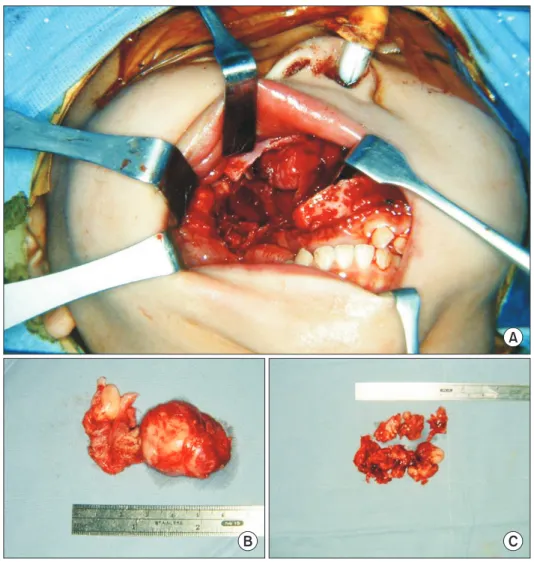
A Le Fort I osteotomy was performed, and the maxilla was retracted downward. This approach revealed relatively well- defined masses in the infratemporal fossa and retro-nasal area. We initially dissected these masses in the infratemporal fossa, and conducted posterior partial maxillectomy including of primary bone tumor and the first case of oromaxillofacial
area origin.
II. Case Report
A 13-year-old Korean boy presented with frequent epistax- is and right buccal cheek swelling. Frequent epistaxis had oc- curred for the previous year. Buccal swelling was first recog- nized one month prior. Clinically, a solid mass was palpated on the buccal area, and there was no pain or paresthesia.(Fig.
1) The patient also complained of loss of appetite, fatigue, and dizziness. Blood test revealed iron deficiency anemia status of red blood cell 2.68×10⁶/μL, hemoglobin 5.0 g/dL, mean corpuscular volume 65 fL, mean corpuscular hemoglo- bin 18.7 pg, and mean corpuscular hemoglobin concentration 29 g/dL. Continuous nasal bleeding was suspected to be the main reason for anemia.
MRI showed a well-defined mass in the right infratemporal fossa and buccal area with extension to the intracranial cav- ernous sinus through the foramen rotundum, the orbital apex through the inferior orbital fissure, and the retro-nasal area,
A B
C D
Fig. 2. Preoperation magnetic reso- nance imaging. A. Axial T2-weighted image of low signal intensity in poste- rior maxillar and retro-nasal area with bony destruction of pterygoid process (black and white arrows). B. Axial T2- weighted image of homogeneous low signal intensity in buccal area. C. Coro- nal T2-weighted image of heteroge- neous low signal intensity in retro-nasal cavity, infratemporal fossa, and cavern- ous sinus through foramen rotundum (arrows). D. Sagittal T1-weighted image of homogeneous low signal intensity in infratemporal fossa, and orbital apex through infraorbital fissure (arrows).
Il-Kyu Kim et al: Retiform hemangioendothelioma in the infratemporal fossa and buccal area: a case report and literature review. J Korean Assoc Oral Maxillofac Surg 2016
patchy positivity for smooth muscle actin (SMA) and desmin.
Positivity for Ki-67 was less than 0.1%. The final histological diagnosis was RH.
3. Prognosis
Epistaxis subsided after surgery, and anemia status was resolved to the normal range. Postoperative MRI showed a small enhancing soft tissue lesion in the pterygopalatine fossa, inferior orbital fissure, and anterior cavernous sinus, confirming residual tumor segments. No significant interval changes were observed on follow-up MRI over 4 years (Fig.
5), and no clinical neurological signs or symptoms were seen over 8 years of follow-up except for facial asymmetry due to under-development on the right face.
III. Discussion
RH is a rare vascular neoplasm of intermediate stage be- the destructed pterygoid process and the remodeled portion
of the maxillary posterior wall and tuberosity. Tumor masses adjacent to the inferior orbital fissure and retro-nasal area were segmentally dissected.(Fig. 3) Anatomically, the com- plete removal of masses in the deep portion of the infraorbital fissure and cavernous sinus was not possible. Loss of vision and neurological deficits are critical complications that can- not be risked.
2. Histopathology
Histological examination of the tumor revealed an irregular pattern of elongated and arborising vessels. Neoplastic ves- sels with hyaline core were lined by a single layer of hobnail- like endothelial cells that protruded within the narrow lumina.
Dense sclerotic intervening stroma and focal lymphocytes infiltrated around vessels. Immunohistochemical stain results were positive for CD31, CD34, and factor VIII-related anti- gen in endothelial cells.(Fig. 4) Vascular wall showed weak
Fig. 3. Intraoperative photograph. A.
Le Fort I osteotomy reveals buccal, infratemporal fossa, maxillary sinus and nasal cavity. B. Main mass of buccal, infratemporal and retro-nasal area. C.
Segmentally resected masses of infe- rior orbital fissure area.
Il-Kyu Kim et al: Retiform hemangioendothelioma in the infratemporal fossa and buccal area: a case report and literature review. J Korean Assoc Oral Maxillofac Surg 2016
A
B C
29 papers and 48 RH cases have been reported, including this case.(Table 1)1-28 There has been a female predominance (female:male, 32:16), and the patients were predominantly young and middle-aged adults in 2005. However, in this review, patients under 20 years represented nearly 30% of the sample, and patients over 50 years accounted for nearly 20%. In addition, Serel et al.6 reported a congenital RH case.
This means that the remarkable predominant generation is not defined. Most tumor sizes were less than 10 cm except in two cases. The mean duration before treatment was approxi- mately three years. This data implies that RH grows slowly and asymptomatically at the beginning.
RH location was a limb in 32 cases (65.3%), the trunk in- tween benign hemangioma and malignant angiosarcoma with
a high rate of local recurrence and low rate of metastasis1. Most reported cases originate from cutaneous or superficial portions of the body, except for one case of primary bone tumor reported by Aditya et al.3. The tumor has nonspecific clinical and radiological features, but this infiltrative neo- plasm is histologically characterized by elongated arborizing vessels, arranged in an anastomosing pattern that resembles the normal rete testis, and is lined with a single layer of matchstick or hobnail-like endothelial cells that protrude within the narrow lumina4.
Tan et al.5 in 2005 reviewed 24 cases of RH, and the num- ber of reported cases has doubled within one decade. To date,
A B
C D
Fig. 4. Microscopic findings of retiform hemangioendothelioma. A. Characteristic elongated and narrow arborizing vascular channels and focal lymphocytic infiltrate (H&E staining, ×40). B. Monomorphic endothelial cells with hobnail appearance simulate the architecture of rete testis (H&E staining, ×200). C. Vacuolated cells and focal papillae with hyaline core (H&E staining, ×200). D. Neoplastic cells are immuno- histochemically reactive for vascular marker, CD31 (immunohistochemistry staining, ×200).
Il-Kyu Kim et al: Retiform hemangioendothelioma in the infratemporal fossa and buccal area: a case report and literature review. J Korean Assoc Oral Maxillofac Surg 2016
Half of RH locally recurred within a mean recurrence pe- riod of approximately 12 months after surgery. Nearly half of recurred tumors were detected within six months. Metastasis is rare, only seen in three patients. One case of metastasis was lost to follow-up. In two cases with lymph node metastasis reported by Calonje et al.1 and O’Duffy et al.7, surgical exci- sion with radiation therapy was performed, and the patients remained tumor-free. Metastasis itself does not seem like a fatal prognostic factor.
Two patients died but not due to metastasis. One patient experienced post-surgical hypovolemic shock in the context of diffuse lymphangiomatosis with pulmonary localization8, and the other case, described as aggressive RH of the scalp9, was probably better interpreted as classic angiosarcoma with a focal retiform pattern29.
Histopathological examinations must be conducted for confirmation of diagnosis because RH does not have unique clinical or radiological features. Histopathologically, tumor- involved tissues are infiltrated by vessels like a normal rete testis. Neoplastic vessels with hyaline core are lined with a single layer of matchstick or hobnail-like endothelial cells.
cluding one case of penis in 10 cases (20.4%), and head and neck in 7 cases (14.3%). Among RHs in the head and neck area, five originated from the superficial portion of body including scalp, canthus, or pinna. One case originated from the parietal bone. Most other RHs originated from vessels in a superficial area of the body like skin or subcutaneous tissue. RH cells usually extend to the deep dermis or subcu- taneous tissues1. However, three cases including this case showed bone-involved lesions. O’Duffy et al.7 presented an active mass involving the left pinna with signs of left mastoid osseous involvement, but the origin was the pinna. Aditya et al.3 first reported RH as a primary bone tumor; computed tomography (CT) images showed destruction of the parietal bone, and the skin over it was essentially normal. The present case is the second of RH presenting as primary bone tumor and the first originating from the oromaxillofacial area. The lesion started from the sphenoid bone of the infratemporal fossa and extended to the buccal area, orbital apex, intracra- nial cavernous sinus, and retro-nasal area. These two cases imply no limitation of the origin of RH other than high ana- tomic vascularity.
A B
C D
Fig. 5. Seven-month (A, B) and four- year (C, D) follow-up magnetic reso- nance imaging demonstrating residual tumor segments on infratemporal fossa area with no significant interval chang- es. A, C. Aixial T2-weighted images of low signal intensity in infratemporal fos- sa area and inferior orbital fissure (black and white arrows). B, D. Coronal T2- weighted images of low signal intensity in cavernous sinus and pterygoid plate (black and white arrows).
Il-Kyu Kim et al: Retiform hemangioendothelioma in the infratemporal fossa and buccal area: a case report and literature review. J Korean Assoc Oral Maxillofac Surg 2016
using the minimally invasive transmaxillary approach. The route is convenient for exposing the structures of the anterior part of the infratemporal fossa including retro-nasal area, pterygomaxillary fissure, and pterygopalatine fossa. Le Fort I osteotomy is nearly the same as the transmaxillary approach, which is familiar to oral and maxillofacial surgeons.
In our case, considering the preoperative diagnosis of ju- venile capillary hemangioma and the intraoperatively benign character, the tumor mass was conservatively excised around the cavernous sinus and orbital apex. Le Fort I osteotomy with posterior partial maxillectomy was conducted to simul- taneously approach the infratemporal fossa, buccal, retro- nasal, and posterior maxilla area. The patient’s epistaxis subsided after surgery. However, postoperative CT images showed small enhancing soft tissue lesions in the pterygo- palatine fossa, inferior orbital fissure, and anterior cavernous sinus, confirming residual tumor segments. As discussed above, given the intermediate tendency of RH, we decided not to perform further procedures. Close follow-up was per- formed. There was no evidence of expansion or metastasis during follow-up with MRI over 4 years and no clinical signs or symptoms over 8 years of follow-up.
In conclusion, RHs originate not only from the superficial vessels of the body, but also from deep structures such as the sphenoid bone of the infratemporal fossa area that has ana- tomically high vascularity. Half of all reported recurrences presented within six months, and close follow-up is recom- mended during this period. If the residual RH has relatively benign tendency and does not expand or metastasize, close follow-up can be the appropriate treatment choice rather than additional aggressive therapy.
Conflict of Interest
No potential conflict of interest relevant to this article was reported.
ORCID
Il-Kyu Kim, http://orcid.org/0000-0003-3930-766X Hyun-Young Cho, http://orcid.org/0000-0003-3055-0591 Bum-Sang Jung, http://orcid.org/0000-0002-9773-0637 Sang-Pill Pae, http://orcid.org/0000-0002-8931-2267 Hyun-Woo Cho, http://orcid.org/0000-0002-0062-5217 Ji-Hoon Seo, http://orcid.org/0000-0003-3618-6380 Seung-Hoon Park, http://orcid.org/0000-0001-6847-0082 Dense sclerotic intervening stroma and focal lymphocytes in-
filtrate around vessels. Two features of absence of dissection between individual collagen bundles and absence of endothe- lial atypia or mitotic activity distinguish RH from angiosar- coma. This low-grade neoplasm recurs frequently but has a very low metastatic rate1. Immunohistochemical stain results were positive for CD31, CD34, and factor VIII-related anti- gen in neoplastic endothelial cells, and the vascular wall was negative for SMA29. These previously identified histological findings were consistent with our results. The vascular wall showed weak patchy positivity for SMA, and desmin Ki- 67 positivity was less than 0.1% in this case. Unfortunately, most final diagnoses of previous RHs were confirmed after surgery. Preoperative biopsy helps with diagnosis but is not always available. For this reason, postoperative management after confirmed RH diagnosis should be carefully considered with surgical treatment.
Requena and Kutzner29 summarized hemangioendothelio- mas (HE) and presented seven subtypes including RH, spin- dle cell HE (hemangioma), papillary intralymphatic angioen- dothelioma (Dabska tumor), RH, kaposiform HE, epithelioid HE, pseudomyogenic HE (epithelioid sarcoma-like HE), and composite HE9. These vascular neoplasms have borderline biological behavior, an intermediate stage between entirely benign hemangiomas and highly malignant angiosarcoma.
All cases of spindle cell HE showed benign biological be- havior and so were categorized as hemangioma. Epithelioid HE appears to have more aggressive biological behavior than the other subtypes. The other five subtypes including RH are truly intermediate stage. Even though RH locally recurs with a high rate, no deaths have been reported.
The need for surgical treatment and additional postopera- tive therapy for RH should be decided in consideration of this intermediate character. Radiotherapy was conducted in six patients. Five were successfully treated, and one patient died but the diagnosis was considered classic angiosarcoma9. In addition, Hirsh et al.10 first reported successful treatment of RH with low-dose cisplatin and moderate radiotherapy with- out surgical resection. Use of surgical treatment and adjuvant therapies should be carefully considered to avoid unnecessary interventions and potential severe complications.
For the approach to the infratemporal area and the lateral skull base, the infratemporal fossa approach has been com- monly used30. However, this route has complications of hear- ing loss, facial nerve palsy, and scar caused by a periauricular incision. The approach to the nasal cavity is also limited.
Roche et al.31 proposed surgery of the infratemporal fossa
4. El Darouti M, Marzouk SA, Sobhi RM, Bassiouni DA. Retiform hemangioendothelioma. Int J Dermatol 2000;39:365-8.
5. Tan D, Kraybill W, Cheney RT, Khoury T. Retiform hemangio- endothelioma: a case report and review of the literature. J Cutan Pathol 2005;32:634-7.
6. Serel S, Serel BI, Uluc A, Heper AO, Gultan MS. Congenital reti- form hemangioendothelioma. Indian J Dermatol 2007;52:160-2.
7. O'Duffy F, Timon C, Toner M. A rare angiosarcoma: retiform hae- mangioendothelioma. J Laryngol Otol 2012;126:200-2.
8. Albertini AF, Brousse N, Bodemer C, Calonje E, Fraitag S. Reti- form hemangioendothelioma developed on the site of an earlier cystic lymphangioma in a six-year-old girl. Am J Dermatopathol 2011;33:e84-7.
9. Zhang G, Lu Q, Yin H, Wen H, Su Y, Li D, et al. A case of reti- form-hemangioendothelioma with unusual presentation and ag- gressive clinical features. Int J Clin Exp Pathol 2010;3:528-33.
10. Hirsh AZ, Yan W, Wei L, Wernicke AG, Parashar B. Unresectable retiform hemangioendothelioma treated with external beam radia- tion therapy and chemotherapy: a case report and review of the literature. Sarcoma 2010. doi: 10.1155/2010/756246.
11. Duke D, Dvorak A, Harris TJ, Cohen LM. Multiple retiform he- mangioendotheliomas. A low-grade angiosarcoma. Am J Dermato- pathol 1996;18:606-10.
12. Dufau JP, Pierre C, De Saint Maur PP, Bellavoir A, Gros P. Reti- form hemangioendothelioma. Ann Pathol 1997;17:47-51.
13. Mentzel T, Stengel B, Katenkamp D. Retiform hemangioendothe- lioma. Clinico-pathologic case report and discussion of the group of low malignancy vascular tumors. Pathologe 1997;18:390-4.
14. Sanz-Trelles A, Rodrigo-Fernandez I, Ayala-Carbonero A, Con- treras-Rubio F. Retiform hemangioendothelioma. A new case in a child with diffuse endovascular papillary endothelial proliferation.
J Cutan Pathol 1997;24:440-4.
15. Schommer M, Herbst RA, Brodersen JP, Kiehl P, Katenkamp D,
20. Ioannidou D, Panayiotides J, Krasagakis K, Stefanidou M, Manios A, Tosca A. Retiform hemangioendothelioma presenting as bruise- like plaque in an adult woman. Int J Dermatol 2006;45:53-5.
21. Parsons A, Sheehan DJ, Sangueza OP. Retiform hemangioendothe- liomas usually do not express D2-40 and VEGFR-3. Am J Derma- topathol 2008;30:31-3.
22. Love WE, Keiler SA, Tamburro JE, Honda K, Gosain AK, Bor- deaux JS. Surgical management of congenital dermatofibrosarcoma protuberans. J Am Acad Dermatol 2009;61:1014-23.
23. Bhutoria B, Konar A, Chakrabarti S, Das S. Retiform hemangio- endothelioma with lymph node metastasis: a rare entity. Indian J Dermatol Venereol Leprol 2009;75:60-2.
24. Emberger M, Laimer M, Steiner H, Zelger B. Retiform hemangio- endothelioma: presentation of a case expressing D2-40. J Cutan Pathol 2009;36:987-90.
25. Kajo K, Macháleková K, Pauer M. Retiform hemangioendotelioma in a 8-year-old girl--case report. Cesk Patol 2009;45:72-4.
26. Aydingöz IE, Mansur AT, Celasun B. Correspondence: retiform hemangioendothelioma presenting as a hyperhidrotic tumor. Int J Dermatol 2010;49:1076-77.
27. Choi WK, Lee SH, Oh SA, Kang DH. Retiform hemangioendothe- lioma on the finger. Arch Plast Surg 2012;39:80-2.
28. Findikçioğlu K, Findikçioğlu F, Kutlugün C, Karabağli P. Retiform hemangioendothelioma originated from capillary malformation: a rare case. Turk J Plast Surg 2012;20:12-5.
29. Requena L, Kutzner H. Hemangioendothelioma. Semin Diagn Pathol 2013;30:29-44.
30. Zhang M, Garvis W, Linder T, Fisch U. Update on the infratem- poral fossa approaches to nasopharyngeal angiofibroma. Laryngo- scope 1998;108:1717-23.
31. Roche PH, Fournier HD, Laccourreye L, Mercier P. Surgical anat- omy of the infratemporal fossa using the transmaxillary approach.
Surg Radiol Anat 2001;23:209-13.