Journal of Bacteriology and Virology 2006. Vol. 36, No. 1 p.31 – 39
Detection and Genetic Characterization of Isolates of Hepatitis E Virus from Pigs and Human in Chungnam Region of Korea
Mi-Kyung Chae, Ji-Young Kim, Jiaqi Chu, Duck-Hwan Kim, Han Sang Yoo1, Chang-Sik Park2, Myung-Cheol Kim and Moo-Hyung Jun*
College of Veterinary Medicine, Chungnam National University, Daejeon 305-764,
1College of Veterinary Medicine, Seoul National University, Seoul 138-200, Korea
2Research Center for Transgenic Cloned Pigs, Chungnam National University, Daejeon 305-764, Korea
Received : February 2, 2006 Accepted : March 22, 2006
Swine hepatitis E virus (HEV) has been reported as a new zoonotic agent due to its close genomic resemblance to the human HEV. Recently this virus is indicated as one of the important pathogens in xenotransplantation that uses pig as a donor animal. We carried out to investigate the prevalence of HEV infections among the pigs and human population in Chungnam region using a nested RT-PCR for detection of a part of HEV ORF2 gene. The sequences of the amplified DNA were analyzed and the genetical divergency were characterized. A total of 18 HEV strains, comprising 16 strains from pig and 2 strains from human, were genetically isolated from the fecal and serum samples. Among the isolates, 5 strains (2.5%) were detected from 200 swine sera and 2 strains (2.0%) from 100 human sera. All of the 16 swine strains were isolated from the pigs at 3 month of age, but none of age groups revealed the positive for swine HEV RNA. In comparison of the nucleotide sequence between 16 swine HEV and 2 human HEV isolates, the range of identities was 91.5% to 100%. Two human HEV isolates shared 99.7% homology. In phylogenetic analysis, all of the isolates were classified into genotype III, and the 18 isolates were also closely related to the prototype of swine HEV and human HEV strains isolated in the United States and others recently identified from swine in Japan and Netherland.
Key Words: Hepatitis E virus, Swine HEV, Human HEV, Nucleotide sequences
INTRODUCTION
Among the six hepatitis types (A, B, C, D, E and G), hepatitis E is known as food-borne and water-borne hepa- titis, as it is believed to be transmitted primarily by the fecal-oral route via contaminated food or water. Therefore, hepatitis E is considered an important public health problem in many developing countries (20,22).
Hepatitis E virus (HEV), the causative agent of hepatitis E, is a positive-sense, single-strand RNA virus without
envelope. Although it was once classified in the family Caliciviridae, due to the uniqueness of its genome structure, it has been separated from family Caliciviridae and desi- gnated an unclassified group called 'hepatitis E-like viruses' (5,20). The genome of HEV is approximately 7.2 kb and contains three open reading frames and a short 5' and 3' nontranslated region. ORF1 is the largest of the three open reading frames and encodes nonstructural proteins. ORF2 encodes the putative capsid protein, and ORF3 encodes a small protein of unknown function (1,21,26). Two immu- nodominant epitopes have been identified in HEV, one at the carboxyl end of ORF2 and one at the carboxyl end of ORF3. ORF2 is relatively highly conserved. In contrast, ORF3 is more heterogeneous.
HEV sequences have tentatively been classified into four 31
*Corresponding author: Moo-Hyung Jun. College of Veterinary Medicine, Chungnam National University, 220 Gungdong, Youseongu, Daejeon 305-764, Republic of Korea.
Phone: +82-42-821-6753, Fax: +82-42-821-6753 e-mail: [email protected]
major genetic groups (genotypes I-IV). The majority of HEV infections in Asia and Africa are caused by genotype I and Mexico and Nigeria are caused by genotype II, while genotype III or IV have been described in the United States, European countries, Korea, Japan, Taiwan and China (2,3, 6,7,10,11,23~25,27,29). HEV was previously considered endemic only in many developing countries of Asia, Middle East, and Africa and also in Mexico. However, recent studies have documented evidence for hepatitis E among persons from several industrialized nations without any history of travel to endemic countries. In addition, high levels of anti- HEV antibodies were detected in several animal species, including pigs, sheep, cattle, dogs, rodents, and monkeys, which lived in both countries of HEV endemicity and count- ries of nonendemicity (1,4,8,12). These facts suggest that animals are an important reservoir of HEV infections in humans.
Swine HEV is ubiquitous in pig herds of various count- ries (2,3,6,10,11,26). In the United States, two distinct HEVs have been isolated from two patients with acute hepatitis E (designated US-1 and US-2) (15,16,29). It was reported that a novel swine HEV strain isolated in pigs in the United States was genetically very closely related to two U.S. strains of human HEV (15,16). Similarly, the swine HEV strains isolated from pigs in Taiwan and Japan are closely related to human HEV strains isolated in Taiwan and Japan, respec- tively (10,18,29).
Recently swine has been considered as a good donor animal for xenotransplantation. However, it has been im- plied that the organ transplantation might directly transmit swine viruses to a human recipient who may pose further xenozoonotic risks in the community (12,20,30). Also, HEV from swine might sometimes be transmitted to humans through environmental contact. All in all, swine HEV is of primary concern to screen and eliminate from xenotrans- plantation protocols.
In Korea, detection of HEV strains from human and swine and prevalence of anti-HEV antibodies in swine and human population have been reported (2). And the genes of swine HEV were detected in the liver specimens from the commercial swine herds by RT-PCR and in situ hybridi- zation (7). However, it is necessary to elucidate further the genetic variations among swine HEV and the epidemiolo- gical patterns of swine HEV infection in the swine farms in
Korea.
The aim of this study was to detect and characterize the HEV in fecal and serum samples from the pigs and humans in Chungnam region using a nested RT-PCR and nucleo- tide sequencing. In this study, a total of 18 HEV strains were isolated from the pigs and human populations and the gene- tical characters of the isolates were demonstrated.
MATERIALS AND METHODS 1. Fecal and serum samples
The fecal and serum samples used in this study were collected from a total of 200 pigs, 170 heads of 2 to 5 months of age and 30 sows over 7 months of age, from 11 different pig herds located in Chungnam region (Table 1).
The pigs for sample collection were randomly selected.
Fecal samples from rectal swabs were resuspended in 10%
calcium- and magnesium-free phosphate-buffered saline, and the suspensions were centrifuged at 3,000 rpm for 10 min at room temperature. A total of 100 human serum sam- ples were obtained from the regional public health centers and local hospitals regardless of ages and genders. Serum and fecal samples were stored at -70℃ until they were tested.
2. RNA extraction
Total RNA was extracted from 400 µl of fecal suspension or sera with Solution D buffer (4 M guanidium isothio- cyanate, 25 mM NaCl, sodium citrate, pH 7.0, 0.5% N- lauroyl sarcosine, 0.1 M 2-β-mercaptoethanol, 0.1% DEPC).
Fifty µl of 2 M sodium acetate, pH 4.5, and 600 µl of phenol/chloroform/isoamyl-alcohol (PCI) were added to the tube containing the extracted RNA before the tube was centrifuged at 12,000 rpm for 10 min at room temperature.
The supernatant was transferred to a fresh tube containing equal volume of isopropanol before the tube was incubated for 10 min at room temperature. The precipitated RNA was collected by centrifugation at 12,000 rpm for 20 min. The pellet was washed twice with 75% ethanol by centrifugation.
The RNA pellet was dried under vacuum and was dissolved in 20 µl of DEPC-treated H2O.
3. Primers, RT-PCR and nested PCR
Total RNA was reverse transcribed with HEV-specific
primers and SuperScript II reverse transcriptase (GIBCO- BRL, Grand Island, NY, USA) in RT buffer (5× buffer, 0.1 M DTT, 10 mM dNTP mix) at 42℃ for 1 h. The cDNA templates were subjected to amplification by a PCR stan- dardized to detect HEV RNA (2,11). Two sets of primers derived from the putative capsid gene of ORF2 genes of different known strains of human HEV and the U.S. swine HEV strain were used for the nested PCR. The external set of primers were designed to produce a 731 bp PCR product referring to the nucleotides 5711 to 6441 of the US swine HEV (11). The external set of primers had the following sequences: forward primer 5'-AATTATGCCTCAGTACT- CGGAGTTG-3', and reverse primer 5'-CCCTTAGTCC- TTGCTGACGCATTCTC-3'. The expected size of PCR product amplified with the nest set of primers was 353 bp (nucleotides 5992 to 6345 of the US swine HEV) (11). The nest set of primers had the following sequences: forward primer, 5'-GTTAATGCTTCTGCATATCATGGCT-3' and reverse primer 5'-AGCCGACGAAATCAATTCTGTC-3'.
The initial PCR consisted of 39 cycles of denaturation at 94℃ for 1 min, annealing at 42℃ for 1 min, and extension at 72℃ for 2 min, followed by a nested PCR of 39 cycles with 10 µl of the first-round PCR product. The nested PCR was conducted with the following components: 10 µl of the initial RT-PCR product, 5 µl of the 10× PCR buffer with MgCl2 (25 mg/ml), 4 µl of the dNTP mix (10 mM of each dNTP), 1 µl of the nested forward primer (100 pM/µl), 1 µl of the nested reverse primer (100 pM/µl), 1 µl of Taq poly- merase (5 units/µl), and 28 µl of the double-distilled water.
The thermal cycling conditions for the nested PCR included 5 cycles of denaturation for 30 s at 94℃, annealing for 30 s at 45℃, and extension for 1 min 15 s at 72℃. This was followed by 35 cycles of denaturation for 30 s at 94℃, annealing for 30 s at 53℃, and extension for 1 min 15 s at 72℃, and a final incubation for 7 min at 72℃. The ampli- fication products were electrophoresed on a 1.5% (w/v) agarose gel, stained with ethidium bromide and photogra- phed under UV light and then were purified by Gel extrac- tion kit (Gel sv, GENEALL, Korea).
4. Cloning of PCR products
E. coli DH5α was cultured overnight in 5 ml of Luria- Bertani broth (Tryptone 10 g, Yeast extract 5 g, NaCl 10 g per liter) and prepared as the competent cells. The cells
were dispensed into 200 µl aliquots in the pre-chilled micro- fuge tubes and stored at -70℃ until they were used. T4 DNA ligase (Promega, Madison, WI, USA) was used to ligate the PCR products (353 bp) into multicloning sites containing lac Z gene of plasmid vector pGEM-T Easy (Promega). Ligtion mixtures of a 2 µl of plasmid vector DNA, 10 µl of 2× T4 ligation buffer (Promega), 1 µl of T4 ligase (Promega), 7 µl of PCR products and distilled water to make a total volume of 20 µl was incubated at 16℃ for 12 hr. The resulting recombinant plasmid was designated as pGEM-T Easy-ORF2
For transformation of E. coli DH5α competent cells, recombinant plasmid DNA pGEM-T Easy-ORF2 was added to a pre-chilled, sterile, round - buttomed test tube. Compe- tent cells of 200 µl in a tube were rapidly thawed and were added with plasmid DNA. The mixed tube was placed on ice for 30 min and then heat-shocked by placing the tube in a 42℃ heating block for 90 s. The tube was kept on ice for 5 min before 700 µl of LB broth was added to the tube and then the tube was incubated at 37℃ for 1 hr with vigo- rous shaking. The cultured cells were centrifuged and were spread on selective LB agar plate containing ampicillin (100 µg/ml), 35 µl of 50 µg/ml X-gal (Promega), and 20 µl of 1 M isopropylthio - galactoside (IPTG, Sigma Chemical Co., St, Louis, MO, USA). After overnight incubation at 37℃, a white colony was picked from the selective LB agar and was transferred in LB medium containing ampicillin (100 µg/ml) before it was incubated overnight at 37℃ with vigorous shaking. The insert of ORF2 gene was identified by restriction enzyme digestion with EcoRI. The PCR pro- ducts were purified with PCR purification kit (GENEALL, Korea).
5. Analysis of nucleotide sequences
After gene cloning of PCR products, the DNAs were used as the sample for nucleotide sequencing analysis. Analysis of nucleotide sequences of the clones were carried out by Solgent Company (Korea) using ABI prism 3100 DNA analyzer (Perkin Elmer Cetus, Norwalk, CT, USA). Pair- wise sequence comparison and phylogenetic analyses were carried out with the aid of computer software with a weigh- ted residue weight table (Window Version 5,0; DNASTAR, Inc., Madison, WI, USA). The sequences were assembled by the Editseq program. Multiple sequence alignments were
performed with the Seqman program in the DNAstar pack- age. The graphical outputs of the phylogenetic trees were produced by the Maqalign program in the package.
The name of isolates, the GenBank accession numbers and the geographic origins of the HEV strains used in analyses of the nucleotide sequence and phylogenesis are as follows: Hev037 (X98292, India), Sar-55 (M80581, Pakistan), Vietnam (AF170450), Burma (M73218), JRA1 (AP003430, Japan), Hetian (L08816, China), Ch-T21 (AF- 151963, China), Tw32sw (AF117280, Taiwan), Morocco (AF065061), Mexico (M74506), U.S. swine HEV (AF- 082843), HEV-US1 (AF060668, U.S.), HEV-US2 (AF- 060669, U.S.), avian (AY043166, U.S.). swj7-1 (AB094219, Japan), JSN-Sap (AB091395, Japan), swj681 (AB073910, Japan), NLSW20 (AF336290, Netherlands), Egypt (AF- 051351), swKOR1 (AF516178, Korea), swKOR2 (AF- 516179, Korea), and swKOR3 (AF527942, Korea).
RESULTS
1. Detection of swine and human HEV by PCR The initial PCR was performed with the template cDNA and a set of external forward and reverse primers. The reaction was expected to produce a 731 bp PCR product.
However, the initial PCR conditions used in this study produced a HEV-specific DNA band in a few specimens.
Therefore, the product of PCR was amplified again with a set of nest forward and reverse primers. This method successfully produced the 353 bp HEV-specific DNA band.
The isolates of HEV from the feces and sera were finally identified by the nested RT-PCR as the 353 bp PCR pro- duct.
Sixteen swine HEV strains were identified in the pig samples of 200 feces and sera collected from 11 different herds in Chungnam region. All of the isolates were origina- ted from the pigs at 3 month of age, but none of age groups revealed the positive for swine HEV RNA. Eleven strains of 16 isolates (5.5%) were identified from the 200 fecal samples and 5 (2.5%) from 200 sera (Table 1). The hundred samples of human sera were tested for HEV RNA. Two strains (2.0%) named as KorHEV-1 and KorHEV-2 were isolated from the sera.
2. Sequence analysis of HEV isolates
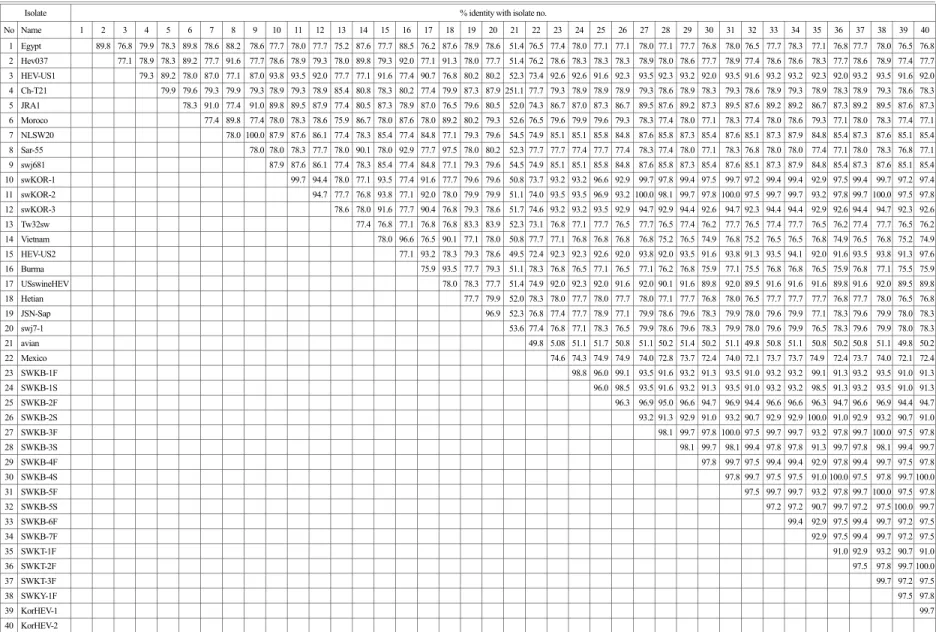
Eighteen HEV isolates were genetically analyzed by comparing the highly conserved 323 bp of ORF2 to those of other human and swine HEV isolates (Table 2). The iso- lates shared the identities of 92.9% to 99.7%, 93.2% to 100% and 92.3% to 94.7% against swKOR1, swKOR2, and swKOR3 of Korean isolates reported previously, respecti- vely. In comparison with the human and swine strains, the sequences of KorHEV-1 against SWKB-5S, and those of SWKB-3S, SWKB-4S and SWKT-2F against KorHEV-2 showed 99.4 to 100% identity. Two human HEV isolates;
KorHEV-1 and KorHEV-2, shared 99.7% homology. In comparison with the foreign isolates, 18 isolates shared 89.5% to 92.3% identities with the prototype U. S. swine HEV strain (AF082843), 85.1% to 89.5% identities with Table 1. Detection of HEV RNA in the specimens from the pigs and humans
No. of positive samples (%) Species Age groups No. of samples
tested Feces Serum Designation of isolates
2a 29 0 0
3 67 11 (16.4) 5 (7.5)
4 49 0 0
5 25 0 0
Pig
>7 (sows) 30 0 0
SWKB1F, SWKB2F, SWKB3F, SWKB4F, SWKB5F, SWKB6F, SWKB7F, SWKB1S, SWKB2S, SWKB3S, SWKB4S, SWKB5S SWKT1F, SWKT2F, SWKT3F, SWKY1F
Subtotal 200 11 ( 5.5) 5 (2.5)
Human 30~50b 100 NT 2 (2.0) KorHEV-1, KorHEV-2
a Month old, b Years old, NT; not tested
Table 2. Pairwise comparison of the nucleotide identity of partial ORF2 gene (6020~6342 nt) of 18 HEV isolates identified in this study and other selected strains of HEV worldwidea
Isolate % identity with isolate no.
No Name 1 2 3 4 5 6 7 8 9 10 11 12 13 14 15 16 17 18 19 20 21 22 23 24 25 26 27 28 29 30 31 32 33 34 35 36 37 38 39 40 1 Egypt 89.8 76.8 79.9 78.3 89.8 78.6 88.2 78.6 77.7 78.0 77.7 75.2 87.6 77.7 88.5 76.2 87.6 78.9 78.6 51.4 76.5 77.4 78.0 77.1 77.1 78.0 77.1 77.7 76.8 78.0 76.5 77.7 78.3 77.1 76.8 77.7 78.0 76.5 76.8 2 Hev037 77.1 78.9 78.3 89.2 77.7 91.6 77.7 78.6 78.9 79.3 78.0 89.8 79.3 92.0 77.1 91.3 78.0 77.7 51.4 76.2 78.6 78.3 78.3 78.3 78.9 78.0 78.6 77.7 78.9 77.4 78.6 78.6 78.3 77.7 78.6 78.9 77.4 77.7 3 HEV-US1 79.3 89.2 78.0 87.0 77.1 87.0 93.8 93.5 92.0 77.7 77.1 91.6 77.4 90.7 76.8 80.2 80.2 52.3 73.4 92.6 92.6 91.6 92.3 93.5 92.3 93.2 92.0 93.5 91.6 93.2 93.2 92.3 92.0 93.2 93.5 91.6 92.0 4 Ch-T21 79.9 79.6 79.3 79.9 79.3 78.9 79.3 78.9 85.4 80.8 78.3 80.2 77.4 79.9 87.3 87.9 251.1 77.7 79.3 78.9 78.9 78.9 79.3 78.6 78.9 78.3 79.3 78.6 78.9 79.3 78.9 78.3 78.9 79.3 78.6 78.3 5 JRA1 78.3 91.0 77.4 91.0 89.8 89.5 87.9 77.4 80.5 87.3 78.9 87.0 76.5 79.6 80.5 52.0 74.3 86.7 87.0 87.3 86.7 89.5 87.6 89.2 87.3 89.5 87.6 89.2 89.2 86.7 87.3 89.2 89.5 87.6 87.3 6 Moroco 77.4 89.8 77.4 78.0 78.3 78.6 75.9 86.7 78.0 87.6 78.0 89.2 80.2 79.3 52.6 76.5 79.6 79.9 79.6 79.3 78.3 77.4 78.0 77.1 78.3 77.4 78.0 78.6 79.3 77.1 78.0 78.3 77.4 77.1 7 NLSW20 78.0 100.0 87.9 87.6 86.1 77.4 78.3 85.4 77.4 84.8 77.1 79.3 79.6 54.5 74.9 85.1 85.1 85.8 84.8 87.6 85.8 87.3 85.4 87.6 85.1 87.3 87.9 84.8 85.4 87.3 87.6 85.1 85.4 8 Sar-55 78.0 78.0 78.3 77.7 78.0 90.1 78.0 92.9 77.7 97.5 78.0 80.2 52.3 77.7 77.7 77.4 77.7 77.4 78.3 77.4 78.0 77.1 78.3 76.8 78.0 78.0 77.4 77.1 78.0 78.3 76.8 77.1 9 swj681 87.9 87.6 86.1 77.4 78.3 85.4 77.4 84.8 77.1 79.3 79.6 54.5 74.9 85.1 85.1 85.8 84.8 87.6 85.8 87.3 85.4 87.6 85.1 87.3 87.9 84.8 85.4 87.3 87.6 85.1 85.4 10 swKOR-1 99.7 94.4 78.0 77.1 93.5 77.4 91.6 77.7 79.6 79.6 50.8 73.7 93.2 93.2 96.6 92.9 99.7 97.8 99.4 97.5 99.7 97.2 99.4 99.4 92.9 97.5 99.4 99.7 97.2 97.4 11 swKOR-2 94.7 77.7 76.8 93.8 77.1 92.0 78.0 79.9 79.9 51.1 74.0 93.5 93.5 96.9 93.2 100.0 98.1 99.7 97.8 100.0 97.5 99.7 99.7 93.2 97.8 99.7 100.0 97.5 97.8 12 swKOR-3 78.6 78.0 91.6 77.7 90.4 76.8 79.3 78.6 51.7 74.6 93.2 93.2 93.5 92.9 94.7 92.9 94.4 92.6 94.7 92.3 94.4 94.4 92.9 92.6 94.4 94.7 92.3 92.6 13 Tw32sw 77.4 76.8 77.1 76.8 76.8 83.3 83.9 52.3 73.1 76.8 77.1 77.7 76.5 77.7 76.5 77.4 76.2 77.7 76.5 77.4 77.7 76.5 76.2 77.4 77.7 76.5 76.2 14 Vietnam 78.0 96.6 76.5 90.1 77.1 78.0 50.8 77.7 77.1 76.8 76.8 76.8 76.8 75.2 76.5 74.9 76.8 75.2 76.5 76.5 76.8 74.9 76.5 76.8 75.2 74.9 15 HEV-US2 77.1 93.2 78.3 79.3 78.6 49.5 72.4 92.3 92.3 92.6 92.0 93.8 92.0 93.5 91.6 93.8 91.3 93.5 94.1 92.0 91.6 93.5 93.8 91.3 97.6 16 Burma 75.9 93.5 77.7 79.3 51.1 78.3 76.8 76.5 77.1 76.5 77.1 76.2 76.8 75.9 77.1 75.5 76.8 76.8 76.5 75.9 76.8 77.1 75.5 75.9 17 USswineHEV 78.0 78.3 77.7 51.4 74.9 92.0 92.3 92.0 91.6 92.0 90.1 91.6 89.8 92.0 89.5 91.6 91.6 91.6 89.8 91.6 92.0 89.5 89.8 18 Hetian 77.7 79.9 52.0 78.3 78.0 77.7 78.0 77.7 78.0 77.1 77.7 76.8 78.0 76.5 77.7 77.7 77.7 76.8 77.7 78.0 76.5 76.8 19 JSN-Sap 96.9 52.3 76.8 77.4 77.7 78.9 77.1 79.9 78.6 79.6 78.3 79.9 78.0 79.6 79.9 77.1 78.3 79.6 79.9 78.0 78.3 20 swj7-1 53.6 77.4 76.8 77.1 78.3 76.5 79.9 78.6 79.6 78.3 79.9 78.0 79.6 79.9 76.5 78.3 79.6 79.9 78.0 78.3 21 avian 49.8 5.08 51.1 51.7 50.8 51.1 50.2 51.4 50.2 51.1 49.8 50.8 51.1 50.8 50.2 50.8 51.1 49.8 50.2 22 Mexico 74.6 74.3 74.9 74.9 74.0 72.8 73.7 72.4 74.0 72.1 73.7 73.7 74.9 72.4 73.7 74.0 72.1 72.4 23 SWKB-1F 98.8 96.0 99.1 93.5 91.6 93.2 91.3 93.5 91.0 93.2 93.2 99.1 91.3 93.2 93.5 91.0 91.3 24 SWKB-1S 96.0 98.5 93.5 91.6 93.2 91.3 93.5 91.0 93.2 93.2 98.5 91.3 93.2 93.5 91.0 91.3 25 SWKB-2F 96.3 96.9 95.0 96.6 94.7 96.9 94.4 96.6 96.6 96.3 94.7 96.6 96.9 94.4 94.7 26 SWKB-2S 93.2 91.3 92.9 91.0 93.2 90.7 92.9 92.9 100.0 91.0 92.9 93.2 90.7 91.0 27 SWKB-3F 98.1 99.7 97.8 100.0 97.5 99.7 99.7 93.2 97.8 99.7 100.0 97.5 97.8 28 SWKB-3S 98.1 99.7 98.1 99.4 97.8 97.8 91.3 99.7 97.8 98.1 99.4 99.7 29 SWKB-4F 97.8 99.7 97.5 99.4 99.4 92.9 97.8 99.4 99.7 97.5 97.8 30 SWKB-4S 97.8 99.7 97.5 97.5 91.0 100.0 97.5 97.8 99.7 100.0 31 SWKB-5F 97.5 99.7 99.7 93.2 97.8 99.7 100.0 97.5 97.8
32 SWKB-5S 97.2 97.2 90.7 99.7 97.2 97.5 100.0 99.7
33 SWKB-6F 99.4 92.9 97.5 99.4 99.7 97.2 97.5
34 SWKB-7F 92.9 97.5 99.4 99.7 97.2 97.5
35 SWKT-1F 91.0 92.9 93.2 90.7 91.0
36 SWKT-2F 97.5 97.8 99.7 100.0
37 SWKT-3F 99.7 97.2 97.5
38 SWKY-1F 97.5 97.8
39 KorHEV-1 99.7
40 KorHEV-2
a References for other HEV strains used in comparisons: Hev037 (X98292, India), Sar-55 (M80581, Pakistan), Vietnam (AF170450), Burma (M73218), JRA1 (AP003430, Japan), Hetian (L08816, China), Ch-T21 (AF151963, China), Tw32sw (AF117280, Taiwan), Morocco (AF065061), Mexico (M74506), U.S. swine HEV (AF082843), HEV-US1 (AF060668, U.S.), HEV-US2 (AF060669, U.S.), avian (AY043166, U.S.). swj7-1 (AB094219, Japan), JSN-Sap (AB091395, Japan), swj681 (AB073910, Japan), NLSW20 (AF336290, Netherlands), Egypt (AF051351), swKOR1 (AF516178, Korea), swKOR2 (AF516179, Korea), and swKOR3 (AF527942, Korea)
Detection of Hepatitis E Virus in Pigs and Human in Korea35
Japanese swine HEV strains, 84.8% to 87.9% identities with a Netherland strain and 76.2% to 77.7% identities with a Taiwanese swine HEV. In contrast, the 18 isolates shared 49.8% to 51.7% nucleotide sequence identities with the avian HEV and 72.1% to 74.9% identifies with Mexican isolates (Table 2).
Phylogenetic analysis showed that all the Korean HEV isolates identified in this study clustered in the same geno- type with three swine HEV strains, swKOR1, swKOR2 and swKOR3, which were previously isolated from the pig sera in Korea, and with the human and swine HEV strains iso- lated from the United States, Japan and Netherland. They formed a distinct branch in genotype III (Fig. 1). The 18 isolates were also closely related to the prototype U.S. swine HEV isolate, two U.S. human HEV strains (US1, US2) and
other recently identified from swines in Japan (swj681) and Netherland (NLSW20) (Fig. 1).
DISCUSSION
Recently, numerous novel strains of HEV have been identified from human and swine in both developing and industrialized countries. And swine HEV was known to be genetically related to human HEV strains. It has been reco- gnized that a large portion of pigs are infected with the HEV in the world (10,31). The swine HEV appeared to be non-pathogenic for pigs and primates in experimental infec- tions, but it might become pathogenic in the immunosup- pressed animals and humans (12,30).
In this study, a total of 18 HEV strains, comprising 16 Figure 1. Phylogenetic tree analysis of Korean isolates of swine HEV by comparison of the conserved 323 bp (6020~6342 nt) of ORF2 in the various swine and human HEV isolates. Groups; I, II, III and IV.
strains from pigs and 2 strains from human, were isolated from the fecal and serum samples from swine and human by the nested RT-PCR for the partial ORF2 gene. Swine HEV RNA was isolated from fecal and serum samples obtained only from the swine group at 3 month of age. The relevance within age groups in infection of swine and human HEV has been reported, indicating that a prevalent age groups for HEV is evidently present (2,13,31). However, the reason of age prevalence in swine HEV infection has never been elucidated. Based on the viremic patterns, sero- logical changes and shedding of the virus in feces, it is conjectured that susceptibility of swine and infectivity of the virus would be closely dependent on the swine ages.
Further experimental studies need to demonstrate the rela- tionship between the age and pathogenesis of swine HEV.
The detection rates of swine HEV RNA were much higher in stool samples than those in serum samples. These data indicate that more HEV particles are present in feces than serum, and some of the pigs and human examined were at the viremic phase. We have tentatively classified the pig farms into 3 groups by bleeding conditions, and the preva- lence of HEV RNA was analyzed. It was found that the farms with better bleeding condition showed the lower pre- valence of HEV (data not shown). We suppose that this observation may support that the hygienic measures in swine farm would be important to prevent the transmission of HEV.
Cross-species infection of HEV has been documented and evidence that hepatitis E is a zoonosis is accumulating (9,12,14,15,17). In this study, the sequences of KorHEV-1 against SWKB-5S, and those of SWKB-3S, SWKB-4S and SWKT-2F against KorHEV-2 showed almost 100% identity.
These results indicate that swine HEV could be infected over interspecies between swine and human in Korea. The phylogenetic analysis revealed that all of 16 swine HEV isolates from this study clustered in the same group with the KorHEV-1 and KorHEV-2 strain from human, but were distinct from the Taiwanese swine HEV and most strains of human HEV from other countries. These data indicate that, as with human HEV strains, swine HEV strains from di- fferent geographic regions of the world are also genetically heterogenic.
A prototype swine HEV strain of genotype III isolated in the United States showed nucleotide sequence identity of
91.8% to a human HEV strain of US origin (US2) over the entire genome (16,24). Recently, Japanese isolates of swine and human HEV classified into genotype IV HEV (swJ13-1 and HE-JA1, respectively) were reported closely related with 99.0% identity over the entire genome. On the amino acid sequence level, swJ13-1 and HE-JA1 shared 99.8%, 100% and 100% identities in ORFs 1, 2 and 3, respectively, indicating that swJ13-1 and HE-JA1 express a capsid protein with an identical amino acid sequence and that they are antigenically indistinguishable from each other (8,24,25).
Similarly, Taiwan, China and European swine isolates were closely related with human HEV strain. These reports sug- gest that, in particular geographical regions, the HEV strains isolated from pigs and humans are genetically closely rela- ted.
In comparison of the nucleotide sequence between 16 swine HEV and 2 human HEV isolates, the range of iden- tities was 92.3% to 100%. In comparison with the human strains, the sequences of KorHEV-2, and SWKB-3S, SWKB- 4S and SWKT-2F from pig also showed 99.4 to 100%
identity as same as the sequence of KorHEV-1 from human versus SWKB-5F from pig. These findings support the hy- pothesis that swine HEV isolates may act as zoonotic agents in Korea. The facts that the swine strain showed the highest similarity with a human strain isolated in the same country implicate that zoonotic infection of HEV between humans and pigs occurs. In this study it was evident that 18 HEV isolates comprising 16 swine HEV and 2 human HEV were grouped into genotype III by phylogenetic tree analysis and were closely related to the swine and human HEV isolates identified in the United States, Japan and Netherland.
Recently, xenotransplantation has become the focus of intensive research for a solution to the shortage of organ donors for transplantations (12,30). Swine are relatively easy to breed and maintain; therefore, xenotransplantation with pig organs has received considerable attention. However, xenozoonoses, the transmission of pathogens from pigs to human recipients, is of major concern in xenotransplanta- tion using pigs as donor animal (12,28). Elimination of the zoonotic agents from the pigs is considered as a critical subject for transplantation of pig organs to humans.
Our results suggest that the swine HEV is widely distri- buted in the commercial swine herds in Korea and some pigs and human are viremic state of hepatitis E virus. The
swine HEV may have the ability to cross species barriers to infect humans. Therefore, it needs to raise further public health concerns for HEV zoonosis not only for xenotrans- plantation studies but also for control of human hepatitis E virus infection.
Acknowledgments
We thank Se-Jong Park of the Hong Sung Jo-Eun veter- inary hospital for his kind assistance for collection of por- cine specimens. This work was supported by grant No.
R11-2002-100-00000-0 from ERC program of the Korea Science & Engineering Foundation. This study was also financially supported by Research Fund of Chungnam Nati- onal University in 2004.
REFERENCES
1) Aggarwal R, Krawczynski K: Hepatitis E: an over- view and recent advances in clinical and laboratory research. J Gastroenterol Hepatol 15: 9-20, 2000.
2) Ahn JM, Kang SG, Lee DY, Shin SJ, Yoo HS: Identi- fication of novel human hepatits (HEV) isolates and determination of the seroprevalence of HEV in Korea.
J Clin Microbiol 43(7): 3042-3048, 2005.
3) Arankalle VA, Chobe LP, Joshi MV, Chadha MS, Biduth K, Walimbe AM: Human and swine hepatitis E viruses from Western India belong to different geno- types. J Hepato 36: 417-425, 2002.
4) Arankalle VA, Joshi MV, Kulkarni AM, Gandhe SS, Chobe LP, Rautmare SS, Mishra AC, Padbidri VS:
Prevalence of anti-hepatitis E virus antibodies in di- fferent Indian animal species. J Viral Hepat 8: 223-227, 2001.
5) Berke T, Matson DO: Reclassification of the Calici- viridae into distinct genera and excluion of hepatits E virus from the family on the basis of comparative phy- logenetic analysis. Arch Virol 145: 1421-1436, 2000.
6) Chandler JD, Riddell MA, Li F, Love RJ, Anderson DA: Serological evidence for swine hepatitis E virus infection in Australian pig herds. Vet Microbiol 68: 95 -105, 1999.
7) Choi CS, Ha SK, Chae CH: Development of nested RT-PCR for the detection of swine hepatitis E virus in formalin-fixed, paraffin-embedded tissues and compa-
rison with in situ hybridization. Journal of Virological Methods 115: 67-71, 2004.
8) Favorov MO, Kosoy MY, Tsarev SA, Childs JE, Margolis HS: Prevalence of antibody to hepatitis E virus among rodents in the United States. J Infect Dis 181: 449-455, 2000.
9) Halbur PG, Kasorndorkbua C, Gilbert C, Guenette D, Potters MB, Purcell RH, Emerson SU, Toth TE, Meng XJ: Comparative pathogenesis of infection of pigs with hepatitis E viruses recovered from a pig and a human. J Clin Microbiol 39: 918-923, 2001.
10) Hsieh SY, Meng XJ, Wu YH, Liu ST, Tam AW, Lin DY, Liaw YF: Identity of a novel swine hepatitis E virus in Taiwan forming a monophyletic group with Taiwan isolates of human hepatitis E virus. J Clin Microbiol 37: 3828-3834, 1999.
11) Huang FF, Haqshenas G, Guenette DK, Halbur PG, Schommer SK, Pierson FW, Toth TE, Meng XJ:
Detection by reverse transcription-PCR and genetic characterization of field isolates of swine hepatitis E virus from pigs in different geographic regions of the United States. J Clin Mincrobiol 40: 1326-1332, 2002.
12) Meng XJ: Swine hepatitis E virus: cross-species in- fection and risk in xenotransplantation. Curr Top Cro- biol Immunol 278: 185-216, 2003.
13) Meng XJ, Dea S, Engle RE, Friendship R, Lyoo YS, Sirinarumitr T, Urairong K, Wang D, Yoo D, Zhang Y, Purcell RH, Emerson SU: Prevalence of anti- bodies to the hepatitis E virus in pigs from countries where hepatitis E is common or rare in the human population. J Med Virol 59: 297-302, 1999.
14) Meng XJ, Halbur PG, Haynes JS, Tsareva TS, Bruna JD, Royer RL, Purcell RH, Emerson SU:
Experimental infection of pigs with the newly identi- fied swine hepatitis E virus (swine HEV), but not with human strains of HEV. Arch. Virol 143: 1405-1415, 1998.
15) Meng XJ, Halbur PG, Shapiro MS, Govindarajan S, Bruna JD, Musgahwar IK, Purcell RH, Emerson SU: Genetic and experimental evidence for cross-species infection by the swine hepatitis E virus. J Virol 72:
9714-9721, 1998.
16) Meng XJ, Purcell RH, Halbur PG, Lehman JR, Webb DM, Tsareva TS, Haynes JS, Thacker BJ,
Emerson SU: A novel virus in swine is closely related to the human hepatitis E virus. Proc Natl Acad Sci USA 94: 9860-9865, 1997.
17) Meng XJ, Wiseman B, Elvinger F, Guenette DK, Toth TE, Engle RE, Emerson SU, Purcell RH: Pre- valence of antibodies to hepatitis E virus in veterina- rians working with swine and in normal blood donors in the United States and other countries. J Clin Micro- biol 40: 117-122, 2002.
18) Okamoto H, Takahashi M, Nishizawa T, Fukai K, Muramatsu U, Yoshikawa A: Analysis of the com- plete genome of indigenous swine hepatitis E virus isolated in Japan. Biochem. Biophys. Res Commun 289:
929-936, 2001.
19) Poel VD, Verschoor F, Heide RVD, Herrera MI, Vivo A, Kooreman M, Husman DA: Hepatitis E virus sequences in swine related to sequences in humans, the Netherlands. Emerg Infect Dis 7: 970-976, 2001.
20) Pringle CR: Virus taxonomy-San Diego 1998. Arch Virol 143: 1449-1459, 1998.
21) Purcell RH: Hepatitis E virus, p. 2831-2843. In Fields BN. Knipe DM, Howley PM, et al. (ed.), Fields virology, 4rd ed., vol. 2. Lippincott-Raven Publishers, Philadel- phia, 2001.
22) Reyes GR: Overview of the epidemiology and biology of the hepatitis E virus, p. 239-258. In Willsen RA (ed.), Viral hepatitis. Marcel Dekker, Inc., New York, N.Y., 1997.
23) Schlauder GG, Dawson GJ, Erker JC, Kwo PY, Knigge MF, Smally DL, Rosenblatt JE, Desai SM, Mushahwar IK: The sequence and phylogenetic analysis of a novel hepatitis E virus isolated from a patient with acute hepatitis reported in the United States. J Gen Virol 79: 447-456, 1998.
24) Takahashi K, Kang JH, Ohnishi S, Hino K, Miya-
kawa H, Miyakawa Y, Maekubo H, Mishiro S: Full- length sequences of six hepatitis E virus isolates of genotypes III and IV from patients with sporadic acute or fulminant hepatitis in Japan. Intervirology 46(5):
308-314, 2003.
25) Takahashi M, Nishizawa T, Miyajima H, Gotanda Y, Iita T, Tsuda F, Okamoto H: Swine hepatitis E virus strains in Japan form four phylogenetic clusters com- parable with those of Japanese isolates of human hepa- titis E virus. J Gen Virol 84: 851-862, 2003.
26) Wang Y, Zhang H, Li Z, Gu W, Lan H, Hao W, Ling R, Li H, Harrison TJ: Detection of sporadic cases of hepatitis E virus (HEV) infection in China using im- munoassays based on recombinant open reading frame 2 and 3 polypeptides from HEV genotype 4. J Clin Microbiol 39: 4370-4379, 2001.
27) Wang Y, Zhang H, Xia N, et al: Prevalence, isolation, and partial sequence analysis of hepatitis E virus from domestic animals in China. J Med Virol 67: 516-521, 2002.
28) Weiss RA: Transgenic pigs and virus adaptation. Nature 391: 327-328, 1998.
29) Wu JC, Chen CM, Chiang TY, Tsai WH, Jeng WJ, Sheen IJ, Kin CC, Meng XJ: Spread of hepatitis E virus among different-aged pigs: two-year survey in Taiwan. J Med Virol 66: 488-492, 2002.
30) Yoo D, Giulivi A: Xenotransplantation and the poten- tial risk of xenogeneic transmission of porcine viruses.
Can J Vet Res 64: 193-203, 2000.
31) Yoo D, Willson P, Pei Y, Hayes MA, Deckert A, Dewey CE, Friendship RM, Yoon Y, Gottschalk M, Yason C, Giulivi A: Prevalence of hepatitis E virus antibodies in Canadian swine herds and identification of a novel variant of swine hepatitis E virus. Clin Diagn Lab Immunol 8: 1213-1219, 2001.