서 론
전이성 척추종양은 암환자에서 흔히 관찰되는 전이성 병 변으로, 전체 암환자의 약 5~10% 정도에서 척추전이가 발 견되며, 전이가 있는 암환자의 약 70%에서 척추전이가 진
CLINICAL ARTICLE
J Korean Neurotraumatol Soc 2011;7:57-62 ISSN 1738-8708
단된다.22-24,36,37) 이러한 전이성 척추종양에 대한 기본적인
치료는 방사선치료라 하겠으나 척수신경 압박에 의한 하지 위약이나 대소변 기능장애 등 신경학적인 증상이 나타난다 거나 척추 불안정성, 방사선 치료 실패시 수술적 치료를 고 려할 수 있다.3,4,12,19) 과거에는 척수 감압의 목적으로 주로 후궁 절제술을 시행했었으나 그 효과와 부작용 등이 논란 이 되어 왔고, 최근에는 적극적인 척수 감압과 척추고정 수 술방법이 보편화되면서 치료성적에 괄목할 만한 발전을 이
루었다.9,10,30,33,34) 이러한 전이성 척추종양의 수술의 목적은
생존기간의 연장과 더불어 quality of life (QOL)의 향상이라 고 했는데,9,10) 이를 바탕으로 과거에는 en bloc spondylec- Received: March 29, 2011 / Revised: August 13, 2011
Accepted: August 15, 2011
Address for correspondence: Sang Ryong Jeon, MD, PhD Department Neurological Surgery, Asan Medical Center, Univer- sity of Ulsan, College of Medicine, 88 Olympic-ro 43-gil, Songpa- gu, Seoul 138-736, Korea
Tel: +82-2-3010-3550, Fax: +82-2-3010-3550 E-mail: [email protected]
전이성 흉추 척추종양의 전후방 접근법과 후방 접근법의 수술 전후 효과 비교
울산대학교 의과대학 서울아산병원 신경외과학교실
김지훈 .박진훈 .전상용
Comparison of Peri-Operative Effectiveness between Anterior-Posterior Approach and Posterior Only Approach in Metastatic Thoracic Spinal Tumor
Ji Hoon Kim, MD, Jin Hoon Park, MD and Sang Ryong Jeon, MD, PhD
Department Neurological Surgery, Asan Medical Center, University of Ulsan, College of Medicine, Seoul, Korea
Objective: This paper shows the appropriate method of metastatic thoracic spine cord surgery by comparing survival, pain scale (Numeric Rating Scale) and Barthel index which are considered as the prognosis of surgery in anterior-posteri- or approach and posterior approach. Methods: The author has researched 61 cases of metastatic thoracic spine tumor op- erations; 10 cases of anterior-posterior approach and 51 cases of posterior approach, performed in this institution for 8 years from January 2001 to December 2008. The author has compared improvement of neurologic symptoms after surgery (improvement in ambulation), survival, pain scale (Numeric Rating Scale) and functional outcome according to Barthel in- dex. Statistical analysis was done using Kaplan Meyer Survival analysis, Log-Rank test and Mann-Whitney test. Results:
The average age of patients who received surgery were 56.8 years (35-72 years) and 53.9 years (26-75 years), in the ante- rior-posterior approach group and the posterior approach group respectively. The Barthel index increased from average 68.7 to 72.9 in the anterior-posterior approach group and 61.6 to 69.3 in the posterior approach group (p=0.027, p<0.001).
Improvement in pain were 40% in the anterior-posterior approach group and 51% in the posterior approach on 1 month post- operation. Both posterior decompression and screw fixation were performed in both operations, and it has shown that there were no significant difference in survival, improvement of ambulation, improvement in pain and functional outcome compared with the anterior-posterior approach. Conclusion: Considering similar survival and clinical outcomes, posterior approach can minimize morbidity related with operation. (J Korean Neurotraumatol Soc 2011;7:57-62)
KEY WORDS: Metastatic spinal tumor ㆍAnterior-posterior approach ㆍPosterior approach ㆍPrognosis.
tomy로 광범위하게 종양을 절제하고 360도 고정하는 전 후방 접근법이 주류를 이뤘으나,20,21) 최근에는 이러한 수술 법이 흉부나 후 복부를 열어야 하며 내부장기에 손상을 줄 수 있는 단점이 있으며 신경 감압 및 후방 접근 고정술에 비 하여 수술 이후 신경학적인 호전 및 생존률 향상에 유의한 차 이가 없음이 보고되고 있다.5-7) 따라서 저자는 흉추전이 종 양의 전후방 접근법과 후방 접근법을 시행하는 수술법의 예 후라고 생각되는 생존, 통증지수(Numeric Rating Scale) 과 Barthel index를 이용한 기능적 예후 등을 비교분석 하 여 이러한 전이성 흉추종양의 적합한 수술법에 대해서 논 하고자 한다.
대상 및 방법
본 논문은 2001년 1월부터 2008년 12월까지 8년 동안 본원에서 시행된 전이성 흉추종양수술에 대한 후향적인 분 석(retrospective analysis)을 바탕으로 하였다. 원발암이 진단이 되었고 신경학적인 위약 증상이 명확한 전이성 척추 종양 61예에 대한 연구하였다. 모든 환자에서 MRI와 CT 로 진단하였으며 원발성 종양의 진행 정도를 평가하기 위 해 bone scan, ultrasonography, CT 등을 시행하였다. 백혈 구, 혈소판, performance scale, bleeding tendency, 영양상 태(체중, 혈중 albumin, protein)로 환자의 전신상태를 평 가하여 수술적 치료의 적용 유무를 판단하였다. 신세포암, 간암, 갑상선암 같은 과다 혈관종양은 수술시 출혈을 최소 화하기 위해 응급수술을 제외하고는 색전술을 시행하였고 수술적 치료에 있어서 단순히 종양 감압술을 시행한 경우 는 배제하였다. 남녀의 비는 38 대 23로 남자가 많았으며, 수 술 당시의 평균 나이는 54.6세 (45~75세)까지로 측정되었다.
흉추전이된 종양들만을 대상으로 하였고, 수술법에 의해 두 그룹으로 분류되었다. 전후방 접근 그룹은 단일 혹은 양 일 수술을 통해 최대한 종양의 제거 후 전방 재건 및 후방 나사못 고정술을 하였고, 후방 접근법은 후궁과 후관절을 제거하여 감압한 후 후방에서 제거 가능한 최대한 종양의 제거하고 나사못 제거술을 시행하였다 (Figure 1A, B). 각각 의 그룹에서의 원발암 종류와 환자의 특징은 Table 1에 기 술하였다. 수술의 적응증은 진행하는 하지 위약이 있는 경우 로만 국한하였다. 수술 이후 신경학적인 호전(보행 가능 정 도 비교), 생존, 통증지수(Numeric Rating Scale)과 Barthel Index를 이용한 기능적 예후 등을 비교분석 하였다. 신경학 적인 호전 또는 보행 정도는 수술 6개월 후에 평가하였다.
통계학적 분석법으로는 Kaplan Meyer survival 분석, Log- Rank test, Mann-Whitney test 등을 사용하였다.
결 과
각 그룹에 해당되는 환자 수는 전후방 접근그룹이 10예, 후방 접근그룹이 51예였다. 전후방 접근법으로 수술을 받은 환자들의 평균 나이는 56.8세 (35~72세)였고, 후방 접근법 을 받은 환자의 평균나이는 53.9세 (26~75세)였으며, 평균 surgical level은 전후방 접근법과 후방 접근법은 각각 1.04 (1-2)와 1.18 (1-3)으로 두 수술법 간의 나이와 surgical level에 따른 유의한 차이는 없었다. 전이성 척추종양 환자 에 있어서 수술의 적응증, 예후 등을 평가하는 Tokuhashi score를 비교해보면 전후방 접근법에서는 score가 7.3±
2.36이며 후방 접근법에서는 6.5±2.3이었으며, 각 모집단 간에 성비와 tumor location에 따른 차이도 보이지 않았다 (Table 1). 각 수술법을 시행 받은 환자에 대해서 수술 전
FIGURE 1. A: Radiographic photography of anterior-posterior group. B: Radiographic photography of posterior group.
B
A
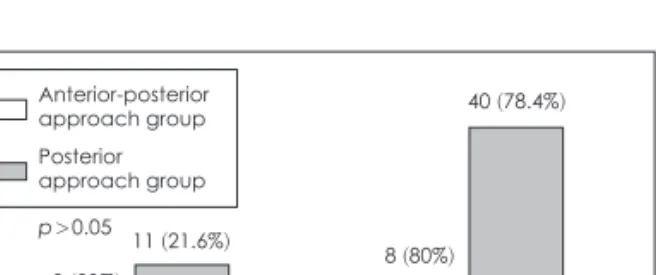
후의 보행상태를 비교하였고, 수술 전 각각 Bed ridden, Wheel chair, walker, cane 보행으로 분류되었고, 수술 후 호전 및 보행 정도는 wheel chair와 amblation with or without aid로 분류하였다. 각 그룹의 호전 정도에 있어 두 그룹간의 통계적인 유의한 차이는 없었다 (p=0.074)(Figure 2, 3). Bethel index (BI)는 만성 질병을 가진 환자의 재활 에 있어서 독립생활을 할 수 있는가를 점수로 환산한 단순 지표로, 수술법 간의 Barthel index와 통증의 호전 정도에 대해서 비교하였는데 먼저 Barthel index의 경우 전후방 그 룹의 경우는 평균 68.7에서 72.9로 증가하였고, 후방 그룹 의 경우에는 평균 61.6에서 69.3으로 증가하였다 (p=0.027,
p<0.001). 하지만 두 그룹 간의 호전 정도의 차이에 있어서
는 의미 있는 차이를 보이지 않았다 (p=0.085)(Figure 4).
통증에 관한 예후를 비교해 보면 수술 한달 째 양 그룹에 서 전후방 접근법이 40%, 후방그룹이 51%에서 호전을 보였 으나 각 그룹간의 의미 있는 차이를 보이지는 않았다 (Figure 5). 수술 이후 발생한 합병증으로는 술후 출혈, 감염, 수술 중 출혈, 잘못된 위치의 케이지, 증상이 나타나서 수술이 필요했던 재발이 보고되었고, 두 모집단에서 고정 기구의 이 탈, 균열, 파손 같은 실패는 없었다 (Table 2).
고 찰
전이성 척추종양에 대한 수술적 치료는 환자의 생존기간 과 임상적인 요소 등으로 제한받아 왔으나 눌렸던 신경을 감압하고 불안정한 척추를 고정하여 진행하는 신경학적인 결손을 막고, 통증을 완화하는데 그 역할이 크다.2,5,6,8,39,40)
일반적으로 원발암은 조절되었으나 단발성으로 척추에 전 이가 발견된 경우와 신경압박으로 사지위약 등 증상이 확실 하며, 여명기간이 6개월 이상인 경우가 수술 적응증이라 할 수 있다.4,29,30,36) 단순 신경 감압만으로는 종양의 광범위 절 제가 불가능하고 척추의 불안정성만 가중시키므로 척수의 기능을 보존하고 불안정을 예방하려면 나사못 고정술치료 가 반드시 필요하다.14-19,22,32) 따라서 수술적 치료의 목적은 종양을 제거하여 신경을 감압시키며 고정기구를 사용하여 척 추의 붕괴를 막고 안정성을 유지하는데 있다.11,13,15,22,28,35,38,40)
종양의 위치가 척추체 후면에 위치하여 척수를 전방으로 압박시에는 전방접근법이 효과적이나 수술 후 혈흉, 기흉과 같은 합병증의 발병률이 높으며 전후방 360도 신경감압이 필요한 경우에는 다시 후방으로 접근해야 하는 번거로움이 있다. 따라서 척추의 전-후방 모두 종양이 침범한 경우, 척추 의 전위가 있는 경우, 다발성으로 척추에 종양이 침범되었 다가 병소가 서로 떨어져 있는 경우, 환자의 전신상태가 불 량하여 개흉술을 할 수 없는 경우에는 후방 혹은 후-측방 TABLE 1. Age and Sex, Tokuhashi score, frequency of primary cancer in each group
Anterior-posterior approach group (n=10) Posterior approach group (n=51)
Sex (male : female) 6 : 4 32 : 19
Age 56.2 (45-59) 52.5 (48-75)
Mean Tokuhashi score 7.3±2.36 6.5±2.3
Primary cancer
Breast 2 06
Kidney 2 05
Hepatobilliary system 1 09
Gastrointestinal system 1 05
Lung 0 20
Others 4 06
24
Anterior-posterior approach group
FIGURE 2. Preoperative ambulatory function in each group.
30 25 20 15 10 5
0
Bed ridden Wheel chair Walker 1
5 4
14 Posterior approach group
3 2
8
Cane
FIGURE 3. Postoperative ambulatory function in each group.
50 40 30 20 10 0
Wheel chair Ambulation with or without aid 2 (20%)
11 (21.6%)
8 (80%) 40 (78.4%) Anterior-posterior
approach group Posterior approach group p>0.05
접근법이 유용1,25-27,33,34)할 수 있는데, Overby 등31)은 후방 에서 늑골 횡돌기 절제를 시행한 다음 전방에 위치한 종양 을 제거하고 후방을 고정하여 75%에서 양호한 결과를 보 고하였다. 하지만 이 방법도 척수 손상이나 종양의 완전 제 거하기 위해서는 완전한 방법이라 할 수 없다. 전후방 접근 법은 전방 접근법에 따른 기흉, 혈흉 등의 합병증은 물론 후방 접근법에 따른 신경손상 혹은 신경근, 연조직 손상 등이 있을 수 있고, 수술시간이 길어짐에 따라 감염이 증가 할 수 있는 단점이 있다. 따라서 우리는 많은 경우에 있어 후
방에서 감압과 나사못 고정술을 같이 시행했고, 이를 전후 방 접근과 비교하였을 때, 생존, 보행향상 여부, 통증 및 기능 적 호전에 있어 차이가 없는 것을 확인하였다. Sundaresan 등40)은 종양이 three-column을 모두 침범하여 척추의 불 안전성이 매우 높아진 경우, 척추 종양의 근치적 수술로 생 명의 연장이 기대될 경우, 전방 혹은 후방 접근법으로 충분 한 척추 안정성을 확보하지 못하였을 경우 전후방 접근법 을 시행한다고 보고하였다. 이렇듯이 전방 혹은 전후방, 후 방 접근법들이 널리 쓰이고 있으나 그 예후에 있어서는 명 확히 보고하는 바가 없다. 하지만 Cahill 등40)은 전이성 척 추종양 환자에 있어서 제한적인 기대여명을 고려할 때 전 후방 접근법보다는 후방접근법을 통한 고식적 아전 척추 제거술을 하는 것이 바람직하다고 보고한 바 있다. 우리가 조사한 바에 의하면, 전후방 접근이나 후방 접근의 결과나 예후의 차이가 없다는 결론이지만, 조사 대상에 있어 전후 방 그룹의 대상환자 수가 상대적으로 적어서 한계가 있다.
또 다른 본 연구의 한계로는 후향적 분석이고 양 그룹 환 자들의 수술 전 상태를 보여주는 Tokuhashi score가 비교 적 한시적(palliative) 치료대상의 적응증이 되는 수치들로 보인다.41) 이러한 연구대상의 선택의 편향이 두 그룹간의 차 이를 줄였다고도 볼 수 있다. 척추 전이암의 수술적 결과보 다는 원발암의 치료가 환자의 생존에 좀 더 많은 영향을 미 친다 가정했을 때, 수술적 치료를 위해 의뢰되는 환자들의 많은 부분이 본 연구와 비슷한 수술 전 상태를 보일 것으로 사료된다. 수술받은 환자들의 생존 결과와 고정기구의 실패 가 없었다는 점을 고려해 볼 때, 환자에게 최소한의 수술의 부담으로 비슷한 결과를 가져온 후방 접근에 의한 수술법 이 추천 될 수 있을 것이라 사료된다.
결 론
전이성 흉추종양 환자의 치료에 있어 전후방 접근과 후 FIGURE 4. Comparison of Barthel In- dex in each group. A: Combined anteri- or-posterior group. B: Posterior group.
80 70 60 50 40 30 20 10 0
Pre-operative maximum score
Post-operative maximum score
68.7 72.9
p=0.027
A
80 70 60 50 40 30 20 10 0
Pre-operative maximum score
Post-operative maximum score 61.6
69.3
p<0.001
B
Recur 26 (51.6%)
3 (30%) 5 (9.8%) Anterior-posterior
approach group 30
25 20 15 10 5
0
Aggravation No change Improvement 3 (5.8%)
0 (0%)
3 (30%) 17 (33.3%)
4 (40%) Posterior
approach group
FIGURE 5. Postoperative pain relief in each group after a month.
TABLE 2. Mean surgical level and Surgical complications Anterior-
posterior approach group (n=2/10)
Posterior approach group (n=5/51) Mean surgical level (range) 1.04 (1-2) 1.18 (1-3)
Post operative bleeding 0 2
Wound infection 0 1
Intra OP massive bleeding 1 1
Cage malposition 1 0
Symptomatic recurrence
(SCC) 0 1
Instrument failure 0 0
OP: operative
방 접근으로 수술하는 경우 생존, 보행, 통증, 합병증 등에 유의한 차이는 없었다. 전이 종양 환자의 여생과 전후방 수 술에 의한 이병률을 고려해볼 때, 후방접근에 의한 수술법 이 추천된다. 하지만 본 연구는 균등하지 않은 모집단의 수, 편향된 환자들의 수술 전 상태를 보이고 있어 좀 더 많은 환자를 대상으로 하는 연구가 필요하다.
중심 단어: 전이성 척추종양・전후방 접근법・후방 접근법・
예후.
■ The authors have no financial conflicts of interest.
REFERENCES
1) Akeyson EW, McCutcheon IE. Single-stage posterior vertebrec- tomy and replacement combined with posterior instrumentation for spinal metastasis. J Neurosurg 85:211-220, 1996
2) Bach F, Larsen BH, Rohde K, Børgesen SE, Gjerris F, Bøge- Rasmussen T, et al. Metastatic spinal cord compression. Occur- rence, symptoms, clinical presentations and prognosis in 398 pa- tients with spinal cord compression. Acta Neurochir (Wien) 107:37-43, 1990
3) Barcena A, Lobato RD, Rivas JJ, Cordobes F, de Castro S, Cabre- ra A, et al. Spinal metastatic disease: analysis of factors deter- mining functional prognosis and the choice of treatment. Neuro- surgery 15:820-827, 1984
4) Black P. Spinal metastasis: current status and recommended guidelines for management. Neurosurgery 5:726-746, 1979 5) Boland PJ, Lane JM, Sundaresan N. Metastatic disease of the
spine. Clin Orthop Relat Res:95-102, 1982
6) Brice J, Mckissock W. Surgical treatment of malignant extradural spinal tumours. Br Med J 1:1341-1344, 1965
7) Bridwell KH, Jenny AB, Saul T, Rich KM, Grubb RL. Posterior segmental spinal instrumentation (PSSI) with posterolateral de- compression and debulking for metastatic thoracic and lumbar spine disease. Limitations of the technique. Spine (Phila Pa 1976) 13:1383-1394, 1988
8) Bucy PC. The treatment of malignant tumors of the spine: a re- view. Neurology 13:938-944, 1963
9) Chadduck WM, Boop WC Jr. Acrylic stabilization of the cervical spine for neoplastic disease: evolution of a technique for vertebral body replacement. Neurosurgery 13:23-29, 1983
10) Constans JP, de Divitiis E, Donzelli R, Spaziante R, Meder JF, Haye C. Spinal metastases with neurological manifestations. Re- view of 600 cases. J Neurosurg 59:111-118, 1983
11) Cooper PR, Errico TJ, Martin R, Crawford B, DiBartolo T. A sys- tematic approach to spinal reconstruction after anterior decom- pression for neoplastic disease of the thoracic and lumbar spine.
Neurosurgery 32:1-8, 1993
12) Cybulski GR, Stone JL, Opesanmi O. Spinal cord decompression via a modified costotransversectomy approach combined with posterior instrumentation for management of metastatic neo- plasms of the thoracic spine. Surg Neurol 35:280-285, 1991 13) David W, Cahill MD, Rakesh K. Palliative subtotal vertebrecto-
my with anterior and posterior reconstruction via a single poste- rior approach. J Neurosurg 90:548-54, 1999
14) DeWald RL, Bridwell KH, Prodromas C, Rodts MF. Reconstruc- tive spinal surgery as palliation for metastatic malignancies of the spine. Spine (Phila Pa 1976) 10:21-26, 1985
15) Dunn EJ. The role of methylmethacrylate in the stabilization and replacement of the tumors of the cervical spine. Spine:15-24,
16) Faccioli F, Lima J, Bricolo A. One-stage decompression and sta-1977 bilization in the treatment of spinal tumors. J Neurosurg Sci 29:
199-205, 1985
17) Fessler RG, Dietze DD Jr, Millan MM, Peace D. Lateral parascap- ular extrapleural approach to the upper thoracic spine. J Neuro- surg 75:349-355, 1991
18) Fidler MW. Posterior instrumentation of the spine. An experi- mental comparison of various possible techniques. Spine (Phila Pa 1976) 11:367-372, 1986
19) Gilbert RW, Kim JH, Posner JB. Epidural spinal cord compres- sion from metastatic tumor: diagnosis and treatment. Ann Neu- rol 3:40-51, 1978
20) Greenberg HS, Kim JH, Posner JB. Epidural spinal cord compres- sion from metastatic tumor: results with a new treatment proto- col. Ann Neurol 8:361-366, 1980
21) Hall AJ, Mackay NN. The results of laminectomy for compres- sion of the cord or cauda equina by extradural malignant tumour.
J Bone Joint Surg Br 55:497-505, 1973
22) Harrington KD. Anterior cord decompression and spinal stabili- zation for patients with metastatic lesions of the spine. J Neuro- surg 61:107-117, 1984
23) Harrington KD. Anterior decompression and stabilization of the spine as a treatment for vertebral collapse and spinal cord com- pression from metastatic malignancy. Clin Orthop Relat Res:
177-197, 1988
24) Harrington KD. The use of methlymethacrylate for vertebr-al- body replacement and anterior stabilization of pathological frac- ture-dislocations of the spine due to metastatic malignant dis- ease. J Bone Joint Surg Am 63:1145-1157, 1986
25) Heller JG, Zdeblick TA, Kunz DA, McCabe R, Cooke ME. Spi- nal instrumentation for metastatic disease: in vitro biomechani- cal analysis. J Spinal Disord 6:17-22, 1993
26) Heller M, Perrin R, Macnab I. Treatment of metastatic disease of the spine with posterolateral decompression and luque instru- mentation. J Bone Joint Surg Br 68:853, 1986
27) King GJ, Kostuik JP, McBroom RJ, Richardson W. Surgical management of metastatic renal carcinoma of the spine. Spine (Phila Pa 1976) 16:265-271, 1991
28) Kostuik JP, Errico TJ, Gleason TF, Errico CC. Spinal stabiliza- tion of vertebral column tumors. Spine (Phila Pa 1976) 13:250- 256, 1988
29) McAfee PC, Bohlman HH. One-stage anterior cervical decom- pression and posterior stabilization with circumferential arthrod- esis. A study of twenty-four patients who had a traumatic or a neoplastic lesion. J Bone Joint Surg Am 71:78-88, 1989 30) McAfee PC, Bohlman HH, Ducker T, Eismont FJ. Failure of sta-
bilization of the spine with methylmethacrylate. A retrospective analysis of twenty-four cases. J Bone Joint Surg Am 68:1145-1157, 31) Overby MC, Rothman AS. Anterolateral decompression for met-1986 astatic epidural spinal cord tumors. Results of a modified costo- transversectomy approach. J Neurosurg 62:344-348, 1985 32) Shaw B, Mansfield FL, Borges L. One-stage posterolateral de-
compression and stabilization for primary and metastatic verte- bral tumors in the thoracic and lumbar spine. J Neurosurg 70:
405-410, 1989
33) Siegal T, Siegal T. Surgical decompression of anterior and poste- rior malignant epidural tumors compressing the spinal cord: a pro- spective study. Neurosurgery 17:424-432, 1985
34) Siegal T, Tiqva P, Siegal T. Vertebral body resection for epidural compression by malignant tumors. Results of forty-seven consec- utive operative procedures. J Bone Joint Surg Am 67:375-382, 1985
35) Sundaresan N, Choi IS, Hughes JE, Sachdev VP, Berenstein A.
Treatment of spinal metastases from kidney cancer by presurgi- cal embolization and resection. J Neurosurg 73:548-554, 1990 36) Sundaresan N, Digiacinto GV, Hughes JE, Cafferty M, Vallejo
A. Treatment of neoplastic spinal cord compression: results of a prospective study. Neurosurgery 29:645-650, 1991
37) Sundaresan N, DiGiacinto GV, Krol G, Hughes JE. Spondylecto- my for malignant tumors of the spine. J Clin Oncol 7:1485-1491, 38) Sundaresan N, Galicich JH, Lane JM. Harrington rod stabiliza-1989
tion for pathological fractures of the spine. J Neurosurg 60:282-
286, 1984
39) Sundaresan N, Galicich JH, Lane JM, Bains MS, McCormack P.
Treatment of neoplastic epidural cord compression by vertebral body resection and stabilization. J Neurosurg 63:676-684, 1985 40) Sundaresan N, Steinberger AA, Moore F, Sachdev VP, Krol G,
Hough L, et al. Indications and results of combined anterior-pos- terior approaches for spine tumor surgery. J Neurosurg 85:438- 446, 1996
41) Tokuhashi Y, Ajiro Y, Umezawa N. Outcome of treatment for spi- nal metastases using scoring system for preoperative evaluation of prognosis. Spine (Phila Pa 1976) 34:69-73, 2009