2007, Vol. 51, No. 6
Printed in the Republic of Korea
- -
Synthesis, characterization and spectral studies of various newer long chain aliphatic Acid (2-hydroxy benzylidene and 1H-indol-3-ylmethylene)
hydrazides as mosquito para-pheromones
Suman Awasthi*, Poonam Rishishwar, Ambati N. Rao, Kumaran Ganesan, and Ramesh Chandra Malhotra
Synthetic Chemistry Division, Defence Research & Development Establishment, Jhansi Road, Gwalior 474002 India (2007. 4. 3 접수)
Synthesis, characterization and spectral studies of various newer long chain aliphatic acid (2-hydroxy benzylidene and 1H-indol-3-ylmethylene)
hydrazides as mosquito para-pheromones
Suman Awasthi*, Poonam Rishishwar, Ambati N. Rao, Kumaran Ganesan, and Ramesh Chandra Malhotra
Synthetic Chemistry Division, Defence Research & Development Establishment, Jhansi Road, Gwalior-474002 India (Received April 3, 2007)
요 약. 여러가지 긴 사슬 지방산 하이드라지드는 방향족과 헤테로 고리 알데히드와 반응하여 알코올 용매하에서 2-
hydroxy benzylidene와 새로운 모기 파라-페로몬인1H-indol-3-ylmethylene hydrazides을 얻었다. 마이크로파의 조사기 술과 마찬가지로 전통적인 방법에 의한 다양한 새로운 긴고리 지방산 하이드라지드 (2-hydroxy benzylidene와 1H- indol-3-ylmethylene)의 합성방법도 보고한다. 이 화합물들의 구조는 FTIR, NMR & MS와 같은 분광학적 기법에 의해 증명되었다. 이 화합물의 전자충격질량스펙트럼 분쇄 패턴의 몇 가지 재미있는 특징도 논의했다.
주제어: 긴 사슬 지방산 하이드라지드, 긴 사슬 지방산(2-hydroxy benzylidene& 1H-indol-3-ylmethylene) 하이드라 지드, 모기 파라-페로몬, 마이크로파
ABSTRACT. Various long chain aliphatic acid hydrazides react with aromatic and heterocyclic aldehydes in alcoholic medium in refluxing conditions to give corresponding 2-hydroxy benzylidene and 1H-indol-3-ylmethylene hydrazides, a newer class of mosquito para-pheromones. We describe here synthesis of various novel long chain aliphatic acid (2- hydroxy benzylidene and 1H-indol-3-ylmethylene) hydrazides by conventional as well as microwave irradiation techniques.
The structures of these compounds have been confirmed by spectroscopic techniques (FTIR, NMR & MS). Some of the interesting features of the electron impact mass spectral fragmentation pattern of these compounds have also been discussed.
Keywords: Long Chain Aliphatic Acid Hydrazide, Long Chain Aliphatic Acid (2-hydroxy benzylidene & 1H-indol-3- ylmethylene) Hydrazide, Mosquito Para-pheromones, Microwave
INTRODUCTION
Acyl derivatives of hydrazine are called acid hydrazides. They constitute an important class of biologically active organic compounds. Hydrazides
and their condensation products are reported to pos- ses a wide range of antibacterial activity1-2 and tuberculostatic3-4 properties. Similarly derivatives of aryloxyacetyl hydrazides have antituberculotic activi- ties and some are used as post-emergence, selective
herbicides5 to control terrestrial and aquatic broad leaved weeds in some plants. Another classical application of hydrazines and hydrazides is in the synthesis of heterocycles, and many heterocycles are precursors of drugs, agrochemicals and dye stuffs and are therefore of commercial importance.
Some hydrazines were reported as newer class of insecticidal insect growth regulators. Tebufenozide, methoxyfenozide and chromafenozide are commer- cialized member of the novel group of diacylhydra- zine insect growth regulators.6 From the synthetic point of view, hydrazones are important synthones for several transformations and their synthesis from various precursors is well documented.7 Various long chain acids and esters are reported as semio- chemicals of egg origin that affect the ovipositional behavior of the mosquito Aedes aegypti,8 which is a vector of dengue, chikungunya and yellow fever.
Similarly, substantial documentation is available for oviposition-stimulating semiochemicals such as n- heneicosane,9 trimethylphenol, 4-methylphenol,10 3- methylindole.11
Over the last few years, there has been growing interest in the synthesis of organic compounds under green chemistry such as microwave irradiation because of increasing environmental consciousness. The feasi- bility of microwave assisted synthesis has been demonstrated in various transformations like con- densation,12 cycloaddition,13 alkylation,14 synthesis of various heterocyclic compounds15-17 and in many other chemical reactions. The salient features of these transformations are the enhanced reaction rate, greater selectivity and the experimental ease of manipulation18 leading to an efficient, environmen- tal friendly & cost effective pathway of several syn-
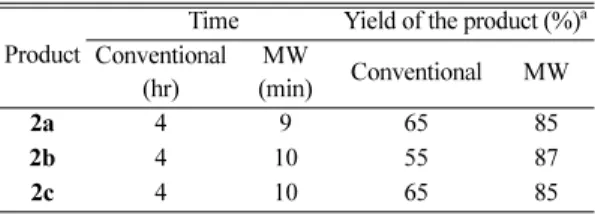
thetically useful compounds. Keeping in view of the biological and synthetic utility of hydrazides, long chain aliphatic esters and acids, we have syn- thesized newer long chain acid hydrazides (2a-c, Table 1) and corresponding substituted hydrazides (3a-f, Table 3) using microwave irradiation tech- nique as well as by conventional method (Scheme 1
& 2). The synthesis of these substituted hydrazides assumes importance because of its utility from social perspective. All the above compounds were charac- terized by spectral analysis.
RESULTS AND DISCUSSION
Hydrazinolysis of various carboxylic acid hydrazides [CH3-(CH2)n-CO-NH-NH2,n=10, 12, 14) from corre- sponding methyl ester was carried out by conven- tional method as well as by microwave technique.
The conventional method involved the refluxing of methyl ester of carboxylic acid with excess of hydrazine hydrate in ethanol medium for 3-4 hours while in case of the microwave technique, a mix- ture of ester and hydrazine hydrate (1:1 molar ratio) was irradiated with microwave for 10-15 minutes without any solvent, catalyst or solid support. The Table 1. Synthesis of various long chain aliphatic acid hydrazides
Product
Time Yield of the product (%)a Conventional
(hr)
MW
(min) Conventional MW
2a 4 9 65 85
2b 4 10 55 87
2c 4 10 65 85
a isolated product
Table 2. Physical & spectral data for compound 2b-c
Comp mp (oC) Mol. formula†† δH (J in Hz) MS (M+)
2a† 103-105 C12H26N2O 0.9(t, 3H, J, 7.0), 1.2(conglomerate, 16H, 8CH2), 2.1(p, 2H, CH2, J, 7.0), 2.8(t, 2H, CH2CO, J, 6.0), 3.9(bs, 2H, NH2), 6.8 (s, 1H, NHCO, exchangeable)
214
2b† 108-110 C14H30N2O 1.0(t, 3H, J, 7.0), 1.4(conglomerate, 20H, 10CH2), 1.9(p, 2H, CH2, J, 7.0), 2.3(t, 2H, CH2CO, J, 6.0), 3.7(bs, 2H, NH2), 6.9(s, 1H, NHCO, exchangeable)
242
2c† 112-114 C16H34N2O 0.9(t, 3H, J, 7.0), 1.3(conglomerate, 24H, 12CH2), 2.0 (p, 2H, CH2, J, 7.0), 2.5(t,2H, CH2CO, J, 6.0), 3.8(bs, 2H, NH2), 6.7
270
†IR: 3350 cm-1(NH2), this IR band was absent in the case of compounds 3a-f
††All the compounds gave satisfactory elemental analyses: (C, H, and N within ± 0.32% of calcd values)
results obtained from two approaches are summa- rized in Table 1 (Entries 2a-c).
Various newer carboxylic acid (2-hydoxybezylidene) hydrazide (3a, 3c, 3e) and carboxylic acid (1H-
indol-3-ylmethylene) hydrazide (3b, 3d, 3f) were also prepared by condensation of 2a-c with 2-hydroxy benzaldehyde and indole-3-carboxaldehyde respec- tively under conventional as well as microwave Table 3. Synthesis of various long chain aliphatic acid (2-hydroxy benzylidene) hydrazides & (1H-indol-3-ylmethylene) hydrazides
Product Time Yield of the producta
Conventional (hr) MW (min) Conventional MW
3.0 12 67 89
4.0 15 55 85
3.0 13 62 87
4.0 16 53 83
3.0 13 63 86
4.0 16 50 80
aisolated product
Scheme 1. Conventional synthesis of acid hydrazide.
irradiation methods. In conventional method, they were prepared by refluxing 1a-c with different alde- hydes in ethanol and in microwave irradiation tech- nique; they were prepared without using any solvent.
The overall yield of the product using microwave irradiation technique was 85-90% as compared to the conventional methods in which the yields were 30-55% and reaction time was 3-10 min by micro- wave irradiation as compared to 4-5 hour in con- ventional method.
Spectral Analysis
IR spectrum of dodecanoic acid hydrazide (2a) showed absorption band at 1635 and 1500 cm-1 cor- responding to C=O and C-N stretching vibrations.
Two bands at 3350 and 3310 cm-1 appeared due to the presence of NH2 and NH groups respectively.
The corresponding dodecanoic acid (2-hydroxyben- zyldene) hydrazide showed similar spectra except that bands due to the NH2 group, it showed band at 1575-1565 cm-1 due to the C=N stretching vibra- tions. The 1H NMR spectrum of dodecanoic acid hydrazide displayed a broad singlet at 4.2 (2H) cor- responding to NH2 protons. Methyl proton CH3 dis- played a triplet at 0.9 in its 1H NMR spectrum while a singlet at 13.8 ppm in its 13C NMR spectrum. A singlet appeared at δ 8.2 ppm due to the NHCO proton. Presence of later was further supported by the appearance of a peak at 171.80 in its 13 C NMR spectrum. CH2-CO proton displayed a triplet at 2.5 in its 1H NMR while a singlet appeared at 39.3 ppm in its 13 C NMR. A distorted quintet was appeared at 1.4 in 1H NMR. The remaining CH2 groups, which were very similar in chemical shift, were strongly coupled to one another; they appeared as partially resolved band and act as a conglomerate of spins in coupling to the CH3 group & signal appeared at 1.2 in its 1H NMR. Similar pattern for the proton reso- nance was also observed in the 1H NMR spectrum of substituted hydrazides (hydrazones). The corre-
sponding substituted hydrazides (hydrazones) of 2a containing phenolic moiety (3a) displayed singlet corresponding N=CH proton at δ 8.0-8.4 while four benzenoid protons appeared as multiplet at 6.9-7.5 ppm. Similar pattern for the resonance was observed in the 1H NMR spectrum of substituted hydrazide (3b) having indolic moiety and displayed a singlet at 10.1 resonated due to indole NH proton. Four benzenoid protons and one indolic CH proton appeared as multiplet at 7.1-7.7 ppm. In the EI mass spectra of dodecanoic acid hydrazide (2a), molecu- lar ion peak was weak but usually discernible and for the corresponding substituted hydrazides (hydra- zones) 3a & 3b, molecular ion peaks were distinct in the mass spectra. Fragment ion peak at m/z 183 could be attributed to the loss of NHNH2 and NHN=CH-Ar radicals from the molecular ions of dodecanoic acid hydrazide (2a) and dodecanoic acid (2-hydroxybenzylidene) hydrazide (3a) & dode- canoic acid (1H indol-3-ylmethylene) hydrazide (3b) respectively. The formation of fragment ion at m/z 74 can be rationalized by the loss of neutral molecule 1-decene from molecular ion (2a) as depicted in Scheme 3. The base peak at m/z 57 could arise due to the loss of methyl radical and H2 molecule from the fragment ion having m/z value of 74 (Scheme 3). The fragment ion peak at m/z 199 could be attributed to the loss of CH3 radical from the molecular ion of dodecanoic acid hydrazide (2a). The ions corresponding to m/z 185, 171, 157, 143, 129, 115, 101, 87, 73 were formed due to loss of CH2 group successively. In addition, Mc-Laf- ferty rearrangement in molecular ion of 3a gave rise to peak at m/z 178 and peaks at m/z 163, 135, 107 were due to successive loss of CH3 radical, CO &
N2 molecules. Similarly the formation of fragment ion at m/z 201 can be rationalized by the loss of neutral molecule dodecene from molecular ion 3b which in turn gave rise to peaks at 186 & 158 due to subsequent loss of CH3 radical and CO mole- Scheme 2. Microwave assisted synthesis of acid hydrazides.
cule. The base peak at m/z 142 could arise due to the loss of neutral molecule tetradeconoic acid amide from molecular ion 3b.
CONCLUSION
In summary, we described the microwave assisted synthesis of long chain acid hydrazides and various newer corresponding benzylidene hydrazides &
indolylmethylene hydrazides and compared with conventional method. Spectral properties and mass spectral fragmentation pattern of these hydrazides
& hydrazones were also discussed. It has been found that some of these hydrazides have attractant activity and some have repellent activity depending on their concentration against mosquitoes and we
will be published somewhere else.19
EXPERIMENTAL
General
All the reagents and solvent were obtained from commercial sources and used without further purifi- cation. Melting points were taken in open capillary in an electro thermal point apparatus and are uncor- rected. IR spectra were recorded as KBr pellet using Perkin Elmer Spectrum BX FT-IR spectro- photometer, 1H NMR spectra in CDCl3/DMSO-d6 on a Bruker Avance (400MHz) spectrometer using TMS as internal reference. 13C NMR spectra were recorded on the same instrument at 100MHz using the same solvent and internal reference. Chemical Scheme 3. Analysis of mass spectra of substituted acid hydrazides (hydrazones).
shift is reported in δ (PPM). Mass spectra were recorded on a Finnigan matt TSQ 700 mass spec- trometer. The progress of all reactions was moni- tored by TLC on 2.0×5.0-cm aluminum sheets precoated with silica gel to a thickness of 0.25-mm (Merck). Microwave assisted syntheses were car- ried out in Samsung CK 138 F domestic microwave oven.
Dodecanoic acid hydrazide 2a
Methyl dodecanoate (10 mmol) was dissolved in 99% hydrazine hydrate (10 mmol) in a conical flask and was placed in domestic microwave oven. After irradiation at 180 Watt for 10 minutes, the solid prod- uct was washed with the ethanol to give dodecanoic acid hydrazide 2a (85% yield) (Table 1 & 2)
General procedure for the synthesis of long chain aliphatic acid (2-hydroxy benzylidene) hydrazides
& (1H-indol-3-ylmethylene) hydrazides Conventional synthesis
To a stirred solution of carboxylic acid hydrazide (5 mmol) in ethanol was added aldehyde (5 mmol) and the reaction mixture was refluxed for 3-4 hrs.
After completion of the reaction, solvent was evap- orated & solid product was separated, filtered, dried,
& recrystallized from ethanol.
Microwave assisted synthesis
Carboxylic acid hydrazide (5 mmol) was mixed with aldehyde (5 mmol) in a conical flask and the mixture was irradiated with microwave irradiation in microwave oven for specified period (300 Watt).
The reaction was monitored by TLC. After comple- tion of the reaction, the solid product was recrystal- lized from ethanol to give the pure substituted hydrazides (hydrazones).
Dodecanoic acid (2-hydroxy benzylidene) hydrazide 3a.
Mp: 108-110 ºC, IR (KBr): 3432, 3238, 2922, 1670, 1560, 1525, 1380, 758 cm-1. 1H NMR (400 MHz, DMSO-d6) δ =10.8 (s, 1H, OH), 8.5 (s, 1H, CONH, exchangeable), 8.0 (s, 1H, N=CH), 6.9-7.5 (m, 4H, Ar-H), 0.9 (t, 3H, CH3), 1.2 (conglomerate, 16H, CH2), 1.4 (p, 2H, CH2), 2.5 (t, 2H, CH2CO), MS: m/z (%) 318 (40), [C19H30N2O2]+, 275 (12), 219 (10), 191
(14), 178 (25), 136 (100), 135 (79), 119 (71), 107 (47), 93 (16), 91 (30), 65 (26).
Dodecanoic acid (1H-indol-3-ylmethylene) hydrazide 3b.
Mp: 145-147 ºC, IR (KBr): 3245, 3055, 2924, 1638, 1597, 1443, 1246, 992, 740 cm-1. 1H NMR (400 MHz, DMSO-d6) δ=10.1 (s, 1H, NH indole, exchangeable), 8.8 (s, 1H, CONH, exchangeable), 8.5 (s, 1H, N=CH), 7.0-7.8 (m, 4 x Ar-H, 1 x indole CH), 2.1 (t, 2H, CH2CO) 1.6 (p, 2H, CH2), 1.2 (conglomerate, 16H, CH2), 1.0(t, 3H, CH3) MS: m/z (%) 341 (41), [C21H27N3O]+, 228 (45), 201 (13), 186 (5), 185 (4), 184 (6), 159 (48), 158 (4), 157 (15), 155 (4), 142 (100), 130 (25), 116 (24), 114 (14), 59 (38).
Tetradecanoic acid (2-hydroxy benzylidene) hydrazide 3c.
Mp: 113-115 ºC, IR (KBr): 3447, 3138, 2920, 1670, 1567, 1491, 1390, 753 cm-1. 1H NMR (400 MHz, DMSO-d6) δ=10.5 (s, 1H, OH), 8.4 (s, 1H, CONH, exchangeable), 8.1 (s, 1H, N=CH), 7.1-7.9 ( m, 4H, Ar-H), 1.1 (t, 3H, CH3), 1.5 (conglomerate, 20H, CH2), 1.9 (p, 2H, CH2), 2.2 (t, 2H, CH2CO), MS: m/z (%) 346 (16), [C21H 34N2O2]+, 219 (8), 233 (4), 219 (5), 205 (4), 191 (10), 178 (15), 177 (4), 163 (6), 136 (100), 135 (79), 120 (65), 119 (57), 107 (34),99 (7), 93 (13), 91 (30),71 (45), 65 (26), 59 (100), 43 (73).
Tetradecanoic acid(1H-indol-3-ylmethylene) hydrazide 3d.
Mp: 154-156 ºC, IR (KBr): 3210, 3035, 2923, 1642, 1447, 1357, 1246, 995, 744 cm-1. 1H NMR (400 MHz, DMSO-d6) δ=10.0 (s, 1H, NH indole, exchangea- ble), 8.4 (s, 1H, CONH, exchangeable), 8.0 (s, 1H, N=CH), 7.2-7.9 (m, 4 x Ar-H, 1 x indole CH), 2.3 (t, 2H, CH2CO), 1.9 (p, 2H, CH2), 1.4 (conglome- rate, 20H, CH2), 0.9 (t, 3H, CH3) MS: m/z (%) 369 (54), [C23H35N3O]+, 228 (43), 211 (4), 201 (5), 186 (5), 185 (4), 184 (6), 159 (74), 158 (14), 157 (15), 155 (4), 142 (100), 130 (25), 116 (20), 114 (14), 59 (40).
Hexadecanoic acid (2-hydroxy benzylidene) hydrazide 3e.
Mp: 118-120 ºC, IR (KBr): 3440, 3038, 2921, 1670, 1560, 1466, 1278, 752 cm-1. 1H NMR (400 MHz, DMSO-d6) δ=10.3 (s, 1H, OH), 8.8 (s, 1H, CONH, exchangeable), 8.5 (s, 1H, N=CH), 7.0-7.8 (m, 4H, Ar-H), 0.9 (t, 3H, CH3), 1.3 (conglomerate, 24H,
CH2), 1.5 (p, 2H, H2), 2.1 (t, 2H, CH2CO), MS: m/z (%) 374 (26), [C23H38N2O2]+, 345 (3), 331 (4), 317 (4), 303 (3), 289 (3), 247 (4), 219 (5), 191 (10), 179 (5), 178 (25), 163 (6), 136 (100), 120 (65), 119 (57), 107 (34), 99 (11), 93 (10), 91 (20), 71 (25), 65 (16), 59 (50), 43 (30).
Hexadecanoic acid(1H-indol-3-ylmethylene) hydrazide 3f.
Mp: 160-162 ºC, IR (KBr): 3227, 3055, 2916, 1638, 1617, 1361, 1247, 991, 739 cm-1. 1H NMR (400 MHz, DMSO-d6) δ=10.2 (s, 1H, NH indole, exchangea- ble), 8.5 (s, 1H, CONH, exchangeable), 8.0 (s, 1H, N=CH), 7.0-7.8 (m, 4 x Ar-H, 1 x indole CH), 2.1 (t, 2H, CH2CO), 1.5 (p, 2H, CH2), 1.2 (conglome- rate, 20H, CH2), 0.9 (t, 3H, CH3) MS: m/z (%) 397 (45), [C23H39N3O]+, 368 (4), 354 (3), 340 (3), 298 (3), 284 (4), 256 (45), 228 (4), 201(10), 185 (4), 184 (6), 159 (70), 158 (24), 157 (12), 155 (4), 142 (100), 130 (23), 116 (20), 114 (14), 59 (54).
Acknowledgements. Authors sincerely thank Er K Sekhar, Director, Defence Research and Devel- opment Establishment, Gwalior for keen interest and encouragement. We are also thankful to Dr.
D.K. Dubey for his valuable suggestions & com- ments and to Dr. Semwal for recording spectra.
REFERENCES
1. Bonicke, R.; Krach, J. Z. Hyg Infektionakranch 1954, 139, 140.
2. Haksar, C. N.; Malhotra, R. C.; Pandya G.; Sethi, R. K.
Lab. J. Sc. Technol., 1981, 9B, 34
3. Binon, F.; Royer, R. J. Chem. Soc., 1953, 1358.
4. Zikolova, Sv. Farmatoiya, 1965, 15(4), 185.
5. Roman, K. L. Span. Patent, ES 506,945, 1982 (Chem.
Abstr., 1985, 89, 67124).
6. Dhadialla, T. S.; Carlson, G. R.; Le, D. P. Annual Review of Entomology 1998, 43, 545-569.
7. Banik, B. K.; Barakat, K. J.; Wagle, W. R.; Manhas, M.
S.; Bose, A. K. J. Org. Chem., 1999, 64, 5746.
8. Ganesan K.; Mendki, M. J.; Suryanarayana, M. V. S.;
Prakash, S.; Malhotra, R. C. Australian Journal of Entomology, 2000, 45, 75-80.
9. Mendki, M. J.; Ganesan, K.; Prakash, S.; Suryanarayana, M. V. S.; Malhotra, R. C.; Rao, K. M.; Vaidyanathaswamy, R. Current Science, 2000, 78, 1295-1296.
10. Bentley, M. D.; McDaniel, I. N.; Yatagai, M.; Lee, H.
P.; Maynard, R. Environmental Entomology, 1979, 8, 206-209.
11. Knight, J. C.; Corbet, S. A. Journal of American Mos- quito Control Association, 1991, 7, 37-41.
12. Villemine, D.; Martin, B. J. Chem. Res., 1994, 146.
13. Lu, Y. F.; Fallis, A. G. Can. J. Chem., 1995, 73, 2239.
14. Soriente, A.; Spinella, A.; DeRosa, M.; Giordano, M.;
Seettri, A. Tetrahedron Lett, 1997, 38, 289.
15. Suarez, M.; Loupy, A.; Salfran, E.; Moran, L.; Rolando, E. Heterocycles, 1999, 51, 21.
16. Goncalo, P.; Roussel, C.; Melot, J. M.; Vebrel, J. J. Chem.
Soc. Perkin Trans 2, 1999, 2111.
17. Danks, T. N. Tetrahedron Lett, 1999, 40, 3957.
18. Verma, R. S. Green Chemistry, 1999, 1, 43.
19. Rishiswar, P.; Awasthi, S.; Jain, N.; Prakash, S.; Gane- san, K.; Malhotra, R.C.; Vijayaraghavan, R. Ovipositional responses of Aedes aegypti (Diptera: Culicidae) to novel synthesized long chain aliphatic hydrazides (to be com- municated to Vector Ecology).