• 검색 결과가 없습니다.

Intra-Rater and Inter-Rater Reliability of Various Forward Head Posture Measurements

N/A
N/A
Protected

Academic year: 2021

Share "Intra-Rater and Inter-Rater Reliability of Various Forward Head Posture Measurements"

Copied!
7
0
0

로드 중.... (전체 텍스트 보기)

전체 글

(1)

Intra-Rater and Inter-Rater Reliability of Various Forward Head Posture Measurements

Won-gyu Yoo, M.Sc., P.T.

Dept. of Rehabilitation Therapy, The Graduate School, Yonsei University

Min-hee Kim, B.H.Sc., P.T.

Dept. of Rehabilitation Therapy, The Graduate School, Yonsei University

Chung-hwi Yi, Ph.D., P.T.

Dept. of Physical Therapy, College of Health Science, Yonsei University Institute of Health Science, Yonsei University 1)

Abstract

The purpose of this study was to determine the intra-rater and inter-rater reliability of various forward head posture measurements. Ten healthy adults (age, 20.4±2.2 yrs; height, 164.0±5.5 ㎝; weight, 58.7±7.3

㎏) participated in the study. They were free of injury and neurologic deficits in the upper extremities and neck at the time of testing. The subjects were asked to perform head forward posture by under the guid- ance of physical therapists. Markers were placed on the C7 spinous process, mastoid process, tragus of the ear, outer canthus, and forehead. Measurement 1 for forward head posture assessment was measured as the angle between the horizontal line through C7 and the line connecting the C7 spinous process with the tragus of the ear. Measurement 2 was measured as the angle between the C7 spinous process, the mastoid process and the outer canthus. Measurement 3 was measured as two kinds of angles the HT (head tilt) angle is between the line from the midpoint of forehead to the tragus line and Y-axis at the tragus point.

The NF (neck flexion) angle is between the line from the tragus to the C7 line and the Y-axis at the C7.

Intra-rater, inter-rater reliability and coefficient of variation was assessed by comparing the measured val- ues from three kinds of measurements of forward head posture. The intra-rater reliability was indicated by intraclass correlation coefficients [ICC(1,1)] and inter-rater reliability was shown by intraclass correlation coefficients [ICC(3,k)]. The results of study were as follows: ICC(1,1) values for intra-rater reliability of three measurements were in the excellentcategory. ICC(3,k) values for inter-rater reliability of three measurements were also in the excellent category. The coefficient of variation of method 2 had a low- er value than method 1 and method 3. This data means that the measured value of method 2 was less scattered. Further research is needed to determine whether the validity of all measurements is revealed in the excellent category.

Key Words: Forward head posture; Reliability; Video analysis.

Introduction

Neck pain accounts for a smaller percentage of work-related musculoskeletal disorder (WMSD) than back pain, but it has been frequently studied, espe- cially for sedentary job tasks associated with sig- nificant amounts of computer usage (Babski-Reeves et al, 2005). There has been mounting evidence in

recent years identifying static neck and shoulder

posture, such as that frequently assumed by com-

puter workers, as a possible risk factor in work-re-

lated neck and upper limb disorders (WRNULD)

(Szeto et al, 2002). Posture of the head, neck, and

shoulders has been recognized as a factor con-

tributing to the onset and perpetuation of cervical

pain dysfunction syndromes (Braun and Amundson,

Corresponding author: Min-hee Kim [email protected]

(2)

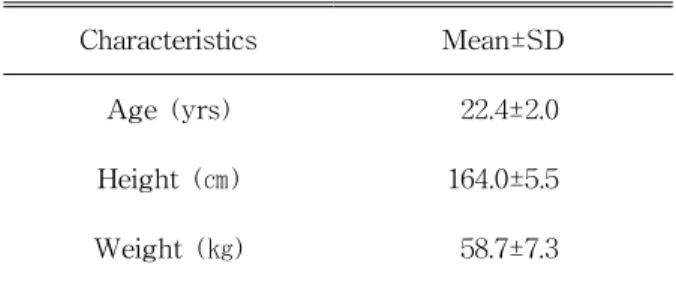
Characteristics Mean±SD

Age (yrs) 22.4±2.0

Height (㎝) 164.0±5.5

Weight (㎏) 58.7±7.3

Table 1. General characteristics of subjects (N=10) 1989). Computer work involves prolonged viewing of

a visual display unit and increases lower cervical flexion muscle tension to support the weight of the head (Straker and Mekhora, 2000). Szeto et al (2005) compared the head, neck and shoulder postures of office workers with and without symptoms in these regions, in their actual work environments and showed that there were trends for increased head tilt and neck flexion postures in the symptomatic sub- jects, compared to the asymptomatic subjects.

Evaluation of head posture has commonly included the profile alignment of the body parts with respect to the trunk (Griegel-Morris et al, 1992). Alignment has been deemed poor when the head is held for- ward in relation to the trunk (Raine and Twomey, 1997). Physical characteristics referred to as poor in- clude a forward tilt of the head and the nature of these characteristics is self-explanatory (Braun and Amundson, 1989). Forward head posture and flexion of the trunk form the main components of slumped sitting (Julius et al, 2004). Forward head posture is a common clinical observation that patients presenting shoulder and back pain frequently demonstrate (Hanten et al, 1991). Other postural correlates also have been described without quantitative verification, such as the view that a forward tilted head is re- lated to an extended upper cervical spine, or to pro- tracted shoulder girdles and a kyphosis thoracic spine (Hanten et al, 1991). However, with forward head posture is very difficult to establish the cause-and-effect relationship of posture and pain (Gooch, 1993). Also, the possible mechanisms leading to pain in patients with postural malalignment have not been examined in any detail (Blouin et al, 2003).

Body posture in performing computer work has been commonly studied in the sagittal plane as two-dimensional posture or movement (Raine and Twomey, 1997; Straker et al, 1997). Other studies have used video cameras to capture the sagittal pro- files and digitized reflective marker locations (Szeto et al, 2002). But, when an observational assessment tool is being used as a measure of clinical outcome,

it is important to establish the reliability of that tool (Portney and Watkins, 2000). The method employed relied on the experimenter's judgment to identify a change in posture and the accuracy associated with taking angular measurements from an LCD screen (Burgess-Limerick et al, 1999). The curvature of the screen may have distorted the angular measurements.

The methods employed can only provide estimates of the number of postural shifts. More detailed quanti- tative data would be needed to provide a more accu- rate measurement of posture changes (Moffet et al, 2002). Therefore, several types of reliability testing are necessary in order to determine grade of forward head posture (Callaghan and Dunk, 2002). The pur- pose of this study was to determine intra-rater reli- ability and inter-rater reliability of various forward head posture measurements.

Methods Subjects

Ten healthy young adults (age, 22.4±2.0 yrs;

height, 164.0±5.5 ㎝; weight, 58.7±7.3 ㎏) participated in the study. They were free of injury and neuro- logic deficits in the neck and upper extremity for 1 year. The age, height, and weight of the subjects are summarized in Table 1.

Instruments

Each subject was videotaped to capture the sag-

ittal profile of the upper body using a single video

camera. All subjects were able to complete three

trials. The measured value of forward head posture

(3)

1 2 3

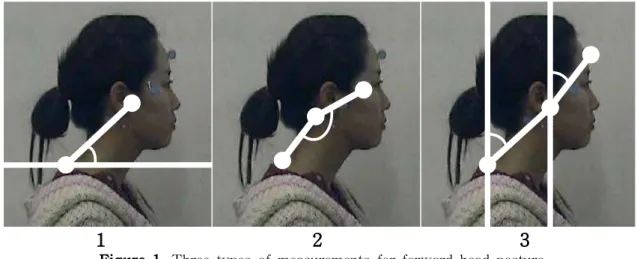
Figure 1. Three types of measurements for forward head posture was recorded by a digital camera and video motion

analysis software SIMI°Twinner Pro

1)

was used to analyze the kinematic data. This system had a sam- pling rate of 30 ㎐ for digitalization.

Procedures

2)

The video camera was set up at approximately 1 m away from and perpendicular to the subjects' sagittal plane. The instructions given to the subject were to look straight ahead, with the arms resting on the lap and the back resting on the backrest of the chair. Yellow foam balls of 2.5 ㎝ diameters were used as skin markers. This procedure was al- ways carried out by the same investigator in order to reduce the variability in maker placement. The video segments were selected on the basis that they represented the forward head posture of the subject, and that there was minimal out of plane movement.

The subjects were taught to perform the forward head postures repeatedly by practicing them under the guidance of a physical therapists.

Measurement 1: Forward head posture is measured as the angle between the horizontal line through C7 and the line connecting the C7 spinous process with the tragus of the ear. As head posture becomes more forward, the angle decreases (Braun et al, 1989).

Measurement 2: Head angle is defined as the anteror angle subtended by lines joining the C7 spinous

process, the mastoid process on a line joining the tragus and outer canthus, and the outer canthus of the eye markers. The position of the head with re- spect to the external environment was described by calculating the position of the horizontal ear-eye line (Burgess-Limerick et al, 1999). Measurement 3:

Forward head posture is commonly adopted by a combination of lower cervical flexion and upper cer- vical extension because the subject was evaluated in two parameters. HT (head tilt) angle is between the midpoint from the forehead to tragus line and the Y-axis. NF (neck flexion) angle is between the tragus to the C7 line and the Y-axis (Szeto et al, 2002) (Figure 1).

Statistical Analysis

Intra-rater and inter-rater reliability was assessed by comparing the measured values from three kinds of measurements during forward head posture. The intraclass correlation coefficients [ICC(1,1)] were used to assess intra-rater reliability of three measure- ments (Sackley et al, 2005) and intraclass correlation coefficients [ICC(3,k)] were used to assess inter-rater reliability of three measurements (Portney and Watkins, 2000). For this study, ICCs below .75 were considered poor to moderate, those above .75 were considered good, and above .90 excellent

(Sackley et al, 2005). The coefficient of variation for

1) SIMI Reality Motion Systems GmbH, Unterschleissheim, Germany.

(4)

Table 4. Coefficients of variation of three measurements for forward head posture (FHP) (N=10)

Method 1 Method 2 Method 3

Rater 1 .402 .132 .263

Rater 2 .371 .092 .177

Table 3. Inter-rater reliability of three measurements for forward head posture (FHP) (N=10)

Method 1 Method 2 Method 3

ICC(3,k) 95% Confidence

interval p ICC(3,k) 95% Confidence

interval p ICC(3,k) 95% Confidence interval p

FHP .991 .965~.998 .000 .992 .966~.998 .000 .988 .950~.997 .000

Table 2. Intra-rater reliability of three measurements for forward head posture (FHP) (N=10)

Method 1 Method 2 Method 3

ICC(1,1) 95% Confidence

interval p ICC(1,1) 95% Confidence

interval p ICC(1,1) 95% Confidence interval p

Rater 1 .954 .876~.987 .000 .966 .909~.991 .000 .937 .834~.982 .000

Rater 2 .955 .878~.987 .000 .985 .960~.996 .000 .973 .926~.993 .000

repeatedly measured values of various measurements by rater1 and rater 2 was used to assess the meas- ure of dispersion of data.

Results

The intra-rater reliability index for forward head posture is shown in Table 2. ICCs revealed that method 1 by rater 1 was .954, method 1 by rater 2 was .955, method 2 by rater 1 was .966, method 2 by rater 2 was .985, method 3 by rater 1 was .937, and method 3 by rater 2 was .973. Overall, method 2 had a higher value of reliability than method 1, and method 3 (Table 2).

The inter-rater reliability index between rater 1 and rater 2 for forward head posture is shown in Table 3. ICC(3,k) values for inter-rater reliability of all items of all methods were in the excellent cat- egory; ICCs revealed that method 1 was .991, method 2 was .992, method 3 was .988. Likewise intra-rater reliability, method 2 had a higher value for inter-rater

reliability than method 1 or method 3 (Table 3).

The coefficient of variation for forward head pos- ture index is shown in Table 4. The coefficient of variation showed that method 1 by rater 1 was .402, method 1 by rater 2 was .371, method 2 by rater 1 was .132, method 2 by rater 2 was .092, method 3 by rater 1 was .263, method 3 by rater 2 was .177 (Table 4). The coefficient of variation of method 2 revealed the lowest value.

Discussion

The purpose of this study was to determine the intra-rater reliability and inter-rater reliability for various forward head posture measurements.

Measurement 1 was measured as the angle between

the horizontal line through C7 and the line connect-

ing the C7 spinous process with the tragus of the

ear. As head posture becomes more forward, the an-

gle decreases (Braun et al, 1989). Measurement 2

was taken from the outer canthus to the mastoid

(5)

process on the line joining the tragus and outer can- thus to the C7 spinous process. The position of the head with respect to the external environment was described by calculating the position of the horizontal ear-eye line (Burgess-Limerick et al, 1999).

Measurement 3 was evaluated in two parameters.

HT angle is between the midpoint of the forehead to the tragus line and Y-axis. NF angle is between the tragus to C7 line and the Y-axis (Szeto et al, 2002).

The ICC(1,1) for the intra-rater reliability and ICC(3,k) values for the inter-rater reliability of all items of all methods were in the excellent cat- egory (Table 2) (Table 3). Intra-rater and inter-rater reliability of all items of method 2 were higher than the items of method 1 and method 3. The coefficient of variation showed by method 1 with rater 1 for forward head posture was .402, method 1 by rater 2 for forward head posture was .371, method 2 by rater 1 for forward head posture was .132, method 2 by rater 2 for forward head posture was .092, meth- od 3 by rater 1 for forward head posture was .263, method 3 by rater 2 for forward head posture was .177 (Table 4). The coefficient of variation of the method 2 was lower than those of method 1 and method 3. This data means that the measured value of method 2 was less scattered.

These results for reliability of forward head pos- ture measurements provide the clinician with insight into the standardization of the test, and the rater with the ability to use the criteria correctly (Harris et al, 1984). Intraclass correlation is used to measure intra-rater reliability. It may also be used to assess inter-rater reliability, although ICC is preferred over Pearson's r only when sample size is small (<15) or when there are more than two tests (one test, one retest) to be correlated. Also, ICC varies depending on whether the judges are all judges of interest or are conceived as a random sample of possible judges, and whether all targets are rated or only a random sample, and whether reliability is to be measured based on individual ratings or mean ratings of all judges (McGraw and Wong, 1996).

There are a number of advantages to using video- tapes as a method of assessing reliability. When the therapists then assess inter-rater reliability, it may be high because everyone agrees on how to angle, but the angle may not be the correct one. Finally, another use for criterion testing video analysis is to have an easy method of assessing ongoing levels of competency. Tests can be completed at regular inter- vals as to ensure that high levels of reliability are maintained (Harris et al, 1984). However, these methods, when employed, relied on the ex- perimenter's judgment to identify a change in pos- ture and the accuracy associated with taking angular measurements from a screen. The above arguments and the data presented are always considered in conjunction with the characteristics of the video analysis and epidemiological data.

The effects of posture on health are becoming

more evident. Spinal pain, mood, blood pressure,

pulse, and lung capacity are among the functions

most easily influenced by posture (Lennon et al,

1994). One of the most common postural problems is

forward head posture. The repetitive use of com-

puters, TVs, video games, and even backpacks have

forced the body to adapt to the forward head

posture. Because the neck and shoulders have to

carry this weight all day in an isometric contraction,

this posture causes loss of blood, damage, fatigue,

strain, pain, burning and fibromyalgia in the neck

muscles. When spinal tissues are subject to a sig-

nificant load for a sustained period of time, they de-

form and undergo remodeling changes that could be-

come permanent (Gore et al, 1986). Increased flexion

at the atlanto-occipital joint increases the horizontal

distance from the center of mass of the head to its

axis of rotation. Similarly, with the trunk in a verti-

cal position, an increase in flexion of the cervical

spine increases the horizontal distance from the cen-

ter of the head and neck combined to the axes of

rotation in the vertebral column. Hence, with the

trunk in an upright position, both atlanto-occipital

and cervical flexion increase the torque required of

(6)

the extensor musculature to maintain static equili- brium (Burgess-Limerick et al, 1999).

The results from this study indicate that it is eminent to assess the reliability of the quality of forward head posture using video analysis.

Especially, the reliability of all items from method 2 was the best. Video motion analysis software SIMI°Twinner Pro of various video analysis pro- grams is exquisite and accurate. The high quality of analysis programs may result in high reliability.

Further research is needed to determine whether the validity of all measurements is revealed in the ex- cellent category.

Conclusion

The aim of this study was to determine the in- tra-rater, inter-rater reliability for various forward head posture measurements. The results showed that the ICC(1,1) for the intra-rater reliability and the ICC(3,k) for the inter-rater reliability of all items from all methods were in the excellent category.

Intra-rater and inter-rater reliability of method 2 were higher than those of method 1 and method 3.

Coefficients of variation of method 2 were lower than those of methods 1 and 3. This data means that the measured value of method 2 were less scattered. These results for reliability and coefficient of variation of three forward head posture measure- ments provide the clinician with insight into the standardization of the test, and the rater with the ability to use the criteria correctly.

References

Babski-Reeves K, Stanfield J, Hughes L. Assessment of video display workstation set up on risk fac- tors associated with the development of low back and neck discomfort. Int J Ind Ergon.

2005;35:593-604.

Blouin JS, Descarreaux M, Belanger-Gravel A, et al.

Self-initiating a seated perturbation modifies the neck postural responses in humans. Neurosci Lett. 2003;347:1-4.

Braun BL, Amundson LR. Quantitative assessment of head and shoulder posture. Arch Phys Med Rehabil. 1989;70:322-329.

Burgess-Limerick R, Plooy A, Fraser K, et al. The influence of computer monitor height on he- ad and neck posture. Int J Ind Ergon.

1999;23:171-179.

Callaghan JP, Dunk NM. Examination of the flexion relaxation phenomenon in the erector spinae muscles during short duration slumped sitting.

Clin Biomech (Bristol, Avon). 2002;17:353-360.

Gooch L. A controlled study of sustained cervical spine flexion. Master Thesis, Curtin University of Technology, Western Australia, 1993.

Gore DR, Sepic SB, Gardner GM. Roentgenographic findings of the cervical spine in asymptomatic people. Spine. 1986;11:521-524.

Griegel-Morris P, Lasson K, Mueller-Klaus K, et al.

Incidence of common postural abnormalities in the cervical, shoulder, and thoracic regions and their association with pain in two age groups of healthy subjects. Phys Ther. 1992;72:425-431.

Hanten WP, Lucio RM, Russell JL, et al. Assessment of total head excursion and resting head posture.

Arch Phys Med Rehabil. 1991;72:877-880.

Harris SR, Haley SM, Tada WL, et al. Reliability of observational measures of the movement assess- ment of infants. Phys Ther. 1984;64:471-476.

Julius A, Lees R, Dilley A, et al. Shoulder posture and median nerve sliding. BMC Musculoskeletal Disorders. 2004;5:23.

Lennon J, Sealy CN, Cady RK, et al. Postural and respiratory modulation of autonomic function, pain and health. Am J Pain Mgmt. 1994;4:36-39.

McGraw KO, Wong SP. Forming inferences about some interclass correlation coefficients.

Psychological Methods. 1996;1(1):30-46.

Moffet H, Hagberg M, Hansson-Risberg E, et al.

(7)

This article was received August 29, 2005, and was accepted November 1, 2005.

Influence of laptop computer design and working position on physical exposure variables. Clin Biomech. 2002;17:368-375.

Portney LG, Watkins MP. Foundations of Clinical Research: Applications to Practice. 2nd ed. New Jersey, Prentice Hall Health, 2000.

Raine S, Twomey LT. Head and shoulder posture variations in 160 asymptomatic women and men.

Arch Phys Med Rehabil. 1997;78:1215-1223.

Sackley CM, Hill HJ, Pound K, et al. The intra-rater reliability of the balance performance monitor when measuring sitting symmetry and weight-shift activity after stroke in a commun- ity setting. Clin Rehabil. 2005;19(7):746-750.

Straker L, Jones KJ, Miller J. A comparison of the pos- tures assumed when using laptop computers and desktop computers. App Ergon. 1997;28:263-268.

Straker L, Mekhora K. An evaluation of visual dis- play unit placement by electromyography, pos- ture, discomfort and preference. Int J Ind Ergo.

2000;26:335-336.

Szeto GP, Straker LM, O'Sullivan PB. A comparison of symptomatic and asymptomatic office workers performing monotonous keyboard work-2: Neck and shoulder kinematics. Man Ther.

2005;10(4):281-291.

Szeto GP, Straker L, Raine S. A field comparison of neck and shoulder postures in symptomatic and asympomatic office worker. Appl Ergon.

2002;33:75-84.

수치

Table 1. General characteristics of subjects (N=10)1989). Computer work involves prolonged viewing of
Figure 1. Three types of measurements for forward head posturewas recorded by a digital camera and video motion
Table 4. Coefficients of variation of three measurements for forward head posture (FHP) (N=10)

참조

관련 문서

Five days later, on 15 January 1975, the Portuguese government signed an agreement with the MPLA, FNLA and UNITA providing for Angola to receive its independence on 11

Usefulness of co-treatment with immunomodulators in patients with inflammatory bowel disease treated with scheduled infliximab maintenance therapy.. Oussalah A, Chevaux JB, Fay

하악지의 내면 한가운데 있으며, 하치조신경과 혈관이

웹 표준을 지원하는 플랫폼에서 큰 수정없이 실행 가능함 패키징을 통해 다양한 기기를 위한 앱을 작성할 수 있음 네이티브 앱과

_____ culture appears to be attractive (도시의) to the

이하선의 실질 속에서 하악경의 후내측에서 나와 하악지의 내측면을 따라 앞으로 간다. (귀밑샘 부위에서 갈라져 나와

각 브랜드의 강점과 약점이 서로 상충되는 경우, 각 브랜드에 있어서 어떤 속 성의 약점을 다른 속성의 강점에 의해 보완하여 전반적인 평가를 내리는 것.

The index is calculated with the latest 5-year auction data of 400 selected Classic, Modern, and Contemporary Chinese painting artists from major auction houses..