• 검색 결과가 없습니다.

Effect of $Y_2O_3$ Nanoparticles on Critical Current Density of $YBa_2Cu_3O_{7-x}$ Thin Films

N/A
N/A
Protected

Academic year: 2021

Share "Effect of $Y_2O_3$ Nanoparticles on Critical Current Density of $YBa_2Cu_3O_{7-x}$ Thin Films"

Copied!
5
0
0

로드 중.... (전체 텍스트 보기)

전체 글

(1)

- 62 -

Effect of Y 2 O 3 Nanoparticles on Critical Current Density of YBa 2 Cu 3 O 7-x Thin Films

H. D. Tran a , D. Sreekantha Reddy a , C. H. Wie a , B. Kang a,* , Sangjun Oh b , Sung-Ik Lee c

a Chungbuk National University, Cheongju, Korea

b National Fusion Research Institute, Daejeon, Korea

c Sogang University, Seoul, Korea

(Received 17 August 2009; revised or reviewed 23 September 2009; accepted 28 September 2009)

Y 2 O 3 나노입자가 YBa 2 Cu 3 O 7-x 박막의 임계전류밀도에 미치는 영향

H. D. Tran a , D. Sreekantha Reddy a , 위창환 a , 강병원 a,* , 오상준 b , 이성익 c

Abstract

Introduction of proper impurity into YBa 2 Cu 3 O 7-x (YBCO) thin films is an effective way to enhance its flux-pinning properties. We investigate effect of Y 2 O 3 nanoparticles on the critical current density J

c

of the YBCO thin films. The Y 2 O 3 nanoparticles were created perpendicular to the film surface (parallel with the c-axis) either between YBCO and substrate or on top of YBCO, YBCO/Y 2 O 3 /LAO or Y 2 O 3 /YBCO/STO, by pulsed laser deposition. The deposition temperature of the YBCO films were varied (780 o C and 800 o C) to modify surface morphology of the YBCO films. Surface morphology characterization revealed that the lower deposition temperature of 780 o C created nano-sized holes on the YBCO film surface which may behave as intrinsic pinning centers, while the higher deposition temperature produced much denser and smoother surface. J

c

values of the YBCO films with Y 2 O 3 particles were either remained nearly the same or decreased for the samples in which YBCO is grown at 780 o C. On the other hand, J

c

values were enhanced for the samples in which YBCO is grown at higher temperature of 800 o C. The difference in the effect of Y 2 O 3 can be explained by the fact that the higher deposition temperature of 800 o C reduces intrinsic pinning centers and J

c

is enhanced by introduction of artificial pinning centers in the form of Y 2 O 3 nanoparticles.

Keywords : YBCO thin film, critical current density, pinning centers, Y 2 O 3 nanoparticle

I. Introduction The discovery of high temperature

superconductors (HTS) have opened a new era for the applications of HTS at higher temperatures. For electrical power application purpose, the critical

*Corresponding author.

e-mail: [email protected]

(2)

current density (J c ) is one of the most important parameters [1].

Many efforts have been devoted to enhance J

c

values of YBCO thin films by doping various kinds of impurities into YBCO at nano-scale as artificial pinning centers [2-6]. Requirements for effective artificial pinning centers include size and density of dopants [7]. The size of artificial pinning centers should be in the range of few times of the coherence length of YBCO (ξ~ 1.5-2 nm) [8], and the defect density should be equivalent to the order of (H/2) × 10 11 /cm 2 [8], where H is the magnitude of the applied magnetic field.

In this work, we investigate the critical current density of the YBCO thin films with introductions of Y 2 O 3 nanoparticles. Y 2 O 3 was chosen as artificial pinning centers because it is chemically nonreactive with YBCO, and has a simple cubic structure of a = 1.06 nm [4] with a small lattice mismatch with YBCO, which will allow epitaxial growth of nanoparticles in YBCO matrix. The superconducting properties of YBCO thin films with Y 2 O 3

nanoparticles are compared with those of the pure YBCO.

II. Experiment

All of pure YBCO, YBCO thin films with Y 2 O 3

nanoparticles were fabricated by using a pulsed lased deposition (PLD) technique. YBCO thin film was deposited at 780 o C with oxygen pressure of 150mTorr and laser energy of 250 mJ. Y 2 O 3 layer was deposited at 800 o C with oxygen pressure of 200 mTorr and laser energy of 250 mJ [9, 10].

Two sets of YBCO thin films with Y 2 O 3

nanoparticles deposited at different temperatures were prepared: Y 2 O 3 (800 o C)/YBCO(780 o C) and Y 2 O 3 (800 o C)/YBCO(800 o C). YBCO and Y 2 O 3

layer were deposited on single crystal (100) SrTiO 3

(STO) and (100) LaAlO 3 (LAO) substrates, respectively. Each set consisted of a pure YBCO (YBCO/STO) and YBCO with Y 2 O 3 nanoparticles (Y 2 O 3 /YBCO/STO and YBCO/Y 2 O 3 /LAO). The

thickness of YBCO layer was 300 nm while Y 2 O 3

was deposited as pseudo layer of nanoparticles.

Structural properties of the samples and the existence of impurity phases were characterized by X-ray diffraction (XRD), atomic force microscopy (AFM) measurement [4]. The magnetization curves M(H) were taken by using magnetic property measurement system (MPMS) for the applied field up to 5 T parallel to the c-axis of films.

III. Results and Discussion

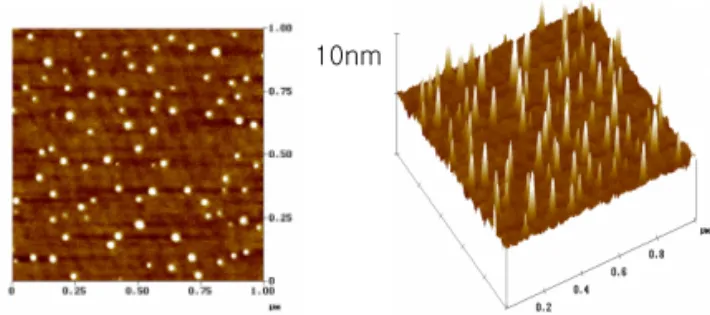
First, properties of Y 2 O 3 nanoparticles deposited on LAO substrate using 160 laser pulses were analyzed. Figure 1 shows the AFM pictures of Y 2 O 3 /LAO samples representing a uniform distribution of Y 2 O 3 . Mean height and diameter of Y 2 O 3 nanoparticles calculated from 2-dimensional (2D) and 3-dimensional (3D) AFM pictures were about 2 nm and 14 nm, respectively.

Fig. 1. 2D and 3D AFM pictures of Y 2 O 3 nanoparticles deposited on LAO substrate using 160 laser pulses.

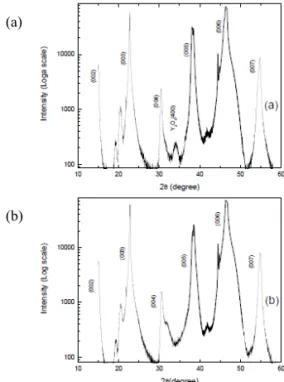
XRD patterns of Y 2 O 3 (800 o C)/YBCO(780 o C)/

STO and pure YBCO(780 o C)/STO samples are shown in Fig. 2. All peaks of YBCO (00l) where l = 2 to 7 appeared for both samples and the (400) peak of Y 2 O 3 in the double layer sample suggest textured growth of both the materials and confirm the existence of Y 2 O 3 impurity in the YBCO film.

The second set of samples in which the YBCO layer is deposited at higher temperature of 800 o C is analyzed by the same procedures. The XRD patterns of Y 2 O 3 (800 o C)/YBCO(800 o C)/STO and pure

10nm

(3)

YBCO(800 o C) samples revealed that all of the peaks of YBCO and Y 2 O 3 appear at the same positions with those in Fig. 2. The existence of textured Y 2 O 3

impurity on the YBCO film surface at deposition temperature of 800 o C is also confirmed.

(a)

(b)

Fig. 2. XRD patterns of (a) Y 2 O 3 (800 o C)/YBCO(780 o C)/

STO and (b) undoped YBCO(780 o C)/STO. Appearance of Y 2 O 3 (400) peak in (a) indicates Y 2 O 3 nanoparticles are produced perpendicular to the film surface.

Figure 3(a) and (b) exhibit AFM pictures of the surface morphology of the Y 2 O 3 (800 o C)/YBCO(780

o C)/STO and Y 2 O 3 (800 o C)/YBCO(800 o C)/STO samples, respectively. For the YBCO layer deposited at 780 o C, the film surface is not smooth and covered with many deep holes. Properties of the holes are listed in Table 1. Y 2 O 3 impurity is coated on top of YBCO in the form of a random distribution of nanoparticles exhibited by the white dots on yellow background. The distribution of Y 2 O 3 is not as regular as that of Y 2 O 3 on LAO substrate in Fig. 1 due to rough surface of the YBCO layer. For the YBCO deposited at 800 o C, the surface of the YBCO layer looks smoother and has smaller number of deep holes than that of the YBCO deposited at 780 o C.

Y 2 O 3 nanoparticles are still randomly mounted on the YBCO surface. Properties of the holes are compared with the Y 2 O 3 particles in Table 2.

(a)

(b)

Fig. 3. AFM pictures of (a) Y 2 O 3 (800 o C)/YBCO(780

o C)/STO and (b) Y 2 O 3 (800 o C)/YBCO(800 o C)/STO for 160 laser pulses at scale of 5 x 5 μm 2 .

Table 1. Comparison of Y 2 O 3 particles and holes existed on Y 2 O 3 (800 o C)/YBCO(780 o C)/STO film surface .

Mean

diameter Mean height

(depth) Density Y 2 O 3 14.0 nm 1.8 nm 167 /μm 2 Holes 30.4 nm 4.6 nm 78 /μm 2

Table 2. Comparison of Y 2 O 3 particles and holes existed on Y 2 O 3 (800 o C)/YBCO(800 o C)/STO film surface .

Mean

diameter Mean height

(depth) Density Y 2 O 3 14.0 nm 1.8 nm 167 /μm 2 Holes 15.4 nm 2.4 nm 18 /μm 2

Flux pinning properties of the samples were compared by evaluating J

c

from the magnetization measurement. Figure 4 represents the field dependence of J

c

values of the set of YBCO samples with Y 2 O 3

200nm

200nm

(4)

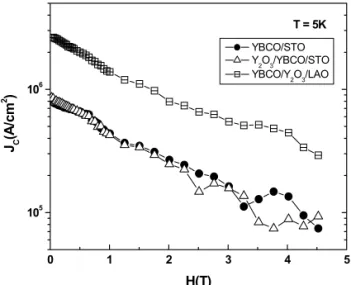
nanoparticles in which the YBCO layer was deposited at 780 o C compared to that of the pure YBCO. The magnetization curves were taken with the magnetic field parallel to the c-axis of the samples. The inset of Fig. 4 shows the magnetization M(H) versus the field H at T = 5 K. The critical current density J

c

was calculated by using a Bean model, J

c

= 30ΔM/VR [11], where ΔM is the difference of M, V is the sample volume and R is the and R is the mean radius of samples which was taken as one fourth of sample length and width. It could be seen that the J

c

value of the Y 2 O 3 (800 o C)/YBCO(780 o C)/STO sample is slightly larger than that of the pure YBCO at zero field and decreases little faster than the pure one as the field is increased. On the other hand, J

c

of the YBCO(780 o C)/Y 2 O 3 (800 o C)/LAO sample decreases much faster than that of the pure YBCO and as a result, the value of J

c

became nearly a half of that of the pure at H = 5 T. These results suggest two things.

First, the Y 2 O 3 nanoparticles deposited on top of the YBCO layer do not significantly change pinning property of the sample. It indicates that the Y 2 O 3

nanoparticles on top of the YBCO layer do not serve as effective pinning centers. Second, the Y 2 O 3

nanoparticles deposited in between the YBCO layer and the substrate drastically degrade pinning property

0 1 2 3 4 5

10

5

10

6

T = 5K J

C

(A /c m

2

)

H(T)

YBCO/STO Y

2

O

3

/YBCO/STO YBCO/Y

2

O

3

/LAO

Fig. 4. Comparison of J

c

values of YBCO(780 o C)/STO, Y 2 O 3 (800 o C)/YBCO(780 o C)/STO and YBCO(780 o C)/

Y 2 O 3 (800 o C)/LAO measured at T = 5 K.

of the sample. The reason for this might be not only due to the Y 2 O 3 nanoparticles but also due to the surface morphology of the YBCO layer. We will discuss this later.

In order to understand the decrease of J

c

of the YBCO(780 o C)/Y 2 O 3 (800 o C)/LAO sample in magnetic field, J

c

was measured for the set of the samples in which the YBCO layer was deposited at 800 o C and plotted as a function of magnetic field as shown in Fig. 5. Similar to the result observed in the first set, the value and the field dependence of J

c

of the Y 2 O 3 (800 o C)/YBCO(800 o C)/STO sample is almost the same with that of the pure YBCO. The value of J

c

of the YBCO(800 o C)/Y 2 O 3 (800 o C)/LAO sample, contrary to the previous result, is about 3 times larger than that of the pure YBCO at zero field and this enhancement is maintained in all range of fields.

The opposite behaviors of J

c

of Y 2 O 3 (800 o C)/

YBCO(780 o C)/STO and Y 2 O 3 (800 o C)/YBCO(800

o C)/STO in fields might come from the difference in the surface morphology of the YBCO layer deposited at different temperatures. As shown in Fig.

3 and summarized in Table 1, the YBCO layer deposited at 780 o C has relatively rough surface and many deep holes of which dimensions and density

0 1 2 3 4 5

10

5

10

6

YBCO/STO Y

2

O

3

/YBCO/STO YBCO/Y

2

O

3

/LAO

J

C

(A /c m

2

)

H(T)

T = 5K

Fig. 5. Comparison of J

c

values of YBCO(800 o C)/STO, Y 2 O 3 (800 o C)/YBCO(800 o C)/STO and YBCO(800 o C)/

Y 2 O 3 (800 o C)/LAO measured at T = 5 K

(5)

are comparable with those of Y 2 O 3 nanoparticles.

These holes seem to behave as intrinsic pinning centers. Since there exist enough intrinsic pinning centers already, introduction of artificial pinning centers in form of Y 2 O 3 nanoparticles leads to reduction in superconducting areas and J

c

decreases as the field is increased as shown in Fig. 4. On the other hand, the holes on the YBCO layer deposited at 800 o C are much less and smaller than those on the YBCO layer deposited at 780 o C. This indicates that less numbers of intrinsic pinning centers exist in the set of samples deposited at 800 o C manifested by smaller J

c

of the undoped YBCO sample at zero field than that of sample deposited at 780 o C. As artificial pinning centers in the form of Y 2 O 3 nanoparticles were added to YBCO films, pinning property is greatly enhanced, and the value and the field dependence of J

c

become comparable with those of the pure YBCO deposited at 780 o C.

IV. Summary

Two sets of samples of YBCO thin films with Y 2 O 3 nanoparticles were prepared by PLD at different deposition temperatures of YBCO (780 o C and 800 o C) in order to see the change in flux pinning property of the YBCO thin films. The number of laser pulse of 160 was chosen to deposite Y 2 O 3

nanoparticles. The existence of textured Y 2 O 3

nanoparticles was confirmed by the XRD and AFM analyses. Changes in flux pinning property were probed by evaluating J

c

of the two sets of samples from the magnetization measurements. At lower deposition temperature of YBCO of 780 o C, the YBCO layer has rough surface with large density of deep holes which serve as intrinsic pinning centers, so introduction of artificial pinning centers in the form of Y 2 O 3 nanoparticles leaded to reduction in J

c

of the YBCO thin films in fields. But the results were different for the YBCO thin films deposited at higher temperature of 800 o C. The smoother film surface contained less amount of intrinsic pining centers and consequently the addition of Y 2 O 3 nanoparticles

effectively enhanced flux pinning property of YBCO leading to increase in J

c

.

Acknowledgments

This work was supported by the research grant of the Chungbuk National University in 2009.

References

[1] T. P. Orlando, K. A. Delin, Foundations of applied superconductivity, Addison-Wesley (1990).

[2] J. L. Macmanus-Driscoll, S. R. Foltyn, Q. X. Jia, H.

Wang, A. Serquis, L. Civale, B. Maiorov, M. E.

Hawley, M. P. Maley, D. E. Peterson, Nature materials 3, 393 (2004).

[3] T. J. Haugan, P. N. Barnes, T. A. Campell, A. Goyal, A. Gapud, L. Heatherly, S. Kang, Physica C 425, 21-26 (2005).

[4] P. Mele, K. Matsumoto, T. Horide, O. Miura, A.

Ichinose, M. Mukaida, Y. Yoshida, S. Horii, Physica C 426-431, 1108-1112 (2005).

[5] S. K. Viswanathan, A. A. Gapud, M. Varela, J. T.

Abiade, D. K. Christen, S. J. Pennycook, D. Kumar, Thin solid film 515, 6452-6455 (2007).

[6] M. Sparing, E. Backen, T. Freudenberg, R. Huhne, B.

Rellinghaus, L. Schultz, B. Holzapfel, Supercond. Sci.

Technol. 20, S239-S246 (2007).

[7] P. Mele, K. Matsumoto, T. Horide, A. Ichinose, M.

Mukaida, Y. Yoshida, S. Horii, Physica C 463-465, 653-656 (2007)

[8] T. Haugan, P. N. Barnes, I. Maartense, C. B. Cobb, J.

Mater. Res. 18, 11 (2003).

[9] RJ. Gaboriaud, F. Pailloux, J. Perriere, Applied surface science 186, 477-482 (2002).

[10] XCheng, Z. Qi, G. Zhang, H. Zhou, W. Zhang, M. Yin, Physica B 404, 146-149 (2009).

[11] TA. Campbell, T. J. Haugan, I. Maartense, J. Murphy, L. Brunke, P. N. Barnes, Physica C 423, 1-8 (2005).

[12] JAlbrecht, S. Leonhardt, H. U. Habermeier, S. Bruck,

R. Spolenak, H. Kronmuller, Physica C 404, 18-21

(2004).

수치

Fig. 1. 2D and 3D AFM pictures of Y 2 O 3  nanoparticles  deposited on LAO substrate using 160 laser pulses
Fig. 3. AFM pictures of (a) Y 2 O 3 (800  o C)/YBCO(780
Fig. 4. Comparison of J c  values of YBCO(780  o C)/STO,  Y 2 O 3 (800  o C)/YBCO(780  o C)/STO and YBCO(780  o C)/

참조

관련 문서

In a statement to Kuwait News Agency (KUNA) on the sidelines of a meeting of the Arab Parliament's Foreign Affairs Political and National Security

The meeting was attended by Assistant Foreign Minister for GCC Affairs, Ambassador, Nasser Al-Muzayyen, and Deputy Assistant Foreign Minister for the Office of the

“ Sheikh Nasser has a written message from HH the Amir, Sheikh Sabah Al-Ahmad Al-Jaber Al-Sabah to the Chinese President, Chi Gen Beng related to enhancing mutual

On his part, CEO of Express Roads Authority, Saud Al-Naqqi said that the heavy rains of the previous day led to clogging parts of the express

Kuwait will celebrate on Sunday the fourth anniversary of the UN honoring and proclamation of His Highness the Amir, Sheikh Sabah Al-Ahmad Al-Jaber Al-Sabah as

• 이명의 치료에 대한 매커니즘과 디지털 음향 기술에 대한 상업적으로의 급속한 발전으로 인해 치료 옵션은 증가했 지만, 선택 가이드 라인은 거의 없음.. •

The proposal of the cell theory as the birth of contemporary cell biology Microscopic studies of plant tissues by Schleiden and of animal tissues by Microscopic studies of

It considers the energy use of the different components that are involved in the distribution and viewing of video content: data centres and content delivery networks