An Assessment of Records Management Practice in
Selected Local Government Councils in Ogun State, Nigeria
Abdullahi A. Bakare
Department of Library and Information Science, College of Information and Communication Technology, Kwara State University, Malete, Ilorin E-mail: [email protected]
Abdulwahab Olanrewaju Issa *
Department of Library and Information Science, Faculty of Communication and Information Sciences, University of Ilorin, Ilorin
E-mail: [email protected]
Open Access
Accepted date: February 26, 2016 Received date: April 25, 2015
*Corresponding Author: Abdulwahab Olanrewaju Issa
Associate Professor
Department of Library and Information Science Faculty of Communication and Information Sciences University of Ilorin, Ilorin
E-mail: [email protected]
All JISTaP content is Open Access, meaning it is accessible online to everyone, without fee and authors’ permission. All JISTaP content is published and distributed under the terms of the Creative Commons Attribution License (http:/ creativecommons. org/licenses/by/3.0/). Under this license, authors reserve the copyright for their content; however, they permit anyone to unrestrictedly use, distribute, and reproduce the content in any medium as far as the original authors and source are cited. For any reuse, redistribution, or reproduction of a work, users must clarify the license terms under which the work was produced.
ABSTRACT
What government does/fails to do is conveyed to the public largely by records and information of various types in the public service, without which there will be no government. When records are poorly managed, much time is involved in sorting and locating needed information from large volumes of records. The rate of records misplaced or lost from which useful information for decision making is usually obtained makes it difficult to provide concise and up-to-date records of both past and present operations, raising the challenge of effective record-keeping. Thus this study examined records management practices in selected local government councils in Ogun State, Nigeria, adopting the descriptive survey research method using questionnaires for data collection. Its population comprised 415 records of personnel in the selected councils, of which 208 were sampled using simple random technique. From the 208 copies of the questionnaire administered on the registry personnel, 150 copies were useable, with a 72.12% response rate. Descriptive statistics were used for the analysis. The results indicated a prev-alence of paper as the dominant medium for recording/conveying information in the councils with most of these being either in active state, semi-active, and vital and were kept and maintained in the registry, while in-active records were kept in the records store. Storage facilities for record-keeping were insufficient. Security measures against unauthorized access to records were by restrictions and subject users to managerial clearance. The study concluded that council records were in chaos and recommended the formulation of coherent records manage-ment policy, adequate budgetary provision, and adequate finance.
Keywords: Records, Records management, Local government council, Registry personnel, Ogun State
J Inf Sci Theory Pract 4(1): 49-64, 2016
http://dx.doi.org/10.1633/JISTaP.2016.4.1.4
Abiola A. Abioye
Department of Library, Archival and Information Studies, Faculty of Education, University of Ibadan, Ibadan
E-mail: [email protected] eISSN : 2287-4577 pISSN : 2287-9099
1. INTRODUCTION
Information has been regarded as an indispensable asset of any organization, whether public or private. It is presently a parameter for classifying the countries of the world into two main classes, namely information poor and information rich countries. Evidently, infor-mation availability, accessibility, and utilization have a strong relationship with the national development of any country. Hence, information is a national resource that can be used to produce value added goods and services (Popoola, 2000). Records and information are inseparable, since they contain information need-ed for planning, decision making, and control in any organization such as public service institutions. The International Foundation for Information Technology (2010) defines a record as something that represents proof of existence and that can be used to recreate or prove state of existence, regardless of medium or char-acteristics. A record is either created or received by an organization in pursuance of, or compliance with legal obligations, or in the transaction of business. Records can be either tangible objects, such as paper documents like birth certificates, drivers’ licenses, and physical medical x-rays, or digital information, such as electronic office documents, data in application data-bases, web site content, and electronic mail.
Robek (1995) defines records management as the application of systematic and scientific controls to recorded information required in the operation of an organization’s business. The International Standards Organization (2001) defines records management as “the field of management responsible for the efficient and systematic control of the creation, receipt, main-tenance, use and disposition of records, including the processes for capturing and maintaining evidence of and information about business activities and trans-actions in the form of records.” It states that records management includes activities such as: setting pol-icies and standards; assigning responsibilities and authorities; establishing and promulgating procedures and guidelines; providing a range of services relating to the management and use of records; designing, implementing and administering specialized systems for managing records; and integrating records man-agement into business systems and processes. Simi-larly, Wallace, Lee, and Schubert (1992) see records
management as the systematic control placed over the life cycle of recorded information from creation to its ultimate disposition or permanent storage. The life cycle of a record includes its conception, creation, distribution, usage, maintenance, storage, disposition, and the archival preservation stage. Dawha and Biu (1993) opine that records management can play an important role in charting the course of policy and determining program priorities. It can also introduce a sense of unity of purpose into the whole adminis-tration. Thus, it seeks to create records necessary for the efficient and successful running of an organiza-tion; to produce the records when they are needed; to conserve records relevant to the continued operation of the organization; and to create only those records which are necessary.
Local government is the closest tier of government to the people and is also known as grassroots govern-ment recognized by law. Maddick (1963) defines local government as a sub-unit of government controlled by a local council, which is authorized by the central gov-ernment to pass ordinances having a local application, levy taxes or exact labor, and within limits specified by the central government, vary centrally decided policy in applying it locally. The present local government system in Nigeria started with the 1976 local gov-ernment reforms, which aimed at restructuring the local government administration in conformity with modern society, and at best to make Nigeria’s local government administration an ideal in Africa. A typ-ical local government unit should have a population range of 150,000 to 800,000 (Olanipekun, 1988). The reform focuses on the administration of the public at the grassroots level, where the majority of the popula-tion in Nigeria resides. Atulomah (2011) observed that improving records management in public institutions will help to eliminate various observed administrative/ managerial problems and weaknesses that cause inef-ficiency and ineffectiveness in the institutions. There-fore, proper care of records could translate into quality service delivery by the government to the populace. No government can function effectively without prop-er management of records. Govprop-ernments go and come but the records of their activities remain. Therefore, poor management of records can lead to cost increases in the administration of government. Thus the place of proper records management practices in entrenching
good governance, especially at the local government level, cannot be over-emphasized if the local councils are to make significant impact on grassroots gover-nance in Nigeria.
2. STATEMENT OF THE PROBLEM
What government does or fails to do is conveyed to the public, largely, by records and information of various types in the public service. Research findings have shown that adequate management of records provides good information for the provision of welfare and infrastructure to the citizenry. Akor and Udensi (2013) stress that proper records management could help public institutions to manage their information efficiently, fulfill their mandate, protect them from litigation, preserve their corporate memory, and foster accountability and good governance. This can lead to improved healthcare delivery and education, among other benefits. This is to the extent that poor records management inhibits good planning and management of scarce resources.
Observations have shown that there is an alarming rate of records misplacement and loss, from which useful information for decision making is usually derived, in most public institutions. This makes it dif-ficult to provide concise and up-to-date records of all their past and present operations, thereby raising the challenge of effective record keeping. Therefore, the local government that has been observed to have many inter-linking departments in which records are gen-erated on a daily basis also seemed to be experiencing the absence of proper records management. This may lead to low productivity in the local council, thereby obstructing the realization of the Council’s prime man-date of affecting the lives of the people at the grassroots level positively, through an unfettered development. Such a condition has a great potential of hampering the success of developmental programs and policies at the local council levels in Nigeria, with the possibility of slowing down national development. Against this backdrop, this study investigated the records manage-ment practices in selected local governmanage-ment councils in Ogun State, Nigeria.
3. OBJECTIVES OF THE STUDY
The main objective of this study is to examine the records management practices in selected local gov-ernment councils in Ogun State, Nigeria. The specific objectives are to:
i. ascertain the classes of records created, main-tained, and used by the selected local government councils, as well as their formats;
ii. determine what storage facilities and level of se-curity are provided for these records;
iii. examine the retrieval tools used in locating re-cords and rere-cords retrieval rate; and
iv. identify the barriers to effective records manage-ment in the local governmanage-ment councils.
4. REVIEW OF RELATED LITERATURE
4.1. Importance of Records in Organizations
Records are important, without which an organiza-tion simply cannot funcorganiza-tion. The day-to-day operaorganiza-tions of any successful organization depend entirely on its records. Many organizations will not survive without keeping, maintaining, and using their records. Akor and Udensi (2013) define a record as any document or other source of information compiled, recorded, or stored in written form or on film, by electronic process, or in any other manner or by any other means. They further state that “State record” refers to any record made and kept, or received and kept, by any person in the course of the exercise of official functions in a public office, or for any purpose of a public office, or for the use of a public of-fice, whether before or after the commencement of this section. Penn (1983) asserts that the records life cycle consists of creation, maintenance, and use, and its dis-position. He stresses that if a record is not necessary, do not create it, stressing further the need for the mainte-nance of records that are created. Therefore, all the stag-es involved in the records life-cycle must be considered before any record is created. Ogunrombi, Abareh, and Adamu (1998) are of the opinion that an organization cannot but develop a culture of maintaining a record in whatever form which will serve as a reference tool in helping the organization fulfill its obligation for effective management of the problems of that organization.
essential instrument of administration without which operational processes and functions cannot be executed in organizations. To Popoola records are barometers for measuring the performance of an organization. In addition, records are the by-products of managerial and administrative activities, and they mirror the overall quality of the organization’s business performance. If re-cords are barometers for measuring the performance of any organization, according to Popoola (2000), it then means that without records, no organization can func-tion. Dollar (2000) also sees records as recorded infor-mation in any form created or received and maintained by an organization, person, or system in the transaction of a business or the conduct of affairs and kept in a widely accessible form as evidence of such activity. This definition, however, must be recognized as only the starting points for a complete and useful definition. To be meaningful, it must be accompanied by a detailed set of definitions that identify when a record is created and what type of evidence is required to create reliable and authentic records.
4.2. Records Management
Records management is a field of management re-sponsible for the systematic control of the creation, maintenance, use, reproduction, and disposition of records. According to Ette (1984), records management relates to three stages through which records pass, namely the current, semi-current, and non-current stages. At the current stage, records are created and used frequently. In the semi-current stage, which is the intermediate stage, records are referred to occasionally. At the non-current stage, they are no longer referred to but are sent to the archives after appraising them. Aleg-beleye (1983) defines records and information manage-ment as an all-embracing activity which include form control, correspondence control, reports management and control, active files management, records inventory and appraisal, records retention and disposition, ar-chives management and control, and copy reproduction (reprography). In conventional paper based organi-zations, such as the local government councils, paper continues to be viewed as the material for records in administrative documentations (Igwoku, 2008). Indeed, Unuigbe (1990) posits that records management deals with the full range of paper work from the creation of a new record to the moment when a decision is made
either to destroy it or keep it for all time. It is the appli-cation of systematic analysis and scientific control of business records from their creation through process-ing, maintenance, protection, and final disposition.
In records management, policies, procedures, and standards cover the creation, receipt, distribution, use, retention, storage, retrieval, protection, preservation, and final disposition of all types of recorded informa-tion throughout the organizainforma-tion (Mark, 2001). Ug-wunze (1992) asserts that records management involves planning, implementing, and review of the functions for the administration of the records of an organization. Ugwunze stresses that records management helps to control the quantity and quality of information that is created. Thus, the information can be maintained in a manner that effectively serves the needs of the organi-zation. Unighe (2000), quoted by Abioye and Habila (2004), sees records management as quality, quantity, and cost of records, and encompassing the procedures, systems, operations, space, equipment, and staff re-quired to administer the records. It is therefore the responsibility of records management functions to de-velop and operate systems and procedures for creating, maintaining, and disposing of records necessary for the successful operation of an organization (Abioye & Ha-bila, 2004).
4.3. Records Management Practices in Organizations
Records management practices are vital to every or-ganization aiding in the achievement of certain goals set by the founders of that organization from the concep-tualization of that business. Records management oc-cupies a strategic position in the efficient and effective management of public institutions. In fact, the practice is central in the administration of the institutions be-cause it documents the planning and implementation of appropriate courses of services allowing proper mon-itoring of work (Egwunyenga, 2009). As stated by Ro-beck, Brown, and Stephens (2002), the reasons why or-ganizations practice records management are to control the creation and growth of records, reduce operating costs, improve efficiency and productivity, assimilate new records management technologies, ensure regu-latory compliance, minimize litigation risk, safeguard vital information, support better management decision making, preserve the corporate memory, and foster
professionalism in running the business. The need for records preservation is, therefore, paramount to the cultural heritage of the past and for future generations obtainable in any organization (Abdulkareem, Isah, & Issa, 2013).
Akor and Udensi (2013) assert that decision making in an organization is an administrative function and invariably requires information in the form of records. They assert that administration is ordinarily discussed as the art of “getting things done,” while emphasizing the processes and methods for insuring incisive action. Principles are set forth for securing concerted action from groups of people. Decisions are made at different levels in the organization—the lower, the middle, and the higher. Irrespective of the level, however, informa-tion will be required one way or another. In all spheres of activity, decisions are being made about the allocation of budgetary resources, the prioritization of programs, the granting of social benefits, the commissioning of new projects, the closure of unproductive ventures, the information to release to the public, or the level of classification that certain information requires. Records and archives provide the information that is required by those who make the decisions. The main question therefore is whether or not these records are available to these decision makers and whether or not the decision makers are aware of their existence and thus make use of them for decision making.
Thus efficient and effective management of records helps the critical stakeholders of an organization or institution as well as its administrators who require re-cords to facilitate accurate, timely decisions (Nwankwo, 2001). Decision making is the backbone of administra-tive actions and administrators execute plans through actions (Akor & Udensi, 2013). Information is every organization’s most basic and essential asset, and in common with any other business asset, recorded infor-mation requires effective management. Records man-agement ensures that information can be accessed easily and destroyed routinely when no longer needed, and enables organizations not only to function on a day to day basis, but also to fulfill legal and financial require-ments. The preservation of the records of government, for example, ensures it can be held accountable for its actions, that society can trace the evolution of policy in historical terms, and allows access to an important re-source for future decision making (National Archives of
Scotland, 2013).
All organizations create records to support and pro-vide epro-vidence of their transactions. Consequently, re-cords, regardless of their formats, are important sources of information and knowledge. They ensure effective transparency and accountability in decision-making and contribute to national development (Internation-al Records Management Trust, 2003; Kemoni, 2007). Therefore, sound management of records, whether electronic or paper, has become a topical issue not only in Nigeria but globally. The World Bank (2006) and the International Records Management Trust (2003) concur that records are essential for the effective and productive functioning of private and public organiza-tions. They assert that records register the decisions and activities of governments and other organizations, and serve as benchmarks against which they can measure their future activities and decisions. Without records, there can be no rule of law and accountability (World Bank, 2006). Consequently, without good records, orga-nizations make ad hoc decisions without the benefit of institutional memories.
Kalusopa (2011) observes that, for organizations to participate meaningfully in the national development process, they must develop the capacity to manage re-cords and information. The reason is that the challenges of conceiving, initiating, implementing, monitoring, and evaluating activities will always require reliable, pertinent, and timely records as well as information. Therefore, every organization has the role to monitor and measure progress with inclusive participatory na-tional economic processes and good corporate ethics that the principles of openness, integrity, and account-ability underpin with regards to its records management (Kanyenze, Kondo, & Martens, 2006).
4.4. Records Management in Local Government Councils in Nigeria
The concept of “local government” has been given different meanings by different scholars. Hicky (1966) referred to local government as “the management of services and regulatory functions by locally elected councils and officials responsible to them, under statu-tory and inspectorial supervision of central legislature and executive, but with enough financial and other independence to admit of a fair degree of local initiative and policy making.” The United Nations Office for
Pub-lic Administration (1961) defines local government as “a political subdivision of a nation or (in a federal system) state, which is constituted by law and has substantial control of local affairs, including the powers to impose taxes or to exact labor for prescribed purposes. The gov-erning body of such an entity can be elected or locally selected.” This definition has been widely accepted as reasonably embracing.
Finally, Yakubu (2003), quoting Chief Obafemi Awolowo, referred to local government as “a system of government where local councils make, accept respon-sibility for, and implement their own decisions subject only to such control as may be exercised by the people through their own regional government.” Accordingly, the local government councils under the fourth Sched-ule of section 7 of the 1999 Nigerian Constitution have numerous functions listed for them. Hence, from the myriad activities with which they are saddled, consider-able amounts of records are bound to be generated. It is therefore imperative to have records management pro-grams in place to manage the large volume of records being generated both internally and externally by the local government councils.
Several factors have been identified to have con-tributed to the absence of good records management practices in local government councils in Nigeria. Aleg-beleye (1988), Evborokhai (1990), and Unuigbe (1990) all report the absence of an enforcement of a records management program as contained in the law. Assante (1989) laments the poor management of records in Africa and posits that the major contributing factor to the gross inefficiency and a lack of continuity in pol-icies, procedures, and measures of most African gov-ernments and business establishments is not frequent changes in government, as is commonly supposed, but bad management of records. Similarly, Mnjama (1993) remarks that the problems of records management in Africa include lack of resources, poor management, and inappropriate staff and training. These problems are also peculiar to local governments in Nigeria as a subset of African states. Dawha and Biu (1993) examined the archive and records management of the Biu Municipal Council in Nigeria and found that the council has no law governing the implementation of records manage-ment, no records center, and lacked in-house manuals or guides for the creation and control of records. From the foregoing review of the literature, it is obvious that
of the few studies on records management in Nigeria even fewer are those concerned with the local govern-ment councils. Hence, the justification for a study to ex-amine the practices in selected local government areas of Ogun State, Nigeria.
5. METHODOLOGY
The research design adopted for this study is the descriptive survey method using simple random sam-pling. This research setting is Ogun State, located in the southwest geopolitical zone of Nigeria, and one of the six states in the zone. Its choice for this study arose from the fact that it is one of the earliest exposed states in the federation to western education even as it is rap-idly developing in both commerce and industry; this is perhaps owing to its proximity and affinity to Lagos State, the country’s commercial capital. As a fast grow-ing state, it is expected to serve as a role model in best practices generally, and in particular, local government administration; hence its choice for this study. The study population comprises the 415 personnel in the registry of the three selected local government councils in Ogun State, namely Sagamu (155), Ikenne (148), and Remo North (112). They are both in the senior and ju-nior categories responsible for handling records in the Registry. From the study population of 415, a sample of 208 was drawn, representing 50.12%. Out of the 208 copies of the questionnaire administered, 150 copies were completed by the respondents and found useable for the purpose of analysis, giving a very high return rate of 72.12%. This is as presented in Table 1.
Apart from the questionnaire, which formed the major instrument for collecting the needed data, the other instrument was the interview, which was con-ducted with the three (3) heads of Registry in the three local government areas, which had only five questions serving as a follow-up to confirm those contained in the questionnaire. The questionnaire, validated by two experts in archives and records management in the De-partment of Library, Archival and Information Studies, University of Ibadan, was pilot-tested on thirty (30) staff of the Ilorin East local government area of Kwara, since they would not be a part of the final respondent group. Adopting the Split-half method, the results of their responses yielded a Cronbach’s Alpha reliability
co-ef-ficient of r=071. The questionnaire was administered and collected back by the researchers personally while the interview was conducted immediately on the com-pleting of the questionnaire. A descriptive data analysis method was employed through tabular presentation and simple percentage.
6. RESULTS
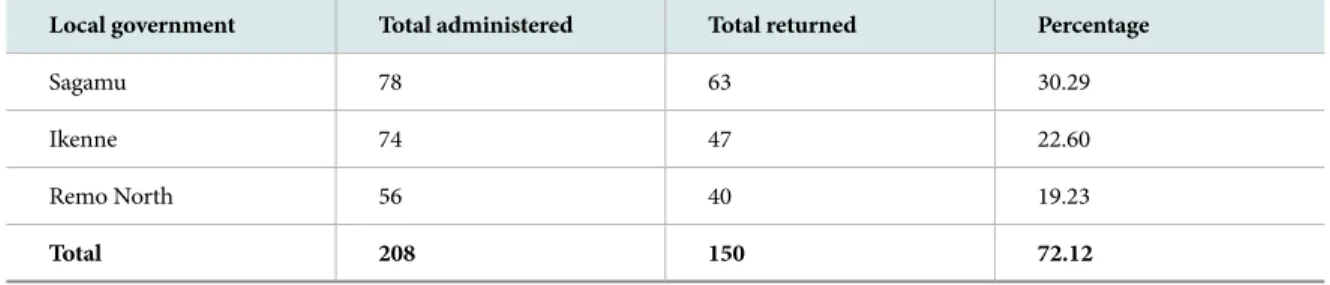
The return rate of the respondents in the three select-ed local councils is as shown in Table 2.
The result in Table 2 shows that, out of a total of 208 copies of the questionnaire that were administered to the registry personnel in the three selected local government councils, namely the Sagamu, Ikenne, and Remo North local councils respectively, in Ogun State, 150 copies were duly filled and returned giving a return rate of 72.12%. The high return rate recorded here could be attributed to the fact that the researchers were personally involved in both the administration and collection of the questionnaire, a situation that also afforded the researchers the opportunity to conduct
the interview with heads of the Registries in the three Councils immediately.
6.1. Objective 1: Classes of Records Managed and their Formats
Analysis of the classes of records created and their formats is as shown in Table 3.
The table shows that the classes of records managed by the three selected local government councils in-clude: active records, which shows very high response in Sagamu (58.73%), followed by Ikenne (55.32%) and Remo North (50.00%); and vital records, with the same pattern of response but in reverse order with Remo North (47.50%), Ikenne (44.68%), and Sagamu (38.10%), while a few semi-active and in-active records were also kept in the registry. The breakdown of this indicates 3.17% of semi-active records for Sagamu with no response in Ikenne and Remo North, and 2.50% of in-active records for Remo North with no response in Sagamu and Ikenne. That the results showed that all the three Councils studied have records in their registries ranging from active and semi-active to inactive records provided a clear picture of the classification of records
Table 1. Study Population and Sample
LGA Population Sample Percentage
Sagamu 155 78 50.32
Ikenne 148 74 50
Remo North 112 56 50
Total 415 208 50.12
Table 2. Return Rate of the Respondents
Local government Total administered Total returned Percentage
Sagamu 78 63 30.29
Ikenne 74 47 22.60
Remo North 56 40 19.23
expected of a typical Records Centre, hence taking no exception to the rule.
The table also revealed that most of these records were in paper format with an overwhelming response coming from Remo North (100.00%), followed by Sagamu (87.30%) and Ikenne (76.59%). A very low percentage in the local government councils indicated that fewer electronic records were maintained, with the highest response in Ikenne (14.89%), followed by Sag-amu (9.52%) and no response in Remo North; while the film-based format appeared for Ikenne (4.26%), Sagamu (3.18%), and Remo North without response. That most of the records in these Councils were in paper format suggested that most of their records were not digitally born or created. Given the present overwhelming influence of ICT application to nearly all facets of human endeavor this finding was most unexpected, especially in a highly developed State like the one studied. This makes for an interesting finding indeed, because the natural expectation was that the ICT trend and fashion would be clearly evident in the records management practices in these Councils.
6.2. Objective 2: Records Storage Facilities Available for Records Security
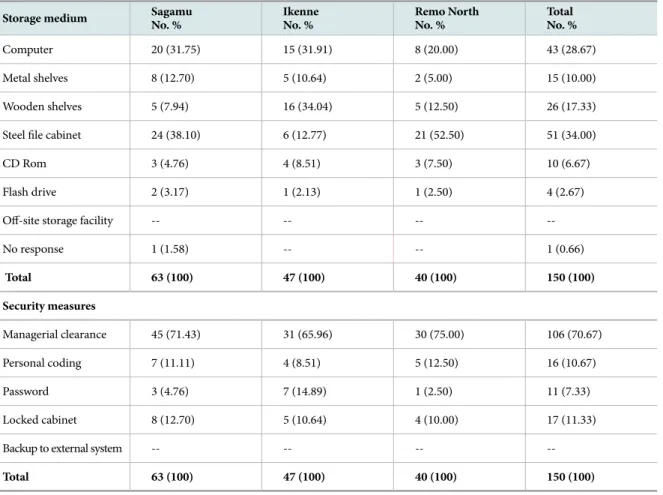
The analysis of the records storage facilities available and the level of records security in the selected local government councils is presented in Table 4.
Table 4 shows that a majority (52.50%) from Remo North, 38.10% from Sagamu, and 12.77% from Ikenne indicated that steel file cabinets constituted their main storage facility. This is closely followed by the computer (28.67%), where the 31.91% of the respondents who indicated this were from Ikenne, 31.75% from Sagamu, and 20.00% from Remo North. This is followed by the use of wooden shelves (17.33%) with 34.04% in Iken-ne, 12.50% in Remo North, and 7.94% in Sagamu, as a medium of storage. Only a few respondents indicated that metal shelves, CD-ROMs, and flash drives were used in their respective local government councils with 12.70% from Sagamu, 10.64% from Ikenne, and 5.00% from Remo North for metal shelves; 8.51% from Iken-ne, 7.50% from Remo North, and 4.76% from Ikenne for CD-ROMs; while 2.50% from Remo North, 3.17% from Sagamu, and 2.13% from Ikenne indicated flash Table 3. Classes of Records and their Formats
Classes of records SagamuNo. % IkenneNo. % Remo NorthNo. % Total No. %
Active records 37 (58.73) 26 (55.32) 20 (50.00) 83 (55.33) Vital records 24 (38.10) 21 (44.68) 19 (47.50) 64 (42.67) Semi-active records 2 (3.17) -- -- 2 (1.33) Inactive records -- -- 1 (2.50) 1 (0.67) Total 63 (100) 47 (100) 40 (100) 150 (100) Records format Paper-based records 55 (87.30) 36 (76.59) 40 (100.00) 131 (87.33) Electronic records 6 (9.52%) 7 (14.89) -- 13 (8.67) Film-based records 2 (3.18%) 2 (4.26) -- 4 (2.67) Tape -- -- -- --No response -- 2 (4.26) -- 2 (1.33) Total 63 (100) 47 (100) 40 (100) 150 (100)
drives. In all, no respondent indicated that an off-site storage facility is used as a storage medium for the councils’ records.
Concerning security measures taken by each of the councils to prevent unauthorized access, mutilation, and stealing of their records, a majority (70.67%) indi-cated that managerial clearance was often employed, with 75.00% from Remo North, 71.43% from Sagamu, and 65.96% from Ikenne, respectively. Other methods include personal coding, with 12.50% in Remo North, 11.11% in Sagamu, and 8.51% in Ikenne. The use of passwords to complement managerial clearance was not as significant as the responses showed only 14.89% for Ikenne, 4.76% for Sagamu, and 2.50% for Remo North. Also, the use of locked cabinets, 12.70% in Sag-amu, 10.64% in Ikenne, and 10.00% in Remo North,
respectively, is considered as essential to safeguard records of the councils. None of the respondents indi-cated that backups to external systems were considered a significant security measure by the councils. These security and safety measures were completely manual, devoid of taking on all the advantages offered by mod-ern-day information and communication technology facilities. This situation does not show that the Councils were proactive in their records management practices, thus exposing their records to disasters without pre-paredness and plans, contrary to standard practice in a typical Records Centre. This is as undesirable as it is unacceptable, particularly for a State that is as advanced as Ogun State, expected to have entrenched good prac-tices in all its activities, including their records manage-ment practice.
Table 4. Records Storage Facilities and Security Measures
Storage medium SagamuNo. % IkenneNo. % Remo NorthNo. % Total No. %
Computer 20 (31.75) 15 (31.91) 8 (20.00) 43 (28.67)
Metal shelves 8 (12.70) 5 (10.64) 2 (5.00) 15 (10.00)
Wooden shelves 5 (7.94) 16 (34.04) 5 (12.50) 26 (17.33)
Steel file cabinet 24 (38.10) 6 (12.77) 21 (52.50) 51 (34.00)
CD Rom 3 (4.76) 4 (8.51) 3 (7.50) 10 (6.67)
Flash drive 2 (3.17) 1 (2.13) 1 (2.50) 4 (2.67)
Off-site storage facility -- -- --
--No response 1 (1.58) -- -- 1 (0.66) Total 63 (100) 47 (100) 40 (100) 150 (100) Security measures Managerial clearance 45 (71.43) 31 (65.96) 30 (75.00) 106 (70.67) Personal coding 7 (11.11) 4 (8.51) 5 (12.50) 16 (10.67) Password 3 (4.76) 7 (14.89) 1 (2.50) 11 (7.33) Locked cabinet 8 (12.70) 5 (10.64) 4 (10.00) 17 (11.33)
Backup to external system -- -- --
6.3. Objective 3: Retrieval Tools for Locating Records and Records Retrieval Rate
The analysis of retrieval tools as well as the retrieval rate used in locating records in the selected local gov-ernment councils is as indicated in Table 5.
Table 5 indicates that registers constituted the most common type of finding aid by the councils, where Sagamu had 71.43%, followed by Ikenne (59.57%) and Remo North (55.00%). This pattern is followed by indexes, in a reversed order where Remo North had 20.00%, Ikenne (12.77%), and Sagamu (12.70%). Other types of finding aids included simple lists in Ikenne (12.77%), Sagamu (11.11%), as well as simple lists and functional codes (10.00% and 7.50%, respectively), for Remo North. This finding is an extension of an earlier one, which revealed that the records in these Councils were largely created manually as opposed to digital-ly, given that the origin of records goes a long way to
determining their mode of storage and retrieval, gen-erally. However, in contrast to the non-digital creation of records in the Councils, findings here revealed that the majority of them employed the use of such records storage media as the computer, CD-ROM, and flash drive aside metal shelves. This showed the Councils taking recourse to the trend after all, even though this practice needs to be further entrenched especially at the records creation stage, where it is presently nearly non-existent.
As for the records retrieval rate, the table shows that a majority of the respondents, 46.81% in Ikenne, 42.86% in Sagamu, and 35.00% in Remo North, indi-cated that it took them an average of 5-10 minutes to retrieve the needed records. Next were the respondents from Remo North (32.50%), Ikenne (25.53%), and Sag-amu (25.40%) who indicated an average of 1-5 minutes as their record retrieval rate. Others indicated 10-15
Table 5. Retrieval Tools and Record Retrieval Rate
Types of Finding Aids SagamuNo. % IkenneNo. % Remo NorthNo. % Total No. %
Simple list 7 (11.11) 6 (12.77) 4 (10.00) 17 (11.33) Register 45 (71.43) 28 (59.57) 22 (55.00) 95 (63.33) Calendar -- -- 2 (5.00) 2 (1.33) Color code 1 (1.59) 3 (6.38) 1 (2.50) 5 (3.33) Index 8 (12.70) 6 (12.77) 8 (20.00) 22 (14.68) Functional code -- -- 3 (7.50) 3 (2.00) No response 2 (3.17) 4 (8.51) -- 6 (4.00) Total 63 (100) 47 (100) 40 (100) 150 (100)
Record Retrieval Rate
1-5 minutes 16 (25.40) 12 (25.53) 13 (32.50) 41 (27.33) 5-10 minutes 27 (42.86) 22 (46.81) 14 (35.00) 63 (42.00) 10-15 minutes 13 (20.63) 8 (17.02) 8 (20.00) 29 (19.33) 15-20 minutes 5 (7.94) 3 (6.38) 3 (7.50) 11 (7.34) No response 2 (3.17) 2 (4.26) 2 (5.00) 6 (4.00) Total 63 (100) 47 (100) 40 (100) 150 (100)
minutes, including 20.63% from Sagamu, 20.00% from Remo North, and 17.02% from Ikenne, while only a few indicated 15-20 minutes, with 7.94% for Sagamu, 7.50% for Remo North, and 6.38% for Ikenne. Very few respondents in Remo North (5.00%), Ikenne (4.26%), and Sagamu (3.17%) gave no response to this effect. Given the rather good retrieval time rate as found above, especially since this is a largely manual records environment, the situation will definitely be improved upon when the Councils adopt electronic records management practices. Of great concern, however, is the problem of disorganized records resulting from the retrieval of needed records. Embracing the digital approach will help not only to improve even better the retrieval time rate but also to address perfectly the residual problem of record scattering effects, usually arising from each retrieval exercise, leaving the records situation worse than it was before the search and re-trieval.
6.4. Objective 4: Barriers to Effective Records Management in the Councils
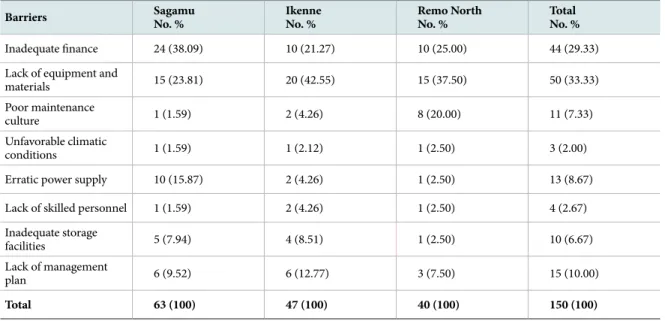
Table 6 presents results on barriers against records management.
The table 6indicates that the problem of inadequate
finance was most pronounced in Sagamu (38.09%), followed by Ikenne (21.27%) and then Remo North (25.00%), respectively. As for the lack of equipment and materials, responses from Ikenne (42.55%), Remo North (37.50%), and Sagamu (23.81%) were instruc-tive, while poor maintenance culture has the highest response of 20.00% in Remo North, followed with a huge margin by Ikenne (4.26%) and the lowest in Sag-amu (1.59%). Unfavorable climatic conditions recorded low responses in the three local Councils generally with the lowest from Sagamu (1.59%), followed by Ikenne (2.12%) and Remo North (2.50%). Erratic power sup-ply constituted a major barrier in Sagamu (15.87%), then in Ikenne (4.26%) and Remo North (2.50%). The response on the lack of skilled personnel was high for Ikenne (4.26%), followed by Remo North (2.50%), but less for Sagamu (1.59%). Inadequate storage facilities, as a barrier, received high response in Ikenne (8.51%) and Sagamu (7.94%), but was low in Remo North (2.50%). A similar pattern of response was received with respect to lack of management planning as a barrier: Ikenne has 12.77%, Sagamu 9.52%, and Remo North 7.50%, respectively. Noteworthy from these findings is the fact that of all the barriers identified, the absence of a man-agement plan remained the most central because such
Table 6. Barriers to Effective Records Management in the Councils
Barriers SagamuNo. % IkenneNo. % Remo NorthNo. % Total No. %
Inadequate finance 24 (38.09) 10 (21.27) 10 (25.00) 44 (29.33)
Lack of equipment and
materials 15 (23.81) 20 (42.55) 15 (37.50) 50 (33.33)
Poor maintenance
culture 1 (1.59) 2 (4.26) 8 (20.00) 11 (7.33)
Unfavorable climatic
conditions 1 (1.59) 1 (2.12) 1 (2.50) 3 (2.00)
Erratic power supply 10 (15.87) 2 (4.26) 1 (2.50) 13 (8.67)
Lack of skilled personnel 1 (1.59) 2 (4.26) 1 (2.50) 4 (2.67)
Inadequate storage
facilities 5 (7.94) 4 (8.51) 1 (2.50) 10 (6.67)
Lack of management
plan 6 (9.52) 6 (12.77) 3 (7.50) 15 (10.00)
a plan will naturally incorporate all the needs required for a good records management practice, thereby eliminating most, if not all, of the barriers mentioned here. Furthermore, the absence of such a management plan was a strong indicator of the fact that none of the Councils studied has anything close to a standard re-cords management practice in operation. This situation is undesirable, to say the least.
7. DISCUSSION OF THE FINDINGS AND
THEIR IMPLICATIONS
This study is on records management in selected local government councils in Ogun State, Nigeria. The study established the prevalence of paper as the medium for recording and conveying information in the selected local government councils. However, with modern technologies, multiple copies of a record can be created, which may lead to unnecessary large volume of re-cords. Popoola (2003), in Nakpodia (2011), noted that when the creation of records is not properly managed, attainment of goals and objectives becomes a problem. These problems often manifest in the difficulty in locat-ing papers/information, bulky files, wrong fillocat-ing, wrong titles of files, and having offices cluttered with papers and files. It is therefore important to observe the rule of thumb in records management, which Penn (1983) gave as the necessity of not creating a record when it is not needed. However, the findings showed that most of these paper-based records were active, semi-active, or vital, and maintained by the councils in the registry, while in-active records were kept in the records store.
The study also found that all the steel cabinets mostly used by the local government councils were grossly inadequate and as a result some records were either placed on top of the cabinets or kept on the floor. This act, apart from making information retrieval a difficult task, also endangers the safety of any classified informa-tion contained in them. Ajewole (2001) opines that the hallmark of any effective records management is a stor-age device that facilitates, rather than hampers, a quick retrieval process for prompt usability of the records. Findings of this study further revealed that computers, rather than being used as a medium of storage, were used for records creation.
On the security measures in place to prevent
unau-thorized access to the records, the study revealed that strong restrictions were placed on the use of records. Access to records is usually subjected to manageri-al clearance. In fact, observations showed that users have to fulfill bureaucratic procedures before being allowed access to records for inspection and needed information for official and public use. Hopler (1976), in Abioye and Habila (2004), notes that records are the life blood of any organization and to treat the matter of storage and protection of these records lightly would be undesirable. He further argues that records which are not properly stored will be at the mercy of agents of records destruction such as rats and termites, and even human destructive tendencies like theft and vandalism, and concludes that if a record is worth keeping, then such records must be adequately stored and protected. Further to this, the preservation of records of govern-ment ensures it can be held accountable for its actions, that society can trace the evolution of policy in histor-ical terms, and allows access to an important resource for future decision making (National Archive of Scot-land, 2013).
Furthermore, findings of this study indicated that registers were the commonest type of finding aid used in the selected local government councils. This was not surprising, since all records, especially those received, are usually registered as they are filed and their registers can be useful in locating the needed records from their stores. Next to this were index and simple list devices as other types of finding aids employed by these local gov-ernment councils. This result is similar to the result of a previous study carried out by Abioye (2006). However, the use of color coding as a modern record finding tool was not given adequate attention, especially from an economic point of view. Popoola (2000) submits that the use of color coding can reduce record handling costs significantly in the records office (registry).
The findings also showed that the rate at which re-cords were retrieved took an average of 5-10 minutes in the selected local governments. This is a better record retrieval rate considering the chaotic situation of re-cords management in the local government councils, given the observation that some of the records were scattered over the shelves. However, this assertion only applied to the retrieval of active and vital records, which are kept in the registry. The same cannot be said of non-current and inactive records, which were just
care-lessly dumped in a records store. Interview responses also revealed that it took an average of 1-2 hours and even at times one or two days to retrieve the needed records from their stores. Each attempt to search for re-quired records in the store further compounded the sit-uation as the records were left more disorganized than before the searcher met them. Abioye (2006) opines that easy retrieval guarantees timely availability of re-cords for decision making. Delay in rere-cords retrieval processes is a manifestation of poor records manage-ment practices, which breeds inefficiency.
The findings also revealed that a number of barriers were confronting effective management of records in the studied local government councils. These problems range from lack of equipment and materials, quate finance, and poor maintenance culture, to inade-quate storage facilities. Other problems included erratic power supply, lack of management planning, and lack of skilled personnel. Most of these finding were sup-ported by Popoola (2000).
The implication of these findings is that there is no institutionalized framework for the proper harnessing of public records and information in the studied local government councils. This, in turn, will almost cer-tainly affect the efficient and effective administration of these councils. Considering the strategic position of Ogun State, as one of the foremost parts of Nigeria to be exposed to Western education and development, its Councils’ administration should serve as a worthy practice to be emulated by others across the country in terms of institutionalization and standardization. The findings of this study did not reveal this, a situation that is to say the least, undesirable. Therefore, allocation of adequate space and supply of modern and adequate equipment and facilities are necessary for the enhance-ment of proper storage and easy retrieval of records. Adequate budgetary provisions will ensure that proper funding is available to support records management programs. An adequate management plan provides the basis for systematic procedures for records manage-ment. Exhibition of good maintenance culture ensures longevity for those records of permanent value. Ad-equate power supply will not only support electronic records programs but also ensure their accessibility. A team of skilled personnel will represent the heart and the life-blood of an effective records management program and providing a conducive environment for
records ensures that records are in stable condition. It is therefore imperative that proper attention be paid to all these measures to achieve successful and functional records management practices.
8. CONCLUSIONS AND RECOMMENDATIONS
Records created, used, kept, and maintained by the selected local government councils examined are in four categories, namely active, vital, semi-active, and inactive, most of which were predominantly in paper based format. However, some records were stored in electronic formats such as disc, tape, and film. It must be noted that some of the selected local government councils still make use of archaic wooden shelves as a media of storage where available steel file cabinets were in short supply. The public service institutions’ ap-proach to records security are through personal coding, passwords, and seeking managerial clearance before records are used as well as employing trained staff in records security and control, while modern security measures such as locked cabinets and backups to exter-nal systems, among other solutions, are not in place.
Records of the selected local government councils were in a chaotic situation. Most of the semi-active and inactive records were usually dumped in the records store. This has the tendency to hamper information retrieval from the records stores when required. The local government councils are faced with a myriad of barriers from lack of equipment and materials, inade-quate finance, and poor maintenance culture, to unre-liable power supply, lack of skilled personnel, and lack of management plans. It is therefore significant to deal with these factors in a bid to move the local govern-ment councils in particular and Nigeria in general into a world where records management strategies exist and impact positively on their governments, their staff, and their people.
On the basis of these conclusions reached, the fol-lowing recommendations were made:
1. A coherent records management policy should be formulated and provision made for all phases of records’ life cycles, namely the records’ cre-ation, use and maintenance, and disposition. This policy should be strictly adhered to by the councils’ registry staff.
2. Old and archaic storage facilities such as wooden shelves should be discarded while steel file cab-inets, presently in short supply, should be pro-vided in sufficient quantities. From an economic point of view and for space management, steel file cabinets with aisle features should be pro-cured and used for filing records. Off-site storage facilities should also be considered, especially where vital records are concerned.
3. Integrated records management programs should be adopted without downplaying any of the components of records management. The councils should adopt a holistic and realistic approach in the establishment, implementation, and administration of a comprehensive records management program.
4. Adequate budgetary provisions should be pro-vided for records management programs in these councils. Adequate finance should be provided to procure modern and adequate storage equip-ment and facilities.
REFERENCES
Abioye, A. A. (2006). Records management practices of the Court of Appeal and the Supreme Court in the administration of justice in Nigeria. (Unpublished thesis, Department of Library, Archival and Infor-mation Studies, Faculty of Education, University of Ibadan), 80, 86.
Abioye A. A., & Habila, J. R. (2004). Records manage-ment practices in colleges of education in Nigeria: A study of Federal College of Education, Yola and College of Education, Jalingo. Gateway Library Journal, 7(2), 68-79.
Ajewole, B. (2001). Records and information resource management in public service: A theoretical and practical framework. Lagos: Administrative Staff College of Nigeria (ASCON).
Akor, P. U., & Udensi, J. (2013). An assessment of re-cord management system in establishment division of two universities in Nigeria. Mediterranean Jour -nal of Social Sciences, 4(12).
Alegbeleye, G. O. (1983). Towards an integrated records and information management for Nigeria. Paper presented at the Second General Assembly of West
African Regional Branch of International Council on Archives (WARBICA) and Seminar on Archives and Records Management, Jos.
Alegbeleye, G. O. (1988). Archives administration and records management in Nigeria: Up the decade from amalgamation. ARMA Records Management Quarterly, July, 26-30.
Assante, K. B. (1989). Closing address at the Second West Africa Regional Workshop on Management of Semi-current Records, Accra, Ghana, 23 July 23 - 19 August.
Atulomah, B. C. (2011). Perceived records management practice and decision making among university administrators in Nigeria. Library Philosophy and Practice. Retrieved from http://unllib.uni.edu/LPP/ Dawha, M. K., & Biu, A. B. (1993). Archive and records management in a typical municipal council in Ni-geria. New Library World, 94(4), 1108.
Dollar, C. M. (2000). Authentic electronic records strat -egies for long-term access. Chicago, IL: Cohasset Associates, 23, 47-50.
Egwunyenga, E. J. (2009). Records keeping in universi-ties: Associated problems and management options in south west geo-political zone of Nigeria. Inter -national Journal of Education Science, Kamla-Raj, 1(2), 109-113.
Emmerson, P. (1989). How to manage your records. Cambridge, UK: TCSA Publishing.
Ette, E. M. (1984). The Organisation and utilization of the Ibadan archives. (Unpublished Master’s thesis, University of Ibadan, Ibadan).
Evborokhai, A. O. (1990). Records management sys-tem. Lecture delivered at the Principles of Records Management and Archives Administration Course, National Archives Zonal Office, Ibadan, 23 October - 16 November, 10.
Helen, S., & Tim, M. (1996). Records and information resource management in public service: A theoreti-cal and practitheoreti-cal framework. Lagos: Administrative Staff College of Nigeria (ASCON).
Hicky, T. J. D. (1966). Enemies within and enemies without the gates. Political Quarterly, 37(2), 159-168.
Hopler, F. B. (1976). Records management practices in Colleges of Education in Nigeria: A study of Federal College of Education, Yola and College of Education, Jalingo. Gateway Library Journal, 7(2),
68-79.
Igwoku, I. F. (2008). An analysis of record management strategies in western Nigeria. (Unpublished M.Ed. dissertation, Delta State University, Abraka). International Foundation for Information
Technolo-gy (2010). Definition of records. Retrieved from http://www.if4it.com.
International Organisation for Standardisation (ISO) (2001). ISO 15489-1 Information and documenta -tion-records management: Part 1 general. Geneva: ISO.
International Records Management Trust (IRMT) (2003). Evidence-based government in the elec -tronic age: Case summaries. Retrieved from http:// ww.irmt.org/evidence/index.html
Kalusopa, T. (2011). Developing an e-records readiness framework for labour organisations in Botswana. (Ph.D. thesis, University of South Africa, Pretoria). Kanyenze, G., Kondo, K., & Martens, J. (2006). The
search for sustainable human development in South-ern Africa. Harare: ANSA.
Kemoni, H. N. (2007). Records management practices and public service delivery in Kenya. (Ph.D. thesis, University of KwaZulu-Natal, Pietermaritzburg, South Africa).
Maddick, H. (1963). Introduction. In Democracy, de -centralisation and development. Bombay: Asia Pub-lishing House.
Mark, C. (2001). Records and information resource man -agement in public service: A theoretical and practical framework. Lagos: Administrative Staff College of Nigeria (ASCON).
Mnjama, N. M. (1993). Archives and records manage-ment in Africa. Information Developmanage-ment, 9(1/2), 83-86.
Abdulkareem, M. Y., Isah, A., & Issa, A. O. (2013). Challenges of digital preservation of manuscripts to the Nigerian education and information sys-tems. Library & Archival Security, 25(2), 119-131. Nakpodia, E. D. (2011). Student’s records: Challenges in
the management of student personnel in Nigerian tertiary institutions. Prime Research on Education (PRE), 1(3), 44-49.
National Archive of Scotland (2013). Records Man-agement. Retrieved from http://www.nas.gov.uk/ recordKeeping/recordsManagement.asp
Nwankwo, J. I. (2001). Fundamentals of management
information systems. Ibadan: Spectrum Books. Ogunrombi, S. A., Abare, H. M., & Adamu, D. B. (1998).
Problem records book: A tool for effective library management in Nigeria university libraries. Li -brary Bulletin: Nigerian University Li-brary System, 3(1&2), 101-109.
Olanipekun, J. M. (1988). Local government in Nigeria. An address by the chairman, Ibarapa local govern-ment area of Oyo State, Nigeria, Africa Leadership Forum, 27 October.
Penn, I. A. (1983). Understanding the life cycle concept of records management. Records Management Quarterly, 17(3), 5-8.
Popoola, S. O. (2000). Records management system in the civil service of Oyo State, Nigeria: A cost mod-el approach. (Ph.D. thesis, University of Ibadan, Ibadan).
Popoola, S. O. (2000). Records survey and security of public records. Paper presented at National Train -ing Workshop on Records Management organized by the Office of Civil Service of the Federation, Es-tablishment and Pensions Office for Desk/Schedule Officers on (GL. 12-14) in Nigerian Public Service, Ijaiye-Ogba, Ikeja, Lagos, 25-30 September.
Robek, M. F. (1995). Records and information resource management in public service: A theoretical and practical framework. Lagos: Administrative Staff College of Nigeria (ASCON).
Robek, M. F., Brown, G. F., & Stephens, D. O. (2002). Information and records management: Docu-ment-based information systems (4th ed.). New York: McGraw-Hill, 5-6.
Ugwunze, V. I. (1992). An examination of records man-agement in the University of Lagos Registry. Af-rican Journal of Library. Archival and Information Science, 2(1), 39-46.
Unuigbe, E. O. (1990). The future of records manage-ment in Nigeria. Nigerian Archives, 2(3), 26-33. United Nations Office for Public Administration
Con-ference (1961). Administrative aspects of decentrali-sation. Hague.
Wallace, P., Lee, J. A., & Schubert, D. (1992). Records management: Integrated information system (3rd ed.). Englewood Cliffs, NJ: Prentice Hall.
World Bank (2006). Why records management? Records management as a key support for development effec-tiveness. Retrieved from http://web.worldbank.org/
WBSITE/ EXTERNAL/ EXTABOUTUS/EXTAR-CHIVES/
Yakubu, J. A. (2003). Socio legal essays in local govern-ment administration in Nigeria. Ibadan: Demyas Law Books.