©1995 Burr-Brown Corporation PDS-1296C Printed in U.S.A. October, 1996 A1
A2
A3
40kΩ 40kΩ
40kΩ 40kΩ
VIN 2
1
8
3
6
5 VIN
RG
V+
V–
INA128, INA129
Ref VO INA128:
G = 1 + 50kΩ RG
INA129:
G = 1 +49.4kΩ RG –
+
Over-Voltage Protection
25kΩ(1)
25kΩ(1)
Over-Voltage Protection
4 7
NOTE: (1) INA129: 24.7kΩ
FEATURES
● LOW OFFSET VOLTAGE: 50µV max
● LOW DRIFT: 0.5µV/°C max
● LOW INPUT BIAS CURRENT: 5nA max
● HIGH CMR: 120dB min
● INPUTS PROTECTED TO ±40V
● WIDE SUPPLY RANGE: ±2.25 to ±18V
● LOW QUIESCENT CURRENT: 700µA
● 8-PIN PLASTIC DIP, SO-8
DESCRIPTION
The INA128 and INA129 are low power, general purpose instrumentation amplifiers offering excellent accuracy. Their versatile 3-op amp design and small size make them ideal for a wide range of applications.
Current-feedback input circuitry provides wide band- width even at high gain (200kHz at G = 100).
A single external resistor sets any gain from 1 to 10,000. INA128 provides an industry standard gain equation; INA129’s gain equation is compatible with the AD620.
The INA128/INA129 is laser trimmed for very low offset voltage (50µV), drift (0.5µV/°C) and high com- mon-mode rejection (120dB at G ≥ 100). It operates with power supplies as low as ±2.25V, and quiescent current is only 700µA—ideal for battery operated systems. Internal input protection can withstand up to
±40V without damage.
The INA128/INA129 is available in 8-pin plastic DIP, and SO-8 surface-mount packages, specified for the –40°C to +85°C temperature range. The INA128 is also available in dual configuration, the INA2128.
Precision, Low Power
INSTRUMENTATION AMPLIFIERS
®
INA128
INA129
APPLICATIONS
● BRIDGE AMPLIFIER
● THERMOCOUPLE AMPLIFIER
● RTD SENSOR AMPLIFIER
● MEDICAL INSTRUMENTATION
● DATA ACQUISITION
INA128
INA128
INA129
INA129
International Airport Industrial Park • Mailing Address: PO Box 11400, Tucson, AZ 85734 • Street Address: 6730 S. Tucson Blvd., Tucson, AZ 85706 • Tel: (520) 746-1111 • Twx: 910-952-1111 Internet: http://www.burr-brown.com/ • FAXLine: (800) 548-6133 (US/Canada Only) • Cable: BBRCORP • Telex: 066-6491 • FAX: (520) 889-1510 • Immediate Product Info: (800) 548-6132
SBOS051
SPECIFICATIONS
At TA = +25°C, VS = ±15V, RL = 10kΩ, unless otherwise noted.
INA128P, U INA128PA, UA
INA129P, U INA129PA, UA
PARAMETER CONDITIONS MIN TYP MAX MIN TYP MAX UNITS
✻ Specification same as INA128P, U or INA129P, U.
NOTE: (1) Input common-mode range varies with output voltage—see typical curves. (2) Guaranteed by wafer test. (3) Temperature coefficient of the 50kΩ (or 49.4kΩ) term in the gain equation. (4) Nonlinearity measurements in G = 1000 are dominated by noise. Typical nonlinearity is ±0.001%.
INPUT
Offset Voltage, RTI
Initial TA = +25°C ±10 ±100/G ±50 ±500/G ±25 ±100/G ±125 ±1000/G µV
vs Temperature TA = TMIN to TMAX ±0.2 ± 2/G ±0.5 ± 20/G ±0.2 ± 5/G ±1 ± 20/G µV/°C
vs Power Supply VS = ±2.25V to ±18V ±0.2 ±20/G ±1 ±100/G ✻ ±2 ±200/G µV/V
Long-Term Stability ±0.1 ±3/G ✻ µV/mo
Impedance, Differential 1010 || 2 ✻ Ω || pF
Common-Mode 1011 || 9 ✻ Ω || pF
Common-Mode Voltage Range(1) VO = 0V (V+) – 2 (V+) – 1.4 ✻ ✻ V
(V–)+ 2 (V–) + 1.7 ✻ ✻ V
Safe Input Voltage ±40 ✻ V
Common-Mode Rejection VCM = ±13V, ∆RS = 1kΩ
G=1 80 86 73 ✻ dB
G=10 100 106 93 ✻ dB
G=100 120 125 110 ✻ dB
G=1000 120 130 110 ✻ dB
BIAS CURRENT ±2 ±5 ✻ ±10 nA
vs Temperature ±30 ✻ pA/°C
Offset Current ±1 ±5 ✻ ±10 nA
vs Temperature ±30 ✻ pA/°C
NOISE VOLTAGE, RTI G = 1000, RS = 0Ω
f = 10Hz 10 ✻ nV/√Hz
f = 100Hz 8 ✻ nV/√Hz
f = 1kHz 8 ✻ nV/√Hz
fB = 0.1Hz to 10Hz 0.2 ✻ µVp-p
Noise Current
f=10Hz 0.9 ✻ pA/√Hz
f=1kHz 0.3 ✻ pA/√Hz
fB = 0.1Hz to 10Hz 30 ✻ pAp-p
GAIN
Gain Equation, INA128 1 + (50kΩ/RG) ✻ V/V
INA129 1 + (49.4kΩ/RG) ✻ V/V
Range of Gain 1 10000 ✻ ✻ V/V
Gain Error G=1 ±0.01 ±0.024 ✻ ±0.1 %
G=10 ±0.02 ±0.4 ✻ ±0.5 %
G=100 ±0.05 ±0.5 ✻ ±0.7 %
G=1000 ±0.5 ±1 ✻ ±2 %
Gain vs Temperature(2) G=1 ±1 ±10 ✻ ✻ ppm/°C
50kΩ (or 49.4kΩ) Resistance(2, 3) ±25 ±100 ✻ ✻ ppm/°C
Nonlinearity VO = ±13.6V, G=1 ±0.0001 ±0.001 ✻ ±0.002 % of FSR
G=10 ±0.0003 ±0.002 ✻ ±0.004 % of FSR
G=100 ±0.0005 ±0.002 ✻ ±0.004 % of FSR
G=1000 ±0.001 (Note 4) ✻ ✻ % of FSR
OUTPUT
Voltage: Positive RL = 10kΩ (V+) – 1.4 (V+) – 0.9 ✻ ✻ V
Negative RL = 10kΩ (V–) + 1.4 (V–) + 0.8 ✻ ✻ V
Load Capacitance Stability 1000 ✻ pF
Short-Circuit Current +6/–15 ✻ mA
FREQUENCY RESPONSE
Bandwidth, –3dB G=1 1.3 ✻ MHz
G=10 700 ✻ kHz
G=100 200 ✻ kHz
G=1000 20 ✻ kHz
Slew Rate VO = ±10V, G=10 4 ✻ V/µs
Settling Time, 0.01% G=1 7 ✻ µs
G=10 7 ✻ µs
G=100 9 ✻ µs
G=1000 80 ✻ µs
Overload Recovery 50% Overdrive 4 ✻ µs
POWER SUPPLY
Voltage Range ±2.25 ±15 ±18 ✻ ✻ ✻ V
Current, Total VIN = 0V ±700 ±750 ✻ ✻ µA
TEMPERATURE RANGE
Specification –40 85 ✻ ✻ °C
Operating –40 125 ✻ ✻ °C
θJA 8-Pin Dip 80 ✻ °C/W
SO-8 SOIC 150 ✻ °C/W
The information provided herein is believed to be reliable; however, BURR-BROWN assumes no responsibility for inaccuracies or omissions. BURR-BROWN assumes no responsibility for the use of this information, and all use of such information shall be entirely at the user’s own risk. Prices and specifications are subject to change without notice. No patent rights or licenses to any of the circuits described herein are implied or granted to any third party. BURR-BROWN does not authorize or warrant any BURR-BROWN product for use in life support devices and/or systems.
ELECTROSTATIC
DISCHARGE SENSITIVITY
This integrated circuit can be damaged by ESD. Burr-Brown recommends that all integrated circuits be handled with ap- propriate precautions. Failure to observe proper handling and installation procedures can cause damage.
ESD damage can range from subtle performance degradation to complete device failure. Precision integrated circuits may be more susceptible to damage because very small parametric changes could cause the device not to meet its published specifications.
ORDERING INFORMATION
PACKAGE
DRAWING TEMPERATURE
PRODUCT PACKAGE NUMBER(1) RANGE
INA128PA 8-Pin Plastic DIP 006 –40°C to +85°C
INA128P 8-Pin Plastic DIP 006 –40°C to +85°C
INA128UA SO-8 Surface-Mount 182 –40°C to +85°C
INA128U SO-8 Surface-Mount 182 –40°C to +85°C
INA129PA 8-Pin Plastic DIP 006 –40°C to +85°C INA129P 8-Pin Plastic DIP 006 –40°C to +85°C INA129UA SO-8 Surface-Mount 182 –40°C to +85°C
INA129U SO-8 Surface-Mount 182 –40°C to +85°C
NOTE: (1) For detailed drawing and dimension table, please see end of data sheet, or Appendix C of Burr-Brown IC Data Book.
PIN CONFIGURATION
8-Pin DIP and SO-8
RG V–IN V+IN V–
RG V+
VO Ref 1
2 3 4
8 7 6 5 Top View
Supply Voltage ...±18V Analog Input Voltage Range ...±40V Output Short-Circuit (to ground) ... Continuous Operating Temperature ... –40°C to +125°C Storage Temperature ... –40°C to +125°C Junction Temperature ... +150°C Lead Temperature (soldering, 10s) ... +300°C
ABSOLUTE MAXIMUM RATINGS
TYPICAL PERFORMANCE CURVES
At TA = +25°C, VS = ±15V, unless otherwise noted.
COMMON-MODE REJECTION vs FREQUENCY
Frequency (Hz)
Common-Mode Rejection (dB)
10 100 1k 10k 1M
140
120
100
80
60
40
20
0
100k G = 1V/V
G = 10V/V G = 100V/V G = 1000V/V
POSITIVE POWER SUPPLY REJECTION vs FREQUENCY
Frequency (Hz)
Power Supply Rejection (dB)
140
120
100
80
60
40
20
0
10 100 1k 10k 100k 1M
G = 100V/V G = 1000V/V
G = 1V/V G = 10V/V
INPUT COMMON-MODE RANGE vs OUTPUT VOLTAGE, VS = ±5, ±2.5V
Output Voltage (V)
Common-Mode Voltage (V)
–5 5 4 3 2 1 0 –1 –2 –3 –4 –5
–4 –3 –2 –1 0 1 2 3 4 5
VS = ±5V VS = ±2.5V
G = 1 G = 1
G ≥ 10 G ≥ 10
G ≥ 10 G = 1
NEGATIVE POWER SUPPLY REJECTION vs FREQUENCY
Frequency (Hz)
Power Supply Rejection (dB)
140
120
100
80
60
40
20
0
10 100 1k 10k 100k 1M
G = 100V/V G = 1000V/V
G = 1V/V G = 10V/V
INPUT COMMON-MODE RANGE vs OUTPUT VOLTAGE, VS = ±15V
Output Voltage (V)
Common-Mode Voltage (V)
–15 –10 –5 0 5 15
15
10
5
0
–5
–10
–15
10
G = 1 G = 1
G ≥ 10 G ≥ 10
VD/2 – +–
+ VCM
VO
VD/2 Ref
–15V +15V
+
GAIN vs FREQUENCY 60
50 40 30 20 10 0 –10 –20
Gain (dB)
Frequency (Hz)
1k 10k 100k 1M 10M
G = 100V/V
G = 10V/V
G = 1V/V G = 1000V/V
INPUT OVER-VOLTAGE V/I CHARACTERISTICS 5
4 3 2 1 0 –1 –2 –3 –4 –5
Input Current (mA)
Input Voltage (V)
–50 –40 –30 –20 –10 0 10 20 30 40 50 G = 1V/V
G = 1V/V G = 1000V/V
G = 1000V/V VIN
IIN –15V
+15V Flat region represents
normal linear operation.
TYPICAL PERFORMANCE CURVES (CONT)
At TA = +25°C, VS = ±15V, unless otherwise noted.
INPUT- REFERRED NOISE vs FREQUENCY
Frequency (Hz)
Input-Referred Voltage Noise (nV/√ Hz)
1 10 100 1k
1k
100
10
1
10k G = 1V/V
G = 10V/V
100
10
1
0.1
Input Bias Current Noise (pA/√ Hz)
Current Noise G = 100, 1000V/V
SETTLING TIME vs GAIN
Gain (V/V)
Settling Time (µs)
100
10
1
1 10 100 1000
0.01%
0.1%
INPUT OFFSET VOLTAGE WARM-UP 10
8 6 4 2 0 –2 –4 –6 –8 –10
0 100 200 300 400 500
Time (µs)
Offset Voltage Change (µV)
INPUT BIAS CURRENT vs TEMPERATURE 2
1
0
–1
–2
–75 –50 –25 0 25 50 75 100 125
Temperature (°C)
Input Bias Current (nA)
IOS
IB
Typical IB and IOS Range ±2nA at 25°C QUIESCENT CURRENT and SLEW RATE
vs TEMPERATURE
Temperature (°C)
Quiescent Current (µA)
0.85
0.8
0.75
0.7
0.65
0.6
6
5
4
3
2
1
–75 –50 –25 0 25 50 75 100 125
Slew Rate (V/µs)
IQ
Slew Rate
TYPICAL PERFORMANCE CURVES (CONT)
At TA = +25°C, VS = ±15V, unless otherwise noted.
OUTPUT VOLTAGE SWING vs OUTPUT CURRENT (V+)
(V+)–0.4 (V+)–0.8 (V+)–1.2
(V+)+1.2 (V–)+0.8 (V–)+0.4 V–
0 1 2 3 4
Output Current (mA)
Output Voltage (V)
OUTPUT VOLTAGE SWING vs POWER SUPPLY VOLTAGE V+
(V+)–0.4
(V+)–0.8
(V+)–1.2
(V–)+1.2
(V–)+0.8
(V–)+0.4
V–
0 5 10 15 20
Power Supply Voltage (V)
Output Voltage Swing (V)
+25°C +85°C
–40°C
+25°C –40°C
+85°C RL = 10kΩ
+85°C –40°C
SHORT-CIRCUIT OUTPUT CURRENT vs TEMPERATURE 18
16 14 12 10 8 6 4 2 0
–75 –50 –25 0 25 50 75 100 125
Temperature (°C)
Short Circuit Current (mA)
–ISC
+ISC
MAXIMUM OUTPUT VOLTAGE vs FREQUENCY
Frequency (Hz)
Peak-to-Peak Output Voltage (Vpp)
30
25
20
15
10
5
0
1k 10k 100k 1M
G = 1
G = 10, 100
G = 1000
TOTAL HARMONIC DISTORTION + NOISE vs FREQUENCY
Frequency (Hz)
THD + N (%)
100 1k 10k
1
0.1
0.01
0.001
100k
VO = 1Vrms G = 1
RL = 10kΩ
G = 10V/V RL = 100kΩ G = 100, RL = 100kΩ
G = 1, RL = 100kΩ 500kHz Measurement
Bandwidth
Dashed Portion is noise limited.
TYPICAL PERFORMANCE CURVES (CONT)
At TA = +25°C, VS = ±15V, unless otherwise noted.
LARGE-SIGNAL (G = 1, 10)
SMALL-SIGNAL (G = 100, 1000) SMALL-SIGNAL
(G = 1, 10)
LARGE-SIGNAL (G = 100, 1000)
VOLTAGE NOISE 0.1 to 10Hz INPUT-REFERRED, G ≥ 100
20µs/div 5µs/div
20µs/div 5µs/div
1s/div 0.1µV/div
5V/div G = 1
G = 10
5V/div G = 100
G = 1000 20mV/div
G = 1
G = 10
20mV/div G = 100
G = 1000
A1
A2
A3
6
40kΩ 40kΩ
40kΩ 40kΩ
7
4 3
8 1 VIN 2
VIN RG
V+
V–
INA128, INA129 –
+
5 Over-Voltage
Protection
25kΩ(1)
25kΩ(1)
Over-Voltage Protection
Load VO = G • (VIN+ – VIN–) 0.1µF
0.1µF
+
–
VO
RG
Also drawn in simplified form:
INA128 Ref
VO VIN–
VIN+
Ref
NOTE: (1) INA129: 24.7kΩ
APPLICATION INFORMATION
Figure 1 shows the basic connections required for operation of the INA128/INA129. Applications with noisy or high impedance power supplies may require decoupling capaci- tors close to the device pins as shown.
The output is referred to the output reference (Ref) terminal which is normally grounded. This must be a low-impedance connection to assure good common-mode rejection. A resis- tance of 8Ω in series with the Ref pin will cause a typical device to degrade to approximately 80dB CMR (G = 1).
SETTING THE GAIN
Gain is set by connecting a single external resistor, RG, connected between pins 1 and 8:
INA129: (2)
Commonly used gains and resistor values are shown in Figure 1.
The 50kΩ term in Equation 1 (49.4kΩ in Equation 2) comes from the sum of the two internal feedback resistors of A1 and A2. These on-chip metal film resistors are laser trimmed to
INA128: (1)
G=1+50kΩ RG
FIGURE 1. Basic Connections.
accurate absolute values. The accuracy and temperature coefficient of these internal resistors are included in the gain accuracy and drift specifications of the INA128/INA129.
The stability and temperature drift of the external gain setting resistor, RG, also affects gain. RG’s contribution to gain accuracy and drift can be directly inferred from the gain equation (1). Low resistor values required for high gain can make wiring resistance important. Sockets add to the wiring resistance which will contribute additional gain error (possi- bly an unstable gain error) in gains of approximately 100 or greater.
DYNAMIC PERFORMANCE
The typical performance curve “Gain vs Frequency” shows that, despite its low quiescent current, the INA128/INA129 achieves wide bandwidth, even at high gain. This is due to the current-feedback topology of the input stage circuitry.
Settling time also remains excellent at high gain.
NOISE PERFORMANCE
The INA128/INA129 provides very low noise in most appli- cations. Low frequency noise is approximately 0.2µVp-p measured from 0.1 to 10Hz (G ≥ 100). This provides dramatically improved noise when compared to state-of-the- art chopper-stabilized amplifiers.
G= 1+ 49.4kΩ RG
DESIRED RG NEAREST RG NEAREST
GAIN (V/V) (Ω) 1% RG (Ω) (Ω) 1% RG (Ω)
1 NC NC NC NC
2 50.00k 49.9k 49.4k 49.9k
5 12.50k 12.4k 12.35k 12.4k
10 5.556k 5.62k 5489 5.49k
20 2.632k 2.61k 2600 2.61k
50 1.02k 1.02k 1008 1k
100 505.1 511 499 499
200 251.3 249 248 249
500 100.2 100 99 100
1000 50.05 49.9 49.5 49.9
2000 25.01 24.9 24.7 24.9
5000 10.00 10 9.88 9.76
10000 5.001 4.99 4.94 4.87
NC: No Connection.
INA128 INA129
50kΩ RG INA128:
G = 1 +
INA129:
G = 1 +49.4kΩ RG
OFFSET TRIMMING
The INA128/INA129 is laser trimmed for low offset voltage and offset voltage drift. Most applications require no exter- nal offset adjustment. Figure 2 shows an optional circuit for trimming the output offset voltage. The voltage applied to Ref terminal is summed with the output. The op amp buffer provides low impedance at the Ref terminal to preserve good common-mode rejection.
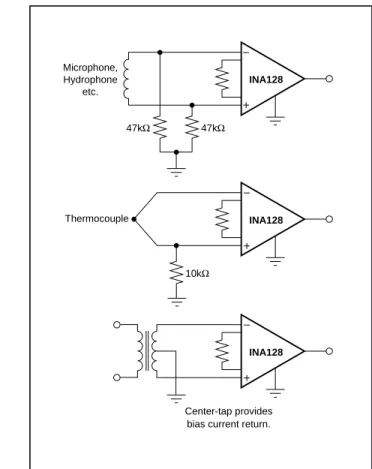
INPUT BIAS CURRENT RETURN PATH
The input impedance of the INA128/INA129 is extremely high—approximately 1010Ω. However, a path must be pro- vided for the input bias current of both inputs. This input bias current is approximately ±2nA. High input impedance means that this input bias current changes very little with varying input voltage.
Input circuitry must provide a path for this input bias current for proper operation. Figure 3 shows various provisions for an input bias current path. Without a bias current path, the inputs will float to a potential which exceeds the common- mode range, and the input amplifiers will saturate.
If the differential source resistance is low, the bias current return path can be connected to one input (see the thermo- couple example in Figure 3). With higher source impedance, using two equal resistors provides a balanced input with possible advantages of lower input offset voltage due to bias current and better high-frequency common-mode rejection.
INPUT COMMON-MODE RANGE
The linear input voltage range of the input circuitry of the INA128/INA129 is from approximately 1.4V below the positive supply voltage to 1.7V above the negative supply.
As a differential input voltage causes the output voltage increase, however, the linear input range will be limited by the output voltage swing of amplifiers A1 and A2. So the FIGURE 2. Optional Trimming of Output Offset Voltage.
OPA177 10kΩ
±10mV Adjustment Range
100Ω
100Ω 100µA 1/2 REF200
100µA 1/2 REF200 V+
V–
RG INA128 Ref
VO VIN–
VIN+
FIGURE 3. Providing an Input Common-Mode Current Path.
47kΩ 47kΩ
10kΩ Microphone,
Hydrophone etc.
Thermocouple
Center-tap provides bias current return.
INA128 INA128 INA128
linear common-mode input range is related to the output voltage of the complete amplifier. This behavior also de- pends on supply voltage—see performance curves “Input Common-Mode Range vs Output Voltage”.
Input-overload can produce an output voltage that appears normal. For example, if an input overload condition drives both input amplifiers to their positive output swing limit, the difference voltage measured by the output amplifier will be near zero. The output of A3 will be near 0V even though both inputs are overloaded.
LOW VOLTAGE OPERATION
The INA128/INA129 can be operated on power supplies as low as ±2.25V. Performance remains excellent with power supplies ranging from ±2.25V to ±18V. Most parameters vary only slightly throughout this supply voltage range—see typical performance curves. Operation at very low supply voltage requires careful attention to assure that the input voltages remain within their linear range. Voltage swing requirements of internal nodes limit the input common- mode range with low power supply voltage. Typical perfor- mance curves, “Input Common-Mode Range vs Output Voltage” show the range of linear operation for ±15V, ±5V, and ±2.5V supplies.
INA128 RG
VO
C1 0.1µF
OPA130
Ref R1
1MΩ
f–3dB = 1 2πR1C1
= 1.59Hz VIN
+ –
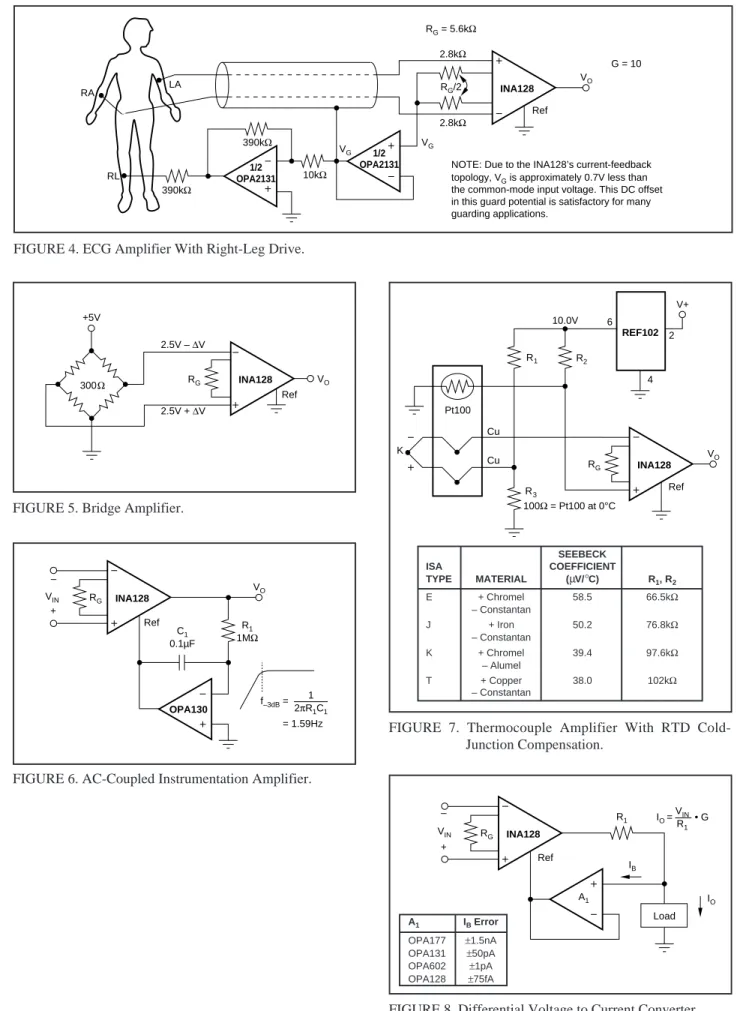
FIGURE 4. ECG Amplifier With Right-Leg Drive.
FIGURE 8. Differential Voltage to Current Converter.
A1 IB Error OPA177 ±1.5nA OPA131 ±50pA
OPA602 ±1pA
OPA128 ±75fA
SEEBECK
ISA COEFFICIENT
TYPE MATERIAL (µV/°C) R1, R2
E + Chromel 58.5 66.5kΩ
– Constantan
J + Iron 50.2 76.8kΩ
– Constantan
K + Chromel 39.4 97.6kΩ
– Alumel
T + Copper 38.0 102kΩ
– Constantan
FIGURE 7. Thermocouple Amplifier With RTD Cold- Junction Compensation.
FIGURE 5. Bridge Amplifier.
FIGURE 6. AC-Coupled Instrumentation Amplifier.
REF102 R2
R1
R3 Pt100
Cu
Cu
V+
K
10.0V 6
4 2
INA128 VO
Ref 100Ω = Pt100 at 0°C
RG
INA128 RG
IB R1 VIN
–
+
A1 IO
Load IO = • GVIN
R1
Ref INA128 RG/2
RG = 5.6kΩ
VO LA
RL RA
10kΩ
Ref
NOTE: Due to the INA128’s current-feedback topology, VG is approximately 0.7V less than the common-mode input voltage. This DC offset in this guard potential is satisfactory for many guarding applications.
G = 10
2.8kΩ
VG VG
2.8kΩ
1/2 OPA2131
390kΩ
390kΩ
1/2 OPA2131
300Ω +5V
2.5V – ∆V
2.5V + ∆V
RG INA128 VO
Ref
IMPORTANT NOTICE
Texas Instruments and its subsidiaries (TI) reserve the right to make changes to their products or to discontinue any product or service without notice, and advise customers to obtain the latest version of relevant information to verify, before placing orders, that information being relied on is current and complete. All products are sold subject to the terms and conditions of sale supplied at the time of order acknowledgment, including those pertaining to warranty, patent infringement, and limitation of liability.
TI warrants performance of its semiconductor products to the specifications applicable at the time of sale in accordance with TI’s standard warranty. Testing and other quality control techniques are utilized to the extent TI deems necessary to support this warranty. Specific testing of all parameters of each device is not necessarily performed, except those mandated by government requirements.
Customers are responsible for their applications using TI components.
In order to minimize risks associated with the customer’s applications, adequate design and operating safeguards must be provided by the customer to minimize inherent or procedural hazards.
TI assumes no liability for applications assistance or customer product design. TI does not warrant or represent that any license, either express or implied, is granted under any patent right, copyright, mask work right, or other intellectual property right of TI covering or relating to any combination, machine, or process in which such semiconductor products or services might be or are used. TI’s publication of information regarding any third party’s products or services does not constitute TI’s approval, warranty or endorsement thereof.
Copyright 2000, Texas Instruments Incorporated