bloodresearch.or.kr Blood Res 2019;54:149-156.
Letters to the Editor 153
infection caused by nilotinib. However, nilotinib may also be a risk factor for TB by inhibiting T cell-mediated immune responses, similar to imatinib [8]. Steroids also inhibit im- munity, so we cannot rule out the possibility that pulmonary Tb may be an effect of steroids. However, in our case, as the initial sputum AFB culture obtained before methyl- prednisolone therapy showed a positive result after 6 weeks of incubation, TB infection was the initial pathogenic event of the pulmonary symptoms and it is less likely that TB was caused by the steroid.
Drug resistance tests of the initial sputum indicated that the TB strain was sensitive to first-line drugs, but respiratory symptoms remained after sufficient treatment. This may have been due to drug-drug interactions (DDIs) between the antituberculosis medications and TKIs.
The patient was switched to second-line drugs due to drug resistance, with acceptable CML and TB treatment outcomes. DDIs between radotinib and antituberculosis medications have not been studied, so further pharmaco- logical studies are required to understand DDIs and to de- termine the optimum doses of TKIs during antituberculosis therapy.
To the best of our knowledge, this is the first case report of TB developing during nilotinib treatment. In the case described, the clinical manifestations were those of atypical pneumonia, not those of typical pulmonary TB. Furthermore, because it takes at least 6 weeks for culture results for Mycobacterium tuberculosis to be reported, diagnosis and treatment of TB were delayed. As the clinical features of this case were not typical of TB infection, it was difficult to diagnose and properly manage the patient. Thus, when CML patients on nilotinib treatment suffer from atypical pneumonia which is unresponsive to conventional anti- biotics, it is important to suspect TB infection and repeat sputum studies even if it is not diagnosed at once. In partic- ular, in areas endemic for TB such as South Korea, the possibility of reactivation of TB in patients receiving treat- ment with nilotinib should be considered.
Da Jung Kim1, Seri Jeong2, Seom Gim Kong3, Ho Sup Lee1
1Department of Internal Medicine, Kosin University College of Medicine, Kosin University Gospel Hospital, 2Department of Laboratory Medicine and 3Pediatrics, Kosin University College of Medicine, Busan, Korea
Correspondence to: Ho Sup Lee Department of Internal Medicine, Kosin University College of Medicine, 262 Gamcheon-ro, Seo-gu, Busan 49267, Korea E-mail: [email protected]
Received on Mar. 8, 2018; Revised on Jan. 16, 2019; Accepted on Jan. 22, 2019 https://doi.org/10.5045/br.2019.54.2.151
AuthorsÊ Disclosures of Potential Conflicts of Interest No potential conflicts of interest relevant to this article were reported.
REFERENCES
1. Reinwald M, Boch T, Hofmann WK, Buchheidt D. Risk of in- fectious complications in hemato-oncological patients treated with kinase inhibitors. Biomark Insights 2016;10(Suppl 3):55-68.
2. Daniels JM, Vonk-Noordegraaf A, Janssen JJ, Postmus PE, van Altena R. Tuberculosis complicating imatinib treatment for chronic myeloid leukaemia. Eur Respir J 2009;33:670-2.
3. Kang BW, Lee SJ, Moon JH, et al. Chronic myeloid leukemia pa- tient manifesting fatal hepatitis B virus reactivation during treat- ment with imatinib rescued by liver transplantation: case report and literature review. Int J Hematol 2009;90:383-7.
4. Mattiuzzi GN, Cortes JE, Talpaz M, et al. Development of Varicella-Zoster virus infection in patients with chronic myelog- enous leukemia treated with imatinib mesylate. Clin Cancer Res 2003;9:976-80.
5. García-Muñoz R, Galar A, Moreno C, et al. Parvovirus B19 acute infection and a reactivation of cytomegalovirus and herpesvirus 6 in a chronic myeloid leukemia patient during treatment with dasatinib (BMS-354825). Leuk Lymphoma 2007;48:2461-4.
6. Senn L, Kovacsovics T, Tarr PE, Meylan P. Peritoneal tuber- culosis after imatinib therapy. Arch Intern Med 2009;169:312-3.
7. Seggewiss R, Loré K, Greiner E, et al. Imatinib inhibits T-cell re- ceptor-mediated T-cell proliferation and activation in a dose-de- pendent manner. Blood 2005;105:2473-9.
8. Chen J, Schmitt A, Chen B, et al. Nilotinib hampers the pro- liferation and function of CD8+ T lymphocytes through in- hibition of T cell receptor signalling. J Cell Mol Med 2008;12:
2107-18.
9. Fei F, Yu Y, Schmitt A, et al. Dasatinib exerts an immuno- suppressive effect on CD8+ T cells specific for viral and leukemia antigens. Exp Hematol 2008;36:1297-308.
10. de Lavallade H, Khoder A, Hart M, et al. Tyrosine kinase in- hibitors impair B-cell immune responses in CML through off-tar- get inhibition of kinases important for cell signaling. Blood 2013;122:227-38.
11. Saglio G, Kim DW, Issaragrisil S, et al. Nilotinib versus imatinib for newly diagnosed chronic myeloid leukemia. N Engl J Med 2010;362:2251-9.
What is the most appropriate regimen for untreated Waldenström
macroglobulinemia? - An updated analysis of rituximab and half-dose CHOP therapy and cost effectiveness
TO THE EDITOR: Waldenström macroglobulinemia (WM) is a rare type of low-grade B-cell lymphoma in which over- expression of the IgM monoclonal protein occurs. In most cases of WM, an L265P mutation is present in MYD88 [1], and approximately 30–50% of cases have a chromosomal 6q deletion [2]. Owing to its rarity, reports on therapies
Blood Res2019;54:149-156 bloodresearch.or.kr
154 Letters to the Editor
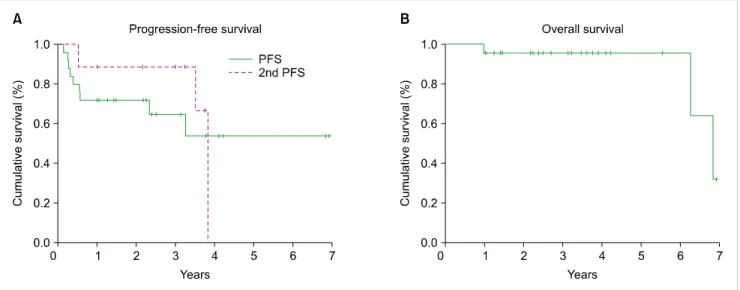
Fig. 1. Survival curve. (A) Progression-free survival (PFS). The median PFS of half-dose R-CHOP therapy was not reached, and the estimated 2-year PFS was 72% and 3-year PFS was 64%. The estimated 3-year second PFS by a bendamustine-containing regimen was 89%. (B) Overall survival (OS).
The estimated 3-year OS was 96%.
from prospective randomized studies for WM are limited.
We previously reported the impact of half-dose CHOP ther- apy [cyclophosphamide (CPA); hydroxy-doxorubicin (ADR);
vincristine (VCR); and prednisone (PSL)] combined with the anti-CD20 antibody, rituximab (R) (R-half CHOP), for untreated patients with WM [3], because the standard-dose R-CHOP therapy [4, 5] caused severe myelosuppression and peripheral neuropathy (PN). Herein, we have presented the updated outcomes over the median follow-up period of 37.7 months.
Twenty-five untreated symptomatic patients with WM who received R-half CHOP as the primary therapy at our hospital between April 2011 and April 2017 were analyzed retrospectively. Approval from the Institutional Review Board of our hospital was obtained, and the study was per- formed according to the Declaration of Helsinki formulated in 1995. R-half CHOP consisted of 6 treatment cycles, with each cycle separated by 3 weeks; however, for 21 patients, vincristine was omitted. Two (8%) patients achieved com- plete response (CR), 1 (4%) patient achieved very good partial response (VGPR), 12 (48%) patients achieved partial response (PR), and 6 (25%) patients achieved minimal re- sponse (MR). The median follow-up of all 25 patients was 37.7 months (range, 12–83.2 mo). The median pro- gression-free survival (PFS) was not reached, although the estimated 2-year and 3-year PFS was 72% and 64%, re- spectively (Fig. 1A). Nine patients developed refractory dis- ease or progression. All patients received a bendamustine (Benda)-containing regimen as second-line therapy.
Subsequently, 2 (22%) patients achieved VGPR and 6 (67%) achieved PR. The estimated 3-year second PFS was 89%
(Fig. 1A). The estimated 3-year overall survival (OS) was 96% (Fig. 1B). A swimmer plot of patient responses is pre- sented in Fig. 2. Grade 3/4 leukocytopenia, neutropenia,
febrile neutropenia, and Grade 1 peripheral neuropathy (PN) occurred in 33%, 38%, 0%, and 21% of patients, respectively.
During the follow-up, 3 patients died: 1 patient experienced traumatic subarachnoid hemorrhage with disease pro- gression, 1 patient had Bing-Neel syndrome, and 1 patient who maintained CR committed suicide (Fig. 2). Furthermore, none of the patients had secondary malignancies. Thus, we confirmed that half-dose R-CHOP was effective and well-tolerated as the primary therapy for untreated WM.
In addition, the use of a Benda-containing regimen as sec- ond-line therapy had a high response rate and favorable PFS. Therefore, half-dose R-CHOP as first-line therapy and Benda-containing regimen as second-line therapy would be an appropriate treatment strategy for newly diagnosed symptomatic WM.
Buske et al. [6] previously reported treatment and out- come patterns for 454 patients with WM outside of clinical trials between 2000 and 2014 in 10 European countries.
One hundred and ninety-three (43%) patients received monotherapy including chlorambucil (Chl, 27%), and R (6%); 164 patients (36%) received R and alkylating agents (chemo-immunotherapy), such as R-CHOP (11%) [4, 5], and dexamethasone, R, and cyclophosphamide (DRC) ther- apy (6%) [7]. Olszewski et al. [8] reported patterns in treat- ment regimens associated with survival for patients of ≥65 years of age with WM for whom first-line rituximab-based therapy was initiated in 2008–2014 by using the Surveillance, Epidemiology, and End Results registry in the US. Of the 681 patients, 58% received R alone, 22% received chemo-immunotherapy, 11% received a bortezomib (Bor)-containing regimen, and 9% received a Benda-con- taining regimen. They also found no significant difference in OS between immune-chemotherapy combinations with classical agents and those with Bor-containing or
bloodresearch.or.kr Blood Res 2019;54:149-156.
Letters to the Editor 155
Fig. 2. Swimmer plot for 25 patients who received half-dose R-CHOP therapy. Nine patients developed refractory disease or progression and 3 patients received third-line therapy.
Table 1. Summary of responses to each regimen, survival, and drug prices.
Regimen First author Ref No. N Duration of
treatment ORR Time to
response Survival Drug prices
(JPY)
DRC Dimopoulus 7 72 18 wk 83% 4.1 mo 35 mo (mPFS) 1,345,014/total
R-CHOP Buske 4 23 18 wk 91% NA 63 mo (mTTF) 1,479,936/total
Half-dose R-CHOP Present study 25 18 wk 85% 5.7 wk 64% (3-yr PFS) 1,425,612/total
R-bendamustine Rummel 5 22 24 wk 95% NA 69.5 mo (mPFS) 3,526,806/total
BDR Treon 11 23 60 wk 96% 1.4 mo NR (mTTP≥30 mo) 6,182,104/total
Ibrutiniba) Treon 12 63b) Until PD 90.5% 4 wk 69.1% (2-yr PFS) 10,895,797/yr
a)Ibrutinib is not approved in Japan for WM. b)Data relapsed/refractory WM.
Abbreviations: R, rituximab; DRC, dexamethasone, R, cyclophosphamide; R-CHOP, R, cyclophosphamide, hydroxyl-doxorubicin, vincristine, prednisone; BDR, bortezomib, dexamethasone, R; ORR, overall response rate; JPY, japanese yen; PFS, progression-free survival; TTF, time to treatment failure; TTP, time to progression; PD, progressive disease; NA, not applicable; NR, not reached.
Benda-containing regimens, although the proportion of Benda- or Bor-containing regimens increased significantly between 2008 and 2014. In studies from Asia, Lee et al. [9] reported the prevalence of Chl alone (35.2%) followed by an alkylating regimen (±R, 28.2%) in a Korean study.
This was similar in Japan, with Saito et al. reporting the prevalence of oral alkylating agent therapy alone (46.5%) and CHOP-like regimens (25.4%) [10]. Therefore, the regi- mens of R alone, oral alkylating agents alone, and R+alkylat- ing agent regimens, including R-CHOP therapy, are popular, according to clinical treatment data.
In a consideration of the costs of WM therapy, Olszewski et al. [8] reported no apparent survival benefit and higher costs of treatment for Bor- or Benda-containing regimens.
Thus, their value compared with classical regimens should be reconsidered in US practice. We also calculated the drug prices of each regimen in Japanese yen, as shown in Table 1. The prices were calculated for a patient with a body-sur-
face area (BSA) of 1.74 m2, which was the average BSA of Japanese men between 65 and 69 years of age in 2017.
The costs of Benda-containing regimens and Bor-containing regimens [11] were more than 2 and 4 times higher than those for R-alkylating regimens, respectively.
Furthermore, novel agents, such as ibrutinib (Ibr), have been developed for WM. Ibr is an orally administered in- hibitor of Bruton’s tyrosine kinase (BTK). In 2015, it was approved by the US Food and Drug Administration and the European Medicine Agency for adults with re- lapsed/refractory WM or for previously untreated patients with WM for whom treatment with chemo-immunotherapy is not suitable [12, 13]. Ibr monotherapy was highly active, associated with sustainable responses, and safe [12], and the use of Ibr with R resulted in a significantly higher PFS than the use of R alone [13]. However, as the cost of Ibr treatment is very high, Olszewski et al. [14] examined the cost-effectiveness of Ibr use compared with che-
Blood Res2019;54:149-156 bloodresearch.or.kr
156 Letters to the Editor
mo-immunotherapy. Italian medical and economical experts analyzed the cost-effectiveness of single-agent Ibr compared with the Italian current therapeutic pathways (CTP) for relapse/refractory WM by using an incremental cost-effec- tiveness ratio [15]. They concluded that Ibr increased the Life Years Gained and costs were comparable with CTP.
These reports have confirmed the need for additional analy- ses of the cost-effectiveness of each drug and regimen, in- cluding Ibr.
In conclusion, numerous drugs are available currently;
however, in addition to the drug approval status, the age of patients to be treated, presence of severe symptoms such as hyperviscosity syndrome, treatment period, response rate, long-term survival rate, secondary malignancies, costs, and any other relevant factors, should be comprehensively exam- ined to allow making an informed decision on the treatment regimen.
Naohiro Sekiguchi1,2, Airi Hamano3, Tomoko Kitagawa2, Kenichi Ito1, Kazuhiko Hirano4, Kazuaki Yamada4
1Hematology Division, 2Clinical Research Division,
3Pharmaceutical Division, 4Laboratory and Pathology Division, National Hospital Organization Disaster Medical Center, Tokyo, Japan Correspondence to: Naohiro Sekiguchi Hematology Division, National Hospital Organization Disaster Medical Center, 3256 Midori-cho, Tachikawa, Tokyo 190-0014, Japan E-mail: [email protected]
Received on Jan. 31, 2019; Revised on Feb. 25, 2019; Accepted on Mar. 8, 2019 https://doi.org/10.5045/br.2019.54.2.153
AuthorsÊ Disclosures of Potential Conflicts of Interest No potential conflicts of interest relevant to this article were reported.
REFERENCES
1. Treon SP, Xu L, Yang G, et al. MYD88 L265P somatic mutation in Waldenström's macroglobulinemia. N Engl J Med 2012;
367:826-33.
2. Sekiguchi N, Nomoto J, Nagata A, et al. Gene expression profile signature of aggressive Waldenström macroglobulinemia with chromosome 6q deletion. Biomed Res Int 2018;2018:6728128.
3. Sekiguchi N, Hamano A, Kitagawa T, et al. Impact of rituximab and half-dose CHOP as primary therapy for untreated sympto- matic Waldenström Macroglobulinemia: review of a combined regimen of rituximab with an alkylating agent. Blood Res
2018;53:117-22.
4. Buske C, Hoster E, Dreyling M, et al. The addition of rituximab to front-line therapy with CHOP (R-CHOP) results in a higher response rate and longer time to treatment failure in patients with lymphoplasmacytic lymphoma: results of a randomized trial of the German Low-Grade Lymphoma Study Group (GLSG).
Leukemia 2009;23:153-61.
5. Rummel MJ, Niederle N, Maschmeyer G, et al. Bendamustine plus rituximab versus CHOP plus rituximab as first-line treat- ment for patients with indolent and mantle-cell lymphomas: an open-label, multicentre, randomised, phase 3 non-inferiority trial. Lancet 2013;381:1203-10.
6. Buske C, Sadullah S, Kastritis E, et al. Treatment and outcome pat- terns in European patients with Waldenström's macro- globulinaemia: a large, observational, retrospective chart review. Lancet Haematol 2018;5:e299-e309.
7. Dimopoulos MA, Anagnostopoulos A, Kyrtsonis MC, et al.
Primary treatment of Waldenström macroglobulinemia with dexamethasone, rituximab, and cyclophosphamide. J Clin Oncol 2007;25:3344-9.
8. Olszewski AJ, Treon SP, Castillo JJ. Application and outcomes of bendamustine- or bortezomib-based therapy for Waldenstrom's macroglobulinemia. Blood (ASH Annual Meeting Abstracts) 2017;130(Suppl):abst 348.
9. Lee HS, Kim K, Yoon DH, et al. Clinical factors associated with response or survival after chemotherapy in patients with Waldenström macroglobulinemia in Korea. Biomed Res Int 2014;2014:253243.
10. Saito A, Isoda A, Kojima M, et al. Retrospective analysis of prog- nostic factors for Waldenstrӧm macroglobulinemia: a multi- center cooperative study in Japan. Int J Hematol 2017;106:
681-90.
11. Treon SP, Ioakimidis L, Soumerai JD, et al. Primary therapy of Waldenström macroglobulinemia with bortezomib, dex- amethasone, and rituximab: WMCTG clinical trial 05-180. J Clin Oncol 2009;27:3830-5.
12. Treon SP, Tripsas CK, Meid K, et al. Ibrutinib in previously treated Waldenström's macroglobulinemia. N Engl J Med 2015;372:
1430-40.
13. Dimopoulos MA, Tedeschi A, Trotman J, et al. Phase 3 trial of ibrutinib plus rituximab in Waldenström's macroglobulinemia.
N Engl J Med 2018;378:2399-410.
14. Olszewski AJ, Castillo JJ. Ibrutinib and rituximab in Waldenström's macroglobulinemia. N Engl J Med 2018;379:
1973-4.
15. Aiello A, D'Ausilio A, Lo Muto R, Randon F, Laurenti L. Cost-ef- fectiveness analysis of ibrutinib in patients with Waldenström macroglobulinemia in Italy. J Mark Access Health Policy 2017;
5:1393308.