History of Investigative and Clinical Urology and an analysis of published articles
Jae Young Park1 , Kwangsung Park2 , Seong Jin Jeong3
1Editorial Assistant of Investigative and Clinical Urology, Department of Urology, Korea University Ansan Hospital, Korea University College of Medicine, Ansan, 2Editor- in-Chief of Investigative and Clinical Urology, Department of Urology, Chonnam National University Medical School, Gwangju, 3Editorial Associate of Investigative and Clinical Urology, Department of Urology, Seoul National University Bundang Hospital, Seoul National University School of Medicine, Seongnam, Korea
Investigative and Clinical Urology is the official journal of the Korean Urological Association (KUA). Taehan Pinyogikwa Hakhoe chi was the first version of the official journal of the KUA and was published in January 1960. The journal was renamed the Korean Journal of Urology in February 2009 and the Korean Journal of Urology changed its title to Investigative and Clinical Urology in January 2016. The official YouTube channel of Investigative and Clinical Urology has been in operation since January 2016. In- vestigative and Clinical Urology was registered in Science Citation Index Expanded (SCIE) on October 30, 2018. A total of 8,103 papers were published in Investigative and Clinical Urology from January 1960 to December 2018. The most common subjects in published articles were oncology (4,602), pediatric urology (1,540), endourology & urolithiasis (1,477), and sexual dysfunction &
infertility (1,285). A total of 23 articles on randomized controlled trials were published from March 2010 to December 2018. The ac- ceptance rate of original articles in Investigative and Clinical Urology has decreased continuously since 2014. Meanwhile, the sub- mission rate by international authors has shown an increasing trend from 2014 to 2018. As the first urologic journal in South Korea, Investigative and Clinical Urology has faithfully played its academic role in the past and present for 60 years. Since joining the SCIE list in 2018, further progress of Investigative and Clinical Urology is highly expected.
Keywords: History; Publications; Urology
This is an Open Access article distributed under the terms of the Creative Commons Attribution Non-Commercial License (http://creativecommons.org/licenses/by-nc/4.0) which permits unrestricted non-commercial use, distribution, and reproduction in any medium, provided the original work is properly cited.
Received: 22 September, 2019 • Accepted: 10 December, 2019
Corresponding Author: Seong Jin Jeong https://orcid.org/0000-0002-3580-1452
Editorial Associate of Investigative and Clinical Urology, Department of Urology, Seoul National University Bundang Hospital, Seoul National University School of Medicine, 82 Gumi-ro 173beon-gil, Bundang-gu, Seongnam 13620, Korea
TEL: +82-31-787-7349, FAX: +82-31-787-4057, E-mail: [email protected]
ⓒ The Korean Urological Association
www.icurology.org
Investig Clin Urol 2020;61 Suppl 1:S64-69.
https://doi.org/10.4111/icu.2020.61.S1.S64 pISSN 2466-0493 • eISSN 2466-054X
HISTORY OF INVESTIGATIVE AND CLINICAL UROLOGY
From the start of the Republic of Korea in 1945, the Ko- rean Urological Association (KUA) has contributed to the development of medicine and promotion of health in this country. The Association started as “the Korean Dermato- logical and Urological Association,” which was established on November 10, 1945, and which hosted its first convention on November 15, 1947, launching activities as an academic
and research organization exploring professional roles in the field of urology. The members decided to separate urol- ogy and dermatology on June 20, 1954, during a temporary meeting and modified the constitution, selecting president Hak Song Lee and vice-president Choi, Jae Wee of the KUA. After the first convention on November 15, 1947, the Association hosted academic conventions along with the dermatology association [1]. Since hosting an independent convention at Sudo Medical University on October 3, 1959, during the 11th Korean Medical Association convention, the
KUA hosted its own convention once a year. The number of conventions increased to twice a year in 1974, once in spring and once in fall, with the 71st convention hosted as of 2019.
The KUA published Taehan Pinyogikwa Hakhoe chi in January 1960 (Fig. 1). The journal was the first Korean- language periodical dedicated to urology in Korea. At the be- ginning, this journal was published twice a year. It was pub- lished quarterly from 1968 to 1976 and bimonthly (six times a year) from 1977 to 1981. Owing to a significant increase in the number of articles submitted, the publication frequency increased to eight times a year in 1982. The frequency re- turned to six times a year from 1983 to 1993 [1]. The journal acquired an ISSN in 1987 (ISSN 0494-4747), and an index of all journals published previously was published in 1988 [2].
The journal was published monthly (12 times a year) from 1994 to 2015. The journal was published by Seoheung pub- lisher since 1994 and by Euihak Munhwasa since March 2001. The name of the publisher changed to MEDRang Inc.
in January 2002, and it has published the journal since then.
The journal was renamed as the Korean Journal of Urol- ogy (pISSN 2005-6737; eISSN 2005-6745) in February 2009,
and the Korean Journal of Urology changed its title to In- vestigative and Clinical Urology starting in January 2016.
This change intended to open doors for more international authors and readers [3]. The abbreviated journal name is In-
vestig Clin Urol. The journal went back to being published six times a year in 2016, with Volume 60, Issue 6, published as of November 2019. The changes to the journal’s cover are shown in Fig. 2A–E.
The journal was supplemented in 1989, aiding in the collection and understanding of articles and information published in Korea in the field of urology, which continued
Fig. 1. The first issue of Taehan Pinyogikwa Hakhoe chi was published in January 1960.
Fig. 2. The covers of Taehan Pinyogikwa Hakhoe chi, Korean Journal of Urology, and Investigative and Clinical Urology.
(A) 1979–1997, (B) 1988–2008, (C) Janu- ary 2009, (D) 2009–2015, (E) 2016–pres- ent.
A B
C D E
until 2008. These data were uploaded to the official website of KUA instead of being included in the journal from 2009 to 2016, after which this was stopped. The keyword index system was adopted beginning with Volume 31, Issue 2, in 1990, and a special issue regarding the index revision from Volume 1 to 31 was published in May 1991.
With the change of the “Common Form of the Medical Journal” Vancouver style (the 4th edition) created by the International Committee of Medical Journal Editors in 1993, new rules for manuscript submission to the journal were announced beginning with the Volume 33, Issue 6, and the new rules of manuscript submission were enforced from 1993. Since 1994, when the journal established its policy of monthly publication, the editorial office adopted an elec- tronic manuscript submission system, so a word processing file had to be sent online or saved in a memory system and delivered to the publishing office. This change allowed a de- crease in the article processing charge. The academic depart- ment of KUA was divided into the academic board and the editorial board, and the editorial board has been responsible for the journal since November 16, 1996. The “corresponding author” system was adopted from Volume 38, Issue 12, in 1997. The corresponding author should be a urologist, and he or she is assumed to have all responsibilities about the arti- cle. The format of the journal changed in 1998. The editorial office was established with full-time staff in December 2006.
The official website of the journal (www.kjurology.org) was launched in February 2009, and articles published before February 2009 can be found in a submenu on the official website of KUA (http://urology.inforang.com/). In addition, the same year, an online submission system was developed, so that authors contributed papers and reviewers reviewed papers online. The review of manuscript is by peer review, which is carried out as a fair process in a double-blind man- ner.
The guideline that all manuscripts submitted to the journal be written in English was implemented in 2010. The summary of Korean translation from the author was posted on the website for the convenience of the reader at the be- ginning, but that has been abolished since 2016.
The journal announced that it welcomes articles contain- ing video clips regarding minimally invasive surgery and advanced surgical technique. Video clips from authors have been uploaded in the “Urology in Motion” section of the offi- cial YouTube channel of Korean Journal of Urology (https://
www.youtube.com/user/KJUrology) since February 2013 [4].
In addition, video clips of author interviews have been up- loaded since November 2013. The official YouTube channel of Investigative and Clinical Urology (https://www.youtube.
com/channel/UCciAvoz70ooL8UplxhIqflQ) has been in op- eration since January 2016.
Korean Journal of Urology, the previous version of In- vestigative and Clinical Urology, became the official jour- nal of the Korean Endourological Society and the Korean Society of Pediatric Urology since 2014 as well as the KUA [5]. These two new joining societies had published their own journals, but the significant overlap in scope and members among the three societies resulted in the merging of the three individual journals. The role of the Korean Endouro- logical Society and the Korean Society of Pediatric Urology was to take over editing in the endourology and pediatric urology sections of the Korean Journal of Urology. As a result, the societies could provide more in-depth knowledge in the sections of endourology and pediatric urology and improve the overall quality of the journal. Since March 2018, the ScholarOne online submission system of Clarivate Ana- lytics, an international manuscript submission system, has been used to make the submission by domestic and foreign authors easier.
Fifteen professors have been appointed as editor-in- chief of this journal, including Dr. Kun Weon Choo as the first editor-in-chief [6] and Dr. Kwangsung Park, the pres- ent editor-in-chief, who has served in 2008 to 2010, and since 2012 to present. The term of the appointment of editor-in- chief was initially diverse, ranging from 1 to 7 years in the beginning. In the 2000s, the editor-in-chief was assigned for 2 years and allowed to serve for another 2 years. Since No- vember 2013, the editor-in-chief has been assigned for 5 years and allowed to serve for another 5 years to comply with the editorial system of other international journals. Members of the editorial board are currently allowed to serve for 2 years and are eligible for a second term. Concerning international editors, Isaac Yi Kim from the United States and two others reviewed English-written articles for the first time in 2008.
All published articles have been written in English since January 2010 [7], and the number of foreign editors has in- creased to 11, including Karl-Erik Anderson from the United States in 2011. In 2018, the number of international editors increased to 33 from 18 countries. The international Investi- gative and Clinical Urology editorial board meeting started
in 2013 at the American Urological Association (AUA) an- nual meeting. The foreign editors who join the AUA annual meeting have a meeting with the Korean editors to discuss issues on the editing process of Investigative and Clinical Urology. Dr. Kwangsung Park, the current editor-in-chief of Investigative and Clinical Urology works with 2 deputy edi-
tors (Trinity J. Bivalacqua and Sung Kyu Hong), 6 associate editors, 9 consulting editors, the editorial board consisting
of 36 supporting doctors, and the editor-in-chief office team consisting of 8 dedicated doctors. In addition, ethics editors, a biostatistics consultant, a language consultant, manuscript editors including 1 full-time employee, and publication staff are great supporters for Investigative and Clinical Urology [8].
Taehan Pinyogikwa Hakhoe chi was selected as a candi- date journal of the Korea Citation Index (KCI) in 1999 and was listed as one of the KCI registered journals in 2002, pav- ing the way for a representative journal in the field of urol- ogy [7]. After that, it was registered in Scopus in 2005 and the Korean Journal of Urology was registered in Excerpta Medica Database in 2009, gaining more prominent inter- national academic status [9]. Continuously, the journal was registered in PubMed Central and PubMed in 2010 and was finally selected to be indexed in MEDLINE in 2014, all of which were great steps toward becoming a highly regarded international journal [7,10]. In October 2015, the journal was added to the Emerging Sources Citation Index (ESCI), mov- ing one step closer to entering the Science Citation Index (Expanded) (SCI[E]). Finally, Investigative and Clinical Urol- ogy was registered in SCIE on October 30, 2018, taking a gi- ant step toward becoming a premier journal in the field of urology [6]. It is important to note that the journals listed in MEDLINE, SCIE, and Scopus are 15 of 264 member journals of the Korean Association of Medical Journal Editors, and 6 of 33 members of the Korean Academy of Medical Sciencesʼ main journals, proving once again the excellence and com- petitiveness of Investigative and Clinical Urology.
Investigative and Clinical Urology aims to provide out- standing scientific and clinical research articles that will advance knowledge and understanding of urological diseases and current therapeutic treatments [2]. Investigative and Clinical Urology publishes Original Articles, Rapid Com-
munications, Review Articles, Special Articles, Innovations in Urology, Editorials, and Letters to the Editor, with a focus on the following areas of expertise: Precision Medicine in Urology, Urological Oncology, Robotics/Laparoscopy, En- dourology/Urolithiasis, Lower Urinary Tract Dysfunction, Female Urology, Sexual Dysfunction/Infertility, Infection/
Inflammation, Reconstruction/Transplantation, Geriatric Urology, Pediatric Urology, and Basic/Translational Re- search.
One of the notable features of Investigative and Clinical Urology is the application of multimedia platforms facili- tating easy-to-access online video clips of newly developed surgical techniques from the journal’s website by a quick response code located in the article or via YouTube. Inves- tigative and Clinical Urology provides current and highly relevant knowledge to a broad audience at the cutting edge
of urological research and clinical practice.
ANALYSIS OF PUBLISHED ARTICLES IN INVESTIGATIVE AND CLINICAL UROLOGY
The previous bibliometric review was done by Yang et al. in 2009 [9]. The present analysis was based on that study and updated. A total of 8,103 papers were published in In- vestigative and Clinical Urology from January 1960 to De- cember 2018. According to the analysis of papers published in Investigative and Clinical Urology, the number of papers published increased sharply from 214 in the 1960s, 606 in the 1970s, and 1,577 in the 1980s to 2,486 in the 1990s. In the 2000s, 2,218 articles were published. In the 2010s, the publi- cation rate of manuscripts decreased due to the qualitative improvement of the journal. So far, 1,002 papers have been published until December 2018.
When the published articles were classified as original articles, case reports, and review articles, the rate of original articles to total articles was 62.6% in the 1960s, 62.2% in the 1970s, and 63.2% in the 1980s, but increased to 81.3% in the 1990s. This rate was maintained at 77.5% in the 2000s but decreased to 69.1% in the 2010s. The reason the rate of origi- nal papers has decreased since the 2000s was an increase in the number of review papers: 46 review papers were pub- lished in the 2000s and 133 in the 2010s (Fig. 3).
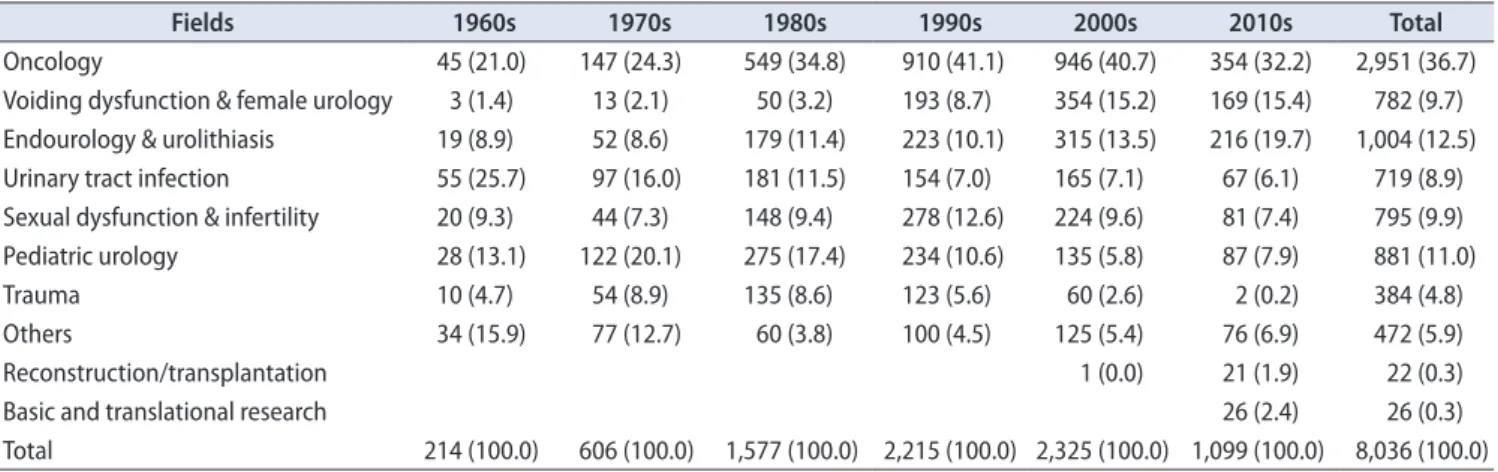
The results of an analysis of articles published from the first issue in the 1960s to the 1990s were as follows: the most common subject was oncology, followed by pediatric urology, infection, and urolithiasis and endourology (Table 1). From January 2006 to December 2018, the most common subjects dealt with by original articles were endourology (435), oncol- ogy (270), and andrology (129) over the last 13 years (Table 2).
A total of 23 articles on randomized controlled trials were published in Investigative and Clinical Urology from March 2010 to December 2018. The subjects on randomized controlled trials were as follows: 9 articles in endourology/
urolithiasis, 7 in lower urinary tract dysfunction, 3 in uro- logical oncology, 2 in female urology, and 1 in pediatric urol- ogy and sexual dysfunction/infertility.
The acceptance rate of original articles in Investigative and Clinical Urology has decreased continuously since 2014.
The acceptance rate last year excluding review articles and editorials was 20.5% (Fig. 4A). Meanwhile, the submission rate by international authors has shown an increasing trend from 2014 to 2018 (Fig. 4B).
The social network service will be used to increase the journal’s citation. Toward this aim, authors will be re- quired to submit a brief message of within 280 words to be
uploaded on the journal’s website when submitting their manuscript. Two or three of the articles in each issue will be selected as the best article, and the tables or figures will be uploaded in SNS as well. As the first journal specializing in urology in South Korea, Investigative and Clinical Urol- ogy has faithfully played its academic role in the past and
present for 60 years. Without the dedicated support of all authors, reviewers, readers, editors, and staff, these achieve- ments would not have been possible. With the joining of the SCIE list in 2018, further progress of Investigative and Clini- cal Urology is highly expected.
CONFLICTS OF INTEREST
The authors have nothing to disclose.
Fig. 3. The numbers of published articles, including original articles, case reports, and review articles, from the 1960s to 2010s.
1960s (%) 1970s (%) 1980s (%)
1990s (%) 2000s (%) 2010s (%)
Original article Case report Review article Others
37.4 0
62.6
18.6
81.3
37.6
62.2
20.4 2
77.5
36.8
63.2
69.1 10.9
13.2 6.8
0 0.2 0 0 0
0.1 0 0.1
Table 1. Classification of published articles according to subject from the 1960s to 2010s
Fields 1960s 1970s 1980s 1990s 2000s 2010s Total
Oncology 45 (21.0) 147 (24.3) 549 (34.8) 910 (41.1) 946 (40.7) 354 (32.2) 2,951 (36.7)
Voiding dysfunction & female urology 3 (1.4) 13 (2.1) 50 (3.2) 193 (8.7) 354 (15.2) 169 (15.4) 782 (9.7) Endourology & urolithiasis 19 (8.9) 52 (8.6) 179 (11.4) 223 (10.1) 315 (13.5) 216 (19.7) 1,004 (12.5) Urinary tract infection 55 (25.7) 97 (16.0) 181 (11.5) 154 (7.0) 165 (7.1) 67 (6.1) 719 (8.9) Sexual dysfunction & infertility 20 (9.3) 44 (7.3) 148 (9.4) 278 (12.6) 224 (9.6) 81 (7.4) 795 (9.9) Pediatric urology 28 (13.1) 122 (20.1) 275 (17.4) 234 (10.6) 135 (5.8) 87 (7.9) 881 (11.0)
Trauma 10 (4.7) 54 (8.9) 135 (8.6) 123 (5.6) 60 (2.6) 2 (0.2) 384 (4.8)
Others 34 (15.9) 77 (12.7) 60 (3.8) 100 (4.5) 125 (5.4) 76 (6.9) 472 (5.9)
Reconstruction/transplantation 1 (0.0) 21 (1.9) 22 (0.3)
Basic and translational research 26 (2.4) 26 (0.3)
Total 214 (100.0) 606 (100.0) 1,577 (100.0) 2,215 (100.0) 2,325 (100.0) 1,099 (100.0) 8,036 (100.0) Values are presented as number (%).
Table 2. Classification of subjects in original articles from 2006 to 2018
Subject Number
Endourology/Urolithiasis 435
Urological Oncology 270
Sexual Dysfunction/Infertility 129 Lower Urinary Tract Dysfunction 98
Robotics/Laparoscopy 90
Pediatric Urology 67
Infection/Inflammation 64
New Technology/Lasers in Urology 57 Basic and Translational Research 52
Female Urology 43
Reconstruction/Transplantation 16
Geriatric Urology 9
Genomics/Stem Cells in Urology 8
Others 8
Total 1,346
ACKNOWLEDGMENTS
Ms. Hye In Park provided us dedicated support and sum- marized data regarding publication in Investigative and Clinical Urology. Without her help, this article would not have been possible. All the authors really appreciate her help.
AUTHORS’ CONTRIBUTIONS
Research conception and design: Jae Young Park. Data acquisition: Seong Jin Jeong and Kwangsung Park. Data analysis and interpretation: Jae Young Park and Kwang- sung Park. Drafting of the manuscript: Jae Young Park.
Critical revision of the manuscript: Kwangsung Park. Ob- taining funding: Seong Jin Jeong. Supervision: Seong Jin Jeong and Kwangsung Park. Approval of the final manu- script: all authors.
REFERENCES
1. The Korean Urological Association. History of Korean Uro- logical Association [Internet]. Seoul: The Korean Urological Association; 2019 [cited 2019 Jun 20]. Available from: http://
www.urology.or.kr/eng/sub01/sub02.html.
2. Investigative and Clinical Urology. About Investigative and Clinical Urology. [Internet]. Seoul: Investigative and Clini- cal Urology; 2019 [cited 2019 Jun 20]. Available from: https://
icurology.org/index.php?body=about.
3. Park K. Journal title changes from Korean Journal of Urology to Investigative and Clinical Urology. Investig Clin Urol 2016;
57:1-2.
4. Park K. Wisdom of snake. Korean J Urol 2013;54:1.
5. Park K. Taking a great leap forward on a blue horse. Korean J Urol 2014;55:1.
6. Park K. Taking a giant step forward to become a premier jour- nal in urology. Investig Clin Urol 2018;59:355-6.
7. Park K. A new era in the Korean Journal of Urology. Korean J Urol 2010;51:297.
8. Investigative and Clinical Urology. Editorial Board of Inves- tigative and Clinical Urology. [Internet]. Seoul: Investigative and Clinical Urology; 2019 [cited 2019 Jun 20]. Available from:
https://icurology.org/index.php?body=board.
9. Yang SK, Kim SJ, Park K. Bibliometrics review of the Korean Journal of Urology from 1960 to 2008: trends and future direc- tions. Korean J Urol 2009;50:731-8.
10. Park K. KJU indexed in MEDLINE. Korean J Urol 2014;55:435.
Fig. 4. (A) Acceptance rate of original articles in Investigative and Clinical Urology. (B) Proportion of submission by international authors.
50
40
30
20
10
2014 2015 2016 2017 2018 2019.10
(%)
42.5
31.8 34.3
26.8
20.5 21.6
0
A B
100.0
80.0
60.0
40.0
20.0
2014 2015 2016 2017 2018 2019.10
(%)
59.7
69.0 74.1 77.3
73.1 70.3
0.0
Year Year