• 검색 결과가 없습니다.

The Effect of Extracorporeal Shock Wave Therapy for Calcific Tendinitis of the Shoulder

N/A
N/A
Protected

Academic year: 2021

Share "The Effect of Extracorporeal Shock Wave Therapy for Calcific Tendinitis of the Shoulder"

Copied!
5
0
0

로드 중.... (전체 텍스트 보기)

전체 글

(1)

http://dx.doi.org/10.5763/kjsm.2015.33.1.1 pISSN 1226-3729 eISSN 2288-6028

체외 충격파 치료를 이용한 견관절 석회화 건염의 치료 효과

국민건강보험 일산병원 정형외과

1

, 연세대학교 의과대학 정형외과학교실

2

이윤태1ㆍ박준영2ㆍ성사현2ㆍ박상훈1

The Effect of Extracorporeal Shock Wave Therapy for Calcific Tendinitis of the Shoulder

Yun-Tae Lee

1

, Jun-Young Park

2

, Sa-Hyun Soung

2

, Sang-Hoon Park

1

1

Department of Orthopedic Surgery, National Health Insurance Service, Ilsan Hospital, Ilsan,

2

Department of Orthopedic Surgery, Yonsei University College of Medicine, Seoul, Korea

To evaluate the functional and radiologic outcomes of extracorporeal shock wave therapy (ESWT) in shoulders with chronic calcific tendinitis. We report a retrospective study to compare the outcome after ESWT (group l, 15 cases) with the effect of medication treatment (group 2, 15 cases) in patients with chronic calcific tendinitis. Patients were aged 42 to 58 years, mean of 48 years and treated with extracorporeal shock waves or medication from September 2012 to May 2014. The ESWT was performed six cycles of shock waves, weekly treatment for the three cycles and the rest cycles after 2 weeks of pause. In the same period, there were 12 women and 3 men treated with medication treatment for calcific tendinitis. The clinical outcomes were evaluated according to Constant and Murley score and pain visual analogue scale. Radiologic evaluation was performed to confirm disintegration of calcific deposits 3 months and 6 months after treatment. Clinical outcomes were significantly improved in ESWT group, and there was significant difference between ESWT group and medication group. In radiographic evaluation, the calcific deposit was significantly decreased in ESWT group. ESWT therapy is more effective to achieve functional improvement and to alleviate pain in the patients with calcific tendinitis of the shoulder.

Keywords: Shoulder, Calcific tendinitis, Extracorporeal shock wave therapy

Received: October 23, 2014 Revised: March 19, 2015 Accepted: May 27, 2015

Correspondence: Sang-Hoon Park

Department of Orthopedic Surgery, National Health Insurance Service, Ilsan Hospital, 100 Ilsan-ro, Ilsandong-gu, Goyang 410-719, Korea

Tel: +82-31-900-0340, Fax: +82-31-900-0343 E-mail: [email protected]

Copyright ©2015 The Korean Society of Sports Medicine

CC

This is an Open Access article distributed under the terms of the Creative Commons Attribution Non-Commercial License (http://creativecommons.org/

licenses/by-nc/4.0) which permits unrestricted non-commercial use, distribution, and reproduction in any medium, provided the original work is properly cited.

서 론

견관절의 석회화 건염은 회전근개 내의 칼슘염 침착에 의한

반응성 석회화 질환으로 견관절 통증과 운동 제한을 초래하는

흔한 질환이다

1,2)

. 칼슘염 침착은 극상근이 상완골에 부착하는

부위에서 가장 흔하게 발견되며 극하근, 소원형근, 견갑하근

의 순으로 관찰된다

3)

. 석회화 건염의 원인은 명확하지 않으며,

40–50대의 여성에서 더 흔한 것으로 보고된다. 석회화 건염의

발생률은 초음파, 자기공명영상(magnetic resonance imaging),

X-ray 등의 진단 방법, 무증상 환자의 포함 여부에 따라서

2.7%에서 63%까지 다양하게 보고된다

1,4-6)

. 석회화 건염은 석

(2)

Table 1. Demnographic factors

Parameter Group 1 (n=15)

(ESWT therapy)

Group 2 (n=15)

(conservative treatment) p-value*

Age (y) 48.1±4.2 (42−58) 49.1±4.5 (43−59) 0.331

Gender (male/female) 3/12 3/12 -

Morbidity period (mo) 6.9±2.8 7.1±3.1 0.272

ESWT: extracorporeal shock wave therapy.

*Mann-Whitney test.

Fig. 1. Extracorporeal shock wave therapy.

회화 침착물의 자발적인 용해로 증상이 자연 호전된다고 하나

7)

, 석회침착의 용해 기간이 길며 통증을 유발하기 때문에 환자의 일상 생활에 불편을 초래한다.

석회화 건염의 치료는 질환의 자연경과를 앞당기거나 증상 을 완화시키는 목적으로 이루어지며 현재 다양한 방법을 이용 한 보존적 치료를 시행하고 있다. 비스테로이드성 소염제의 경구 투여나 견봉하 간격으로 스테로이드 주사, 주사침을 이용 한 석회 침착 제거

8)

, 수동적 견관절 관절 운동을 포함하는 물리치료 등의 방법이 있으나

9)

, 그 효과에 한계가 있는 것으로 보고되고 있다

10-12)

. 보존적 치료에 반응하지 않는 환자에서는 개방적 술식 또는 관절경을 이용한 수술적 제거술이 증상 호전에 도움이 되기도 한다

2,13)

.

본 연구는 견관절 석회화 건염 환자에 대한 체외 충격파 치료의 임상적, 방사선학적 효과에 대해 알아보고자 한다.

연구 방법

1. 환자 선정

견관절의 석회화 건염 주소로 본원 외래를 내원한 환자 중 2013년 9월부터 2014년 5월까지 체외 충격파 치료 또는 약물 치료를 받은 30명을 후향적으로 분석하였다. 연구 대상으 로 선정된 환자들은 체외 충격파 치료를 시행한 제 1군과 약물 치료를 시행한 제 2군으로 분류하였다. 제1군은 15명(남자 3명, 여자 12명)으로 42세에서 58세까지의 연령분포로 평균연령은 48.1세였다. 제2군은 15명(남자 3명, 여자 12명)으로 43세에서 59세까지 연령분포를 보이고, 평균연령은 49.1세였다. 최소 3개월 이상 1년 이내의 이환 기간을 갖는 환자를 대상으로 하였으며, 제1군은 6.9개월(범위, 3–12개월), 제2군은 7.5개월 (범위, 3–12개월)이었다(Table 1).

2. 치료 방법

체외 충격파 치료는 6회에 걸쳐 진행되었다. 충격파는 0.03

mJ/mm

2

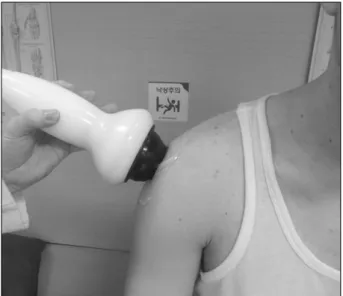
의 강도로 분당 120회, 총 1,200회 시행하였다. 1주 간격으로 3회 치료를 시행한 뒤 2주간의 휴지기를 두고 다시 3회의 치료를 시행하였다. 휴지기는 환자의 치료 준수(com- pliance)를 높이고, 회전근개 부위의 손상을 막기 위해 2주간 시행하였다. 체외 충격파는 동일한 시술자에 의해 시행되었고, 석회성 건염의 위치는 체외 충격파 조사 전 초음파를 통하여 확인하였다 . 모든 환자는 앉은 자세에서 체외 충격파를 시행받 도록 하였다(Fig. 1). 약물치료는 비스테로이드성 소염제 (aceclofenac)를 하루 2회씩 2개월간 투여하였고, 위장관계 부 작용 예방을 위하여 H2 차단제(H2-blocker)를 같이 투여하였다.

3. 치료 후 분석 방법

견관절의 기능 회복을 평가하기 위해 두 군의 환자들에게

치료 전과 치료 후 6개월 뒤 Constant and Murley Scale (CMS)을

계산하였고 동통의 정도를 파악하기 위해 pain visual analog

scale (VAS)를 측정하였다. CMS는 견관절의 기능을 평가하는

표준화된 임상 방법으로 총 100점 만점으로 통증 정도, 일상

(3)

Table 2. Clinical outcomes between ESWT therapy and conservative treatment

Outcome

Group 1 (n=15) (ESWT therapy)

Group 2 (n=15)

(conservative treatment) p-value

Preop Last F/U Preop Last F/U

CMS score 26 72 (47−92) 29 45 (23−78) <0.05

VAS score 8.8 2.3 8.3 5.2 <0.05

ESWT: extracorporeal shock wave therapy, Preop: preoperative, F/U: follow up, CMS: Constant and Murley Scale, VAS:

visual analog scale.

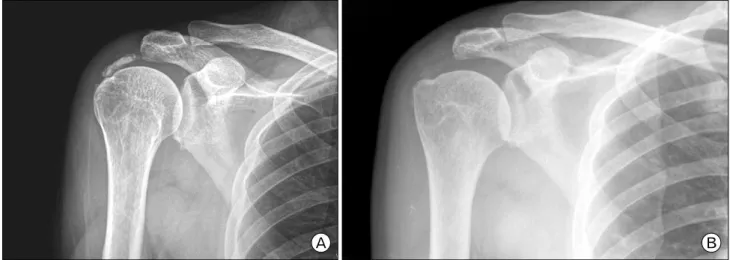
Fig. 2. (A) Initial plain X-ray of calcific tendinitis patient. (B) After 6 months, follow-up X-ray of extracorporeal shock ave therapy therapy patient for calcific tendinitis.

생활 수행능력의 주관적 요소(35점)과 운동범위, 근력의 객관 적 요소(65점)으로 구성된다. VAS는 동통을 주관적인 평가에 기초하여 나타내며 통증이 없는 경우를 0점으로 하고 극심한 통증을 10점으로 정하였고, 치료 전과 치료 이후 6개월에 조사 하였다. 방사선학적 치료 평가를 위하여 치료 전과 치료 후 3개월 및 6개월에 단순방사선촬영을 시행하여 석회화 결절의 크기를 확인하였다. 통계적 검증은 SPSS ver.17.0 (SPSS Inc., Chicago, IL, USA)를 이용하였다. Demographic factor는 Mann- Whitney test로, 치료 전 후 결과는 paired t-test를 이용하여 p-value<0.05인 변수는 유의한 차이가 있는 것으로 분석하였다.

결 과

CMS 점수는 체외 충격파 치료를 시행한 제1군에서 치료 전 평균 26점에서 치료 후 평균 72점(범위, 47–92점)으로 증가 하였고 약물 치료를 시행한 제 2군에서는 치료 전 평균 29점에 서 치료 후 평균 45점(범위, 23–78점)으로 호전되어 체외충격 파 치료를 시행한 경우 더 월등한 견관절 기능의 회복을 보였

다 . VAS 점수도 두 군에서 모두 감소하였으나 제1군에서 치료 전 평균 8.8점(범위, 6–10점)에서 치료 후 평균 2.3점(범위, 0–5점)으로 감소하였고 제2군에서는 치료 전 평균 8.3점(범위, 5–10점)에서 치료 후 평균 5.2점(범위, 2–10점)으로 체외 충격 파 치료 시행 시 더 나은 통증의 감소를 보였다. 이는 모두 통계학적으로 유의하였다(Table 2).

방사선학적 평가에서 제2군에서는 총 15명의 환자 중 약물 치료 3개월 뒤 3명, 6개월 뒤 7명이 방사선 촬영에서 석회화 결절의 감소가 관찰된 것에 비해 제1군에서는 총 15명 중 체외 충격파 치료 3개월 뒤 7명, 6개월 뒤 13명에서 석회화 결절의 감소가 관찰되었다. 체외 충격파 치료 시 방사선학적 석회화 결절의 감소도 더 뚜렷한 것으로 나타났다(Fig. 2).

체외충격파 치료 이후 건 파열이나 골 부종과 같은 심각한

임상적 부작용은 없었다.

(4)

고 찰

석회화 건염은 퇴행성이 아닌 반응성 석회화 과정으로 석회 침착의 형성과 용해의 진행에 따라 석회화 전기, 석회화기, 석회화 후기로 구분한다

2,3,7)

. 통증이나 운동 제한 등의 증상은 주로 석회화기에서 발생하는 것으로 알려져 있다 . 견관절 통증 은 팔을 거의 움직일 수 없을 정도로 극심할 수 있으며 야간에 악화되는 양상을 보인다. 석회 침착은 수년이 지나면 저절로 흡수되어 사라지게 된다 . Gartner와 Simons

14)

는 견관절 방사선 에서 경계가 뚜렷한 석회 침착이 3년 뒤 33%에서 자발적으로 사라졌음을 보고하였으며, Bosworth

1)

는 석회 침착의 6.4%가 자발적인 용해 과정을 거쳤음을 보고하였다.

본 연구에서는 석회화 건염 환자에게 체외 충격파 요법을 시행한 군에서 약물 치료를 시행한 군보다 증상의 완화와 기능의 개선이 더 월등하며, 석회화 침착의 소실도 더 많은 것으로 나타났다. 그 동안의 증례 보고, 코호트 연구 및 임상 실험을 포함한 다양한 보고에서도 석회화 건염 환자에 있어 체외 충격파 요법이 좋은 치료 결과를 보고하였다

15)

. 수술적 치료에 비해서도 체외 충격파 요법은 비침습적이고 안정성이 보장되어 있어 더 효과적인 치료로 알려져 있다

16)

. 이 연구 역시 이러한 경향을 뒷받침한다.

체외 충격파 쇄석술(extracorporeal shock wave therapy)은 1980년부터 요석 제거 목적으로 임상에서 사용되었고 최근에 는 비뇨기과 영역에서 요석 치료의 가장 많이 이용되고 있다.

90년대 초반부터 체외 충격파 쇄석술은 골절의 불유합, 족저근 막염과 외측상과염 등의 만성 건염에 대한 치료에 되었다

17-19)

. Loew 등

20)

은 견관절의 석회화 병변에 체외충격파 치료의 효과 에 대해 기술한 바 있으며, 이후에도 다양한 보고가 이루어

졌다

16,21)

. 체외 충격파 치료의 성공률은 30%에서 85%로 다양

하게 보고되며 , 각각의 경우마다 다른 횟수, 용량, 시술 방법으 로 시행되기 때문에 결과에 대해 논란이 많다

22,23)

.

체외 충격파 요법의 효과에 대한 정확한 생체 내 기전은 알려져 있지 않다 . 신생 혈관 생성, 조직의 재분화, 과잉자극에 따른 마비효과가 조직 회복에 중요한 역할을 한다고 알려져

있으며

7,14)

, 체외 충격파는 직접적으로 조직 자극을 통해 분자

수준에서 이러한 반응을 유도한다는 가설도 제기되고 있다

24)

. 또한 체외 충격파는 인접 점액낭으로의 석회 침착물의 흡수를 촉진시키며 국소 염증 반응을 통해 침착물의 파괴를 돕는다고 알려져 있다

25,26)

.

체외 충격파 요법을 시행한 후 국소 발적이나 피하 혈종의

발생 등의 부작용이 보고된 바 있다

27)

. 또한 고에너지의 충격파 를 조사하였을 경우 시술 중 통증을 호소하는 경우가 있으며 이러한 통증 감소를 위해 시술 전 국소 마취를 시행하는 경우도 있다. 그러나 그 동안 체외 충격파 요법에 의해 건 파열이나 골 부종과 같은 심각한 임상적 부작용이 발생되었다는 보고는 없다. 본 연구에서도 이러한 부작용은 발생하지 않았다.

본 연구의 제한점은 후향적 연구로 진행되었으며, 체외 충격파의 용량에 따른 차이를 분석하지 않은 점이다. 또한 석회성 건염의 자연사로 인해 증상이 호전된 것인지, 체외 충격파나 약물치료로 인해 증상이 호전된 것인지 명확하지 않다. 그렇지만 저용량의 체외 충격파 치료로도, 초음파를 통해 정확한 부위에 시행을 할 경우에 석회화 건염의 치료에 효과적임을 알 수 있다.

견관절 석회화 건염에 있어 체외충격파 치료는 약물 치료보 다 더 유의미한 관절 기능의 향상과 통증의 감소 및 방사선학적 소견의 호전을 보인다.

References

1. Bosworth BM. Calcium deposits in the shoulder and subacro- mial bursitis: a survey of 12,122 shoulders. JAMA 1941;116:

2477-82.

2. Ark JW, Flock TJ, Flatow EL, Bigliani LU. Arthroscopic treatment of calcific tendinitis of the shoulder. Arthroscopy 1992;8:183-8.

3. Uhthoff HK. Calcifying tendinitis. Ann Chir Gynaecol 1996;

85:111-5.

4. Refior HJ, Krodel A, Melzer C. Examinations of the path- ology of the rotator cuff. Arch Orthop Trauma Surg 1987;

106:301-8.

5. Milone FP, Copeland MM. Calcific tendinitis of the shoulder joint. Presentatin of 136 cases treated by irradiation. Am J Roentgenol Radium Ther Nucl Med 1961;85:901-13.

6. Gerdesmeyer L, Wagenpfeil S, Haake M, et al. Extracorporeal shock wave therapy for the treatment of chronic calcifying tendonitis of the rotator cuff: a randomized controlled trial.

JAMA 2003;290:2573-80.

7. Moseley HF. The natural history and clinical syndromes pro- duced by calcified deposits in the rotator cuff. Surg Clin North Am 1963;43:1489-93.

8. Parlier-Cuau C, Champsaur P, Nizard R, Wybier M, Bacque MC, Laredo JD. Percutaneous treatments of painful shoulder.

Radiol Clin North Am 1998;36:589-96.

9. Gimblett PA, Saville J, Ebrall P. A conservative management

(5)

protocol for calcific tendinitis of the shoulder. J Manipulative Physiol Ther 1999;22:622-7.

10. Green S, Buchbinder R, Glazier R, Forbes A. Systematic review of randomised controlled trials of interventions for painful shoulder: selection criteria, outcome assessment, and efficacy.

BMJ 1998;316:354-60.

11. Philadelphia Panel. Philadelphia Panel evidence-based clinical practice guidelines on selected rehabilitation interventions for shoulder pain. Phys Ther 2001;81:1719-30.

12. Ebenbichler GR, Erdogmus CB, Resch KL, et al. Ultrasound therapy for calcific tendinitis of the shoulder. N Engl J Med 1999;340:1533-8.

13. Ogden JA, Alvarez RG, Levitt R, Marlow M. Shock wave therapy (Orthotripsy) in musculoskeletal disorders. Clin Orthop Relat Res 2001;(387):22-40.

14. Gartner J, Simons B. Analysis of calcific deposits in calcifying tendinitis. Clin Orthop Relat Res 1990;(254):111-20.

15. Rompe JD, Hope C, Kullmer K, Heine J, Burger R. Analgesic effect of extracorporeal shock-wave therapy on chronic tennis elbow. J Bone Joint Surg Br 1996;78:233-7.

16. Rompe JD, Zoellner J, Nafe B. Shock wave therapy versus conventional surgery in the treatment of calcifying tendinitis of the shoulder. Clin Orthop Relat Res 2001;(387):72-82.

17. Birnbaum K, Wirtz DC, Siebert CH, Heller KD. Use of extra- corporeal shock-wave therapy (ESWT) in the treatment of non- unions: a review of the literature. Arch Orthop Trauma Surg 2002;122:324-30.

18. Rompe JD, Schoellner C, Nafe B. Evaluation of low-energy extracorporeal shock-wave application for treatment of chronic plantar fasciitis. J Bone Joint Surg Am 2002;84:335-41.

19. Wang CJ, Chen HS. Shock wave therapy for patients with lateral epicondylitis of the elbow: a one- to two-year follow-up study. Am J Sports Med 2002;30:422-5.

20. Loew M, Daecke W, Kusnierczak D. The effects of extracor- poreal shock wave application (ESWA) in treatment of calci- fying tendinitis of the shoulder. J Bone Joint Surg Br 1997;

79(Suppl 2):202-3.

21. Schmitt J, Haake M, Tosch A, Hildebrand R, Deike B, Griss P. Low-energy extracorporeal shock-wave treatment (ESWT) for tendinitis of the supraspinatus: a prospective, randomised study. J Bone Joint Surg Br 2001;83:873-6.

22. Speed CA, Richards C, Nichols D, et al. Extracorporeal shock- wave therapy for tendonitis of the rotator cuff: a double- blind, randomised, controlled trial. J Bone Joint Surg Br 2002;84:509-12.

23. Haake M, Deike B, Thon A, Schmitt J. Exact focusing of extracorporeal shock wave therapy for calcifying tendinopathy.

Clin Orthop Relat Res 2002;(397):323-31.

24. Wang CJ. An overview of shock wave therapy in musculo- skeletal disorders. Chang Gung Med J 2003;26:220-32.

25. Wang CJ, Wang FS, Yang KD. Biological effects of extra- corporeal shockwave in bone healing: a study in rabbits. Arch Orthop Trauma Surg 2008;128:879-84.

26. Delius M, Draenert K, Al Diek Y, Draenert Y. Biological effects of shock waves: in vivo effect of high energy pulses on rabbit bone. Ultrasound Med Biol 1995;21:1219-25.

27. Seil R, Wilmes P, Nuhrenborger C. Extracorporeal shock wave therapy for tendinopathies. Expert Rev Med Devices 2006;3:

463-70.

수치

Table  1.  Demnographic  factors
Fig.  2.  (A)  Initial  plain  X-ray  of  calcific  tendinitis  patient.  (B)  After  6  months,  follow-up  X-ray  of  extracorporeal  shock ave  therapy  therapy  patient  for  calcific  tendinitis.

참조

관련 문서

견관절의 석회화 건염에 대한 치료로 초음파 유도 하 다발성 천공술 및 고에너지 체외 충격파 병행 치.. 료는 정확한 치료 부위 선정으로 임상적 기능 향상 과 초음파 영상

08) Kim JS, Yoo JH and Yoo SO: Arthroscopic treatment of chronic calcific tendinitis of the shoulder. Journal of Korean Shoulder and Elbow Society, 1-1:6-11, 1998.. 09) Rhee YG, Kim

Published literature shows low intensity extracorporeal shock wave therapy (LIESWT) and low intensity pulsed ultrasound (LI- PUS) therapy to improve erectile function and

(A) Mean international index of erectile function-erectile function (IIEF-EF) domain score for patients treated with low-intensity extracorpo- real shock wave therapy (Li-ESWT) or

A first prospective, randomized, double-blind, placebo-controlled clinical trial evaluating extracorporeal shock wave therapy for the treatment of Peyronie’s

Conclusion These results indicate that extracorporeal shock waves therapy could be considered as an effective and efficient treatment modality for myofascial pain

최근 연부 조직의 질환에 대하여 체외충격파 치료 (extracorporeal shock wave therapy)를 시행하 여 통증의 감소 및 좋은 임상적 결과를 보고하고 있 다.

By far shock wave dose parameter has not yet been established while acoustic exposure in ESWT is specified in terms of various parameters including efd, total acoustic