ABSTRACT
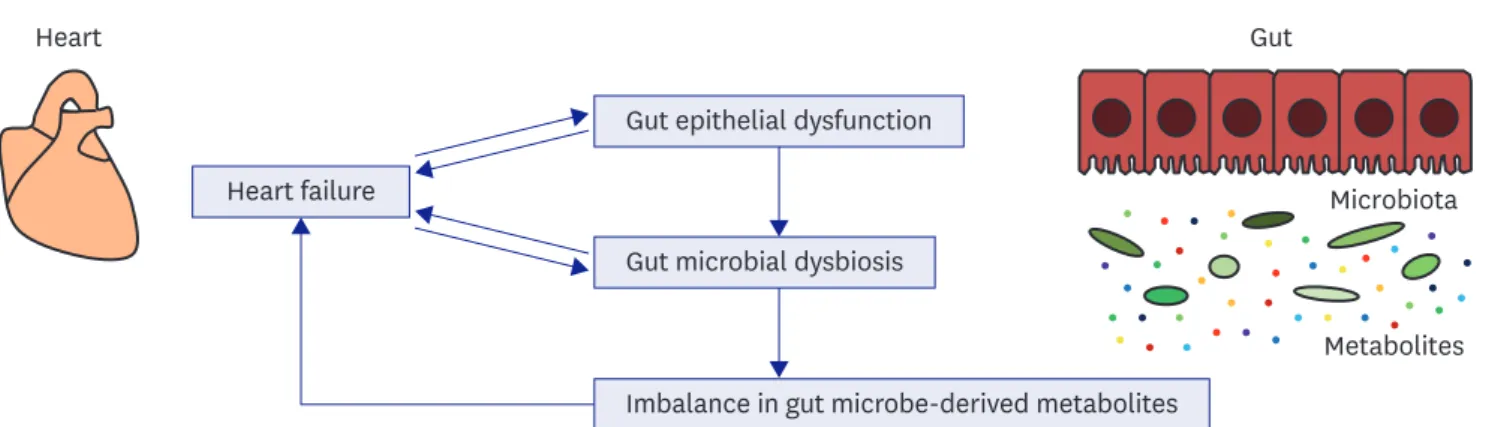
Patients with heart failure (HF) have structural and functional changes of the gut as a result of microcirculatory disturbances. A disrupted gut epithelial barrier may lead to translocation of microbial products into systemic circulation, possibly aggravating HF by inducing inflammatory responses. Gut microbiota play an essential role in the maintenance of host homeostasis because large quantities of their gene products complement host physiological processes. Emerging evidence has suggested the potential clinical significance of gut microbiota in the pathophysiology of HF. Imbalances of gut microbe-derived metabolites can contribute to cardiac dysfunction and other morbidities in patients with HF. Therapeutic research for HF through targeting microbiota is under way. Thus, the novel concept of a heart-gut axis may lead to breakthroughs in the development of innovative diagnostics and therapeutic approaches for HF.
Keywords: Gut epithelial barrier; Gastrointestinal microbiome; Dysbiosis; Microbe-derived metabolites
INTRODUCTION
The potential role of the gut in the pathophysiology of heart failure (HF) has recently begun to attract increased attention. Patients with HF develop reduced cardiac output, increased tissue congestion, and develop peripheral vasoconstriction. These disturbances may impair gut epithelial function, contributing to malnutrition and cachexia complicating advanced HF, and may also lead to translocation of bacteria-derived endotoxins across the gut epithelial barrier, thereby inducing systemic inflammatory responses.
1-4)There are more microbial cells residing in the human gut than human cells in the body, and their combined genomes contain millions of genes, at least one hundred-fold that of the number of human genes.
There is growing evidence that imbalances in the composition and function of gut microbiota, known as dysbiosis, are associated with a wide spectrum of host disorders ranging from gastrointestinal diseases to inflammatory, metabolic, and neurologic diseases.
For example, we recently used 16S ribosomal RNA gene sequencing of fecal samples from HF patients to determine that gut microbial dysbiosis is associated with HF.
5)Importantly, this result is suggestive of the potential impact that the gut microbiota may have on the
Review Article
Received: Feb 1, 2017 Accepted: Mar 1, 2017 Correspondence to Hiroshi Akazawa, MD, PhD
Department of Cardiovascular Medicine, Graduate School of Medicine, The University of Tokyo, 7-3-1 Hongo, Bunkyo-ku, Tokyo 113- 8654, Japan.
Tel: +81-3-5800-9116 Fax: +81-3-5800-9182
E-mail: [email protected] Issei Komuro, MD, PhD
Department of Cardiovascular Medicine, Graduate School of Medicine, The University of Tokyo, 7-3-1 Hongo, Bunkyo-ku, Tokyo 113- 8654, Japan.
Tel: +81-3-5800-6526 Fax: +81-3-3815-2087 E-mail: [email protected] Copyright © 2017. The Korean Society of Cardiology
This is an Open Access article distributed under the terms of the Creative Commons Attribution Non-Commercial License (https://
creativecommons.org/licenses/by-nc/4.0) which permits unrestricted noncommercial use, distribution, and reproduction in any medium, provided the original work is properly cited.
Funding
This work was supported in part by grants from the Japan Society for the Promotion of Science (KAKENHI 26670395) to H.A. H.A.
has received research funding from Takeda Pharmaceutical Co., Ltd., Daiichi Sankyo Co., Ltd., Shionogi & Co., Ltd., Nippon Boehringer Ingelheim Co., Ltd., Bristol-Myers Squibb K.K., MSD K.K., Sanofi K.K., Mitsubishi
Takehiro Kamo, MD, PhD
1, Hiroshi Akazawa, MD, PhD
1, Jun-ichi Suzuki, MD, PhD
2, and Issei Komuro, MD, PhD
11
Department of Cardiovascular Medicine, Graduate School of Medicine, The University of Tokyo, Tokyo, Japan
2