• 검색 결과가 없습니다.

Randomized controlled clinical trial of oral health-related quality of life in patients wearing conventional and self-ligating brackets

N/A
N/A
Protected

Academic year: 2022

Share "Randomized controlled clinical trial of oral health-related quality of life in patients wearing conventional and self-ligating brackets"

Copied!
9
0
0

로드 중.... (전체 텍스트 보기)

전체 글

(1)

Randomized controlled clinical trial of oral

health-related quality of life in patients wearing conventional and self-ligating brackets

Objective: The aim of this randomized controlled clinical trial was to com- pare oral health-related quality of life (OHRQoL) of patients treated with con- ventional, active self-ligating (ASL), and passive self-ligating (PSL) brackets in different therapeutic phases. Methods: Sixty patients (mean age 18.3 years;

29 males and 31 females) requiring orthodontic treatment were randomly and equally assigned to receive conventional (Victory Series), ASL (In-Ovation R), or PSL (Damon 3MX) brackets. OHRQoL was measured with a self-administered modified 16-item Malaysian version of the Oral Health Impact Profile for immediate (soon after the visit) and late (just before the subsequent visit) assessments of the bonding and activation phases. Data were analyzed with the Kruskal-Wallis and chi-square tests. Results: The PSL and ASL groups showed more immediate and late impacts in the bonding phase, respectively; the conventional group was affected in both the assessments. The first activation phase had similar impacts in the groups. After the second activation, the conventional group showed more immediate impacts, whereas the PSL and ASL groups had more late impacts. The commonly affected domains were

“physical disability,” “functional limitation,” “physical pain,” and “psychological discomfort.” No significant differences in the prevalence and severity of immediate and late impacts on OHRQoL of the patients were noted in any therapeutic phase. Conclusions: No bracket system seems to ensure superior OHRQoL. This information could be useful for explaining the therapeutic phases, especially the initial one, and selecting the optimal bracket system based on the patient’s preference.

[Korean J Orthod 2014;44(4):168-176]

Key words: Perception, Fixed appliances, Self-ligating bracket, Orthodontic treat ment, Public health

Siti Adibah Othman

a,b

Noorhanizar Mansor

a

Roslan Saub

c,d

a

Department of Paediatric Dentistry and Orthodontics, Faculty of Dentistry, University of Malaya, Kuala Lumpur, Malaysia

b

Clinical Craniofacial Dentistry Research Group, Faculty of Dentistry, University of Malaya, Kuala Lumpur, Malaysia

c

Department of Community Oral Health and Clinical Prevention, Faculty of Dentistry, University of Malaya, Kuala Lumpur, Malaysia

d

Community Oral Health Research Group, Faculty of Dentistry, University of Malaya, Kuala Lumpur, Malaysia

Received October 3, 2013; Revised November 25, 2013; Accepted December 4, 2013.

Corresponding author: Siti Adibah Othman.

Associate Professor, Department of Paediatric Dentistry and Orthodontics, Faculty of Dentistry, University of Malaya, 50603 Kuala Lumpur, Malaysia.

Tel +60-3-79674873 e-mail [email protected]

*This work was funded by research grants (numbers FS173/2008C and P0084/2008C) from the University of Malaya.

© 2014 The Korean Association of Orthodontists.

The authors report no commercial, proprietary, or financial interest in the products or companies described in this article.

This is an Open Access article distributed under the terms of the Creative Commons Attribution Non-Commercial License (http://creativecommons.org/licenses/by-nc/3.0) which permits unrestricted non-commercial use, distribution, and reproduction in any medium, provided the original work is properly cited.
pISSN 2234-7518 • eISSN 2005-372X

http://dx.doi.org/10.4041/kjod.2014.44.4.168

(2)

INTRODUCTION

In general, orthodontic treatment focuses on impro- ving functional occlusion and facial appearance.

1

Awa- reness of how facial appearance affects quality of life has rapidly increased the demand for such treatment.

In most cases, the motivating factors for undergoing orthodontic treatment are enhanced dental and facial aesthetics and consequently minimized psychosocial problems.

2,3

Studies of oral health-related quality of life (OHRQoL) in orthodontics are important because they provide information about therapeutic needs and outcomes as well as long-term oral health improvement.

4

They can also ensure better therapeutic choices based on the patient’s perception.

5

Self-ligating brackets are popular in orthodontics be- cause of their proposed superior properties including low static frictional resistance, full and stable archwire engagement, improved oral hygiene, preserved ancho- rage, reduced chair time and therapeutic time, and prolonged therapeutic intervals.

6-9

Several researchers compared therapeutic efficiency,

7

friction,

8

speed of archwire changes,

9

therapeutic time,

10

and initial align- ment of the mandibular arch

11

between self-liga ting and conventional brackets, but the patient’s views were often not considered. Further, although studies of pain and discomfort have been performed in orthodontics,

12-15

OHRQoL has not been assessed in patients wearing self-ligating and conventional brackets. Such an inves- tigation would provide specific information on how ortho dontic treatment affects the patient’s physical, social, and psychological well-being in daily activities. It would also improve the patient’s understanding of the potential benefits and drawbacks of treatment.

16

The objective of this study was to compare OHRQoL of patients wearing conventional, active self-ligating (ASL), and passive self-ligating (PSL) brackets in different therapeutic phases. The null hypothesis was that the prevalence and severity of impacts on OHRQoL would not differ among the patients in any therapeutic phase.

MATERIALS AND METHODS

Study population

This randomized controlled clinical trial included 60 Malaysian patients who visited the Faculty of Dentistry, University of Malaya, for fixed orthodontic treatment.

The subjects were selected from the waiting list by purposive sampling. The inclusion criteria were age 14−24 years; Class I, II, or III skeletal pattern; moderate crowding or spacing in the maxillary and mandibular arches; and no intervention planned with extraoral and other intraoral appliances within the first 6 months of treatment. The exclusion criteria included severe skeletal

disharmony requiring orthognathic surgery and presence of syndromes, dental caries, or periodontal disease.

All the subjects were given oral healthcare products (orthodontic toothbrush, fluoride mouthwash, and inter- dental toothbrush) and reimbursed for transportation during the study; they paid only half the total cost of the treatment. Ethical approval was obtained from the Research Ethics Committee of the Faculty of Dentistry, University of Malaya [DF OT0803/0024(P)]. This study was monitored by the local institutional review boards.

Randomization

Block randomization was performed by a dental nurse to allocate the subjects to conventional (Victory Series;

3M Unitek, Monrovia, CA, USA), ASL (In-Ovation R;

Dentsply GAC International, Islandia, NY, USA), and PSL (Damon 3MX; Ormco Corporation, Orange, CA, USA) groups. In brief, each patient’s initials were written on a piece of paper, and the paper was randomly placed in one of three boxes representing the bracket systems.

The process was repeated until all the 60 patients were assigned to a group. It ensured that the subjects had the same probability of being allocated to a group and the groups included an equal number of subjects.

Instruments

A self-administered questionnaire was developed to gather information on sociodemographics. OHRQoL was measured by using a modified 16-item Malaysian ver- sion of the Oral Health Impact Profile (OHIP-16[M]), adapted from Saub et al.

17

This instrument was chosen because it is used in most studies of OHRQoL in ortho- dontics. It focuses on the impact of oral health on qua- lity of life via seven domains: “functional limitation,”

“physical pain,” “psychological discomfort,” “physical disability,” “psychological disability,” “social disability,”

and “handicap.” Responses to each item are scored as follows: 1 = never; 2 = hardly ever; 3 = occasionally; 4

= fairly often; and 5 = very often.

For this study, three items were added on the basis of the outcome of a pretest: “problems in speech,” “pro- blems in cleaning,” and “pain.” The item “have you had to spend a lot of money?” was removed because the patients were mainly schoolchildren funded by their parents. The total score ranged from 16 to 80, where 16 indicated no impact and 80 indicated the worst impact on OHRQoL.

The questionnaires were prepared in Malay and English. They were tested before data collection to check for face validity.

Intervention

Each patient received an information sheet about

the research and gave written informed consent before

(3)

responding to the first questionnaire. After examination, diagnosis, and treatment planning, the patients com- pleted the baseline questionnaire to assess OHRQoL before any intervention. At the next appointment, the brackets were bonded according to the manufacturers’

protocols. Activation was performed according to the manufacturers’ specifications at intervals of 4, 6, and 8 weeks in the conventional, ASL, and PSL groups, respectively.

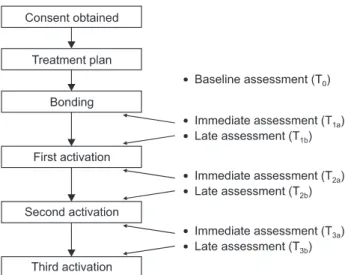
Immediate and late assessments were conducted in the bonding, first activation, and second activation phases.

For the immediate assessment, the questionnaires were given to the patients, and they mailed the completed questionnaires after the visit. The late assessment coin- cided with the activation appointments, minimizing patient constraints and maximizing compliance; the patients completed these questionnaires before the sub sequent visit. The data collection sequence is sum- marized in Figure 1. The therapeutic intervals and arch- wire changes were standardized for every activation phase. Only one operator performed the interventions.

Statistical analysis

Two parameters of OHIP-16[M] were computed according to Locker and Quiñonez

18

:

i. Prevalence: the percentage of respondents reporting one or more impacts as “very often” or “quite often.” This variable identifies those whose oral health impacts are chronic rather than transitory.

ii. Severity: the sum of the response scores of the 16 items, which considers impacts experienced at all frequency levels.

Because items in each domain vary, the scores were standardized to a range of 0 to 100 by using the Fayers

and Machin

19

formula:

Z = X [100/(m × (k − 1)],

where Z is the standardized score, X is the summed score, m is the number of items, and k is the response category.

The prevalence and severity values were not normally distributed. Therefore, the Kruskal-Wallis and chi- square tests were used for analyzing continuous and categorical data, respectively. p-value was set at 0.05. All measurements were analyzed using Statistical Package for Science Social version 17.0 (SPSS, Inc, Chicago, IL, USA).

RESULTS

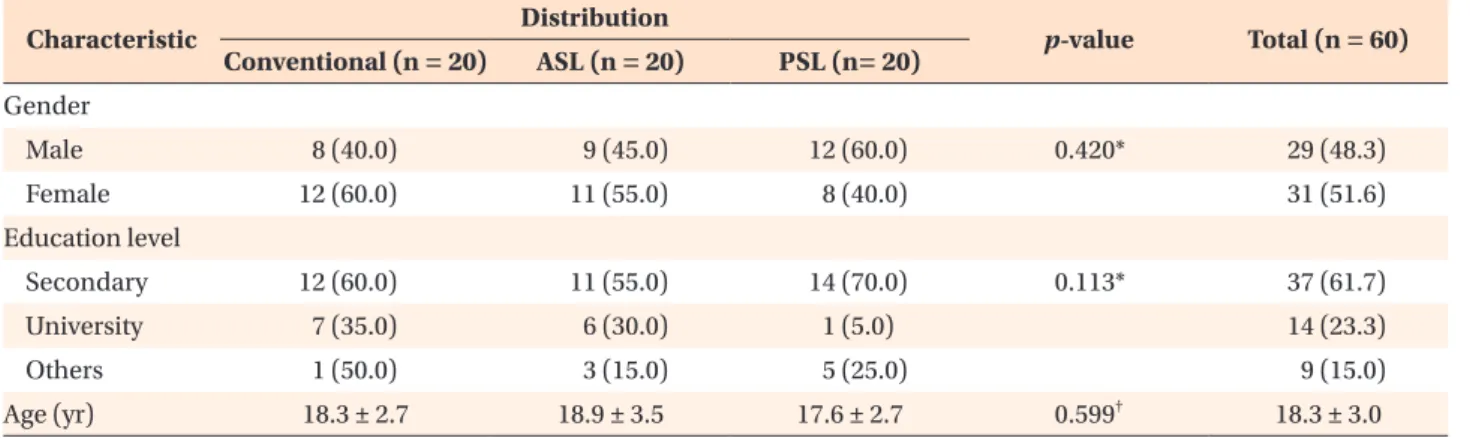
The response rate was 100% and all the subjects com- pleted the questionnaires in all the therapeutic phases (Figure 2). The groups did not show significant diffe- rences in age, gender, and educational level (Table 1).

They also did not show significant differences in the prevalence and severity of impacts on OHRQoL at the baseline and immediate and late assessments (Table 2).

The immediate impacts were more prevalent and severe than the late impacts in all the therapeutic phases regardless of the group. The bonding phase had the greatest effect; the PSL and ASL groups showed more immediate and late impacts, respectively, whe- reas the conventional group showed impacts in both the assessments. The first activation phase had similar impacts regardless of the assessment time. The con- ventional group showed more immediate impacts after the second activation, whereas the PSL and ASL groups had more late impacts in this phase.

Similar OHIP-16[M] domains (“physical disability,”

“functional limitation,” “physical pain,” and “psycho- logical discomfort”) were affected in the therapeutic phases (Table 3). The “social disability” and “handicap”

domains were the least affected in all the groups.

Significant differences in the prevalence of “physical pain” and severity of “social disability” were noted at the late assessment of the second activation phase, with the PSL group showing the highest values. Significant differences were also observed in the severity of “food stuck between teeth” and “lack of self-confidence”

at the late assessment of the bonding phase (Table 4). Further, the prevalence of “difficulties in chewing”

and severity of “avoided going out” and “difficulty in performing daily activities” showed significant dif- ferences at the late assessment of the second activation phase. The PSL group had the most severe impacts according to the OHIP-16[M] items in this phase.

Figure 1. Flowchart depicting the data collection se­

quence.

(4)

DISCUSSION

In this study, the absence of significant differences in the prevalence and severity of impacts on OHRQoL in any therapeutic phase among the groups proves our hypothesis.

In this study, the prevalence of impacts was quite high (65−75%) at the baseline. This value is higher than that (slightly over 50%) found by Saub and Locker

20

in

Malaysian adults. The difference was expected because the present subjects were patients with malocclusion who requested treatment.

In the bonding phase, PSL brackets (Damon 3MX) caused the highest prevalence of immediate impacts.

This observation may be explained by the bracket shape.

Major et al.

21

compared the shape of In-Ovation and

Damon Q brackets and found that Damon Q brackets

(Ormco Corporation, Orange, CA, USA) are more rectan-

Figure 2. Consolidated Standards of Reporting Trials flow diagram.

(5)

Table 1. Sociodemographic characteristics of the patients according to the bracket groups

Characteristic Distribution

p-value Total (n = 60) Conventional (n = 20) ASL (n = 20) PSL (n= 20)

Gender

Male 8 (40.0) 9 (45.0) 12 (60.0) 0.420* 29 (48.3)

Female 12 (60.0) 11 (55.0) 8 (40.0) 31 (51.6)

Education level

Secondary 12 (60.0) 11 (55.0) 14 (70.0) 0.113* 37 (61.7)

University 7 (35.0) 6 (30.0) 1 (5.0) 14 (23.3)

Others 1 (50.0) 3 (15.0) 5 (25.0) 9 (15.0)

Age (yr) 18.3 ± 2.7 18.9 ± 3.5 17.6 ± 2.7 0.599

18.3 ± 3.0

Values are presented as number (%) or mean ± standard deviation.

ASL, Active self-ligating; PSL, passive self-ligating.

By *chi-square test, and

Kruskal-Wallis test.

p < 0.05 is statistically significant.

Table 2. Prevalence and severity of impacts on OHRQoL in the therapeutic phases at the immediate and late assessments Treatment

phases Group Patient (n) Prevalence of

impact, n (%) p–value* Severity (OHIP-16[M] score)

p-value

Mean (SD) Median

T

0

C 20 13 (65.0) 34.6 (8.8) 33.0

ASL 20 15 (75.0) 0.735 34.3 (10.1) 34.5 0.603

PSL 20 13 (65.0) 32.5 (9.4) 31.0

T

1a

C 20 18 (90.0) 45.6 (10.6) 43.0

ASL 20 16 (80.0) 0.322 42.3 (12.7) 40.0 0.443

PSL 20 19 (95.0) 41.4 (8.0) 42.5

T

1b

C 20 17 (85.0) 36.0 (8.8) 34.0

ASL 20 12 (60.0) 0.098 36.6 (11.3) 34.5 0.440

PSL 20 11 (55.0) 32.7 (9.3) 31.0

T

2a

C 20 14 (70.0) 38.3 (9.8) 38.5

ASL 20 16 (80.0) 0.689 35.7 (11.6) 32.5 0.652

PSL 20 16 (80.0) 36.3 (9.0) 36.0

T

2b

C 20 14 (70.0) 32.7 (9.5) 33.0

ASL 20 13 (65.0) 0.928 33.7 (10.1) 31.5 0.933 PSL 20 13 (65.0) 32.4 (7.9) 31.0

T

3a

C 20 15 (75.0) 35.9 (9.7) 35.5

ASL 20 13 (65.0) 0.735 34.0 (9.6) 33.0 0.874

PSL 20 13 (65.0) 34.5 (8.2) 35.0

T

3b

C 20 10 (50.0) 30.6 (8.6) 27.0

ASL 20 13 (65.0) 0.138 32.6 (10.0) 33.0 0.695 PSL 20 16 (80.0) 31.9 (5.9) 31.5

OHRQoL, Oral health-related quality of life; C, conventional; ASL, active self-ligating; PSL, passive self-ligating; T

0

, baseline;

T

1a

, bonding, immediate assessment; T

1b

, bonding, late assessment; T

2a

, first activation, immediate assessment; T

2b

, first activation, late assessment; T

3a

, second activation, immediate assessment; T

3b

, second activation, late assessment; OHIP- 16[M], modified 16-item Malaysian version of the Oral Health Impact Profile; SD, standard deviation.

By *chi-square test, and

Kruskal-Wallis test.

p < 0.05 is statistically significant.

(6)

gular, with nearly 90-degree corners between the slot bottom and the walls. Damon Q brac kets are a more com patible and sophisticated version of Damon 3MX brackets. As Damon 3MX brackets are relatively bulky, the patients wearing these brackets may have felt more uncomfortable and had greater difficulty in cleaning their teeth than the other patients.

Interestingly, the subjects bonded with conventional brackets had the highest severity score, indicating poorer OHRQoL than those with self-ligating brackets.

The tension and compression of the periodontal liga- ment during orthodontic treatment cause pain.

22

This situation would be more apparent in patients with con- ventional brackets because of elastomeric ligatures, which produce friction that causes pain, when compared with self-ligating brackets, which are frictionless. Such pain will affect eating abilities, as reflected by the most affected domain (“physical pain”) in the present study. The conventional group also reported the highest prevalence of late impacts after bonding. Although elas- tomeric ligatures reportedly have force decay tendencies, the failure load remained comparably high (67%) in situ even after 6 weeks.

23

The late assessment of the bonding phase was performed after 4 weeks, so the effect of elastomeric ligation would still have been per- ceptible. The lower prevalence of impacts of self-liga- ting brackets may be attributable to the adaptation to the relatively bulky brackets and frictionless system.

The questionnaires in the PSL and ASL groups were administered at 8- and 6-week intervals, respectively, which would have allowed the subjects to adapt to the situation.

Immediate assessment after the first activation showed that self-ligating brackets had higher prevalence of

impacts than the conventional group. In this phase, the archwire was drastically changed from a small round one (0.014 inch copper-nickel-titanium) to a larger rectangular one (0.014 × 0.025 inch copper- nickel-titanium) in the PSL group. An increase in wire size would increase static frictional resistance,6 which can cause pain and discomfort. Therefore, use of rectangular archwire might have had a greater im- pact. However, again, the conventional group had more severe impacts, which may have been caused by the strain from elastomeric ligatures. Furthermore, the archwire in the conventional group was slightly larger (0.016 inch copper-nickel-titanium) in this phase than in the bonding phase (0.014 inch copper-nickel-tita- nium). All the three bracket systems caused almost similar prevalence and severity of late impacts on “psy- chological discomfort” and “physical disability.” This finding might be explained by the adaptation to the brackets over time. Studies have shown that perceived pain peaks at around 24 hours after the placement of arch wire, with reducing levels subsequently.

24-26

This also suggests better adaptation of all patients to appliances, a phenomenon known as “learning experiences of treat- ment.”

27

At the second activation, the archwire for conventional and ASL brackets was changed from round (0.016 inch) to rectangular (0.016 × 0.022 inch) copper-nickel- titanium. Meanwhile, in the PSL group, the shape of the archwire was the same (i.e., rectangular) but a larger dimension was used (from 0.014 × 0.025 inch to 0.018 × 0.025 inch copper-nickel-titanium). In this phase, the conventional group again had the highest prevalence and severity of immediate impacts. Although this was the first instance where rectangular archwire Table 3. Significance of the prevalence and severity (standardized score) of impacts on OHIP­16[M] domains in the therapeutic phases at the immediate and late assessments

Treatment phase

Functional

limitation Physical

pain Psychological

discomfort Physical

disability Psychological

disability Social

disability Handicap

Pre Sev Pre Sev Pre Sev Pre Sev Pre Sev Pre Sev Pre Sev

T

1a

0.934 0.291 0.414 0.376 0.521 0.199 0.338 0.769 0.887 0.319 0.364 0.816 0.322 0.122 T

1b

0.803 0.930 0.435 0.471 0.215 0.142 0.414 0.436 0.322 0.240 - 0.492 0.596 0.019 T

2a

0.535 0.451 0.549 0.439 0.521 0.472 0.935 0.409 0.343 0.154 0.362 0.705 0.596 0.437

T

2b

0.449 0.833 0.490 0.841 0.189 0.926 0.166 0.733 0.596 0.203 - 0.993 - 0.437

T

3a

0.490 0.642 0.622 0.856 0.414 0.357 0.233 0.227 0.596 0.936 0.362 0.842 - 0.775 T

3b

0.208 0.682 0.026* 0.497 0.414 0.961 0.344 0.816 0.596 0.769 - 0.036* - 0.670 All data are p-values.

OHIP-16[M], Modified Malaysian version of the Oral Health Impact Profile; Pre, prevalence; Sev, severity; T

1a

, bonding, immediate assessment; T

1b

, bonding, late assessment; T

2a

, first activation, immediate assessment; T

2b

, first activation, late assessment; T

3a

, second activation, immediate assessment; T

3b

, second activation, late assessment.

Chi-square and Kruskal-Wallis tests were used to analyze the significance of prevalence and severity, respectively.

*p < 0.05.

(7)

was inserted in both the conventional and the ASL groups, elastomeric ligatures in the conventional group

could have complicated the situation. Further, the pre- valence of late impacts was higher in the PSL group Table 4. Significance of the prevalence and severity (mean score) of impacts on OHIP­16[M] items in the therapeutic phases at the immediate and late assessments

OHIP-16[M]

T

1a

T

1b

T

2a

T

2b

T

3a

T

3b

Domain Items

Functional limitation Difficulties in chewing Pre 0.921 0.344 0.256 0.364 0.742 0.009*

Sev 0.200 0.932 0.873 0.392 0.449 0.158

Bad breath Pre 0.349 0.126 0.362 0.343 1.000 0.596

Sev 0.393 0.775 0.416 0.652 0.609 0.921 Difficulties in pronunciation Pre 0.732 0.676 0.596 0.574 0.349 0.596 Sev 0.912 0.929 0.519 0.708 0.755 0.780

Physical pain Discomfort in eating Pre 0.803 0.215 0.233 0.732 0.048 0.225

Sev 0.842 0.490 0.158 0.991 0.898 0.333

Ulcer Pre 0.418 0.804 0.574 0.217 0.189 0.524

Sev 0.073 0.512 0.276 0.802 0.263 0.456

Pain Pre 0.911 0.596 0.344 0.804 0.503 0.189

Sev 0.661 0.529 0.605 0.396 0.399 0.404 Psychological discomfort Food stuck in between teeth Pre 0.503 0.153 0.812 0.072 0.619 0.414 Sev 0.253 0.038 0.401 0.898 0.290 0.651

Embarrassment Pre 1.000 0.362 0.362 0.126 0.362 -

Sev 0.314 0.686 0.674 0.269 0.462 0.191 Physical disability Avoid eating certain food Pre 0.269 0.449 0.766 0.641 0.279 0.153 Sev 0.572 0.507 0.067 0.732 0.204 0.816

Avoid smiling Pre 0.887 0.349 0.596 0.126 - 0.362

Sev 0.775 0.329 0.967 0.192 0.547 0.942

Cleaning Pre 0.057 0.911 0.928 0.170 0.711 0.102

Sev 0.632 0.632 0.945 0.599 0.395 0.955

Psychological disability Disturbed sleep Pre 0.804 0.322 0.349 0.596 0.596 0.362

Sev 0.387 0.170 0.039* 0.034 0.778 0.629

Concentration affected Pre 0.851 0.362 0.362 - - 0.362

Sev 0.630 0.089 0.474 0.999 0.926 0.938

Social disability Avoid going out Pre 0.343 - - - - -

Sev 0.169 0.167 0.659 0.799 0.105 0.045*

Difficulty in carrying out daily activities Pre 0.804 - 0.362 - 0.362 - Sev 0.440 0.446 0.520 0.949 0.792 0.021*

Handicap Lack of self-confident Pre 0.322 0.596 0.596 - - -

Sev 0.122 0.019* 0.485 0.437 0.775 0.670 All data are p-values.

OHIP-16[M], Modified Malaysian version of the Oral Health Impact Profile; Pre, prevalence; Sev, severity; T

1a

, bonding, immediate assessment; T

1b

, bonding, late assessment; T

2a

, first activation, immediate assessment; T

2b

, first activation, late assessment; T

3a

, second activation, immediate assessment; T

3b

, second activation, late assessment.

Chi-square and Kruskal-Wallis tests were used to analyze the significance of prevalence and severity, respectively.

*p < 0.05 .

(8)

and the domains mostly affected were “physical pain”

and “psychological discomfort,” with “food stuck in between teeth” being the most common effect reported.

The larger archwire in the PSL group could have caused food to become trapped between the archwire and the teeth, causing discomfort. The severity of impacts was the highest in the ASL group, which could be due to the sustained friction in this system, compared with con- ventional brackets, which might show forced decay of elastomeric ligatures.

This study has several limitations in terms of sample size and administration of questionnaires. Strict inclu- sion and exclusion criteria were used to optimize group homogeneity, because factors such as age and severity of malocclusion play a role in the reporting of impacts on OHRQoL.

28,29

Block randomization was performed to ensure an equal number of subjects per group, because pooling of eligible patients would have been time consuming given the stringent inclusion criteria.

Although the small number of participants in each group could cause bias, the operator had no control over the responses, so the bias may not be significant.

Further, the bracket systems in this study had different manufacturer-specified therapeutic intervals, which could have introduced bias, because a longer interval would have allowed adaptation to the appliance and thus affected the reporting of OHRQoL. The sample was initially planned to ensure 30 patients per group, as proposed by Roscoe.

30

However, because of the stringent inclusion criteria and required therapeutic time, only 20 patients could be recruited in each group. The estimated statistical power by the post-hoc test was 74% for a sample size of 60, divided into three groups, with medium effect.

CONCLUSION

Within the study limitations, we conclude that no bracket system offers superior OHRQoL. Patients may experience some impacts in the initial therapeutic phase.

These findings would be useful when clinicians want to modify the standard protocol of the manufacturers, such as the archwire sequences or therapeutic intervals, to achieve patient comfort, as long as treatment is not jeopardized. They could also be applied when explaining the therapeutic phases, especially the initial one, and selecting the optimal bracket system based on the patient's preference.

REFERENCES

1. Cunningham SJ, Hunt NP, Feinmann C. Psycho- logical aspects of orthognathic surgery: a review of the literature. Int J Adult Orthodon Orthognath Surg

1995;10:159-72.

2. Schmidt A, Ciesielski R, Orthuber W, Koos B. Survey of oral health-related quality of life among skeletal malocclusion patients following orthodontic treat- ment and orthognathic surgery. J Orofac Orthop 2013;74:287-94.

3. Bellot-Arcís C, Montiel-Company JM, Almerich-Silla JM. Psychosocial impact of malocclusion in Spanish adolescents. Korean J Orthod 2013;43:193-200.

4. Cunningham SJ, O’Brien C. Quality of life and ortho dontics. Semin Orthod 2007;13:96-103.

5. O'Brien K, Kay L, Fox D, Mandall N. Assessing oral health outcomes for orthodontics--measuring health status and quality of life. Community Dent Health 1998;15:22-6.

6. Read-Ward GE, Jones SP, Davies EH. A comparison of self-ligating and conventional orthodontic brac- ket systems. Br J Orthod 1997;24:309-17.

7. Harradine NW. Self-ligating brackets and treatment efficiency. Clin Orthod Res 2001;4:220-7.

8. Khambay B, Millett D, McHugh S. Evaluation of methods of archwire ligation on frictional resistance.

Eur J Orthod 2004;26:327-32.

9. Turnbull NR, Birnie DJ. Treatment efficiency of conventional vs self-ligating brackets: effects of archwire size and material. Am J Orthod Dentofacial Orthop 2007;131:395-9.

10. Eberting JJ, Straja SR, Tuncay OC. Treatment time, outcome, and patient satisfaction comparisons of Damon and conventional brackets. Clin Orthod Res 2001;4:228-34.

11. Miles PG. SmartClip versus conventional twin brac- kets for initial alignment: is there a difference? Aust Orthod J 2005;21:123-7.

12. Tecco S, D'Attilio M, Tetè S, Festa F. Prevalence and type of pain during conventional and self-ligating orthodontic treatment. Eur J Orthod 2009;31:380- 4.

13. Fleming PS, Dibiase AT, Sarri G, Lee RT. Pain experience during initial alignment with a self-liga- ting and a conventional fixed orthodontic appliance system. A randomized controlled clinical trial. Angle Orthod 2009;79:46-50.

14. Fleming PS, Johal A. Self-ligating brackets in orthodontics. A systematic review. Angle Orthod 2010;80:575-84.

15. Kohli SS, Kohli VS. Patient pain experience after placement of initial aligning archwire using active and passive self-ligating bracket systems: a rando- mized clinical trial. Orthodontics (Chic.) 2012;

13:e58-65.

16. Liu Z, McGrath C, Hägg U. Associations between

orthodontic treatment need and oral health-related

quality of life among young adults: does it depend

(9)

on how you assess them? Community Dent Oral Epidemiol 2011;39:137-44.

17. Saub R, Locker D, Allison P. Derivation and valida- tion of the short version of the Malaysian Oral Health Impact Profile. Community Dent Oral Epide- miol 2005;33:378-83.

18. Locker D, Quiñonez C. Functional and psychosocial impacts of oral disorders in Canadian adults: a na- tional population survey. J Can Dent Assoc 2009;

75:521.

19. Fayers PM, Machin D. Quality of Life: assessment, analysis and interpretation. Chichester: John Wiley and Sons Ltd; 2000.

20. Saub R, Locker D. The impact of oral conditions on the quality of life of the Malaysian adult population:

preliminary results. Med J Malaysia 2006;61:438-46.

21. Major TW, Carey JP, Nobes DS, Major PW. Ortho- dontic bracket manufacturing tolerances and di- men sional differences between select self-ligating brackets. J Dent Biomech 2010;2010:781321.

22. Krishnan V. Orthodontic pain: from causes to mana- gement--a review. Eur J Orthod 2007;29:170-9.

23. Crawford NL, McCarthy C, Murphy TC, Benson PE. Physical properties of conventional and Super Slick elastomeric ligatures after intraoral use. Angle Orthod 2010;80:175-81.

24. Ngan P, Kess B, Wilson S. Perception of discomfort by patients undergoing orthodontic treatment. Am J Orthod Dentofacial Orthop 1989;96:47-53.

25. Jones M, Chan C. The pain and discomfort expe- rienced during orthodontic treatment: a rando- mized controlled clinical trial of two initial aligning arch wires. Am J Orthod Dentofacial Orthop 1992;

102:373-81.

26. Erdinç AM, Dinçer B. Perception of pain during orthodontic treatment with fixed appliances. Eur J Orthod 2004;26:79-85.

27. Zhang M, McGrath C, Hägg U. Changes in oral health-related quality of life during fixed ortho- dontic appliance therapy. Am J Orthod Dento facial Orthop 2008;133:25-9.

28. Masood Y, Masood M, Zainul NN, Araby NB, Hussain SF, Newton T. Impact of malocclusion on oral health related quality of life in young people. Health Qual Life Outcomes 2013;11:25.

29. Rusanen J, Lahti S, Tolvanen M, Pirttiniemi P.

Quality of life in patients with severe malocclusion before treatment. Eur J Orthod 2010;32:43-8.

30. Roscoe JT. Fundamental research statistic for the

behavioral sciences. 2nd ed. New York: Holt, Rine-

hart and Winston; 1975.

수치

Figure 1. Flowchart depicting the data collection se­
Table 1. Sociodemographic characteristics of the patients according to the bracket groups Characteristic Distribution p-value Total (n = 60) Conventional (n = 20) ASL (n = 20) PSL (n= 20) Gender     Male 8 (40.0) 9 (45.0) 12 (60.0) 0.420* 29 (48.3)     Fem

참조

관련 문서

The Oral health status (such as subjective oral heal th status, toothache) and oral health behaviors (such as tooth brush, or al health examination) were

The Relationship between Physical Activities and Health-related Quality of Life in Korean Adults with Diabetes

: Development of Microstructure and Alteration of Mechanical Properties.. 4.6 The homogeneous nucleation rate as a function of undercooling ∆T. ∆T N is the critical

The experimental group consisted of 458 children from two schools that have oral health centers run by Suncheon Public Health Department, and the control group consisted of

Prevalence of Undiagnosed Diabetes and Related Factors in Korean Postmenopausal Women:.. The 2011-2012 Korean National Health and

Values of Glucose, T-protein, T-cholesterol and Triglyceride of Blistered fluid caused by Buhang blistering --- 19..

One of m ain reason s is that t he actuat or s with the speed reducer had w eakness in supporting the w eight of the body and leg it self. Each leg of the robot com poses of t hr

 Following completion of the Life Cycle Inventory (LCI), the Impact Assessment begins:. Life