Journal of the Korea Institute of Building Construction, Vol. 13, No. 6
http://dx.doi.org/10.5345/JKIBC.2013.13.6.541 www.jkibc.org
Life Cycle Costing: Maintenance and Repair Costs of Hospital Facilities Using Monte Carlo Simulation
Kim, Tae-Hui
1Choi, Jong-Soo
2Park, Young Jun
3Son, Kiyoung
4*1)Department of Architectural Engineering, Mokpo National University, Muan-gun, Jeonnam, 534-729, Korea
1Department of Architectural Engineering, Dongguk University-Seoul, Jung-Gu, 100-715, Korea
2Department of Construction Engineering and Environmental Science, Korea Military Academy, Nowon-gu, Seoul, 139-799, Korea
3School of Architecture, University of Ulsan, Nam-Gu, Ulsan, 680-749, Korea
4Abstract
During the administration of a construction project, various types of participants are engaged in the project. From the design phase to the maintenance phase, these participants may confront many risks. To avoid these risks, participants should utilize an insurance company or a bond company. The types of risks and liability that a construction manager may face are listed in the construction law or contract. But there are some arguments related to risk transferring and the content of risks. For this reason, construction managers must carefully consider any possible risks in the contract and the construction law. Therefore, for construction managers to deal with risks appropriately, the introduction of a legal requirement to carry professional liability insurance, a defined compensation range for damages, a method of guarantee in the event of defects, a defined compensation claim period for damage, and a method of damage claim were suggested in this study.
Keywords : construction manager, negligence, insurance, risk
1. LCCA for facilities
The major consideration of stakeholders in maintaining their facilities is to anticipate the costs of building operations over the life of the building. The National Institute of Standards and Technology (NIST) has defined Life Cycle Cost Analysis (LCCA) as “a method for assessing the total cost of facility ownership.” It takes into ac- count all costs of acquiring, owning, and disposing of a building or building system[1]. LCCA enables
Received : June 3, 2013
Revision received : September 26, 2013 Accepted : October 7, 2013
* Corresponding author : Son, Kiyoung
[Tel: 82-52-259-2788, E-mail: [email protected]]
ⓒ2013 The Korea Institute of Building Construction, All rights reserved.
stakeholders to make better-informed decisions on facility operations by estimating expected annual costs over a building’s life cycle.
In order to predict the costs over the life of a
building, the Net Present Value (NPV) and the
Uniform Annualized Cost (UAC) methods are com-
monly used in LCCA[2]. The Present Value (PV) is
determined for future expenses by taking the an-
ticipated inflation of present dollars into account
and discounting that amount by a predicted rate
over the period between the anticipated time of
future expenses and the present time. Therefore,
the NPV represents today’s sum of all present
and future values, including discount and escala-
tion factors, while the UAC method is used to
transform present and future costs into a uniform
annual cost series, as shown in Table 1. In this
Life Cycle Costing: Maintenance and Repair Costs of Hospital Facilities Using Monte Carlo Simulation
research, the NPV method was used to predict the average Maintenance and Repair costs (M&R) for hospital facilities. The formula of the NPV method is as follows[3]:
Table 1. NPV vs UAC
NPV UAC
PV = present value FV = Future value of
expenses
n = number of years between time of analysis and time of
expense i = discount rate
A = end of year expenses PV = Present value from n = number of years from
of analysis to end of life time cycle
i = discount rate
2. Literature review
2.1 Deterministic vs. probabilistic methods
For decades, the most commonly used LCCA method was the deterministic method. Utilizing historical data or expert knowledge, assumptions were made on both time and costs, which included the initial and operation costs of a building. In this method, these costs were kept as fixed.
Therefore, using these fixed input variables, the expected costs could be easily calculated[4].
However, as it used fixed data, the method does not consider the uncertainty of a building’s environment. When it comes to future M&R costs, there are potential errors, such as interest rate and inflation rate. In the real world, the costs cannot be calculated accurately without the con- sideration of uncertainty[5]. Therefore, in order to solve the problems of uncertainty, a probabilistic approach has recently emerged in LCCA. The dis- count factor and M&R costs can be calculated by using probabilistic distributions[6].
For example, Muga et al.[7] compared the eco- nomic impact of two different roof systems, a green and a built-up roof, by using NPV
calculation. In their research, a probabilistic meth- od was used to more precisely predict the life cycle cost of these two different roof systems. By using Monte Carlo simulation, the results showed the variation range of the life cycle costs for each roof system. Herbold[8] used the probabilistic method for pavement cost analysis. The initial cost, future rehabilitation costs, discount rate, and year of re- habilitation were calculated using probability distributions. Random sampling was then used to compute NPV, and by conducting iterations, a probability distribution of results was obtained.
2.2 Using monte carlo simulation for probabilistic method
In order to predict maintenance and repair costs over the whole life span of a certain facility, it is essential to consider the uncertain environment of a certain project[7]. While in the deterministic method, input variables such as maintenance and repair costs are fixed, in the probabilistic method, the costs can be calculated using statistical meth- ods that take into consideration the uncertainty conditions of a certain facility. In the method, to provide a probability confidence interval for pre- dicting appropriate life cycle costs, Monte Carlo simulation is widely used. The simulation is de- fined by providing the probability distribution with a minimum, a most likely, and a maximum value.
Distribution types include normal, triangular, uni-
form and log-normal[9]. In this research, the
log-normal distribution was used to predict the
M&R costs of a research hospital facility. A
log-normal distribution is a probability distribution
of a random variable whose logarithm is normally
distributed. The major assumption of a log-normal
distribution is that if X is a random variable dis-
tributed normally, then Y=Exp (X) has a log-nor-
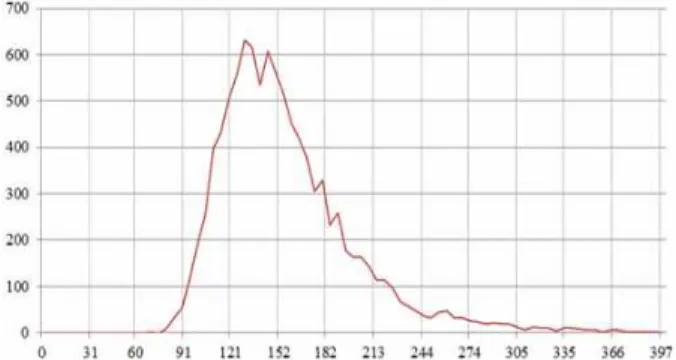
mal distribution[10]. From Monte Carlo simulation,
through multiple iterations. The probability den- sity function of a log-normal is as follows: