Journal of the Korean Society of Marine Environment & Safety Research Paper Vol. 23, No. 7, pp. 885-892, December 31, 2017, ISSN 1229-3431(Print) / ISSN 2287-3341(Online) https://doi.org/10.7837/kosomes.2017.23.7.885
11. 서 론
우리나라 남해안은 쿠로시오 해류(Kuroshio Current)의 지류 인 황해난류수(Yellow Sea Warm Current), 대마난류수(Tsushima
* First Author : [email protected], 051-629-6576 Corresponding Author : [email protected] 051-629-6574
동중국해를 거쳐 제주도 주변을 시계방향으로 흐르는 Current),
제주난류(Cheju Warm Current) 그리고 겨울철 냉각과 수직혼합 으로 형성되는 서해남부연안수(Yellow Sea Coastal Water)와 남 해연안수(South Korean Coastal Water) 등의 영향을 받는다(Na et al., 1990; Lie et al., 2000; Teague et al., 2003). 하계에는 양자 강하구 등의 담수 기원인 중국연안안수(Chinese Coastal Water)
춘계 남해 전선역에서 알칼리 인산분해 효소를 통한 제한 영양염의 평가
오석진 장민익 남기택 김석윤
부경대학교 해양학과
*, **
Limiting Nutrient Based on Alkaline Phosphatase Activity in the Frontal Area of the Southern Sea, Korea
Seok Jin Oh* Minik Jang** Ki Taek Nam** Seok-Yun Kim**
*, ** Department of Oceanography, Pukyong National University, 45 Yongso-ro, Nam-gu, Busan 48513, Korea
요 약 : 2017년 추계에 남해 전선역을 파악하고 알칼리 인산분해 효소, (Alkaline Phosphatase; APase) 활성을 이용하여 제한 영양염과 제한 영양염의 시간적인 변화를 평가하였다 전선역이 형성된 인근해역의 경우 용존무기인. , (dissolved inorganic phosphorus; DIP)의 농도와 용존무 기질소(dissolved inorganic nitrogen; DIN): DIP 비가 각각 0.2μM 이하와 최대 23.2 , DIP로 가 제한된 환경임에도 불구하고 Chlorophyll a(Chl.-a 가 ) 0.2μg/L로 높은 생물생산력을 보였다. APase와 DIP는 중요한 역의 상관관계(r =-0.81; P<0.001)를 보여, DIP가 제한되어진 해역임을 알 수 있 었으며, APase와 Chl-a 관계는 APase의 60 가 식물플랑크톤% , 40 가 박테리아 기원인 것으로 평가되었다 용존태 % . APase와 입자태 APase의 분포로부터 전선역은 장기간 DIP가 제한된 해역이며 그 외의 해역은 최근에 , DIP 제한이 해소된 것으로 판단되었다 따라서 전선역에서 . 와 같이 가수분해효소의 측정은 제한 영양염의 시공간적인 변화 특성을 평가할 수 있으며 전선역에서 생지화학 순환의 이해를 높일
APase ,
수 있을 것으로 생각된다.
핵심용어 : 알칼리 인산분해 효소 전선역 용존무기인, , (DIP), 용존무기질소(DIN), Chlorophyll a, DIN: DIP
Abstract : We estimated the limiting nutrient and DIP limiting history based on alkaline phosphatase (APase) activity during the spring of 2017 in the Southern Sea, Korea. In the frontal area, concentration of dissolved inorganic phosphorus (DIP), dissolved inorganic nitrogen (DIN): DIP ratio and Chlorophyll a (Chl-a) were < 0.2 M, 23.2 and 2.2μ μg/L, respectively, indicating high productivity despite DIP limiting. The relationship between APase and DIP indicates that the study area had limited DIP because of a strongly reverse correlation (r= -0.81; P<0.001). Relationship between APase and Chl-a (r=0.61, p<0.001) also indicated that APase may have been induced by phytoplankton (ca. 60 %) and bacteria (ca. 40 %). In DIP limiting history in this study area, frontal area and non-frontal areas might have induced long-term DIP limitation and the recent relief from DIP-limitation, respectively, based on distributions of dissolved APase and particulate APase. Thus, these results suggest that by measuring the enzyme that hydrolyzes organic matter such as APase in frontal area, it is possible to estimate temporal and spatial characteristics of limiting nutrient, thereby improving our understanding of biogeochemistry cycles.
Key Words : Alkaline phosphatase, Frontal area, Dissolved inorganic phosphorus (DIP), Dissolved inorganic nitrogen (DIN), Chlorophyll a, DIN: DIP
및 동해에서 기원되는 대한해협 저층냉수(Korea Strait Bottom 가 분포하게 되어 더욱 복잡한 물리적인 환경이 조성
Water) ,
된다(Teague et al., 2003; Lie and Cho, 2016 또한 바람 등의 ).
기상적인 요인에 따라 이들 수괴의 침강 및 확장이 되기 때 문에 남해전선역의 위치가 시공간적으로 달라진다, (Yang et al., 1998).
전선역은 서로 다른 특성을 가진 두 수괴가 수렴하는 해 역으로 일차생산 뿐만 아니라 상위영양단계의 생물량이 높 아 수산자원학적으로 중요한 해역이다, (Yanagi, 1987; Matsuda
남해 전선역의 경우도 난 자치어 등 유용해양생
et al., 1995). ·
물의 주요 서식장소로 알려져 있다(Kim, 1992; Choo and Kim, 남해 전선역에서 일차생산자와 이화 1998; Moon et al., 2010).
학적 변수의 상호관계에 관련한 대표 보고는 Kang and 이 영양염 식물플랑크톤 및 그 상위영양단계에 있 Jeon(1999) ,
는 동물플랑크톤의 관련성을 조사하였다. Yoon et al.(2007)과 은 수괴에 따라 식물플랑크톤이 종조성이 달 Baek et al.(2010)
라진다고 하였다 또한 . Jeong et al.(2013)은 남해안에서 계절 별로 달라지는 식물플랑크톤의 잠재적 제한 영양염(potential
은 질산염으로 파악하였으나 춘계와 하계의
limiting nutrient) ,
경우에는 인산염으로 보고하였다.
일차생산자는 리비히 최소율의 법칙(Liebig’s law of the 에 따라 생장이 율속이 된다 제한영양염의 파악은
minimum) .
해수의 질소 인 그리고 규소의 화학양론, (stoichiometry), 즉
“Redfield ratio”(N/P=16; Redfield, 1958)와 “Redfield-Brzezinski 에 따른 것으로 지금까지 영양 ratio”(Si/N=1; Brzezinski, 1985)
염에 따른 식물플랑크톤의 생장에 관한 연구에 중요한 인자 로 사용되어 왔다(Tilman et al., 1982; Hecky and Kilham, 1988).
호소학의 경우, DIP 농도가 5μg/L(약 0.16μM) 또는 300~500 g/L(21~35
μ μM)를 초과할 경우 비가 , 16 이상과 이하가 되어 도 제한 영양염으로 작용할 수 없다(Reynolds, 1984). 이는 제
한 영양염은 비율도 중요하지만 절대농도에 대한 식물플랑,
크톤 생장의 이해가 필요하다 하지만 모든 식물플랑크톤의 .
생장에 직접적인 관련이 있는 영양염 흡수속도(uptake rate), 세포내 영양염 함유량(cellular nutrient quoter)을 파악한다는
것은 불가능하기 때문에 식물플랑크톤 생리적인 지식을 기,
반으로 하는 제한 영양염 지시자(indicator)가 필요하다. 한편 해수 중에 용존 되어 있는 인은 용존무기인(dissolved
뿐만 아니라 용존유기인
inorganic phosphorus; DIP) (dissolved 이 있으며
organic phosphorus; DOP) (Cembella et al., 1984; Oh et al.,
빈영양상태의 해수일지라도 의 농도는
2005), DOP 0.1~0.3 Mμ
로DIP와 같이 고갈되지 않는다(Suzumura and Ingall, 2004). 여 러 연구에서 DIP의 제한상태에서 일차생산자의 DOP 이용을 보고하였으며(Nishijima et al., 1989; Dyhrman and Palenik, 1999;
Oh et al., 2002; Yamaguchi et al., 2004, 2005; Oh et al., 2010), 특히 DOP 중 인산모노에스테르(phosphomonoester)는 해수의 약 알칼리 환경에서 활성도가 높은 인산분해 효소(alkaline
에 따라 가수분해 되어 분해성 인
phosphatase; APase) , (labile-P)
의 형태로 생태계에서 중요한 역할을 담당한다(Cembella et 는 플랑크톤과 박테리아의 세 al., 1984; Oh et al., 2005). APase
포벽에 있는 입자성-APase(P-APase)와 해수에 용존 되어 있는 용존태-APase(D-APase)로 구별되며, DIP가 제한 정도에 따라
유도되기 때문에 DIP의 제한정도를 나타내는 지시자로 사용
된다(Kwon et al., 2011). P-APase과 D-APase의 비율은 해역의 제한 정도에 따라 그 비율이 달라지기 때문에
DIP (Kwon et
는 각각의 활성도를 측정함으로써 al., 2010), Li et al.(1998)
제한의 시간적인 변화를 추적할 수 있는 가능성을 제시 DIP
하였다.
따라서 본 연구는 2017년 추계에 수괴분석을 바탕으로 남
해 전선역을 파악하고 화학양론적 비가 아닌 식물플랑크톤,
의 효소활성(APase)을 기반으로 조사 해역의 제한 영양염이 무엇인지를 밝혔다 또한 제한영양염의 변화도 토의하였다. .
재료 및 방법 2.
본 연구는 2017년 월 일에 부경대학교 탐사선 나라호4 3 (G/T 1,494ton)를 이용하여 부산에서 제주도 까지 개 정점, 10 에서 수심별 관측을 수행하였다(Fig. 1). 전선역의 위치를 파 악하기 위해 CTD(SBE 911plus, Sea-Bird Electronics Inc.)를 이 용하여 수온 염분 그리고 용존산소를 조사하였으며 이 중 , ,
개 수층에서
7 (0, 10, 20, 30, 50, 75, 100m) Rossette sampler를 이용하여 해수를 채수하였다.
채수된 시료는 선상에서 즉시 유리섬유필터(ɸ 0.47 m, μ 를 이용하여 식물플랑크톤 세포가 파괴되지 GF/F, Whatman)
않는 30mmHg 이하의 낮은 압력으로 여과하였으며 분석시, 까지 급속냉동고(-20 )에 보관하였다. DIP 그리고 용존무기 질소(dissolved inorganic nitrogen; DIN=NH4-N+NO2-N+NO3-N)는 해양환경공정시험기준에 따라 분광광도계(spectrophotometer;
로 비색 정량하였다
DU 730, Beckman Coulter) · (MOF, 2013). DOP 는 용존총인(dissolved total phosphorus; DTP)에서 DIP를 공제 하여 평가하였으며, DTP는 산화제를 사용한 Koroleff(1983)의 방법으로 측정하였다. Chlorophyll a(Chl.-a 는 해수를 박막여) 과지(ɸ 0.45 m, Milliporeμ )에 여과한 후 아세톤 추출법에 따, 라 선상에서 모두 분석하였다(MOF, 2013).
활성은 짝수 정점에서 수심
APase 30 까지 분석하였다m .
분석방법은 해수시료에 disodium phenylphosphate, tris (hydroxymethyl) amino methane·HCl solution(pH 9)을 첨가하여
일정시간 배양 후, aminoantipyrine 및 ferricyanide를 첨가하여 발색시키고 disodium phenylphosphate의 가수분해로 축적된
농도를 분광광도계 로 비색정
phenol (DU 730, Beckman Coulter)
량 하였다(Yamaguchi et al., 2004). P-APase와 D-APase의 분리를 위해서 낮은 여압 하에서(< 30 mmHg 박막여과지) (ɸ 0.22 m; μ Millipore)를 이용하여 여과한 후 그 여액을 , D-APase로 간주 하였으며 총 , APase(T-APase)에서 D-APase를 공제하여 P-APase 로 가정하였다 모든 . APase 분석은 선상에서 시료 채수 즉시 수행하였다.
Fig. 1. Location of sampling stations in the Southern Sea, Korea.
결과 및 고찰 3.
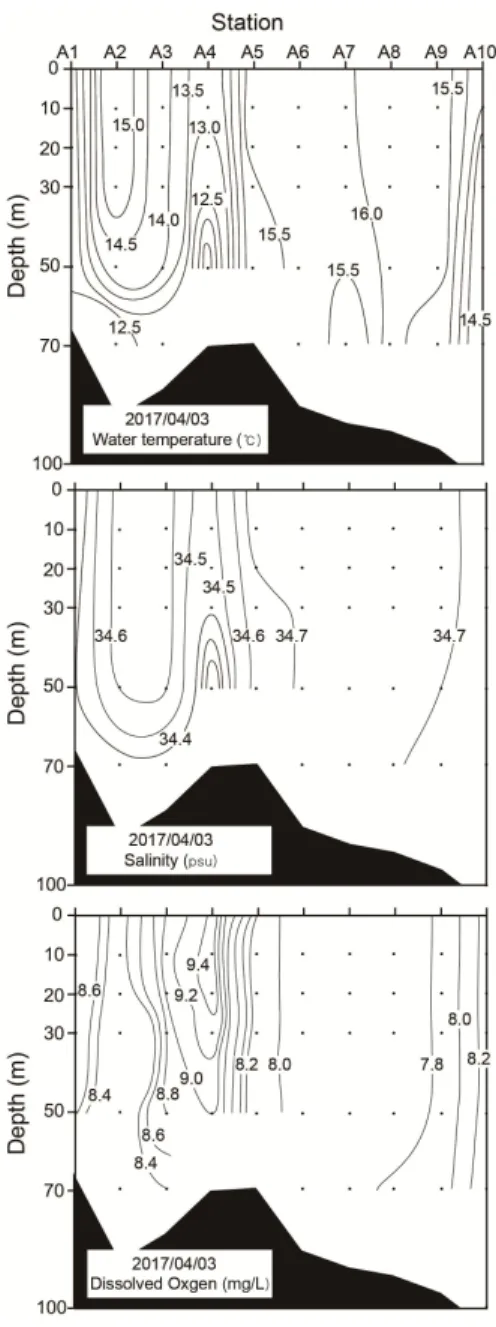
수온은 정점 A1과 A2에서 12.8 부터 15.4 까지 그리고 정점 A3과 A5에서 12.6 에서 15.7 까지 급격한 수온변화를 보였으며 나머지 정점에서는 큰 수온의 변화가 없었다 그, . 리고 정점 A4의 수심 20m 이심에서 11 의 낮은 수온역이 분포하였다(Fig. 2). 염분도 정점 A1과 A2에서 34.3psu에서 34.7psu, 정점 A3과 A5에서 34.6psu에서 34.7 psu로 염분변화가 보였으며 정점 , A4의 30m 이심에서 낮은 수온을 보였던 수 심에서 비교적 낮은 염분농도를 나타내었다(34.1 psu; Fig. 2).
용존산소도 유사하게 정점 A1과 A2(8.8mg/L에서 8.3 mg/L) 그리고 정점 A3과 A5에서(9.1mg/L에서 8.1mg/L) 뚜렷한 변 화가 보였으나 정점 , A4의 30m 이심의 낮은 수온과 염분으 로 특징지을 수 있는 수괴에 대해서는 뚜렷한 차이가 없었 다(Fig. 2). 따라서 본 조사해역의 전선역은 정점 A3과 A5 사
이에서 뚜렷하게 형성된 것을 알 수 있다.
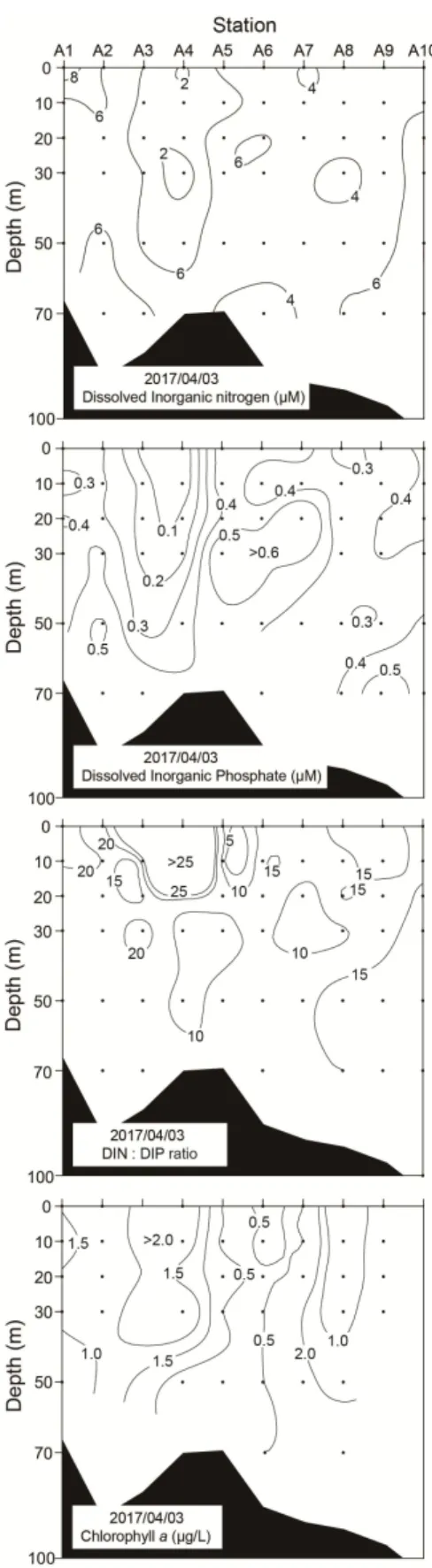
의 수직적 분포를 보면
DIN , 1.87~9.38μM의 범위로 정점
과 에서 최대농도를 보였지만
A1 A2 (9.38μM), 정점 A2과 A3
에서는 급격히 낮아지는 경향을 보였다 특히 정점 . A4의 표
층의 경우는 2μM 이하의 낮은 농도를 나타내었다(Fig. 3).
DIP는 0.15~0.67μM의 범위로, DIN과 유사한 분포경향이었으 며 특히 정점 , A3과 A4의 표층에서 0.2μM 이하로 낮은 농도 를 나타내었다(Fig. 3). DIN:DIP 비는 5.19~23.2이며 정점 에, 3 서 의 표층에서 5 Redfield 비(16)보다 높게 나타났고 최대 (
그 외의 정점에서는 비와 유사하거나 낮게 나
23.2), Redfield ,
타났다(Fig. 3). 하지만, Chl.-a는 정점 A1과 A2, 그리고 정점
에서 의 표층에서 높게 나타났으며 최대 농도는 정점
A3 A5 ,
과 사이에서
A3 A5 2.21μg/L로 나타나(Fig. 4), 기존의 보고인 전선역 주변해역에서 높은 생물생산이 보인다는 사실과 일 치하였다(Kim, 1992; Choo and Kim, 1998; Moon et al., 2010).
Fig. 2. Vertical distributions of temperature, salinity and dissolved oxygen in the surveyed stations.
Fig. 3. Vertical distributions of DIN, DIP, DIN: DIP ratio and Chlorophyll a in the surveyed stations.
Fig. 4. Vertical distributions of total alkaline phosphatase (T-APase), dissolved alkaline phosphatase (D-APase) and particulate alkaline phosphatase (P-APase) activity in the surveyed stations.
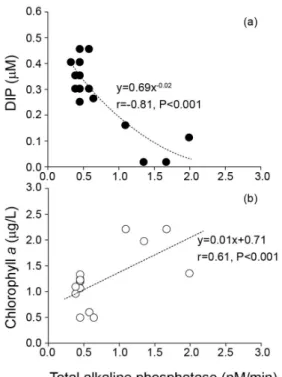
본 연구해역에서 T-APase는 0.11~2.04nM/min의 범위를 나 타내었으며 정점 , A4에서 측정된 모든 수심에서 높은 활성을 보였다(1.50±0.45nM/min; Fig. 4). 하지만 그 외의 정점에서는 유사한 활성을 나타내었다(0.11~0.48 nM/min; Fig. 4). Redfield 비(DIN:DIP)는 정점 A4의 표층에서 높은 비를 나타내어, DIP 가 제한인자로 나타났지만(Fig. 3), T-APase는 전 정점에서 검 출되어 DIP제한을 지시하였다 실제 . T-APase와 DIP와는 강한 역의 상관관계를 보여(r = -0.81, p >0.001; Fig. 5), 전선역과 그 주변해역은 DIP가 제한된 해역으로 고려할 수 있다. 본 연구 에서 유도된 T-APase는 사용된 기질 그리고 비색법 또는 형 광법 등의 분석방법이 다르기 때문에 타 해역과 비교는 힘 들지만 본 해역에서 사용한 기질, (phenylphosphate)과 같은 방 법으로 측정된 해역과 비교하면 일본의 , Uranouchi Inlet(1.20
~70.1nM/min; Yamaguchi et al., 2004)과 Tokuyama 만(0.00~142 보다는 낮은 활성을 보였으며
nM/min; Tanaka, 1984) , 우리나
라 대표적인 내만역인 가막만(0.51~5.21 nM/min; Kwon et al.,
의 활성보다도 낮았다 일본의 경우는 년부터 발효
2011) . 1979
된 Seto 내해 환경 보전 특별 조치법(Law Concerning Special Measures for Conservation of the Environment of the Seto Inland 발효로 인 정화기준 강화 및 인이 함유된 세제 제조 금 Sea)
지에 따라 해양으로 인 유입이 감소되어 춘 하계의 경우 · 농도가 검출한계 이하의 값을 보이는 등
DIP (Yamamoto et
우리나라 해역보다 가 크게 제한되어 있기 때
al., 2002), DIP
문에 높은 활성이 보인 것으로 생각된다.
Fig. 5. (a) Relationship between dissolved inorganic phosphorus (DIP) and total alkaline phosphatase (T-APase). The hyperbolic curve is calculated by power equation. (b) Relationship between chlorophyll a and T-APase.
D-APase는 0.04~0.93nM/min의 범위이며, T-APase와 같이 정점 A4에서 높은 활성이 보였으며(0.75±0.13nM/min), 나머 지 정점에서는 낮았지만, 0.30±0.10nM/min로 검출되었다(Fig.
그리고 는 정점 와 일부 정점의 수심에서만 활
4). P-APase A4
성이 측정되었다(0.50±0.50nM/min). T-APase중 D-APase의 비율 은 정점 A4에서 30~70 였으며 나머지 정점에서는 % , T-APase 의 대부분이 D-APase로 존재하였다 즉 전선역의 경우 식물. 플랑크톤 또는 박테리아의 세포내 활성 및 세포로부터 방 출된 APase가 검출되었음을 의미하지만 나머지 정점에서는 , 세포내에서 합성된 APase는 없었으며 세포로부터 방출된 , 만 존재한다는 것을 나타낸다 또한 전선역의 경우
APase .
DIP의 강한 제한을 시사한 것으로 이상의 16 DIN:DIP 비에 따른 DIP제한과 일치한 결과를 나타내었다 가막만의 경우. ,
중 활성의 비율이 하계와 동계에서
T-APase D-APase 8~15 %
로 대부분이 P-APase로 반대의 경향을 나타내었다(Kwon et
이는 내만역의 제한 정도가 본 해역보다 강하
al., 2010). DIP
다는 것을 의미한다 반면에서 홍해북부의 경우는 . 42~74 % 로 본 해역과 유사한 DIP 제한 정도를 가지는 것으로 생각 된다(Li et al., 1998).
해수 중에 유리된 D-APase와 식물플랑크톤에 표면에 위 치 한 P-APase를 측정함에 따라 현장해수 중의 DIP의 제한 정도를 가지 경우로 파악할 수 있다4 (Li et al., 1998).
와 가 낮거나 검출되지 않는다면 해역에서
D-APase P-APase
제한이 없거나 약한 상태이며 낮은 와 높은
DIP , D-APase
이면 최근에 가 제한된 해역이고 높은
P-APase DIP ,
와 의 경우 장기간 제한이 있는 해역으로
D-APase P-APase DIP
판단할 수 있다 마지막으로 . 높은 D-APase와 낮은 P-APase 의 경우 최근에 , DIP 제한이 해소된 것을 암시한다 이를 활. 용하여 본 해역을 검토한 결과 전선역의 경우 리비히 최소, , , 율의 법칙에 따라 일차생산자 또는 분해자의 생장에 인이 중
요한 제한인자이며 높은 생물생산력을 유지하기 위해 지속,
적으로 DIP를 소비하고 있지만, DIP만으로도 인원(phosphorus
이 불충하여 를 이용하고 있다는 것을 의미한다
sources) DOP .
그 외의 해역은 DIP 제한이 최근에 해소되어, DIP만으로 충
분히 생장이 가능하다는 것을 지시한다 이와 같이 세포내 .
용존태 유기물의 가수분해 관련 효소 활성도를 측정함으로
써 기존의 제한 영양염 평가의 공간적인 평가에서 시간적,
인 평가가 가능하게 되어 해역의 생지화학 순환의 근본적,
인 이해를 도울 수 있을 것으로 생각된다.
한편 APase의 기원을 밝히기 위해 T-APase 활성과 Chl.-a 의 상관관계를 분석한 결과(r = 0.61; p >0.001), 식물플랑크톤 과 박테리아 유래가 약 60 와 % 40% 정도로 차지하는 것으 로 나타났다(Fig. 5). 같은 빈영양상태의 해역에서도 박테리아 의 생물량이 식물플랑크톤을 초과하는 경우(Cho and Azam,
유사한 경우 식물플랑크톤의 절반
1990), (Yanada et al., 2003),
의 경우(Robarts et al., 1996) 등 차이를 보이기 때문에 APase 는 박테리아와 식물플랑크톤의 생물량의 차이에 따라 발생
하는 것으로 보인다 하지만 빈영양상태의 해역보다 영양염.
이 다소 높을 것으로 기대되는 해역 연안역 또는 전선역의 (
경우 은 ) APase의 대부분이 식물플랑크톤 기원인 것으로 보 고되었다(Nausch, 1998; Yamaguchi et al., 2004; Kwon et al.,
본 연구해역에서 식 2011; Huang et al., 2007; Samo et al., 2012).
물플랑크톤과 박테리아의 입자성유기탄소(particulate organic 에 대한 기여율에 대한 연구가 전무한 실정이기 carbon; POC)
때문에 APase의 인과관계를 언급하기에는 힘든 부분이 있지 만, APase의 활성과 Chl-a의 관계를 기초로 living POC는 식물 플랑크톤과 박테리아가 약 60 :40 비율로 차지할 것으로 생
각된다.
하지만 APase기원을 밝히기 위한 직접적인 연구는 현실 적으로 어려움이 있다. APase는 식물플랑크톤과 박테리아의
세포벽에 부착하여 있으며 외부적인 충격과 같은 낮은 스,
트레스에도 쉽게 탈착되는 성질을 가지고 있기 때문에 식물플랑크톤과 박테리아를 분리하기 위한 기 (Chrost 1991),
존의 size fraction을 통한 분리 분석은 용존태 APase의 증가를 가져오기 때문에 오차를 발생시킬 수 있다(Nausch, 1998). 따 라서 새로운 APase의 유래를 밝힐 수 있는 실험적 접근이 필 요할 것으로 보인다.
전선역과 주변해역의 DTP 중 DOP의 비율을 보면 전선역은 84 이며 주변해역은 % , 63 로 전선역에서 높은 % DOP 비율을 보였다 일반적으로 해양에서 . DOP을 구성하는 성분에 대한 명확한 답은 분석의 어려움 때문에 가지고 있지 않지만, DOP 는 1990년대 이후 십자류 여과방식(Tangential Flow Filtration) 로부터 해수 중의 용존유기물을 분자량으로 분리할 수 있는 방법이 개발되면서 약 1nm, 분자량 1,000 를 경계로 고분da 자량 DOP와 저분자량 DOP로 구별된다(Benner, 1991). 더욱이 최근에 고분자량 DOP를 한외여과필터(ultrafiltration)를 통하 여 무기염류로부터 분리 농축이 가능하게 되었으며 핵자기· , 공명법(Nuclear magnetic resonance spectroscopy)등과 같은 분석 기술의 발달에 따라 일부 분자 화학구조를 동정할 수 있게 되었다(Suzumura et al., 2015). 고분자량 DOP는 C-P결합에 따 라 phosphomonoester(PME)와 phosphodiester(PDE)로 나뉘고 난, 분해성 phosphonate가 일정부분을 차지하며, PME와 PDE는 각각 APase와 phosphodiesterase에 의해서 식물플랑크톤이 이 용할 수 있는 DIP로 가수분해 된다(Suzumura et al., 1998). 실 험실 실험에서 남해안에서 우점하는 식물플랑크톤의 고분
자량 DOP 이용성 실험에서 대부분의 식물플랑크톤이 이용
성이 높은 것을 확인하였다(Oh et al., 2010). 또한 Oh et al.
과 은 로 가수분해가 되어진 해
(2005) Kwon et al.(2011) APase
수 중 DOP를 가수분해인산염(Alkaline phosphatase-hydrolyzed 으로 정의하고 기존에 박테리아에 의해 분 phosphorus; APHP) ,
해가 되어 공급되는 DIP 뿐만 아니라 APHP도 생태계에서 중요한 인 공급원으로 설명하였다 특히 . APase 활성에 의해 가수분해 된 APHP를 APase 효소를 가지고 있지 않으며, DIP 반포화상수(half saturation constant; Ks)가 낮은 r-strategy 식물
플랑크톤이 흡수하여 우점하는 경우도 발생할 수 있다 그.
렇기 때문에 본 해역의 전선역과 주변해역의 DOP 중 APHP 와 같은 분해성 DOP의 분포 및 구성(PME와 PDE)의 이해는
왜 제한 상태에서 높은 생물생산력을 유지하는지 에
“ ? DIP ”
대한 질문에 좋은 해답이 될 것으로 기대된다.
사 사
이 논문은 부경대학교 자율창의학술연구비(2016 )년 에 의
하여 연구되었습니다 또한 본 연구를 진행하는데 있어 많.
은 도움을 주신 부경대학교 나라호 선장님과 선생님 여러분 께 감사드립니다.
References
[1] Baek, S. H., K. Shin, B. Hyun, P. -G. Jang, H. -S. Kim and O. -M. Hwang(2010), Distribution characteristics and community structure of phytoplankton in the different water masses during early summer of Southern Sea of Korea, Ocean and Polar Research. Vol. 32, No. 1, pp. 1-13.
[2] Benner, R.(1991), Ultra-filtration for the concentration of bacteria, viruses, and dissolved organic matter, In: Hurd D. C.
and D. W. Spencer (eds), Marine Particles: Analysis and Characterization, Geophysical Monograph Series, Vol. 63, pp.
181-186.
[3] Brzezinski, M. A.(1985), The Si:C:N ratio of marine diatoms:
interspecific variability and the effect of some environmental variables, J. Phycol., Vol. 21, pp. 347-357.
[4] Cembella, A. D., N. J. Antia and P. J. Harrison(1984). The utilization of inorganic and organic phosphorus compounds as nutrients by eukaryotic microalgae: a multidisciplinary perspective:
Part 1., CRC Critic. Rev. Microbiol., Vol. 10, pp. 317-391.
[5] Choo, H. -S. and D. -S. Kim(1998), Effect of Variations in the Tsushima Warm Currents on the Egg and Larval Transport of Anchovy in the Southern Sea of Korea, J.
Korean Fish. Soc., Vol. 31, pp. 226-244.
[6] Cho, B. C. and F. Azam(1990), Biogeochemical significance of bacterial biomass in the ocean’s euphotic zone, Mar. Ecol.
Prog. Ser., Vol. 63, pp. 253-259.
[7] Chorst, R. J.(1991), Environmental control of the synthesis and activity of aquatic microbial ectoenzymes, In: Chrost, R.
J. (ed), Microbial enzymes in aquatic environments, Springer- Verlag, New York, pp. 29-59.
[8] Dyhrman, S. T. and B. Palenik(1999), Phosphate stress in cultures and field populations of the dinoflagellate Prorocentrum
minimum detected by a single-cell alkaline phosphatase assay,
Appl. Environ. Microbiol., Vol. 65, pp. 3205 3212.[9] Hecky, R. E. and P. Kilham(1988), Nutrient limitation of phytoplankton in freshwater and marine environments: a
review of recent evidence on the effect of enrichment, Limnol. Oceanogr., Vol. 33, pp. 796-822.
[10] Huang, B., L. Ou, X. Wang, W. Huo, R. Li, H. Hong, M.
Zhu and Y. Qi(2007), Alkaline phosphatase activity of phytoplankton in East China Sea coastal waters with frequent harmful algal bloom occurrences, Aquat, Mcriob. Ecol., Vol.
49, pp. 195-206.
[11] Jeong, D. H., H. H. Shin, S. W. Jung and D. I. Lim(2013), Variations and characters of water quality during flood and dry seasons in the eastern coast of South Sea, Korea, Korean J. of Environ. Biol., Vol. 31, No. 1, pp.19-36.
[12] Kang, Y. S. and K. A. Jeon(1999), Biological and chemical characteristics and trophodynamics in the frontal zone in the southern waters of Korea, J. Korean Fish. Soc., Vol. 32, pp.
22-29.
[13] Kim, J. Y.(1992), The early life history and recruitment of anchovy, Engraulis japonica in the southern waters of Korea, Ph.D Thesis, NFUB, pp. 70-72.
[14] Koroleff, F.(1983), Determination of phosphorus, In:
Grasshoff, K., M. Ehrhardt and K. Kremling (eds), Methods of seawater analysis, Verlag Chemie, Weinheim, p. 172.
[15] Kwon, H. K., S. J. Oh and H. -S. Yang(2010), Distribution characteristics of alkaline phosphatase activity and phosphatase hydrolyzable phosphorus in northern Gamak Bay in autumn and winter, Kor. J. Fish. Aquat. Sci., Vol. 43, pp. 540-546.
[16] Kwon, H. K., S. J. Oh and H. -S. Yang(2011), Ecological significance of alkaline phosphatase activity and phosphatase- hydrolyzed phosphorus in the northern part of Gamak Bay, Korea, Mar. Pollution Bull., Vol. 62, pp. 2476-2482.
[17] Li, H., M. J. W. Veldhuis and A. F. Post(1998), Alkaline phosphatase activities among planktonic communities in the northern Red Sea, Mar. Ecol. Prog. Ser., Vol. 173, pp.
107-115.
[18] Lie, H. -J., C, -H. Cho, J. -H. Lee, S. Lee and Y.
Tang(2000), Seasonal variation of the Cheju warm current in the northern East China Sea, J of Oceanogr., Vol. 56, pp.
197-211.
[19] Lie, H. -J. and C. -H. Cho(2016), Seasonal circulation patterns of the Yellow and East China Seas derived from satellite-tracked drifter trajectories and hydrographic observations, Progress in Oceanography, Vol. 146, pp.
121-141.
[20] Matsuda, O., T. Yamamoto and T. Hashimoto(1995), Mechanisms of nutrient supply coastal fronts, Engankaiyoukenkyu, Vol. 33,
pp. 9-18.
[21] MOF(2013), Ministry of Ocenas and Fisheries, Standard methods for the examination of sea water, sediment and marine organism, Seoul, Korea, p. 516.
[22] Moon, S. Y., H. -J. Oh and H. Y. Soh(2010), Seasonal variation of zooplankton communities in the southern coastal waters of Korea, Ocean and Polar Research, Vol. 32, pp.
411-426.
[23] Na, J. -Y., S. -K Han and K. -D. Cho(1990), A study on sea water and ocean current in the sea adjacent to Korea Peninsula - Expansion of coastal waters and Its effect on temperature variations in the South Sea of Korea, J. of Korean Fish. Soc., Vol. 23, pp. 267-279.
[24] Nausch, M.(1998), Alkaline phosphatase activites and the relationship to inorganic phosphate in the Pomeranian Bight (southern Baltic Sea), Aquatic Microbial Ecology, Vol. 16, pp.
87-94.
[25] Nishijima, T., Y. Hata and S. Yamauchi(1989), Physiology ecology of Prorocentrum triestinum, Nippon Suisan Gakkaishi, Vol. 55, pp. 2009-2014.
[26] Oh, S. J., T. Yamamoto, Y. Kataoka, O. Matsuda, Y.
Matsuyama and Y. Kotani(2002), Utilization of dissolved organic phosphorus by the two toxic dinoflagellates, Alexandrium
tamarense and Gymnodinium catenatum (Dinophyceae), Fish.
Sci., Vol. 68, pp. 416-424.
[27] Oh, S. J., Y. H. Yoon, T. Yamamoto and Y. Matsuyama (2005), Alkaline phosphatase activity and phosphatase hydrolyzable phosphorus for phytoplankton in Hiroshima Bay, Japan, Ocean Sci. J., Vol. 40, pp. 183-190.
[28] Oh, S .J., H. K. Kwon and H. -S. Yang(2010), Alkaline phosphatase activity and utilization of dissolved organic phosphorus by phytoplankton isolated from Korea coastal water, The Sea, Vol. 15, pp. 16-24.
[29] Reynolds, C. S.(1984), The Ecology of Freshwater Phytoplankton, Cambridge University Press, Cambridge.
[30] Redfield, A. C.(1958), The biological control of chemical factors in the environment, Am. Sci., Vol. 46, pp. 205-221.
[31] Robarts, D. R., T. Zohary, M . J. Waiser and Y. Z. Yacobi (1996), Bacterial abundance, biomass, production in relation to phytoplankton biomass in the Levantine Basin of the southeastern Mediterranean Sea, Mar. Ecol. Prog. Ser., Vol.
137, pp. 273-281.
[32] Samo, T. J., B. E. Pedler, G. I. Ball, A. L. Pasulka, A. G.
Taylor, L. I. Aluwihare, F. Azam, R. Goericke and M. R.
Landry(2012), Microbial distribution and activity across a water mass frontal zone in the California current ecosystem, Journal of Plankton Research, Vol. 34, No. 9, pp. 802-814.
[33] Suzumura, M., K. Ishikawa and H. Ogawa(1998), Characterization of dissolved organic phosphorus in coastal seawater using ultrafiltration and phosphohydrolytic enzymes, Limnol. oeanogr., Vol. 43, pp. 1553-1564.
[34] Suzumura, M. and E. D. Ingall(2004), Distribution and dynamics of various forms of phosphorus in seawater: insights from field observations in the Pacific Ocean and laboratory experiment, Dee-Sea Research Part I, Oceanographic Research Papers, Vol .51, pp. 1113-1130.
[35] Suzumura, M., A. Tsukasaki, F. Hashima, M. Sato and Y.
Umezawa(2015) Analytical perspectives of biogeochemical phosphorus cycle in oligotrophic marine environments, AIRIES, pp. 77-88.
[36] Tanaka, K.(1984), Measurement method of alkaline phosphatase activity in seawater, Annual report of Yamaguchi Prefectural Environmental Pollution Research Center, Vol. 9, pp. 134-139.
[37] Teague, W. J., G. A. Jacobs, D. S. Ko, T. Y. Tang, K. -I.
Chang and M, -S. Suk(2003), Connectivity of the Taiwan, Cheju, Korea straits, Continental Shelf Research, Vol. 23, pp.
63-77.
[38] Tilman, D., S. S. Kilham and P. Kilham(1982), Phytoplankton community ecology: the role of limiting nutrients, Annu. Rev.
Ecol. Syst., Vol. 13, pp. 349-372.
[39] Yamaguchi, H., T. Nishijima, H. Nishitani, K. Fukami and M.
Adachi(2004), Organic phosphorus utilization and alkaline phosphatase production of 3 red tide phytoplankton, Nippon Suisan Gakkaishi, Vol. 70, pp. 123-130.
[40] Yamaguchi, H., H. Sakou, K. Fukami, M. Adachi, M.
Yamaguchi and N. Nishijima(2005), Utilization of organic phosphorus and production of alkaline phosphatase by the phytoplankton, Hepterocapsa circularisquama, Fibrocapsa
japonica and Chaetoceros ceratosporum, Plankton Biol. Ecol.,
Vol. 52, pp. 65-75.[41] Yamamoto, T, T. Hashimoto, K. Tsuji, O. Matuda and K.
Tarutani(2002), Spatial and temporal variations of biophilic elements in Hiroshima Bay, Japan, during 1991-2000, with special reference to the deviation of phytoplanktonic C:N:P ratio from the Redfield ratio, Bull. Coast. Oceanogr., Vol. 39, pp. 163-169.
[42] Yanada, M., H. Tanaka and H. Morshita(2003), Biogeochemical significance of adenosine triphosphate measurements for
estimating the carbon biomass of bacteria in the central and eastern North Pacific Ocean during Summer, Bull. Soc. Sea Water Sci. Jpn., Vol. 57, pp. 387-396.
[43] Yanagi, T.(1987), Classification of “siome”, streaks and fronts, J. Oceanogr. Soc. Japan, Vol. 43, pp. 149-158.
[44] Yang, J. Y., S. H. Kim and H. K. Rho(1998), A study on the temperature fronts observed in the South-West sea of Korea and the northern area of the East China Sea, J. Korean Fish Soc., Vol. 31, pp. 695-706.
[45] Yoon, Y. H., J. S. Park, Y. G. Park and I. H. Noh(2007), Marine environment and the distribution of phytoplankton community in the southwestern sea of Korea in summer 2005, Journal of the Korean Society for Marine Environmental Engineering, Vol. 10, No. 3, pp. 155-166.
Received : 2017. 11. 22.
Revised : 2017. 12. 15. (1st) : 2017. 12. 22. (2nd) Accepted : 2017. 12. 28.