INTRODUCTION
In recent decades, the abundance of fishery resources has begun to decline, due to over fishing and marine pollution. In addition, climate change has led to the introduction of foreign fish species, consequently altering the structure of marine ecosystems. The common octopus is one of the most important fishery resources among Cephalopod, along with squid and other octopus species in South Korea. The annual catch for O.
minor in 1993 was estimated to be approximately 14,000t. However, due to a sharp decrease in fishery resources, the common octopus was designated as a target organism for fishery resource enhancement from 2005 onward by Ministry of
Ocean and Fisheries, Korea. The recent catches are evidence of the declining trend, with a 17%
decrease within 3 years, from 6,954t in 2010 to 5,799t in 2012 (MIFFA, 2012). There are multiple methods for catching common octopus, with net traps and long-lines being the most common.
Common octopus net traps are cylindrical in shape, with 3 entrances on the side. The total number of the net traps used by each fishing vessel is now set to 2,500 pots by the law of South Korea. Common octopus pots are usually immersed for a period of 7 to 14 days. Since many fisheries are concentrated in the major fishing grounds, minor incidents may occur among fisheries to secure areas causing the loss of pots.
Size selectivity of the net pot for common octopus Octopus minor used in the southern coastal sea of Korea
Seonghun K
IM, Seongwook P
ARKand Kyounghoon L
EE*
Fisheries Engineering Division, National Fisheries Research & Development Institute, Busan 619-705, Korea
This paper presents the mesh selectivity of a net pot for common octopus Octopus minor for the sustainable resources management of common octopus. The filed experiments were carried out the total 10 times in the southern part of coastal sea in Korea from March to May in 2010 using net pots of five different mesh sizes (16, 18, 20, 22 and 26mm). The test of size selectivity, indicated a 50% selection value on the logistic master curve of 3.195, whereby 50% of individuals with a mantle size of approximately 70.3mm selected a mesh size of 22mm. Considering that 50% of common octopus entering sexual maturity have a mantle size of 70.6mm, the optimum mesh size should be equal to, or larger than 22mm.
Keywords: Selectivity, Common Octopus, Octopus minor, Pot, Mesh size, SELECT
*Corresponding author: [email protected], Tel: 82-51-720-2583, Fax: 82-51-720-2586 J. Kor. Soc. Fish. Tech., 49 (3), 200-207, 2013
http://dx.doi.org/10.3796/KSFT.2012.49.3.200
Recently, fishermen have been request the revision of the mesh size regulation to government from 22mm to more small size because the production of common octopus is decreased.
There are only a limited number of studies focused on common octopus net pots in South Korea. For example, Kim et al. (2007) investigated the fishing power of octopus pots, while Park et al.
(2006) conducted studies on the entering mechanism of common octopus and associated fishing power of pots. Furthermore, Ahn et al.
(2007) calculated the fishing power index.
The objective of this study was to estimate optimal mesh size of the net pot for common octopus. The experiments of the mesh size selectivity were conducted with five different mesh sizes in the south coastal sea of Korea to determine the optimal mesh size of the net pot for common octopus.
MATERIALS AND METHODS
Experimental fishing gearThe diameter of the experimental cylindrical net pot was 40cm and the height was 12cm. The pot was then shaped with an iron frame of 8.6mm in diameter, and covered with netting made from PE Td210 12ply (Fig. 1).
There were 3 entrances of 18cm in width and 10cm in depth, to replicate that of commercial octopus pots. The entrance was made from PA (Nylon) Td210 9ply, and the ends of each entrance were connected to maintain the shape of the entrance.
In this study, for the experiment of mesh size selectivity by common octopus, the experimental pots were made with 5 different mesh sizes;
specifically, 16mm, 18mm, 20mm, 22mm (commercial pot mesh size), and 26mm. The hanging ratio of the net was 70%.
Experimental fishing operation
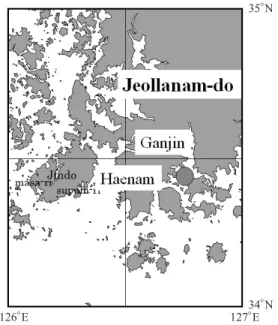
A sea trial was performed in the coastal sea of Gang-jin, Jeollanam-do, and the survey area is shown in Fig. 2.
A coastal fishing vessel for pots, weighing 0.93 tons and made of FRP (fiberglass reinforced plastics), was used as the survey vessel. The tests of mesh size selectivity were conducted from April
Fig. 1. Common octopus net pot used in the southwest sea of Korea.
Fig. 2. Location of the study site for experimental hauls in Gangjin, Korea.
127。E 126。E
35。N
34。N
to June of 2010, which is the major fishing period.
The sea trial was performed 10 times during this period.
The net pots of five mesh sizes included the commercial net pot were arranged at intervals of 9?10m. Twenty net pots of each type were setup, creating 100 net pots per line. Eight lines of pots of this particular array were constructed, thus generating a total of 500 net pots for the experiment. The arrangement of net pots is shown in Fig. 3.
The bait for common octopus pots was the Japanese ghost crab (Macrophthalmus japonicus).
Ten to fifteen Japanese ghost crabs were put in each pot, and the soaking period was 7 to 10 days.
Data analysis
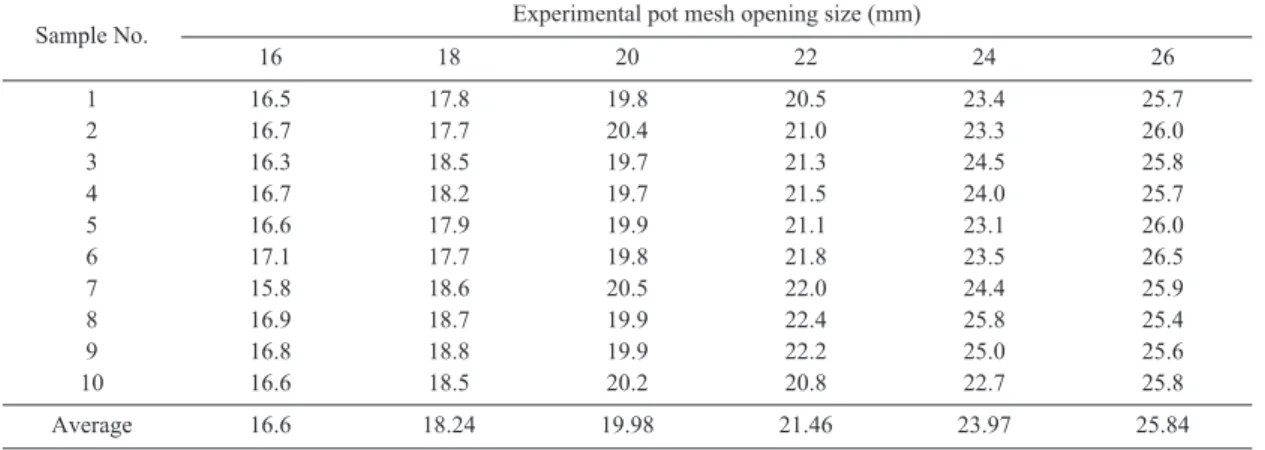
Fish caught from the experimental fishing gear was distinguished for each experimental pot and separated by species. The total number of each fish species was counted, and the mantle length was measured to an accuracy of 0.1mm by vernier calipers, while weight was measured to an accuracy of 0.01g with an electronic scale (SW-1WS, CAS Korea). In addition, the mesh size of the pot used for the experiment was measured to an accuracy of 0.1mm, and is shown in Table 1.
Selectivity analysis
The selectivity curve and relative fishing efficiency were estimated with the SELECT model by Millar (1992) and Millar and Walsh (1992) and the master curve method by Tokai and Kitahara (1998). The SELECT method is often used for selectivity experiments comparing catches from two or more gear types.
For mantle length l common octopus caught in both gear types, the proportion of common octopus caught in the experimental gear is given as:
Fig. 3. Composition and arrangement of the experimental pots for Octopus minor.
Table 1. Average mesh opening size (inner size) of each experimental pot
Sample No. Experimental pot mesh opening size (mm)
16 18 20 22 24 26
1 2 3 4 5 6 7 8 9 10
16.5 16.7 16.3 16.7 16.6 17.1 15.8 16.9 16.8 16.6
17.8 17.7 18.5 18.2 17.9 17.7 18.6 18.7 18.8 18.5
19.8 20.4 19.7 19.7 19.9 19.8 20.5 19.9 19.9 20.2
20.5 21.0 21.3 21.5 21.1 21.8 22.0 22.4 22.2 20.8
23.4 23.3 24.5 24.0 23.1 23.5 24.4 25.8 25.0 22.7
25.7 26.0 25.8 25.7 26.0 26.5 25.9 25.4 25.6 25.8
Average 16.6 18.24 19.98 21.46 23.97 25.84
(a) Composition of the experimental pots
(b) Arrangement of the several pots
16mm 18mm 20mm 24mm 26mm … 16mm 18mm 20mm 24mm 26mm
nLl
f
1〓 ________ (1)
nsl
+ n
LlWhere f
1is the proportion of common octopus caught in the experimental gear, and n
sland n
Llare the numbers of mantle size l common octopus caught in the control and the experimental gear, respectively.
The catch data was fitted using the SELECT model; the most commonly used logistic function on carapace length l:
exp (a + bl)
r (l)
〓 ______________ 0<r (l)<1 (3) 1 + exp (a + bl)
Where a and b are parameters to be estimated.
These two parameters characterize the selectivity curve. The fish size of 50% retention (l
50), and the selection range, SR (〓l
75-l
25), was described with
-a/b and (2ln 3/b), respectively.
The selectivity curve parameters (a and b) and the split parameter p are estimated by maximizing the log-likelihood function of Equation 4 on the assumption that the observed proportions are binomially distributed (Hiramatsu, 1992; Jeong et al., 2000). Maximization was implemented using the add-in software SOLVER in MS-Excel (Fujimori and Tokai, 2001) where:
In L 〓 ∑
l
{C
lln f (l) + (N
l-C
l) ln (1 -f (l))}(4) Where N
lis the total number of mantle length l individuals caught in pots, and C
lis the number of mantle length l individuals caught in pot of large mesh size out of N
l.
The appropriateness of the model was evaluated with Akaike’s information criterion (AIC; Akaike, 1974). The AIC value of each model was calculated using Equation 5.
AIC
〓-2ln L
max+ 2k (5)
Where ln L
maxis the maximum log-likelihood obtained from Equation 4, and k is the number of model parameters.
Generally, for mesh size selectivity, selectivity is estimated as a function of the standardized mantle length and mesh size inner diameter. The master curve was estimated using the SELECT model and the master curve method (Jeong et al., 2000;
Fujimori and Tokai, 2001).
exp (1 + b (l
i/ m
j))
r (l, mj
)〓 ___________________ (6) 1 + exp (1 + b (l
i/ m
j))
Where l
iis the mantle length of the i-th individual and m
jis mesh size of the j-th individual.
RESULTS
Catch compositionTo determine net selectivity based on differences in mesh size to identify the optimal mesh size, the comparative net test and sea trials were performed.
The mantle lengths of common octopus caught by the pot of each mesh size are shown in Table 2.
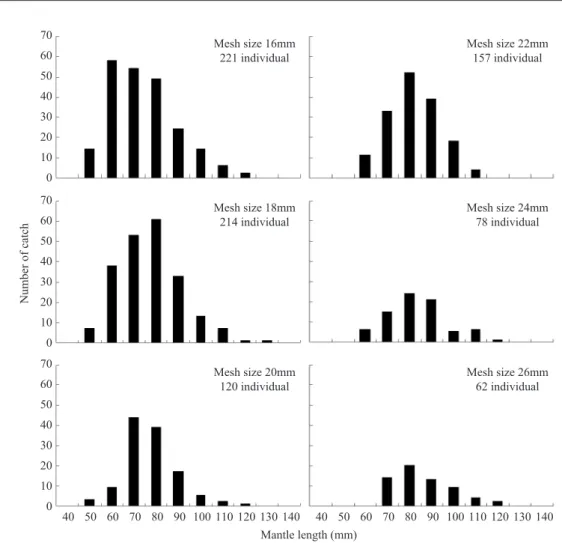
Table 2 indicates that as the mesh size increased, the total catch decreased, while the size of individuals tended to increase. The amount of existing bait declined as mesh increased. The smallest pot (mesh size: 16mm) among the experimental fishing gears had the largest catch of 221 individuals (29,200g). The catch rate of the 16mm mesh was about double that of the current fisheries regulation mesh size in Korea (22mm mesh: 120 individuals at 20,168g). The mantle size distribution of caught common octopus per experimental pot is shown in Fig. 4.
As the mesh size declined, more small fish were
caught. Overall, there were many individuals with a
mantle size of 70 to 80mm in the 16mm-mesh sized
pot compared to other pots. Moreover, individuals
Table 2. Number of catches for the common octopus in accordance with the mantle length of each experimental pot
Fig. 4. Catch distributions of common octopus caught in the experimental pots for analyzing selectivity.
Mantle length (mm)
Mesh size (mm) Sum
(individual)
16 18 20 22 24 26
40 50 60 70 80 90 100 110 120 130 140 150
0 14 58 54 49 24 14 6 2 0 0 0
0 7 38 53 61 33 13 7 1 1 0 0
0 4 12 57 51 22 7 3 1 0 0 0
0 0 8 25 39 30 14 3 1 0 0 0
0 0 6 15 24 21 5 6 1 0 0 0
0 0 0 14 20 13 9 4 2 0 0 0
0 25 122 218 244 143 62 29 8 1 0 0 Sum1
(individual) 221 214 157 120 78 62 852
Sum2
(weight, g) 29,200 30,973 22,567 20,168 13,499 11,639 128,046
70 60 50 40 30 20 10 0 70 60 50 40 30 20 10 0 70 60 50 40 30 20 10
0 40 50 60 70 80 90 100 110 120 130 140 40 50 60 70 80 90 100 110 120 130 140 Mantle length (mm)
Mesh size 16mm 221 individual
Mesh size 22mm 157 individual
Mesh size 18mm 214 individual
Mesh size 24mm 78 individual
Mesh size 20mm 120 individual
Mesh size 26mm 62 individual
Number of catch
with mantles of 80mm were mainly caught in the regulation 22mm-mesh sized pot. Therefore, as mesh size decreased below 22mm, the rate of catching smaller fish increased.
Estimation of the selectivity curve
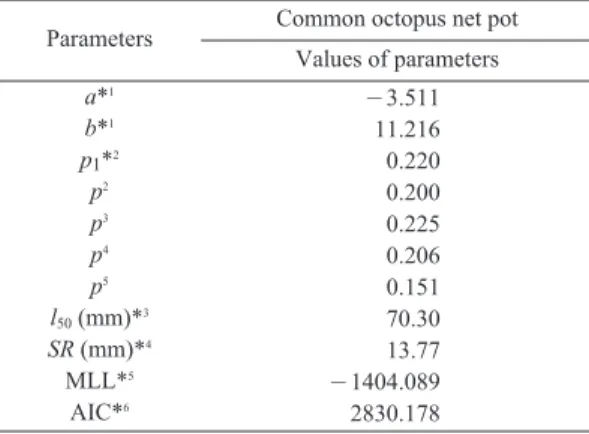
Table 3 shows parameter estimates, the mantle length for 50% retention, and selection range (SR), for each mesh size in the two models. Selectivity curves obtained from logistic parameters of each mesh size in Table 3 are shown in Fig. 5. The were increased with mesh size (Table 4) and the
selectivity curves of larger mesh sizes are shifted to the right, like the mesh selectivity of trawl cod-end (Fig. 5). The results suggest that pot size selectivity is dependent in mesh size.
Using the catch data in relation to the mantle length of common octopus, the master selectivity curve was estimated and presented in Fig. 6.
The 50% selection value on the master curve was 3.195, and the mantle size of 50% of selected individuals was approximately 70.3mm for the 22mm-mesh size. The selection range (SR) was 13.77mm. In the fisheries law of South Korea, the minimum landing size of octopus is regulated to 300g, but common octopus has no such regulation.
Considering the mantle size of 50% of individuals entering sexual maturity is 70.6mm (Kim DS and Kim JM, 2006), the optimum mesh size should be equal to, or larger than, 22mm.
Table 3. The estimated parameters of the SELECT model for the common octopus pot
*1Parameters from the logistic equation r (l)〓exp (a + bl) / [1 + exp (a + bl)], whereis the retention probability and is the mantle length/mesh size.
*2p1∼p5is the relative fishing intensity.
*3Mantle length of 50% retention probability on legal mesh size (22 mm).
*4Selection range defined as l75(mantle length of 75%
retention)-l25(mantle length of 25% retention).
*5Maximum log-likelihood.
*6Akaike’s Information Criterion.
Table 4. 50% selection of mantle length and weight in each experimental trap by the master selectivity curve
Parameters Common octopus net pot Values of parameters a*1
b*1 p1*2
p2 p3 p4 p5 l50(mm)*3 SR (mm)*4 MLL*5
AIC*6
-3.511 11.216 0.220 0.200 0.225 0.206 0.151 70.30 13.77
-1404.089 2830.178
Mesh size (mm)
50% selection mantle length and weight Mantle length (mm) Weight (g) 16
18 20 22 24 26
51.5 57.5 63.9 70.3 76.7 81.0
63 86 102 130 158 190
Fig. 5. Selectivity curve of each experimental net pot by SELECT model.
Fig. 6. Mesh size selectivity master curve of the pot for the common octopus by using the SELECT model.
1.0 0.8 0.6 0.4 0.2
0.00 20 40 60 80 100 120 140
0 1 2 3 4 5 6 7 8
Mantle length (mm)
Mantle length / Mesh size
Retention probabilityRetention probability
1.0 0.8 0.6 0.4 0.2 0.0
DISCUSSION
The common octopus mainly feeds on crustaceans and inhabits the bottom material of the seabed, which is composed of mud-sand and mud.
The common octopus has a developed visual organ (Cohre, 1973), an olfactory organ, a tactile organ (Well, 1963), and a strong habit of hiding (Chang and Kim, 2003). The common octopus is a voracious organism, with a developed tentacle.
Based on these characteristics, small live crabs are used to attract and catch the common octopus.
According to a study by Park et al. (2006), when the common octopus enters the trap, it uses the long tentacle to sense the smell and motion of prey.
Recently, fishermen involved in trap fishery for common octopus have requested a change in the regulation of the mesh size, since the size of the Japanese ghost crab is variable, resulting in their escape through gaps in the mesh. This in turn leads to lower catch rates of octopus, some of which also escape through the gaps. To determine the optimum mesh size, a mesh size selectivity test was performed. We found that as mesh size increased, the amount of existing bait decreased, resulting in more bait being required, which in turn would increase fishing expenses. When using the 22mm mesh size designated by current Korean fisheries law, the mantle length of 50% of the common octopus found in the pot was 70.3mm, with a weight of 130g. Considering that 50% of individuals with a mantle length of 70.6mm are classified as entering sexual maturity, this indicates that the minimum biologically viable size should be 22mm.
The immersion time for common octopus pots is generally longer than for target species in other fishing industries. The pots are thrown immediately after hauling in the net, resulting in their being a
type of set net. Due to the poor catch rate of common octopus, the number of pots on each vessel is steadily increasing, resulting in excessive fishing effort. According to a recent survey, about 12,000 pots per vessel are being used (Ahn et al., 2007).
Moreover, stacked fishing grounds and poor weather conditions during periods of long trap immersion increase the chance of losing pots.
Therefore, by protecting the marine environmental pollution against the loss of pots and by estimating the amount of optimum fishing effort, fisheries for the common octopus must continue to manage the fishing capacity by reducing the overuse of fishing gear (Kim et al., 2007).
CONCLUSION
This paper presents the mesh selectivity of a net pot for common octopus Octopus minor for the sustainable resources management of common octopus. To determine the optimum mesh size, the field tests of size selectivity were carried out the total 10 times in the southern part of coastal sea in Korea using net pots of five different mesh sizes (16, 18, 20, 22 and 26mm). The test of size selectivity, indicated a 50% selection value on the logistic master curve of 3.195, whereby 50% of individuals with a mantle size of approximately 70.3mm selected a mesh size of 22mm.
Considering that 50% of common octopus entering sexual maturity have a mantle length of 70.6mm, the optimum mesh size should be equal to, or larger than 22mm. Therefore, the resource of common octopus were capable of management by adjusting the mesh size.
ACKNOWLEDGMENT
This study was funded by the National Fisheries
Research and Development Institute (Grant No.
RP-2013-FE-029).
REFERENCES
Ahn HC, Lee KH, Park SW, Park CD and Shin JK. 2007.
Assessment of fishing power of common octopus (Octopus minor) trap fishery. J Kor Soc Fish Tech 43, 176-182.
Akaike H. 1974. A new look at the statistical model identification. IEEE Trans. Autom Contr AC-19, 716-723.
Chang DJ and Kim DA. 2003. Characteristics by the behavior and habits of the common octopus (Octopus minor). J Kor Fish Soc 36, 735-742.
Cohre AL. 1973. An ultrastructural analysis of the photo receptors of the squid and their synaptic connections, photoreceptive and non-synaptic regions of the retina. J Comp Neur 147, 351-378.
Fujimori Y and Tokai T. 2001. Estimation of gillnet selectivity curve by maximum likelihood method.
Fish Sci 67, 644-654.
Hiramatsu K. 1992. A statistical study of fish population dynamics using maximum likelihood method ? parameter estimation and model selection. Bull Natl Inst Far Seas Fish 29, 57-114.
Jeong EC, Park CD, Park SW, Lee JH and Toaki T. 2000.
Size selectivity of trap for male red queen crab Chionoecetes japonicus with the extended SELECT model. Fish Sci 66, 494-501.
Kim DH, An HC, Lee KH and Hwang JW. 2007. Fishing capacity assessment of the octopus coastal trap fishery using data envelopment analysis (DEA). J Kor Soc Fish Tech 43, 339-346.
Kim DS and Kim JM. 2006. Sexual maturity and growth characteristics of Octopus minor. J Kor Soc Fish Tech 39, 410-418.
MIFFA. 2012. Food, Agriculture, Forestry and Fisheries statistical yearbook. MIFFA, 298-335.
Millar RB. 1992. Estimating the size-selectivity of fishing gear by conditioning on the total catch. J Am Stat Assoc 87, 962-968.
Millar RB and Walsh SJ. 1992. Analysis of trawl selectivity studies with an application to trouser trawls. Fish Res 13, 205-220.
Park SW, Kim HY and Cho SK. 2006. Entering behavior and fishing efficiency of common octopus, Octopus minor to cylindric trap. J Kor Soc Fish Tech 42, 11
-18.
Tokai T and Kitahara T. 1998. Methods of determining the mesh selectivity curve of trawl net. Nippon Suisan Gakkaishi 64, 597-600.
Well MJ. 1963. The orientation of octopus. Ergeb Biol 26, 40-54.