ORIGINAL ARTICLE
윤리적 소비 가치관이 환경친화적 태도와 행동의도(재활용, 재사용, 감량화)에 미치는 영향
송현정 이수형* 문선정
경북대학교 경영학부
The Impact of Ethical Values on Eco-friendly Attitudes and Behavioral Intentions (Recycling, Reusing, Reducing)
Hyun-Jung Song, Soo-Hyung Lee*, Sun-Jung Moon
Dept. of Business Administration, Kyungpook National University, Daegu 41556, Korea
Abstract
It is important to understand consumer attitudes associated with their eco-friendly behavior on account of not only environmental reasons, but also corporate aspects. In this study, we examine the relations between variables influencing eco-friendly attitudes and eco-friendly behavioral intentions, namely, recycling, reusing, and reducing (3R). We first, performed a theoretical consideration through reviews of literature on ethical identity, ethical obligation, altruism, and eco-friendly attitudes, and behavioral intentions. Based on the literature review, we designed a study model and drew hypotheses. Further, we collected data using a survey and processed them statistically in order to verify the hypotheses. A total of 265 samples were collected and the data were analyzed using a structural equation model (-LISREL 8.70). The results suggest that ethical identity and altruism significantly influence environmental attitudes. However, the effects of ethical obligations on eco-friendly attitudes are insignificant. The environmental attitudes have a significant effects on the consumer behavioral intention for recycling, reusing, and reducing. Although this study has some limitations, it is expected that it will positively trigger follow-up research.
Key words : Ethical obligation, Ethical identity, Altruism, Environmental attitude, Recycling, Reusing, Reducing
1)
1. 서 론현대사회는 공산품, 농산품 등의 대량생산, 대량유 통과 대량소비로 인간의 생활이 훨씬 편리해졌다. 그 러나 이에 따른 부작용으로 환경오염과 지구온난화
등 지구환경의 급격한 변화로 인해 인류의 생존자체 가 위협받고 있다. 이러한 환경문제는 지난 수십 년 간 중요한 이슈로 떠오르고 있다(Milfont et al., 2006).
한편, 마케팅 분야에서도 지금까지의 즉각적인 소비자 만족과 기업의 이익만을 중요시하는 기존의
Received 8 August, 2016; Revised 13 October, 2016;
Accepted 16 October, 2016
*
Corresponding author : Soo-Hyung Lee, Department of Business Administration, Kyungpook National University, Daegu 41556, Korea
Phone: +82-53-950-5434 E-mail: [email protected]
ⓒ The Korean Environmental Sciences Society. All rights reserved.
This is an Open-Access article distributed under the terms of the Creative Commons Attribution Non-Commercial License (http://
creativecommons.org/licenses/by-nc/3.0) which permits unrestricted non-commercial use, distribution, and reproduction in any medium, provided the original work is properly cited.
본 논문은 2015년도 경북대학교의 석사 학위논문을 수정·보완한 것입니다.
Characteristic Frequency Percentage
Gender Male 124 46.8%
Female 141 52.8%
Age
20s 136 51.3%
30s 84 31.7%
40s 29 10.9%
50s 13 4.9%
60s 3 1.1%
Marriage Married 65 24.5%
Single 200 75.5%
Table 1. Respondent's demographic information
전통적인 마케팅 사고에서 사회 전체의 복지를 함께 고려하는 장기적 관점의 마케팅 사고로 변화하고 있 다(Belz and Peattie, 2009). 마케팅 사고의 변화로 인 해 소비자 연구에서는 친환경 소비나 윤리적 소비에 대한 관심이 증대되고 있다. 이러한 흐름을 반영하여 국외연구에서는 대부분 가치관과 친환경 태도, 친환 경 행동과의 연관성을 연구하였다. Follows and Jobber (2000)는 가치관이 개인적·환경적 결과에 대한 지각을 통해 친환경 제품의 구매의도에 미치는 영향 을 살펴보았으며, Shaw et al.(2000)은 윤리적 소비행 동과 윤리적 의무 및 자아정체성 간의 관계를 연구하 였다. Michaelidou and Hassan(2008)은 윤리적 정체 성이 소비자의 태도와 행동에 미치는 영향을 분석하 였다. 국내 연구에서는 Moon et al.(2010)이 개인의 가치관과 친환경 구매의도와의 관계를 연구하였으며, Huh and Kim(2012)은 윤리적 소비와 관련된 요인을 분석하였다. Yang et al.(2014)은 이기주의와 이타주 의 가치관이 친환경 제품에 대한 태도를 통해 친환경 제품 구매의도에 미치는 영향을 살펴보았다.
그러나 지금까지의 연구는 이러한 새로운 흐름을 반영하여 개인의 가치관과 친환경 구매행동에 대한 연구가 어느 정도 활발히 이루어져 왔으나, 친환경 행 동에 중요한 영향요인인 윤리적 가치관과 친환경 행 동과의 관계에 관한 연구는 여전히 매우 제한적으로 이루지고 있다. 특히 친환경 행동의도에 관한 연구들 은 주로 친환경 제품 구매의도(Schwepker and Cornwell, 1991; Follow and Jobber, 2000; Moon et al., 2010) 혹은 재활용 행동의 단일 차원에 한하여 연
구되어 왔다(McCarty and Shrum, 1994; Oh and Yoon, 2014).
본 연구에서는 이러한 기존 선행연구들의 한계점 을 보완하기 위해 소비자의 윤리적 소비 가치관을 윤 리적 의무, 윤리적 정체성, 이타주의 세 가지 차원으로 분류하고, 소비자의 환경 친화적 행동을 세 가지 차 원, 즉, 재활용(recycling), 재사용(reuse), 감량화 (reducing)라는 3R로 나누어, 윤리적 소비 가치관이 환경 친화적 태도를 매개로 환경 친화적 행동(3R)에 각각 어떠한 영향을 미치는지 살펴보고자 한다.
2. 재료 및 방법
2.1. 연구 대상자
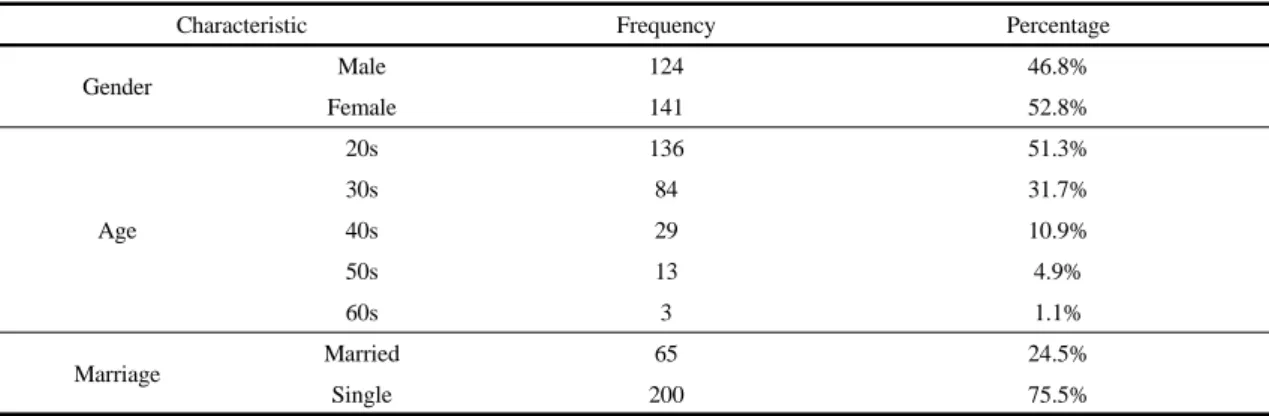
본 연구는 윤리적 소비 경험이 있거나 구매를 고려 해 본 적이 있는 만 20세 이상 성인을 연구대상으로 설문조사를 실시하였다. 조사는 2015년 3월 9일 ~ 3 월 29일까지 20일 동안 실시하였고, 총 300부의 설문 지를 배포한 후 265부를 회수하였다. 응답자의 인구 통계적 특성은 Table 1과 같다.
2.2. 조사 및 분석
설문지(부록 1)는 먼저 응답자의 이해를 돕기 위해 윤리적 소비란 무엇인가에 대해 설명을 하였으며, 윤 리적 소비 가치관(윤리적 의무, 윤리적 정체성, 이타 주의), 환경 친화적 태도, 환경 친화적 행동의도(재활 용 의도, 재사용 의도, 감량화 의도) 및 소비자의 인 구통계학적 특성을 측정하는 문항들로 구성되었다.
인구통계학적 문항을 제외한 문항들은 해당 항목에 대한 동의 정도를 나타내는 5점 리커트 척도(1: 전혀 그렇지 않다 5: 매우 그렇다)를 사용하여 측정하였 다. 모든 측정 항목은 선행 연구들로부터 신뢰성과 타 당성이 확보된 문항들을 바탕으로 본 연구에 맞게 수 정 및 보완하여 사용하였으며, 윤리적 소비 가치관은 친환경 제품 중 특히 사용자 개인에게 직접 영향을 주 면서도 일상생활에서 친숙하게 접할 수 있는 식료품 에 대해 설문하였다.
윤리적 의무를 측정하기 위한 척도는 Spark and Shepherd(1992)와 Oh and Yoon(2014)의 연구에서 사용된 3문항, 윤리적 정체성은 Spark and Shepherd (1992)와 Mun(2013)의 연구에서 사용된 4문항을 사 용하였으며, 이타주의를 측정하기 위한 척도는 Oh and Yoon(2014)과 Mun(2013)의 연구에서 사용된 5 문항을 사용하였다. 환경 친화적 태도를 측정하기 위 한 척도는 Nameghi and Shadi(2013)의 연구에서 사 용된 5문항을 사용하였으며, 재활용 의도, 재사용 의 도, 감량화 의도를 측정하기 위한 척도는 Nameghi and Shadi(2013)의 연구에서 사용된 9개의 문항을 사 용하였다.
본 연구에서는 SPSS 20.0을 이용하여 빈도분석과 측정 항목의 신뢰성을 검증하였고, LISREL 8.70을 이용하여 수렴 타당성 및 판별타당성, 구조방정식 모 형을 분석하였다.
3. 결과 및 고찰
3.1. 윤리적 소비 가치관
윤리적 소비란 소비자 개인의 윤리적 신념을 토대 로 자신뿐만 아니라 사회전체의 건강을 생각하는 것 이다(Shin, 2012). 이러한 윤리적 소비는 기존의 소비 를 반성하고 새로운 소비의 필요성을 깨닫는 데에서 시작되었다(Park and Kim, 2012). 그리하여 오늘날 소비자는 제품을 선택할 때, 품질과 가격을 중시하는 이성적 소비자에서 윤리적 가치를 중시하는 윤리적 소비자로 점점 바뀌고 있다(Oh and Yoon, 2014).
본 연구에서 윤리적 소비 가치관은 윤리적 소비를 중요시 하는 신념이나 가치로서, 이러한 윤리적 소비 가치관을 윤리적 의무, 윤리적 정체성, 이타주의 세 가
지 구성요소로 나누어 분석하였다.
3.1.1. 윤리적 의무
윤리적 의무는 옳고 그른 것에 대한 개인적 신념을 반영하는 윤리적 규칙을 주관화, 내면화 한 것이다 (Shaw et al., 2000). 이는 소비자가 지각하는 윤리적 책임감이며, 사회구성원으로서 공익에 일조해야하는 것이다(Huh, 2011). Shaw et al.(2005)은 윤리적 의무 가 소비자의 복잡한 의사결정의 유의성을 향상시키고 욕구에 대한 이해를 증가시킬 수 있다고 보았다. 윤리 적 의무는 태도에 어떠한 관련성을 가지게 되는데, 예 컨대 옳은 행동을 하면 더 나은 사람이 된 것처럼 느끼 는 것을 통해 알 수 있다(Dean et al., 2008).
3.1.2. 윤리적 정체성
윤리적 정체성이란 윤리적 이슈들이 소비자의 자 기정체성에 얼마나 중요한가에 대한 관심으로 정의 할 수 있다(Shaw, 2006). Shaw and Shiu(2002; 2003) 는 계획된 행동이론에 윤리적 의무와 윤리적 정체성 을 추가하여 수정된 계획행동이론을 만들어 실증적 분석을 하였으며, 연구결과 윤리적 구매의사결정과정 에서 윤리적 의무와 윤리적 정체성이 주관적 규범이 나 지각된 행동통제보다 상대적으로 중요한 변수로 나타났다.
3.1.3. 이타주의
이타주의는 자신과 가족의 복지에만 관심을 갖는 것이 아니라 미래세대와 다른 나라에 살고 있는 사람 들의 복지에도 관심을 가지는 것을 의미한다(Loureiro and Lotade, 2004). 윤리적 소비와 관련한 이타주의는 자신의 개인적 이익보다는 타인이나 제 3세계 노동자 나 사회적 약자의 복지에 관심을 가지는 것을 의미한 다(Huh and Kim, 2012). 이는 타인의 선을 이루는데 그 목적을 두고 , 자신보다는 타인을 먼저 생각하는 사 상이다(Nam, 2005).
3.2. 환경 친화적 태도
환경 친화적 태도는 환경보호를 위해 지속적으로 가지고 있는 신념과 감정, 또는 긍정적이거나 부정적 인 심리적 성향으로 정의된다(Park et al., 2012).
You(2014)는 환경 친화적 태도를 환경보호의 중요성 에 대한 인식 정도와 환경 친화적 소비에 따른 편익 및
비용이 사회전체의 복지에 기여하는 정도로 보았다.
환경 친화적 태도와 관련된 Homer and Kahle (1988)의 연구에서는 소비가치, 천연식품에 대한 태 도, 구매행동 간의 관계를 실증적으로 연구하였으며, Thøgerson and Öander(2002)는 지속가능한 소비지향 행위와 환경 친화적 정책에 대한 태도 간의 관계를 연 구하였다.
3.3. 환경 친화적 행동의도
환경 친화적 행동의도는 환경에 유익한 방향으로 행동하려는 의도를 말한다(Park et al., 2012). 이러한 환경 친화적 행동의도는 환경 친화적 행동과 강력한 관계가 있거나 최소한 중간 정도의 관계가 있다(Suh, 2012).
본 연구에서는 Nameghi and Shadi(2013)의 연구를 바탕으로 환경 친화적 행동 의도를 재활용(recycling) 의도, 재사용(reusing) 의도, 감량화(reducing) 의도 세 차원으로 나누어 분석하였다.
3.3.1. 재활용 의도
재활용이란 에너지를 보다 효율적으로 사용하기 위한 노력의 한 부분으로 쓰레기를 새로운 물질로 전 환시키는 것을 말한다(Dahlstrom, 2011). 즉 중고 상 품이나 중고자재를 자원으로 전환시키거나, 다시 제 조 혹은 회복시키려는 모든 노력을 말하는 것으로 자 원소비, 오염, 폐기물생성 등을 줄이려는 여러 전략들 을 포함한다(Cone and Hayes, 1980).
3.3.2. 재사용 의도
재사용은 새로운 제품을 생산하는 데에 필요한 비용 을 방지하기 위해 사용된 제품을 다시 사용하는 것을 말한다(Dahlstrom, 2011). 이러한 재사용은 물건을 구 입할 당시의 의도를 유지한 채, 그 물건을 다양하게 또 는 추가적으로 사용하는 것으로, 예컨대, 병을 회수해 서 다시 사용하거나 각 가정에서 사용하지 않는 의류, 가구 등을 교환시장이나 지역 재활용 센터를 통해 서 로 교환해서 사용하는 것이 포함된다(Park, 2006). 이 와 같이 재사용은 형태를 변화시키지 않은 상태에서 반복적으로 사용할 수 있는 모든 방법들을 포함한다.
3.3.3. 감량화 의도
감량화는 원·부자재의 사용량을 줄이거나 사용 후
발생하는 오염물질 자체를 줄이는 것을 말한다. 쓰레 기를 감량화는 단순히 처분 행동만의 문제가 아니라 통합적 자원관리의 일환으로 접근하여 제품의 구매 및 사용 행동에 대한 의사결정과정에서부터 쓰레기 폐기물을 줄일 수 있는 모든 소비 행동을 포함해야 한 다(Hong, 2009).
3.4. 변수 간의 관계
3.4.1. 윤리적 소비 가치관과 환경 친화적 태도와의 관계
윤리적 소비 가치관에 대한 선행연구에서는 윤리 적 의무, 윤리적 정체성, 이타주의 등의 소비 가치관이 소비자의 태도에 중요한 영향을 미치는 요인으로 보 았다. 예를 들면, Michaelidou and Christodoulides (2011)는 윤리적 의무와 제품에 대한 태도 간에 매우 유의적인 관련성이 있음을 확인하였다. 또한 수정된 합리적 행위이론을 적용한 Huh(2011) 및 Oh and Yoon(2014)의 연구에서도 윤리적 의무가 윤리적 상 품에 대한 태도에 긍정적인 영향을 주는 것으로 나타 났다. 그리고 Michaelidou and Hassan(2008)은 윤리 적 정체성이 유기농 식품에 대한 태도에 영향을 미치 는 것을 밝혔으며, You(2014)는 윤리적 정체성이 윤 리적 경영 기업에 대한 태도에 긍정적인 영향을 미 치는 것을 확인하였다. 또한 Noh(2011)의 연구에서 도 윤리적 정체성이 공정무역 커피에 대한 태도에 긍정적인 영향을 미치는 것으로 나타났다. 다음으로 Thøgerson and Grunert-Beckmann(1997)의 연구에서 이타주의가 소비자의 태도 및 행동에 긍정적인 영향 을 주는 것으로 마타났다. Huh(2011)는 이타주의가 윤리적 상품에 대한 태도와 구매의도 모두에 긍정적 인 영향을 미치는 것을 밝혀냈으며, Kong(2011)은 이 타주의가 환경 친화적 제품의 태도에 긍정적 영향을 미치는 것을 확인하였다.
3.4.2. 환경 친화적 태도와 환경 친화적 행동 의도와의 관계
환경 친화적 태도는 환경 친화적 행동 의도 및 행동 에 결정적인 영향을 미치는 것으로 보고 있다(Chu and Chiu, 2003; Kim, 2004; Nameghi and Shadi, 2013). Chu and Chiu(2003)는 환경 친화적 태도가 환경 친화적 행동의도에 영향을 미치는 것을 확인했으며,
Scales
Internal consistency
reliability Convergent validity
Cronbach's alpha Standardized loading
Standard error (Theta-delta)
Reliability coefficient AVE
Ethical consumption
behavior characteristic
Ethical obligation
OBL1
0.911
0.81 0.32
0.948 0.898
OBL2 0.79 0.38
OBL3 0.74 0.44
Ethical identity
IDN1
0.892
0.89 0.46
0.908 0.900
IDN2 0.88 0.20
IDN3 0.80 0.35
Altruism
ALT1
0.866
0.79 0.37
0.877 0.864
ALT2 0.75 0.44
ALT3 0.80 0.36
ALT5 0.81 0.34
Environmental attitude
ATT1
0.873
0.82 0.31
0.926 0.823
ATT4 0.85 0.27
ATT5 0.83 0.31
Environmentally behavioral
intention
Intention to recycle
REC1
0.919
0.82 0.31
0.944 0.787
REC2 0.93 0.27
REC3 0.92 0.32
Intention to reuse
REU1
0.903
0.87 0.23
REU2 0.89 0.19
REU3 0.84 0.28
Intention to reduce
RED1
0.932
0.89 0.19
RED2 0.94 0.10
RED3 0.89 0.20
Table 2. Confirmatory factor analysis
Nameghi and Shadi(2013)는 태도가 재사용 행동에 상당한 영향을 미치는 것을 확인하였다. Kim(2004)은 폐기물 감량 행동에 영향을 미치는 다양한 변수들의 관계를 정립하고 이들 변수들 간에 인과관계를 실증 분석하기 위해 통합적으로 모형을 정립하였다. 연구 결과, 폐기물 감량 태도는 폐기물 감량 행동의도를 매 개로 폐기물 감량 행동에 영향을 미치는 것을 확인하 였다.
본 연구에서는 이러한 이론적 고찰을 기반으로 다 음과 같은 가설을 설정하여 실증적 분석을 하였다.
가설 1. 윤리적 소비 가치관은 환경 친화적 태도에 긍정적인 영향을 미칠 것이다.
가설 1-1. 윤리적 의무는 환경 친화적 태도에 긍정
적인 영향을 미칠 것이다.
가설 1-2. 윤리적 정체성은 환경 친화적 태도에 긍 정적인 영향을 미칠 것이다.
가설 1-3. 이타주의는 환경 친화적 태도에 긍정적 인 영향을 미칠 것이다.
가설 2. 환경 친화적 태도는 환경 친화적 행동의도 에 긍정적인 영향을 미칠 것이다.
가설 2-1. 환경 친화적 태도는 재활용 의도에 긍정 적인 영향을 미칠 것이다.
가설 2-2. 환경 친화적 태도는 재사용 의도에 긍정 적인 영향을 미칠 것이다.
가설 2-3. 환경 친화적 태도는 감량화 의도에 긍정 적인 영향을 미칠 것이다.
Ethical
obligation Ethical identity Altruism Environmental attitude
Intention to recycle
Intention to reuse
Intention to reduce Ethical
obligation 0.898
Ethical identity 0.767
(.633) 0.900
Altruism 0.541 (.292)
0.695
(.483) 0.864 Environmental
attitude
0.522 (.272)
0.592 (.350)
0.566
(.320) 0.823 Intention to
recycle
0.469 (.219)
0.460 (.211)
0.591 (.349)
0.502
(.252) 0.787 Intention to
reuse
0.454 (.206)
0.522 (.272)
0.577 (.332)
0.522 (.272)
0.723
(.522) 0.841 Intention to
reduce
0.478 (.228)
0.649 (.421)
0.559 (.312)
0.523 (.273)
0.698 (.487)
0.780
(.608) 0.830 Note: The diagonal numbers are AVE and the numbers in the brackets are the square of correlation coefficient
Table 3. Discriminant validity test
3.5. 변수들의 확인요인 분석 및 판별타당성
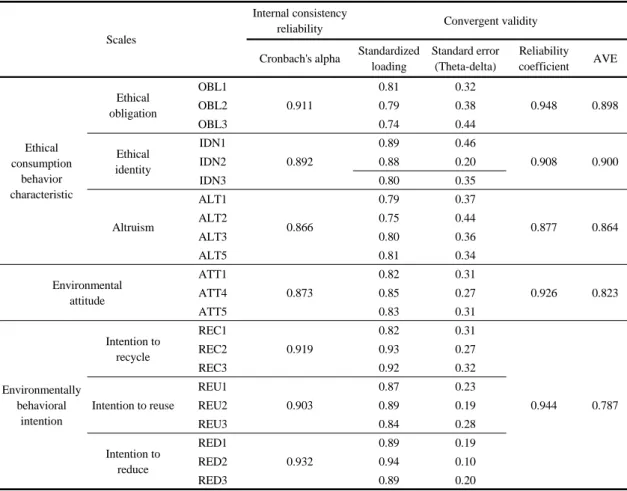
측정 변수에 대한 각 요인별 신뢰성에 대한 검증 결 과, 크론바 알파 값은 기준 값 0.6보다 모두 높은 값으 로 내적 일관성 적정수준을 만족하였다. 항목 대 개념 평균값 상관계수도 기준 값인 0.6을 상회하는 것으로 나타났다. 또한 요인적재치의 값은 기준 값인 0.5이상, 신뢰성 계수의 값이 기준 값인 0.6이상, 그리고 분산 추출 값은 기준 값인 0.5이상으로 나타나 구성개념의 수렴타당성을 확인하였다. 구체적인 측정 항목의 신 뢰성 및 타당성에 관한 확인 요인 분석 결과는 Table 2 와 같다.
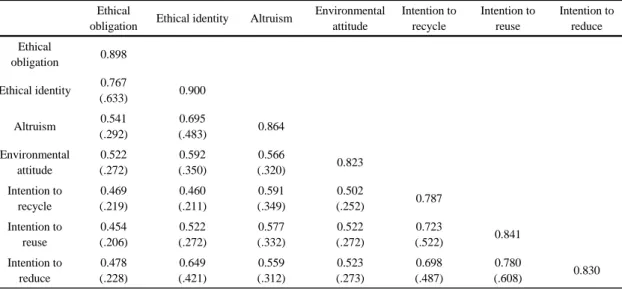
전체 모델의 전반적 적합도 검증 결과 X2는 733.84 (df=305), p값은 0.00으로 나타났다. GFI는 0.84로 권 장수준을 상회하는 것으로 나타났고, AGFI 역시 0.81 으로 권장수준을 상회하는 것으로 나타났다. RMR은 0.048으로 권장수준인 0.05 이하로 나타났다. NFI는 0.90, NNFI는 0.99, CFI는 0.93, IFI는 0.93, PGFI는 0.68로 권장수준에 부합하는 것으로 나타났다. 개념 간의 판별 타당성을 분석한 결과는 Table 3과 같다. 각 구성 개념 간에 판별 타당성이 있음을 확인하였다.
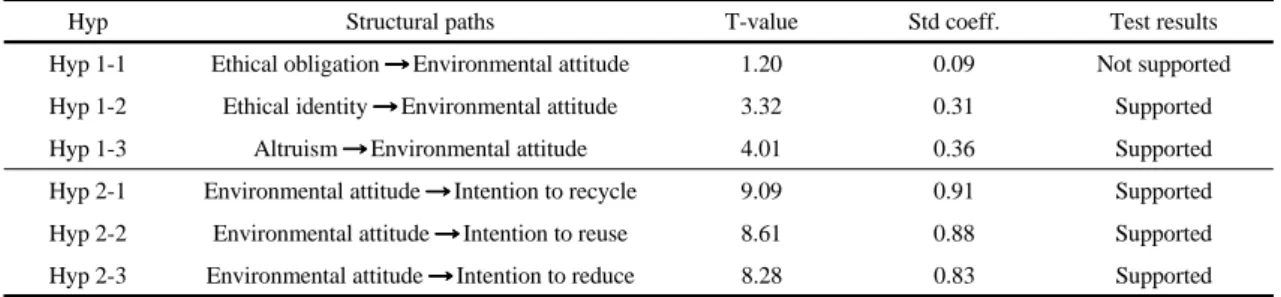
연구결과는 Table 4와 같다. 가설 1 윤리적 의무와 환경 친화적 태도와의 관계를 제외하고 윤리적 정체 성과 이타주의는 환경 친화적 태도에 긍정적인 영향
을 미치는 것으로 나타났다. 또한 환경 친화적 태도는 재활용 의도, 재사용 의도, 감량화 의도에 모두 긍정적 인 영향을 미치는 것으로 나타났다.
먼저 윤리적 의무는 환경 친화적 태도에 유의한 영 향을 미치지 않는 것으로 나타나 기존 연구와 상반된 결과를 보였다. 이는 환경 친화적 태도를 가지는데 있 어 윤리적 의무나 책임감이 큰 영향을 미치지 않는다 는 것을 의미하는 것으로, 윤리적 의무는 옳고 그름에 대한 소비자 개인의 신념으로 어떤 행동을 반드시 해 야 된다는 규범과는 다른 것으로 보고 있기 때문인 것 으로 보인다. 윤리적 정체성과 이타주의는 환경 친화 적 태도에 유의한 영향을 미치는 것으로 나타나 기존 선행연구와 일치하는 결과를 보였다. 즉, 윤리적 소비 에 대해 확고한 신념을 가진 소비자나 개인적 이익보 다 미래세대와 타인을 먼저 생각하는 소비자일수록 환경 친화적 태도를 가지는 것으로 보인다.
환경 친화적 태도는 재활용, 재사용, 폐기물 감량 행동 의도에 긍정적인 영향을 미치는 것으로 나타났다.
환경 친화적 태도를 가질수록 환경 친화적 행동을 할 의향이 높아진다는 것을 보여주고 있다. 특히 환경 친 화적 태도는 감량화 의도에 가장 큰 영향을 미쳤으며 그 다음 재사용, 재활용 순으로 영향을 미치는 것으로 나타났다. 이는 재활용이 3R 행동에서 가장 핵심적인
Hyp Structural paths T-value Std coeff. Test results Hyp 1-1 Ethical obligation Environmental attitude 1.20 0.09 Not supported Hyp 1-2 Ethical identity Environmental attitude 3.32 0.31 Supported
Hyp 1-3 Altruism Environmental attitude 4.01 0.36 Supported
Hyp 2-1 Environmental attitude Intention to recycle 9.09 0.91 Supported Hyp 2-2 Environmental attitude Intention to reuse 8.61 0.88 Supported Hyp 2-3 Environmental attitude Intention to reduce 8.28 0.83 Supported Note: t=1.96 is significant at 0.025
Table 4. Structural model test
요소이지만, 소비자들은 쉽게 실천할 수 있는 것을 먼 저 생각하는 것으로 보인다. 즉 가정에서 수돗물, 전기 사용량을 줄이거나 사용하고 있는 제품을 버리지 않 고 다시 사용하는 것으로 친환경 실천행동을 하려고 하는 것으로 생각된다.
한편, 본 연구 결과가 주는 시사점을 보면, 윤리적 정체성과 이타주의가 환경 친화적 태도를 형성하여 궁극적으로 환경 친화적 행동으로 이어주는 중요한 역할을 한다는 사실을 보여주고 있다. 이러한 것은 윤 리적 측면을 강조한 환경 친화적 프로그램의 개발 및 그러한 프로그램을 활용하는 환경 교육의 필요성을 시사하고 있다 하겠다.
REFERENCES