Effects of Gamdutang on Protection Against Accumulation of Cadmium in Rats
In-Sook Lee · Young-Chae Cho *
†Department of Public Health, Graduate School of Chungnam National University
*Department of Preventive Medicine and Public Health, College of Medicine, Chungnam National University, and Research Institute for Medical Sciences
(Received September 17, 2008/Revised September 30, 2008/Accepted October 13, 2008)
ABSTRACT
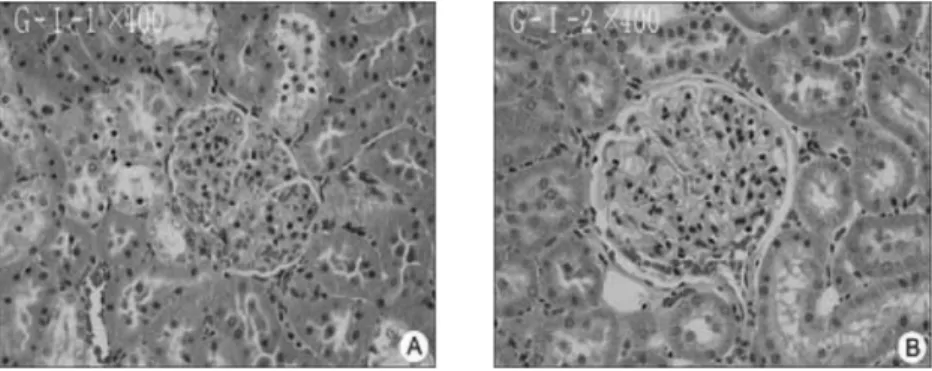
These experiments were conducted to determine the effects of Gamdutang on the accumulation of cadmium in the body of groups of rats that received an 8-week administration of 1.7, 3.4 and 6.8 μg/g/day of cadmium, respectively, while the other groups of rats received an 8-week administration of a mixture of cadmium by concentration and Gamdutang. A comparative analysis of these groups was conducted in respect of weight, accumulated cadmium in blood and diverse organs and pathological findings from the kidneys. As for the cadmium accumulation in blood, livers, kidneys, and testis, with the lengthening of the experiment period, the cadmium and Gamdutang mixture- administered groups tended to have reduced accumulation levels compared with the groups exclusively administered cadmium. Histopathological observation of the kidneys, observed in the cadmium exclusively administered groups showed hemorrhagic necrosis in glomeruli, swelling of tubules, epithelial shedding and necrosis of tubules;
however, only mild tissue lesions were observed in the cadmium and Gamdutang mixture-administered groups.
Given the above results, Gamdutang is deemed to have the effects of reducing the accumulation of cadmium in blood, liver, and testis when low-concentration cadmium is administered to rats.
Keywords: Cadmium, Accumulation, Blood, Liver, Kidney, Testis, Rat
I. Introduction
Of pollutants created as a result of humans' industrial activities and every day lives, heavy metal substances, if humans are exposed to them in a long time, will accumulate in the body, inflicting adverse impacts on it.
Cadmium toxication in the body varies accor- ding to exposure amounts, chemical forms, exposure periods, and bodily absorption pathways;
1,2)cadmium toxication is generally known to cause disorders in the kidney, impairment to liver tissues, disorders in the central nerve, osteoporosis, osteomalacia, and hypertension, among other diseases.
3-5)Also, it was reported that cadmium hampers the activation of
diverse metalloenzymes in the body, impairs ery- throcyte and thus retards its growth, and causes congenital malformation.
6,7)Cadmium is absorbed into the body mostly through the respiratory organs and the gastroin- testinal tract, and except for its absorption into the respiratory system due to occupational exposure, cadmium is generally absorbed into the gastroin- testinal system through foods
8). 50~85% of cadmium absorbed into the body is known to be accumulated in the kidney and the liver,
9-11)and it exists mostly in the form of metallothionein.
12)According to existing research into the protective effects against cadmium absorbed into the body, there are several reports that necrosis in testis caused by cadmium is protected against by zinc,
13,14)as well as a report that selenium also powerfully protects against the damage to the testis.
15)However, there has been little research into the effects of bio-substances with little side
†
Corresponding author : Department of Preventive Medi- cine and public Health, College of Medicine, Chungnam National University
Tel: 82-42-580-8265, Fax: 82-42-583-7561
E-mail: [email protected]
effects of restraining cadmium toxicity.
16)Thus, this research aims to study the effects of Gamdutang on cadmium accumulation in the body; Gamdutang, made from extracts of licorice and black adzuki beans, has been drunk as a herb medicine for detoxication for a long period of time, thereby proving its stability. Previous research into Gam- dutang includes a study on Gamdutang's effects of reducing lead toxication in rats,
17)a study on carbon tetrachloride's effects of easing liver toxication
18)and a study on Gamdutang having the effect of restraining the growth of cancerous cells in the in vitro cell toxication experiment,
19)however, no research has been conducted to study Gamdu- tang's effects of reducing cadmium accumulation in the body.
Thus, in an effort to determine the effects of Gamdutang administered into the body on the absorption and accumulation of cadmium in the body, this research conducted an array of experiments using rats, and significant results thereof are hereby reported.
II. Materials and Methods 1. Experimental animals
Five-week-old Sprague-Dawley male rats (Samtaco Bio-Korea Co, Korea), as bought, were made to undergo a week of adjustment and being raised in the laboratory. Afterwards, of them, 140 rats whose weight was 205.0 g±2.8, and that were clinically acceptable, were used as experimental animals.
The animal raising environment provided a temperature of 24±2
oC, a relative humidity of 55±
5%, and artificial lighting with a 12-hour light/12- hour dark cycle.
2. Formulation of cadmium solution and Gam- dutang
Powdered cadmium with a fineness of 99.5%
(Cd; Sigma-Aldrich. Inc., USA) was melted, and was used as a cadmium solution (MOE, 2004).
8,000 mL Gamdutang was formulated by putting 3,000 g Seomoktae (a kind of black bean) and 3,000 g licorice into unwoven cloth, pouring 30 L water into it, and boiling it for four hours in a jar at 121
oC under 1.5 pressure.
20)It was the absence of cadmium or other heavy metals in the formulated
Gamdutang.
3. Deployment of experimental animals and administering of cadmium and Gamdutang
Experimental animals were divided into seven groups, each of which consisted of 20 animals.
After the experiment began, five rats per group were slaughtered and used for experiment in the 1st week, 2nd week, 4th week, and 8th week, respectively.
The control group was not administered with cadmium and Gamdutang, but administered orally with 3.5 mL distilled water every day. The cadmium exclusively administered groups - G-I-1, G-II-1 and G-III-1 - were orally administered every day with 3.0 mL distilled water; the groups administered with a mixture of cadmium and Gamdutang - G-I-2, G-II-2 and G-III-2 - were orally administered every day with a mixture of 3.0 mL Gamdutang and cadmium solution with cadmium solution amounting to 1.7 μ g, 3.4 μ g and 6.8 μ g, respectively, per gram of rat's weight (Table 1).
4. Measuring rats' weight and collection of test samples
Rats' weight was measured once on the first day of every week after the experiment began, using a balance (CAS, Computing Scale, Korea) in order to observe a change in the weight.
For the collection of blood and diverse organs, in the 1st week, 2nd week, 4th week, and 8th week after the experiment commenced, five rats per each group were anesthetized with ethyl ether;
hearts were punctured, about 5 mL blood was taken from there, while the abdomens were incised, and livers, kidneys, and testis were extracted to be used in the experiment.
5. Measuring cadmium concentration in blood and organs
Each of blood and organs was weighed precisely
at 1 g, to which 5 mL HNO
3was added, then
organic substances were decomposed using the
Microwave Sample Preparation System (MDS-
2100: CEM Corporation, America). The cadmium
concentration was measured using the Atomic
Absorption Spectrophotometer (Varian 280FS, Varian
Co, USA).
6. Histopathological findings of kidneys For histopathological observation, kidneys were extracted, were dyed with hematoxylin-eosin (H&E), and were observed using the optical microscope (Polyvar, Reichert-Jung, Germany).
7. Statistical analysis
Data were analyzed using the SPSSWIN (Ver 13.0) statistical program. The significance was verified through t-test and ANOVA, and the correlation between variables was reviewed using the Pearson correlation coefficient. The significance level of all statistics was set at p<0.05.
III. Results
1. A change in weight following the adminis- tration of Gamdutang
The weight of the control group and each test
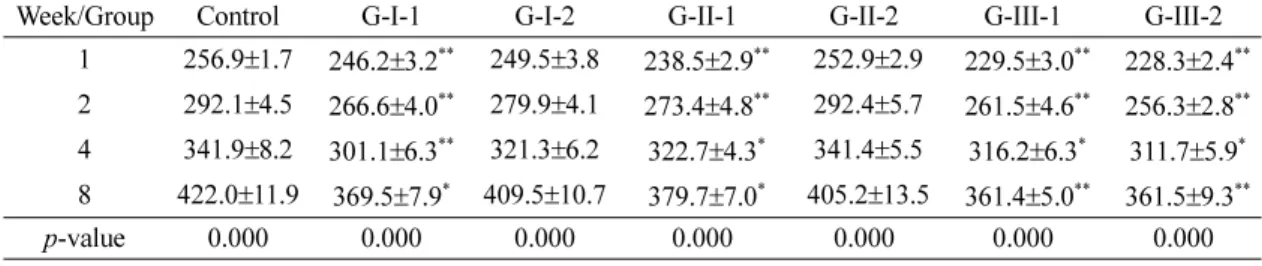
group was compared. The cadmium exclusively administered groups - G-I-1, G-II-1, and G-III-1 - compared with the control group, tended to decrease their weight significantly; however, the cadmium and Gamdutang mixture-administered groups - G-I-2 and G-II-2 - did not show a signi- ficant change in weight, while G-III-2 showed a significant decrease in weight (Table 2).
2. Accumulation of cadmium in blood following the administration of Gamdutang
The cadmium accumulation was compared between the cadmium exclusively administered groups, and the cadmium and Gamdutang mixture- administered groups. In the case of G-I-1 and G-I- 2 groups, the cadmium exclusively administered groups showed a significantly high level of cadmium accumulation in the 2nd week, 4th week and 8th week, compared with the cadmium and
Table 1. Experimental design for treatment of cadmium and Kamdutang
Group Treatment Number of rats at first day of experimental week
1 wk 2 wk 4 wk 8 wk Total
Control DW
†5 5 5 5 20
G-I-1 Cd 1.7 μ g/g + DW 5 5 5 5 20
G-I-2 Cd 1.7 μ g/g + KD
‡5 5 5 5 20
G-II-1 Cd 3.4 μ g/g + DW 5 5 5 5 20
G-II-2 Cd 3.4 μ g/g + KD 5 5 5 5 20
G-III-1 Cd 6.8 μ g/g + DW 5 5 5 5 20
G-III-2 Cd 6.8 μ g/g + KD 5 5 5 5 20
Total 35 35 35 35 140
†