First author:Kim, Yong-Hoon, Gyeonggi-Do Forestry Environment Research Center, Tel : +82-31-8008-6788, E-mail : [email protected]
Corresponding author:Oh, Choong-Hyeon, Department of Biological & Environmental Science, Dongguk University, Tel : +82-31-961-3123, E-mail : [email protected]
Received:19 April, 2020. Revised:5 August, 2020. Accepted:30 July, 2020.
- 45 -
군집구조분석을 통한 바다향기수목원 소사나무림 식재모델 연구
- 대부도 및 영흥도를 대상으로 -
김용훈1)⋅권오정2)⋅반수홍3)⋅오충현4)
1)경기도산림환경연구소 연구사⋅2)동국대학교 생태환경연구소 전임연구원⋅
3)동국대학교 대학원 바이오환경과학과 학생⋅4)동국대학교 바이오환경과학과 교수
The Planting Models of
Carpinus turczaninowii
Community by the Plant Community Structure Analysis in Badahyanggi Arboretum- Case Study of Daebu-Yeongheung Islands -
Kim, Yong-Hoon1)⋅Kwon, Oh-Jung2)⋅Ban, Su-Hong3) and Oh, Choong-Hyeon4)
1)Gyeonggi-Do Forestry Environment Research Center, Researcher,
2)Institute of Ecological Environment, Dongguk University, Senior Researcher,
3)Department of Biological & Environmental Science, Dongguk University Graduate School, Student,
4)Department of Biological & Environmental Science, Dongguk University, Professor.
ABSTRACT
This study suggested the planting models of Carpinus turczaninowii community to make in Badahyanggi Arboretum and was carried out to the structure of C. turczaninowii commnity in Daebu-Yeongheung Islands. In order to identify the current ecological environment, this study set to 13 plots(i.e. 100㎡) for analysing detailed structure of plant communities. The research methodology was qualitative analysis. It used TWINSPAN, PCA and Indicator Species Analysis tools which are per- formed well in several comparisons of classification techniques and one of the ordination techniques showed that the plant communities. The results were classified into 3 communities that C. turczanino- wii-Pinus densiflora community(Ⅰ),C. turczaninowii-Quercus serrata community(Ⅱ) and C. turczani- nowii-Platycarya strobilacea community(Ⅲ). In all of communities, C. turczaninowii was dominant species in canopy layer and understory layer, the degree of closure was high. Proposed the planting models that areⅠ~Ⅱ communities based on planting status in Badahyanggi Arboretum(Island Plant
Botanical Garden), the structure of plant communities, indicator species and individual distribution by DBH classes. Also, The multi-layer planting plans are necessary, such as P. strobilacea, Lindera eryth- rocarpa, Viburnum carlesii, V. dilatatum, Ligustrum obtusifolium, Zanthoxylum schinifoliumand so on.
Key Words:TWINSPAN, PCA, Indicator Species Analysis, Multi-layer planting plan
I. 서 론
국제적으로 생물자원 보전은 국가의무로 이 행을 요구하고 있다. 특히 생물다양성협약 (CDB)의 세계식물보전전략(GSPC 2020)에서 각 국가의 희귀식물 75% 이상을 현지 외 보전 시설에서 보전・관리하도록 의무화함에 따라 국가기관의 주도적인 기능수행이 강조되고 있 다(Kim et al, 2014). 또한 지구온난화 등에 따 른 서식환경 악화로 인해 지속적으로 생물종이 감소되고 있어, 유전자원 확보 및 생물종다양성 보전이 더욱 중요해지고 있다.
산림청은 제3차 수목원진흥기본계획을 통해 국가 산림생물종의 전략적 보존 및 관리기반 구 축, 산림생물다양성의 효과적 보전, 국가수목원 확충, 공・사립수목원의 역량강화 등을 위한 수 목원 물적기반 확충 등과 같이 5대 전략과 18개 핵심과제를 설정하여 노력하고 있다(Korea Forest Service, 2014).
경기도는 2000~2005년 다양한 산림생물자원 을 관리하고 산림자원의 홍보・전시를 위하여 오산시에 약 34ha의 규모로 경기도 제1도립 수 목원인 물향기수목원을 조성하였다. 이 후 2007
~2020년 약 101ha의 규모로 경기도 안산시 대 부도에 제2도립 수목원인 바다향기수목원을 조 성 중에 있으며, 2019년 5월 우선 개원하였다.
바다향기수목원은 서해 도서식물자원의 서식지 외 보전을 목적으로 다양한 주제원을 조성 중에 있으며, 이 중 약용식물, 민속식물, 희귀식물 등 을 주제로 하는 도서식물원 조성을 추진하고 있 다(Gyeonggi Province, 2007). 또한 도서식물원
조성을 위해 2017~2018년 안산시 단원구 대부 동 서남부연결도로 공사에서 벌목 대상인 소사 나무를 굴취 및 이식하였다.
소사나무는 한국, 중국, 일본에 분포하는 낙 엽활엽 소교목이며, IUCN RED LIST 중 관심 대상(LC)으로 분류되는 종이다(Shaw et al, 2014). 한국에서는 지리적으로 남쪽 해안 도서 에서 경기도 해안선까지 분포하며, 주로 도서지 역의 능선부와 산정부, 해안단애지를 중심으로 분포하는 특징을 가지고 있다(Lee et al, 2003;
Song et al, 2008; Choi et al, 2012; Bae et al, 2014; Choi et al, 2015). 이와 같이 소사나무는 서해 도서식물자원 중 대표적인 수목자원이지 만 소사나무림을 서식지 외 보전하기 위한 서식 환경 연구 등의 기초자료가 부족하여 수목원 조 성에 어려움이 많다.
서식지 외 보전을 목적으로 소사나무를 주제 로 한 도서식물원 조성을 위해서는 소사나무림 에 대한 기초연구와 이를 활용한 식재설계가 필 요하다. 식재설계를 진행하기 위해서는 소사나 무 서식 대상지와 주변에 대한 식생조사와 분석 이 필요하다. 또한 조사결과를 바탕으로 지역적 특성 및 생물 기후를 고려하여 식재할 식물종을 선정하고, 동반종(companion species)으로 구성 된 식물군락을 조성해 주는 것이 필요하다(Kim and Sim, 2010). 이처럼 생태적 접근방법을 바 탕으로 식재 설계한 사례로는 Kwon et al(2004) 의 인천광역시 해안지역(덕적도, 영흥도)에 자 생하는 곰솔군집과 소나무-상수리나무군집의 식생구조 분석을 통한 해안매립지 및 해안가 방 풍림과 녹지대의 생태적 식재모델, Hong et
Figure 1. Location map of survey area in Daebu island, Yeongheung island and Badahyanggi Arboretum
al(2010)의 식물군집구조 분석 등을 통한 충청 남도 당진군 일대 온대중부지역 소나무림 군락 식재 모델, Kim(2011)의 지리적 분포 특성 및 잠재자연식생을 고려한 순천만 해안방풍림 조 성 모델 등이 있다.
본 연구는 소사나무 군집구조 분석을 통해 서해 도서식물자원의 서식지 외 보전 및 수목원 조성에 필요한 기초자료를 제공하고 바다향기 수목원 내 도서식물원 조성을 위한 생태적 식재 모델을 제시하는데 목적이 있다.
II. 연구대상지 및 연구방법 1. 연구대상지 및 시기
본 연구는 경기도 안산시 단원구 대부황금로 399에 위치한 바다향기수목원 내 도서식물원 (1,991㎡)을 대상으로 하였다. 또한 바다향기수 목원 주변에 위치한 소사나무림을 찾기 위하여 국가생물종지식정보시스템 내 표본 채집지 및 분포도, Lim et al(2014)과 Lim et al(2015)의 연 구를 참고하여 인천광역시 옹진군 영흥면 내리
에 위치한 영흥도 통일사 및 국사봉(156.3m), 안산시 단원구 대부남동에 위치한 대부도 큰산 (105.9m) 주변을 연구대상지로 선정하였다 (Figure 1).
현지조사는 2018년 7월 21일 ~ 9월 12일까지 총 4회 걸쳐 소사나무 위치 파악 및 군집구조 조사를 진행하였으며, 조사대상지의 위치정보 를 기록하기 위해 휴대용 GPS 단말기(Magellan Explorist610)를 이용하였다.
2. 조사 및 분석방법
바다향기수목원 내 도서식물원 조성에 필요 한 소사나무 군집특성 및 식재모델 도출을 위해 도서식물원의 현황을 파악하고자 이식된 수목 의 수종, 수고, 흉고직경, 개체수 등 수목식재 현황을 전수 조사하였다. 소사나무 군집구조 분 석을 위해 대상지 내 소규모로 출현하는 소사나 무를 제외하고 여러 개체가 주로 출현하는 대상 지를 중심으로 상관식생을 고려하여 10×10m (100㎡) 크기의 방형구 13개소(영흥도 9개소:
B01~B09, 대부도 4개소: B10~B13)에 대한 조사
Species
Island Plant Botanical
Garden A Island Plant Botanical Garden B DBH(㎝) Height(m)Number
of plant DBH
(㎝) Height(m)Number of plant Carpinus turczaninowii Hance 14~55 2~8 7* 10~32 2~8 16*
Pinus densiflora Siebold & Zucc. 10 2 2 12~53 4~8 3
Diospyros lotus L. 8 3 1 - - -
Quercus serrata Murray 10 2 1 9 6 2
Prunus serrulata Lindl. var. pubescens (Makino) Nakai 5~14 2 5 - - - Sorbus alnifolia (Siebold & Zucc.) K.Koch 15~17 8 5 - - - Acer tataricumsubsp. ginnala (Maxim.) Wesm. - - - 17~47 4~6 2*
Styrax obassia Siebold & Zucc. - - - 9 1 1
Styrax japonicus Siebold & Zucc. 3 2 1 5 3 2 Stephanandra incisa (Thunb.) Zabel - - - <2 0.8 30 Kalopanax septemlobus (Thunb.) Koidz. 3 2 1 - - - Rhododendron mucronulatumTurcz. - - - <2 0.3~1 35 Prunus japonica f. rufinervis (Nakai) T.B.Lee - - - <2 2 1
Viburnum carlesii Hemsl. - - - <2 1 11
Total - - 23 - - 103
*Type of sprouts
Table 1. Planting status in Badahyanggi Arboretum(Island Plant Botanical Garden)
를 진행하였다. 방형구 내 출현하는 수목에 대 하여 교목(수고 8m 이상), 아교목(수고 2~8m), 관목(수고 2m 미만)으로 층위를 구분하였고 수 고, 흉고직경, 수관폭, 개체수를 조사하였다. 환 경인자 등을 분석하기 위해 암석노출도, 토양경 도, 해발고도, 경사도, 향, 울폐도를 조사하였다.
식생조사를 토대로 층위별 각 수종의 상대적 우 세 등을 파악하기 위해 중요치(importance value:
I.V.)를 통합하여 백분율로 나타낸 상대우점치 (importance percentage: I.P.)를 산출하여 분석하 였다(Curtis and McIntoch, 1951; Brower and Zar, 1977). 상대우점치는 (상대밀도+상대피도)/2로 계산하였다. 개체들의 크기를 고려하여 수관층 위별로 가중치를 부여한 평균상대우점치(mean importance percentage: M.I.P.)는 [(교목층 I.P.×3) +(아교목층 I.P.×2)+(관목층 I.P.×1)]/6으로 계산 하였다(Yim et al, 1980; Park et al, 1987). 군집분 류는 PC-ORD(McCune and Mefford, 2016)를 이 용하여 TWINSPAN에 의한 classification 분석
(Hill, 1979)과 Hasegawa(2006)가 제시한 서열기 법의 기준으로 PCA에 의한 ordination 분석 (Goodall, 1954)을 하였고 군집 내 지표종 추출을 위하여 Dufréne and Legendre(1997)의 Indicator Species Analysis를 수행하였다. Pielou(1975)의 방법으로 군집별 종 구성의 다양한 정도를 알아 보기 위해 Shannon의 종다양도(H’), 최대종다양 도(H’max), 균재도(J’), 우점도(D)를 분석하였고 군집 간의 유사성 정도를 측정하기 위해 Whittaker (1956)의 수식을 이용하여 유사도지수(Similarity Index: S.I.)를 분석하였다.
III. 결과 및 고찰
1. 도서식물원 수목식재 현황 및 환경인자 분석결과 바다향기수목원 내 주제원인 도서식물원은 A(820㎡), B(1,171㎡)의 두 개의 지역으로 나눠 져 있으며, 식재종은 소사나무, 소나무, 팥배나 무, 분꽃나무 등 총 14종 126주이다(Figure 2).
Figure 2. Planting status map in Badahyanggi Arboretum(Island Plant Botanical Garden)(At: Acer tataricumsubsp. ginnala, Ct: Clerodendrum trichotomum, Dl: Diospyros lotus, Ks:Kalopanax septemlobus, Pd: Prunus densiflora, Pj: Prunus japonica, Ps: Prunus serrulata Lindl. var.
pubescens, Qs: Quercus serrata, Rm: Rhododendron mucronulatum, Sa: Sorbus alnifolia, Si:
Stephanandra incisa, Sj: Styrax japonicus, So: Styrax obassia, Vc: Viburnum carlesii)
식재된 수목 중 교목의 수고는 2~8m이며, 흉고 직경별 개체수를 조사한 결과 소사나무는 DBH 10~55㎝ 23개체로 모두 맹아가 발달된 수형이 었다. 소나무(DBH 10~53㎝) 5개체, 졸참나무 (DBH 9~10㎝) 3개체, 팥배나무(DBH 15~17㎝) 5개체, 잔털벚나무(DBH 5~14㎝) 5개체, 분꽃나 무 11개체, 국수나무 30개체, 진달래 35개체 등 으로 조사되었다(Table 1). 특히 도서식물원 A 는 관목이 식재되어 있지 않은 상태이다. 토양 경도를 조사한 결과 도서식물원 A는 0.57kg/㎠
이며, 도서식물원 B는 0.50kg/㎠이다. 토양경도 값은 Oh and Chung(1998)의 무등산 도립공원 내 용추계곡과 평두계곡의 등산로 주변 식생의 토양경도 값인 0.43~0.87kg/㎠ 범위 내에 있으 나, 토양답압이 증가하지 않도록 지속적인 노력 이 필요할 것으로 판단된다.
2. 식물군집구조 분석
1) Classification 및 Ordination 분석 Figure 3은 13개 조사구에 대하여 TWINSPAN 에 의한 classification 분석을 실시한 것이다. 분석
결과 1~2 division의 지표종에 의하여 총 3개의 그 룹으로 구분되어졌다. 제 1단계(level 1) 제 1 divi- sion에서는 분꽃나무(-), 비목나무(-)와 덜꿩나무 (+) 출현유무에 따라 두 개의 그룹으로 나눠졌다.
분꽃나무(-)와 비목나무(-)가 출현하는 Group 1은 조사구 B10, B11, B12, B13이 해당되었다. 제 2단 계(level 2) 제 2 division에서는 덜꿩나무(+)의 출현 하는 그룹 중 누리장나무(+)가 출현하지 않은 Group 2(조사구: B01, B02, B03, B04, B05, B06, B08, B09)와 누리장나무(+)가 출현하는 Group 3 (조사구: B07)으로 분리되었다. Table 4와 같이 조 사구별 평균상대우점치와 연계하여 군락명을 부 여한 결과 Group 1은 소사나무-소나무 군락(군락
Ⅰ), Group 2는 소사나무-졸참나무 군락(군락 Ⅱ), Group 3은 소사나무-굴피나무 군락(군락 Ⅲ)으로 총 3개 군락으로 구분되었다. PCA Ordination의 분석결과는 Figure 4와 같다.
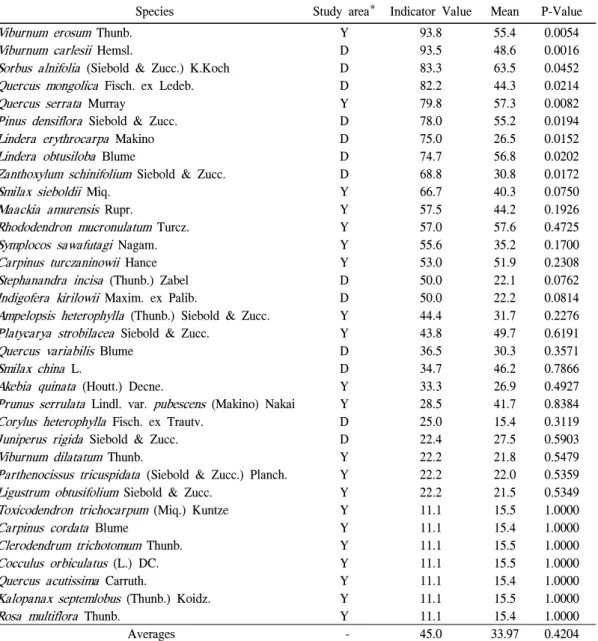
군락 내 지표종 추출을 위한 Indicator Species Analysis는 Table 2와 같다. Dufréne and Legendre(1997)의 기준인 Indicator Value가 25% 이상인 동시에 P-Value가 0.05 이하를 만
Figure 3. Classification of 13 plots by the TWINSPAN analysis in Daebu-Yeongheung Islands(Ct: Clerodendrum trichotomum, Le: Lindera erythrocarpa, Vc:
Viburnum carlesii, Ve: Viburnum erosum)
Figure 4. PCA ordination diagram of 13 plots in Daebu-Yeongheung Islands
Species Study area* Indicator Value Mean P-Value
Viburnum erosum Thunb. Y 93.8 55.4 0.0054
Viburnum carlesii Hemsl. D 93.5 48.6 0.0016
Sorbus alnifolia (Siebold & Zucc.) K.Koch D 83.3 63.5 0.0452 Quercus mongolica Fisch. ex Ledeb. D 82.2 44.3 0.0214
Quercus serrata Murray Y 79.8 57.3 0.0082
Pinus densiflora Siebold & Zucc. D 78.0 55.2 0.0194
Lindera erythrocarpa Makino D 75.0 26.5 0.0152
Lindera obtusiloba Blume D 74.7 56.8 0.0202
Zanthoxylum schinifoliumSiebold & Zucc. D 68.8 30.8 0.0172
Smilax sieboldii Miq. Y 66.7 40.3 0.0750
Maackia amurensis Rupr. Y 57.5 44.2 0.1926
Rhododendron mucronulatumTurcz. Y 57.0 57.6 0.4725
Symplocos sawafutagi Nagam. Y 55.6 35.2 0.1700
Carpinus turczaninowii Hance Y 53.0 51.9 0.2308 Stephanandra incisa (Thunb.) Zabel D 50.0 22.1 0.0762 Indigofera kirilowii Maxim. ex Palib. D 50.0 22.2 0.0814 Ampelopsis heterophylla (Thunb.) Siebold & Zucc. Y 44.4 31.7 0.2276 Platycarya strobilacea Siebold & Zucc. Y 43.8 49.7 0.6191
Quercus variabilis Blume D 36.5 30.3 0.3571
Smilax china L. D 34.7 46.2 0.7866
Akebia quinata (Houtt.) Decne. Y 33.3 26.9 0.4927 Prunus serrulata Lindl. var. pubescens (Makino) Nakai Y 28.5 41.7 0.8384 Corylus heterophylla Fisch. ex Trautv. D 25.0 15.4 0.3119 Juniperus rigida Siebold & Zucc. D 22.4 27.5 0.5903
Viburnum dilatatumThunb. Y 22.2 21.8 0.5479
Parthenocissus tricuspidata (Siebold & Zucc.) Planch. Y 22.2 22.0 0.5359 Ligustrum obtusifoliumSiebold & Zucc. Y 22.2 21.5 0.5349 Toxicodendron trichocarpum(Miq.) Kuntze Y 11.1 15.5 1.0000
Carpinus cordata Blume Y 11.1 15.4 1.0000
Clerodendrum trichotomumThunb. Y 11.1 15.5 1.0000 Cocculus orbiculatus(L.) DC. Y 11.1 15.5 1.0000
Quercus acutissima Carruth. Y 11.1 15.4 1.0000
Kalopanax septemlobus (Thunb.) Koidz. Y 11.1 15.5 1.0000
Rosa multiflora Thunb. Y 11.1 15.4 1.0000
Averages - 45.0 33.97 0.4204
*D: Daebu Island, Y: Yeongheung Island
Table 2. Indicator Species Analysis of 13 plots in Daebu-Yeongheung Islands
족하는 종으로 대부도 조사구에서는 분꽃나무, 팥배나무, 신갈나무, 소나무, 비목나무, 생강나 무, 산초나무이며, 영흥도 조사구에서는 덜꿩나 무, 졸참나무로 분석되었다. 이 중 군락 Ⅰ(소사 나무-소나무 군락)의 주요 지표종인 분꽃나무는 Song et al(2008)의 인천광역시 강화군 무인도 서 해식애의 식생 연구 중 소사나무군락 내 수
반하는 종 중 하나였다.
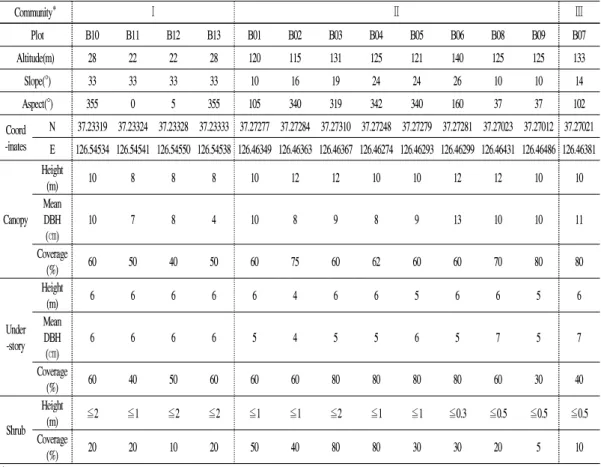
2) 환경인자, 흉고직경 분포 및 상대우점치 분석 군락 Ⅰ(소사나무-소나무 군락)이 출현한 조사 구(대부도 지역)의 해발고도는 22m와 28m로써 해수면에 인접한 저지대에서 능선하부 지역이며, 향은 355~5°로 주로 북향이다. 경사는 33°인 급경
Community* Ⅰ Ⅱ Ⅲ
Plot B10 B11 B12 B13 B01 B02 B03 B04 B05 B06 B08 B09 B07
Altitude(m) 28 22 22 28 120 115 131 125 121 140 125 125 133
Slope(°) 33 33 33 33 10 16 19 24 24 26 10 10 14
Aspect(°) 355 0 5 355 105 340 319 342 340 160 37 37 102
Coord -inates
N 37.23319 37.23324 37.23328 37.23333 37.27277 37.27284 37.27310 37.27248 37.27279 37.27281 37.27023 37.27012 37.27021 E 126.54534 126.54541 126.54550 126.54538 126.46349 126.46363 126.46367 126.46274 126.46293 126.46299 126.46431 126.46486 126.46381
Canopy Height
(m) 10 8 8 8 10 12 12 10 10 12 12 10 10
MeanDBH
(㎝) 10 7 8 4 10 8 9 8 9 13 10 10 11
Coverage
(%) 60 50 40 50 60 75 60 62 60 60 70 80 80
Under -story
Height
(m) 6 6 6 6 6 4 6 6 5 6 6 5 6
MeanDBH
(㎝) 6 6 6 6 5 4 5 5 6 5 7 5 7
Coverage
(%) 60 40 50 60 60 60 80 80 80 80 60 30 40
Shrub Height
(m) ≦2 ≦1 ≦2 ≦2 ≦1 ≦1 ≦2 ≦1 ≦1 ≦0.3 ≦0.5 ≦0.5 ≦0.5
Coverage
(%) 20 20 10 20 50 40 80 80 30 30 20 5 10
*Plant community names are referred form figure 3 and 4
Table 3. General description of the physical features and vegetation of the surveyed plots in Daebu-Yeongheung Islands
사지이며, 토양경도는 0.2~0.3kg/㎠, 암벽노출도 는 1~5%, 울폐도는 60~79%로 분석되었다. 상대 우점치 분석 결과 교목층에서 소사나무(I.P.:
39.2%), 소나무(I.P.: 29.1%), 신갈나무(I.P.:
14.6%), 졸참나무(I.P.: 5.3%) 등의 순으로 우점하 였으며, 아교목층은 소사나무(I.P.: 74.9%), 팥배 나무(I.P.: 13.9%), 굴피나무(I.P.: 5.3%), 소나무 (I.P.: 3.0%) 등의 순으로 우점하였다. 관목층은 생강나무(I.P.: 28.9%), 진달래(I.P.: 21.7%), 분꽃 나무(I.P.: 18.2%), 비목나무(I.P.: 5.9%), 소사나무 (I.P.: 4.8%), 팥배나무(I.P.: 3.3%) 등의 순으로 우 점하였다. 연륜 및 개체군 분석 결과 군락 Ⅰ은 400㎡ 내에 DBH 18~57㎝인 소사나무 25개체, DBH 2㎝ 이하인 소사나무 6개체, DBH 12~22㎝
인 소나무 13개체, DBH 2~70㎝인 신갈나무 6개
체, DBH 12~22cm인 굴참나무 2개체 등으로 총 20종 176개체가 출현하였다. DBH 7㎝인 소사나 무는 14년생이나 대부분이 맹아가 발달한 수형으 로 출현하여 그 이상의 수령일 것으로 판단된다.
DBH 22㎝인 소나무는 31년생, DBH 17㎝인 굴 피나무는 21년생이다(Table 3 and 4).
군락 Ⅱ(소사나무-졸참나무 군락)가 출현한 조 사구(영흥도)의 해발고도는 115~140m의 능선 상 부지역으로서 남동향(105°, 160°), 북서향(319°, 340°, 342°)과 북향(37°)이다. 경사는 10~26°로 완 경사지 및 경사지이며, 토양경도는 0.0~0.2kg/㎠, 암벽노출도는 0~5%, 10%, 30%, 40%, 울폐도는 81~91%로 분석되었다. 상대우점치 분석 결과 교 목층에서 소사나무(I.P.: 46.2%), 졸참나무(I.P.:
21.8%), 소나무(I.P.: 10.2%), 굴피나무(I.P.:
Community* Ⅰ Ⅱ Ⅲ Layer**
Species C U S M C U S M C U S M
Pinus densifloraSiebold & Zucc. 29.1 3.0 - 15.6 10.2 - - 5.1 - - - - Juniperus rigidaSiebold & Zucc. - 2.9 - 1.0 - - 0.4 0.1 - - - - Platycarya strobilaceaSiebold & Zucc. 3.4 5.3 0.6 3.6 9.1 2.0 5.1 6.1 10.3 17.8 2.2 11.5 Carpinus cordataBlume - - - 0.8 - 0.3 - - - - Carpinus turczaninowiiHance 39.2 74.9 4.8 45.4 46.2 84.0 1.2 51.3 70.9 82.2 - 62.9 Corylus heterophyllaFisch. ex Trautv. - - 0.6 0.1 - - - - Quercus acutissimaCarruth. - - - - 1.3 - - 0.7 - - - - Quercus mongolicaFisch. ex Ledeb. 14.6 - 3.1 7.8 2.9 1.3 0.1 1.9 - - - - Quercus serrataMurray 5.3 - 1.8 3.0 21.8 5.7 1.8 13.1 18.8 - - 9.4 Quercus variabilisBlume 3.7 - 0.0 1.8 0.9 - 0.7 0.5 - - - - Lindera erythrocarpaMakino - - 5.9 1.0 - - - - Lindera obtusilobaBlume - - 28.9 4.8 - 1.8 7.9 1.9 - - 11.1 1.9 Akebia quinata(Houtt.) Decne. - - - 0.4 0.1 - - 2.2 0.4 Cocculus orbiculatus(L.) DC. - - - 2.2 0.4 Rosa multifloraThunb. - - - 0.1 - - - - - Prunus serrulataLindl. var.pubescens(Makino) Nakai 1.6 - 2.0 1.1 7.0 - 0.4 3.6 - - - - Sorbus alnifolia(Siebold & Zucc.) K.Koch 3.0 13.9 3.3 6.7 0.5 0.8 3.2 1.1 - - - - Stephanandra incisa(Thunb.) Zabel - - 1.4 0.2 - - - - Maackia amurensisRupr. - - 0.5 0.1 - - 3.6 0.6 - - - - Indigofera kirilowiiMaxim. ex Palib. - - 0.8 0.1 - - - - Zanthoxylum schinifoliumSiebold & Zucc. - - 2.7 0.5 - - - 2.2- 0.4 Toxicodendron trichocarpum(Miq.) Kuntze - - - 0.2 - - - - - Ampelopsis heterophylla(Thunb.) Siebold & Zucc. - - - 0.7 0.1 - - 6.7 1.1 Parthenocissus tricuspidata(Siebold & Zucc.) Planch. - - - 0.4 0.1 - - - - Kalopanax septemlobus(Thunb.) Koidz. - - - 4.6 0.8- Rhododendron mucronulatumTurcz. - - 21.7 3.6 - - 32.0 5.3 - - 2.2 0.4 Symplocos sawafutagiNagam. - - - 1.7 1.0 0.7 - - 1.5 0.3 Ligustrum obtusifoliumSiebold & Zucc. - - - 0.9 0.1 - - - - Clerodendrum trichotomumThunb. - - - 54.2 9.0 Viburnum carlesiiHemsl. - - 18.2 3.0 - - 1.4 0.2 - - - - Viburnum dilatatumThunb. - - - 2.3 0.4 - - - - Viburnum erosumThunb. - - 2.1 0.3 - 1.9 33.5 6.2 - - 2.2 0.4
*Plant community names are referred form figure 3 and 4
**C: importance percentage in canopy layer, U: importance percentage in understory layer, S: importance percentage in shrub layer, M: mean importance percentage
Table 4. Mean importance percentage of woody plants by 3 classified communities in Daebu-Yeongheung Islands
9.1%), 팥배나무(I.P.: 0.5%) 등의 순으로 우점하 였으며, 아교목층은 소사나무(I.P.: 84.0%), 졸참 나무(I.P.: 5.7%), 굴피나무(I.P.: 2.0%) 등의 순으
로 우점하였다. 관목층은 덜꿩나무(I.P.: 33.5%), 진달래(I.P.: 32.0%), 생강나무(I.P.: 7.9%), 굴피나 무(I.P.: 5.1%), 다릅나무(I.P.: 3.6%), 팥배나무
Community* H’(Shannon) H’max J’(evenness) D(dominance)
Ⅰ 1.1109 1.3010 0.8539 0.1461
Ⅱ 1.0310 1.4150 0.7286 0.2714
Ⅲ 0.8745 1.1461 0.7630 0.2370
* Plant community names are referred form figure 3 and 4
Table 5. The species diversity of 3 communities in Daebu-Yeongheung Islands
Community* Ⅰ Ⅱ
Ⅱ 33.42 -
Ⅲ 29.27 12.50
* Plant community names are referred form figure 3 and 4
Table 6. Similarity Index(%) between each communities in Daebu-Yeongheung Islands
(I.P.: 3.2%) 등의 순으로 우점하였다. 연륜 및 개 체군 분석 결과 군락 II는 800㎡ 내에 DBH 4~76
㎝인 소사나무 90개체, DBH 2㎝ 이하인 소사나 무 10개체, DBH 4~48㎝인 졸참나무 36개체, DBH 12~28㎝인 소나무 11개체, DBH 8~27㎝인 굴피나무 26개체, DBH 2㎝ 이하인 굴피나무 34 개체 등 총 28종 620개체가 출현하였다. DBH 16
㎝인 소사나무는 27년생이나 대부분이 맹아가 발 달한 수형으로 27년 이상의 수령일 것으로 판단 된다. DBH 24㎝인 졸참나무는 27년생, DBH 29
㎝인 굴피나무는 34년생이다(Table 3 and 4).
군락 Ⅲ(소사나무-굴피나무 군락)이 출현한 조사구(영흥도)의 해발고도는 133m의 능선 상 부지역이며 주로 동남향(102°)이다. 경사는 14°
로 완경사지이며, 토양경도는 0.06kg/㎠, 암벽노 출도는 10%, 울폐도는 91%로 분석되었다. 상대 우점치 분석 결과 교목층에서 소사나무(I.P.:
70.9%), 졸참나무(I.P.: 18.8%), 굴피나무(I.P.:
10.3%) 순으로 우점하였으며, 아교목층은 소사 나무(I.P.: 82.2%), 굴피나무(I.P.: 17.8%) 순으로 우점하였다. 관목층은 누리장나무(I.P.: 54.2%), 생강나무(I.P.: 11.1%) 등의 순으로 우점하였다.
개체군 분석 결과 군락 III은 100㎡ 내에 DBH 4~25㎝인 소사나무 16개체, DBH 2~16㎝인 굴 피나무 4개체, DBH 23~28㎝인 졸참나무 2개체 등 총 15종 69개체가 출현하였다(Table 3 and 4).
군락 Ⅰ~Ⅲ은 소사나무가 교목 및 아교목층 에서 주로 우점하는 특징을 보였다. 이로 인하 여 울폐도가 높게 유지되는 등 Lee et al(2003) 의 영종도를 대상으로 한 소사나무군락 분석 결 과와 일정부분 일치하나, 아교목 및 관목층의 상대우점치, 평균상대우점치 등을 고려할 경우 졸참나무, 굴피나무, 팥배나무 등과 지속적인 경쟁이 예측된다. 또한 Choi et al(2012)의 전라 남도 신안군 장도의 식생 연구 중 소사나무군락 내 주요 상관을 구성하는 종으로 졸참나무, 팥 배나무, 굴피나무 등의 출현, 맹아의 발달 및 기 형적인 수형 관찰 등의 특징과 유사하였다.
3) 유사도지수 및 종다양도 분석
종다양도(H’)는 0.8745~1.1109로 나타났으며, 군락 Ⅰ이 1.1109로 가장 높았다. Shin and Yun (2014)의 충청남도 가양산 소사나무군락의 종다 양도(H’) 0.4632, Lee et al(1999)의 경상남도 거제 도 노자산지역 소사나무군락의 종다양도(H’) 0.9075보다 높거나 비슷하였다. 또한 Kim et al(2018)의 전라남도 홍도 소사나무군락 1.977보 다는 낮았다. 우점도(D)는 0.1461~0.2714로 나타 났으며(Table 5), 군락 Ⅱ가 0.2714로 가장 높았 다. Whittaker(1965)의 종이 우점도 값을 기준으 로 볼 때 0.1~0.3에서는 다수의 중요종에 의해 우점도가 나눠진다. 본 3개의 군락은 0.1461~
Classification Island Plant Botanical Garden A Island Plant Botanical Garden B Canopy
layer 10≦DBH Carpinus turczaninowii, Pinus
densiflora, Sorbus alnifolia Carpinus turczaninowii, Pinus densiflora, Quercus serrata Understory
layer 2≦DBH<10
Quercus serrata, Quercus mongolica, Platycarya strobilacea, Lindera erythrocarpa, Prunus serrulata Lindl.
var. pubescens
Carpinus turczaninowii, Sorbus alnifolia, Platycarya strobilacea, Prunus serrulata Lindl. var. pubescens, Quercus serrata,
Shrub layer DBH<2 Rhododendron mucronulatum, Viburnum carlesii, Zanthoxylum schinifolium, Ligustrum obtusifolium
Rhododendron mucronulatum, Viburnum carlesii, Viburnum dilatatum, Ligustrum obtusifolium
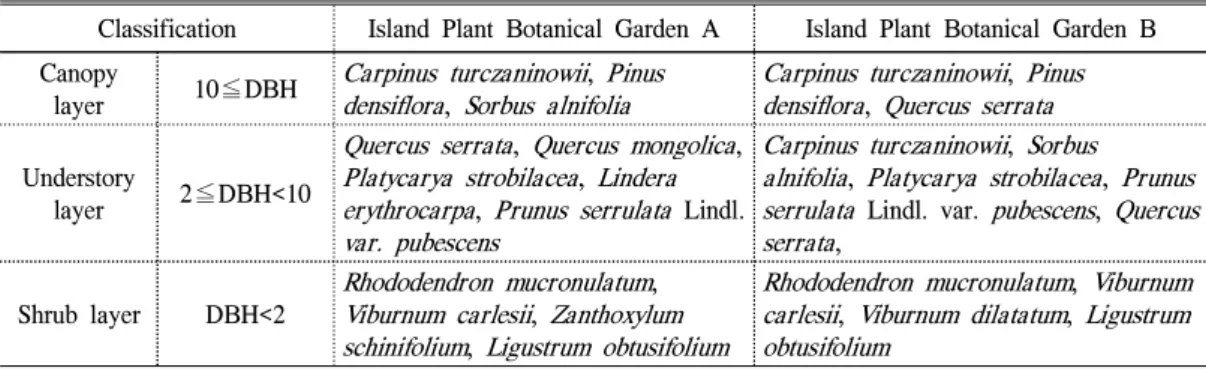
Table 8. Suggested plant species by the results of classification and community structure analysis
Community* Ⅰ Ⅱ Ⅲ
Island Plant Botanical Garden A
Island Plant Botanical Garden B
DBH<2(Shrub layer) 30.50 56.50 43.00 0.00 6.58
2≦DBH<10 1.50 6.38 11.00 0.85 0.43
10≦DBH<20 6.00 7.88 10.00 1.22 1.45
20≦DBH<40 5.25 5.50 5.00 0.49 0.17
40≦DBH 0.75 1.25 0.00 0.24 0.17
*Plant community names are referred form figure 3 and 4
Table 7. Individual distribution by diameter of breast height classes in 3 communities and Badahyanggi Arboretum(Island Plant Botanical Garden A and B)
0.2714로 다수의 종이 우점하고 있다고 볼 수 있 다. 유사도 지수는 Table 6과 같으며, 유사도지수 가 20% 이하일 때 군락간은 이질적이고, 80% 이 상일 땐 동질적이라 할 수 있다(Whittaker, 1956;
Lee et al, 1999). 이를 기준으로 볼 때 각 군락 간의 유사도지수는 12.50%, 29.27%, 33.42%로 비교적 낮은 것으로 분석되었으며, 각 군락 간 이질적인 상태로 판단된다.
3. 도서식물원 조성방향
바다향기수목원 내 주제원인 도서식물원 조 성을 위해 대부도 및 영흥도를 대상으로 한 소 사나무림 군집구조분석 결과인 군락Ⅰ~Ⅲ의 주요 상관 수종을 기준으로 도서식물원 A는 소 사나무, 소나무, 졸참나무, 팥배나무, 잔털벚나 무 등이 식재되어 있어 대부도에서 출현하는 군 락 Ⅰ(소사나무-소나무 군락)을 기본 방향으로 설정하였으며, 도서식물원 B는 소사나무, 소나
무, 졸참나무 등이 주로 식재되어 있어 영흥도 에서 출현하는 군락 Ⅱ(소사나무-졸참나무 군 락)를 기본 방향으로 설정하였다. 조성에 필요 한 도서식물원 지표종 선정은 TWINSPAN에 의한 classification 분석을 활용한 군집구조분석 과 Indicator Species Analysis에 의하여 추출된 지표종 자료 등을 고려하여 도서식물원 A는 분 꽃나무, 팥배나무, 신갈나무, 소나무, 비목나무, 생강나무, 산초나무와 도서식물원 B는 덜꿩나 무, 졸참나무를 제안하였다.
주제원 조성에 필요한 식재수량을 파악하기 위하여 100㎡ 범위 내 흉고직경별 개체수를 분 석한 결과 현재 조성 중인 도서식물원은 군락
Ⅰ~Ⅲ보다 매우 낮은 것으로 분석되었다(Table 7). 특히 도서식물원 A의 교목인 경우 군락 Ⅰ 과 비교할 경우 현재에 식재된 개체수의 2~5배 이상을 추가로 식재할 필요가 있다.
군락 Ⅰ~Ⅲ은 주로 북향, 남동향, 북서향, 동
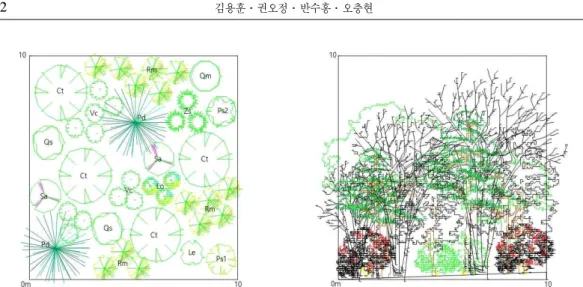
Figure 5. Stand visualization simulation of Island Plant Botanical Garden A(vertical and horizontal structure)(Ct: Clerodendrum trichotomum, Le: Lindera erythrocarpa, Lo:
Ligustrum obtusifolium, Pd: Pinus densiflora, Ps1: Prunus serrulata Lindl. var.
pubescens, Ps2: Platycarya strobilacea, Qm: Quercus mongolica, Qs: Quercus serrata, Rm: Rhododendron mucronulatum, Sa: Sorbus alnifolia, Vc: Viburnum carlesii, Zs: Zanthoxylum schinifolium)
Figure 6. Stand visualization simulation of Island Plant Botanical Garden B(vertical and horizontal structure)(Ct: Clerodendrum trichotomum, Lo:Ligustrum obtusifolium, Pd: Pinus densiflora, Ps1: Prunus serrulata Lindl. var. pubescens, Ps2: Platycarya strobilacea, Qs: Quercus serrata, Rm:Rhododendron mucronulatum, Sa: Sorbus alnifolia, Vc:Viburnum carlesii, Vd: Viburnum dilatatum)
남향에서 출현하였으며, 33°, 10~26° 14° 등의 완경사지 및 급경사지, 토양경도 값은 0.2~0.3kg/㎠, 0.0~0.2kg/㎠, 0.06kg/㎠ 등의 환경인자를 고려할 경우 이 중 토양경도의 값이 매우 높음에 따라 도서식물원 A(토양경도: 0.57kg/㎠)와 B(토양경 도: 0.50kg/㎠)의 토양경도를 개선할 필요가 있으
며, 추후 주제원 조성 시 탐방객 주요 관찰로를 조성 할 경우 주이용 동선을 분리하가나 목재데 크 등을 설치하여 토양답압이 증가하지 않도록 지속적인 관리가 필요할 것으로 판단된다.
도서식물원 A는 Figure 5와 같이 교목은 굴 피나무, 신갈나무, 비목나무 등을 추가 식재할
것을 제안하며, 현재 관목은 식재되지 않은 상 태이므로 지표종으로 선정된 산초나무, 생강나 무, 분꽃나무 등을 추가 식재할 필요가 있다. 또 한 도서식물원 B는 Figure 6과 같이 굴피나무, 덜꿩나무 등을 추가로 식재할 것을 제안하였다.
도서식물원은 수목원 조성계획과 별개로 인위 적으로 조성됨에 따라 단순한 식재패턴과 단층 구조로 된 층위로 구성되어 있으므로 주제원 조 성 시 수종별 흉고직경, 수고, 위치 등을 고려하 여 다층구조 형태의 주제원 조성이 필요하다 (Table 8).
IV. 결 론
본 연구는 대부도 및 영흥도 내 소사나무의 식물군집구조 분석을 통해 바다향기수목원 내 도서식물원 조성을 위한 생태적 식재모델을 제 시하고자 하였다. 군집구조 분석을 위하여 소사 나무가 출현하는 대부도 및 영흥도를 대상으로 총 13개의 방형구(각 100㎡)를 설치 및 조사하 였다. 군집분류는 TWINSPAN에 의한 classi- fication과 PCA에 의한 ordination 분석을 하였 으며, 지표종 추출을 위하여 Indicator Species Analysis를 하였다. 군집분류 결과 소사나무-소 나무 군락(Ⅰ), 소사나무-졸참나무 군락(Ⅱ), 소 사나무-굴피나무 군락(Ⅲ) 등 총 3개의 군락으 로 분류되었다. 군락 내 지표종 추출결과 대부 도 조사구에서는 분꽃나무, 팥배나무, 신갈나무, 소나무, 비목나무, 생강나무, 산초나무이며, 영 흥도 조사구에서는 덜꿩나무, 졸참나무로 분석 되었다. 군락 Ⅰ~Ⅲ은 소사나무가 교목 및 아교 목층에서 주로 우점하는 특징을 보였으며, 이로 인하여 울폐도가 높게 유지되는 특징을 보였다.
종다양도(H’)는 0.8745~1.1109로 나타났으며, 우점도(D)는 0.1461~0.2714로 나타났다. 바다향 기수목원 내 주제원인 도서식물원의 식재종은 소사나무, 소나무, 팥배나무, 분꽃나무 등 총 14 종 126주이었다. 바다향기수목원 내 도서식물원
식재현황, 군집분류 및 군집구조 분석, 지표종 추출 결과, 흉고직경별 개체수 등을 기초로 군 락 Ⅰ(소사나무-소나무 군락)과 군락 Ⅱ(소사나 무-졸참나무 군락)를 기본방향으로 설정하였다.
군락 Ⅰ은 비목나무, 굴피나무, 산초나무, 생강 나무, 분꽃나무 등과 군락 Ⅱ는 굴피나무, 덜꿩 나무 등을 추가 식재하여 다층구조의 도서식물 원 조성이 필요하다.
References
Bae KH⋅Kim JS⋅Cho HJ⋅Yum CW and Cho YC. 2014. Syngeographical characteristics of forest vegetation in limestone areas, Mt.
Deokhang, Kangwondo. Korean J. Environ.
Ecol. 28(2): 161-170. (in Korean with English abstract)
Brower JE and Zar JH. 1977. Field laboratory methods for general ecology. Wm. C. Brown Company.
Choi BK⋅Kim JW⋅Kim SY and Lim JC. 2012.
Vegetation of Jangdo island. Korean J.
Environ. Ecol. 26(4): 512-527. (in Korean with English abstract)
Choi BK⋅Huh MK and Kim SY. 2015.
Syntaxonomical and Synecological research of forest vegetation on Mt. Byeokbang.
Journal of Life Science 25(6): 646-655. (in Korean with English abstract)
Curtis JT and McIntoch RP. 1951. An upland forest continuum in the prairie-forest border region of Wisconsin. Ecology 32(3): 476-496.
Dufréne Mand Legendre P. 1997. Species Assemblages and indicator species: The need for a flexible asymmetrical apporach. Ecological Monographs 67(3): 345-366.
Goodall DW. 1954. Objective methods for the classification of vegetation. III. An essay in
the use of factor analysis. Australian Journal of Botany 2: 304-324.
Gyeonggi Province. 2007. Master plan for the Badanaeum arboretum. (in Korea)
Hasegawa M. 2006. Application of ordination in community ecology of soil animals. Edaphologia 80(0): 35-64. (in Japanese with English abstract) Hill MO. 1979. TWINSPAN-a FORTRAN program for
arranging multivariate data in an ordered two-way table by classification of the individuals and attributes. Ecology and Systematics, New York:
Cornel University Ithaca.
Hong SH⋅Han BH and Kwak JI. 2010.
Development of the Pinus densiflora community planting model in the central cool temperate zone of Korea. Journal of Korean Institute of Landscape Architecture 38(3):
107-114. (in Korean with English abstract) Kim DG. 2011. The Development of ecological
planting model for the make up of costal windbreak forest on Suncheon bay in Suncheon-si. Korea. J. Korean Env. Res.
Tech. 14(1): 89-104. (in Korean with English abstract)
Kim HJ⋅Shin JK⋅Lee CH and Yun CW. 2018.
Phytosociological community type classification and stand structure in the forest vegetation of Hongdo island, Jeollanam-do Province. J. Korea Soc. For. Sci. 107(3): 245-257. (in Korean with English abstract)
Kim MK and Sim WK. 2010. Suggestions for multi-layer planting model in Seoul area based on a cluster analysis and interspecific association. Journal of Korean Institute of Landscape Architecture 38(4): 106-127. (in Korean with English abstract)
Kim SS⋅Yang BH⋅Kim MJ⋅Kwon YH⋅Jin HY and Shin HT. 2014. Master plan for
Central National Arboretum. The Journal of Korean Institute of Forest Recreation 18(2):
17-31. (in Korean with English abstract) Kwon JO⋅Lee KJ and Jang SH. 2004. The
planting models of maritime forest by the plant community structure analysis in the seaside, Incheon-A case study on Pinus thunbergii community and P. densiflora community. Journal of Korean Institute of Landscape Architecture 31(6): 53-63. (in Korean with English abstract)
Korea Forest Service. 2014. The furtherance of arboretum master plan. (in Korea)
Lee HJ⋅Kim JH⋅Chun YM and Choung HL.
2003. Synecology of the Forest Vegetation of Yeongjongdo. The Korean journal of ecology 26(5): 223-236. (in Korean with English abstract)
Lee KJ⋅Cho W and Lee SD. 1999. Plant community structure of Nojasan in Koje island. Korean J. Environ. Ecol. 13(1): 78-88.
(in Korean with English abstract)
Lim YS⋅Na HR⋅Han BW⋅Seo WB and Hyun JO. 2015. Floristic study of Yeongheungdo island. Korean J. Plant Res 28(4): 456-474. (in Korean with English abstract)
Lim YS⋅Yoo KP⋅The Korean Society of Plant Parataxonomists and Hyun JO. 2014. Floristic study of Daebudo island. Korean J. Plant Res 27(5): 447-476. (in Korean with English abstract)
McCune B and Mefford MJ. 2016. PC-ORD.
Multivariate analysis of ecological data.
Version 7. Oregon: MjM Software Design.
Oh KI and Chung NC. 1998. A comparative Study on deterioration of hiking trail and change of soil environment in the sabbatical area-On Youngchoo and Pyungdoome valleys in the
moodeung provincial park. Agricultural Science & Technology Review 33: 83-97. (in Korean with English abstract)
Park IH⋅Lee KJ and Jo JC. 1987. Forest community structure of Mt. Bukhan area.
Journal of Korean applied ecology 1(1): 1-23.
(in Korean with English abstract)
Pielou EC. 1975. Mathematical ecology. New York, John Wiley & Sons.
Shaw K⋅Roy S and Wilson B. 2014. Carpinus turczaninowii. The IUCN Red List of Threatened Species 2014: e.T194630A2354078. https://dx.do- i.org/10.2305/IUCN.UK.2014-3.RLTS.T194630 A2354078.en
Shin HS and Yun CW. 2014. Species composition and community characteristics of forest vegetation of Mt. Gaya in Chungnam. Journal
of Ariculture & Life Science 48(3): 22-35. (in Korean with English abstract)
Song HS⋅Cho W and Ahn YH. 2008. Vegetation at sea cliffs of uninhabited islets off Ganghwa-gun, Korea. Korean J. Environ. Ecol. 22(4): 453-460.
(in Korean with English abstract)
Whittaker RH. 1956. Vegetation of the Great Smoky Mountains. Ecological Monographs 26: 1-80.
Whittaker RH. 1965. Dominance and diversity in land plant communities. Science 147: 250- 260.
Yim KB⋅Park IH and Lee KJ. 1980. Phytosociological changes of Pinus densiflora forest induced by insect damage in Kyonggi-do area. Journal of Korean Forestry 50: 56-71. (in Korean with English abstract)