Print ISSN: 2288-4637 / Online ISSN 2288-4645 doi:10.13106/jafeb.2020.vol7.no7.489
1
First Author and Corresponding Author. Lecturer, Business and Economic Faculty, Universitas Muhamadiyah Yogyakarta, Indonesia [Postal Address: Jl. Brawijaya, Geblagan, Tamantirto, Kec. Kasihan, Bantul, Daerah Istimewa Yogyakarta 55183, Indonesia]
2
Business and Economic Faculty, Universitas Muhammadiyah Yogyakarta, Indonesia, Email: [email protected]
© Copyright: The Author(s)
This is an Open Access article distributed under the terms of the Creative Commons Attribution
Non-Commercial License (http://Creativecommons.org/licenses/by-nc/4.0/) which permits
unrestricted noncommercial use, distribution, and reproduction in any medium, provided the
original work is properly cited.
Analysis of Unequal Distribution of Population Income in Indonesia
Nano PRAWOTO
1, Richa Dwi CAHYANI
2
Received: April 09, 2020 Revised: May 03, 2020 Accepted: June 07, 2020
Abstract
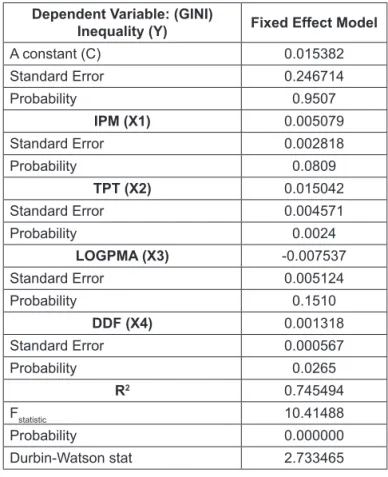
Income inequality is a problem that is not only faced by developing countries such as Indonesia, but also developed countries. The difference lies in the proportion of an inequality that occurs and the solution to the level of difficulty experienced. Thus, this study aims to empirically analyze the unequal distribution of population income in Java island, Indonesia, by including the human development index, open unemployment rate, foreign investment, and the degree of fiscal decentralization. The research model used in this study was multiple linear regression to analyze the panel data with a fixed-effect model approach. The results of the study showed that human development index, open unemployment rate, and the degree of fiscal decentralization had a positive and significant effect on income inequality in Java island.
Meanwhile, foreign investment had a negative and insignificant effect on income inequality in Java. It is because the value of the investment is more invested in the capital-intensive sector. The government is expected to be more selective in accepting foreign investments that enter the country, especially in Java, and it should be labor-intensive investments. In addition, the government has to equalize locations for foreign investment without reducing good cooperation with these foreign investors.
Keywords: Human Development Index, Foreign Investment, Income Distribution, Indonesia JEL Classification Code: F21, O15, R42
1. Introduction
Income inequality is a problem that is not only faced by developing countries, but also developed countries (Banister, Bloom, & Rosenberg, 2012; Li, Wang, Xu, & Yuan, 2020).
The difference lies in the proportion of an inequality that occurs and the solution to the level of difficulty experienced (Molero-Simarro, 2017; Shi & Chuliang, 2011; Xie & Zhou, 2014). The state of income distribution in several countries is divided into two categories, namely, the distribution of relative income and the distribution of absolute income.
The relative income distribution is the ratio of the amount of income received by various income earners, which are divided into three groups, namely, 40 percent of the population receiving the lowest income, 40 percent of the middle- income population, and 20 percent of the highest-income population. Whereas, the absolute income distribution is the percentage of the population whose income reaches a certain level or below the level (Sukirno, 2006).
The indicator used to determine income inequality is the Gini coefficient or the Gini index, which ranges from zero to one. The Gini index of zero indicates perfect equality, where everyone has almost the same income. Meanwhile, the Gini index of one indicates perfect inequality (Hudiyanto, 2017). Moreover, Java island is a central area of activity in Indonesia, both for economic and government centers.
This condition should be able to reduce inequality in the
distribution of people’s income compared to other islands,
such as Sumatra, Kalimantan, Sulawesi, Papua, Bali, and
Nusa Tenggara. However, this condition has not been able
to enable the island of Java to suppress inequality compared
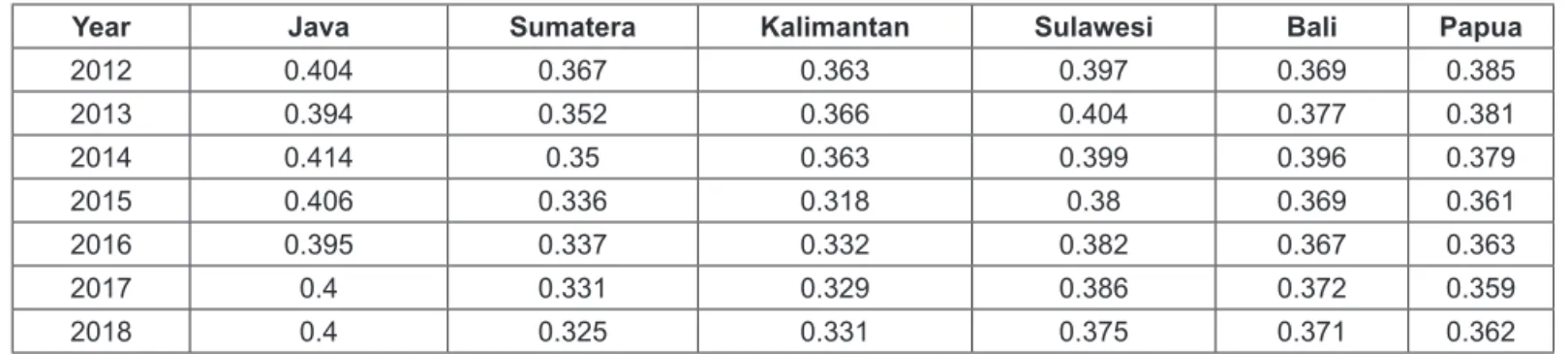
to other islands, which can be seen from the measurement
number of income inequality. Table 1 performs the data on
the development of the inter-island Gini index in Indonesia: