하천의 생태적 복원을 위한 자연하천변의 목본성 식물군락에 대한 연구
방제용 ․ 허은복
*․ 김혜주**․ 유영한*†
서울여자대학교 환경생명과학부
*공주대학교 자연과학대학 생명과학과
**김혜주자연환경계획연구소
1)
Studies on the Woody Vegetation in the Edge of Natural River for Ecological Restoration in Korea
Bang, Je-Yong․Un-Bok Hu
*․Hyea-Ju Kim
**․Young-Han You
*†Faculty of Environment and Life Sciences, Seoul Women’s University
*
Dept of Biology, College of Natural Sciences, Kongju National University
**
Institute of Landscape Planning Hyea-Ju Kim
(Received: 03 February 2015, Revised: 23 February 2015, Accepted: 23 February 2015)
요 약
하천의 복원을 위한 기초자료로 사용하고자 인간의 간섭에 의한 훼손이 없거나 적은 10개의 자연하천을 군집생태학적 방법으로 조사하여 통계적으로 분석하였다. 그 결과 신갈나무군락과 소나무군락, 사시나무군락, 굴참나무군락, 산벚나 무군락 등 총 29개의 식물군락으로 확인되었다. 하천식생은 계곡‧계반림과 하변림으로 나누어졌다. 계곡‧계반림은 경사 가 급하고 물에 의한 영향이 적어 경목림이 우점하였고, 하변 연목림은 버드나무류로 대변되었다. 하천 선택시 자연성 이 기준이 되어 인간의 간섭이 많은 하류보다 중‧상류에 위치한 조사지가 많았고, 그에 따라 출현군락의 92%(44 plot) 는 경목림이었고, 8%(4 plot)는 연목림이었다. 전층을 이용한 PCA 분석에서는 신갈나무군락 그룹과 산벚나무군락 그 룹, 소나무군락 그룹, 산벚나무군락과 소나무군락 혼합 그룹, 기타군락 그룹으로 크게 5개의 그룹으로 나누어졌다. 교 목층을 이용한 PCA 분석은 신갈나무군락 그룹, 산벚나무군락 그룹, 기타군락 그룹으로 크게 3개의 그룹으로 나누어졌 다. 하천변에 출현한 식물군락은 경목림과 연목림으로 나누어졌으며, 이를 통해 하천제방권 및 고수위권은 신갈나무, 소나무, 사시나무, 굴참나무와 산벚나무 등의 종을 식재하는 것이 적합하고, 고수부지권 및 저수위권은 버드나무속 식 물을 식재하는 것이 적합할 것으로 판단된다. 식재될 목본에 따른 초본의 선택은 통계분석에서 같은 그룹에 속해있고, 높은 빈도로 출현하는 종으로 하는 것이 적합하다고 판단된다.
핵심용어 : 생태적 복원, 자연하천, 군집생태학적 방법, 식생
Abstract
In order to get as ecological basic data for river restoration, vegetation investigation was conducted in natural river and analysed it synecological methods, such as ordination cluster. 29 plant communities units were identified and the major dominant plant communites were Quercus mongolica community, Pinus densiflora community, Populus davidiana community, Q. variabilis community and Prunus sargentii community. River vegetations were classified into ravine and gorge forest type and riverine softwood forest type. Ravine and gorge forest was dominanted by hardwood which located in steep slope and in high elevation, and riverine softwood forest by softwood, salix spp.
Naturality was an important criterion for the selection of rivers, so many of the selected rivers are located in the upper stream and mid stream rather than the lower stream, where more human intervention is involved. Plant communities were consisted of hardwood forest(44 plots, 92%) and softwood forest(4 plot, 8%), respectively. PCA with total layer data showed 5 groups of communities: Q. mongolica community group, Prunus sargentii community group, Pinus densiflora community group, Prunus sargentii community - Pinus densiflora community group and the rest communities group. PCA with tree layer showed 3 groups: Q. mongolica community group, Prunus sargentii community group, and the rest community group. Cluster analysis also a showed a similar communities group to PCA ordination, but Magnolia sieboldii community and Prunus sargentii community were distinguished from the PCA result. From the result, it can be concluded that the plant communities of riparian be divided into hardwood and
†To whom correspondence should be addressed.
Department of Biology, College of Natural Sciences, Kongju National University, Kongju City, 314-701, Korea
E-mail: [email protected]
softwood forest by statistical techniques. It was appropriate to plant species such as Quercus mongolica, Pinus densiflora, Populus davidiana, Quercus variabilis and Prunus sargentii, at levee zone and high water level. And Sliax spp. were appropriate for planted plants at waterfront and low water level. The herb species to be planted on the floodplain were recommanded in the species composition co-occurred with the woody species.
Key words : Ecological restoration, Natural river, Synecological methods, Vegetation
1. 서 론
하천생태계는 수중생태계와 육상생태계를 연결하는 전이 대(ecotone) 역할 뿐 아니라 하천을 중심으로 하는 복잡한 먹이사슬이 얽혀 있어 생물다양성의 유지에 있어 매우 중 요하다. 하천과 생물들 간의 관계 뿐 아니라 하천과 인간 간의 관계에 있어서도 매우 밀접하게 연관되어있다. 우리나 라의 하천관리정책은 홍수방지를 위한 치수위주의 하천정 비 사업이 추진되어 왔으며, 특히 1960년대부터 산업화, 도 시화과정에서 생활용수 및 공업용수 등 각종 용수 수요급 증에 따른 다목적 댐 등의 구조물 조성에 의한 수자원개발 이 주요 사업으로 추진되어 왔다. 이와 같은 하천 정비 사 업은 우리나라의 하천정비대상 35,781km 중 80%이상이 개보수작업이 추진되었으며, 직할하천은 거의 하천 정비 사 업이 완료되었다(Park et al., 2003).
우리나라 하천생태계의 주요 변화 요인은 물리적 변형, 화학적‧생물학적 변화 등으로 크게 나눌 수 있다. 물리적 변 형으로는 댐 건설, 직강화, 준설, 골재 채취, 제방 건설, 고 수부지 개발, 용수공급을 위한 과도한 하천수의 이용, 유역 의 교란(산림 벌채, 산불, 농경지 개간, 습지 매립), 수중보 등을 들 수 있으며, 이러한 물리적 변화요인은 화학적‧생물 학적 변화에도 큰 영향을 미쳐 왔다(Choo et al., 1997).
하천식생에 관한 국내 연구 중 자연하천을 대상으로 진행 된 연구는 Cho and Lee (1988)의 Ordination 방법을 통한 가야산 홍류동 계곡의 식생군집의 연구, Song and Song (1996)의 낙동강 상류 한천 일대의 하천변 식생의 식물사 회학적 연구, Song (1999)의 안동과 예천 지방의 자연성이 높은 하천식생에 대한 연구, Shim (2001)의 갑천변의 자연 하천 유지구간의 생태에 관한 연구, Son and Jeon (2003) 의 낙동강 하류 연안의 지류 내에 형성된 자연습지에 관한 연구, Kim et al. (2008)의 홍수터복원을 위한 국내 현재자 연하천 식생에 대한 연구 등이 있다.
해외 연구로는 Haslam and Wolsely (1981)의 하천식생 의 평가와 관리에 관한 연구, Penka et al. (1985)은 홍수터 숲의 생태계에 관한 연구, Jarolímek et al. (1991)의 한반 도 북쪽의 질소가 풍부한 연못과 강 주변의 군집에 관한 연 구, Muchna and Wallnöfer (1993)의 슬로바키아 이탄지 에 대한 연구 등이 있다.
본 연구에서는 하천의 복원을 위한 기초자료로 사용하고자 인간의 간섭에 의한 훼손이 없거나 적은 자연하천을 군집생태 학적 방법으로 조사하여 분석하였다. 이와 같은 연구를 통하여 복원할 하천의 특성에 맞은 식물군락 및 종의 선택과 식물이
정착하여 지속가능한 환경을 조성하는데 기여하고자 한다.
2 . 조사지 개황
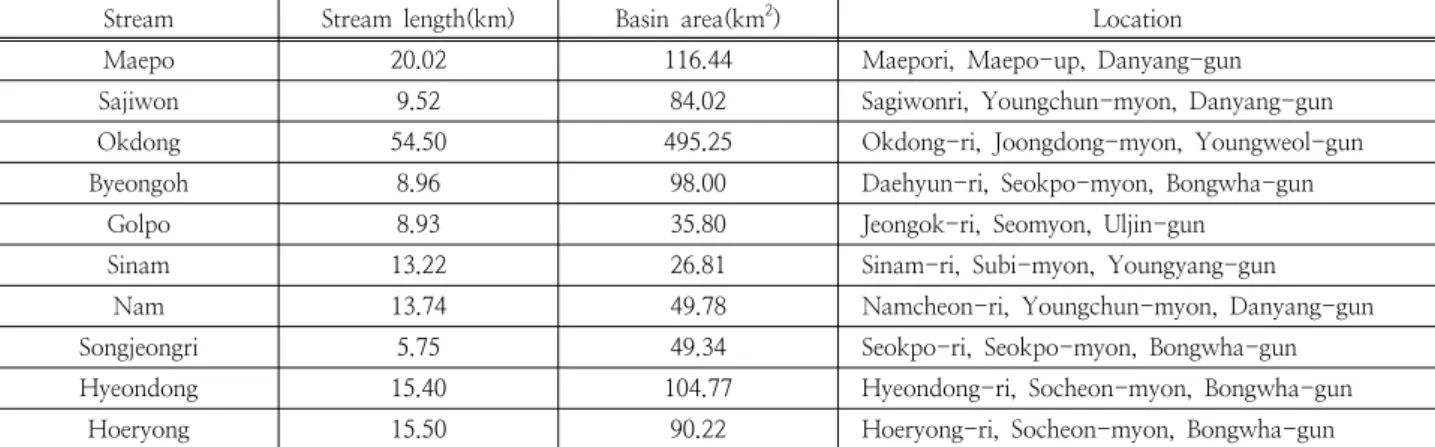
본 연구는 2008년 8월에서 10월까지 강원도 영월군 중동 면에 위치한 옥동천, 경북 울진군 서면에 위치한 골포천, 경북 영양군 수비면에 위치한 신암천, 경북 봉화군 석포면 에 위치한 송정리천과 병오천, 경북 봉화군 소천면에 위치 한 현동천과 회룡천, 충북 단양군 매포읍에 위치한 매포천, 충북 단양군 영춘면에 위치한 사지원천, 남천 등 총 10개 하천을 대상으로 조사를 실시하였다(Fig. 1, Table 1).
Fig. 1. Map of study site in Korea. (1, Maepo stream; 2, Sajiwon stream; 3, Okdong stream; 4, Byeongoh stream; 5, Golpo stream; 6, Sinam stream; 7, Nam stream; 8, Songjeongri stream;
9, Hyeondong stream; 10, Hoeryong stream)
3. 조사 방법
3.1 식생조사 방법
군락 선정은 물에 의한 영향을 받고 있거나 받았던 곳을 대상으로 하였다. 물에 의한 영향 여부는 우점종의 뿌리부분이 침수되어 있거나 침수되었던 흔적을 유관으로 확인하여 판단하 였다. 방형구의 크기는 10 × 10m로 통일하였고, 한 개의 하천에 서 5개의 방형구를 설치하여 10개 하천에서 총 50개의 방형구를 조사하였다. 50개의 방형구 중 2개의 방형구는 자연성이 낮아 데이터 정리 과정에서 제외 시켜 48개의 방형구를 활용하였다.
식생조사는 Braun-Blanquet (1964)의 우점도 계급을 이용
Table 1. Hydrological outline of study sites
Stream Stream length(km) Basin area(km2) Location
Maepo 20.02 116.44 Maepori, Maepo-up, Danyang-gun
Sajiwon 9.52 84.02 Sagiwonri, Youngchun-myon, Danyang-gun
Okdong 54.50 495.25 Okdong-ri, Joongdong-myon, Youngweol-gun
Byeongoh 8.96 98.00 Daehyun-ri, Seokpo-myon, Bongwha-gun
Golpo 8.93 35.80 Jeongok-ri, Seomyon, Uljin-gun
Sinam 13.22 26.81 Sinam-ri, Subi-myon, Youngyang-gun
Nam 13.74 49.78 Namcheon-ri, Youngchun-myon, Danyang-gun
Songjeongri 5.75 49.34 Seokpo-ri, Seokpo-myon, Bongwha-gun
Hyeondong 15.40 104.77 Hyeondong-ri, Socheon-myon, Bongwha-gun
Hoeryong 15.50 90.22 Hoeryong-ri, Socheon-myon, Bongwha-gun
하였다. 종의 동정은 Lee (1996)와 Lee (2003)의 도감에 따랐으 며, 미동정 종은 채집 및 사진을 통하여 실내에서 동정하였다.
3.2 Ordination analysis
본 연구에서는 배열법(ordination)을 통하여 식생 자료를 요약시키고, 배열하여 각 종들의 분포 양상에 대한 유사성 (similarity)을 확인하였다.
주성분분석(Principal Component Analysis, PCA), 집락 분석(cluster analysis)은 분석패키지 STATISTICA7 (Statsoft Co.) 프로그램을 사용하였다.
4. 결과 및 고찰
4.1 식물군락 4.1.1 경목림(Hardwood)
경목림은 신갈나무, 소나무, 굴참나무, 산벚나무, 신나무, 시무 나무, 서어나무, 돌배나무, 가래나무 등 25개 군락으로 구성되며 전체 48개의 방형구 중 92%(44 Plot)방형구가 이에 해당되었다.
이러한 결과는 본 연구에서 고수위권까지 하변 식물군락으로 포함시켰기 때문으로 북반구에서 하천의 개척자 종으로 알려진 오리나무속, 사시나무속과 버드나무속 식물(Malanson, 1993;
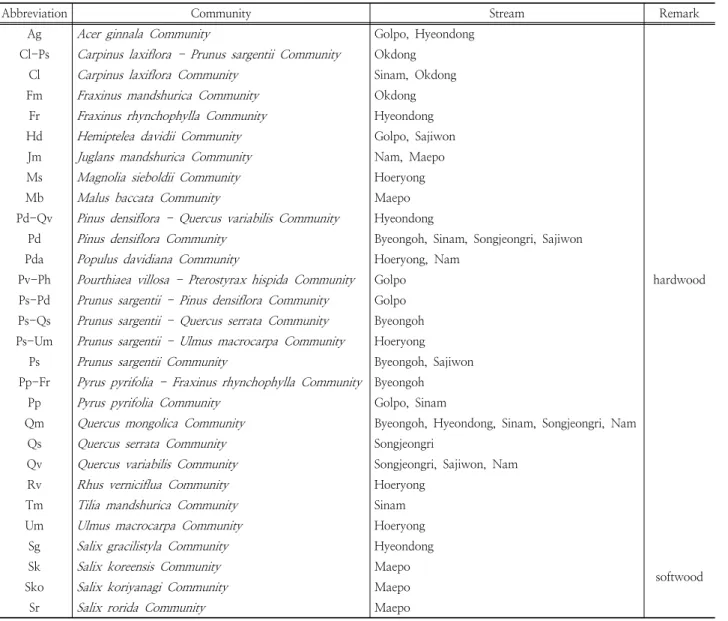
Karrenberg et al., 2002)이 우점하는 군락보다 다른 종들이 우점하는 군락이 많이 포함되었다(Table 2).
최근조사에서 참나무류는 우리나라의 잠재자연하천 식생 의 교목층에 높은 빈도로 분포하고 있고(Kim et al., 2008), 참나무속 6종 유식물의 침수 실험 결과 장기간(2개월)의 침수에도 성장을 하는 것으로 나타났다(Han et al., 2009).
이러한 연구들은 산지식생으로 알려진 참나무류도 하천변 에서 생육이 가능하며, 하천복원에 이용될 수 있다는 것을 보여준다.
4.1.2 연목림(Softwood forest)
하변연목림(하천의 영향을 받는 범위 내에서 형성된 산 림)은 산지의 골짜기에서 자라는 계곡‧계반림과 달리 주기적 인 홍수에 의해 유지되는 위극상림(paraclimax forest) 또는 지속군락(perpetual community)에 해당된다(Lee, 2005).
본 연구에서 연목림은 하천의 중‧하류 구간에서 출현하였 고, 수위를 기준으로 저수위권에 해당되었다. 중‧하류뿐만 아니라 상류 활주사면의 모래 충적지지에 초본 군락이나 목본 군락이 형성되는 경우도 있으나(Ahn et al., 2001;
Lee et al., 2003; Song, 2008), 본 조사지의 모래 충적지는 보수력(保水力)이 약하여 식생이 형성되어 있지 않았다. 버 드나무속 식물은 발아능력 기간이 1개월로 매우 짧고, 종자 의 낙하 장소가 건조하면 발아하지 못하기 때문으로 판단 된다(Lee et al., 2003).
전체 방형구 중 8%(4 Plot)가 연목림에 해당되었고, 버드나무속 (Salix) 군락으로 대변되었다. 4개의 군락이 출현하였으며, 버드나 무, 갯버들, 분버들, 키버들이 각각 우점하였다(Table 2).
4.2. Ordination에 의한 하천식생 분석 4.2.1 PCA
1) 전층(total layer) 분석
전층(total layer)을 이용한 PCA 결과 신갈나무군락 그룹 과 산벚나무군락 그룹, 소나무군락 그룹, 산벚나무군락과 소나무군락 혼합 그룹, 기타군락 그룹으로 크게 5개의 그룹 으로 나누어지는 것을 볼 수 있었다(Fig. 2).
Fig. 2. PCA ordination of plant communities(48 plots) using species of total layer. The round circle is the assembly of the
near plant community.
Table 2. 29 Plant communities in study site
Abbreviation Community Stream Remark
Ag
Acer ginnala Community
Golpo, Hyeondonghardwood Cl-Ps
Carpinus laxiflora - Prunus sargentii Community
OkdongCl
Carpinus laxiflora Community
Sinam, OkdongFm
Fraxinus mandshurica Community
OkdongFr
Fraxinus rhynchophylla Community
HyeondongHd
Hemiptelea davidii Community
Golpo, SajiwonJm
Juglans mandshurica Community
Nam, MaepoMs
Magnolia sieboldii Community
HoeryongMb
Malus baccata Community
MaepoPd-Qv
Pinus densiflora - Quercus variabilis Community
HyeondongPd
Pinus densiflora Community
Byeongoh, Sinam, Songjeongri, SajiwonPda
Populus davidiana Community
Hoeryong, NamPv-Ph
Pourthiaea villosa - Pterostyrax hispida Community
Golpo Ps-PdPrunus sargentii - Pinus densiflora Community
Golpo Ps-QsPrunus sargentii - Quercus serrata Community
Byeongoh Ps-UmPrunus sargentii - Ulmus macrocarpa Community
HoeryongPs
Prunus sargentii Community
Byeongoh, SajiwonPp-Fr
Pyrus pyrifolia - Fraxinus rhynchophylla Community
ByeongohPp
Pyrus pyrifolia Community
Golpo, SinamQm
Quercus mongolica Community
Byeongoh, Hyeondong, Sinam, Songjeongri, NamQs
Quercus serrata Community
SongjeongriQv
Quercus variabilis Community
Songjeongri, Sajiwon, NamRv
Rhus verniciflua Community
HoeryongTm
Tilia mandshurica Community
SinamUm
Ulmus macrocarpa Community
HoeryongSg
Salix gracilistyla Community
Hyeondongsoftwood
Sk
Salix koreensis Community
MaepoSko
Salix koriyanagi Community
MaepoSr
Salix rorida Community
Maepo5개로 나누어진 각 그룹을 보면 첫 번째 그룹은 신갈나무 군락 그룹으로 10개의 방형구로 이루어져 있으며, 가깝게 나타난 군락은 신갈나무군락, 굴참나무군락, 왕느릅나무군 락과 사시나무군락이었다. 두 번째 그룹은 산벚나무군락 그 룹으로 7개의 방형구가 가깝게 나타났으며, 그 군락은 산벚 나무-왕느릅나무군락, 산벚나무-소나무군락, 들메나무군 락, 서어나무군락, 산벚나무군락과 서어나무-산벚나무군락 이었다. 세 번째 그룹은 소나무군락 그룹으로 5개의 방형구 로 이루어져 있으며, 소나무군락, 소나무-굴참나무군락과 서어나무군락이 가깝게 나타났다. 네 번째 그룹은 산벚나무 군락과 소나무군락의 혼합 그룹으로 3개의 방형구가 가깝 게 나타났으며, 산벚나무군락, 소나무군락과 산벚나무-졸 참나무군락이 나타났다. 네 번째 그룹은 산벚나무군락 그룹 과 소나무군락 그룹 사이에 위치하고 있어 산벚나무군락과 소나무군락이 혼합하여 나타나고 있다. 다섯 번째 그룹은 기타 군락 그룹으로 23개의 방형구가 속해있으며, 그룹의 속성을 결정지을 만한 뚜렷한 군락은 없었다.
군락을 나누는데 있어 Factor 1의 기여도는 18.82%였으
며, Factor 2의 기여도는 9.92%로 나타났다. Factor 1과 Factor 2의 기여도가 낮은 것은 방형구 수가 48개 이므로 Factor의 기여도 값이 48개로 분산되고, 48개의 방형구가 갖는 식생상관이 29개로 다양하기 때문으로 판단된다.
2) 교목층(tree layer + subtree layer) 분석
교목층을 이용한 PCA 결과 신갈나무군락 그룹, 산벚나무 군락 그룹, 기타군락 그룹으로 크게 3개의 그룹으로 나누어 졌다(Fig. 3). 전층을 이용한 PCA에서 소나무군락 그룹은 산벚나무군락 그룹과 기타군락 그룹의 사이에 위치하였는 데 교목층을 이용한 PCA에서는 산벚나무군락 그룹과 기타 군락 그룹에 나누어져 속하였다.
3개의 그룹 중 첫 번째 그룹은 신갈나무군락 그룹으로 10개의 방형구가 가깝게 나타났으며, 그 군락은 신갈나무 군락, 굴참나무군락, 왕느릅나무군락과 사시나무군락이었 다. 두 번째 그룹은 산벚나무군락 그룹으로 9개의 방형구가 포함되었으며, 그 군락은 산벚나무군락, 서어나무-산벚나 무군락, 산벚나무-소나무군락, 산벚나무-왕느릅나무군락,
Fig. 3. PCA ordination of plant communities(48 plots) using species of tree layer. The tree layer is the sum total of the T1 layer and T2 layer (T1, tree layer; T2, subtree layer). The round
circle is the assembly of the near plant community.
산벚나무-졸참나무군락, 소나무군락과 윤노리나무-나래쪽 동백나무군락이었다. 세 번째 그룹은 기타군락 그룹으로 23개의 방형구가 가깝게 분포하였다.
군락을 나누는데 있어 Factor 1의 기여도는 20.11%이었 으며, Factor 2의 기여도는 14.34%였다. 기여도가 높지 못 한 이유는 위에서 설명했던 것처럼 48개의 방형구에 의해 기여도 값이 분산되어지고, 48개의 방형구가 갖는 식생상 관이 다양하기 때문으로 판단된다.
4.2.2 집락분석(Cluster analysis) 1) 전층을 이용한 집락분석
집락분석에서 비유사성 또는 거리는 각기 유사성(similarity) 또는 가까운 정도(closeness)의 상반된 개념으로 두 방형구 사이의 거리가 멀면, 비유사성은 크게 된다. 반대로, 거리가 가까우면 비유사성은 작아지고 유사성은 커진다. 이러한 기 준으로 볼 때 함박꽃나무군락(Plot 21)과 산벚나무군락 (Plot 33)은 다른 군락과 이질적으로 구별되었다(Fig. 4)
계층분류법(hierarchical classification method)은 점진적 으로 객체를 분류하는 방법으로 자주 사용되는데 분할 (divisive)계층분류법의 관점에서 볼 때 분할되는 마지막 단 계에서 같은 상관을 갖는 군락이 가까이 형성되는 것을 볼 수 있다. 이렇게 가까이 형성되는 그룹은 신갈나무군락 그 룹, 소나무군락과 소나무-굴참나무군락 그룹, 신나무군락 그룹, 시무나무군락 그룹, 분버들군락과 키버들군락 그룹, 가래나무군락 그룹, 사시나무군락 그룹, 버드나무군락과 갯 버들군락 그룹, 서어나무-산벚나무군락과 산벚나무, 산벚 나무-왕느릅나무군락 그룹, 돌배나무군락과 돌배나무-물 푸레나무군락 그룹, 산벚나무-졸참나무군락과 산벚나무군 락 그룹으로 같은 우점종을 갖는 군락들이 그룹으로 나타 나는 경향이 있었다. 이는 PCA 결과에서 나타난 그룹과
Fig. 4. Unweighted pair-group average clustering of plant communities(48 plots) using species of total layer.
The lines over the species in the fig. bottom is the vegetation units that have the same or similar physiognomy gathered in the divided final step.
대동소이하였고, 함박꽃나무군락과 산벚나무군락이 다른 군락과 이질적으로 나타난 것이 가장 큰 차이점이었다.
2) 교목층을 이용한 집락분석
교목층을 이용한 집락분석에서도 분할계층분류법의 관점 에서 볼 때 분할되는 마지막 단계에서 같은 상관을 갖는 군 락이 가까이 형성되는 몇몇의 그룹을 확인할 수 있었다 (Fig. 5). 전층의 집락분석과 같이 함박꽃나무군락(Plot 21) 과 산벚나무군락(Plot 33)은 다른 군락과 이질적으로 구별 되었다. 신갈나무군락 그룹, 소나무군락과 소나무-굴참나 무군락 그룹, 사시나무군락과 신갈나무군락 그룹, 물푸레나 무군락과 돌배나무-물푸레나무군락 그룹, 신나무군락 그룹,
Fig. 5. Unweighted pair-group average clustering of plant communities(48 plots) using species of tree layer. The tree layer is the sum total of the T1 layer and T2 layer (T1, tree layer; T2, subtree layer). The lines over the species in the fig. bottom is the vegetation units that have the same or similar physiognomy
gathered in the divided final step.
서어나무-산벚나무군락과 산벚나무군락 그룹, 서어나무군 락과 들메나무군락 그룹, 굴참나무군락과 사시나무군락 그 룹, 가래나무군락과 시무나무군락 그룹, 산벚나무-졸참나 무군락과 산벚나무군락 그룹 등으로 그룹 지어지는 것을 볼 수 있었다. 이 결과는 전층을 이용한 집락분석에서 나타 난 그룹과 유사한 것으로 분할되는 마지막 단계에서 같은 우점종을 갖는 군락들이 그룹으로 나타났다.
References
Ahn, YH, YC, Yang, SH, Chun (2001). A study on the distribution patterns of Salicaceae species at the An-sung stream-refered to Woldongcheon, Yokjungcheon, Joyoungcheon and Gisolcheon-
J. of Environment and Ecology,
15(3), pp. 213-223.[Korean Literature]Braun-Blanquet, J (1964).
Planzensozilogie
. 3rd ed. Wien · NewYork; Springer.Cho, JC, Lee, KJ (1988). Study on the vegetational community of Hongrudong valley in the Mt. Gaya by ordination techniques.
Korean J. of Forestry
. 77(1), pp. 73-82.[Korean Literature]
Choo, KJ, Kim, HW, Ha, K (1997). The development of stream ecology and current status.
Korean J. of Ecology
, 20(1), pp.69-78.[Korean Literature]
Han, SJ, Kim, HJ, You, YH (2009). Selection on tolerant oak species to water flooding for flood plain restoration.
J. of Wetlands Research
, 11(2), pp. 1-7. [Korean Literature]Haslam, SM. and PA. Wolseley (1981).
River vegetation: It's identification, assessment and management
. London:Cambridge University Press.
Jarolímek, I, K. Jiří and D. Jiří (1991). Annual nitrophilous pond and river bank communities in north part of Korean peninsula. Folia Geobotanic et Phytotaxonomica. 26(1), pp. 1-112.
Karrenberg, S., S. Blaser, J. Kollmann, T. Speck and PJ. Edwards.
(2002). Root anchorage of saplings and cuttings of woody pioneer species in a riparian environment.
Functional Ecology
, 17, pp. 170-177.Kim, HJ., BK. Sin, YH, You, CH, Kim (2008). A Study on the
vegetation of the present-day potential natural state of water for flood plain restoration in South Korea.
Korean J. of Environment and Ecology
, 22(5), pp. 564-594.[Korean Literature]
Lee, CB (2003).
Coloured Flora of Korea
, Hyangmunsa.[Korean Literature]
Lee, CS, Oh, JM, Lee, NJ (2003). Rivers and waterside plants:
Conservation and Manegement of Vegetation.
Sinkwangmunwhasa. pp. 32-111.[Korean Literature]
Lee, WC (1996).
Coloured Standard Illustrations of Korean Plants
, Academybook.[Korean Literature]Lee, YK (2005).
Syntaxonomy and synecology of the riparian vegetation in South Korea
. Ph.D Dissertation. Keimyung University, Daegu, Korea.[Korean Literature]Malanson, GP (1993).
Riparian Landscapes
. Cambridge University Press, Cambridge, UK.Mucina, L., G. Grabherr and S. Wallnöfer (1993).
Die pflanzen geselschaften Österreichs: wälder und gebüsche
. Stuttgart·NewYork:Gustav Fisher/Verlag Jena.
Park, SY, Yoon, SY, Lee, KC, Bae DH, Kim, HS, Kim, KG (2003).
Wetland study principle. Gyeongnam Institute of development. p.40.[Korean Literature]
Penka, M., M. Vyskot, E. Klimo and F. Vasicek (1985).
Floodplain forest ecosystem
. Praha: Academia.Shim, JK (2001). A study on the natural ecology of the Gabcheon stream(Kasuwonkyo-Manneonkyo). Mokwon Journal of Natural Science. 10(2), pp. 5-30.[Korean Literature]
Son, MW, YG, Jeon (2003). Physical geographical characteristics of natural wetlands on the downstream reach of Nakdong river.
Korean J. of Regional Geography
, 9(1), pp. 66-76.[Korean Literature]Song, JS (2008). A synecological study of the riverside vegetation of the upper stream of Nakdong river, Korea-Ⅰ. Forest and shrub vegetation-.
Korean J. of Environment and Ecology,
22(4), pp. 443-452.[Korean Literature]Song, JS, SD, Song (1996). A phytosociological study on the riverside vegetation around Hanchon, an upper stream of Nak-tong river.
Korean J. of Ecology
, 19(5), pp.431-451.[Korean Literature]